APPLICATION OF ENZYMES
IN STARCH MODIFICATION
Dr. Jyoti Singh
CENTRAL UNIVESITY OF PUNJAB BHATHINDA
Starch is a major reserve carbohydrate of higher plants and occurs
in the form of water-insoluble granules. It is a heterogeneous
polysaccharide composed of two high molecular weight entities
called amylose and amylopectin. These two polymers have
different structures and physical properties. The
agricultural biomass containing starch can be used as a
potent substrate for production of various important
bioactive compounds or products like liquid or gaseous fuels,
feed proteins and chemicals by using corn, wheat, oats,
rice, potato, and cassava as the important substrates. Starch as
an important constituent of human diet, can also be used
chemically and enzymatically processed into a variety of different
products such as starch hydrolysates, glucose syrups,
fructose, maltodextrin derivatives or cyclodextrins, used in
food industry.
STARCH
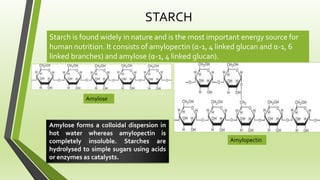
Starch is found widely in nature and is the most important energy source for
human nutrition. It consists of amylopectin (α-1, 4 linked glucan and α-1, 6
linked branches) and amylose (α-1, 4 linked glucan).
Amylose
Amylopectin
Amylose forms a colloidal dispersion in
hot water whereas amylopectin is
completely insoluble. Starches are
hydrolysed to simple sugars using acids
or enzymes as catalysts.
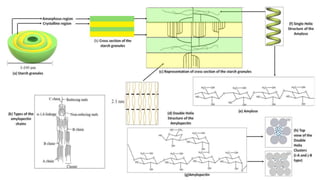
 Amylose fraction accounts for 20–30% of starch granule, whereas amylopectin accounts
for 70–80%. Starch granules vary in size, shape, distribution, and crystallinity based on
chain length, branched chains, and branching density.
 In the food processing industry, starch plays a vital role in the quality and nutritional
value of many food products. Starch may attribute multifaceted functional properties to
food products such as swelling, thickeners, emulsifiers, encapsulants, gelling agents,
gelatinization, gelation, and binders.
 Due to these properties of starch, it has been widely used as a functional ingredient in
food industries. However, industrial application of native starch is limited due to its
inherent properties such as high hot-paste viscosity, instability to thermal and shear
stress, and tend to retrograde quickly concomitant poor cold-storage stability and poor
resistance to acid, shear, and high temperatures, which is responsible for deteriorating
product quality and makes it less suitable for extensive application in the food
processing industry
ISSUES ADDRESSED BY STARCH MODIFICATION
 The small starch granules have novel properties, including the capability to hold
and release sensitive materials, such as flavors.
 Small granules from wheat starches (2 μm average diameter) can mimic lipid
micelles, providing a fat-like texture. Waxy maize starch nano-crystals have also
been prepared by α-amylase.
 applications of the starch nanoparticles in food industry as a filler in composites,
that can improve not only the mechanical properties but also the biodegradability
of the composites.
 Retrogradation of starchy foodstuffs, which has been referred to as staling, is a
major problem that must be solved.
Thus there is substantial interest in
starch modification to achieve
desirable physicochemical and
functional characteristics and enhance
its suitability to industrial requisites
 Modification of starch is associated with improvement in nutritional quality,
physicochemical characteristics of amylose and amylopectin chains, functional and
textural properties by modifying chain length, branch point formation, debranching,
and disproportionation.
 Modified starches are widely used in the food industry to impart thickening and
gelling effect, as a stabilizer, preparation of edible coatings, encapsulation of food
coatings, retard retrogradation, fat substitution, and amplify resistant starch
content.
 The classes of enzymes that act on starch include endoamylases,
exoamylases, debranching enzymes and transferases. Starch-
modifying enzymes of microbial origin are utilized in a wide variety of
industrial applications.
 Enzyme treatment is a means of directly modifying starch structure,
providing changes in the molecular size, the ratio of amylose to
amylopectin, molecular weight, and branch chain length distribution
 The regions that are susceptible to enzymatic attack are the less well-
organized amorphous regions, whereas the crystalline lamellae are
more resistant to enzymatic erosion
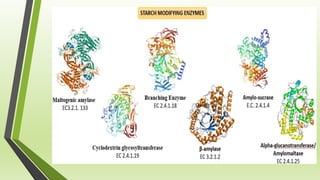
Important starch modifying enzymes
Glycoside hydrolase and transglycosylase
Glycosyltransferase
Glycoside hydrolases (GHs) are also referred to as glycosidases, and sometimes
also as glycosyl hydrolases. Family 13 (GH13) includes enzymes such as α-amylase
(EC 3.2.1.1), pullulanase (EC 3.2.1.41), isoamylase (EC 3.2.1.68), glucan branching
enzyme (EC 2.4.1.18), and cyclodextrin glycosyltransferase (EC 2.4.1.19), whereas
Family 77 (GH77) contains amylomaltase and 4-α-glucanotransferase (EC
2.4.1.24)
Glycoside hydrolases (EC 3.2.1.-) are enzymes that catalyze the hydrolysis
of the glycosidic linkage of glycosides, leading to the formation of a sugar
hemiacetal or hemiketal and the corresponding free aglycon. In contrast,
transglycosylases are enzymes that can catalyze the transformation of one
glycoside to another.
Maltogenic amylase
Applications of Enzymatically Modified Starch
 Enzymatically modified starch is commonly used in food and non-food applications such as
pharmaceuticals and drug delivery systems.
 Enzymatically modified starch used in food products possesses enhanced properties, including
softness, freshness, and shelf-life of baking products. For example, the gluten-free rice bread
prepared using β-amylase and D-enzyme. Moreover, starch acylation via the B-lipase of Candida
antarctica and the potential applications of acetylated rice starch in the pharmaceutical and
cosmetics industries.
 emulsion stabilized using octenylsuccinic anhydride-modified waxy maize starch. Here, the
octenylsuccinic reaction of waxy maize starch was performed using β-amylase to increase its
emulsification properties. Enzymatically modified starch is mainly used in the pharmaceutical
industry owing to the unique property of releasing drugs at a constant rate.
 Dura and Rosell obtained porous starch using cyclodextrin glycosyltransferase enzyme (CGT).
The authors reported that CGT improved the hydrolysis of the amorphous part of the starch,
making more starch susceptible to enzymatic hydrolysis.

enzymatic application in starch modification_021851.pptx

  • 1.
    APPLICATION OF ENZYMES INSTARCH MODIFICATION Dr. Jyoti Singh CENTRAL UNIVESITY OF PUNJAB BHATHINDA
  • 2.
    Starch is amajor reserve carbohydrate of higher plants and occurs in the form of water-insoluble granules. It is a heterogeneous polysaccharide composed of two high molecular weight entities called amylose and amylopectin. These two polymers have different structures and physical properties. The agricultural biomass containing starch can be used as a potent substrate for production of various important bioactive compounds or products like liquid or gaseous fuels, feed proteins and chemicals by using corn, wheat, oats, rice, potato, and cassava as the important substrates. Starch as an important constituent of human diet, can also be used chemically and enzymatically processed into a variety of different products such as starch hydrolysates, glucose syrups, fructose, maltodextrin derivatives or cyclodextrins, used in food industry.
  • 3.
    STARCH Starch is foundwidely in nature and is the most important energy source for human nutrition. It consists of amylopectin (α-1, 4 linked glucan and α-1, 6 linked branches) and amylose (α-1, 4 linked glucan). Amylose Amylopectin Amylose forms a colloidal dispersion in hot water whereas amylopectin is completely insoluble. Starches are hydrolysed to simple sugars using acids or enzymes as catalysts.
  • 4.
     Amylose fractionaccounts for 20–30% of starch granule, whereas amylopectin accounts for 70–80%. Starch granules vary in size, shape, distribution, and crystallinity based on chain length, branched chains, and branching density.  In the food processing industry, starch plays a vital role in the quality and nutritional value of many food products. Starch may attribute multifaceted functional properties to food products such as swelling, thickeners, emulsifiers, encapsulants, gelling agents, gelatinization, gelation, and binders.  Due to these properties of starch, it has been widely used as a functional ingredient in food industries. However, industrial application of native starch is limited due to its inherent properties such as high hot-paste viscosity, instability to thermal and shear stress, and tend to retrograde quickly concomitant poor cold-storage stability and poor resistance to acid, shear, and high temperatures, which is responsible for deteriorating product quality and makes it less suitable for extensive application in the food processing industry
  • 5.
    ISSUES ADDRESSED BYSTARCH MODIFICATION  The small starch granules have novel properties, including the capability to hold and release sensitive materials, such as flavors.  Small granules from wheat starches (2 μm average diameter) can mimic lipid micelles, providing a fat-like texture. Waxy maize starch nano-crystals have also been prepared by α-amylase.  applications of the starch nanoparticles in food industry as a filler in composites, that can improve not only the mechanical properties but also the biodegradability of the composites.  Retrogradation of starchy foodstuffs, which has been referred to as staling, is a major problem that must be solved.
  • 6.
    Thus there issubstantial interest in starch modification to achieve desirable physicochemical and functional characteristics and enhance its suitability to industrial requisites
  • 7.
     Modification ofstarch is associated with improvement in nutritional quality, physicochemical characteristics of amylose and amylopectin chains, functional and textural properties by modifying chain length, branch point formation, debranching, and disproportionation.  Modified starches are widely used in the food industry to impart thickening and gelling effect, as a stabilizer, preparation of edible coatings, encapsulation of food coatings, retard retrogradation, fat substitution, and amplify resistant starch content.
  • 10.
     The classesof enzymes that act on starch include endoamylases, exoamylases, debranching enzymes and transferases. Starch- modifying enzymes of microbial origin are utilized in a wide variety of industrial applications.  Enzyme treatment is a means of directly modifying starch structure, providing changes in the molecular size, the ratio of amylose to amylopectin, molecular weight, and branch chain length distribution  The regions that are susceptible to enzymatic attack are the less well- organized amorphous regions, whereas the crystalline lamellae are more resistant to enzymatic erosion
  • 11.
    Important starch modifyingenzymes Glycoside hydrolase and transglycosylase Glycosyltransferase Glycoside hydrolases (GHs) are also referred to as glycosidases, and sometimes also as glycosyl hydrolases. Family 13 (GH13) includes enzymes such as α-amylase (EC 3.2.1.1), pullulanase (EC 3.2.1.41), isoamylase (EC 3.2.1.68), glucan branching enzyme (EC 2.4.1.18), and cyclodextrin glycosyltransferase (EC 2.4.1.19), whereas Family 77 (GH77) contains amylomaltase and 4-α-glucanotransferase (EC 2.4.1.24)
  • 12.
    Glycoside hydrolases (EC3.2.1.-) are enzymes that catalyze the hydrolysis of the glycosidic linkage of glycosides, leading to the formation of a sugar hemiacetal or hemiketal and the corresponding free aglycon. In contrast, transglycosylases are enzymes that can catalyze the transformation of one glycoside to another.
  • 15.
  • 16.
    Applications of EnzymaticallyModified Starch  Enzymatically modified starch is commonly used in food and non-food applications such as pharmaceuticals and drug delivery systems.  Enzymatically modified starch used in food products possesses enhanced properties, including softness, freshness, and shelf-life of baking products. For example, the gluten-free rice bread prepared using β-amylase and D-enzyme. Moreover, starch acylation via the B-lipase of Candida antarctica and the potential applications of acetylated rice starch in the pharmaceutical and cosmetics industries.  emulsion stabilized using octenylsuccinic anhydride-modified waxy maize starch. Here, the octenylsuccinic reaction of waxy maize starch was performed using β-amylase to increase its emulsification properties. Enzymatically modified starch is mainly used in the pharmaceutical industry owing to the unique property of releasing drugs at a constant rate.  Dura and Rosell obtained porous starch using cyclodextrin glycosyltransferase enzyme (CGT). The authors reported that CGT improved the hydrolysis of the amorphous part of the starch, making more starch susceptible to enzymatic hydrolysis.