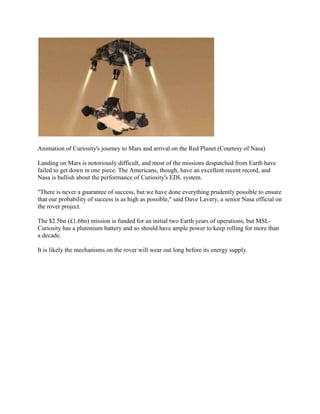
4 August 2012 Last updated at 22:13 GMT

Share this page

       Email
       Print

2.2K

       Share
       Facebook
       Twitter


Nasa's Curiosity rover edges closer to Mars

                  By Jonathan Amos Science correspondent, BBC News, Pasadena


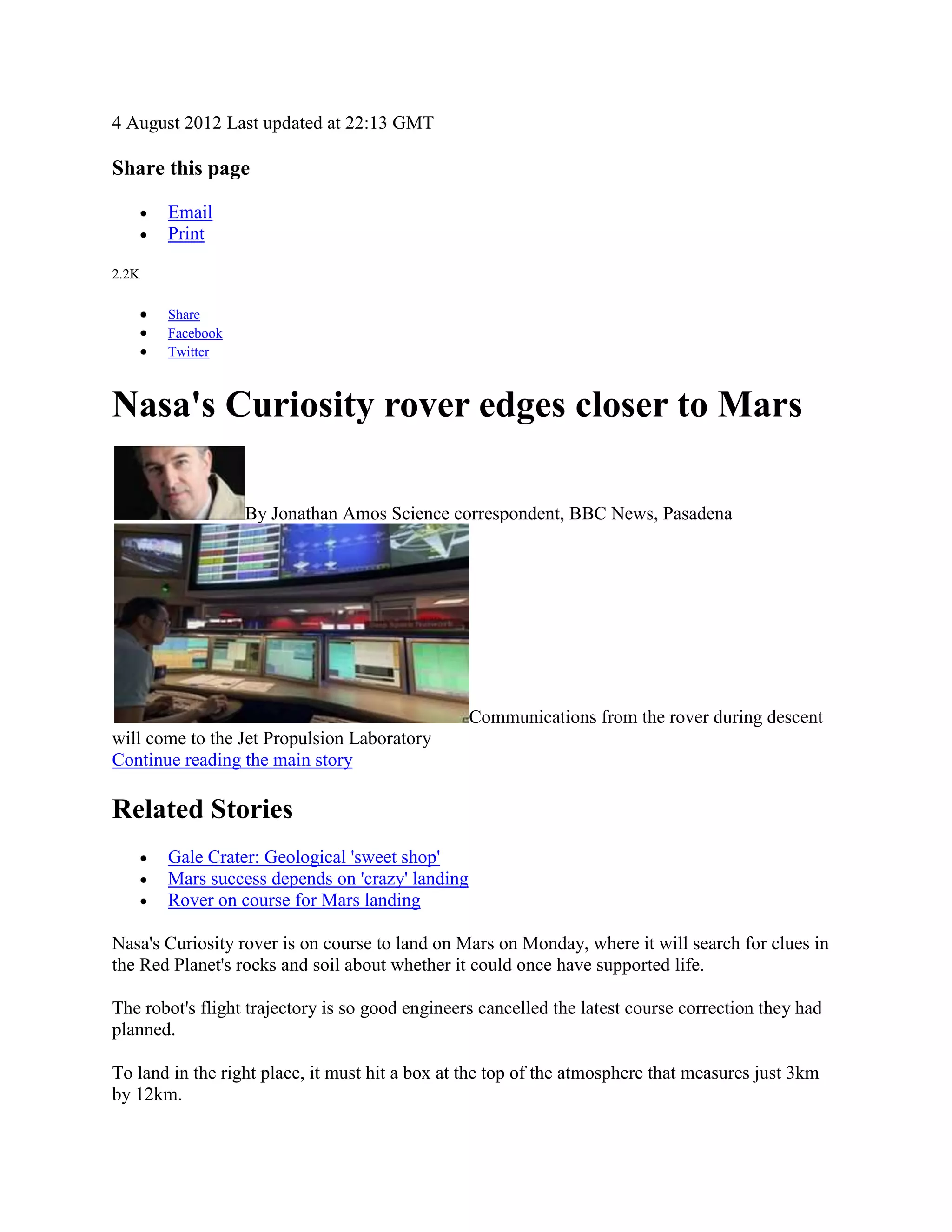
                                                 Communications from the rover during descent
will come to the Jet Propulsion Laboratory
Continue reading the main story

Related Stories
       Gale Crater: Geological 'sweet shop'
       Mars success depends on 'crazy' landing
       Rover on course for Mars landing

Nasa's Curiosity rover is on course to land on Mars on Monday, where it will search for clues in
the Red Planet's rocks and soil about whether it could once have supported life.

The robot's flight trajectory is so good engineers cancelled the latest course correction they had
planned.

To land in the right place, it must hit a box at the top of the atmosphere that measures just 3km
by 12km.
Curiosity has spent eight months travelling from Earth to Mars.

The robot - -also known as the Mars Science Laboratory - has covered more than 560 million
km.

"Our inbound trajectory is right down the pipe," said Arthur Amador, Curiosity's mission
manager.

"The team is confident and thrilled to finally be arriving at Mars, and we're reminding ourselves
to breathe every so often. We're ready to go."

The rover's power and communications systems are in excellent shape.

The one major task left for the mission team is to prime the back-up computer that will take
command if the main unit fails during the entry, descent and landing (EDL) manoeuvres.

Continue reading the main story

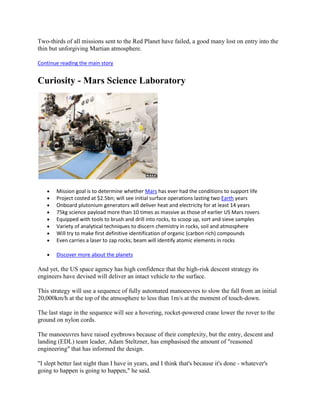
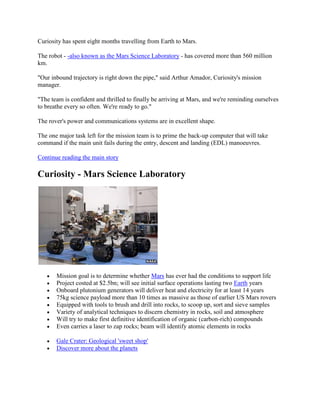
Curiosity - Mars Science Laboratory


       Mission goal is to determine whether Mars has ever had the conditions to support life
       Project costed at $2.5bn; will see initial surface operations lasting two Earth years
       Onboard plutonium generators will deliver heat and electricity for at least 14 years
       75kg science payload more than 10 times as massive as those of earlier US Mars rovers
       Equipped with tools to brush and drill into rocks, to scoop up, sort and sieve samples
       Variety of analytical techniques to discern chemistry in rocks, soil and atmosphere
       Will try to make first definitive identification of organic (carbon-rich) compounds
       Even carries a laser to zap rocks; beam will identify atomic elements in rocks

       Gale Crater: Geological 'sweet shop'
       Discover more about the planets
The robot was approaching Mars at about 13,000km/h on Saturday. By the time the spacecraft
hits the top of Mars' atmosphere, about seven minutes before touch-down, gravity will have
accelerated it to about 21,000km/h.

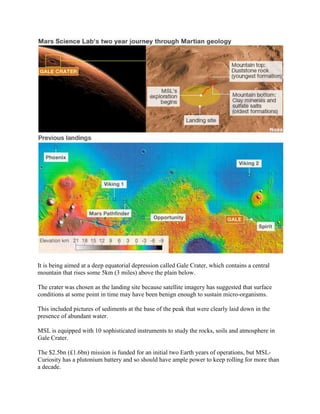
The vehicle is being aimed at Gale Crater, a deep depression just south of the planet's equator.

It is equipped with the most sophisticated science payload ever sent to another world.

Its mission, when it gets on the ground, is to characterise the geology in Gale and examine its
rocks for signs that ancient environments on Mars could have supported microbial life.

Touch-down is expected at 05:31 GMT (06:31 BST) Monday 6 August; 22:31 PDT, Sunday 5
August.

It is a fully automated procedure. Nasa will be following the descent here at mission control at
the Jet Propulsion Laboratory in Pasadena, California.

The rover will broadcast X-band and UHF signals on its way down to the surface.

These will be picked up by a mix of satellites at Mars and radio antennas on Earth.

The key communication route will be through the Odyssey orbiter. It alone will see the rover all
the way to the ground and have the ability to relay UHF telemetry straight to Earth.

And mission team members remain hopeful that this data will also include some images that
Curiosity plans to take of itself just minutes after touching the ground.

These would be low-resolution, wide-angle, black and white images of the rear wheels.

They may not be great to look at, but the pictures will give engineers important information
about the exact nature of the terrain under the rover.

A lot has been made of the difficulty of getting to Mars, and historically there have been far
more failures than successes (24 versus 15), but the Americans' recent record at the Red Planet is
actually very good - six successful landings versus two failures.

Even so, Nasa continues to downplay expectations.

"If we're not successful, we're going to learn," said Doug McCuistion, the head of the US space
agency's Mars programme.

"We've learned in the past, we've recovered from it. We'll pick ourselves up, we'll dust ourselves
off, we'll do something again; this will not be the end.

"The human spirit gets driven by these kinds of challenges, and these are challenges that drive us
to explore our surroundings and understand what's out there."
Curiosity is heading for Gale Crater

The mission team warned reporters on Saturday not to jump to conclusions if there was no
immediate confirmation of landing through Odyssey.

There were "credible reasons", engineers said, why the UHF signal to Odyssey could be lost
during the descent, such as a failure on the satellite or a failure of the transmitter on the rover.

Continued efforts would be made to contact Curiosity in subsequent hours as satellites passed
overhead and when Gale Crater came into view of radio antennas on Earth.

"There are situations that might come up where we will not get communications all the way
through [to the surface], and it doesn't necessarily mean that something bad has happened; it just
means we'll have to wait and hear from the vehicle later," explained Richard Cook, the deputy
project manager.

This was emphasised by Allen Chen, the EDL operations lead. His is the voice from mission
control that will be broadcast to the world during the descent. He will call out specific milestones
on the way down. He told BBC News there would be no rush to judgement if the Odyssey link
was interrupted or contained information that was "off nominal".

"I think we proceed under any situation as though the spacecraft is there, and there for us to
recover - to find out what happened," he said.

"That's the most sensible thing to do. There are only a few instances I think where you could
know pretty quickly that we'd be in trouble."

Step by step: How the Curiosity rover will land on Mars
Continue reading the main story
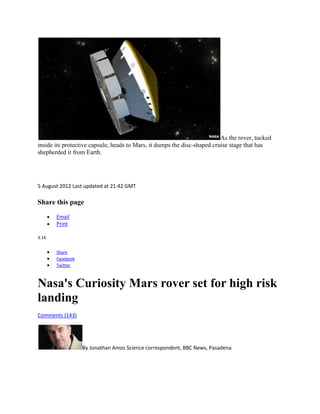
As the rover, tucked
inside its protective capsule, heads to Mars, it dumps the disc-shaped cruise stage that has
shepherded it from Earth.


5 August 2012 Last updated at 21:42 GMT

Share this page

       Email
       Print

3.1K


       Share
       Facebook
       Twitter


Nasa's Curiosity Mars rover set for high risk
landing
Comments (143)


                  By Jonathan Amos Science correspondent, BBC News, Pasadena
Nasa news conference after the Curiosity rover lands on Mars

Continue reading the main story


Related Stories
       Rover edges closer to Red Planet
       Gale Crater: Geological 'sweet shop' awaits Mars rover
       Mars success depends on 'crazy' landing

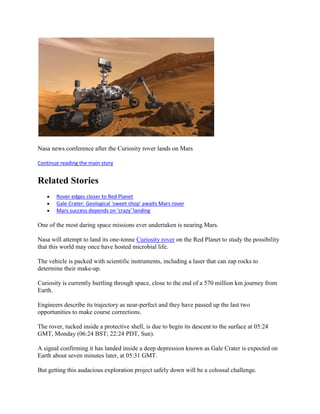
One of the most daring space missions ever undertaken is nearing Mars.

Nasa will attempt to land its one-tonne Curiosity rover on the Red Planet to study the possibility
that this world may once have hosted microbial life.

The vehicle is packed with scientific instruments, including a laser that can zap rocks to
determine their make-up.

Curiosity is currently hurtling through space, close to the end of a 570 million km journey from
Earth.

Engineers describe its trajectory as near-perfect and they have passed up the last two
opportunities to make course corrections.

The rover, tucked inside a protective shell, is due to begin its descent to the surface at 05:24
GMT, Monday (06:24 BST; 22:24 PDT, Sun).

A signal confirming it has landed inside a deep depression known as Gale Crater is expected on
Earth about seven minutes later, at 05:31 GMT.

But getting this audacious exploration project safely down will be a colossal challenge.
Two-thirds of all missions sent to the Red Planet have failed, a good many lost on entry into the
thin but unforgiving Martian atmosphere.

Continue reading the main story


Curiosity - Mars Science Laboratory


        Mission goal is to determine whether Mars has ever had the conditions to support life
        Project costed at $2.5bn; will see initial surface operations lasting two Earth years
        Onboard plutonium generators will deliver heat and electricity for at least 14 years
        75kg science payload more than 10 times as massive as those of earlier US Mars rovers
        Equipped with tools to brush and drill into rocks, to scoop up, sort and sieve samples
        Variety of analytical techniques to discern chemistry in rocks, soil and atmosphere
        Will try to make first definitive identification of organic (carbon rich) compounds
        Even carries a laser to zap rocks; beam will identify atomic elements in rocks

        Discover more about the planets

And yet, the US space agency has high confidence that the high-risk descent strategy its
engineers have devised will deliver an intact vehicle to the surface.

This strategy will use a sequence of fully automated manoeuvres to slow the fall from an initial
20,000km/h at the top of the atmosphere to less than 1m/s at the moment of touch-down.

The last stage in the sequence will see a hovering, rocket-powered crane lower the rover to the
ground on nylon cords.

The manoeuvres have raised eyebrows because of their complexity, but the entry, descent and
landing (EDL) team leader, Adam Steltzner, has emphasised the amount of "reasoned
engineering" that has informed the design.

"I slept better last night than I have in years, and I think that's because it's done - whatever's
going to happen is going to happen," he said.
Nasa will be monitoring the drama from the Jet Propulsion Laboratory (JPL) in Pasadena,
California.

It is here that mission control will receive the telemetry from Curiosity that has been bounced to
Earth by the overflying satellite known as Odyssey.

Engineers can only watch and wait, however. The 250 million km between Mars and Earth right
now means there is a 13-minute lag in communications.

The mission team knows that when it gets that first signal to say the rover has entered the
planet's atmosphere, the vehicle will in reality have already landed or been destroyed some seven
minutes previously.

Step by step: How the Curiosity rover will land on Mars
Continue reading the main story


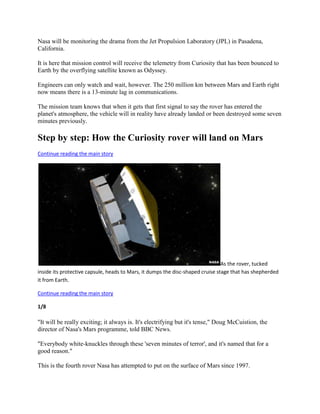
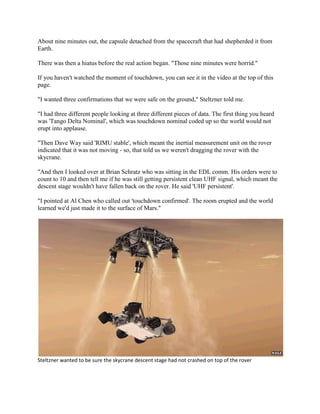
                                                                                As the rover, tucked
inside its protective capsule, heads to Mars, it dumps the disc-shaped cruise stage that has shepherded
it from Earth.

Continue reading the main story

1/8

"It will be really exciting; it always is. It's electrifying but it's tense," Doug McCuistion, the
director of Nasa's Mars programme, told BBC News.

"Everybody white-knuckles through these 'seven minutes of terror', and it's named that for a
good reason."

This is the fourth rover Nasa has attempted to put on the surface of Mars since 1997.
But Curiosity - also known as the Mars Science laboratory (MSL) - dwarfs those previous efforts
in size and sophistication.


The rover will sample rocks for signs that Mars was once favourable to life

Assuming the robot lands safely, it will spend 98 (Earth) weeks scouring Martian soils and rocks
for any signs that current or past environments on the planet could have supported microbial life.

Gale Crater was chosen as the landing site because satellite pictures had spied sediments in the
depression that looked as though they were laid down in the presence of abundant water.

"We see a lot of evidence that water was on Mars in the distant past and flowed across the
surface for maybe millions of years," explained Ashwin Vasavada, the MSL-Curiosity deputy
project scientist.

"This mission goes one step further by trying to understand whether the environments in which
the water persisted were habitable. Were there basic ingredients for life there? We're going to
understand what the conditions were like when life was most likely in Mars' ancient history."

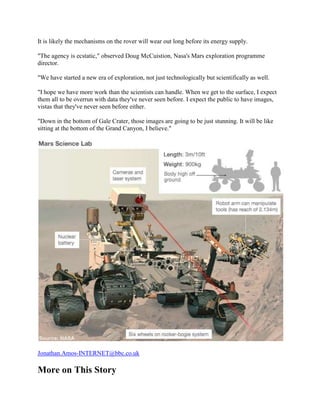
The rover is equipped with 10 advanced instruments. It also has a plutonium battery and so
should have ample power to keep rolling for more than a decade.
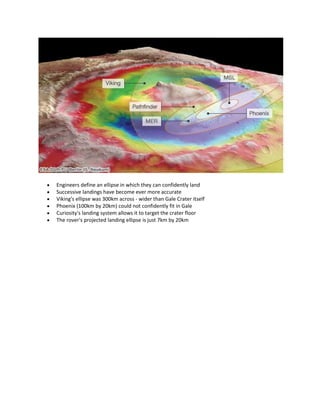
Engineers define an ellipse in which they can confidently land
Successive landings have become ever more accurate
Viking's ellipse was 300km across - wider than Gale Crater itself
Phoenix (100km by 20km) could not confidently fit in Gale
Curiosity's landing system allows it to target the crater floor
The rover's projected landing ellipse is just 7km by 20km
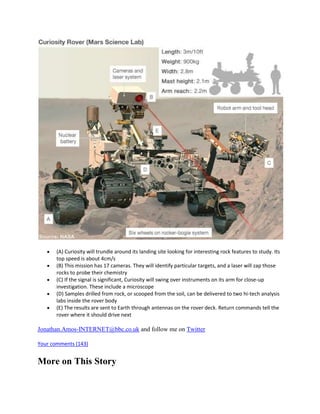
(A) Curiosity will trundle around its landing site looking for interesting rock features to study. Its
       top speed is about 4cm/s
       (B) This mission has 17 cameras. They will identify particular targets, and a laser will zap those
       rocks to probe their chemistry
       (C) If the signal is significant, Curiosity will swing over instruments on its arm for close-up
       investigation. These include a microscope
       (D) Samples drilled from rock, or scooped from the soil, can be delivered to two hi-tech analysis
       labs inside the rover body
       (E) The results are sent to Earth through antennas on the rover deck. Return commands tell the
       rover where it should drive next

Jonathan.Amos-INTERNET@bbc.co.uk and follow me on Twitter

Your comments (143)


More on This Story
Related Stories

       Rover edges closer to Red Planet

       04 AUGUST 2012, SCIENCE & ENVIRONMENT

       Gale Crater: Geological 'sweet shop' awaits Mars rover

       03 AUGUST 2012, SCIENCE & ENVIRONMENT

       Mars success depends on 'crazy' landing

       29 JULY 2012, SCIENCE & ENVIRONMENT

       Mars rover narrows landing zone

       12 JUNE 2012, SCIENCE & ENVIRONMENT

       Mars 'has life's building blocks'

       25 MAY 2012, SCIENCE & ENVIRONMENT

       Giant Nasa rover launches to Mars

       26 NOVEMBER 2011, SCIENCE & ENVIRONMENT

       MSL-Curiosity: Biggest Mars mission yet

       24 NOVEMBER 2011, SCIENCE & ENVIRONMENT

       Mars rover aims for deep crater

       22 JULY 2011, SCIENCE & ENVIRONMENT

Related Internet links

       Curiosity - Mars Science Laboratory

The BBC is not responsible for the content of external Internet sites

Comments

This entry is now closed for comments

Jump to comments pagination
Editors' Picks
All Comments (143)


+5

Comment number 96.

Brian Kemp
6th August 2012 - 7:01

This is absolutely fantastic! Good luck to the mission and one day it'd be great to see Men
and Women on Mars after science such as this.


-59

Comment number 47.

jesus bermudez
6th August 2012 - 5:56

What an absolute waste of money and time. There is no life anywhere else. God created
the universe and earth is the only planet which has life. It was created for our
convenience. This money should have been spent on helping children in need.


-10
Comment number 45.

rioesk
6th August 2012 - 5:54

Absolutely beyond awesome. No one can doubt the dominance of the United States when
it comes to unique thought and implementation. The rest of us have a mountain to climb
to compare with this.


+20

Comment number 16.

Harrygh
6th August 2012 - 0:44

I am so glad this could be tried in my lifetime. Good luck NASA and Rover.


+12

Comment number 8.

MacFanatic
6th August 2012 - 0:19

Just finished watching the documentary on iPlayer and must say its well exciting.

Some people think that the landing is crazy but hey were human at the end of the day. We
do crazy very well!

Good Luck Curiousity!
Comments 5 of 6

       Show more

Sign in with your BBC iD, or Register to comment and rate comments

All posts are reactively-moderated and must obey the house rules.

Share this page
3.1K


       Share
       Facebook
       Twitter

       Email
       Print


More Science & Environment stories
RSS


                               Shrimp shells aid uranium harvest

       Researchers outline state-of-the-art proposals to extract uranium - the raw fuel of nuclear
       power - from seawater, including ideas using shrimp and crabs.

       Mars rover's wind sensor damaged
       Bugs sunbathe to 'stay healthy'

Top Stories


                                Greece 'needs more time' for cuts
       Chemical weapons 'excuse for US' New
       Four Paralympic flames kindled
       Dozens killed in Kenyan clashes
       Life term for Terreblanche murder
Features & Analysis


                         Granny's sandwiches

       Why Italians are returning to traditional food


                         Small world

       How long before you can be the ancestor of everyone?


                         Fear of turmoil

       What the death of Meles Zenawi means for Africa


                         Exit strategy

       Why Chinese millionaires are buying foreign residency


Most Popular
Shared

  1.   1: Right-to-die man Nicklinson dead
  2.   2: Life lessons from the mosh pit
  3.   3: Tracing the world's common ancestor
  4.   4: Teen invents cancer test using web
5. 5: Beach rubbish reaches 23 tonnes

Read

    1.    1: Right-to-die man Nicklinson dead
    2.    2: Chemical weapons 'excuse for US'
    3.    3: Sitting straight 'bad for backs'
    4.    4: Wood's death certificate changed
    5.    5: Greece 'needs more time' for cuts
    6.    6: Nikon's Android-powered camera
    7.    7: Tracing the world's common ancestor
    8.    8: Dozens killed in Kenyan clashes
    9.    9: Italians feast on traditional 'granny' food
    10.   10: EU hails Russia's entry into WTO

Video/Audio

    1.    1: Athens battles for tourists Watch
    2.    2: Teen invents cancer test using web Watch
    3.    3: China's rich seek overseas residency Watch
    4.    4: Meles Zenawi's body returns to Ethiopia Watch
    5.    5: Nyad: Jellyfish sting 'like fire' Watch
    6.    6: One-minute World News Watch
    7.    7: Prince Harry 'an easy target' for press Watch
    8.    8: 'Gates of Paradise' restored in Florence Watch
    9.    9: Meles Zenawi archive interview Watch
    10.   10: Missouri residents on Akins row Watch


BBC Future


How many alien worlds exist?
Play with our interactive graphic to find out... Read more...


Programmes
Fast Track Watch

      Annoyed at Greece’s overseas reputation - how young Greeks are attempting to repair the
      damage

Ads by Google

      What Happens When You Die

      New theory says death isn't the end

      RobertLanzaBiocentrism.com

      Rokit - Water Rocket

      The World famous pop-bottle rocket for education and great fun.Buy now

      www.rokit.com

      Affordable Probe Station

      DC thru Microwave Probe Measurement Materials and Semiconductor

      www.jmicrotechnology.com


3 August 2012 Last updated at 23:41 GMT

Share this page

      Email
      Print

540
Share
       Facebook
       Twitter


                       Article written by Jonathan Amos Science correspondent

       More from Jonathan
       Follow Jonathan on Twitter


Gale Crater: Geological 'sweet shop' awaits
Mars rover
Comments (238)


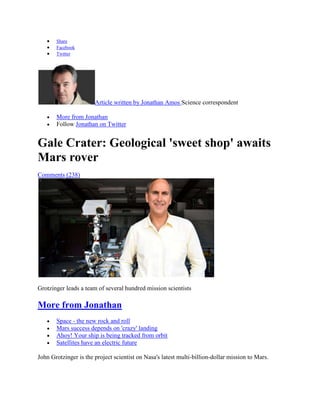
Grotzinger leads a team of several hundred mission scientists

More from Jonathan
       Space - the new rock and roll
       Mars success depends on 'crazy' landing
       Ahoy! Your ship is being tracked from orbit
       Satellites have an electric future

John Grotzinger is the project scientist on Nasa's latest multi-billion-dollar mission to Mars.
He's going to become a familiar face in the coming months as he explains to TV audiences the
importance of the discoveries that are made by the most sophisticated spacecraft ever sent to
touch the surface of another world.

The Curiosity Rover - also called the Mars Science Laboratory (MSL) - is set to land on Monday
(GMT) for a minimum two-year exploration of a deep hole on Mars' equator known as Gale
Crater.

The depression was punched out by an asteroid or comet billions of years ago.

The lure for Grotzinger and his fellow scientists is the huge mound of rock rising 5km from the
crater floor.

Mount Sharp, as they refer to it, looks from satellite pictures to be constructed from ancient
sediments - some deposited when Mars still had abundant water at its surface.


                                                  From orbit, Mount Sharp looks like Australia.
Gale is named after an Australian astronomer.

That makes it an exciting place to consider the possibility that those distant times may also once
have supported microbial life.

And Curiosity, with its suite of 10 instruments, will test this habitability hypothesis.

Grotzinger is a geologist affiliated to the California Institute of Technology and he recently took
the BBC Horizon programme to the mountains of the nearby Mojave Desert to illustrate the
work the rover will be doing on Mars.

He climbed to a level and then pointed to the rock sediments on the far side of the valley.
"What you see here is a stack of layers that tell us about the early environmental history of Earth,
representing hundreds of millions of years," he told Horizon.

"They read like a book of Earth history and they tell us about different chapters in the evolution
of early environments, and life.

"And the cool thing about going to Mount Sharp and Gale Crater is that there we'll have a
different book about the early environmental history of Mars.

"It will tell us something equally interesting, and we just don't know what it is yet," he said.

Curiosity dwarfs all previous landing missions undertaken by the Americans.

At 900kg, it's a behemoth. It's nearly a hundred times more massive than the first robot rover
Nasa sent to Mars in 1997.

Curiosity will trundle around the foothills of Mount Sharp much like a human field geologist
might walk through Mojave's valleys. Except the rover has more than a hammer in its rucksack.

It has hi-res cameras to look for features of interest. If a particular boulder catches the eye,
Curiosity can zap it with an infrared laser and examine the resulting surface spark to query the
rock's elemental composition.

If that signature intrigues, the rover will use its long arm to swing over a microscope and an X-
ray spectrometer to take a closer look.
Still interested? Curiosity can drill into the boulder and deliver a powdered sample to two high-
spec analytical boxes inside the rover belly.

These will lay bare the rock's precise make-up, and the conditions under which it formed.

"We're not just scratching and sniffing and taking pictures - we're boring into rock, getting that
powder and analysing it in these laboratories," deputy project scientist, Ashwin Vasavada, told
the BBC.

"These are really university laboratories that would normally fill up a room but which have been
shrunk down - miniaturised - and made safe for the space environment, and then flown on this
rover to Mars."

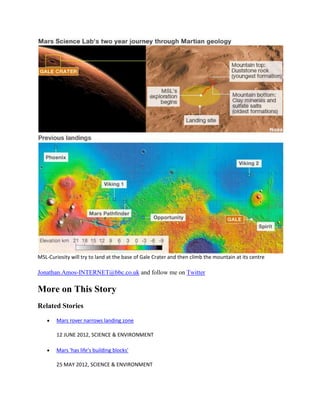
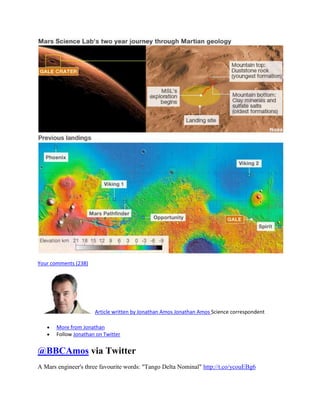
The intention on Monday is to put MSL-Curiosity down on the flat plain of the crater bottom.

The vehicle will then drive up to the base of Mount Sharp.

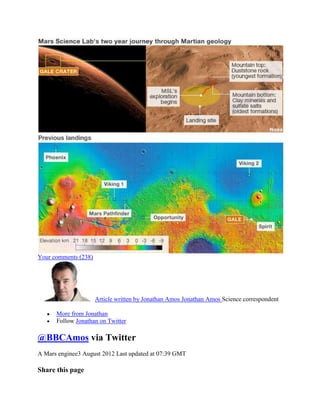
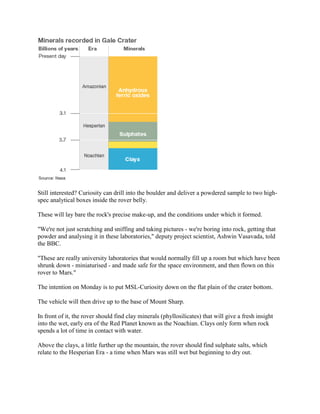
In front of it, the rover should find clay minerals (phyllosilicates) that will give a fresh insight
into the wet, early era of the Red Planet known as the Noachian. Clays only form when rock
spends a lot of time in contact with water.

Above the clays, a little further up the mountain, the rover should find sulphate salts, which
relate to the Hesperian Era - a time when Mars was still wet but beginning to dry out.

"Going to Gale will give us the opportunity to study a key transition in the climate of Mars -
from the Noachian to the Hesperian," said Sanjeev Gupta, an Imperial College London scientist
on the mission.

"The rocks we believe preserve that with real fidelity, and the volume of data we get from
Curiosity will be just extraordinary."

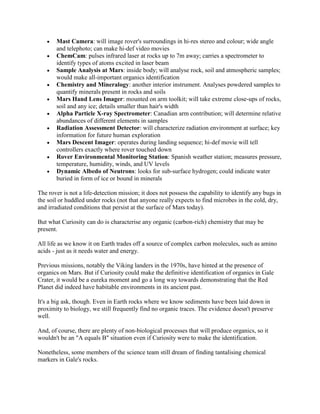
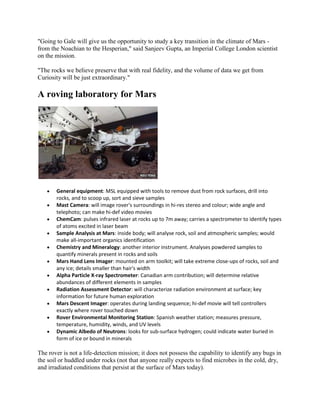
A roving laboratory for Mars


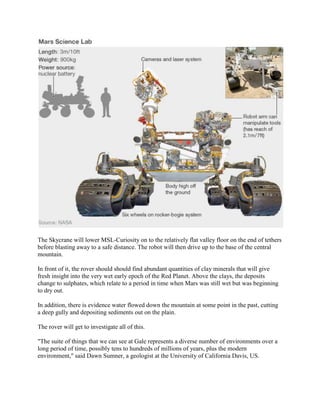
       General equipment: MSL equipped with tools to remove dust from rock surfaces, drill
       into rocks, and to scoop up, sort and sieve samples
Mast Camera: will image rover's surroundings in hi-res stereo and colour; wide angle
       and telephoto; can make hi-def video movies
       ChemCam: pulses infrared laser at rocks up to 7m away; carries a spectrometer to
       identify types of atoms excited in laser beam
       Sample Analysis at Mars: inside body; will analyse rock, soil and atmospheric samples;
       would make all-important organics identification
       Chemistry and Mineralogy: another interior instrument. Analyses powdered samples to
       quantify minerals present in rocks and soils
       Mars Hand Lens Imager: mounted on arm toolkit; will take extreme close-ups of rocks,
       soil and any ice; details smaller than hair's width
       Alpha Particle X-ray Spectrometer: Canadian arm contribution; will determine relative
       abundances of different elements in samples
       Radiation Assessment Detector: will characterize radiation environment at surface; key
       information for future human exploration
       Mars Descent Imager: operates during landing sequence; hi-def movie will tell
       controllers exactly where rover touched down
       Rover Environmental Monitoring Station: Spanish weather station; measures pressure,
       temperature, humidity, winds, and UV levels
       Dynamic Albedo of Neutrons: looks for sub-surface hydrogen; could indicate water
       buried in form of ice or bound in minerals

The rover is not a life-detection mission; it does not possess the capability to identify any bugs in
the soil or huddled under rocks (not that anyone really expects to find microbes in the cold, dry,
and irradiated conditions that persist at the surface of Mars today).

But what Curiosity can do is characterise any organic (carbon-rich) chemistry that may be
present.

All life as we know it on Earth trades off a source of complex carbon molecules, such as amino
acids - just as it needs water and energy.

Previous missions, notably the Viking landers in the 1970s, have hinted at the presence of
organics on Mars. But if Curiosity could make the definitive identification of organics in Gale
Crater, it would be a eureka moment and go a long way towards demonstrating that the Red
Planet did indeed have habitable environments in its ancient past.

It's a big ask, though. Even in Earth rocks where we know sediments have been laid down in
proximity to biology, we still frequently find no organic traces. The evidence doesn't preserve
well.

And, of course, there are plenty of non-biological processes that will produce organics, so it
wouldn't be an "A equals B" situation even if Curiosity were to make the identification.

Nonetheless, some members of the science team still dream of finding tantalising chemical
markers in Gale's rocks.
Dawn Sumner, from the University of California at Davis, is one of them.

"Under very specific circumstances - if life made a lot of organic molecules and they are
preserved and they haven't reacted with the rocks in Gale Crater, we may be able to tell that they
were created by life. It's a remote possibility, but it's something I at least hope we can find," she
said.

"I am confident we will learn amazing new things. Some of them will be answers to questions
we already have, but most of what we learn will be surprises to us.

"We've only been on the ground on Mars in six places, and it's a huge planet.

"Gale Crater and Mount Sharp are unlike anything we've been to before. That guarantees we will
learn exciting new things from Curiosity."

Horizon: Mission to Mars was broadcast on BBC Two Monday 30 July. Watch online via iPlayer
(UK only) or browse more Horizon clips at the above link.
Your comments (238)


                      Article written by Jonathan Amos Jonathan Amos Science correspondent

      More from Jonathan
      Follow Jonathan on Twitter

@BBCAmos via Twitter
A Mars enginee3 August 2012 Last updated at 07:39 GMT

Share this page
Email
       Print

1.6K

       Share
       Facebook
       Twitter


Nasa's Curiosity rover on course for Mars
landing

                  By Jonathan Amos Science correspondent, BBC News, Pasadena


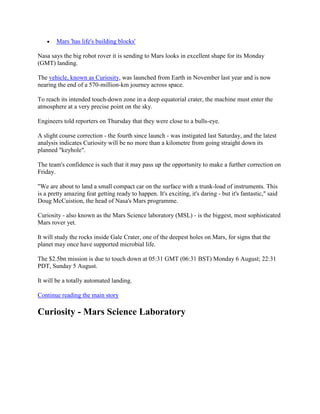
                                                 Adam Steltzner expects the new landing system
to perform as designed
Continue reading the main story

Related Stories
       Mars success depends on 'crazy' landing
       Mars rover narrows landing zone
Mars 'has life's building blocks'

Nasa says the big robot rover it is sending to Mars looks in excellent shape for its Monday
(GMT) landing.

The vehicle, known as Curiosity, was launched from Earth in November last year and is now
nearing the end of a 570-million-km journey across space.

To reach its intended touch-down zone in a deep equatorial crater, the machine must enter the
atmosphere at a very precise point on the sky.

Engineers told reporters on Thursday that they were close to a bulls-eye.

A slight course correction - the fourth since launch - was instigated last Saturday, and the latest
analysis indicates Curiosity will be no more than a kilometre from going straight down its
planned "keyhole".

The team's confidence is such that it may pass up the opportunity to make a further correction on
Friday.

"We are about to land a small compact car on the surface with a trunk-load of instruments. This
is a pretty amazing feat getting ready to happen. It's exciting, it's daring - but it's fantastic," said
Doug McCuistion, the head of Nasa's Mars programme.

Curiosity - also known as the Mars Science laboratory (MSL) - is the biggest, most sophisticated
Mars rover yet.

It will study the rocks inside Gale Crater, one of the deepest holes on Mars, for signs that the
planet may once have supported microbial life.

The $2.5bn mission is due to touch down at 05:31 GMT (06:31 BST) Monday 6 August; 22:31
PDT, Sunday 5 August.

It will be a totally automated landing.

Continue reading the main story

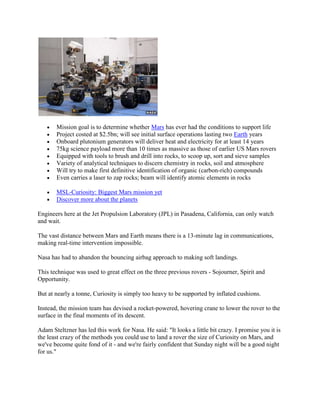
Curiosity - Mars Science Laboratory
Mission goal is to determine whether Mars has ever had the conditions to support life
       Project costed at $2.5bn; will see initial surface operations lasting two Earth years
       Onboard plutonium generators will deliver heat and electricity for at least 14 years
       75kg science payload more than 10 times as massive as those of earlier US Mars rovers
       Equipped with tools to brush and drill into rocks, to scoop up, sort and sieve samples
       Variety of analytical techniques to discern chemistry in rocks, soil and atmosphere
       Will try to make first definitive identification of organic (carbon-rich) compounds
       Even carries a laser to zap rocks; beam will identify atomic elements in rocks

       MSL-Curiosity: Biggest Mars mission yet
       Discover more about the planets

Engineers here at the Jet Propulsion Laboratory (JPL) in Pasadena, California, can only watch
and wait.

The vast distance between Mars and Earth means there is a 13-minute lag in communications,
making real-time intervention impossible.

Nasa has had to abandon the bouncing airbag approach to making soft landings.

This technique was used to great effect on the three previous rovers - Sojourner, Spirit and
Opportunity.

But at nearly a tonne, Curiosity is simply too heavy to be supported by inflated cushions.

Instead, the mission team has devised a rocket-powered, hovering crane to lower the rover to the
surface in the final moments of its descent.

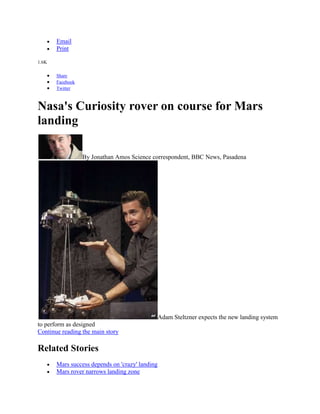
Adam Steltzner has led this work for Nasa. He said: "It looks a little bit crazy. I promise you it is
the least crazy of the methods you could use to land a rover the size of Curiosity on Mars, and
we've become quite fond of it - and we're fairly confident that Sunday night will be a good night
for us."
The team is also keeping a sharp eye on the Martian weather and any atmospheric conditions that
might interfere with the descent manoeuvres.

It is the equivalent of August also on Mars right now, meaning Gale Crater at its position just
inside the southern hemisphere is coming out of winter and moving towards spring.

It is the time of year when winds can kick up huge clouds of dust, and a big storm was spotted
this week about 1,000km from the landing site. But Nasa expects this storm to dissipate long
before landing day.


Science editor David Shukman takes a look at a full-scale replica of Curiosity

The first black-and-white images of the surface taken by Curiosity should be returned to Earth in
the first hours after touch down, but the mission team do not intend to rush into exploration.

For one thing, the rover has a plutonium battery that should give it far greater longevity than the
solar-panelled power systems on previous vehicles.

"This is a very complicated beast," said Pete Theisinger, Curiosity's project manager.

"The speech I made to the team is to recognize that on Sunday night at [22:32 PDT], we will
have a priceless asset that we have placed on the surface of another planet that could last a long
time if we operate it correctly, and so we will be as cautious as hell about what we do with it."

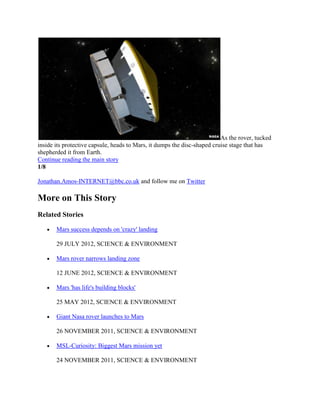
Step by step: How the Curiosity rover will land on Mars
Continue reading the main story
As the rover, tucked
inside its protective capsule, heads to Mars, it dumps the disc-shaped cruise stage that has
shepherded it from Earth.
Continue reading the main story
1/8

Jonathan.Amos-INTERNET@bbc.co.uk and follow me on Twitter

More on This Story
Related Stories

       Mars success depends on 'crazy' landing

       29 JULY 2012, SCIENCE & ENVIRONMENT

       Mars rover narrows landing zone

       12 JUNE 2012, SCIENCE & ENVIRONMENT

       Mars 'has life's building blocks'

       25 MAY 2012, SCIENCE & ENVIRONMENT

       Giant Nasa rover launches to Mars

       26 NOVEMBER 2011, SCIENCE & ENVIRONMENT

       MSL-Curiosity: Biggest Mars mission yet

       24 NOVEMBER 2011, SCIENCE & ENVIRONMENT
Mars rover aims for deep crater

       22 JULY 2011, SCIENCE & ENVIRONMENT

Related Internet links

       Curiosity - Mars Science Laboratory

The BBC is not responsible for the content of external Internet sites

Share this page
1.6K

       Share
       Facebook
       Twitter


       Email
       Print

More Science & Environment stories
RSS


                              Shrimp shells aid uranium harvest

       Researchers outline state-of-the-art proposals to extract uranium - the raw fuel of nuclear
       power - from seawater, including ideas using shrimp and crabs.

       Mars rover's wind sensor damaged
       Bugs sunbathe to 'stay healthy'

r's three favourite words: "Tango Delta Nominal" http://t.co/ycouEBg6


August 2012 Last updated at 13:50 GMT

Share this page
Email
       Print

       Share
       Facebook
       Twitter


Mars data to be analysed by Leicester
scientist


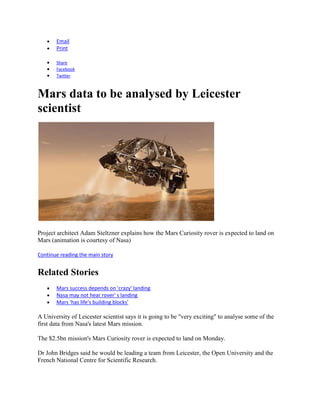
Project architect Adam Steltzner explains how the Mars Curiosity rover is expected to land on
Mars (animation is courtesy of Nasa)

Continue reading the main story


Related Stories
       Mars success depends on 'crazy' landing
       Nasa may not hear rover' s landing
       Mars 'has life's building blocks'

A University of Leicester scientist says it is going to be "very exciting" to analyse some of the
first data from Nasa's latest Mars mission.

The $2.5bn mission's Mars Curiosity rover is expected to land on Monday.

Dr John Bridges said he would be leading a team from Leicester, the Open University and the
French National Centre for Scientific Research.
He said: "Never before has such a powerful set of instruments and such a capable rover been
sent."

Geological history

He added: "The overall aim of the mission is to determine if Mars has ever been habitable for
microbial life. It's incredibly exciting.

"For the first time we can look at a large amount of material which was deposited from water.

"Were there large lakes which lasted for millions of years or just small amounts of water which
lasted a short period of time? These are just some of the fundamental things we can learn about
Mars.

"The mobile Mars Science Laboratory (Curiosity) is expected to revolutionise our understanding
of the geological history of the planet."

The rover was launched in November and is scheduled to land on Monday morning beside a
mountain within Gale Crater called Mt Sharp.

Nasa described Curiosity rover as "car-sized" and weighing one ton (900kg).

It is fitted with a robotic arm, high-resolution cameras and a laser, and is designed to be a
walking laboratory.

Martian meteorites

Dr Bridges said he would be at the Jet Propulsion Laboratory in California to witness the landing
and to start work on the research.

The University of Leicester said Dr Bridges was one of two UK scientists who would conduct
and analyse experiments during the two-year mission.

Dr Bridges said: "For a number of years now I've studied Mars using orbiting spacecraft data,
also from looking at Martian meteorites in detail. This is the next logical step.

"It's the most powerful rover ever sent to Mars - with more instruments... It can go even further
and perhaps even last longer."

More on This Story
Related Stories

        Mars success depends on 'crazy' landing
29 JULY 2012, SCIENCE & ENVIRONMENT

       Nasa may not hear rover' s landing

       16 JULY 2012, SCIENCE & ENVIRONMENT

       Mars 'has life's building blocks'

       25 MAY 2012, SCIENCE & ENVIRONMENT

       Landing Batman would be Splatman

       10 JULY 2012, LEICESTER

       University to get 'supercomputer'

       07 JUNE 2012, LEICESTER

Related Internet links

       Nasa
       University of Leicester
       John Bridges: Mars blog

The BBC is not responsible for the content of external Internet sites

Share this page
       Share
       Facebook
       Twitter

       Email
       Print


BBC Leicester


                                 Fungus-hit ash trees destroyed

       Almost 500 ash trees recently planted in Leicestershire are being destroyed after
       becoming infected with a fungus disease.
Raining tiny yellow plastic balls
      London tops heart survival table

Travel News

      Latest road incidents, public transport information and live traffic jam cameras near
      you

Weather

Leicestershire

Wednesday day weather


      Sunny Intervals
      Max: 20°C
      Min: 13°C

Things To Do
  RUN BY THE BBC AND PARTNERS


      THU 23 AUG

      MCC Spirit of Cricket Girls…

      Leicestershire and Rutland…


      THU 23 AUG

      Medieval Kings, Queens…

      The Guildhall
See Leicester Activities >

                           Tow n, city,
Find activities near you

        BBC Radio Leicester Live
        BBC Leicester Sport

Top Stories


                                 Greece 'needs more time' for cuts
        Chemical weapons 'excuse for US' New
        Four Paralympic flames kindled
        Dozens killed in Kenyan clashes
        Life term for Terreblanche murder


Features & Analysis


                             Granny's sandwiches

        Why Italians are returning to traditional food


                             Small world

        How long before you can be the ancestor of everyone?


                             Fear of turmoil

        What the death of Meles Zenawi means for Africa
Exit strategy

        Why Chinese millionaires are buying foreign residency


Most Popular
Shared

  1.    1: Right-to-die man Nicklinson dead
  2.    2: Life lessons from the mosh pit
  3.    3: Tracing the world's common ancestor
  4.    4: Teen invents cancer test using web
  5.    5: Beach rubbish reaches 23 tonnes

Read

  1.    1: Right-to-die man Nicklinson dead
  2.    2: Chemical weapons 'excuse for US'
  3.    3: Sitting straight 'bad for backs'
  4.    4: Wood's death certificate changed
  5.    5: Greece 'needs more time' for cuts
  6.    6: Nikon's Android-powered camera
  7.    7: Tracing the world's common ancestor
  8.    8: Dozens killed in Kenyan clashes
  9.    9: Italians feast on traditional 'granny' food
  10.   10: EU hails Russia's entry into WTO

Video/Audio

  1.    1: Athens battles for tourists Watch
  2.    2: Teen invents cancer test using web Watch
  3.    3: China's rich seek overseas residency Watch
  4.    4: Meles Zenawi's body returns to Ethiopia Watch
  5.    5: Nyad: Jellyfish sting 'like fire' Watch
  6.    6: One-minute World News Watch
  7.    7: Prince Harry 'an easy target' for press Watch
  8.    8: 'Gates of Paradise' restored in Florence Watch
  9.    9: Meles Zenawi archive interview Watch
  10.   10: Missouri residents on Akins row Watch
Elsewhere on BBC News


                                                         Pensioner pain

     Greece's elderly come under pressure from the country's cuts

Programmes


                                                         Fast Track Watch

     Annoyed at Greece’s overseas reputation - how young Greeks are attempting to repair the
     damage

Ads by Google

     What Happens When You Die

     New theory says death isn't the end

     RobertLanzaBiocentrism.com

     Markley Cove Resort

     Visit our new website to reserve vacation rental for Summer 2011

     www.markleycoveresort.com
Driver Guided Wales Tours

       Flexible Tailored Tours of Wales Small Personalised Tours of Wales

       www.pendragontours.co.uk

16 July 2012 Last updated at 19:35 GMT

Share this page

       Email
       Print

       Share
       Facebook
       Twitter


Nasa may miss Curiosity Mars rover's
landing signal

                  By Jonathan Amos Science correspondent, BBC News


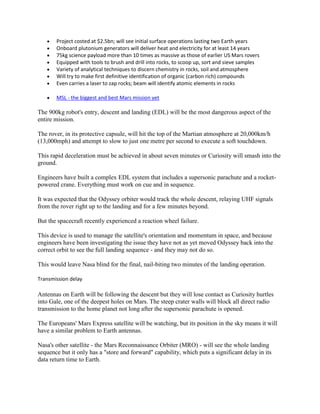
Mars programme director Doug McCuistion: "Is it crazy? Well, not so much" (Courtesy of Nasa)

Continue reading the main story


Related Stories
       Mars rover narrows landing zone
       Mars 'has life's building blocks'
Europe still keen on Mars missions

Nasa might not be able to follow the progress of its big Mars rover all the way to the surface
when it attempts to land on the planet on 6 August (GMT).

The Curiosity vehicle is aiming for a deep depression known as Gale Crater.

The US space agency will be tracking the descent with satellites, but its prime craft for the task
may not now be in the correct place in the sky.

Engineers have been tackling a fault on the Odyssey satellite and it is no longer in the best
observational orbit.

Unless it can be moved back in the next three weeks, Nasa will lose signal to the rover just as it
is about to touch down.

This will not affect the outcome of the landing because Curiosity's descent manoeuvres are all
performed autonomously, but it will give rise to some high anxiety as everyone awaits
confirmation that the $2.5bn mission is safely on the surface.

"Odyssey right now looks like it may not be in the same spot that we'd expected it to be," said
Doug McCuistion, the director of Nasa's Mars exploration programme.

"There may be some changes in real-time communication. We'll let you know as this develops;
we still have more work to do. But keep in mind, there is no risk to [Curiosity] landing. It does
not have an effect on that."

High risk

Continue reading the main story


Curiosity - Mars Science Laboratory


        Mission goal is to determine whether Mars has ever had the conditions to support life
Project costed at $2.5bn; will see initial surface operations lasting two Earth years
       Onboard plutonium generators will deliver heat and electricity for at least 14 years
       75kg science payload more than 10 times as massive as those of earlier US Mars rovers
       Equipped with tools to brush and drill into rocks, to scoop up, sort and sieve samples
       Variety of analytical techniques to discern chemistry in rocks, soil and atmosphere
       Will try to make first definitive identification of organic (carbon rich) compounds
       Even carries a laser to zap rocks; beam will identify atomic elements in rocks

       MSL - the biggest and best Mars mission yet

The 900kg robot's entry, descent and landing (EDL) will be the most dangerous aspect of the
entire mission.

The rover, in its protective capsule, will hit the top of the Martian atmosphere at 20,000km/h
(13,000mph) and attempt to slow to just one metre per second to execute a soft touchdown.

This rapid deceleration must be achieved in about seven minutes or Curiosity will smash into the
ground.

Engineers have built a complex EDL system that includes a supersonic parachute and a rocket-
powered crane. Everything must work on cue and in sequence.

It was expected that the Odyssey orbiter would track the whole descent, relaying UHF signals
from the rover right up to the landing and for a few minutes beyond.

But the spacecraft recently experienced a reaction wheel failure.

This device is used to manage the satellite's orientation and momentum in space, and because
engineers have been investigating the issue they have not as yet moved Odyssey back into the
correct orbit to see the full landing sequence - and they may not do so.

This would leave Nasa blind for the final, nail-biting two minutes of the landing operation.

Transmission delay

Antennas on Earth will be following the descent but they will lose contact as Curiosity hurtles
into Gale, one of the deepest holes on Mars. The steep crater walls will block all direct radio
transmission to the home planet not long after the supersonic parachute is opened.

The Europeans' Mars Express satellite will be watching, but its position in the sky means it will
have a similar problem to Earth antennas.

Nasa's other satellite - the Mars Reconnaissance Orbiter (MRO) - will see the whole landing
sequence but it only has a "store and forward" capability, which puts a significant delay in its
data return time to Earth.
MRO's information will not be available to engineers on Earth for three to four hours after the
rover has placed itself on the surface.

As things stand, Nasa could be waiting on Odyssey to make a late pass of the landing site,
perhaps five to 10 minutes after the rover's planned touchdown.

This is projected to be 22:31 PDT 5 August; 01:31 EDT, 05:31 GMT, 06:31 BST 6 August.

This is "Earth receive" time - the time a signal sent from Mars is received on Earth. The 250
million km between Mars and Earth on 5/6 August mean a radio transmission takes just under 14
minutes to pass between the two planets.

"If Odyssey is not able to be moved and it still remains late, that means it will fly over
[Curiosity] after the spacecraft has landed, and we presumably will [then] be able to see
transmissions from it. It would be somewhere between 22:35 and 22:40 PDT," explained Pete
Theisinger, the rover project manager at Nasa's Jet Propulsion Laboratory in Pasadena,
California.

Curiosity - also known as the Mars Science laboratory (MSL) - is the most sophisticated space
vehicle ever built to touch the surface of another world.

Assuming the robot lands safely, it will spend 98 (Earth) weeks scouring Martian soils and rocks
for any signs that current or past environments on the planet could have supported microbial life.

Gale Crater was chosen as the landing site because satellite pictures had spied sediments in the
depression which looked as though they were laid down in the presence of abundant water.

MSL-Curiosity is equipped with 10 advanced instruments. It also has a plutonium battery and so
should have ample power to keep rolling for more than a decade.

It is likely the mechanisms on the rover will wear out long before its energy supply.
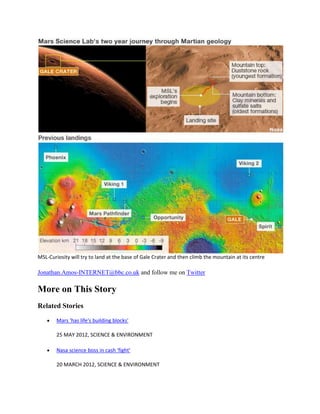
MSL-Curiosity will try to land at the base of Gale Crater and then climb the mountain at its centre

Jonathan.Amos-INTERNET@bbc.co.uk and follow me on Twitter

More on This Story
Related Stories

        Mars rover narrows landing zone

        12 JUNE 2012, SCIENCE & ENVIRONMENT

        Mars 'has life's building blocks'

        25 MAY 2012, SCIENCE & ENVIRONMENT
Europe still keen on Mars missions

       15 MARCH 2012, SCIENCE & ENVIRONMENT

       ‘Six minutes of terror’

       06 MARCH 2012, SCIENCE & ENVIRONMENT

       Mars mission lines up on target

       12 JANUARY 2012, SCIENCE & ENVIRONMENT

       Giant Nasa rover launches to Mars

       26 NOVEMBER 2011, SCIENCE & ENVIRONMENT

       MSL - the biggest and best Mars mission

       24 NOVEMBER 2011, SCIENCE & ENVIRONMENT

Related Internet links

       Nasa's Mars Science Laboratory rover

The BBC is not responsible for the content of external Internet sites

Share this page
       Share
       Facebook
       Twitter

       Email
       Print


More Science & Environment stories
RSS


                                 Shrimp shells aid uranium harvest
Researchers outline state-of-the-art proposals to extract uranium - the raw fuel of nuclear
    power - from seawater, including ideas using shrimp and crabs.

    Mars rover's wind sensor damaged
    Bugs sunbathe to 'stay healthy'

Top Stories


                             Greece 'needs more time' for cuts
    Chemical weapons 'excuse for US' New
    Four Paralympic flames kindled
    Dozens killed in Kenyan clashes
    Life term for Terreblanche murder


Features & Analysis


                      Granny's sandwiches

    Why Italians are returning to traditional food


                      Small world

    How long before you can be the ancestor of everyone?


                      Fear of turmoil

    What the death of Meles Zenawi means for Africa
Exit strategy

        Why Chinese millionaires are buying foreign residency


Most Popular
Shared

  1.    1: Right-to-die man Nicklinson dead
  2.    2: Life lessons from the mosh pit
  3.    3: Tracing the world's common ancestor
  4.    4: Teen invents cancer test using web
  5.    5: Beach rubbish reaches 23 tonnes

Read

  1.    1: Right-to-die man Nicklinson dead
  2.    2: Chemical weapons 'excuse for US'
  3.    3: Sitting straight 'bad for backs'
  4.    4: Wood's death certificate changed
  5.    5: Greece 'needs more time' for cuts
  6.    6: Nikon's Android-powered camera
  7.    7: Tracing the world's common ancestor
  8.    8: Dozens killed in Kenyan clashes
  9.    9: Italians feast on traditional 'granny' food
  10.   10: EU hails Russia's entry into WTO

Video/Audio

  1.    1: Athens battles for tourists Watch
  2.    2: Teen invents cancer test using web Watch
  3.    3: China's rich seek overseas residency Watch
  4.    4: Meles Zenawi's body returns to Ethiopia Watch
  5.    5: Nyad: Jellyfish sting 'like fire' Watch
  6.    6: One-minute World News Watch
  7.    7: Prince Harry 'an easy target' for press Watch
  8.    8: 'Gates of Paradise' restored in Florence Watch
  9.    9: Meles Zenawi archive interview Watch
  10.   10: Missouri residents on Akins row Watch


BBC Future
How many alien worlds exist?
Play with our interactive graphic to find out... Read more...


Programmes


                                                                Fast Track Watch

         Annoyed at Greece’s overseas reputation - how young Greeks are attempting to repair the
         damage

Ads by Google

         What Happens When You Die

         New theory says death isn't the end

         RobertLanzaBiocentrism.com

         EMT Surveillance Robots

         The Most Affordable surveillance & Recon Robots.EOD,Hazmat,Police

         www.EvolutionModelTechnology.ca

         Accuprobe
Probe cards and components Ceramic blades & epoxy ring

       www.accuprobe.com


Accessibility links
       Skip to content
       Skip to local navigation
       Accessibility Help


bbc.co.uk navigation
       News
       Sport
       Weather
       Travel
       Future
       TV
       Radio
       More…


Search term:


                                     Science & Environment
       Home
       UK
       Africa
       Asia
       Europe
       Latin America
       Mid-East
       US & Canada
       Business
       Health
       Sci/Environment
       Tech
       Entertainment
Video

3 August 2012 Last updated at 23:41 GMT

Share this page

       Email
       Print

540


       Share
       Facebook
       Twitter


                      Article written by Jonathan Amos Science correspondent

       More from Jonathan
       Follow Jonathan on Twitter


Gale Crater: Geological 'sweet shop' awaits
Mars rover
Comments (238)
Grotzinger leads a team of several hundred mission scientists

More from Jonathan
       Space - the new rock and roll
       Mars success depends on 'crazy' landing
       Ahoy! Your ship is being tracked from orbit
       Satellites have an electric future

John Grotzinger is the project scientist on Nasa's latest multi-billion-dollar mission to Mars.

He's going to become a familiar face in the coming months as he explains to TV audiences the
importance of the discoveries that are made by the most sophisticated spacecraft ever sent to
touch the surface of another world.

The Curiosity Rover - also called the Mars Science Laboratory (MSL) - is set to land on Monday
(GMT) for a minimum two-year exploration of a deep hole on Mars' equator known as Gale
Crater.

The depression was punched out by an asteroid or comet billions of years ago.

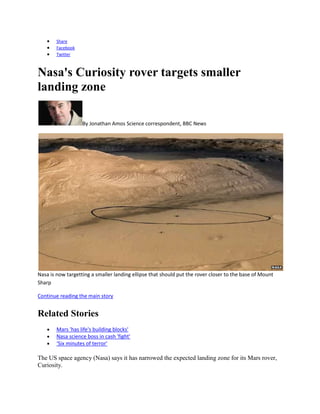
The lure for Grotzinger and his fellow scientists is the huge mound of rock rising 5km from the
crater floor.

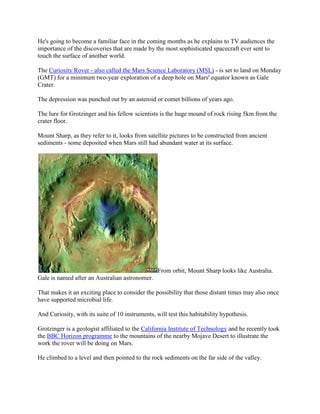
Mount Sharp, as they refer to it, looks from satellite pictures to be constructed from ancient
sediments - some deposited when Mars still had abundant water at its surface.


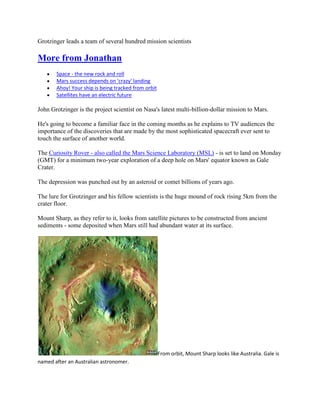
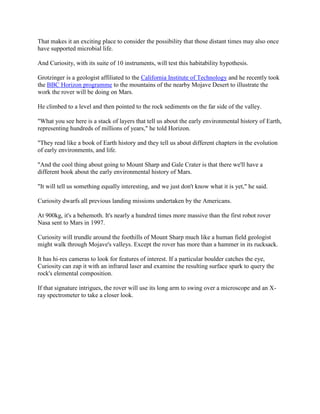
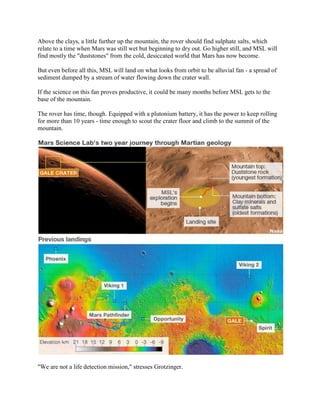
                                                     From orbit, Mount Sharp looks like Australia. Gale is
named after an Australian astronomer.
That makes it an exciting place to consider the possibility that those distant times may also once
have supported microbial life.

And Curiosity, with its suite of 10 instruments, will test this habitability hypothesis.

Grotzinger is a geologist affiliated to the California Institute of Technology and he recently took
the BBC Horizon programme to the mountains of the nearby Mojave Desert to illustrate the
work the rover will be doing on Mars.

He climbed to a level and then pointed to the rock sediments on the far side of the valley.

"What you see here is a stack of layers that tell us about the early environmental history of Earth,
representing hundreds of millions of years," he told Horizon.

"They read like a book of Earth history and they tell us about different chapters in the evolution
of early environments, and life.

"And the cool thing about going to Mount Sharp and Gale Crater is that there we'll have a
different book about the early environmental history of Mars.

"It will tell us something equally interesting, and we just don't know what it is yet," he said.

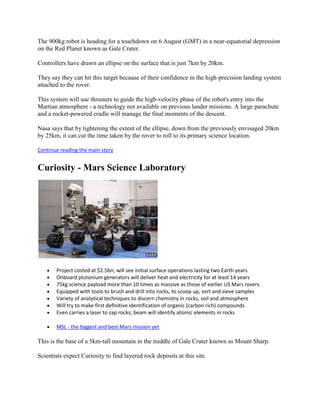
Curiosity dwarfs all previous landing missions undertaken by the Americans.

At 900kg, it's a behemoth. It's nearly a hundred times more massive than the first robot rover
Nasa sent to Mars in 1997.

Curiosity will trundle around the foothills of Mount Sharp much like a human field geologist
might walk through Mojave's valleys. Except the rover has more than a hammer in its rucksack.

It has hi-res cameras to look for features of interest. If a particular boulder catches the eye,
Curiosity can zap it with an infrared laser and examine the resulting surface spark to query the
rock's elemental composition.

If that signature intrigues, the rover will use its long arm to swing over a microscope and an X-
ray spectrometer to take a closer look.
Still interested? Curiosity can drill into the boulder and deliver a powdered sample to two high-
spec analytical boxes inside the rover belly.

These will lay bare the rock's precise make-up, and the conditions under which it formed.

"We're not just scratching and sniffing and taking pictures - we're boring into rock, getting that
powder and analysing it in these laboratories," deputy project scientist, Ashwin Vasavada, told
the BBC.

"These are really university laboratories that would normally fill up a room but which have been
shrunk down - miniaturised - and made safe for the space environment, and then flown on this
rover to Mars."

The intention on Monday is to put MSL-Curiosity down on the flat plain of the crater bottom.

The vehicle will then drive up to the base of Mount Sharp.

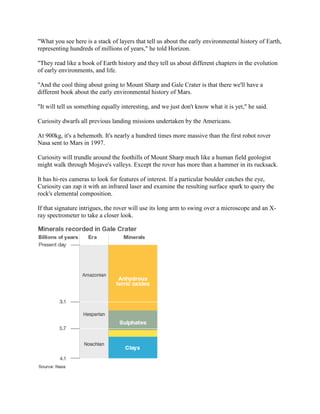
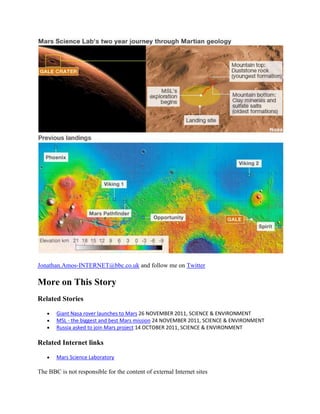
In front of it, the rover should find clay minerals (phyllosilicates) that will give a fresh insight
into the wet, early era of the Red Planet known as the Noachian. Clays only form when rock
spends a lot of time in contact with water.

Above the clays, a little further up the mountain, the rover should find sulphate salts, which
relate to the Hesperian Era - a time when Mars was still wet but beginning to dry out.
"Going to Gale will give us the opportunity to study a key transition in the climate of Mars -
from the Noachian to the Hesperian," said Sanjeev Gupta, an Imperial College London scientist
on the mission.

"The rocks we believe preserve that with real fidelity, and the volume of data we get from
Curiosity will be just extraordinary."

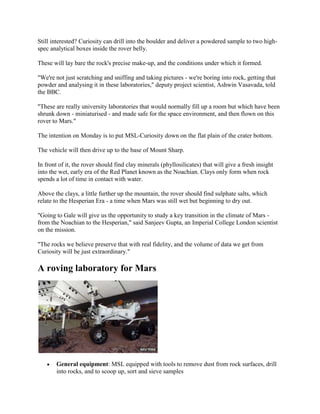
A roving laboratory for Mars


       General equipment: MSL equipped with tools to remove dust from rock surfaces, drill into
       rocks, and to scoop up, sort and sieve samples
       Mast Camera: will image rover's surroundings in hi-res stereo and colour; wide angle and
       telephoto; can make hi-def video movies
       ChemCam: pulses infrared laser at rocks up to 7m away; carries a spectrometer to identify types
       of atoms excited in laser beam
       Sample Analysis at Mars: inside body; will analyse rock, soil and atmospheric samples; would
       make all-important organics identification
       Chemistry and Mineralogy: another interior instrument. Analyses powdered samples to
       quantify minerals present in rocks and soils
       Mars Hand Lens Imager: mounted on arm toolkit; will take extreme close-ups of rocks, soil and
       any ice; details smaller than hair's width
       Alpha Particle X-ray Spectrometer: Canadian arm contribution; will determine relative
       abundances of different elements in samples
       Radiation Assessment Detector: will characterize radiation environment at surface; key
       information for future human exploration
       Mars Descent Imager: operates during landing sequence; hi-def movie will tell controllers
       exactly where rover touched down
       Rover Environmental Monitoring Station: Spanish weather station; measures pressure,
       temperature, humidity, winds, and UV levels
       Dynamic Albedo of Neutrons: looks for sub-surface hydrogen; could indicate water buried in
       form of ice or bound in minerals

The rover is not a life-detection mission; it does not possess the capability to identify any bugs in
the soil or huddled under rocks (not that anyone really expects to find microbes in the cold, dry,
and irradiated conditions that persist at the surface of Mars today).
But what Curiosity can do is characterise any organic (carbon-rich) chemistry that may be
present.

All life as we know it on Earth trades off a source of complex carbon molecules, such as amino
acids - just as it needs water and energy.

Previous missions, notably the Viking landers in the 1970s, have hinted at the presence of
organics on Mars. But if Curiosity could make the definitive identification of organics in Gale
Crater, it would be a eureka moment and go a long way towards demonstrating that the Red
Planet did indeed have habitable environments in its ancient past.

It's a big ask, though. Even in Earth rocks where we know sediments have been laid down in
proximity to biology, we still frequently find no organic traces. The evidence doesn't preserve
well.

And, of course, there are plenty of non-biological processes that will produce organics, so it
wouldn't be an "A equals B" situation even if Curiosity were to make the identification.

Nonetheless, some members of the science team still dream of finding tantalising chemical
markers in Gale's rocks.

Dawn Sumner, from the University of California at Davis, is one of them.

"Under very specific circumstances - if life made a lot of organic molecules and they are
preserved and they haven't reacted with the rocks in Gale Crater, we may be able to tell that they
were created by life. It's a remote possibility, but it's something I at least hope we can find," she
said.

"I am confident we will learn amazing new things. Some of them will be answers to questions
we already have, but most of what we learn will be surprises to us.

"We've only been on the ground on Mars in six places, and it's a huge planet.

"Gale Crater and Mount Sharp are unlike anything we've been to before. That guarantees we will
learn exciting new things from Curiosity."

Horizon: Mission to Mars was broadcast on BBC Two Monday 30 July. Watch online via iPlayer
(UK only) or browse more Horizon clips at the above link.
Your comments (238)


                      Article written by Jonathan Amos Jonathan Amos Science correspondent

       More from Jonathan
       Follow Jonathan on Twitter


@BBCAmos via Twitter
A Mars engineer's three favourite words: "Tango Delta Nominal" http://t.co/ycouEBg6
More on This Story
More from Jonathan

      Space - the new rock and roll
      Mars success depends on 'crazy' landing
      Ahoy! Your ship is being tracked from orbit
      Satellites have an electric future
      Virgin to launch small satellites
      Move to open sky for spaceplanes
      China in space: Running fast to catch up
      Super-chilled robot ready to slice and dice

Related Stories

      Rover on course for Mars landing

      03 AUGUST 2012, SCIENCE & ENVIRONMENT

      Mars success depends on 'crazy' landing

      29 JULY 2012, SCIENCE & ENVIRONMENT

      Mars rover narrows landing zone

      12 JUNE 2012, SCIENCE & ENVIRONMENT

      Mars 'has life's building blocks'

      25 MAY 2012, SCIENCE & ENVIRONMENT

      Giant Nasa rover launches to Mars

      26 NOVEMBER 2011, SCIENCE & ENVIRONMENT

      MSL-Curiosity: Biggest Mars mission yet

      24 NOVEMBER 2011, SCIENCE & ENVIRONMENT

      Mars rover aims for deep crater

      22 JULY 2011, SCIENCE & ENVIRONMENT

Related Internet links
Curiosity - Mars Science Laboratory
       John Grotzinger at Californa Institute of Technology
       Sanjeev Gupta at Imperial College London
       Dawn Sumner at University of California Davis

The BBC is not responsible for the content of external Internet sites

Comments

This entry is now closed for comments

Jump to comments pagination

       All Comments (238)


            o   Order by:
            o   Latest First
            o   Highest Rated
            o   Lowest Rated


       0

       Comment number 238.

       ColadadelCid
       5th August 2012 - 23:27

       It would have made for an interesting biological experiment if the craft carried along the
       most resistant life from Earth a cockroach and had it released on the Martian surface. If
       the thing lived and scampered away unharmed imagine what that would mean. But by the
       time Earthlings actually set foot on Mars they likely might need to bring along some
       roach spray and plenty of it.


       +1
Comment number 237.

Cnut the not so Great
5th August 2012 - 23:05

231. SBTC

What?

John 3:16 16 "For God so loved the world that he gave his one and only Son, that
whoever believes in him shall not perish but have eternal life".

Have you actually read Genesis. It's seven days.


+3

Comment number 236.

disgustedofdymchurch
5th August 2012 - 22:52

Why are they sending a Rover? Wouldn't a Mercedes be more reliable?


+1

Comment number 235.

Eggleman
5th August 2012 - 22:42

It is amazing what advances in science have done since we reached the Moon in 1969. I
seriously doubt many people would have predicted this level of technology to reach, let
alone see Mars in such detail to come so quickly.
0

       Comment number 234.

       MickClayton
       5th August 2012 - 22:34

       http://www.esa.int/esaCP/SEM5O1TX55H_index_0.html


Comments 5 of 238

       Show more

Sign in with your BBC iD, or Register to comment and rate comments

All posts are reactively-moderated and must obey the house rules.

Share this page
540


       Share
       Facebook
       Twitter

       Email
       Print


Top Stories


                                Greece 'needs more time' for cuts
       Chemical weapons 'excuse for US'
       Four Paralympic flames kindled
       Dozens killed in Kenya clashes
Life term for Terreblanche murder


Features & Analysis


                        Granny's sandwiches

     Why Italians are returning to traditional food


                        Small world

     How long before you can be the ancestor of everyone?


                        Fear of turmoil

     What the death of Meles Zenawi means for Africa


                        Exit strategy

     Why Chinese millionaires are buying foreign residency


Most Popular
Shared

  1. 1: Right-to-die man Nicklinson dead
  2. 2: Life lessons from the mosh pit
3. 3: Tracing the world's common ancestor
    4. 4: Teen invents cancer test using web
    5. 5: Beach rubbish reaches 23 tonnes

Read

    1.    1: Right-to-die man Nicklinson dead
    2.    2: Chemical weapons 'excuse for US'
    3.    3: Wood's death certificate changed
    4.    4: Sitting straight 'bad for backs'
    5.    5: Ethiopia's Meles lies in state
    6.    6: Greece 'needs more time' for cuts
    7.    7: Italians feast on traditional 'granny' food
    8.    8: EU hails Russia's entry into WTO
    9.    9: Dozens killed in Kenyan clashes
    10.   10: Viewpoint: Ethiopian PM Meles Zenawi's death could create regional turmoil

Video/Audio

    1.    1: Athens battles for tourists Watch
    2.    2: Nyad: Jellyfish sting 'like fire' Watch
    3.    3: China's rich seek overseas residency Watch
    4.    4: Teen invents cancer test using web Watch
    5.    5: Prince Harry 'an easy target' for press Watch
    6.    6: Japanese journalist killed in Syria Watch
    7.    7: Meles Zenawi's body returns to Ethiopia Watch
    8.    8: One-minute World News Watch
    9.    9: Why Angelique Kidjo criticised Mugabe Watch
    10.   10: Can California afford bullet trains? Watch


BBC Future


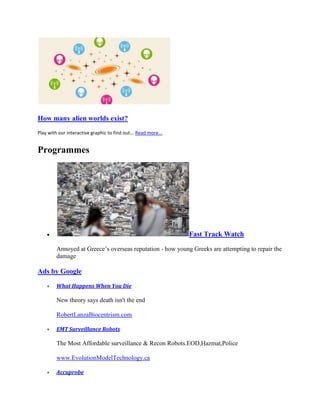
How many alien worlds exist?
Play with our interactive graphic to find out... Read more...
Programmes


                                                          Fast Track Watch

     Annoyed at Greece’s overseas reputation - how young Greeks are attempting to repair the
     damage

Ads by Google

     What Happens When You Die

     New theory says death isn't the end

     RobertLanzaBiocentrism.com

     The Theory of Everything

     Some physicists think the mind is at the heart of modern physics.

     NewPhysicsAndTheMind.net

     Zircon

     for Opacifiers, Refractories, Flour India's only Private Manufacturer

     www.vvmineral.com

Services
     Mobile
     Connected TV
     News feeds
     Alerts
     E-mail news
About BBC News
       Editors' blog
       BBC College of Journalism
       News sources
       Media Action


BBC links

           o      Mobile site
           o      Terms of Use
           o      About the BBC

           o      Advertise With Us
           o      Privacy
           o      BBC Help

           o      Ad Choices
           o      Cookies
           o      Accessibility Help

           o      Parental Guidance
           o      Contact Us


BBC © 2 January 2012 Last updated at 05:15 GMT

Share this page

       Email
       Print

       Share
       Facebook
       Twitter


Nasa Mars rover mission lines up on target
By Jonathan Amos Science correspondent, BBC News

Continue reading the main story


Curiosity - Mars Science Laboratory
Project costed at $2.5bn; will see initial surface operations lasting two Earth years
       Onboard plutonium generators will deliver heat and electricity for at least 14 years
       75kg science payload more than 10 times as massive as those of earlier US Mars rovers
       Equipped with tools to brush and drill into rocks, to scoop up, sort and sieve samples
       Variety of analytical techniques to discern chemistry in rocks, soil and atmosphere
       Will try to make first definitive identification of organic (carbon rich) compounds
       Even carries a laser to zap rocks; beam will identify atomic elements in rocks

       MSL - the biggest and best Mars mission yet

Continue reading the main story


Related Stories
       Giant Nasa rover launches to Mars
       MSL - the biggest and best Mars mission
       Russia asked to join Mars project

Nasa's Mars Science Laboratory (MSL), currently en route to the Red Planet, has had its course
corrected to put it on target for an August landing.

The 900kg rover is flying through space at 4.5km/s following its launch on an Atlas rocket from
Florida in November.

Wednesday's manoeuvre ensures MSL is properly lined up on Mars, leaving the Atlas, which is
following behind, to miss the planet.

The roving lab is aiming to land inside a 150km-wide bowl called Gale Crater.

It will use its sophisticated instruments to assess whether the location has ever had the conditions
capable of supporting life.

The course correction involved firing the eight thrusters on MSL's cruise stage in a planned
sequence that lasted almost three hours.
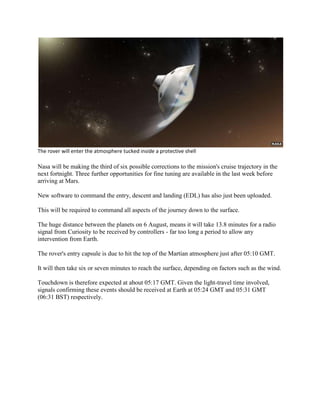
The cruise stage is the support vehicle that is carrying the rover to the Red Planet. The laboratory
itself is tucked away inside a protective cone-shaped capsule.

All of this equipment will have to be jettisoned for MSL to make its landing, expected to take
place on the morning of 6 August (GMT).

The thruster firings initiated what is expected to be the biggest change in course for the probe
during its nine-month, 570-million-km-long journey to the Red Planet.

Further manoeuvres, however, will still be needed to precisely point MSL at its destination, with
a last correction being made perhaps just before the mission's entry into the Martian atmosphere.

Changing course like this mid-way through a cruise is standard practice.

Planetary protection protocols drawn up by scientists demand that space missions limit the
amount of earthly contamination they take to other worlds, and while MSL was prepared to
exacting standards of cleanliness the same could not be said of its Atlas launcher.


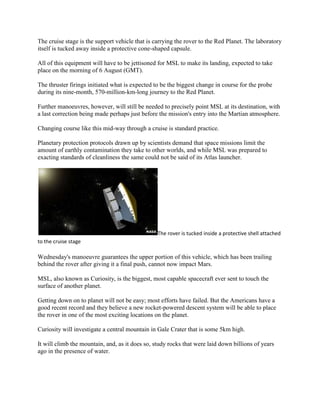
                                                 The rover is tucked inside a protective shell attached
to the cruise stage

Wednesday's manoeuvre guarantees the upper portion of this vehicle, which has been trailing
behind the rover after giving it a final push, cannot now impact Mars.

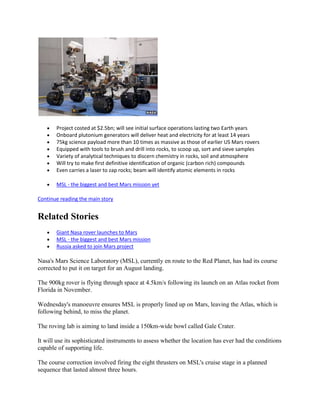
MSL, also known as Curiosity, is the biggest, most capable spacecraft ever sent to touch the
surface of another planet.

Getting down on to planet will not be easy; most efforts have failed. But the Americans have a
good recent record and they believe a new rocket-powered descent system will be able to place
the rover in one of the most exciting locations on the planet.

Curiosity will investigate a central mountain in Gale Crater that is some 5km high.

It will climb the mountain, and, as it does so, study rocks that were laid down billions of years
ago in the presence of water.
Jonathan.Amos-INTERNET@bbc.co.uk and follow me on Twitter

More on This Story
Related Stories

       Giant Nasa rover launches to Mars 26 NOVEMBER 2011, SCIENCE & ENVIRONMENT
       MSL - the biggest and best Mars mission 24 NOVEMBER 2011, SCIENCE & ENVIRONMENT
       Russia asked to join Mars project 14 OCTOBER 2011, SCIENCE & ENVIRONMENT

Related Internet links

       Mars Science Laboratory

The BBC is not responsible for the content of external Internet sites
Share this page
      Share
      Facebook
      Twitter

      Email
      Print


More Science & Environment stories
RSS


                              Shrimp shells aid uranium harvest

      Researchers outline state-of-the-art proposals to extract uranium - the raw fuel of nuclear
      power - from seawater, including ideas using shrimp and crabs.

      Mars rover's wind sensor damaged
      Bugs sunbathe to 'stay healthy'

Top Stories


                               Greece 'needs more time' for cuts
      Chemical weapons 'excuse for US'
      Four Paralympic flames kindled
      Dozens killed in Kenya clashes
      Life term for Terreblanche murder


Features & Analysis


                        Granny's sandwiches

      Why Italians are returning to traditional food
Small world

       How long before you can be the ancestor of everyone?


                         Fear of turmoil

       What the death of Meles Zenawi means for Africa


                         Exit strategy

       Why Chinese millionaires are buying foreign residency


Most Popular
Shared

  1.   1: Right-to-die man Nicklinson dead
  2.   2: Life lessons from the mosh pit
  3.   3: Tracing the world's common ancestor
  4.   4: Teen invents cancer test using web
  5.   5: Beach rubbish reaches 23 tonnes

Read

  1.   1: Right-to-die man Nicklinson dead
  2.   2: Sitting straight 'bad for backs'
  3.   3: Chemical weapons 'excuse for US'
  4.   4: Wood's death certificate changed
  5.   5: Dozens killed in Kenyan clashes
6.    6: Ethiopia's Meles lies in state
  7.    7: Greece 'needs more time' for cuts
  8.    8: Italians feast on traditional 'granny' food
  9.    9: Viewpoint: Ethiopian PM Meles Zenawi's death could create regional turmoil
  10.   10: Tracing the world's common ancestor

Video/Audio

  1.    1: Athens battles for tourists Watch
  2.    2: Teen invents cancer test using web Watch
  3.    3: China's rich seek overseas residency Watch
  4.    4: Meles Zenawi's body returns to Ethiopia Watch
  5.    5: Japanese journalist killed in Syria Watch
  6.    6: Prince Harry 'an easy target' for press Watch
  7.    7: Nyad: Jellyfish sting 'like fire' Watch
  8.    8: Mikias in Addis Ababa: 'You see changes' Watch
  9.    9: Why Angelique Kidjo criticised Mugabe Watch
  10.   10: One-minute World News Watch


Elsewhere on BBC News


                                                               Pensioner pain

        Greece's elderly come under pressure from the country's cuts

Programmes
Fast Track Watch

       Annoyed at Greece’s overseas reputation - how young Greeks are attempting to repair the
       damage

Ads by Google

       What Happens When You Die

       New theory says death isn't the end

       RobertLanzaBiocentrism.com

       Learn physics fast:

       Relativity, quantum physics, string theory, quantum gravity, cosmology.

       NewPhysicsAndTheMind.net

       Affordable Probe Station

       DC thru Microwave Probe Measurement Materials and Semiconductor

       www.jmicrotechnology.com

2012 The BBC is not responsible for the content of external sites. Read more.


Accessibility links
Skip to content
       Skip to local navigation
       Accessibility Help


bbc.co.uk navigation
       News
       Sport
       Weather
       Travel
       Future
       TV
       Radio
       More…


Search term:


                                      Science & Environment
       Home
       UK
       Africa
       Asia
       Europe
       Latin America
       Mid-East
       US & Canada
       Business
       Health
       Sci/Environment
       Tech
       Entertainment
       Video

24 November 2011 Last updated at 17:09 GMT

Share this page

       Email
       Print

207


       Share
Facebook
       Twitter


                       Article written by Jonathan Amos Science correspondent

       More from Jonathan
       Follow Jonathan on Twitter


MSL-Curiosity: Biggest Mars mission yet
Comments (101)


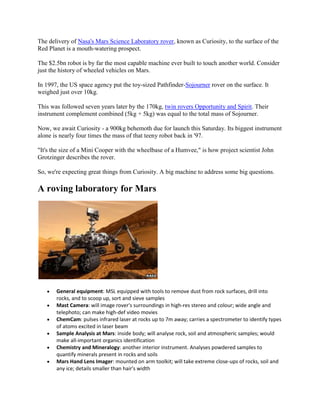
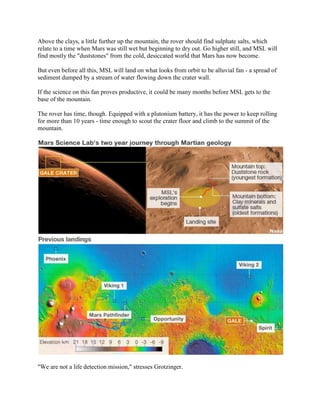
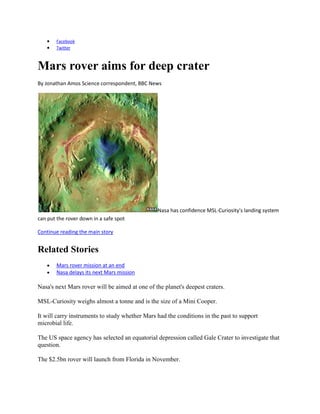
An elevation model of Gale crater made using data from Europe's Mars Express orbiter. MSL lands on
the lower, nearside of the central peak, which rises more than 5km above the crater floor


More from Jonathan
       Space - the new rock and roll
       Gale Crater: Geological 'sweet shop' awaits Mars rover
       Mars success depends on 'crazy' landing
       Ahoy! Your ship is being tracked from orbit
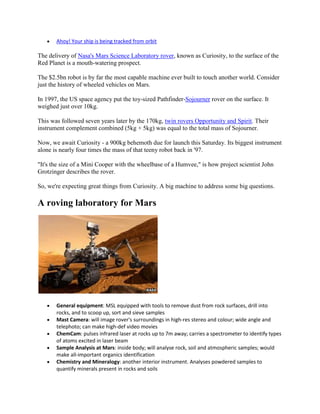
The delivery of Nasa's Mars Science Laboratory rover, known as Curiosity, to the surface of the
Red Planet is a mouth-watering prospect.

The $2.5bn robot is by far the most capable machine ever built to touch another world. Consider
just the history of wheeled vehicles on Mars.

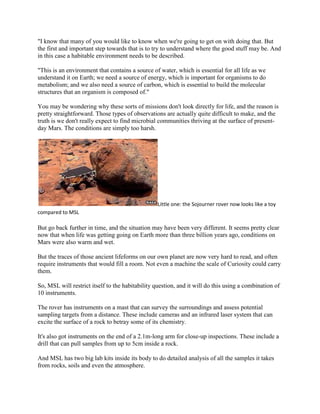
In 1997, the US space agency put the toy-sized Pathfinder-Sojourner rover on the surface. It
weighed just over 10kg.

This was followed seven years later by the 170kg, twin rovers Opportunity and Spirit. Their
instrument complement combined (5kg + 5kg) was equal to the total mass of Sojourner.
Now, we await Curiosity - a 900kg behemoth due for launch this Saturday. Its biggest instrument
alone is nearly four times the mass of that teeny robot back in '97.

"It's the size of a Mini Cooper with the wheelbase of a Humvee," is how project scientist John
Grotzinger describes the rover.

So, we're expecting great things from Curiosity. A big machine to address some big questions.

A roving laboratory for Mars


       General equipment: MSL equipped with tools to remove dust from rock surfaces, drill into
       rocks, and to scoop up, sort and sieve samples
       Mast Camera: will image rover's surroundings in high-res stereo and colour; wide angle and
       telephoto; can make high-def video movies
       ChemCam: pulses infrared laser at rocks up to 7m away; carries a spectrometer to identify types
       of atoms excited in laser beam
       Sample Analysis at Mars: inside body; will analyse rock, soil and atmospheric samples; would
       make all-important organics identification
       Chemistry and Mineralogy: another interior instrument. Analyses powdered samples to
       quantify minerals present in rocks and soils
       Mars Hand Lens Imager: mounted on arm toolkit; will take extreme close-ups of rocks, soil and
       any ice; details smaller than hair's width
Alpha Particle X-ray Spectrometer: Canadian arm contribution; will determine the relative
       abundances of different elements in samples
       Radiation Assessment Detector: will characterize radiation environment at surface; key
       information for future human exploration
       Mars Descent Imager: operates during landing sequence; high-def movie will tell controllers
       exactly where rover touched down
       Rover Environmental Monitoring Station: Spanish weather station; measures pressure,
       temperature, humidity, winds, and UV levels
       Dynamic Albedo of Neutrons: looks for sub-surface hydrogen; could indicate water buried in
       form of ice or bound in minerals

Mike Meyer is the lead scientist on Nasa's Mars exploration effort: "MSL plays a central role in a
series of missions of looking at Mars and determining whether or not it has the potential for life.
It is capable of going to a region and exploring that region, and telling us whether or not it has
been, or may even still be today, a habitable place - something that could support microbial life."

Engineers have designed a new entry, descent and landing system they say can put the roving
laboratory down on a button.

OK, so this button is 20km wide but the accuracy being promised is an order or magnitude better
than previous technology, and it has allowed researchers essentially to go where their heart
desired.

They've chosen a near-equatorial depression called Gale Crater. It's one of the deepest holes on
Mars - deeper even than Valles Marineris, that great scar that tears across one quarter of the
planet.

Scientists believe Gale will be the geological equivalent of a sweet shop - so enticing and varied
are the delights it appears to offer.

"This crater is about 100 miles across and it has a central mound that's about three miles high,"
explains Grotzinger.

"The important thing is that the central mound is a series of layers that cut across the history of
Mars covering over a billion years. So, not only do we have high-resolution images showing we
have layers in this mound, but also because of the spectrometers we have in orbit flying around
Mars, we can see minerals that have obviously interacted with water."

The intention is to put MSL-Curiosity down on the flat plain of the crater bottom. The vehicle
will then drive up to the base of the peak.

In front of it, the rover should find abundant quantities of clay minerals (phyllosilicates) that will

give a fresh insight into the very wet, early epoch of the Red Planet. Clays only form when rock
spends a lot of time in contact with water.
Above the clays, a little further up the mountain, the rover should find sulphate salts, which
relate to a time when Mars was still wet but beginning to dry out. Go higher still, and MSL will
find mostly the "duststones" from the cold, desiccated world that Mars has now become.

But even before all this, MSL will land on what looks from orbit to be alluvial fan - a spread of
sediment dumped by a stream of water flowing down the crater wall.

If the science on this fan proves productive, it could be many months before MSL gets to the
base of the mountain.

The rover has time, though. Equipped with a plutonium battery, it has the power to keep rolling
for more than 10 years - time enough to scout the crater floor and climb to the summit of the
mountain.


"We are not a life detection mission," stresses Grotzinger.
"I know that many of you would like to know when we're going to get on with doing that. But
the first and important step towards that is to try to understand where the good stuff may be. And
in this case a habitable environment needs to be described.

"This is an environment that contains a source of water, which is essential for all life as we
understand it on Earth; we need a source of energy, which is important for organisms to do
metabolism; and we also need a source of carbon, which is essential to build the molecular
structures that an organism is composed of."

You may be wondering why these sorts of missions don't look directly for life, and the reason is
pretty straightforward. Those types of observations are actually quite difficult to make, and the
truth is we don't really expect to find microbial communities thriving at the surface of present-
day Mars. The conditions are simply too harsh.


                                                  Little one: the Sojourner rover now looks like a toy
compared to MSL

But go back further in time, and the situation may have been very different. It seems pretty clear
now that when life was getting going on Earth more than three billion years ago, conditions on
Mars were also warm and wet.

But the traces of those ancient lifeforms on our own planet are now very hard to read, and often
require instruments that would fill a room. Not even a machine the scale of Curiosity could carry
them.

So, MSL will restrict itself to the habitability question, and it will do this using a combination of
10 instruments.

The rover has instruments on a mast that can survey the surroundings and assess potential
sampling targets from a distance. These include cameras and an infrared laser system that can
excite the surface of a rock to betray some of its chemistry.

It's also got instruments on the end of a 2.1m-long arm for close-up inspections. These include a
drill that can pull samples from up to 5cm inside a rock.

And MSL has two big lab kits inside its body to do detailed analysis of all the samples it takes
from rocks, soils and even the atmosphere.
One eureka moment for this mission would be if it could definitively identify a range of complex
organic (carbon-rich) molecules, such as amino acids.

Previous missions, notably the Viking landers in the 1970s, have hinted at the presence of
organics. It would be good if Curiosity could bury all doubts. But it will be tough.

Even in Earth rocks where we know sediments have been laid down in proximity to biology, we
still frequently find no organic traces. The evidence doesn't preserve well.

So, getting a positive result on Mars would be a triumph for the MSL team. Although, I guess
one should make it clear - just finding complex organics does not indicate the presence of life
because we know these carbon molecules can have non-biological origins, in meteorites, for
example.

Nonetheless, it would help to build a case that at least the necessary preconditions have existed
for life on the Red Planet at some point.

We can then think about how we might go about testing for life itself, although I think the only
real solution will be to return rocks for analysis in those room-sized instruments here on Earth.

Your comments (101)


                       Article written by Jonathan Amos Jonathan Amos Science correspondent

       More from Jonathan
       Follow Jonathan on Twitter


@BBCAmos via Twitter
A Mars engineer's three favourite words: "Tango Delta Nominal" http://t.co/ycouEBg6

More on This Story
More from Jonathan

       Space - the new rock and roll
       Gale Crater: Geological 'sweet shop' awaits Mars rover
       Mars success depends on 'crazy' landing
       Ahoy! Your ship is being tracked from orbit
       Satellites have an electric future
       Virgin to launch small satellites
Move to open sky for spaceplanes
       China in space: Running fast to catch up
       Super-chilled robot ready to slice and dice

Comments

This entry is now closed for comments

Jump to comments pagination

       All Comments (101)


           o   Order by:
           o   Latest First
           o   Highest Rated
           o   Lowest Rated


       0

       Comment number 101.

       Shift That Paradigm
       26th November 2011 - 20:16

       I'm very relieved that the launch went well.

       Between now and next August when Curiosity lands it's probably a good idea to fix our
       money system otherwise a gaping black hole awaits us and all our endeavours might all
       be for nothing.

       Usury/interest must go and we need a resource-based economy and not a money-based
       one.

       We really do need a paradigm shift and soon. We can do it.


       0
Comment number 100.

Jones_the_Steve
26th November 2011 - 18:34

Robert Lucien and Powermeerkat,

I wasn't belittling the Russians. My point was that many people complain about the cost
of space science but don't realise the benefits that having a huge scientific and industrial
base working on extremely difficult tasks brings. It isn't just Teflon and velcro. Glad the
launch went well.


+1

Comment number 99.

Robert Lucien
26th November 2011 - 17:51

#94 powermeerkat
, 56.Jones_the_Steve, Shift That Paradigm.

Curiosity just lifted off on an Atlas 5 and the Atlas 5 is powered by Russian technology,
specifically Buran technology, specifically the RD-180 rocket. A good thing since its
about the most powerful and reliable rocket in current use (both Atlas and the RD-180). -
http://en.wikipedia.org/wiki/RD-180


-3

Comment number 98.

BobBall
26th November 2011 - 13:12
21. Tom Ray
       24TH NOVEMBER 2011 - 19:44
       Where can I get one of the batteries that will drive the Curiosity lander artound for 10
       years?

       Personally, it will be fingers crossed that the rocket launch goes well. Otherwise the USA
       may suffer serious radiation contamination from the plutonium batteries on Curiosity.


       0

       Comment number 97.

       Whizz1967
       26th November 2011 - 10:58

       Knights of Cydonia,now that is art


Comments 5 of 101

       Show more

Sign in with your BBC iD, or Register to comment and rate comments

All posts are reactively-moderated and must obey the house rules.

Share this page
207


       Share
       Facebook
       Twitter

       Email
       Print


Top Stories
Greece 'needs more time' for cuts
    Chemical weapons 'excuse for US'
    Four Paralympic flames kindled
    Dozens killed in Kenya clashes
    Life term for Terreblanche murder


Features & Analysis


                      Granny's sandwiches

    Why Italians are returning to traditional food


                      Small world

    How long before you can be the ancestor of everyone?


                      Fear of turmoil

    What the death of Meles Zenawi means for Africa


                      Exit strategy

    Why Chinese millionaires are buying foreign residency
Most Popular
Shared

  1.    1: Right-to-die man Nicklinson dead
  2.    2: Life lessons from the mosh pit
  3.    3: Tracing the world's common ancestor
  4.    4: Teen invents cancer test using web
  5.    5: Beach rubbish reaches 23 tonnes

Read

  1.    1: Right-to-die man Nicklinson dead
  2.    2: Sitting straight 'bad for backs'
  3.    3: Chemical weapons 'excuse for US'
  4.    4: Wood's death certificate changed
  5.    5: Dozens killed in Kenyan clashes
  6.    6: Ethiopia's Meles lies in state
  7.    7: Greece 'needs more time' for cuts
  8.    8: Italians feast on traditional 'granny' food
  9.    9: Viewpoint: Ethiopian PM Meles Zenawi's death could create regional turmoil
  10.   10: Tracing the world's common ancestor

Video/Audio

  1.    1: Athens battles for tourists Watch
  2.    2: Teen invents cancer test using web Watch
  3.    3: China's rich seek overseas residency Watch
  4.    4: Meles Zenawi's body returns to Ethiopia Watch
  5.    5: Japanese journalist killed in Syria Watch
  6.    6: Prince Harry 'an easy target' for press Watch
  7.    7: Nyad: Jellyfish sting 'like fire' Watch
  8.    8: Mikias in Addis Ababa: 'You see changes' Watch
  9.    9: Why Angelique Kidjo criticised Mugabe Watch
  10.   10: One-minute World News Watch


BBC Future
How many alien worlds exist?
Play with our interactive graphic to find out... Read more...


Programmes


                                                                Fast Track Watch

         Annoyed at Greece’s overseas reputation - how young Greeks are attempting to repair the
         damage

Ads by Google

         What Happens When You Die

         New theory says death isn't the end

         RobertLanzaBiocentrism.com

         Rokit - Water Rocket

         The World famous pop-bottle rocket for education and great fun.Buy now

         www.rokit.com

         Zircon
for Opacifiers, Refractories, Flour India's only Private Manufacturer

       www.vvmineral.com

Services
       Mobile
       Connected TV
       News feeds
       Alerts
       E-mail news


About BBC News
       Editors' blog
       BBC College of Journalism
       News sources
       Media Action


BBC links

          o   Mobile site
          o   Terms of Use
          o   About the BBC

          o   Advertise With Us
          o   Privacy
          o   BBC Help

          o   Ad Choices
          o   Cookies
          o   Accessibility Help

          o   Parental Guidance
          o   Contact Us


BBC © 2012 The BBC is not responsible for the content of external sites. Read more.
Accessibility links
       Skip to content
       Skip to local navigation
       Accessibility Help


bbc.co.uk navigation
       News
       Sport
       Weather
       Travel
       Future
       TV
       Radio
       More…


Search term:


                                          Science & Environment
       Home
       UK
       Africa
       Asia
       Europe
       Latin America
       Mid-East
       US & Canada
       Business
       Health
       Sci/Environment
       Tech
       Entertainment
       Video

9 August 2012 Last updated at 14:40 GMT

Share this page

       Email
       Print

321
Share
       Facebook
       Twitter


                        Article written by Jonathan Amos Science correspondent

       More from Jonathan
       Follow Jonathan on Twitter


Space - the new rock and roll
Comments (67)


The reaction from the Nasa control room as the robot landed

More from Jonathan
       Gale Crater: Geological 'sweet shop' awaits Mars rover
       Mars success depends on 'crazy' landing
       Ahoy! Your ship is being tracked from orbit
       Satellites have an electric future

"I hope to do something as great in my life in the future, but if I don't - this will have been
enough."
Adam Steltzner has had a little time to reflect on the historic touchdown of the Curiosity rover on
Mars, although he confesses the adrenaline of the past few days means he hasn't himself yet
landed back on Earth.

The man who led the Nasa team that devised the "crazy" system to get Curiosity on the ground is
still buzzing.

"It is a triumph. It is a triumph of ingenuity and engineering, and it's something the team should
be very, very proud of," he says.

For a few days, Stelzner became the face of this mission.

His engaging personality and presentation, allied to his rock and roll looks, meant he was a
natural magnet to the news cameras.

In those remarkable pictures from the Jet Propulsion Laboratory control room, he was the one
pacing around and pointing.


                                                 Steltzner and the Curiosity landing system now go
their separate ways

And all eyes were on him - the master of ceremonies.

The worst part, he says, was waiting for the rover in its descent capsule to touch the top of the
atmosphere.
About nine minutes out, the capsule detached from the spacecraft that had shepherded it from
Earth.

There was then a hiatus before the real action began. "Those nine minutes were horrid."

If you haven't watched the moment of touchdown, you can see it in the video at the top of this
page.

"I wanted three confirmations that we were safe on the ground," Steltzner told me.

"I had three different people looking at three different pieces of data. The first thing you heard
was 'Tango Delta Nominal', which was touchdown nominal coded up so the world would not
erupt into applause.

"Then Dave Way said 'RIMU stable', which meant the inertial measurement unit on the rover
indicated that it was not moving - so, that told us we weren't dragging the rover with the
skycrane.

"And then I looked over at Brian Schratz who was sitting in the EDL comm. His orders were to
count to 10 and then tell me if he was still getting persistent clean UHF signal, which meant the
descent stage wouldn't have fallen back on the rover. He said 'UHF persistent'.

"I pointed at Al Chen who called out 'touchdown confirmed'. The room erupted and the world
learned we'd just made it to the surface of Mars."


Steltzner wanted to be sure the skycrane descent stage had not crashed on top of the rover
Where do you go after you've done something like that? Steltzner is unsure. He's out of a job
now. He has to write up a report on the landing and hand it to Nasa's top brass, but then he's got
to find another project.

"Will engineer for food", is how he advertises his skills.

The frustrating part about all this is that the extraordinary landing system devised by Steltzner's
team appears to be a one shot affair.

The skycrane was supposed to be used again in 2018 to put a pair of rovers on Mars, but then
this joint European and US plan was scrapped. Technical drawings can get filed away
somewhere, but the expertise that makes them real is all too often allowed to just drift apart.

Instead of building on success, space agencies have an infuriating habit of going back to zero and
starting all over again.

I know this is an oversimplification, but it seems that everything must be bespoke. We design
something once and then we design something different. This appears to be the way with
planetary exploration at any rate.

Contrast the approach with communications satellites which come off a production line. Their
unit costs are substantially less as a consequence.

Given the opportunity, Adam Steltzner is in no doubt where he'd like to land next: "We should
be going to Europa, the moon of Jupiter that is the most likely place in the Solar System to have
existent life."
Your comments (67)


                      Article written by Jonathan Amos Jonathan Amos Science correspondent

       More from Jonathan
       Follow Jonathan on Twitter


@BBCAmos via Twitter
A Mars engineer's three favourite words: "Tango Delta Nominal" http://t.co/ycouEBg6

More on This Story
More from Jonathan

       Gale Crater: Geological 'sweet shop' awaits Mars rover
       Mars success depends on 'crazy' landing
       Ahoy! Your ship is being tracked from orbit
Satellites have an electric future
       Virgin to launch small satellites
       Move to open sky for spaceplanes
       China in space: Running fast to catch up
       Super-chilled robot ready to slice and dice

Comments

This entry is now closed for comments

Jump to comments pagination

       All Comments (67)


           o   Order by:
           o   Latest First
           o   Highest Rated
           o   Lowest Rated


       0

       Comment number 67.

       springheeledjaks
       10th August 2012 - 23:35

       I said to my wife as we watched the NASA TV coverage that the EDL scheme was a very
       typical "American" solution. It was gutsy, maybe a bit crazy at first sight but it has a "can
       do" attitude and you know that if it hadn't worked NASA would have come up with
       something else and tried again. The only way to fail is not to try.


       0
Comment number 66.

Under-Used
10th August 2012 - 15:35

@44 Wilem

OK. That goes a long way to explaining the time frame and my other queries. Thanks for
explaining it clearly for me. I did figure that safety was probably paramount in selecting
the landing zone, but given how successful the landing was hindsight made me ask those
questions.


0

Comment number 65.

Pardip Bhardwaj
10th August 2012 - 15:10

No amount is too much in the quest of knowledge.


+2

Comment number 64.

Mitchy1275
10th August 2012 - 14:34

Another comment thread for the cavemen to come out and express their ill-informed
opinions about how all this is a waste of money. Followed by the religious nuts going
completely of subject and claiming that science can't disprove the existence of god.
Makes me chuckle every lunch time.
+4

       Comment number 63.

       yiannis
       10th August 2012 - 13:58

       We did not sent 2.5 billion $$s to Mars.

       This is 2.5 billion that was invested back into our society, engineering and science.

       2.5 billion well invested I beleave.


Comments 5 of 67

       Show more

Sign in with your BBC iD, or Register to comment and rate comments

All posts are reactively-moderated and must obey the house rules.

Share this page
321


       Share
       Facebook
       Twitter

       Email
       Print


Top Stories
Greece 'needs more time' for cuts
    Chemical weapons 'excuse for US'
    Four Paralympic flames kindled
    Dozens killed in Kenya clashes
    Life term for Terreblanche murder


Features & Analysis


                      Granny's sandwiches

    Why Italians are returning to traditional food


                      Small world

    How long before you can be the ancestor of everyone?


                      Fear of turmoil

    What the death of Meles Zenawi means for Africa


                      Exit strategy

    Why Chinese millionaires are buying foreign residency
Most Popular
Shared

  1.    1: Right-to-die man Nicklinson dead
  2.    2: Life lessons from the mosh pit
  3.    3: Tracing the world's common ancestor
  4.    4: Teen invents cancer test using web
  5.    5: Beach rubbish reaches 23 tonnes

Read

  1.    1: Right-to-die man Nicklinson dead
  2.    2: Wood's death certificate changed
  3.    3: Sitting straight 'bad for backs'
  4.    4: Chemical weapons 'excuse for US'
  5.    5: Dozens killed in Kenyan clashes
  6.    6: Greece 'needs more time' for cuts
  7.    7: Ethiopia's Meles lies in state
  8.    8: Nikon's Android-powered camera
  9.    9: Italians feast on traditional 'granny' food
  10.   10: Life term for Terreblanche murder

Video/Audio

  1.    1: Athens battles for tourists Watch
  2.    2: Teen invents cancer test using web Watch
  3.    3: Meles Zenawi's body returns to Ethiopia Watch
  4.    4: Prince Harry 'an easy target' for press Watch
  5.    5: Japanese journalist killed in Syria Watch
  6.    6: China's rich seek overseas residency Watch
  7.    7: One-minute World News Watch
  8.    8: What will 4G mean for customers? Watch
  9.    9: 'Gates of Paradise' restored in Florence Watch
  10.   10: Nyad: Jellyfish sting 'like fire' Watch


BBC Future
How many alien worlds exist?
Play with our interactive graphic to find out... Read more...


Programmes


                                                                Fast Track Watch

         Annoyed at Greece’s overseas reputation - how young Greeks are attempting to repair the
         damage

Ads by Google

         What Happens When You Die

         New theory says death isn't the end

         RobertLanzaBiocentrism.com

         Far Infrared Clothing

         BioCeramic Infrared Clothing Quantity Discounts Available

         www.Promolife.com

         Sebastian Tours&Transport
Daily shuttle from Cesky Krumlov to Linz, Vienna, Salzburg, Hallstatt.

       www.sebastianck-tours.com

Services
       Mobile
       Connected TV
       News feeds
       Alerts
       E-mail news


About BBC News
       Editors' blog
       BBC College of Journalism
       News sources
       Media Action


BBC links

          o   Mobile site
          o   Terms of Use
          o   About the BBC

          o   Advertise With Us
          o   Privacy
          o   BBC Help

          o   Ad Choices
          o   Cookies
          o   Accessibility Help

          o   Parental Guidance
          o   Contact Us


BBC © 2012 The BBC is not responsible for the content of external sites. Read more.
Accessibility links
       Skip to content
       Skip to local navigation
       Accessibility Help


bbc.co.uk navigation
       News
       Sport
       Weather
       Travel
       Future
       TV
       Radio
       More…


Search term:


                                         Science & Environment
       Home
       UK
       Africa
       Asia
       Europe
       Latin America
       Mid-East
       US & Canada
       Business
       Health
       Sci/Environment
       Tech
       Entertainment
       Video

12 June 2012 Last updated at 07:41 GMT

Share this page

       Email
       Print

612
Share
        Facebook
        Twitter


Nasa's Curiosity rover targets smaller
landing zone

                   By Jonathan Amos Science correspondent, BBC News


Nasa is now targetting a smaller landing ellipse that should put the rover closer to the base of Mount
Sharp

Continue reading the main story


Related Stories
        Mars 'has life's building blocks'
        Nasa science boss in cash 'fight'
        ‘Six minutes of terror’

The US space agency (Nasa) says it has narrowed the expected landing zone for its Mars rover,
Curiosity.
The 900kg robot is heading for a touchdown on 6 August (GMT) in a near-equatorial depression
on the Red Planet known as Gale Crater.

Controllers have drawn an ellipse on the surface that is just 7km by 20km.

They say they can hit this target because of their confidence in the high-precision landing system
attached to the rover.

This system will use thrusters to guide the high-velocity phase of the robot's entry into the
Martian atmosphere - a technology not available on previous lander missions. A large parachute
and a rocket-powered cradle will manage the final moments of the descent.

Nasa says that by tightening the extent of the ellipse, down from the previously envisaged 20km
by 25km, it can cut the time taken by the rover to roll to its primary science location.

Continue reading the main story


Curiosity - Mars Science Laboratory


       Project costed at $2.5bn; will see initial surface operations lasting two Earth years
       Onboard plutonium generators will deliver heat and electricity for at least 14 years
       75kg science payload more than 10 times as massive as those of earlier US Mars rovers
       Equipped with tools to brush and drill into rocks, to scoop up, sort and sieve samples
       Variety of analytical techniques to discern chemistry in rocks, soil and atmosphere
       Will try to make first definitive identification of organic (carbon rich) compounds
       Even carries a laser to zap rocks; beam will identify atomic elements in rocks

       MSL - the biggest and best Mars mission yet

This is the base of a 5km-tall mountain in the middle of Gale Crater known as Mount Sharp.

Scientists expect Curiosity to find layered rock deposits at this site.
These sediments should provide new insights on past environmental conditions on the Red
Planet - conditions that may have supported microbial life many billions of years ago.

"We have reduced the amount of time it takes to traverse to that point by several months -
perhaps as many as four," explained Pete Theisinger, the rover project manager at Nasa's Jet
Propulsion Laboratory in Pasadena, California.

"And that allows a greater duration of prime mission at those key science targets and the
accomplishment of science objectives."

The encapsulated Curiosity, also known as the Mars Science Laboratory (MSL), was launched in
November last year.

Engineers are using the nine-month, 570-million-km-long cruise from Earth to the Red Planet to
check out the rover's systems.

All 10 of the scientific instruments it will use on the surface appear to be in good health.

However, the mission team has lingering concerns about the drill Curiosity will employ to grind
up rock samples for analysis.

This tool has a tendency to shed a Teflon coating as it manages the movement of powdered
samples through its interior.

Nasa has so far spent about $2m on an experimental programme designed to understand how this
contamination will affect the analytical chemistry conducted by the rover. But John Grotzinger,
the rover project scientist from the California Institute of Technology, told reporters he was not
that worried about the issue.

"It is not a serious problem because we see so many ways to work around this," he said.
The rover will enter the atmosphere tucked inside a protective shell

Nasa will be making the third of six possible corrections to the mission's cruise trajectory in the
next fortnight. Three further opportunities for fine tuning are available in the last week before
arriving at Mars.

New software to command the entry, descent and landing (EDL) has also just been uploaded.

This will be required to command all aspects of the journey down to the surface.

The huge distance between the planets on 6 August, means it will take 13.8 minutes for a radio
signal from Curiosity to be received by controllers - far too long a period to allow any
intervention from Earth.

The rover's entry capsule is due to hit the top of the Martian atmosphere just after 05:10 GMT.

It will then take six or seven minutes to reach the surface, depending on factors such as the wind.

Touchdown is therefore expected at about 05:17 GMT. Given the light-travel time involved,
signals confirming these events should be received at Earth at 05:24 GMT and 05:31 GMT
(06:31 BST) respectively.
Animation of Curiosity's journey to Mars and arrival on the Red Planet (Courtesy of Nasa)

Landing on Mars is notoriously difficult, and most of the missions despatched from Earth have
failed to get down in one piece. The Americans, though, have an excellent recent record, and
Nasa is bullish about the performance of Curiosity's EDL system.

"There is never a guarantee of success, but we have done everything prudently possible to ensure
that our probability of success is as high as possible," said Dave Lavery, a senior Nasa official on
the rover project.

The $2.5bn (£1.6bn) mission is funded for an initial two Earth years of operations, but MSL-
Curiosity has a plutonium battery and so should have ample power to keep rolling for more than
a decade.

It is likely the mechanisms on the rover will wear out long before its energy supply.
MSL-Curiosity will try to land at the base of Gale Crater and then climb the mountain at its centre

Jonathan.Amos-INTERNET@bbc.co.uk and follow me on Twitter

More on This Story
Related Stories

        Mars 'has life's building blocks'

        25 MAY 2012, SCIENCE & ENVIRONMENT

        Nasa science boss in cash 'fight'

        20 MARCH 2012, SCIENCE & ENVIRONMENT
‘Six minutes of terror’

       06 MARCH 2012, SCIENCE & ENVIRONMENT

       Where now for Mars exploration?

       14 FEBRUARY 2012, SCIENCE & ENVIRONMENT

       Nasa budget slashes Mars funding

       13 FEBRUARY 2012, SCIENCE & ENVIRONMENT

       Mars mission lines up on target

       12 JANUARY 2012, SCIENCE & ENVIRONMENT

       Giant Nasa rover launches to Mars

       26 NOVEMBER 2011, SCIENCE & ENVIRONMENT

       MSL - the biggest and best Mars mission

       24 NOVEMBER 2011, SCIENCE & ENVIRONMENT

Related Internet links

       Nasa's Mars Science Laboratory rover

The BBC is not responsible for the content of external Internet sites

Share this page
612


       Share
       Facebook
       Twitter

       Email
       Print


More Science & Environment stories
RSS
Shrimp shells aid uranium harvest

    Researchers outline state-of-the-art proposals to extract uranium - the raw fuel of nuclear
    power - from seawater, including ideas using shrimp and crabs.

    Mars rover's wind sensor damaged
    Bugs sunbathe to 'stay healthy'

Top Stories


                             Greece 'needs more time' for cuts
    Chemical weapons 'excuse for US'
    Four Paralympic flames kindled
    Dozens killed in Kenya clashes
    Life term for Terreblanche murder


Features & Analysis


                      Granny's sandwiches

    Why Italians are returning to traditional food


                      Small world

    How long before you can be the ancestor of everyone?
Fear of turmoil

        What the death of Meles Zenawi means for Africa


                          Exit strategy

        Why Chinese millionaires are buying foreign residency


Most Popular
Shared

  1.    1: Right-to-die man Nicklinson dead
  2.    2: Life lessons from the mosh pit
  3.    3: Tracing the world's common ancestor
  4.    4: Teen invents cancer test using web
  5.    5: Beach rubbish reaches 23 tonnes

Read

  1.    1: Right-to-die man Nicklinson dead
  2.    2: Chemical weapons 'excuse for US'
  3.    3: Wood's death certificate changed
  4.    4: Sitting straight 'bad for backs'
  5.    5: Ethiopia's Meles lies in state
  6.    6: Greece 'needs more time' for cuts
  7.    7: Italians feast on traditional 'granny' food
  8.    8: EU hails Russia's entry into WTO
  9.    9: Dozens killed in Kenyan clashes
  10.   10: Viewpoint: Ethiopian PM Meles Zenawi's death could create regional turmoil

Video/Audio

  1. 1: Athens battles for tourists Watch
  2. 2: Teen invents cancer test using web Watch
  3. 3: China's rich seek overseas residency Watch
4.    4: Meles Zenawi's body returns to Ethiopia Watch
    5.    5: Japanese journalist killed in Syria Watch
    6.    6: Prince Harry 'an easy target' for press Watch
    7.    7: Nyad: Jellyfish sting 'like fire' Watch
    8.    8: Mikias in Addis Ababa: 'You see changes' Watch
    9.    9: Why Angelique Kidjo criticised Mugabe Watch
    10.   10: One-minute World News Watch


BBC Future


How many alien worlds exist?
Play with our interactive graphic to find out... Read more...


Programmes


                                                                Fast Track Watch

          Annoyed at Greece’s overseas reputation - how young Greeks are attempting to repair the
          damage

Ads by Google

          What Happens When You Die
New theory says death isn't the end

    RobertLanzaBiocentrism.com

    Osmometer made in Germany

    Fast and effective measuring - competent after sales service!

    www.gonotec.com

    Laser Target Designator

    NEW Compact Laser Module for Laser Target Designator Systems.

    www.laserpathtech.com

Services
    Mobile
    Connected TV
    News feeds
    Alerts
    E-mail news


About BBC News
    Editors' blog
    BBC College of Journalism
    News sources
    Media Action


BBC links

       o   Mobile site
       o   Terms of Use
       o   About the BBC

       o   Advertise With Us
       o   Privacy
       o   BBC Help

       o   Ad Choices
       o   Cookies
       o   Accessibility Help
o   Parental Guidance
           o   Contact Us


BBC © 2012 The BBC is not responsible for the content of external sites. Read more.


Accessibility links
       Skip to content
       Skip to local navigation
       Accessibility Help


bbc.co.uk navigation
       News
       Sport
       Weather
       Travel
       Future
       TV
       Radio
       More…


Search term:


                                      Science & Environment
       Home
       UK
       Africa
       Asia
       Europe
       Latin America
       Mid-East
       US & Canada
       Business
       Health
Sci/Environment
       Tech
       Entertainment
       Video

26 November 2011 Last updated at 17:57 GMT

Share this page

       Email
       Print

2K


       Share
       Facebook
       Twitter


Giant Nasa rover launches to Mars

                  By Jonathan Amos Science correspondent, BBC News


The Atlas 5 launch rocket carrying the Mars rover blasted off from Florida

Continue reading the main story


Related Stories
MSL - the biggest and best Mars mission
       Russia asked to join Mars project
       Mars rover aims for deep crater

Nasa has launched the most capable machine ever built to land on Mars.

The near one-tonne rover, tucked inside a capsule, left Florida on an Atlas 5 rocket at 10:02 local
time (15:02 GMT).

Nicknamed Curiosity, the rover will take eight and a half months to cross the vast distance to its
destination.

If it can land safely next August, the robot will then scour Martian soils and rocks for any signs
that current or past environments on the planet could have supported microbial life.

The Atlas flight lasted almost three-quarters of an hour.

Continue reading the main story


Curiosity - Mars Science Laboratory


       Project costed at $2.5bn; will see initial surface operations lasting two Earth years
       Onboard plutonium generators will deliver heat and electricity for at least 14 years
       75kg science payload more than 10 times as massive as those of earlier US Mars rovers
       Equipped with tools to brush and drill into rocks, to scoop up, sort and sieve samples
       Variety of analytical techniques to discern chemistry in rocks, soil and atmosphere
       Will try to make first definitive identification of organic (carbon rich) compounds
       Even carries a laser to zap rocks; beam will identify atomic elements in rocks

       MSL - the biggest and best Mars mission yet

By the time the encapsulated rover was ejected on a path to the Red Planet, it was moving at
10km/s (6 miles per second).
Spectacular video taken from the upper-stage of the rocket showed it drifting off into the
distance.

"Our spacecraft is in excellent health and it's on its way to Mars," said Curiosity project manager
Peter Theisinger.

Nasa received a first communication from the cruising spacecraft about 50 minutes after lift-off
through a tracking station in Canberra, Australia.

Controllers will command a course correction manoeuvre in two weeks to refine the trajectory to
the Red Planet.

The rover - also known as the Mars Science laboratory (MSL) - is due to arrive at the Red Planet
on 6 August 2012 (GMT). Then, the hard part begins - landing safely.

One senior space agency official this week called Mars the "Death Planet" because so many
missions have failed to get down in one piece.

The Americans, though, have a good recent record and they believe a new rocket-powered
descent system will be able to place the rover very precisely in one of the most exciting locations
on the planet.
It is being aimed at a deep equatorial depression called Gale Crater, which contains a central
mountain that rises some 5km (3 miles) above the plain below.

The crater was chosen as the landing site because satellite imagery has suggested that surface
conditions at some point in time may have been benign enough to sustain micro-organisms.

This included pictures of sediments at the base of the peak that were clearly laid down in the
presence of abundant water.

MSL is equipped with 10 sophisticated instruments to study the rocks, soils and atmosphere in
Gale Crater.

The $2.5bn (£1.6bn) mission is funded for an initial two Earth years of operations, but MSL-
Curiosity has a plutonium battery and so should have ample power to keep rolling for more than
a decade.
It is likely the mechanisms on the rover will wear out long before its energy supply.

"The agency is ecstatic," observed Doug McCuistion, Nasa's Mars exploration programme
director.

"We have started a new era of exploration, not just technologically but scientifically as well.

"I hope we have more work than the scientists can handle. When we get to the surface, I expect
them all to be overrun with data they've never seen before. I expect the public to have images,
vistas that they've never seen before either.

"Down in the bottom of Gale Crater, those images are going to be just stunning. It will be like
sitting at the bottom of the Grand Canyon, I believe."


Jonathan.Amos-INTERNET@bbc.co.uk

More on This Story
Related Stories

       MSL - the biggest and best Mars mission 24 NOVEMBER 2011, SCIENCE & ENVIRONMENT
       Russia asked to join Mars project 14 OCTOBER 2011, SCIENCE & ENVIRONMENT
       Mars rover aims for deep crater 22 JULY 2011, SCIENCE & ENVIRONMENT
       Nasa rides 'bucking bronco' to Mars 17 FEBRUARY 2010, SCI/TECH
       Nasa accepts defeat over Spirit 26 JANUARY 2010, SCI/TECH
       Nasa delays its next Mars mission 04 DECEMBER 2008, SCI/TECH

Related Internet links

       Mars Science Laboratory

The BBC is not responsible for the content of external Internet sites

Share this page
2K


       Share
       Facebook
       Twitter

       Email
       Print


More Science & Environment stories
RSS


                              Shrimp shells aid uranium harvest

       Researchers outline state-of-the-art proposals to extract uranium - the raw fuel of nuclear
       power - from seawater, including ideas using shrimp and crabs.

       Mars rover's wind sensor damaged
       Bugs sunbathe to 'stay healthy'

Top Stories
Greece 'needs more time' for cuts
    Chemical weapons 'excuse for US'
    Four Paralympic flames kindled
    Dozens killed in Kenya clashes
    Life term for Terreblanche murder


Features & Analysis


                      Granny's sandwiches

    Why Italians are returning to traditional food


                      Small world

    How long before you can be the ancestor of everyone?


                      Fear of turmoil

    What the death of Meles Zenawi means for Africa


                      Exit strategy

    Why Chinese millionaires are buying foreign residency
Most Popular
Shared

  1.    1: Right-to-die man Nicklinson dead
  2.    2: Life lessons from the mosh pit
  3.    3: Tracing the world's common ancestor
  4.    4: Teen invents cancer test using web
  5.    5: Beach rubbish reaches 23 tonnes

Read

  1.    1: Right-to-die man Nicklinson dead
  2.    2: Chemical weapons 'excuse for US'
  3.    3: Wood's death certificate changed
  4.    4: Sitting straight 'bad for backs'
  5.    5: Ethiopia's Meles lies in state
  6.    6: Greece 'needs more time' for cuts
  7.    7: Italians feast on traditional 'granny' food
  8.    8: EU hails Russia's entry into WTO
  9.    9: Dozens killed in Kenyan clashes
  10.   10: Viewpoint: Ethiopian PM Meles Zenawi's death could create regional turmoil

Video/Audio

  1.    1: Athens battles for tourists Watch
  2.    2: Teen invents cancer test using web Watch
  3.    3: China's rich seek overseas residency Watch
  4.    4: Meles Zenawi's body returns to Ethiopia Watch
  5.    5: Japanese journalist killed in Syria Watch
  6.    6: Prince Harry 'an easy target' for press Watch
  7.    7: Nyad: Jellyfish sting 'like fire' Watch
  8.    8: Mikias in Addis Ababa: 'You see changes' Watch
  9.    9: Why Angelique Kidjo criticised Mugabe Watch
  10.   10: One-minute World News Watch


Elsewhere on BBC News
Pensioner pain

     Greece's elderly come under pressure from the country's cuts

Programmes


                                                         Fast Track Watch

     Annoyed at Greece’s overseas reputation - how young Greeks are attempting to repair the
     damage

Ads by Google

     What Happens When You Die

     New theory says death isn't the end

     RobertLanzaBiocentrism.com

     EMT Surveillance Robots

     The Most Affordable surveillance & Recon Robots.EOD,Hazmat,Police

     www.EvolutionModelTechnology.ca

     ISI indexed Conferences
Academic Conferences, Global venues Double-blind peer reviewed

       academic-conferences.org

Services
       Mobile
       Connected TV
       News feeds
       Alerts
       E-mail news


About BBC News
       Editors' blog
       BBC College of Journalism
       News sources
       Media Action


BBC links

          o   Mobile site
          o   Terms of Use
          o   About the BBC

          o   Advertise With Us
          o   Privacy
          o   BBC Help

          o   Ad Choices
          o   Cookies
          o   Accessibility Help

          o   Parental Guidance
          o   Contact Us


BBC © 2012 The BBC is not responsible for the content of external sites. Read more.
Accessibility links
       Skip to content
       Skip to local navigation
       Accessibility Help


bbc.co.uk navigation
       News
       Sport
       Weather
       Travel
       Future
       TV
       Radio
       More…


Search term:


                                      Science & Environment
       Home
       UK
       Africa
       Asia
       Europe
       Latin America
       Mid-East
       US & Canada
       Business
       Health
       Sci/Environment
       Tech
       Entertainment
       Video

24 November 2011 Last updated at 17:09 GMT

Share this page

       Email
       Print

207
Share
       Facebook
       Twitter


                       Article written by Jonathan Amos Science correspondent

       More from Jonathan
       Follow Jonathan on Twitter


MSL-Curiosity: Biggest Mars mission yet
Comments (101)


An elevation model of Gale crater made using data from Europe's Mars Express orbiter. MSL lands on
the lower, nearside of the central peak, which rises more than 5km above the crater floor


More from Jonathan
       Space - the new rock and roll
       Gale Crater: Geological 'sweet shop' awaits Mars rover
       Mars success depends on 'crazy' landing
Ahoy! Your ship is being tracked from orbit

The delivery of Nasa's Mars Science Laboratory rover, known as Curiosity, to the surface of the
Red Planet is a mouth-watering prospect.

The $2.5bn robot is by far the most capable machine ever built to touch another world. Consider
just the history of wheeled vehicles on Mars.

In 1997, the US space agency put the toy-sized Pathfinder-Sojourner rover on the surface. It
weighed just over 10kg.

This was followed seven years later by the 170kg, twin rovers Opportunity and Spirit. Their
instrument complement combined (5kg + 5kg) was equal to the total mass of Sojourner.
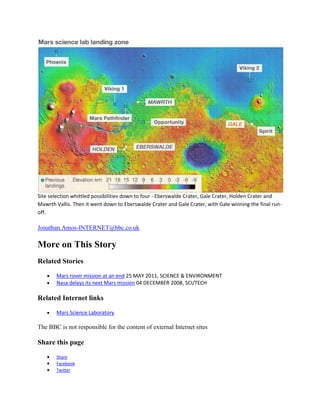
Now, we await Curiosity - a 900kg behemoth due for launch this Saturday. Its biggest instrument
alone is nearly four times the mass of that teeny robot back in '97.

"It's the size of a Mini Cooper with the wheelbase of a Humvee," is how project scientist John
Grotzinger describes the rover.

So, we're expecting great things from Curiosity. A big machine to address some big questions.

A roving laboratory for Mars


       General equipment: MSL equipped with tools to remove dust from rock surfaces, drill into
       rocks, and to scoop up, sort and sieve samples
       Mast Camera: will image rover's surroundings in high-res stereo and colour; wide angle and
       telephoto; can make high-def video movies
       ChemCam: pulses infrared laser at rocks up to 7m away; carries a spectrometer to identify types
       of atoms excited in laser beam
       Sample Analysis at Mars: inside body; will analyse rock, soil and atmospheric samples; would
       make all-important organics identification
       Chemistry and Mineralogy: another interior instrument. Analyses powdered samples to
       quantify minerals present in rocks and soils
Mars Hand Lens Imager: mounted on arm toolkit; will take extreme close-ups of rocks, soil and
       any ice; details smaller than hair's width
       Alpha Particle X-ray Spectrometer: Canadian arm contribution; will determine the relative
       abundances of different elements in samples
       Radiation Assessment Detector: will characterize radiation environment at surface; key
       information for future human exploration
       Mars Descent Imager: operates during landing sequence; high-def movie will tell controllers
       exactly where rover touched down
       Rover Environmental Monitoring Station: Spanish weather station; measures pressure,
       temperature, humidity, winds, and UV levels
       Dynamic Albedo of Neutrons: looks for sub-surface hydrogen; could indicate water buried in
       form of ice or bound in minerals

Mike Meyer is the lead scientist on Nasa's Mars exploration effort: "MSL plays a central role in a
series of missions of looking at Mars and determining whether or not it has the potential for life.
It is capable of going to a region and exploring that region, and telling us whether or not it has
been, or may even still be today, a habitable place - something that could support microbial life."

Engineers have designed a new entry, descent and landing system they say can put the roving
laboratory down on a button.

OK, so this button is 20km wide but the accuracy being promised is an order or magnitude better
than previous technology, and it has allowed researchers essentially to go where their heart
desired.

They've chosen a near-equatorial depression called Gale Crater. It's one of the deepest holes on
Mars - deeper even than Valles Marineris, that great scar that tears across one quarter of the
planet.

Scientists believe Gale will be the geological equivalent of a sweet shop - so enticing and varied
are the delights it appears to offer.

"This crater is about 100 miles across and it has a central mound that's about three miles high,"
explains Grotzinger.

"The important thing is that the central mound is a series of layers that cut across the history of
Mars covering over a billion years. So, not only do we have high-resolution images showing we
have layers in this mound, but also because of the spectrometers we have in orbit flying around
Mars, we can see minerals that have obviously interacted with water."

The intention is to put MSL-Curiosity down on the flat plain of the crater bottom. The vehicle
will then drive up to the base of the peak.

In front of it, the rover should find abundant quantities of clay minerals (phyllosilicates) that will
give a fresh insight into the very wet, early epoch of the Red Planet. Clays only form when rock
spends a lot of time in contact with water.
Above the clays, a little further up the mountain, the rover should find sulphate salts, which
relate to a time when Mars was still wet but beginning to dry out. Go higher still, and MSL will
find mostly the "duststones" from the cold, desiccated world that Mars has now become.

But even before all this, MSL will land on what looks from orbit to be alluvial fan - a spread of
sediment dumped by a stream of water flowing down the crater wall.

If the science on this fan proves productive, it could be many months before MSL gets to the
base of the mountain.

The rover has time, though. Equipped with a plutonium battery, it has the power to keep rolling
for more than 10 years - time enough to scout the crater floor and climb to the summit of the
mountain.


"We are not a life detection mission," stresses Grotzinger.
"I know that many of you would like to know when we're going to get on with doing that. But
the first and important step towards that is to try to understand where the good stuff may be. And
in this case a habitable environment needs to be described.

"This is an environment that contains a source of water, which is essential for all life as we
understand it on Earth; we need a source of energy, which is important for organisms to do
metabolism; and we also need a source of carbon, which is essential to build the molecular
structures that an organism is composed of."

You may be wondering why these sorts of missions don't look directly for life, and the reason is
pretty straightforward. Those types of observations are actually quite difficult to make, and the
truth is we don't really expect to find microbial communities thriving at the surface of present-
day Mars. The conditions are simply too harsh.


                                                  Little one: the Sojourner rover now looks like a toy
compared to MSL

But go back further in time, and the situation may have been very different. It seems pretty clear
now that when life was getting going on Earth more than three billion years ago, conditions on
Mars were also warm and wet.

But the traces of those ancient lifeforms on our own planet are now very hard to read, and often
require instruments that would fill a room. Not even a machine the scale of Curiosity could carry
them.

So, MSL will restrict itself to the habitability question, and it will do this using a combination of
10 instruments.

The rover has instruments on a mast that can survey the surroundings and assess potential
sampling targets from a distance. These include cameras and an infrared laser system that can
excite the surface of a rock to betray some of its chemistry.

It's also got instruments on the end of a 2.1m-long arm for close-up inspections. These include a
drill that can pull samples from up to 5cm inside a rock.

And MSL has two big lab kits inside its body to do detailed analysis of all the samples it takes
from rocks, soils and even the atmosphere.
One eureka moment for this mission would be if it could definitively identify a range of complex
organic (carbon-rich) molecules, such as amino acids.

Previous missions, notably the Viking landers in the 1970s, have hinted at the presence of
organics. It would be good if Curiosity could bury all doubts. But it will be tough.

Even in Earth rocks where we know sediments have been laid down in proximity to biology, we
still frequently find no organic traces. The evidence doesn't preserve well.

So, getting a positive result on Mars would be a triumph for the MSL team. Although, I guess
one should make it clear - just finding complex organics does not indicate the presence of life
because we know these carbon molecules can have non-biological origins, in meteorites, for
example.

Nonetheless, it would help to build a case that at least the necessary preconditions have existed
for life on the Red Planet at some point.

We can then think about how we might go about testing for life itself, although I think the only
real solution will be to return rocks for analysis in those room-sized instruments here on Earth.

Your comments (101)


                       Article written by Jonathan Amos Jonathan Amos Science correspondent

       More from Jonathan
       Follow Jonathan on Twitter


@BBCAmos via Twitter
A Mars engineer's three favourite words: "Tango Delta Nominal" http://t.co/ycouEBg6

More on This Story
More from Jonathan

       Space - the new rock and roll
       Gale Crater: Geological 'sweet shop' awaits Mars rover
       Mars success depends on 'crazy' landing
       Ahoy! Your ship is being tracked from orbit
       Satellites have an electric future
       Virgin to launch small satellites
Move to open sky for spaceplanes
       China in space: Running fast to catch up
       Super-chilled robot ready to slice and dice

Comments

This entry is now closed for comments

Jump to comments pagination

       All Comments (101)


           o   Order by:
           o   Latest First
           o   Highest Rated
           o   Lowest Rated


       0

       Comment number 101.

       Shift That Paradigm
       26th November 2011 - 20:16

       I'm very relieved that the launch went well.

       Between now and next August when Curiosity lands it's probably a good idea to fix our
       money system otherwise a gaping black hole awaits us and all our endeavours might all
       be for nothing.

       Usury/interest must go and we need a resource-based economy and not a money-based
       one.

       We really do need a paradigm shift and soon. We can do it.


       0
Comment number 100.

Jones_the_Steve
26th November 2011 - 18:34

Robert Lucien and Powermeerkat,

I wasn't belittling the Russians. My point was that many people complain about the cost
of space science but don't realise the benefits that having a huge scientific and industrial
base working on extremely difficult tasks brings. It isn't just Teflon and velcro. Glad the
launch went well.


+1

Comment number 99.

Robert Lucien
26th November 2011 - 17:51

#94 powermeerkat
, 56.Jones_the_Steve, Shift That Paradigm.

Curiosity just lifted off on an Atlas 5 and the Atlas 5 is powered by Russian technology,
specifically Buran technology, specifically the RD-180 rocket. A good thing since its
about the most powerful and reliable rocket in current use (both Atlas and the RD-180). -
http://en.wikipedia.org/wiki/RD-180


-3

Comment number 98.

BobBall
26th November 2011 - 13:12
21. Tom Ray
       24TH NOVEMBER 2011 - 19:44
       Where can I get one of the batteries that will drive the Curiosity lander artound for 10
       years?

       Personally, it will be fingers crossed that the rocket launch goes well. Otherwise the USA
       may suffer serious radiation contamination from the plutonium batteries on Curiosity.


       0

       Comment number 97.

       Whizz1967
       26th November 2011 - 10:58

       Knights of Cydonia,now that is art


Comments 5 of 101

       Show more

Sign in with your BBC iD, or Register to comment and rate comments

All posts are reactively-moderated and must obey the house rules.

Share this page
207


       Share
       Facebook
       Twitter

       Email
       Print


Top Stories
Greece 'needs more time' for cuts
    Chemical weapons 'excuse for US'
    Four Paralympic flames kindled
    Dozens killed in Kenya clashes
    Life term for Terreblanche murder


Features & Analysis


                      Granny's sandwiches

    Why Italians are returning to traditional food


                      Small world

    How long before you can be the ancestor of everyone?


                      Fear of turmoil

    What the death of Meles Zenawi means for Africa


                      Exit strategy

    Why Chinese millionaires are buying foreign residency
Most Popular
Shared

  1.    1: Right-to-die man Nicklinson dead
  2.    2: Life lessons from the mosh pit
  3.    3: Tracing the world's common ancestor
  4.    4: Teen invents cancer test using web
  5.    5: Beach rubbish reaches 23 tonnes

Read

  1.    1: Right-to-die man Nicklinson dead
  2.    2: Chemical weapons 'excuse for US'
  3.    3: Wood's death certificate changed
  4.    4: Sitting straight 'bad for backs'
  5.    5: Ethiopia's Meles lies in state
  6.    6: Greece 'needs more time' for cuts
  7.    7: Italians feast on traditional 'granny' food
  8.    8: EU hails Russia's entry into WTO
  9.    9: Dozens killed in Kenyan clashes
  10.   10: Viewpoint: Ethiopian PM Meles Zenawi's death could create regional turmoil

Video/Audio

  1.    1: Athens battles for tourists Watch
  2.    2: Teen invents cancer test using web Watch
  3.    3: China's rich seek overseas residency Watch
  4.    4: Meles Zenawi's body returns to Ethiopia Watch
  5.    5: Japanese journalist killed in Syria Watch
  6.    6: Prince Harry 'an easy target' for press Watch
  7.    7: Nyad: Jellyfish sting 'like fire' Watch
  8.    8: Mikias in Addis Ababa: 'You see changes' Watch
  9.    9: Why Angelique Kidjo criticised Mugabe Watch
  10.   10: One-minute World News Watch


BBC Future
How many alien worlds exist?
Play with our interactive graphic to find out... Read more...


Programmes


                                                                Fast Track Watch

         Annoyed at Greece’s overseas reputation - how young Greeks are attempting to repair the
         damage

Ads by Google

         What Happens When You Die

         New theory says death isn't the end

         RobertLanzaBiocentrism.com

         Rokit - Water Rocket

         The World famous pop-bottle rocket for education and great fun.Buy now

         www.rokit.com

         Zircon
for Opacifiers, Refractories, Flour India's only Private Manufacturer

       www.vvmineral.com

Services
       Mobile
       Connected TV
       News feeds
       Alerts
       E-mail news


About BBC News
       Editors' blog
       BBC College of Journalism
       News sources
       Media Action


BBC links

          o   Mobile site
          o   Terms of Use
          o   About the BBC

          o   Advertise With Us
          o   Privacy
          o   BBC Help

          o   Ad Choices
          o   Cookies
          o   Accessibility Help

          o   Parental Guidance
          o   Contact Us


BBC © 2012 The BBC is not responsible for the content of external sites. Read more.
Accessibility links
       Skip to content
       Skip to local navigation
       Accessibility Help


bbc.co.uk navigation
       News
       Sport
       Weather
       Travel
       Future
       TV
       Radio
       More…


Search term:


                                         Science & Environment
       Home
       UK
       Africa
       Asia
       Europe
       Latin America
       Mid-East
       US & Canada
       Business
       Health
       Sci/Environment
       Tech
       Entertainment
       Video

22 July 2011 Last updated at 15:05 GMT

Share this page

       Email
       Print

       Share
Facebook
       Twitter


Mars rover aims for deep crater
By Jonathan Amos Science correspondent, BBC News


                                                Nasa has confidence MSL-Curiosity's landing system
can put the rover down in a safe spot

Continue reading the main story


Related Stories
       Mars rover mission at an end
       Nasa delays its next Mars mission

Nasa's next Mars rover will be aimed at one of the planet's deepest craters.

MSL-Curiosity weighs almost a tonne and is the size of a Mini Cooper.

It will carry instruments to study whether Mars had the conditions in the past to support
microbial life.

The US space agency has selected an equatorial depression called Gale Crater to investigate that
question.

The $2.5bn rover will launch from Florida in November.
It should touch-down at the Red Planet in August 2012.

Gale Crater is about 155km in diameter, and its lowest point is about 4.6km below datum, the
reference point on Mars from which all other elevations are measured.

The landing zone will be much narrower than the crater's width. But Nasa has high confidence
the rocket-powered descent system designed for MSL-Curiosity can put it inside a target zone
less than 20km across.

If this Skycrane, as it is known, works as planned, the rover will be delivered close to the central
peak of the crater.

This is a huge mountain that contains layers of deposits that should offer an impressive view of
millions of years of Martian geological history.

Continue reading the main story


“Start Quote
It's also going to be just an incredibly beautiful place... where you have steep-sided cliffs with
the rover going in the shallower valleys between them”

Dawn Sumner Co-chair, MSL landing site working group

"What we've learnt over 150 years of exploration is that if you start at the bottom of the pile of
layers and you go to the top, it's like reading a novel," said mission project scientist John
Grotzinger from Nasa's Jet Propulsion Laboratory.

"We think Gale Crater is going to be a great novel about the early environmental evolution of
Mars that offers strong prospects potentially for the discovery of habitable environments, and
maybe even a shot at discovering organic compounds."

Dr Grotzinger stressed that MSL-Curiosity is not a life-detection mission; it cannot identify
microbes or even microbial fossils. But it can assess whether ancient conditions could have
supported organisms.

This means Gale must show evidence for the past presence of water, a source of energy with
which life forms could have metabolised, and a source of organic compounds with which
organisms could have built their structures.

Gale has been chosen because satellite imagery suggests it may well be one of the best places on
Mars to look for these biological preconditions.
The Skycrane will lower MSL-Curiosity on to the relatively flat valley floor on the end of tethers
before blasting away to a safe distance. The robot will then drive up to the base of the central
mountain.

In front of it, the rover should should find abundant quantities of clay minerals that will give
fresh insight into the very wet early epoch of the Red Planet. Above the clays, the deposits
change to sulphates, which relate to a period in time when Mars was still wet but was beginning
to dry out.

In addition, there is evidence water flowed down the mountain at some point in the past, cutting
a deep gully and depositing sediments out on the plain.

The rover will get to investigate all of this.

"The suite of things that we can see at Gale represents a diverse number of environments over a
long period of time, possibly tens to hundreds of millions of years, plus the modern
environment," said Dawn Sumner, a geologist at the University of California Davis, US.
"It's also going to be just an incredibly beautiful place - it will be a lot like the southwest of the
US, areas like Monument Valley where you have steep-sided cliffs with the rover going in the
shallower valleys between them," the co-chair of the landing site working group explained.

Drop-down mock-up

Gale was selected after a rigorous investigation of some 60 competing sites. The selection
process took five years and involved about 150 researchers.

High-resolution imagery was acquired of the best sites, and Nasa even built models of some of
the site surfaces and dropped a simulation rover on to them to assess their suitability.

Michael Watkins, the mission's project engineer, said the expected precision of the new entry,
descent and landing system meant that the space agency could have chosen any of the top
contenders.

"We can control the lift of the vehicle a little bit during entry and we can cancel out some
unexpected differences in atmospheric drag that would cause the landing zone to be large," he
told reporters.

"Previous missions have had landing zones that have been up to 10 times larger than MSL. MSL
is going to land in a 20km-across spot."

MSL-Curiosity has been funded for an initial surface mission of two years. But the fact that
Nasa's Opportunity rover continues to roll across the Red Planet today, seven years after landing,
suggests the new vehicle may have a very long life ahead of it. What is more, the new vehicle
carries a nuclear battery that will provide ample power on a planet where dust storms can blight
the operation of solar panels.

MSL-Curiosity is currently being prepared for its November launch at Nasa's Kennedy Space
Center.
Site selection whittled possibilities down to four - Eberswalde Crater, Gale Crater, Holden Crater and
Mawrth Vallis. Then it went down to Eberswalde Crater and Gale Crater, with Gale winning the final run-
off.

Jonathan.Amos-INTERNET@bbc.co.uk

More on This Story
Related Stories

       Mars rover mission at an end 25 MAY 2011, SCIENCE & ENVIRONMENT
       Nasa delays its next Mars mission 04 DECEMBER 2008, SCI/TECH

Related Internet links

       Mars Science Laboratory

The BBC is not responsible for the content of external Internet sites

Share this page
       Share
       Facebook
       Twitter
Email
      Print


More Science & Environment stories
RSS


                              Shrimp shells aid uranium harvest

      Researchers outline state-of-the-art proposals to extract uranium - the raw fuel of nuclear
      power - from seawater, including ideas using shrimp and crabs.

      Mars rover's wind sensor damaged
      Bugs sunbathe to 'stay healthy'

Top Stories


                               Greece 'needs more time' for cuts
      Chemical weapons 'excuse for US'
      Four Paralympic flames kindled
      Dozens killed in Kenya clashes
      Life term for Terreblanche murder


Features & Analysis


                        Granny's sandwiches

      Why Italians are returning to traditional food


                        Small world
How long before you can be the ancestor of everyone?


                          Fear of turmoil

        What the death of Meles Zenawi means for Africa


                          Exit strategy

        Why Chinese millionaires are buying foreign residency


Most Popular
Shared

  1.    1: Right-to-die man Nicklinson dead
  2.    2: Life lessons from the mosh pit
  3.    3: Tracing the world's common ancestor
  4.    4: Teen invents cancer test using web
  5.    5: Beach rubbish reaches 23 tonnes

Read

  1.    1: Right-to-die man Nicklinson dead
  2.    2: Chemical weapons 'excuse for US'
  3.    3: Wood's death certificate changed
  4.    4: Sitting straight 'bad for backs'
  5.    5: Ethiopia's Meles lies in state
  6.    6: Greece 'needs more time' for cuts
  7.    7: Italians feast on traditional 'granny' food
  8.    8: EU hails Russia's entry into WTO
  9.    9: Dozens killed in Kenyan clashes
  10.   10: Viewpoint: Ethiopian PM Meles Zenawi's death could create regional turmoil

Video/Audio
1.    1: Athens battles for tourists Watch
  2.    2: Teen invents cancer test using web Watch
  3.    3: China's rich seek overseas residency Watch
  4.    4: Meles Zenawi's body returns to Ethiopia Watch
  5.    5: Japanese journalist killed in Syria Watch
  6.    6: Prince Harry 'an easy target' for press Watch
  7.    7: Nyad: Jellyfish sting 'like fire' Watch
  8.    8: Mikias in Addis Ababa: 'You see changes' Watch
  9.    9: Why Angelique Kidjo criticised Mugabe Watch
  10.   10: One-minute World News Watch


Elsewhere on BBC News


                                                            Pensioner pain

        Greece's elderly come under pressure from the country's cuts

Programmes


                                                            Fast Track Watch

        Annoyed at Greece’s overseas reputation - how young Greeks are attempting to repair the
        damage

Ads by Google

        Open a Forex Demo Account
Trade virtual Forex money and join the competition to win $3000!

    www.windsorbrokers.com

    What Happens When You Die

    New theory says death isn't the end

    RobertLanzaBiocentrism.com

    Twice The Ice

    Bulk & Bagged Ice Vending Manufactured by Ice House America

    www.icehouseamerica.com

Services
    Mobile
    Connected TV
    News feeds
    Alerts
    E-mail news


About BBC News
    Editors' blog
    BBC College of Journalism
    News sources
    Media Action


BBC links

       o   Mobile site
       o   Terms of Use
       o   About the BBC

       o   Advertise With Us
       o   Privacy
       o   BBC Help

       o   Ad Choices
       o   Cookies
       o   Accessibility Help
o   Parental Guidance
          o   Contact Us


BBC © 2012 The BBC is not responsible for the content of external sites. Read more.

Mars missions

  • 1.
    4 August 2012Last updated at 22:13 GMT Share this page Email Print 2.2K Share Facebook Twitter Nasa's Curiosity rover edges closer to Mars By Jonathan Amos Science correspondent, BBC News, Pasadena Communications from the rover during descent will come to the Jet Propulsion Laboratory Continue reading the main story Related Stories Gale Crater: Geological 'sweet shop' Mars success depends on 'crazy' landing Rover on course for Mars landing Nasa's Curiosity rover is on course to land on Mars on Monday, where it will search for clues in the Red Planet's rocks and soil about whether it could once have supported life. The robot's flight trajectory is so good engineers cancelled the latest course correction they had planned. To land in the right place, it must hit a box at the top of the atmosphere that measures just 3km by 12km.
  • 2.
    Curiosity has spenteight months travelling from Earth to Mars. The robot - -also known as the Mars Science Laboratory - has covered more than 560 million km. "Our inbound trajectory is right down the pipe," said Arthur Amador, Curiosity's mission manager. "The team is confident and thrilled to finally be arriving at Mars, and we're reminding ourselves to breathe every so often. We're ready to go." The rover's power and communications systems are in excellent shape. The one major task left for the mission team is to prime the back-up computer that will take command if the main unit fails during the entry, descent and landing (EDL) manoeuvres. Continue reading the main story Curiosity - Mars Science Laboratory Mission goal is to determine whether Mars has ever had the conditions to support life Project costed at $2.5bn; will see initial surface operations lasting two Earth years Onboard plutonium generators will deliver heat and electricity for at least 14 years 75kg science payload more than 10 times as massive as those of earlier US Mars rovers Equipped with tools to brush and drill into rocks, to scoop up, sort and sieve samples Variety of analytical techniques to discern chemistry in rocks, soil and atmosphere Will try to make first definitive identification of organic (carbon-rich) compounds Even carries a laser to zap rocks; beam will identify atomic elements in rocks Gale Crater: Geological 'sweet shop' Discover more about the planets
  • 3.
    The robot wasapproaching Mars at about 13,000km/h on Saturday. By the time the spacecraft hits the top of Mars' atmosphere, about seven minutes before touch-down, gravity will have accelerated it to about 21,000km/h. The vehicle is being aimed at Gale Crater, a deep depression just south of the planet's equator. It is equipped with the most sophisticated science payload ever sent to another world. Its mission, when it gets on the ground, is to characterise the geology in Gale and examine its rocks for signs that ancient environments on Mars could have supported microbial life. Touch-down is expected at 05:31 GMT (06:31 BST) Monday 6 August; 22:31 PDT, Sunday 5 August. It is a fully automated procedure. Nasa will be following the descent here at mission control at the Jet Propulsion Laboratory in Pasadena, California. The rover will broadcast X-band and UHF signals on its way down to the surface. These will be picked up by a mix of satellites at Mars and radio antennas on Earth. The key communication route will be through the Odyssey orbiter. It alone will see the rover all the way to the ground and have the ability to relay UHF telemetry straight to Earth. And mission team members remain hopeful that this data will also include some images that Curiosity plans to take of itself just minutes after touching the ground. These would be low-resolution, wide-angle, black and white images of the rear wheels. They may not be great to look at, but the pictures will give engineers important information about the exact nature of the terrain under the rover. A lot has been made of the difficulty of getting to Mars, and historically there have been far more failures than successes (24 versus 15), but the Americans' recent record at the Red Planet is actually very good - six successful landings versus two failures. Even so, Nasa continues to downplay expectations. "If we're not successful, we're going to learn," said Doug McCuistion, the head of the US space agency's Mars programme. "We've learned in the past, we've recovered from it. We'll pick ourselves up, we'll dust ourselves off, we'll do something again; this will not be the end. "The human spirit gets driven by these kinds of challenges, and these are challenges that drive us to explore our surroundings and understand what's out there."
  • 4.
    Curiosity is headingfor Gale Crater The mission team warned reporters on Saturday not to jump to conclusions if there was no immediate confirmation of landing through Odyssey. There were "credible reasons", engineers said, why the UHF signal to Odyssey could be lost during the descent, such as a failure on the satellite or a failure of the transmitter on the rover. Continued efforts would be made to contact Curiosity in subsequent hours as satellites passed overhead and when Gale Crater came into view of radio antennas on Earth. "There are situations that might come up where we will not get communications all the way through [to the surface], and it doesn't necessarily mean that something bad has happened; it just means we'll have to wait and hear from the vehicle later," explained Richard Cook, the deputy project manager. This was emphasised by Allen Chen, the EDL operations lead. His is the voice from mission control that will be broadcast to the world during the descent. He will call out specific milestones on the way down. He told BBC News there would be no rush to judgement if the Odyssey link was interrupted or contained information that was "off nominal". "I think we proceed under any situation as though the spacecraft is there, and there for us to recover - to find out what happened," he said. "That's the most sensible thing to do. There are only a few instances I think where you could know pretty quickly that we'd be in trouble." Step by step: How the Curiosity rover will land on Mars Continue reading the main story
  • 5.
    As the rover,tucked inside its protective capsule, heads to Mars, it dumps the disc-shaped cruise stage that has shepherded it from Earth. 5 August 2012 Last updated at 21:42 GMT Share this page Email Print 3.1K Share Facebook Twitter Nasa's Curiosity Mars rover set for high risk landing Comments (143) By Jonathan Amos Science correspondent, BBC News, Pasadena
  • 6.
    Nasa news conferenceafter the Curiosity rover lands on Mars Continue reading the main story Related Stories Rover edges closer to Red Planet Gale Crater: Geological 'sweet shop' awaits Mars rover Mars success depends on 'crazy' landing One of the most daring space missions ever undertaken is nearing Mars. Nasa will attempt to land its one-tonne Curiosity rover on the Red Planet to study the possibility that this world may once have hosted microbial life. The vehicle is packed with scientific instruments, including a laser that can zap rocks to determine their make-up. Curiosity is currently hurtling through space, close to the end of a 570 million km journey from Earth. Engineers describe its trajectory as near-perfect and they have passed up the last two opportunities to make course corrections. The rover, tucked inside a protective shell, is due to begin its descent to the surface at 05:24 GMT, Monday (06:24 BST; 22:24 PDT, Sun). A signal confirming it has landed inside a deep depression known as Gale Crater is expected on Earth about seven minutes later, at 05:31 GMT. But getting this audacious exploration project safely down will be a colossal challenge.
  • 7.
    Two-thirds of allmissions sent to the Red Planet have failed, a good many lost on entry into the thin but unforgiving Martian atmosphere. Continue reading the main story Curiosity - Mars Science Laboratory Mission goal is to determine whether Mars has ever had the conditions to support life Project costed at $2.5bn; will see initial surface operations lasting two Earth years Onboard plutonium generators will deliver heat and electricity for at least 14 years 75kg science payload more than 10 times as massive as those of earlier US Mars rovers Equipped with tools to brush and drill into rocks, to scoop up, sort and sieve samples Variety of analytical techniques to discern chemistry in rocks, soil and atmosphere Will try to make first definitive identification of organic (carbon rich) compounds Even carries a laser to zap rocks; beam will identify atomic elements in rocks Discover more about the planets And yet, the US space agency has high confidence that the high-risk descent strategy its engineers have devised will deliver an intact vehicle to the surface. This strategy will use a sequence of fully automated manoeuvres to slow the fall from an initial 20,000km/h at the top of the atmosphere to less than 1m/s at the moment of touch-down. The last stage in the sequence will see a hovering, rocket-powered crane lower the rover to the ground on nylon cords. The manoeuvres have raised eyebrows because of their complexity, but the entry, descent and landing (EDL) team leader, Adam Steltzner, has emphasised the amount of "reasoned engineering" that has informed the design. "I slept better last night than I have in years, and I think that's because it's done - whatever's going to happen is going to happen," he said.
  • 8.
    Nasa will bemonitoring the drama from the Jet Propulsion Laboratory (JPL) in Pasadena, California. It is here that mission control will receive the telemetry from Curiosity that has been bounced to Earth by the overflying satellite known as Odyssey. Engineers can only watch and wait, however. The 250 million km between Mars and Earth right now means there is a 13-minute lag in communications. The mission team knows that when it gets that first signal to say the rover has entered the planet's atmosphere, the vehicle will in reality have already landed or been destroyed some seven minutes previously. Step by step: How the Curiosity rover will land on Mars Continue reading the main story As the rover, tucked inside its protective capsule, heads to Mars, it dumps the disc-shaped cruise stage that has shepherded it from Earth. Continue reading the main story 1/8 "It will be really exciting; it always is. It's electrifying but it's tense," Doug McCuistion, the director of Nasa's Mars programme, told BBC News. "Everybody white-knuckles through these 'seven minutes of terror', and it's named that for a good reason." This is the fourth rover Nasa has attempted to put on the surface of Mars since 1997.
  • 9.
    But Curiosity -also known as the Mars Science laboratory (MSL) - dwarfs those previous efforts in size and sophistication. The rover will sample rocks for signs that Mars was once favourable to life Assuming the robot lands safely, it will spend 98 (Earth) weeks scouring Martian soils and rocks for any signs that current or past environments on the planet could have supported microbial life. Gale Crater was chosen as the landing site because satellite pictures had spied sediments in the depression that looked as though they were laid down in the presence of abundant water. "We see a lot of evidence that water was on Mars in the distant past and flowed across the surface for maybe millions of years," explained Ashwin Vasavada, the MSL-Curiosity deputy project scientist. "This mission goes one step further by trying to understand whether the environments in which the water persisted were habitable. Were there basic ingredients for life there? We're going to understand what the conditions were like when life was most likely in Mars' ancient history." The rover is equipped with 10 advanced instruments. It also has a plutonium battery and so should have ample power to keep rolling for more than a decade.
  • 10.
    Engineers define anellipse in which they can confidently land Successive landings have become ever more accurate Viking's ellipse was 300km across - wider than Gale Crater itself Phoenix (100km by 20km) could not confidently fit in Gale Curiosity's landing system allows it to target the crater floor The rover's projected landing ellipse is just 7km by 20km
  • 11.
    (A) Curiosity willtrundle around its landing site looking for interesting rock features to study. Its top speed is about 4cm/s (B) This mission has 17 cameras. They will identify particular targets, and a laser will zap those rocks to probe their chemistry (C) If the signal is significant, Curiosity will swing over instruments on its arm for close-up investigation. These include a microscope (D) Samples drilled from rock, or scooped from the soil, can be delivered to two hi-tech analysis labs inside the rover body (E) The results are sent to Earth through antennas on the rover deck. Return commands tell the rover where it should drive next Jonathan.Amos-INTERNET@bbc.co.uk and follow me on Twitter Your comments (143) More on This Story
  • 12.
    Related Stories Rover edges closer to Red Planet 04 AUGUST 2012, SCIENCE & ENVIRONMENT Gale Crater: Geological 'sweet shop' awaits Mars rover 03 AUGUST 2012, SCIENCE & ENVIRONMENT Mars success depends on 'crazy' landing 29 JULY 2012, SCIENCE & ENVIRONMENT Mars rover narrows landing zone 12 JUNE 2012, SCIENCE & ENVIRONMENT Mars 'has life's building blocks' 25 MAY 2012, SCIENCE & ENVIRONMENT Giant Nasa rover launches to Mars 26 NOVEMBER 2011, SCIENCE & ENVIRONMENT MSL-Curiosity: Biggest Mars mission yet 24 NOVEMBER 2011, SCIENCE & ENVIRONMENT Mars rover aims for deep crater 22 JULY 2011, SCIENCE & ENVIRONMENT Related Internet links Curiosity - Mars Science Laboratory The BBC is not responsible for the content of external Internet sites Comments This entry is now closed for comments Jump to comments pagination
  • 13.
    Editors' Picks All Comments(143) +5 Comment number 96. Brian Kemp 6th August 2012 - 7:01 This is absolutely fantastic! Good luck to the mission and one day it'd be great to see Men and Women on Mars after science such as this. -59 Comment number 47. jesus bermudez 6th August 2012 - 5:56 What an absolute waste of money and time. There is no life anywhere else. God created the universe and earth is the only planet which has life. It was created for our convenience. This money should have been spent on helping children in need. -10
  • 14.
    Comment number 45. rioesk 6thAugust 2012 - 5:54 Absolutely beyond awesome. No one can doubt the dominance of the United States when it comes to unique thought and implementation. The rest of us have a mountain to climb to compare with this. +20 Comment number 16. Harrygh 6th August 2012 - 0:44 I am so glad this could be tried in my lifetime. Good luck NASA and Rover. +12 Comment number 8. MacFanatic 6th August 2012 - 0:19 Just finished watching the documentary on iPlayer and must say its well exciting. Some people think that the landing is crazy but hey were human at the end of the day. We do crazy very well! Good Luck Curiousity!
  • 15.
    Comments 5 of6 Show more Sign in with your BBC iD, or Register to comment and rate comments All posts are reactively-moderated and must obey the house rules. Share this page 3.1K Share Facebook Twitter Email Print More Science & Environment stories RSS Shrimp shells aid uranium harvest Researchers outline state-of-the-art proposals to extract uranium - the raw fuel of nuclear power - from seawater, including ideas using shrimp and crabs. Mars rover's wind sensor damaged Bugs sunbathe to 'stay healthy' Top Stories Greece 'needs more time' for cuts Chemical weapons 'excuse for US' New Four Paralympic flames kindled Dozens killed in Kenyan clashes Life term for Terreblanche murder
  • 16.
    Features & Analysis Granny's sandwiches Why Italians are returning to traditional food Small world How long before you can be the ancestor of everyone? Fear of turmoil What the death of Meles Zenawi means for Africa Exit strategy Why Chinese millionaires are buying foreign residency Most Popular Shared 1. 1: Right-to-die man Nicklinson dead 2. 2: Life lessons from the mosh pit 3. 3: Tracing the world's common ancestor 4. 4: Teen invents cancer test using web
  • 17.
    5. 5: Beachrubbish reaches 23 tonnes Read 1. 1: Right-to-die man Nicklinson dead 2. 2: Chemical weapons 'excuse for US' 3. 3: Sitting straight 'bad for backs' 4. 4: Wood's death certificate changed 5. 5: Greece 'needs more time' for cuts 6. 6: Nikon's Android-powered camera 7. 7: Tracing the world's common ancestor 8. 8: Dozens killed in Kenyan clashes 9. 9: Italians feast on traditional 'granny' food 10. 10: EU hails Russia's entry into WTO Video/Audio 1. 1: Athens battles for tourists Watch 2. 2: Teen invents cancer test using web Watch 3. 3: China's rich seek overseas residency Watch 4. 4: Meles Zenawi's body returns to Ethiopia Watch 5. 5: Nyad: Jellyfish sting 'like fire' Watch 6. 6: One-minute World News Watch 7. 7: Prince Harry 'an easy target' for press Watch 8. 8: 'Gates of Paradise' restored in Florence Watch 9. 9: Meles Zenawi archive interview Watch 10. 10: Missouri residents on Akins row Watch BBC Future How many alien worlds exist? Play with our interactive graphic to find out... Read more... Programmes
  • 18.
    Fast Track Watch Annoyed at Greece’s overseas reputation - how young Greeks are attempting to repair the damage Ads by Google What Happens When You Die New theory says death isn't the end RobertLanzaBiocentrism.com Rokit - Water Rocket The World famous pop-bottle rocket for education and great fun.Buy now www.rokit.com Affordable Probe Station DC thru Microwave Probe Measurement Materials and Semiconductor www.jmicrotechnology.com 3 August 2012 Last updated at 23:41 GMT Share this page Email Print 540
  • 19.
    Share Facebook Twitter Article written by Jonathan Amos Science correspondent More from Jonathan Follow Jonathan on Twitter Gale Crater: Geological 'sweet shop' awaits Mars rover Comments (238) Grotzinger leads a team of several hundred mission scientists More from Jonathan Space - the new rock and roll Mars success depends on 'crazy' landing Ahoy! Your ship is being tracked from orbit Satellites have an electric future John Grotzinger is the project scientist on Nasa's latest multi-billion-dollar mission to Mars.
  • 20.
    He's going tobecome a familiar face in the coming months as he explains to TV audiences the importance of the discoveries that are made by the most sophisticated spacecraft ever sent to touch the surface of another world. The Curiosity Rover - also called the Mars Science Laboratory (MSL) - is set to land on Monday (GMT) for a minimum two-year exploration of a deep hole on Mars' equator known as Gale Crater. The depression was punched out by an asteroid or comet billions of years ago. The lure for Grotzinger and his fellow scientists is the huge mound of rock rising 5km from the crater floor. Mount Sharp, as they refer to it, looks from satellite pictures to be constructed from ancient sediments - some deposited when Mars still had abundant water at its surface. From orbit, Mount Sharp looks like Australia. Gale is named after an Australian astronomer. That makes it an exciting place to consider the possibility that those distant times may also once have supported microbial life. And Curiosity, with its suite of 10 instruments, will test this habitability hypothesis. Grotzinger is a geologist affiliated to the California Institute of Technology and he recently took the BBC Horizon programme to the mountains of the nearby Mojave Desert to illustrate the work the rover will be doing on Mars. He climbed to a level and then pointed to the rock sediments on the far side of the valley.
  • 21.
    "What you seehere is a stack of layers that tell us about the early environmental history of Earth, representing hundreds of millions of years," he told Horizon. "They read like a book of Earth history and they tell us about different chapters in the evolution of early environments, and life. "And the cool thing about going to Mount Sharp and Gale Crater is that there we'll have a different book about the early environmental history of Mars. "It will tell us something equally interesting, and we just don't know what it is yet," he said. Curiosity dwarfs all previous landing missions undertaken by the Americans. At 900kg, it's a behemoth. It's nearly a hundred times more massive than the first robot rover Nasa sent to Mars in 1997. Curiosity will trundle around the foothills of Mount Sharp much like a human field geologist might walk through Mojave's valleys. Except the rover has more than a hammer in its rucksack. It has hi-res cameras to look for features of interest. If a particular boulder catches the eye, Curiosity can zap it with an infrared laser and examine the resulting surface spark to query the rock's elemental composition. If that signature intrigues, the rover will use its long arm to swing over a microscope and an X- ray spectrometer to take a closer look.
  • 22.
    Still interested? Curiositycan drill into the boulder and deliver a powdered sample to two high- spec analytical boxes inside the rover belly. These will lay bare the rock's precise make-up, and the conditions under which it formed. "We're not just scratching and sniffing and taking pictures - we're boring into rock, getting that powder and analysing it in these laboratories," deputy project scientist, Ashwin Vasavada, told the BBC. "These are really university laboratories that would normally fill up a room but which have been shrunk down - miniaturised - and made safe for the space environment, and then flown on this rover to Mars." The intention on Monday is to put MSL-Curiosity down on the flat plain of the crater bottom. The vehicle will then drive up to the base of Mount Sharp. In front of it, the rover should find clay minerals (phyllosilicates) that will give a fresh insight into the wet, early era of the Red Planet known as the Noachian. Clays only form when rock spends a lot of time in contact with water. Above the clays, a little further up the mountain, the rover should find sulphate salts, which relate to the Hesperian Era - a time when Mars was still wet but beginning to dry out. "Going to Gale will give us the opportunity to study a key transition in the climate of Mars - from the Noachian to the Hesperian," said Sanjeev Gupta, an Imperial College London scientist on the mission. "The rocks we believe preserve that with real fidelity, and the volume of data we get from Curiosity will be just extraordinary." A roving laboratory for Mars General equipment: MSL equipped with tools to remove dust from rock surfaces, drill into rocks, and to scoop up, sort and sieve samples
  • 23.
    Mast Camera: willimage rover's surroundings in hi-res stereo and colour; wide angle and telephoto; can make hi-def video movies ChemCam: pulses infrared laser at rocks up to 7m away; carries a spectrometer to identify types of atoms excited in laser beam Sample Analysis at Mars: inside body; will analyse rock, soil and atmospheric samples; would make all-important organics identification Chemistry and Mineralogy: another interior instrument. Analyses powdered samples to quantify minerals present in rocks and soils Mars Hand Lens Imager: mounted on arm toolkit; will take extreme close-ups of rocks, soil and any ice; details smaller than hair's width Alpha Particle X-ray Spectrometer: Canadian arm contribution; will determine relative abundances of different elements in samples Radiation Assessment Detector: will characterize radiation environment at surface; key information for future human exploration Mars Descent Imager: operates during landing sequence; hi-def movie will tell controllers exactly where rover touched down Rover Environmental Monitoring Station: Spanish weather station; measures pressure, temperature, humidity, winds, and UV levels Dynamic Albedo of Neutrons: looks for sub-surface hydrogen; could indicate water buried in form of ice or bound in minerals The rover is not a life-detection mission; it does not possess the capability to identify any bugs in the soil or huddled under rocks (not that anyone really expects to find microbes in the cold, dry, and irradiated conditions that persist at the surface of Mars today). But what Curiosity can do is characterise any organic (carbon-rich) chemistry that may be present. All life as we know it on Earth trades off a source of complex carbon molecules, such as amino acids - just as it needs water and energy. Previous missions, notably the Viking landers in the 1970s, have hinted at the presence of organics on Mars. But if Curiosity could make the definitive identification of organics in Gale Crater, it would be a eureka moment and go a long way towards demonstrating that the Red Planet did indeed have habitable environments in its ancient past. It's a big ask, though. Even in Earth rocks where we know sediments have been laid down in proximity to biology, we still frequently find no organic traces. The evidence doesn't preserve well. And, of course, there are plenty of non-biological processes that will produce organics, so it wouldn't be an "A equals B" situation even if Curiosity were to make the identification. Nonetheless, some members of the science team still dream of finding tantalising chemical markers in Gale's rocks.
  • 24.
    Dawn Sumner, fromthe University of California at Davis, is one of them. "Under very specific circumstances - if life made a lot of organic molecules and they are preserved and they haven't reacted with the rocks in Gale Crater, we may be able to tell that they were created by life. It's a remote possibility, but it's something I at least hope we can find," she said. "I am confident we will learn amazing new things. Some of them will be answers to questions we already have, but most of what we learn will be surprises to us. "We've only been on the ground on Mars in six places, and it's a huge planet. "Gale Crater and Mount Sharp are unlike anything we've been to before. That guarantees we will learn exciting new things from Curiosity." Horizon: Mission to Mars was broadcast on BBC Two Monday 30 July. Watch online via iPlayer (UK only) or browse more Horizon clips at the above link.
  • 25.
    Your comments (238) Article written by Jonathan Amos Jonathan Amos Science correspondent More from Jonathan Follow Jonathan on Twitter @BBCAmos via Twitter A Mars enginee3 August 2012 Last updated at 07:39 GMT Share this page
  • 26.
    Email Print 1.6K Share Facebook Twitter Nasa's Curiosity rover on course for Mars landing By Jonathan Amos Science correspondent, BBC News, Pasadena Adam Steltzner expects the new landing system to perform as designed Continue reading the main story Related Stories Mars success depends on 'crazy' landing Mars rover narrows landing zone
  • 27.
    Mars 'has life'sbuilding blocks' Nasa says the big robot rover it is sending to Mars looks in excellent shape for its Monday (GMT) landing. The vehicle, known as Curiosity, was launched from Earth in November last year and is now nearing the end of a 570-million-km journey across space. To reach its intended touch-down zone in a deep equatorial crater, the machine must enter the atmosphere at a very precise point on the sky. Engineers told reporters on Thursday that they were close to a bulls-eye. A slight course correction - the fourth since launch - was instigated last Saturday, and the latest analysis indicates Curiosity will be no more than a kilometre from going straight down its planned "keyhole". The team's confidence is such that it may pass up the opportunity to make a further correction on Friday. "We are about to land a small compact car on the surface with a trunk-load of instruments. This is a pretty amazing feat getting ready to happen. It's exciting, it's daring - but it's fantastic," said Doug McCuistion, the head of Nasa's Mars programme. Curiosity - also known as the Mars Science laboratory (MSL) - is the biggest, most sophisticated Mars rover yet. It will study the rocks inside Gale Crater, one of the deepest holes on Mars, for signs that the planet may once have supported microbial life. The $2.5bn mission is due to touch down at 05:31 GMT (06:31 BST) Monday 6 August; 22:31 PDT, Sunday 5 August. It will be a totally automated landing. Continue reading the main story Curiosity - Mars Science Laboratory
  • 28.
    Mission goal isto determine whether Mars has ever had the conditions to support life Project costed at $2.5bn; will see initial surface operations lasting two Earth years Onboard plutonium generators will deliver heat and electricity for at least 14 years 75kg science payload more than 10 times as massive as those of earlier US Mars rovers Equipped with tools to brush and drill into rocks, to scoop up, sort and sieve samples Variety of analytical techniques to discern chemistry in rocks, soil and atmosphere Will try to make first definitive identification of organic (carbon-rich) compounds Even carries a laser to zap rocks; beam will identify atomic elements in rocks MSL-Curiosity: Biggest Mars mission yet Discover more about the planets Engineers here at the Jet Propulsion Laboratory (JPL) in Pasadena, California, can only watch and wait. The vast distance between Mars and Earth means there is a 13-minute lag in communications, making real-time intervention impossible. Nasa has had to abandon the bouncing airbag approach to making soft landings. This technique was used to great effect on the three previous rovers - Sojourner, Spirit and Opportunity. But at nearly a tonne, Curiosity is simply too heavy to be supported by inflated cushions. Instead, the mission team has devised a rocket-powered, hovering crane to lower the rover to the surface in the final moments of its descent. Adam Steltzner has led this work for Nasa. He said: "It looks a little bit crazy. I promise you it is the least crazy of the methods you could use to land a rover the size of Curiosity on Mars, and we've become quite fond of it - and we're fairly confident that Sunday night will be a good night for us."
  • 29.
    The team isalso keeping a sharp eye on the Martian weather and any atmospheric conditions that might interfere with the descent manoeuvres. It is the equivalent of August also on Mars right now, meaning Gale Crater at its position just inside the southern hemisphere is coming out of winter and moving towards spring. It is the time of year when winds can kick up huge clouds of dust, and a big storm was spotted this week about 1,000km from the landing site. But Nasa expects this storm to dissipate long before landing day. Science editor David Shukman takes a look at a full-scale replica of Curiosity The first black-and-white images of the surface taken by Curiosity should be returned to Earth in the first hours after touch down, but the mission team do not intend to rush into exploration. For one thing, the rover has a plutonium battery that should give it far greater longevity than the solar-panelled power systems on previous vehicles. "This is a very complicated beast," said Pete Theisinger, Curiosity's project manager. "The speech I made to the team is to recognize that on Sunday night at [22:32 PDT], we will have a priceless asset that we have placed on the surface of another planet that could last a long time if we operate it correctly, and so we will be as cautious as hell about what we do with it." Step by step: How the Curiosity rover will land on Mars Continue reading the main story
  • 30.
    As the rover,tucked inside its protective capsule, heads to Mars, it dumps the disc-shaped cruise stage that has shepherded it from Earth. Continue reading the main story 1/8 Jonathan.Amos-INTERNET@bbc.co.uk and follow me on Twitter More on This Story Related Stories Mars success depends on 'crazy' landing 29 JULY 2012, SCIENCE & ENVIRONMENT Mars rover narrows landing zone 12 JUNE 2012, SCIENCE & ENVIRONMENT Mars 'has life's building blocks' 25 MAY 2012, SCIENCE & ENVIRONMENT Giant Nasa rover launches to Mars 26 NOVEMBER 2011, SCIENCE & ENVIRONMENT MSL-Curiosity: Biggest Mars mission yet 24 NOVEMBER 2011, SCIENCE & ENVIRONMENT
  • 31.
    Mars rover aimsfor deep crater 22 JULY 2011, SCIENCE & ENVIRONMENT Related Internet links Curiosity - Mars Science Laboratory The BBC is not responsible for the content of external Internet sites Share this page 1.6K Share Facebook Twitter Email Print More Science & Environment stories RSS Shrimp shells aid uranium harvest Researchers outline state-of-the-art proposals to extract uranium - the raw fuel of nuclear power - from seawater, including ideas using shrimp and crabs. Mars rover's wind sensor damaged Bugs sunbathe to 'stay healthy' r's three favourite words: "Tango Delta Nominal" http://t.co/ycouEBg6 August 2012 Last updated at 13:50 GMT Share this page
  • 32.
    Email Print Share Facebook Twitter Mars data to be analysed by Leicester scientist Project architect Adam Steltzner explains how the Mars Curiosity rover is expected to land on Mars (animation is courtesy of Nasa) Continue reading the main story Related Stories Mars success depends on 'crazy' landing Nasa may not hear rover' s landing Mars 'has life's building blocks' A University of Leicester scientist says it is going to be "very exciting" to analyse some of the first data from Nasa's latest Mars mission. The $2.5bn mission's Mars Curiosity rover is expected to land on Monday. Dr John Bridges said he would be leading a team from Leicester, the Open University and the French National Centre for Scientific Research.
  • 33.
    He said: "Neverbefore has such a powerful set of instruments and such a capable rover been sent." Geological history He added: "The overall aim of the mission is to determine if Mars has ever been habitable for microbial life. It's incredibly exciting. "For the first time we can look at a large amount of material which was deposited from water. "Were there large lakes which lasted for millions of years or just small amounts of water which lasted a short period of time? These are just some of the fundamental things we can learn about Mars. "The mobile Mars Science Laboratory (Curiosity) is expected to revolutionise our understanding of the geological history of the planet." The rover was launched in November and is scheduled to land on Monday morning beside a mountain within Gale Crater called Mt Sharp. Nasa described Curiosity rover as "car-sized" and weighing one ton (900kg). It is fitted with a robotic arm, high-resolution cameras and a laser, and is designed to be a walking laboratory. Martian meteorites Dr Bridges said he would be at the Jet Propulsion Laboratory in California to witness the landing and to start work on the research. The University of Leicester said Dr Bridges was one of two UK scientists who would conduct and analyse experiments during the two-year mission. Dr Bridges said: "For a number of years now I've studied Mars using orbiting spacecraft data, also from looking at Martian meteorites in detail. This is the next logical step. "It's the most powerful rover ever sent to Mars - with more instruments... It can go even further and perhaps even last longer." More on This Story Related Stories Mars success depends on 'crazy' landing
  • 34.
    29 JULY 2012,SCIENCE & ENVIRONMENT Nasa may not hear rover' s landing 16 JULY 2012, SCIENCE & ENVIRONMENT Mars 'has life's building blocks' 25 MAY 2012, SCIENCE & ENVIRONMENT Landing Batman would be Splatman 10 JULY 2012, LEICESTER University to get 'supercomputer' 07 JUNE 2012, LEICESTER Related Internet links Nasa University of Leicester John Bridges: Mars blog The BBC is not responsible for the content of external Internet sites Share this page Share Facebook Twitter Email Print BBC Leicester Fungus-hit ash trees destroyed Almost 500 ash trees recently planted in Leicestershire are being destroyed after becoming infected with a fungus disease.
  • 35.
    Raining tiny yellowplastic balls London tops heart survival table Travel News Latest road incidents, public transport information and live traffic jam cameras near you Weather Leicestershire Wednesday day weather Sunny Intervals Max: 20°C Min: 13°C Things To Do RUN BY THE BBC AND PARTNERS THU 23 AUG MCC Spirit of Cricket Girls… Leicestershire and Rutland… THU 23 AUG Medieval Kings, Queens… The Guildhall
  • 36.
    See Leicester Activities> Tow n, city, Find activities near you BBC Radio Leicester Live BBC Leicester Sport Top Stories Greece 'needs more time' for cuts Chemical weapons 'excuse for US' New Four Paralympic flames kindled Dozens killed in Kenyan clashes Life term for Terreblanche murder Features & Analysis Granny's sandwiches Why Italians are returning to traditional food Small world How long before you can be the ancestor of everyone? Fear of turmoil What the death of Meles Zenawi means for Africa
  • 37.
    Exit strategy Why Chinese millionaires are buying foreign residency Most Popular Shared 1. 1: Right-to-die man Nicklinson dead 2. 2: Life lessons from the mosh pit 3. 3: Tracing the world's common ancestor 4. 4: Teen invents cancer test using web 5. 5: Beach rubbish reaches 23 tonnes Read 1. 1: Right-to-die man Nicklinson dead 2. 2: Chemical weapons 'excuse for US' 3. 3: Sitting straight 'bad for backs' 4. 4: Wood's death certificate changed 5. 5: Greece 'needs more time' for cuts 6. 6: Nikon's Android-powered camera 7. 7: Tracing the world's common ancestor 8. 8: Dozens killed in Kenyan clashes 9. 9: Italians feast on traditional 'granny' food 10. 10: EU hails Russia's entry into WTO Video/Audio 1. 1: Athens battles for tourists Watch 2. 2: Teen invents cancer test using web Watch 3. 3: China's rich seek overseas residency Watch 4. 4: Meles Zenawi's body returns to Ethiopia Watch 5. 5: Nyad: Jellyfish sting 'like fire' Watch 6. 6: One-minute World News Watch 7. 7: Prince Harry 'an easy target' for press Watch 8. 8: 'Gates of Paradise' restored in Florence Watch 9. 9: Meles Zenawi archive interview Watch 10. 10: Missouri residents on Akins row Watch
  • 38.
    Elsewhere on BBCNews Pensioner pain Greece's elderly come under pressure from the country's cuts Programmes Fast Track Watch Annoyed at Greece’s overseas reputation - how young Greeks are attempting to repair the damage Ads by Google What Happens When You Die New theory says death isn't the end RobertLanzaBiocentrism.com Markley Cove Resort Visit our new website to reserve vacation rental for Summer 2011 www.markleycoveresort.com
  • 39.
    Driver Guided WalesTours Flexible Tailored Tours of Wales Small Personalised Tours of Wales www.pendragontours.co.uk 16 July 2012 Last updated at 19:35 GMT Share this page Email Print Share Facebook Twitter Nasa may miss Curiosity Mars rover's landing signal By Jonathan Amos Science correspondent, BBC News Mars programme director Doug McCuistion: "Is it crazy? Well, not so much" (Courtesy of Nasa) Continue reading the main story Related Stories Mars rover narrows landing zone Mars 'has life's building blocks'
  • 40.
    Europe still keenon Mars missions Nasa might not be able to follow the progress of its big Mars rover all the way to the surface when it attempts to land on the planet on 6 August (GMT). The Curiosity vehicle is aiming for a deep depression known as Gale Crater. The US space agency will be tracking the descent with satellites, but its prime craft for the task may not now be in the correct place in the sky. Engineers have been tackling a fault on the Odyssey satellite and it is no longer in the best observational orbit. Unless it can be moved back in the next three weeks, Nasa will lose signal to the rover just as it is about to touch down. This will not affect the outcome of the landing because Curiosity's descent manoeuvres are all performed autonomously, but it will give rise to some high anxiety as everyone awaits confirmation that the $2.5bn mission is safely on the surface. "Odyssey right now looks like it may not be in the same spot that we'd expected it to be," said Doug McCuistion, the director of Nasa's Mars exploration programme. "There may be some changes in real-time communication. We'll let you know as this develops; we still have more work to do. But keep in mind, there is no risk to [Curiosity] landing. It does not have an effect on that." High risk Continue reading the main story Curiosity - Mars Science Laboratory Mission goal is to determine whether Mars has ever had the conditions to support life
  • 41.
    Project costed at$2.5bn; will see initial surface operations lasting two Earth years Onboard plutonium generators will deliver heat and electricity for at least 14 years 75kg science payload more than 10 times as massive as those of earlier US Mars rovers Equipped with tools to brush and drill into rocks, to scoop up, sort and sieve samples Variety of analytical techniques to discern chemistry in rocks, soil and atmosphere Will try to make first definitive identification of organic (carbon rich) compounds Even carries a laser to zap rocks; beam will identify atomic elements in rocks MSL - the biggest and best Mars mission yet The 900kg robot's entry, descent and landing (EDL) will be the most dangerous aspect of the entire mission. The rover, in its protective capsule, will hit the top of the Martian atmosphere at 20,000km/h (13,000mph) and attempt to slow to just one metre per second to execute a soft touchdown. This rapid deceleration must be achieved in about seven minutes or Curiosity will smash into the ground. Engineers have built a complex EDL system that includes a supersonic parachute and a rocket- powered crane. Everything must work on cue and in sequence. It was expected that the Odyssey orbiter would track the whole descent, relaying UHF signals from the rover right up to the landing and for a few minutes beyond. But the spacecraft recently experienced a reaction wheel failure. This device is used to manage the satellite's orientation and momentum in space, and because engineers have been investigating the issue they have not as yet moved Odyssey back into the correct orbit to see the full landing sequence - and they may not do so. This would leave Nasa blind for the final, nail-biting two minutes of the landing operation. Transmission delay Antennas on Earth will be following the descent but they will lose contact as Curiosity hurtles into Gale, one of the deepest holes on Mars. The steep crater walls will block all direct radio transmission to the home planet not long after the supersonic parachute is opened. The Europeans' Mars Express satellite will be watching, but its position in the sky means it will have a similar problem to Earth antennas. Nasa's other satellite - the Mars Reconnaissance Orbiter (MRO) - will see the whole landing sequence but it only has a "store and forward" capability, which puts a significant delay in its data return time to Earth.
  • 42.
    MRO's information willnot be available to engineers on Earth for three to four hours after the rover has placed itself on the surface. As things stand, Nasa could be waiting on Odyssey to make a late pass of the landing site, perhaps five to 10 minutes after the rover's planned touchdown. This is projected to be 22:31 PDT 5 August; 01:31 EDT, 05:31 GMT, 06:31 BST 6 August. This is "Earth receive" time - the time a signal sent from Mars is received on Earth. The 250 million km between Mars and Earth on 5/6 August mean a radio transmission takes just under 14 minutes to pass between the two planets. "If Odyssey is not able to be moved and it still remains late, that means it will fly over [Curiosity] after the spacecraft has landed, and we presumably will [then] be able to see transmissions from it. It would be somewhere between 22:35 and 22:40 PDT," explained Pete Theisinger, the rover project manager at Nasa's Jet Propulsion Laboratory in Pasadena, California. Curiosity - also known as the Mars Science laboratory (MSL) - is the most sophisticated space vehicle ever built to touch the surface of another world. Assuming the robot lands safely, it will spend 98 (Earth) weeks scouring Martian soils and rocks for any signs that current or past environments on the planet could have supported microbial life. Gale Crater was chosen as the landing site because satellite pictures had spied sediments in the depression which looked as though they were laid down in the presence of abundant water. MSL-Curiosity is equipped with 10 advanced instruments. It also has a plutonium battery and so should have ample power to keep rolling for more than a decade. It is likely the mechanisms on the rover will wear out long before its energy supply.
  • 43.
    MSL-Curiosity will tryto land at the base of Gale Crater and then climb the mountain at its centre Jonathan.Amos-INTERNET@bbc.co.uk and follow me on Twitter More on This Story Related Stories Mars rover narrows landing zone 12 JUNE 2012, SCIENCE & ENVIRONMENT Mars 'has life's building blocks' 25 MAY 2012, SCIENCE & ENVIRONMENT
  • 44.
    Europe still keenon Mars missions 15 MARCH 2012, SCIENCE & ENVIRONMENT ‘Six minutes of terror’ 06 MARCH 2012, SCIENCE & ENVIRONMENT Mars mission lines up on target 12 JANUARY 2012, SCIENCE & ENVIRONMENT Giant Nasa rover launches to Mars 26 NOVEMBER 2011, SCIENCE & ENVIRONMENT MSL - the biggest and best Mars mission 24 NOVEMBER 2011, SCIENCE & ENVIRONMENT Related Internet links Nasa's Mars Science Laboratory rover The BBC is not responsible for the content of external Internet sites Share this page Share Facebook Twitter Email Print More Science & Environment stories RSS Shrimp shells aid uranium harvest
  • 45.
    Researchers outline state-of-the-artproposals to extract uranium - the raw fuel of nuclear power - from seawater, including ideas using shrimp and crabs. Mars rover's wind sensor damaged Bugs sunbathe to 'stay healthy' Top Stories Greece 'needs more time' for cuts Chemical weapons 'excuse for US' New Four Paralympic flames kindled Dozens killed in Kenyan clashes Life term for Terreblanche murder Features & Analysis Granny's sandwiches Why Italians are returning to traditional food Small world How long before you can be the ancestor of everyone? Fear of turmoil What the death of Meles Zenawi means for Africa
  • 46.
    Exit strategy Why Chinese millionaires are buying foreign residency Most Popular Shared 1. 1: Right-to-die man Nicklinson dead 2. 2: Life lessons from the mosh pit 3. 3: Tracing the world's common ancestor 4. 4: Teen invents cancer test using web 5. 5: Beach rubbish reaches 23 tonnes Read 1. 1: Right-to-die man Nicklinson dead 2. 2: Chemical weapons 'excuse for US' 3. 3: Sitting straight 'bad for backs' 4. 4: Wood's death certificate changed 5. 5: Greece 'needs more time' for cuts 6. 6: Nikon's Android-powered camera 7. 7: Tracing the world's common ancestor 8. 8: Dozens killed in Kenyan clashes 9. 9: Italians feast on traditional 'granny' food 10. 10: EU hails Russia's entry into WTO Video/Audio 1. 1: Athens battles for tourists Watch 2. 2: Teen invents cancer test using web Watch 3. 3: China's rich seek overseas residency Watch 4. 4: Meles Zenawi's body returns to Ethiopia Watch 5. 5: Nyad: Jellyfish sting 'like fire' Watch 6. 6: One-minute World News Watch 7. 7: Prince Harry 'an easy target' for press Watch 8. 8: 'Gates of Paradise' restored in Florence Watch 9. 9: Meles Zenawi archive interview Watch 10. 10: Missouri residents on Akins row Watch BBC Future
  • 47.
    How many alienworlds exist? Play with our interactive graphic to find out... Read more... Programmes Fast Track Watch Annoyed at Greece’s overseas reputation - how young Greeks are attempting to repair the damage Ads by Google What Happens When You Die New theory says death isn't the end RobertLanzaBiocentrism.com EMT Surveillance Robots The Most Affordable surveillance & Recon Robots.EOD,Hazmat,Police www.EvolutionModelTechnology.ca Accuprobe
  • 48.
    Probe cards andcomponents Ceramic blades & epoxy ring www.accuprobe.com Accessibility links Skip to content Skip to local navigation Accessibility Help bbc.co.uk navigation News Sport Weather Travel Future TV Radio More… Search term: Science & Environment Home UK Africa Asia Europe Latin America Mid-East US & Canada Business Health Sci/Environment Tech Entertainment
  • 49.
    Video 3 August 2012Last updated at 23:41 GMT Share this page Email Print 540 Share Facebook Twitter Article written by Jonathan Amos Science correspondent More from Jonathan Follow Jonathan on Twitter Gale Crater: Geological 'sweet shop' awaits Mars rover Comments (238)
  • 50.
    Grotzinger leads ateam of several hundred mission scientists More from Jonathan Space - the new rock and roll Mars success depends on 'crazy' landing Ahoy! Your ship is being tracked from orbit Satellites have an electric future John Grotzinger is the project scientist on Nasa's latest multi-billion-dollar mission to Mars. He's going to become a familiar face in the coming months as he explains to TV audiences the importance of the discoveries that are made by the most sophisticated spacecraft ever sent to touch the surface of another world. The Curiosity Rover - also called the Mars Science Laboratory (MSL) - is set to land on Monday (GMT) for a minimum two-year exploration of a deep hole on Mars' equator known as Gale Crater. The depression was punched out by an asteroid or comet billions of years ago. The lure for Grotzinger and his fellow scientists is the huge mound of rock rising 5km from the crater floor. Mount Sharp, as they refer to it, looks from satellite pictures to be constructed from ancient sediments - some deposited when Mars still had abundant water at its surface. From orbit, Mount Sharp looks like Australia. Gale is named after an Australian astronomer.
  • 51.
    That makes itan exciting place to consider the possibility that those distant times may also once have supported microbial life. And Curiosity, with its suite of 10 instruments, will test this habitability hypothesis. Grotzinger is a geologist affiliated to the California Institute of Technology and he recently took the BBC Horizon programme to the mountains of the nearby Mojave Desert to illustrate the work the rover will be doing on Mars. He climbed to a level and then pointed to the rock sediments on the far side of the valley. "What you see here is a stack of layers that tell us about the early environmental history of Earth, representing hundreds of millions of years," he told Horizon. "They read like a book of Earth history and they tell us about different chapters in the evolution of early environments, and life. "And the cool thing about going to Mount Sharp and Gale Crater is that there we'll have a different book about the early environmental history of Mars. "It will tell us something equally interesting, and we just don't know what it is yet," he said. Curiosity dwarfs all previous landing missions undertaken by the Americans. At 900kg, it's a behemoth. It's nearly a hundred times more massive than the first robot rover Nasa sent to Mars in 1997. Curiosity will trundle around the foothills of Mount Sharp much like a human field geologist might walk through Mojave's valleys. Except the rover has more than a hammer in its rucksack. It has hi-res cameras to look for features of interest. If a particular boulder catches the eye, Curiosity can zap it with an infrared laser and examine the resulting surface spark to query the rock's elemental composition. If that signature intrigues, the rover will use its long arm to swing over a microscope and an X- ray spectrometer to take a closer look.
  • 52.
    Still interested? Curiositycan drill into the boulder and deliver a powdered sample to two high- spec analytical boxes inside the rover belly. These will lay bare the rock's precise make-up, and the conditions under which it formed. "We're not just scratching and sniffing and taking pictures - we're boring into rock, getting that powder and analysing it in these laboratories," deputy project scientist, Ashwin Vasavada, told the BBC. "These are really university laboratories that would normally fill up a room but which have been shrunk down - miniaturised - and made safe for the space environment, and then flown on this rover to Mars." The intention on Monday is to put MSL-Curiosity down on the flat plain of the crater bottom. The vehicle will then drive up to the base of Mount Sharp. In front of it, the rover should find clay minerals (phyllosilicates) that will give a fresh insight into the wet, early era of the Red Planet known as the Noachian. Clays only form when rock spends a lot of time in contact with water. Above the clays, a little further up the mountain, the rover should find sulphate salts, which relate to the Hesperian Era - a time when Mars was still wet but beginning to dry out.
  • 53.
    "Going to Galewill give us the opportunity to study a key transition in the climate of Mars - from the Noachian to the Hesperian," said Sanjeev Gupta, an Imperial College London scientist on the mission. "The rocks we believe preserve that with real fidelity, and the volume of data we get from Curiosity will be just extraordinary." A roving laboratory for Mars General equipment: MSL equipped with tools to remove dust from rock surfaces, drill into rocks, and to scoop up, sort and sieve samples Mast Camera: will image rover's surroundings in hi-res stereo and colour; wide angle and telephoto; can make hi-def video movies ChemCam: pulses infrared laser at rocks up to 7m away; carries a spectrometer to identify types of atoms excited in laser beam Sample Analysis at Mars: inside body; will analyse rock, soil and atmospheric samples; would make all-important organics identification Chemistry and Mineralogy: another interior instrument. Analyses powdered samples to quantify minerals present in rocks and soils Mars Hand Lens Imager: mounted on arm toolkit; will take extreme close-ups of rocks, soil and any ice; details smaller than hair's width Alpha Particle X-ray Spectrometer: Canadian arm contribution; will determine relative abundances of different elements in samples Radiation Assessment Detector: will characterize radiation environment at surface; key information for future human exploration Mars Descent Imager: operates during landing sequence; hi-def movie will tell controllers exactly where rover touched down Rover Environmental Monitoring Station: Spanish weather station; measures pressure, temperature, humidity, winds, and UV levels Dynamic Albedo of Neutrons: looks for sub-surface hydrogen; could indicate water buried in form of ice or bound in minerals The rover is not a life-detection mission; it does not possess the capability to identify any bugs in the soil or huddled under rocks (not that anyone really expects to find microbes in the cold, dry, and irradiated conditions that persist at the surface of Mars today).
  • 54.
    But what Curiositycan do is characterise any organic (carbon-rich) chemistry that may be present. All life as we know it on Earth trades off a source of complex carbon molecules, such as amino acids - just as it needs water and energy. Previous missions, notably the Viking landers in the 1970s, have hinted at the presence of organics on Mars. But if Curiosity could make the definitive identification of organics in Gale Crater, it would be a eureka moment and go a long way towards demonstrating that the Red Planet did indeed have habitable environments in its ancient past. It's a big ask, though. Even in Earth rocks where we know sediments have been laid down in proximity to biology, we still frequently find no organic traces. The evidence doesn't preserve well. And, of course, there are plenty of non-biological processes that will produce organics, so it wouldn't be an "A equals B" situation even if Curiosity were to make the identification. Nonetheless, some members of the science team still dream of finding tantalising chemical markers in Gale's rocks. Dawn Sumner, from the University of California at Davis, is one of them. "Under very specific circumstances - if life made a lot of organic molecules and they are preserved and they haven't reacted with the rocks in Gale Crater, we may be able to tell that they were created by life. It's a remote possibility, but it's something I at least hope we can find," she said. "I am confident we will learn amazing new things. Some of them will be answers to questions we already have, but most of what we learn will be surprises to us. "We've only been on the ground on Mars in six places, and it's a huge planet. "Gale Crater and Mount Sharp are unlike anything we've been to before. That guarantees we will learn exciting new things from Curiosity." Horizon: Mission to Mars was broadcast on BBC Two Monday 30 July. Watch online via iPlayer (UK only) or browse more Horizon clips at the above link.
  • 55.
    Your comments (238) Article written by Jonathan Amos Jonathan Amos Science correspondent More from Jonathan Follow Jonathan on Twitter @BBCAmos via Twitter A Mars engineer's three favourite words: "Tango Delta Nominal" http://t.co/ycouEBg6
  • 56.
    More on ThisStory More from Jonathan Space - the new rock and roll Mars success depends on 'crazy' landing Ahoy! Your ship is being tracked from orbit Satellites have an electric future Virgin to launch small satellites Move to open sky for spaceplanes China in space: Running fast to catch up Super-chilled robot ready to slice and dice Related Stories Rover on course for Mars landing 03 AUGUST 2012, SCIENCE & ENVIRONMENT Mars success depends on 'crazy' landing 29 JULY 2012, SCIENCE & ENVIRONMENT Mars rover narrows landing zone 12 JUNE 2012, SCIENCE & ENVIRONMENT Mars 'has life's building blocks' 25 MAY 2012, SCIENCE & ENVIRONMENT Giant Nasa rover launches to Mars 26 NOVEMBER 2011, SCIENCE & ENVIRONMENT MSL-Curiosity: Biggest Mars mission yet 24 NOVEMBER 2011, SCIENCE & ENVIRONMENT Mars rover aims for deep crater 22 JULY 2011, SCIENCE & ENVIRONMENT Related Internet links
  • 57.
    Curiosity - MarsScience Laboratory John Grotzinger at Californa Institute of Technology Sanjeev Gupta at Imperial College London Dawn Sumner at University of California Davis The BBC is not responsible for the content of external Internet sites Comments This entry is now closed for comments Jump to comments pagination All Comments (238) o Order by: o Latest First o Highest Rated o Lowest Rated 0 Comment number 238. ColadadelCid 5th August 2012 - 23:27 It would have made for an interesting biological experiment if the craft carried along the most resistant life from Earth a cockroach and had it released on the Martian surface. If the thing lived and scampered away unharmed imagine what that would mean. But by the time Earthlings actually set foot on Mars they likely might need to bring along some roach spray and plenty of it. +1
  • 58.
    Comment number 237. Cnutthe not so Great 5th August 2012 - 23:05 231. SBTC What? John 3:16 16 "For God so loved the world that he gave his one and only Son, that whoever believes in him shall not perish but have eternal life". Have you actually read Genesis. It's seven days. +3 Comment number 236. disgustedofdymchurch 5th August 2012 - 22:52 Why are they sending a Rover? Wouldn't a Mercedes be more reliable? +1 Comment number 235. Eggleman 5th August 2012 - 22:42 It is amazing what advances in science have done since we reached the Moon in 1969. I seriously doubt many people would have predicted this level of technology to reach, let alone see Mars in such detail to come so quickly.
  • 59.
    0 Comment number 234. MickClayton 5th August 2012 - 22:34 http://www.esa.int/esaCP/SEM5O1TX55H_index_0.html Comments 5 of 238 Show more Sign in with your BBC iD, or Register to comment and rate comments All posts are reactively-moderated and must obey the house rules. Share this page 540 Share Facebook Twitter Email Print Top Stories Greece 'needs more time' for cuts Chemical weapons 'excuse for US' Four Paralympic flames kindled Dozens killed in Kenya clashes
  • 60.
    Life term forTerreblanche murder Features & Analysis Granny's sandwiches Why Italians are returning to traditional food Small world How long before you can be the ancestor of everyone? Fear of turmoil What the death of Meles Zenawi means for Africa Exit strategy Why Chinese millionaires are buying foreign residency Most Popular Shared 1. 1: Right-to-die man Nicklinson dead 2. 2: Life lessons from the mosh pit
  • 61.
    3. 3: Tracingthe world's common ancestor 4. 4: Teen invents cancer test using web 5. 5: Beach rubbish reaches 23 tonnes Read 1. 1: Right-to-die man Nicklinson dead 2. 2: Chemical weapons 'excuse for US' 3. 3: Wood's death certificate changed 4. 4: Sitting straight 'bad for backs' 5. 5: Ethiopia's Meles lies in state 6. 6: Greece 'needs more time' for cuts 7. 7: Italians feast on traditional 'granny' food 8. 8: EU hails Russia's entry into WTO 9. 9: Dozens killed in Kenyan clashes 10. 10: Viewpoint: Ethiopian PM Meles Zenawi's death could create regional turmoil Video/Audio 1. 1: Athens battles for tourists Watch 2. 2: Nyad: Jellyfish sting 'like fire' Watch 3. 3: China's rich seek overseas residency Watch 4. 4: Teen invents cancer test using web Watch 5. 5: Prince Harry 'an easy target' for press Watch 6. 6: Japanese journalist killed in Syria Watch 7. 7: Meles Zenawi's body returns to Ethiopia Watch 8. 8: One-minute World News Watch 9. 9: Why Angelique Kidjo criticised Mugabe Watch 10. 10: Can California afford bullet trains? Watch BBC Future How many alien worlds exist? Play with our interactive graphic to find out... Read more...
  • 62.
    Programmes Fast Track Watch Annoyed at Greece’s overseas reputation - how young Greeks are attempting to repair the damage Ads by Google What Happens When You Die New theory says death isn't the end RobertLanzaBiocentrism.com The Theory of Everything Some physicists think the mind is at the heart of modern physics. NewPhysicsAndTheMind.net Zircon for Opacifiers, Refractories, Flour India's only Private Manufacturer www.vvmineral.com Services Mobile Connected TV News feeds Alerts E-mail news
  • 63.
    About BBC News Editors' blog BBC College of Journalism News sources Media Action BBC links o Mobile site o Terms of Use o About the BBC o Advertise With Us o Privacy o BBC Help o Ad Choices o Cookies o Accessibility Help o Parental Guidance o Contact Us BBC © 2 January 2012 Last updated at 05:15 GMT Share this page Email Print Share Facebook Twitter Nasa Mars rover mission lines up on target By Jonathan Amos Science correspondent, BBC News Continue reading the main story Curiosity - Mars Science Laboratory
  • 64.
    Project costed at$2.5bn; will see initial surface operations lasting two Earth years Onboard plutonium generators will deliver heat and electricity for at least 14 years 75kg science payload more than 10 times as massive as those of earlier US Mars rovers Equipped with tools to brush and drill into rocks, to scoop up, sort and sieve samples Variety of analytical techniques to discern chemistry in rocks, soil and atmosphere Will try to make first definitive identification of organic (carbon rich) compounds Even carries a laser to zap rocks; beam will identify atomic elements in rocks MSL - the biggest and best Mars mission yet Continue reading the main story Related Stories Giant Nasa rover launches to Mars MSL - the biggest and best Mars mission Russia asked to join Mars project Nasa's Mars Science Laboratory (MSL), currently en route to the Red Planet, has had its course corrected to put it on target for an August landing. The 900kg rover is flying through space at 4.5km/s following its launch on an Atlas rocket from Florida in November. Wednesday's manoeuvre ensures MSL is properly lined up on Mars, leaving the Atlas, which is following behind, to miss the planet. The roving lab is aiming to land inside a 150km-wide bowl called Gale Crater. It will use its sophisticated instruments to assess whether the location has ever had the conditions capable of supporting life. The course correction involved firing the eight thrusters on MSL's cruise stage in a planned sequence that lasted almost three hours.
  • 65.
    The cruise stageis the support vehicle that is carrying the rover to the Red Planet. The laboratory itself is tucked away inside a protective cone-shaped capsule. All of this equipment will have to be jettisoned for MSL to make its landing, expected to take place on the morning of 6 August (GMT). The thruster firings initiated what is expected to be the biggest change in course for the probe during its nine-month, 570-million-km-long journey to the Red Planet. Further manoeuvres, however, will still be needed to precisely point MSL at its destination, with a last correction being made perhaps just before the mission's entry into the Martian atmosphere. Changing course like this mid-way through a cruise is standard practice. Planetary protection protocols drawn up by scientists demand that space missions limit the amount of earthly contamination they take to other worlds, and while MSL was prepared to exacting standards of cleanliness the same could not be said of its Atlas launcher. The rover is tucked inside a protective shell attached to the cruise stage Wednesday's manoeuvre guarantees the upper portion of this vehicle, which has been trailing behind the rover after giving it a final push, cannot now impact Mars. MSL, also known as Curiosity, is the biggest, most capable spacecraft ever sent to touch the surface of another planet. Getting down on to planet will not be easy; most efforts have failed. But the Americans have a good recent record and they believe a new rocket-powered descent system will be able to place the rover in one of the most exciting locations on the planet. Curiosity will investigate a central mountain in Gale Crater that is some 5km high. It will climb the mountain, and, as it does so, study rocks that were laid down billions of years ago in the presence of water.
  • 66.
    Jonathan.Amos-INTERNET@bbc.co.uk and followme on Twitter More on This Story Related Stories Giant Nasa rover launches to Mars 26 NOVEMBER 2011, SCIENCE & ENVIRONMENT MSL - the biggest and best Mars mission 24 NOVEMBER 2011, SCIENCE & ENVIRONMENT Russia asked to join Mars project 14 OCTOBER 2011, SCIENCE & ENVIRONMENT Related Internet links Mars Science Laboratory The BBC is not responsible for the content of external Internet sites
  • 67.
    Share this page Share Facebook Twitter Email Print More Science & Environment stories RSS Shrimp shells aid uranium harvest Researchers outline state-of-the-art proposals to extract uranium - the raw fuel of nuclear power - from seawater, including ideas using shrimp and crabs. Mars rover's wind sensor damaged Bugs sunbathe to 'stay healthy' Top Stories Greece 'needs more time' for cuts Chemical weapons 'excuse for US' Four Paralympic flames kindled Dozens killed in Kenya clashes Life term for Terreblanche murder Features & Analysis Granny's sandwiches Why Italians are returning to traditional food
  • 68.
    Small world How long before you can be the ancestor of everyone? Fear of turmoil What the death of Meles Zenawi means for Africa Exit strategy Why Chinese millionaires are buying foreign residency Most Popular Shared 1. 1: Right-to-die man Nicklinson dead 2. 2: Life lessons from the mosh pit 3. 3: Tracing the world's common ancestor 4. 4: Teen invents cancer test using web 5. 5: Beach rubbish reaches 23 tonnes Read 1. 1: Right-to-die man Nicklinson dead 2. 2: Sitting straight 'bad for backs' 3. 3: Chemical weapons 'excuse for US' 4. 4: Wood's death certificate changed 5. 5: Dozens killed in Kenyan clashes
  • 69.
    6. 6: Ethiopia's Meles lies in state 7. 7: Greece 'needs more time' for cuts 8. 8: Italians feast on traditional 'granny' food 9. 9: Viewpoint: Ethiopian PM Meles Zenawi's death could create regional turmoil 10. 10: Tracing the world's common ancestor Video/Audio 1. 1: Athens battles for tourists Watch 2. 2: Teen invents cancer test using web Watch 3. 3: China's rich seek overseas residency Watch 4. 4: Meles Zenawi's body returns to Ethiopia Watch 5. 5: Japanese journalist killed in Syria Watch 6. 6: Prince Harry 'an easy target' for press Watch 7. 7: Nyad: Jellyfish sting 'like fire' Watch 8. 8: Mikias in Addis Ababa: 'You see changes' Watch 9. 9: Why Angelique Kidjo criticised Mugabe Watch 10. 10: One-minute World News Watch Elsewhere on BBC News Pensioner pain Greece's elderly come under pressure from the country's cuts Programmes
  • 70.
    Fast Track Watch Annoyed at Greece’s overseas reputation - how young Greeks are attempting to repair the damage Ads by Google What Happens When You Die New theory says death isn't the end RobertLanzaBiocentrism.com Learn physics fast: Relativity, quantum physics, string theory, quantum gravity, cosmology. NewPhysicsAndTheMind.net Affordable Probe Station DC thru Microwave Probe Measurement Materials and Semiconductor www.jmicrotechnology.com 2012 The BBC is not responsible for the content of external sites. Read more. Accessibility links
  • 71.
    Skip to content Skip to local navigation Accessibility Help bbc.co.uk navigation News Sport Weather Travel Future TV Radio More… Search term: Science & Environment Home UK Africa Asia Europe Latin America Mid-East US & Canada Business Health Sci/Environment Tech Entertainment Video 24 November 2011 Last updated at 17:09 GMT Share this page Email Print 207 Share
  • 72.
    Facebook Twitter Article written by Jonathan Amos Science correspondent More from Jonathan Follow Jonathan on Twitter MSL-Curiosity: Biggest Mars mission yet Comments (101) An elevation model of Gale crater made using data from Europe's Mars Express orbiter. MSL lands on the lower, nearside of the central peak, which rises more than 5km above the crater floor More from Jonathan Space - the new rock and roll Gale Crater: Geological 'sweet shop' awaits Mars rover Mars success depends on 'crazy' landing Ahoy! Your ship is being tracked from orbit
  • 73.
    The delivery ofNasa's Mars Science Laboratory rover, known as Curiosity, to the surface of the Red Planet is a mouth-watering prospect. The $2.5bn robot is by far the most capable machine ever built to touch another world. Consider just the history of wheeled vehicles on Mars. In 1997, the US space agency put the toy-sized Pathfinder-Sojourner rover on the surface. It weighed just over 10kg. This was followed seven years later by the 170kg, twin rovers Opportunity and Spirit. Their instrument complement combined (5kg + 5kg) was equal to the total mass of Sojourner. Now, we await Curiosity - a 900kg behemoth due for launch this Saturday. Its biggest instrument alone is nearly four times the mass of that teeny robot back in '97. "It's the size of a Mini Cooper with the wheelbase of a Humvee," is how project scientist John Grotzinger describes the rover. So, we're expecting great things from Curiosity. A big machine to address some big questions. A roving laboratory for Mars General equipment: MSL equipped with tools to remove dust from rock surfaces, drill into rocks, and to scoop up, sort and sieve samples Mast Camera: will image rover's surroundings in high-res stereo and colour; wide angle and telephoto; can make high-def video movies ChemCam: pulses infrared laser at rocks up to 7m away; carries a spectrometer to identify types of atoms excited in laser beam Sample Analysis at Mars: inside body; will analyse rock, soil and atmospheric samples; would make all-important organics identification Chemistry and Mineralogy: another interior instrument. Analyses powdered samples to quantify minerals present in rocks and soils Mars Hand Lens Imager: mounted on arm toolkit; will take extreme close-ups of rocks, soil and any ice; details smaller than hair's width
  • 74.
    Alpha Particle X-raySpectrometer: Canadian arm contribution; will determine the relative abundances of different elements in samples Radiation Assessment Detector: will characterize radiation environment at surface; key information for future human exploration Mars Descent Imager: operates during landing sequence; high-def movie will tell controllers exactly where rover touched down Rover Environmental Monitoring Station: Spanish weather station; measures pressure, temperature, humidity, winds, and UV levels Dynamic Albedo of Neutrons: looks for sub-surface hydrogen; could indicate water buried in form of ice or bound in minerals Mike Meyer is the lead scientist on Nasa's Mars exploration effort: "MSL plays a central role in a series of missions of looking at Mars and determining whether or not it has the potential for life. It is capable of going to a region and exploring that region, and telling us whether or not it has been, or may even still be today, a habitable place - something that could support microbial life." Engineers have designed a new entry, descent and landing system they say can put the roving laboratory down on a button. OK, so this button is 20km wide but the accuracy being promised is an order or magnitude better than previous technology, and it has allowed researchers essentially to go where their heart desired. They've chosen a near-equatorial depression called Gale Crater. It's one of the deepest holes on Mars - deeper even than Valles Marineris, that great scar that tears across one quarter of the planet. Scientists believe Gale will be the geological equivalent of a sweet shop - so enticing and varied are the delights it appears to offer. "This crater is about 100 miles across and it has a central mound that's about three miles high," explains Grotzinger. "The important thing is that the central mound is a series of layers that cut across the history of Mars covering over a billion years. So, not only do we have high-resolution images showing we have layers in this mound, but also because of the spectrometers we have in orbit flying around Mars, we can see minerals that have obviously interacted with water." The intention is to put MSL-Curiosity down on the flat plain of the crater bottom. The vehicle will then drive up to the base of the peak. In front of it, the rover should find abundant quantities of clay minerals (phyllosilicates) that will give a fresh insight into the very wet, early epoch of the Red Planet. Clays only form when rock spends a lot of time in contact with water.
  • 75.
    Above the clays,a little further up the mountain, the rover should find sulphate salts, which relate to a time when Mars was still wet but beginning to dry out. Go higher still, and MSL will find mostly the "duststones" from the cold, desiccated world that Mars has now become. But even before all this, MSL will land on what looks from orbit to be alluvial fan - a spread of sediment dumped by a stream of water flowing down the crater wall. If the science on this fan proves productive, it could be many months before MSL gets to the base of the mountain. The rover has time, though. Equipped with a plutonium battery, it has the power to keep rolling for more than 10 years - time enough to scout the crater floor and climb to the summit of the mountain. "We are not a life detection mission," stresses Grotzinger.
  • 76.
    "I know thatmany of you would like to know when we're going to get on with doing that. But the first and important step towards that is to try to understand where the good stuff may be. And in this case a habitable environment needs to be described. "This is an environment that contains a source of water, which is essential for all life as we understand it on Earth; we need a source of energy, which is important for organisms to do metabolism; and we also need a source of carbon, which is essential to build the molecular structures that an organism is composed of." You may be wondering why these sorts of missions don't look directly for life, and the reason is pretty straightforward. Those types of observations are actually quite difficult to make, and the truth is we don't really expect to find microbial communities thriving at the surface of present- day Mars. The conditions are simply too harsh. Little one: the Sojourner rover now looks like a toy compared to MSL But go back further in time, and the situation may have been very different. It seems pretty clear now that when life was getting going on Earth more than three billion years ago, conditions on Mars were also warm and wet. But the traces of those ancient lifeforms on our own planet are now very hard to read, and often require instruments that would fill a room. Not even a machine the scale of Curiosity could carry them. So, MSL will restrict itself to the habitability question, and it will do this using a combination of 10 instruments. The rover has instruments on a mast that can survey the surroundings and assess potential sampling targets from a distance. These include cameras and an infrared laser system that can excite the surface of a rock to betray some of its chemistry. It's also got instruments on the end of a 2.1m-long arm for close-up inspections. These include a drill that can pull samples from up to 5cm inside a rock. And MSL has two big lab kits inside its body to do detailed analysis of all the samples it takes from rocks, soils and even the atmosphere.
  • 77.
    One eureka momentfor this mission would be if it could definitively identify a range of complex organic (carbon-rich) molecules, such as amino acids. Previous missions, notably the Viking landers in the 1970s, have hinted at the presence of organics. It would be good if Curiosity could bury all doubts. But it will be tough. Even in Earth rocks where we know sediments have been laid down in proximity to biology, we still frequently find no organic traces. The evidence doesn't preserve well. So, getting a positive result on Mars would be a triumph for the MSL team. Although, I guess one should make it clear - just finding complex organics does not indicate the presence of life because we know these carbon molecules can have non-biological origins, in meteorites, for example. Nonetheless, it would help to build a case that at least the necessary preconditions have existed for life on the Red Planet at some point. We can then think about how we might go about testing for life itself, although I think the only real solution will be to return rocks for analysis in those room-sized instruments here on Earth. Your comments (101) Article written by Jonathan Amos Jonathan Amos Science correspondent More from Jonathan Follow Jonathan on Twitter @BBCAmos via Twitter A Mars engineer's three favourite words: "Tango Delta Nominal" http://t.co/ycouEBg6 More on This Story More from Jonathan Space - the new rock and roll Gale Crater: Geological 'sweet shop' awaits Mars rover Mars success depends on 'crazy' landing Ahoy! Your ship is being tracked from orbit Satellites have an electric future Virgin to launch small satellites
  • 78.
    Move to opensky for spaceplanes China in space: Running fast to catch up Super-chilled robot ready to slice and dice Comments This entry is now closed for comments Jump to comments pagination All Comments (101) o Order by: o Latest First o Highest Rated o Lowest Rated 0 Comment number 101. Shift That Paradigm 26th November 2011 - 20:16 I'm very relieved that the launch went well. Between now and next August when Curiosity lands it's probably a good idea to fix our money system otherwise a gaping black hole awaits us and all our endeavours might all be for nothing. Usury/interest must go and we need a resource-based economy and not a money-based one. We really do need a paradigm shift and soon. We can do it. 0
  • 79.
    Comment number 100. Jones_the_Steve 26thNovember 2011 - 18:34 Robert Lucien and Powermeerkat, I wasn't belittling the Russians. My point was that many people complain about the cost of space science but don't realise the benefits that having a huge scientific and industrial base working on extremely difficult tasks brings. It isn't just Teflon and velcro. Glad the launch went well. +1 Comment number 99. Robert Lucien 26th November 2011 - 17:51 #94 powermeerkat , 56.Jones_the_Steve, Shift That Paradigm. Curiosity just lifted off on an Atlas 5 and the Atlas 5 is powered by Russian technology, specifically Buran technology, specifically the RD-180 rocket. A good thing since its about the most powerful and reliable rocket in current use (both Atlas and the RD-180). - http://en.wikipedia.org/wiki/RD-180 -3 Comment number 98. BobBall 26th November 2011 - 13:12
  • 80.
    21. Tom Ray 24TH NOVEMBER 2011 - 19:44 Where can I get one of the batteries that will drive the Curiosity lander artound for 10 years? Personally, it will be fingers crossed that the rocket launch goes well. Otherwise the USA may suffer serious radiation contamination from the plutonium batteries on Curiosity. 0 Comment number 97. Whizz1967 26th November 2011 - 10:58 Knights of Cydonia,now that is art Comments 5 of 101 Show more Sign in with your BBC iD, or Register to comment and rate comments All posts are reactively-moderated and must obey the house rules. Share this page 207 Share Facebook Twitter Email Print Top Stories
  • 81.
    Greece 'needs moretime' for cuts Chemical weapons 'excuse for US' Four Paralympic flames kindled Dozens killed in Kenya clashes Life term for Terreblanche murder Features & Analysis Granny's sandwiches Why Italians are returning to traditional food Small world How long before you can be the ancestor of everyone? Fear of turmoil What the death of Meles Zenawi means for Africa Exit strategy Why Chinese millionaires are buying foreign residency
  • 82.
    Most Popular Shared 1. 1: Right-to-die man Nicklinson dead 2. 2: Life lessons from the mosh pit 3. 3: Tracing the world's common ancestor 4. 4: Teen invents cancer test using web 5. 5: Beach rubbish reaches 23 tonnes Read 1. 1: Right-to-die man Nicklinson dead 2. 2: Sitting straight 'bad for backs' 3. 3: Chemical weapons 'excuse for US' 4. 4: Wood's death certificate changed 5. 5: Dozens killed in Kenyan clashes 6. 6: Ethiopia's Meles lies in state 7. 7: Greece 'needs more time' for cuts 8. 8: Italians feast on traditional 'granny' food 9. 9: Viewpoint: Ethiopian PM Meles Zenawi's death could create regional turmoil 10. 10: Tracing the world's common ancestor Video/Audio 1. 1: Athens battles for tourists Watch 2. 2: Teen invents cancer test using web Watch 3. 3: China's rich seek overseas residency Watch 4. 4: Meles Zenawi's body returns to Ethiopia Watch 5. 5: Japanese journalist killed in Syria Watch 6. 6: Prince Harry 'an easy target' for press Watch 7. 7: Nyad: Jellyfish sting 'like fire' Watch 8. 8: Mikias in Addis Ababa: 'You see changes' Watch 9. 9: Why Angelique Kidjo criticised Mugabe Watch 10. 10: One-minute World News Watch BBC Future
  • 83.
    How many alienworlds exist? Play with our interactive graphic to find out... Read more... Programmes Fast Track Watch Annoyed at Greece’s overseas reputation - how young Greeks are attempting to repair the damage Ads by Google What Happens When You Die New theory says death isn't the end RobertLanzaBiocentrism.com Rokit - Water Rocket The World famous pop-bottle rocket for education and great fun.Buy now www.rokit.com Zircon
  • 84.
    for Opacifiers, Refractories,Flour India's only Private Manufacturer www.vvmineral.com Services Mobile Connected TV News feeds Alerts E-mail news About BBC News Editors' blog BBC College of Journalism News sources Media Action BBC links o Mobile site o Terms of Use o About the BBC o Advertise With Us o Privacy o BBC Help o Ad Choices o Cookies o Accessibility Help o Parental Guidance o Contact Us BBC © 2012 The BBC is not responsible for the content of external sites. Read more.
  • 85.
    Accessibility links Skip to content Skip to local navigation Accessibility Help bbc.co.uk navigation News Sport Weather Travel Future TV Radio More… Search term: Science & Environment Home UK Africa Asia Europe Latin America Mid-East US & Canada Business Health Sci/Environment Tech Entertainment Video 9 August 2012 Last updated at 14:40 GMT Share this page Email Print 321
  • 86.
    Share Facebook Twitter Article written by Jonathan Amos Science correspondent More from Jonathan Follow Jonathan on Twitter Space - the new rock and roll Comments (67) The reaction from the Nasa control room as the robot landed More from Jonathan Gale Crater: Geological 'sweet shop' awaits Mars rover Mars success depends on 'crazy' landing Ahoy! Your ship is being tracked from orbit Satellites have an electric future "I hope to do something as great in my life in the future, but if I don't - this will have been enough."
  • 87.
    Adam Steltzner hashad a little time to reflect on the historic touchdown of the Curiosity rover on Mars, although he confesses the adrenaline of the past few days means he hasn't himself yet landed back on Earth. The man who led the Nasa team that devised the "crazy" system to get Curiosity on the ground is still buzzing. "It is a triumph. It is a triumph of ingenuity and engineering, and it's something the team should be very, very proud of," he says. For a few days, Stelzner became the face of this mission. His engaging personality and presentation, allied to his rock and roll looks, meant he was a natural magnet to the news cameras. In those remarkable pictures from the Jet Propulsion Laboratory control room, he was the one pacing around and pointing. Steltzner and the Curiosity landing system now go their separate ways And all eyes were on him - the master of ceremonies. The worst part, he says, was waiting for the rover in its descent capsule to touch the top of the atmosphere.
  • 88.
    About nine minutesout, the capsule detached from the spacecraft that had shepherded it from Earth. There was then a hiatus before the real action began. "Those nine minutes were horrid." If you haven't watched the moment of touchdown, you can see it in the video at the top of this page. "I wanted three confirmations that we were safe on the ground," Steltzner told me. "I had three different people looking at three different pieces of data. The first thing you heard was 'Tango Delta Nominal', which was touchdown nominal coded up so the world would not erupt into applause. "Then Dave Way said 'RIMU stable', which meant the inertial measurement unit on the rover indicated that it was not moving - so, that told us we weren't dragging the rover with the skycrane. "And then I looked over at Brian Schratz who was sitting in the EDL comm. His orders were to count to 10 and then tell me if he was still getting persistent clean UHF signal, which meant the descent stage wouldn't have fallen back on the rover. He said 'UHF persistent'. "I pointed at Al Chen who called out 'touchdown confirmed'. The room erupted and the world learned we'd just made it to the surface of Mars." Steltzner wanted to be sure the skycrane descent stage had not crashed on top of the rover
  • 89.
    Where do yougo after you've done something like that? Steltzner is unsure. He's out of a job now. He has to write up a report on the landing and hand it to Nasa's top brass, but then he's got to find another project. "Will engineer for food", is how he advertises his skills. The frustrating part about all this is that the extraordinary landing system devised by Steltzner's team appears to be a one shot affair. The skycrane was supposed to be used again in 2018 to put a pair of rovers on Mars, but then this joint European and US plan was scrapped. Technical drawings can get filed away somewhere, but the expertise that makes them real is all too often allowed to just drift apart. Instead of building on success, space agencies have an infuriating habit of going back to zero and starting all over again. I know this is an oversimplification, but it seems that everything must be bespoke. We design something once and then we design something different. This appears to be the way with planetary exploration at any rate. Contrast the approach with communications satellites which come off a production line. Their unit costs are substantially less as a consequence. Given the opportunity, Adam Steltzner is in no doubt where he'd like to land next: "We should be going to Europa, the moon of Jupiter that is the most likely place in the Solar System to have existent life."
  • 90.
    Your comments (67) Article written by Jonathan Amos Jonathan Amos Science correspondent More from Jonathan Follow Jonathan on Twitter @BBCAmos via Twitter A Mars engineer's three favourite words: "Tango Delta Nominal" http://t.co/ycouEBg6 More on This Story More from Jonathan Gale Crater: Geological 'sweet shop' awaits Mars rover Mars success depends on 'crazy' landing Ahoy! Your ship is being tracked from orbit
  • 91.
    Satellites have anelectric future Virgin to launch small satellites Move to open sky for spaceplanes China in space: Running fast to catch up Super-chilled robot ready to slice and dice Comments This entry is now closed for comments Jump to comments pagination All Comments (67) o Order by: o Latest First o Highest Rated o Lowest Rated 0 Comment number 67. springheeledjaks 10th August 2012 - 23:35 I said to my wife as we watched the NASA TV coverage that the EDL scheme was a very typical "American" solution. It was gutsy, maybe a bit crazy at first sight but it has a "can do" attitude and you know that if it hadn't worked NASA would have come up with something else and tried again. The only way to fail is not to try. 0
  • 92.
    Comment number 66. Under-Used 10thAugust 2012 - 15:35 @44 Wilem OK. That goes a long way to explaining the time frame and my other queries. Thanks for explaining it clearly for me. I did figure that safety was probably paramount in selecting the landing zone, but given how successful the landing was hindsight made me ask those questions. 0 Comment number 65. Pardip Bhardwaj 10th August 2012 - 15:10 No amount is too much in the quest of knowledge. +2 Comment number 64. Mitchy1275 10th August 2012 - 14:34 Another comment thread for the cavemen to come out and express their ill-informed opinions about how all this is a waste of money. Followed by the religious nuts going completely of subject and claiming that science can't disprove the existence of god. Makes me chuckle every lunch time.
  • 93.
    +4 Comment number 63. yiannis 10th August 2012 - 13:58 We did not sent 2.5 billion $$s to Mars. This is 2.5 billion that was invested back into our society, engineering and science. 2.5 billion well invested I beleave. Comments 5 of 67 Show more Sign in with your BBC iD, or Register to comment and rate comments All posts are reactively-moderated and must obey the house rules. Share this page 321 Share Facebook Twitter Email Print Top Stories
  • 94.
    Greece 'needs moretime' for cuts Chemical weapons 'excuse for US' Four Paralympic flames kindled Dozens killed in Kenya clashes Life term for Terreblanche murder Features & Analysis Granny's sandwiches Why Italians are returning to traditional food Small world How long before you can be the ancestor of everyone? Fear of turmoil What the death of Meles Zenawi means for Africa Exit strategy Why Chinese millionaires are buying foreign residency
  • 95.
    Most Popular Shared 1. 1: Right-to-die man Nicklinson dead 2. 2: Life lessons from the mosh pit 3. 3: Tracing the world's common ancestor 4. 4: Teen invents cancer test using web 5. 5: Beach rubbish reaches 23 tonnes Read 1. 1: Right-to-die man Nicklinson dead 2. 2: Wood's death certificate changed 3. 3: Sitting straight 'bad for backs' 4. 4: Chemical weapons 'excuse for US' 5. 5: Dozens killed in Kenyan clashes 6. 6: Greece 'needs more time' for cuts 7. 7: Ethiopia's Meles lies in state 8. 8: Nikon's Android-powered camera 9. 9: Italians feast on traditional 'granny' food 10. 10: Life term for Terreblanche murder Video/Audio 1. 1: Athens battles for tourists Watch 2. 2: Teen invents cancer test using web Watch 3. 3: Meles Zenawi's body returns to Ethiopia Watch 4. 4: Prince Harry 'an easy target' for press Watch 5. 5: Japanese journalist killed in Syria Watch 6. 6: China's rich seek overseas residency Watch 7. 7: One-minute World News Watch 8. 8: What will 4G mean for customers? Watch 9. 9: 'Gates of Paradise' restored in Florence Watch 10. 10: Nyad: Jellyfish sting 'like fire' Watch BBC Future
  • 96.
    How many alienworlds exist? Play with our interactive graphic to find out... Read more... Programmes Fast Track Watch Annoyed at Greece’s overseas reputation - how young Greeks are attempting to repair the damage Ads by Google What Happens When You Die New theory says death isn't the end RobertLanzaBiocentrism.com Far Infrared Clothing BioCeramic Infrared Clothing Quantity Discounts Available www.Promolife.com Sebastian Tours&Transport
  • 97.
    Daily shuttle fromCesky Krumlov to Linz, Vienna, Salzburg, Hallstatt. www.sebastianck-tours.com Services Mobile Connected TV News feeds Alerts E-mail news About BBC News Editors' blog BBC College of Journalism News sources Media Action BBC links o Mobile site o Terms of Use o About the BBC o Advertise With Us o Privacy o BBC Help o Ad Choices o Cookies o Accessibility Help o Parental Guidance o Contact Us BBC © 2012 The BBC is not responsible for the content of external sites. Read more.
  • 98.
    Accessibility links Skip to content Skip to local navigation Accessibility Help bbc.co.uk navigation News Sport Weather Travel Future TV Radio More… Search term: Science & Environment Home UK Africa Asia Europe Latin America Mid-East US & Canada Business Health Sci/Environment Tech Entertainment Video 12 June 2012 Last updated at 07:41 GMT Share this page Email Print 612
  • 99.
    Share Facebook Twitter Nasa's Curiosity rover targets smaller landing zone By Jonathan Amos Science correspondent, BBC News Nasa is now targetting a smaller landing ellipse that should put the rover closer to the base of Mount Sharp Continue reading the main story Related Stories Mars 'has life's building blocks' Nasa science boss in cash 'fight' ‘Six minutes of terror’ The US space agency (Nasa) says it has narrowed the expected landing zone for its Mars rover, Curiosity.
  • 100.
    The 900kg robotis heading for a touchdown on 6 August (GMT) in a near-equatorial depression on the Red Planet known as Gale Crater. Controllers have drawn an ellipse on the surface that is just 7km by 20km. They say they can hit this target because of their confidence in the high-precision landing system attached to the rover. This system will use thrusters to guide the high-velocity phase of the robot's entry into the Martian atmosphere - a technology not available on previous lander missions. A large parachute and a rocket-powered cradle will manage the final moments of the descent. Nasa says that by tightening the extent of the ellipse, down from the previously envisaged 20km by 25km, it can cut the time taken by the rover to roll to its primary science location. Continue reading the main story Curiosity - Mars Science Laboratory Project costed at $2.5bn; will see initial surface operations lasting two Earth years Onboard plutonium generators will deliver heat and electricity for at least 14 years 75kg science payload more than 10 times as massive as those of earlier US Mars rovers Equipped with tools to brush and drill into rocks, to scoop up, sort and sieve samples Variety of analytical techniques to discern chemistry in rocks, soil and atmosphere Will try to make first definitive identification of organic (carbon rich) compounds Even carries a laser to zap rocks; beam will identify atomic elements in rocks MSL - the biggest and best Mars mission yet This is the base of a 5km-tall mountain in the middle of Gale Crater known as Mount Sharp. Scientists expect Curiosity to find layered rock deposits at this site.
  • 101.
    These sediments shouldprovide new insights on past environmental conditions on the Red Planet - conditions that may have supported microbial life many billions of years ago. "We have reduced the amount of time it takes to traverse to that point by several months - perhaps as many as four," explained Pete Theisinger, the rover project manager at Nasa's Jet Propulsion Laboratory in Pasadena, California. "And that allows a greater duration of prime mission at those key science targets and the accomplishment of science objectives." The encapsulated Curiosity, also known as the Mars Science Laboratory (MSL), was launched in November last year. Engineers are using the nine-month, 570-million-km-long cruise from Earth to the Red Planet to check out the rover's systems. All 10 of the scientific instruments it will use on the surface appear to be in good health. However, the mission team has lingering concerns about the drill Curiosity will employ to grind up rock samples for analysis. This tool has a tendency to shed a Teflon coating as it manages the movement of powdered samples through its interior. Nasa has so far spent about $2m on an experimental programme designed to understand how this contamination will affect the analytical chemistry conducted by the rover. But John Grotzinger, the rover project scientist from the California Institute of Technology, told reporters he was not that worried about the issue. "It is not a serious problem because we see so many ways to work around this," he said.
  • 102.
    The rover willenter the atmosphere tucked inside a protective shell Nasa will be making the third of six possible corrections to the mission's cruise trajectory in the next fortnight. Three further opportunities for fine tuning are available in the last week before arriving at Mars. New software to command the entry, descent and landing (EDL) has also just been uploaded. This will be required to command all aspects of the journey down to the surface. The huge distance between the planets on 6 August, means it will take 13.8 minutes for a radio signal from Curiosity to be received by controllers - far too long a period to allow any intervention from Earth. The rover's entry capsule is due to hit the top of the Martian atmosphere just after 05:10 GMT. It will then take six or seven minutes to reach the surface, depending on factors such as the wind. Touchdown is therefore expected at about 05:17 GMT. Given the light-travel time involved, signals confirming these events should be received at Earth at 05:24 GMT and 05:31 GMT (06:31 BST) respectively.
  • 103.
    Animation of Curiosity'sjourney to Mars and arrival on the Red Planet (Courtesy of Nasa) Landing on Mars is notoriously difficult, and most of the missions despatched from Earth have failed to get down in one piece. The Americans, though, have an excellent recent record, and Nasa is bullish about the performance of Curiosity's EDL system. "There is never a guarantee of success, but we have done everything prudently possible to ensure that our probability of success is as high as possible," said Dave Lavery, a senior Nasa official on the rover project. The $2.5bn (£1.6bn) mission is funded for an initial two Earth years of operations, but MSL- Curiosity has a plutonium battery and so should have ample power to keep rolling for more than a decade. It is likely the mechanisms on the rover will wear out long before its energy supply.
  • 104.
    MSL-Curiosity will tryto land at the base of Gale Crater and then climb the mountain at its centre Jonathan.Amos-INTERNET@bbc.co.uk and follow me on Twitter More on This Story Related Stories Mars 'has life's building blocks' 25 MAY 2012, SCIENCE & ENVIRONMENT Nasa science boss in cash 'fight' 20 MARCH 2012, SCIENCE & ENVIRONMENT
  • 105.
    ‘Six minutes ofterror’ 06 MARCH 2012, SCIENCE & ENVIRONMENT Where now for Mars exploration? 14 FEBRUARY 2012, SCIENCE & ENVIRONMENT Nasa budget slashes Mars funding 13 FEBRUARY 2012, SCIENCE & ENVIRONMENT Mars mission lines up on target 12 JANUARY 2012, SCIENCE & ENVIRONMENT Giant Nasa rover launches to Mars 26 NOVEMBER 2011, SCIENCE & ENVIRONMENT MSL - the biggest and best Mars mission 24 NOVEMBER 2011, SCIENCE & ENVIRONMENT Related Internet links Nasa's Mars Science Laboratory rover The BBC is not responsible for the content of external Internet sites Share this page 612 Share Facebook Twitter Email Print More Science & Environment stories RSS
  • 106.
    Shrimp shells aiduranium harvest Researchers outline state-of-the-art proposals to extract uranium - the raw fuel of nuclear power - from seawater, including ideas using shrimp and crabs. Mars rover's wind sensor damaged Bugs sunbathe to 'stay healthy' Top Stories Greece 'needs more time' for cuts Chemical weapons 'excuse for US' Four Paralympic flames kindled Dozens killed in Kenya clashes Life term for Terreblanche murder Features & Analysis Granny's sandwiches Why Italians are returning to traditional food Small world How long before you can be the ancestor of everyone?
  • 107.
    Fear of turmoil What the death of Meles Zenawi means for Africa Exit strategy Why Chinese millionaires are buying foreign residency Most Popular Shared 1. 1: Right-to-die man Nicklinson dead 2. 2: Life lessons from the mosh pit 3. 3: Tracing the world's common ancestor 4. 4: Teen invents cancer test using web 5. 5: Beach rubbish reaches 23 tonnes Read 1. 1: Right-to-die man Nicklinson dead 2. 2: Chemical weapons 'excuse for US' 3. 3: Wood's death certificate changed 4. 4: Sitting straight 'bad for backs' 5. 5: Ethiopia's Meles lies in state 6. 6: Greece 'needs more time' for cuts 7. 7: Italians feast on traditional 'granny' food 8. 8: EU hails Russia's entry into WTO 9. 9: Dozens killed in Kenyan clashes 10. 10: Viewpoint: Ethiopian PM Meles Zenawi's death could create regional turmoil Video/Audio 1. 1: Athens battles for tourists Watch 2. 2: Teen invents cancer test using web Watch 3. 3: China's rich seek overseas residency Watch
  • 108.
    4. 4: Meles Zenawi's body returns to Ethiopia Watch 5. 5: Japanese journalist killed in Syria Watch 6. 6: Prince Harry 'an easy target' for press Watch 7. 7: Nyad: Jellyfish sting 'like fire' Watch 8. 8: Mikias in Addis Ababa: 'You see changes' Watch 9. 9: Why Angelique Kidjo criticised Mugabe Watch 10. 10: One-minute World News Watch BBC Future How many alien worlds exist? Play with our interactive graphic to find out... Read more... Programmes Fast Track Watch Annoyed at Greece’s overseas reputation - how young Greeks are attempting to repair the damage Ads by Google What Happens When You Die
  • 109.
    New theory saysdeath isn't the end RobertLanzaBiocentrism.com Osmometer made in Germany Fast and effective measuring - competent after sales service! www.gonotec.com Laser Target Designator NEW Compact Laser Module for Laser Target Designator Systems. www.laserpathtech.com Services Mobile Connected TV News feeds Alerts E-mail news About BBC News Editors' blog BBC College of Journalism News sources Media Action BBC links o Mobile site o Terms of Use o About the BBC o Advertise With Us o Privacy o BBC Help o Ad Choices o Cookies o Accessibility Help
  • 110.
    o Parental Guidance o Contact Us BBC © 2012 The BBC is not responsible for the content of external sites. Read more. Accessibility links Skip to content Skip to local navigation Accessibility Help bbc.co.uk navigation News Sport Weather Travel Future TV Radio More… Search term: Science & Environment Home UK Africa Asia Europe Latin America Mid-East US & Canada Business Health
  • 111.
    Sci/Environment Tech Entertainment Video 26 November 2011 Last updated at 17:57 GMT Share this page Email Print 2K Share Facebook Twitter Giant Nasa rover launches to Mars By Jonathan Amos Science correspondent, BBC News The Atlas 5 launch rocket carrying the Mars rover blasted off from Florida Continue reading the main story Related Stories
  • 112.
    MSL - thebiggest and best Mars mission Russia asked to join Mars project Mars rover aims for deep crater Nasa has launched the most capable machine ever built to land on Mars. The near one-tonne rover, tucked inside a capsule, left Florida on an Atlas 5 rocket at 10:02 local time (15:02 GMT). Nicknamed Curiosity, the rover will take eight and a half months to cross the vast distance to its destination. If it can land safely next August, the robot will then scour Martian soils and rocks for any signs that current or past environments on the planet could have supported microbial life. The Atlas flight lasted almost three-quarters of an hour. Continue reading the main story Curiosity - Mars Science Laboratory Project costed at $2.5bn; will see initial surface operations lasting two Earth years Onboard plutonium generators will deliver heat and electricity for at least 14 years 75kg science payload more than 10 times as massive as those of earlier US Mars rovers Equipped with tools to brush and drill into rocks, to scoop up, sort and sieve samples Variety of analytical techniques to discern chemistry in rocks, soil and atmosphere Will try to make first definitive identification of organic (carbon rich) compounds Even carries a laser to zap rocks; beam will identify atomic elements in rocks MSL - the biggest and best Mars mission yet By the time the encapsulated rover was ejected on a path to the Red Planet, it was moving at 10km/s (6 miles per second).
  • 113.
    Spectacular video takenfrom the upper-stage of the rocket showed it drifting off into the distance. "Our spacecraft is in excellent health and it's on its way to Mars," said Curiosity project manager Peter Theisinger. Nasa received a first communication from the cruising spacecraft about 50 minutes after lift-off through a tracking station in Canberra, Australia. Controllers will command a course correction manoeuvre in two weeks to refine the trajectory to the Red Planet. The rover - also known as the Mars Science laboratory (MSL) - is due to arrive at the Red Planet on 6 August 2012 (GMT). Then, the hard part begins - landing safely. One senior space agency official this week called Mars the "Death Planet" because so many missions have failed to get down in one piece. The Americans, though, have a good recent record and they believe a new rocket-powered descent system will be able to place the rover very precisely in one of the most exciting locations on the planet.
  • 114.
    It is beingaimed at a deep equatorial depression called Gale Crater, which contains a central mountain that rises some 5km (3 miles) above the plain below. The crater was chosen as the landing site because satellite imagery has suggested that surface conditions at some point in time may have been benign enough to sustain micro-organisms. This included pictures of sediments at the base of the peak that were clearly laid down in the presence of abundant water. MSL is equipped with 10 sophisticated instruments to study the rocks, soils and atmosphere in Gale Crater. The $2.5bn (£1.6bn) mission is funded for an initial two Earth years of operations, but MSL- Curiosity has a plutonium battery and so should have ample power to keep rolling for more than a decade.
  • 115.
    It is likelythe mechanisms on the rover will wear out long before its energy supply. "The agency is ecstatic," observed Doug McCuistion, Nasa's Mars exploration programme director. "We have started a new era of exploration, not just technologically but scientifically as well. "I hope we have more work than the scientists can handle. When we get to the surface, I expect them all to be overrun with data they've never seen before. I expect the public to have images, vistas that they've never seen before either. "Down in the bottom of Gale Crater, those images are going to be just stunning. It will be like sitting at the bottom of the Grand Canyon, I believe." Jonathan.Amos-INTERNET@bbc.co.uk More on This Story
  • 116.
    Related Stories MSL - the biggest and best Mars mission 24 NOVEMBER 2011, SCIENCE & ENVIRONMENT Russia asked to join Mars project 14 OCTOBER 2011, SCIENCE & ENVIRONMENT Mars rover aims for deep crater 22 JULY 2011, SCIENCE & ENVIRONMENT Nasa rides 'bucking bronco' to Mars 17 FEBRUARY 2010, SCI/TECH Nasa accepts defeat over Spirit 26 JANUARY 2010, SCI/TECH Nasa delays its next Mars mission 04 DECEMBER 2008, SCI/TECH Related Internet links Mars Science Laboratory The BBC is not responsible for the content of external Internet sites Share this page 2K Share Facebook Twitter Email Print More Science & Environment stories RSS Shrimp shells aid uranium harvest Researchers outline state-of-the-art proposals to extract uranium - the raw fuel of nuclear power - from seawater, including ideas using shrimp and crabs. Mars rover's wind sensor damaged Bugs sunbathe to 'stay healthy' Top Stories
  • 117.
    Greece 'needs moretime' for cuts Chemical weapons 'excuse for US' Four Paralympic flames kindled Dozens killed in Kenya clashes Life term for Terreblanche murder Features & Analysis Granny's sandwiches Why Italians are returning to traditional food Small world How long before you can be the ancestor of everyone? Fear of turmoil What the death of Meles Zenawi means for Africa Exit strategy Why Chinese millionaires are buying foreign residency
  • 118.
    Most Popular Shared 1. 1: Right-to-die man Nicklinson dead 2. 2: Life lessons from the mosh pit 3. 3: Tracing the world's common ancestor 4. 4: Teen invents cancer test using web 5. 5: Beach rubbish reaches 23 tonnes Read 1. 1: Right-to-die man Nicklinson dead 2. 2: Chemical weapons 'excuse for US' 3. 3: Wood's death certificate changed 4. 4: Sitting straight 'bad for backs' 5. 5: Ethiopia's Meles lies in state 6. 6: Greece 'needs more time' for cuts 7. 7: Italians feast on traditional 'granny' food 8. 8: EU hails Russia's entry into WTO 9. 9: Dozens killed in Kenyan clashes 10. 10: Viewpoint: Ethiopian PM Meles Zenawi's death could create regional turmoil Video/Audio 1. 1: Athens battles for tourists Watch 2. 2: Teen invents cancer test using web Watch 3. 3: China's rich seek overseas residency Watch 4. 4: Meles Zenawi's body returns to Ethiopia Watch 5. 5: Japanese journalist killed in Syria Watch 6. 6: Prince Harry 'an easy target' for press Watch 7. 7: Nyad: Jellyfish sting 'like fire' Watch 8. 8: Mikias in Addis Ababa: 'You see changes' Watch 9. 9: Why Angelique Kidjo criticised Mugabe Watch 10. 10: One-minute World News Watch Elsewhere on BBC News
  • 119.
    Pensioner pain Greece's elderly come under pressure from the country's cuts Programmes Fast Track Watch Annoyed at Greece’s overseas reputation - how young Greeks are attempting to repair the damage Ads by Google What Happens When You Die New theory says death isn't the end RobertLanzaBiocentrism.com EMT Surveillance Robots The Most Affordable surveillance & Recon Robots.EOD,Hazmat,Police www.EvolutionModelTechnology.ca ISI indexed Conferences
  • 120.
    Academic Conferences, Globalvenues Double-blind peer reviewed academic-conferences.org Services Mobile Connected TV News feeds Alerts E-mail news About BBC News Editors' blog BBC College of Journalism News sources Media Action BBC links o Mobile site o Terms of Use o About the BBC o Advertise With Us o Privacy o BBC Help o Ad Choices o Cookies o Accessibility Help o Parental Guidance o Contact Us BBC © 2012 The BBC is not responsible for the content of external sites. Read more.
  • 121.
    Accessibility links Skip to content Skip to local navigation Accessibility Help bbc.co.uk navigation News Sport Weather Travel Future TV Radio More… Search term: Science & Environment Home UK Africa Asia Europe Latin America Mid-East US & Canada Business Health Sci/Environment Tech Entertainment Video 24 November 2011 Last updated at 17:09 GMT Share this page Email Print 207
  • 122.
    Share Facebook Twitter Article written by Jonathan Amos Science correspondent More from Jonathan Follow Jonathan on Twitter MSL-Curiosity: Biggest Mars mission yet Comments (101) An elevation model of Gale crater made using data from Europe's Mars Express orbiter. MSL lands on the lower, nearside of the central peak, which rises more than 5km above the crater floor More from Jonathan Space - the new rock and roll Gale Crater: Geological 'sweet shop' awaits Mars rover Mars success depends on 'crazy' landing
  • 123.
    Ahoy! Your shipis being tracked from orbit The delivery of Nasa's Mars Science Laboratory rover, known as Curiosity, to the surface of the Red Planet is a mouth-watering prospect. The $2.5bn robot is by far the most capable machine ever built to touch another world. Consider just the history of wheeled vehicles on Mars. In 1997, the US space agency put the toy-sized Pathfinder-Sojourner rover on the surface. It weighed just over 10kg. This was followed seven years later by the 170kg, twin rovers Opportunity and Spirit. Their instrument complement combined (5kg + 5kg) was equal to the total mass of Sojourner. Now, we await Curiosity - a 900kg behemoth due for launch this Saturday. Its biggest instrument alone is nearly four times the mass of that teeny robot back in '97. "It's the size of a Mini Cooper with the wheelbase of a Humvee," is how project scientist John Grotzinger describes the rover. So, we're expecting great things from Curiosity. A big machine to address some big questions. A roving laboratory for Mars General equipment: MSL equipped with tools to remove dust from rock surfaces, drill into rocks, and to scoop up, sort and sieve samples Mast Camera: will image rover's surroundings in high-res stereo and colour; wide angle and telephoto; can make high-def video movies ChemCam: pulses infrared laser at rocks up to 7m away; carries a spectrometer to identify types of atoms excited in laser beam Sample Analysis at Mars: inside body; will analyse rock, soil and atmospheric samples; would make all-important organics identification Chemistry and Mineralogy: another interior instrument. Analyses powdered samples to quantify minerals present in rocks and soils
  • 124.
    Mars Hand LensImager: mounted on arm toolkit; will take extreme close-ups of rocks, soil and any ice; details smaller than hair's width Alpha Particle X-ray Spectrometer: Canadian arm contribution; will determine the relative abundances of different elements in samples Radiation Assessment Detector: will characterize radiation environment at surface; key information for future human exploration Mars Descent Imager: operates during landing sequence; high-def movie will tell controllers exactly where rover touched down Rover Environmental Monitoring Station: Spanish weather station; measures pressure, temperature, humidity, winds, and UV levels Dynamic Albedo of Neutrons: looks for sub-surface hydrogen; could indicate water buried in form of ice or bound in minerals Mike Meyer is the lead scientist on Nasa's Mars exploration effort: "MSL plays a central role in a series of missions of looking at Mars and determining whether or not it has the potential for life. It is capable of going to a region and exploring that region, and telling us whether or not it has been, or may even still be today, a habitable place - something that could support microbial life." Engineers have designed a new entry, descent and landing system they say can put the roving laboratory down on a button. OK, so this button is 20km wide but the accuracy being promised is an order or magnitude better than previous technology, and it has allowed researchers essentially to go where their heart desired. They've chosen a near-equatorial depression called Gale Crater. It's one of the deepest holes on Mars - deeper even than Valles Marineris, that great scar that tears across one quarter of the planet. Scientists believe Gale will be the geological equivalent of a sweet shop - so enticing and varied are the delights it appears to offer. "This crater is about 100 miles across and it has a central mound that's about three miles high," explains Grotzinger. "The important thing is that the central mound is a series of layers that cut across the history of Mars covering over a billion years. So, not only do we have high-resolution images showing we have layers in this mound, but also because of the spectrometers we have in orbit flying around Mars, we can see minerals that have obviously interacted with water." The intention is to put MSL-Curiosity down on the flat plain of the crater bottom. The vehicle will then drive up to the base of the peak. In front of it, the rover should find abundant quantities of clay minerals (phyllosilicates) that will give a fresh insight into the very wet, early epoch of the Red Planet. Clays only form when rock spends a lot of time in contact with water.
  • 125.
    Above the clays,a little further up the mountain, the rover should find sulphate salts, which relate to a time when Mars was still wet but beginning to dry out. Go higher still, and MSL will find mostly the "duststones" from the cold, desiccated world that Mars has now become. But even before all this, MSL will land on what looks from orbit to be alluvial fan - a spread of sediment dumped by a stream of water flowing down the crater wall. If the science on this fan proves productive, it could be many months before MSL gets to the base of the mountain. The rover has time, though. Equipped with a plutonium battery, it has the power to keep rolling for more than 10 years - time enough to scout the crater floor and climb to the summit of the mountain. "We are not a life detection mission," stresses Grotzinger.
  • 126.
    "I know thatmany of you would like to know when we're going to get on with doing that. But the first and important step towards that is to try to understand where the good stuff may be. And in this case a habitable environment needs to be described. "This is an environment that contains a source of water, which is essential for all life as we understand it on Earth; we need a source of energy, which is important for organisms to do metabolism; and we also need a source of carbon, which is essential to build the molecular structures that an organism is composed of." You may be wondering why these sorts of missions don't look directly for life, and the reason is pretty straightforward. Those types of observations are actually quite difficult to make, and the truth is we don't really expect to find microbial communities thriving at the surface of present- day Mars. The conditions are simply too harsh. Little one: the Sojourner rover now looks like a toy compared to MSL But go back further in time, and the situation may have been very different. It seems pretty clear now that when life was getting going on Earth more than three billion years ago, conditions on Mars were also warm and wet. But the traces of those ancient lifeforms on our own planet are now very hard to read, and often require instruments that would fill a room. Not even a machine the scale of Curiosity could carry them. So, MSL will restrict itself to the habitability question, and it will do this using a combination of 10 instruments. The rover has instruments on a mast that can survey the surroundings and assess potential sampling targets from a distance. These include cameras and an infrared laser system that can excite the surface of a rock to betray some of its chemistry. It's also got instruments on the end of a 2.1m-long arm for close-up inspections. These include a drill that can pull samples from up to 5cm inside a rock. And MSL has two big lab kits inside its body to do detailed analysis of all the samples it takes from rocks, soils and even the atmosphere.
  • 127.
    One eureka momentfor this mission would be if it could definitively identify a range of complex organic (carbon-rich) molecules, such as amino acids. Previous missions, notably the Viking landers in the 1970s, have hinted at the presence of organics. It would be good if Curiosity could bury all doubts. But it will be tough. Even in Earth rocks where we know sediments have been laid down in proximity to biology, we still frequently find no organic traces. The evidence doesn't preserve well. So, getting a positive result on Mars would be a triumph for the MSL team. Although, I guess one should make it clear - just finding complex organics does not indicate the presence of life because we know these carbon molecules can have non-biological origins, in meteorites, for example. Nonetheless, it would help to build a case that at least the necessary preconditions have existed for life on the Red Planet at some point. We can then think about how we might go about testing for life itself, although I think the only real solution will be to return rocks for analysis in those room-sized instruments here on Earth. Your comments (101) Article written by Jonathan Amos Jonathan Amos Science correspondent More from Jonathan Follow Jonathan on Twitter @BBCAmos via Twitter A Mars engineer's three favourite words: "Tango Delta Nominal" http://t.co/ycouEBg6 More on This Story More from Jonathan Space - the new rock and roll Gale Crater: Geological 'sweet shop' awaits Mars rover Mars success depends on 'crazy' landing Ahoy! Your ship is being tracked from orbit Satellites have an electric future Virgin to launch small satellites
  • 128.
    Move to opensky for spaceplanes China in space: Running fast to catch up Super-chilled robot ready to slice and dice Comments This entry is now closed for comments Jump to comments pagination All Comments (101) o Order by: o Latest First o Highest Rated o Lowest Rated 0 Comment number 101. Shift That Paradigm 26th November 2011 - 20:16 I'm very relieved that the launch went well. Between now and next August when Curiosity lands it's probably a good idea to fix our money system otherwise a gaping black hole awaits us and all our endeavours might all be for nothing. Usury/interest must go and we need a resource-based economy and not a money-based one. We really do need a paradigm shift and soon. We can do it. 0
  • 129.
    Comment number 100. Jones_the_Steve 26thNovember 2011 - 18:34 Robert Lucien and Powermeerkat, I wasn't belittling the Russians. My point was that many people complain about the cost of space science but don't realise the benefits that having a huge scientific and industrial base working on extremely difficult tasks brings. It isn't just Teflon and velcro. Glad the launch went well. +1 Comment number 99. Robert Lucien 26th November 2011 - 17:51 #94 powermeerkat , 56.Jones_the_Steve, Shift That Paradigm. Curiosity just lifted off on an Atlas 5 and the Atlas 5 is powered by Russian technology, specifically Buran technology, specifically the RD-180 rocket. A good thing since its about the most powerful and reliable rocket in current use (both Atlas and the RD-180). - http://en.wikipedia.org/wiki/RD-180 -3 Comment number 98. BobBall 26th November 2011 - 13:12
  • 130.
    21. Tom Ray 24TH NOVEMBER 2011 - 19:44 Where can I get one of the batteries that will drive the Curiosity lander artound for 10 years? Personally, it will be fingers crossed that the rocket launch goes well. Otherwise the USA may suffer serious radiation contamination from the plutonium batteries on Curiosity. 0 Comment number 97. Whizz1967 26th November 2011 - 10:58 Knights of Cydonia,now that is art Comments 5 of 101 Show more Sign in with your BBC iD, or Register to comment and rate comments All posts are reactively-moderated and must obey the house rules. Share this page 207 Share Facebook Twitter Email Print Top Stories
  • 131.
    Greece 'needs moretime' for cuts Chemical weapons 'excuse for US' Four Paralympic flames kindled Dozens killed in Kenya clashes Life term for Terreblanche murder Features & Analysis Granny's sandwiches Why Italians are returning to traditional food Small world How long before you can be the ancestor of everyone? Fear of turmoil What the death of Meles Zenawi means for Africa Exit strategy Why Chinese millionaires are buying foreign residency
  • 132.
    Most Popular Shared 1. 1: Right-to-die man Nicklinson dead 2. 2: Life lessons from the mosh pit 3. 3: Tracing the world's common ancestor 4. 4: Teen invents cancer test using web 5. 5: Beach rubbish reaches 23 tonnes Read 1. 1: Right-to-die man Nicklinson dead 2. 2: Chemical weapons 'excuse for US' 3. 3: Wood's death certificate changed 4. 4: Sitting straight 'bad for backs' 5. 5: Ethiopia's Meles lies in state 6. 6: Greece 'needs more time' for cuts 7. 7: Italians feast on traditional 'granny' food 8. 8: EU hails Russia's entry into WTO 9. 9: Dozens killed in Kenyan clashes 10. 10: Viewpoint: Ethiopian PM Meles Zenawi's death could create regional turmoil Video/Audio 1. 1: Athens battles for tourists Watch 2. 2: Teen invents cancer test using web Watch 3. 3: China's rich seek overseas residency Watch 4. 4: Meles Zenawi's body returns to Ethiopia Watch 5. 5: Japanese journalist killed in Syria Watch 6. 6: Prince Harry 'an easy target' for press Watch 7. 7: Nyad: Jellyfish sting 'like fire' Watch 8. 8: Mikias in Addis Ababa: 'You see changes' Watch 9. 9: Why Angelique Kidjo criticised Mugabe Watch 10. 10: One-minute World News Watch BBC Future
  • 133.
    How many alienworlds exist? Play with our interactive graphic to find out... Read more... Programmes Fast Track Watch Annoyed at Greece’s overseas reputation - how young Greeks are attempting to repair the damage Ads by Google What Happens When You Die New theory says death isn't the end RobertLanzaBiocentrism.com Rokit - Water Rocket The World famous pop-bottle rocket for education and great fun.Buy now www.rokit.com Zircon
  • 134.
    for Opacifiers, Refractories,Flour India's only Private Manufacturer www.vvmineral.com Services Mobile Connected TV News feeds Alerts E-mail news About BBC News Editors' blog BBC College of Journalism News sources Media Action BBC links o Mobile site o Terms of Use o About the BBC o Advertise With Us o Privacy o BBC Help o Ad Choices o Cookies o Accessibility Help o Parental Guidance o Contact Us BBC © 2012 The BBC is not responsible for the content of external sites. Read more.
  • 135.
    Accessibility links Skip to content Skip to local navigation Accessibility Help bbc.co.uk navigation News Sport Weather Travel Future TV Radio More… Search term: Science & Environment Home UK Africa Asia Europe Latin America Mid-East US & Canada Business Health Sci/Environment Tech Entertainment Video 22 July 2011 Last updated at 15:05 GMT Share this page Email Print Share
  • 136.
    Facebook Twitter Mars rover aims for deep crater By Jonathan Amos Science correspondent, BBC News Nasa has confidence MSL-Curiosity's landing system can put the rover down in a safe spot Continue reading the main story Related Stories Mars rover mission at an end Nasa delays its next Mars mission Nasa's next Mars rover will be aimed at one of the planet's deepest craters. MSL-Curiosity weighs almost a tonne and is the size of a Mini Cooper. It will carry instruments to study whether Mars had the conditions in the past to support microbial life. The US space agency has selected an equatorial depression called Gale Crater to investigate that question. The $2.5bn rover will launch from Florida in November.
  • 137.
    It should touch-downat the Red Planet in August 2012. Gale Crater is about 155km in diameter, and its lowest point is about 4.6km below datum, the reference point on Mars from which all other elevations are measured. The landing zone will be much narrower than the crater's width. But Nasa has high confidence the rocket-powered descent system designed for MSL-Curiosity can put it inside a target zone less than 20km across. If this Skycrane, as it is known, works as planned, the rover will be delivered close to the central peak of the crater. This is a huge mountain that contains layers of deposits that should offer an impressive view of millions of years of Martian geological history. Continue reading the main story “Start Quote It's also going to be just an incredibly beautiful place... where you have steep-sided cliffs with the rover going in the shallower valleys between them” Dawn Sumner Co-chair, MSL landing site working group "What we've learnt over 150 years of exploration is that if you start at the bottom of the pile of layers and you go to the top, it's like reading a novel," said mission project scientist John Grotzinger from Nasa's Jet Propulsion Laboratory. "We think Gale Crater is going to be a great novel about the early environmental evolution of Mars that offers strong prospects potentially for the discovery of habitable environments, and maybe even a shot at discovering organic compounds." Dr Grotzinger stressed that MSL-Curiosity is not a life-detection mission; it cannot identify microbes or even microbial fossils. But it can assess whether ancient conditions could have supported organisms. This means Gale must show evidence for the past presence of water, a source of energy with which life forms could have metabolised, and a source of organic compounds with which organisms could have built their structures. Gale has been chosen because satellite imagery suggests it may well be one of the best places on Mars to look for these biological preconditions.
  • 138.
    The Skycrane willlower MSL-Curiosity on to the relatively flat valley floor on the end of tethers before blasting away to a safe distance. The robot will then drive up to the base of the central mountain. In front of it, the rover should should find abundant quantities of clay minerals that will give fresh insight into the very wet early epoch of the Red Planet. Above the clays, the deposits change to sulphates, which relate to a period in time when Mars was still wet but was beginning to dry out. In addition, there is evidence water flowed down the mountain at some point in the past, cutting a deep gully and depositing sediments out on the plain. The rover will get to investigate all of this. "The suite of things that we can see at Gale represents a diverse number of environments over a long period of time, possibly tens to hundreds of millions of years, plus the modern environment," said Dawn Sumner, a geologist at the University of California Davis, US.
  • 139.
    "It's also goingto be just an incredibly beautiful place - it will be a lot like the southwest of the US, areas like Monument Valley where you have steep-sided cliffs with the rover going in the shallower valleys between them," the co-chair of the landing site working group explained. Drop-down mock-up Gale was selected after a rigorous investigation of some 60 competing sites. The selection process took five years and involved about 150 researchers. High-resolution imagery was acquired of the best sites, and Nasa even built models of some of the site surfaces and dropped a simulation rover on to them to assess their suitability. Michael Watkins, the mission's project engineer, said the expected precision of the new entry, descent and landing system meant that the space agency could have chosen any of the top contenders. "We can control the lift of the vehicle a little bit during entry and we can cancel out some unexpected differences in atmospheric drag that would cause the landing zone to be large," he told reporters. "Previous missions have had landing zones that have been up to 10 times larger than MSL. MSL is going to land in a 20km-across spot." MSL-Curiosity has been funded for an initial surface mission of two years. But the fact that Nasa's Opportunity rover continues to roll across the Red Planet today, seven years after landing, suggests the new vehicle may have a very long life ahead of it. What is more, the new vehicle carries a nuclear battery that will provide ample power on a planet where dust storms can blight the operation of solar panels. MSL-Curiosity is currently being prepared for its November launch at Nasa's Kennedy Space Center.
  • 140.
    Site selection whittledpossibilities down to four - Eberswalde Crater, Gale Crater, Holden Crater and Mawrth Vallis. Then it went down to Eberswalde Crater and Gale Crater, with Gale winning the final run- off. Jonathan.Amos-INTERNET@bbc.co.uk More on This Story Related Stories Mars rover mission at an end 25 MAY 2011, SCIENCE & ENVIRONMENT Nasa delays its next Mars mission 04 DECEMBER 2008, SCI/TECH Related Internet links Mars Science Laboratory The BBC is not responsible for the content of external Internet sites Share this page Share Facebook Twitter
  • 141.
    Email Print More Science & Environment stories RSS Shrimp shells aid uranium harvest Researchers outline state-of-the-art proposals to extract uranium - the raw fuel of nuclear power - from seawater, including ideas using shrimp and crabs. Mars rover's wind sensor damaged Bugs sunbathe to 'stay healthy' Top Stories Greece 'needs more time' for cuts Chemical weapons 'excuse for US' Four Paralympic flames kindled Dozens killed in Kenya clashes Life term for Terreblanche murder Features & Analysis Granny's sandwiches Why Italians are returning to traditional food Small world
  • 142.
    How long beforeyou can be the ancestor of everyone? Fear of turmoil What the death of Meles Zenawi means for Africa Exit strategy Why Chinese millionaires are buying foreign residency Most Popular Shared 1. 1: Right-to-die man Nicklinson dead 2. 2: Life lessons from the mosh pit 3. 3: Tracing the world's common ancestor 4. 4: Teen invents cancer test using web 5. 5: Beach rubbish reaches 23 tonnes Read 1. 1: Right-to-die man Nicklinson dead 2. 2: Chemical weapons 'excuse for US' 3. 3: Wood's death certificate changed 4. 4: Sitting straight 'bad for backs' 5. 5: Ethiopia's Meles lies in state 6. 6: Greece 'needs more time' for cuts 7. 7: Italians feast on traditional 'granny' food 8. 8: EU hails Russia's entry into WTO 9. 9: Dozens killed in Kenyan clashes 10. 10: Viewpoint: Ethiopian PM Meles Zenawi's death could create regional turmoil Video/Audio
  • 143.
    1. 1: Athens battles for tourists Watch 2. 2: Teen invents cancer test using web Watch 3. 3: China's rich seek overseas residency Watch 4. 4: Meles Zenawi's body returns to Ethiopia Watch 5. 5: Japanese journalist killed in Syria Watch 6. 6: Prince Harry 'an easy target' for press Watch 7. 7: Nyad: Jellyfish sting 'like fire' Watch 8. 8: Mikias in Addis Ababa: 'You see changes' Watch 9. 9: Why Angelique Kidjo criticised Mugabe Watch 10. 10: One-minute World News Watch Elsewhere on BBC News Pensioner pain Greece's elderly come under pressure from the country's cuts Programmes Fast Track Watch Annoyed at Greece’s overseas reputation - how young Greeks are attempting to repair the damage Ads by Google Open a Forex Demo Account
  • 144.
    Trade virtual Forexmoney and join the competition to win $3000! www.windsorbrokers.com What Happens When You Die New theory says death isn't the end RobertLanzaBiocentrism.com Twice The Ice Bulk & Bagged Ice Vending Manufactured by Ice House America www.icehouseamerica.com Services Mobile Connected TV News feeds Alerts E-mail news About BBC News Editors' blog BBC College of Journalism News sources Media Action BBC links o Mobile site o Terms of Use o About the BBC o Advertise With Us o Privacy o BBC Help o Ad Choices o Cookies o Accessibility Help
  • 145.
    o Parental Guidance o Contact Us BBC © 2012 The BBC is not responsible for the content of external sites. Read more.