National Aeronautics and Space Administration
NASA was founded in 1958, being the successor of NACA, and is
responsible for:
• Civilian space program
• Aeronautics
• Aerospace research
Unmanned programs
Since its creation, NASA has conducted more than 1000 unmanned
missions, the most important ones being:
• Explorer program (It was the first US artificial satellite)
• Pioneer program (Consisted in space probes that have long left our solar system and carry
information about humans)
• Mariner program (It took the first picture taken on Mars)
• Lunar Orbiter programs (They spotted landing sites for the Apollo missions)
• Voyager program (2 probes which studied the gas giants of our system. They also carry
information about humans, should they meet any extraterrestrial life)
• Mars Exploration Rovers (They are rovers that are currently on Mars, gathering information about
the “red planet”)
Manned Programs
 X-15 rocket plane
 Project Mercury
 Project Gemini
 Apollo Program
 Skylab
 Apollo-Soyuz Test Project
 Space Shuttle Program
 International Space Station
The Apollo Program
(1961-1972)
Throughout these programs, mankind has achieved its greatest
accomplishment on 24th of July 1969 with the successful landing of Neil
Armstrong and Buzz Aldrin on the Moon.
6 crews successfully landed on the moon: Apollo 11, Apollo 12, Apollo
14, Apollo 15, Apollo 16, Apollo 17.
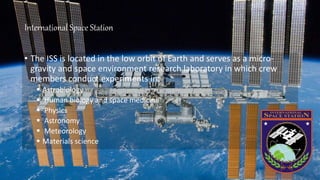
International Space Station
• The ISS is located in the low orbit of Earth and serves as a micro-
gravity and space environment research laboratory in which crew
members conduct experiments in:
 Astrobiology
 Human biology and space medicine
 Physics
 Astronomy
 Meteorology
 Materials science
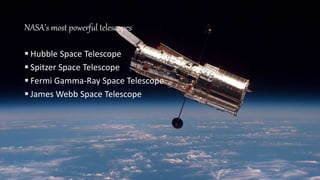
NASA’s most powerful telescopes
 Hubble Space Telescope
 Spitzer Space Telescope
 Fermi Gamma-Ray Space Telescope
 James Webb Space Telescope
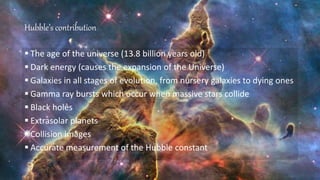
Hubble’s contribution
 The age of the universe (13.8 billion years old)
 Dark energy (causes the expansion of the Universe)
 Galaxies in all stages of evolution, from nursery galaxies to dying ones
 Gamma ray bursts which occur when massive stars collide
 Black holes
 Extrasolar planets
 Collision images
 Accurate measurement of the Hubble constant
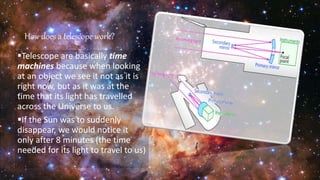
How does a telescope work?
Telescope are basically time
machines because when looking
at an object we see it not as it is
right now, but as it was at the
time that its light has travelled
across the Universe to us.
If the Sun was to suddenly
disappear, we would notice it
only after 8 minutes (the time
needed for its light to travel to us)
The fight against the Novel Coronavirus
NASA, as it has always done, helped scientists fight world’s problems. In
the past few months they have developed new technologies for the
fight against the Covid-19 virus:
• VITAL Ventilator
• Aerospace Valley Positive Pressure Helmets
• AMBUStat
The first 2 devices save the more performant ventilators for people in
critical condition and the latter one purifies the air.
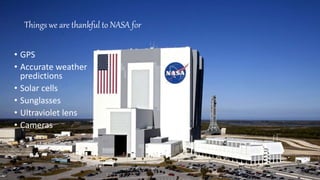
Things we are thankful to NASA for
• GPS
• Accurate weather
predictions
• Solar cells
• Sunglasses
• Ultraviolet lens
• Cameras
Future missions
 The Mars 2020 rover which will collect samples and will seek for
signs of life and habitable conditions
 Sending humans to Moon and Mars
 Sending humans into deep space
 Transforming aviation by developing advanced technology planes
 Space Tech
 Improving Earth’s environment condition
Bibliography
• https://en.wikipedia.org/wiki/NASA
• https://www.nasa.gov/about/whats_next.html
• https://www.space.com/17-amazing-hubble-discoveries.html
Nasa

Nasa

  • 2.
    National Aeronautics andSpace Administration NASA was founded in 1958, being the successor of NACA, and is responsible for: • Civilian space program • Aeronautics • Aerospace research
  • 3.
    Unmanned programs Since itscreation, NASA has conducted more than 1000 unmanned missions, the most important ones being: • Explorer program (It was the first US artificial satellite) • Pioneer program (Consisted in space probes that have long left our solar system and carry information about humans) • Mariner program (It took the first picture taken on Mars) • Lunar Orbiter programs (They spotted landing sites for the Apollo missions) • Voyager program (2 probes which studied the gas giants of our system. They also carry information about humans, should they meet any extraterrestrial life) • Mars Exploration Rovers (They are rovers that are currently on Mars, gathering information about the “red planet”)
  • 4.
    Manned Programs  X-15rocket plane  Project Mercury  Project Gemini  Apollo Program  Skylab  Apollo-Soyuz Test Project  Space Shuttle Program  International Space Station
  • 5.
    The Apollo Program (1961-1972) Throughoutthese programs, mankind has achieved its greatest accomplishment on 24th of July 1969 with the successful landing of Neil Armstrong and Buzz Aldrin on the Moon. 6 crews successfully landed on the moon: Apollo 11, Apollo 12, Apollo 14, Apollo 15, Apollo 16, Apollo 17.
  • 6.
    International Space Station •The ISS is located in the low orbit of Earth and serves as a micro- gravity and space environment research laboratory in which crew members conduct experiments in:  Astrobiology  Human biology and space medicine  Physics  Astronomy  Meteorology  Materials science
  • 7.
    NASA’s most powerfultelescopes  Hubble Space Telescope  Spitzer Space Telescope  Fermi Gamma-Ray Space Telescope  James Webb Space Telescope
  • 8.
    Hubble’s contribution  Theage of the universe (13.8 billion years old)  Dark energy (causes the expansion of the Universe)  Galaxies in all stages of evolution, from nursery galaxies to dying ones  Gamma ray bursts which occur when massive stars collide  Black holes  Extrasolar planets  Collision images  Accurate measurement of the Hubble constant
  • 9.
    How does atelescope work? Telescope are basically time machines because when looking at an object we see it not as it is right now, but as it was at the time that its light has travelled across the Universe to us. If the Sun was to suddenly disappear, we would notice it only after 8 minutes (the time needed for its light to travel to us)
  • 10.
    The fight againstthe Novel Coronavirus NASA, as it has always done, helped scientists fight world’s problems. In the past few months they have developed new technologies for the fight against the Covid-19 virus: • VITAL Ventilator • Aerospace Valley Positive Pressure Helmets • AMBUStat The first 2 devices save the more performant ventilators for people in critical condition and the latter one purifies the air.
  • 11.
    Things we arethankful to NASA for • GPS • Accurate weather predictions • Solar cells • Sunglasses • Ultraviolet lens • Cameras
  • 12.
    Future missions  TheMars 2020 rover which will collect samples and will seek for signs of life and habitable conditions  Sending humans to Moon and Mars  Sending humans into deep space  Transforming aviation by developing advanced technology planes  Space Tech  Improving Earth’s environment condition
  • 13.