Marriott Hotels
Outline
 Overview

of Marriott
 Organizational Environment
 Organizational Culture
 Organizational Structure and Design
 Managing Change and Innovation
Marriott’s Vision & Mission
 Vision
 “To

become the premiere provider and
facilitator of leisure and vacation
experiences in the world.”

 Mission
 “To

enhance the lives of our customers by
creating and enabling unsurpassed vacation
and leisure experiences.”
Marriot Hotels
 Founded

in 1927 by Alice S. and J.
Willard Marriot
 Today it is ran by J.W. Marriott, Jr., is
chairman of the board and chief
executive officer and William J. Shaw is
president and chief operating officer.
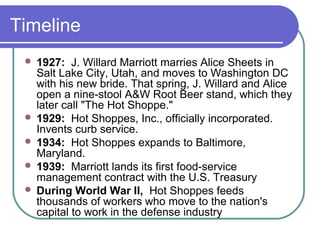
Timeline
1927: J. Willard Marriott marries Alice Sheets in
Salt Lake City, Utah, and moves to Washington DC
with his new bride. That spring, J. Willard and Alice
open a nine-stool A&W Root Beer stand, which they
later call "The Hot Shoppe."
 1929: Hot Shoppes, Inc., officially incorporated.
Invents curb service.
 1934: Hot Shoppes expands to Baltimore,
Maryland.
 1939: Marriott lands its first food-service
management contract with the U.S. Treasury
 During World War II, Hot Shoppes feeds
thousands of workers who move to the nation's
capital to work in the defense industry

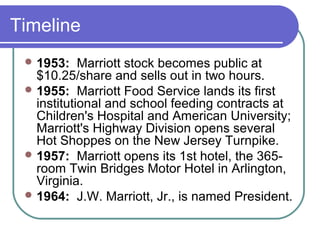
Timeline
 1953:

Marriott stock becomes public at
$10.25/share and sells out in two hours.
 1955: Marriott Food Service lands its first
institutional and school feeding contracts at
Children's Hospital and American University;
Marriott's Highway Division opens several
Hot Shoppes on the New Jersey Turnpike.
 1957: Marriott opens its 1st hotel, the 365room Twin Bridges Motor Hotel in Arlington,
Virginia.
 1964: J.W. Marriott, Jr., is named President.
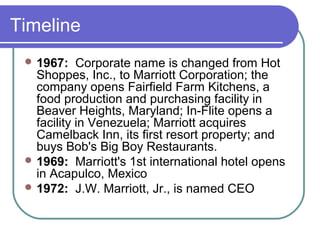
Timeline
 1967:

Corporate name is changed from Hot
Shoppes, Inc., to Marriott Corporation; the
company opens Fairfield Farm Kitchens, a
food production and purchasing facility in
Beaver Heights, Maryland; In-Flite opens a
facility in Venezuela; Marriott acquires
Camelback Inn, its first resort property; and
buys Bob's Big Boy Restaurants.
 1969: Marriott's 1st international hotel opens
in Acapulco, Mexico
 1972: J.W. Marriott, Jr., is named CEO
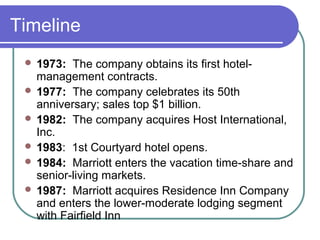
Timeline
 1973:

The company obtains its first hotelmanagement contracts.
 1977: The company celebrates its 50th
anniversary; sales top $1 billion.
 1982: The company acquires Host International,
Inc.
 1983: 1st Courtyard hotel opens.
 1984: Marriott enters the vacation time-share and
senior-living markets.
 1987: Marriott acquires Residence Inn Company
and enters the lower-moderate lodging segment
with Fairfield Inn
Timeline


1993: The company splits into Marriott International
and Host Marriott Corporation.
1995: Marriott acquires the Ritz-Carlton Hotel
Company, LLC.



1997: Marriott acquires the Renaissance Hotel Group
and introduces TownePlace Suites, Fairfield Suites,
and Marriott Executive Residences brands.
2002: Marriott celebrates its 75th anniversary. The
company now has over 2,300 hotels, 156 Senior
Living Services Communities, 200,000 associates, and
operations in 63 countries and territories with annual
sales of $20 billion
Timeline
 2005:

Marriott announces the sale of Ramada
International hotels.
2005: Marriott and Whitbread completed
transaction, forming a 50/50 joint venture to
acquire Whitbread's portfolio of 46 franchised
Marriott and Renaissance hotels of over 8,000
rooms. As part of the joint venture agreement,
Marriott took over management of the hotels,
and the joint venture intends to sell them to
new owners subject to long-term Marriott
management agreements.
Marriott's size and position in the
market
 Operates

and franchises more than 2600
hotels and resorts, totaling approximately
425,900 rooms and 6,300 vacation ownership
villas worldwide.
 15 brands
 Has hotels in 70 countries.
 It is ranked as the lodging industry’s most
admired company and one of the best places
to work for by Fortune® magazine.
Broad idea of the product and
services offered
 Events
 Social

events

 Weddings,

Fund-raising parties, sports groups,
Anniversaries, etc…
 Event planners available that will help you plan
that special occasion.
 Meetings
 technology

support, global conferencing, small
to grand scale conferencing centers.
Broad idea of the product and
services offered
 Specials

and Packages offered

 Last

minute weekend package, Design your
own trip, and Escape packages.
 AAA packages
 AAA

members enjoy the best available discount
on hotel rooms, along with special offers from
Marriott just for our AAA patrons.

 Senior

traveling packages
 Government & Military packages
Marriott Rewards
 Marriott

Rewards members enjoy exclusive
privileges every time they stay at Marriott
brand hotels.
 Take advantage of member-exclusive
specials, including rate discounts,
sweepstakes, and offers from Marriott's travel
partners
 Earn points and use them in many different
ways.


Hotel stays, cruises, theme park passes, packages.
Marriott Brands
 Grand

Residence Club
 Executive Apartments
 ExecuStay
 The Ritz-Carlton
 Horizons
 Vacation Club International
 Towne Place Suites
 Conference Centers
Marriott Brands cont..
 Marriott

Hotels and Resorts
 JW Marriott Hotels and Resorts
 Renaissance Hotels and Resorts
 Courtyard
 Residence Inn
 Fairfield Inn
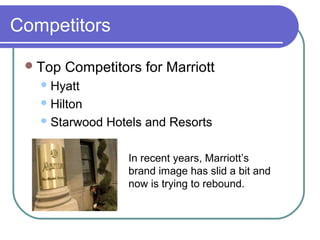
Competitors
 Top

Competitors for Marriott

 Hyatt
 Hilton
 Starwood

Hotels and Resorts
In recent years, Marriott’s
brand image has slid a bit and
now is trying to rebound.
Cont.


Competitors such as Starwood and Hilton could have
an advantage over Marriott in upgrading rooms
because they own a larger proportion of their
properties, so they don't need to persuade other
owners or franchisees to pay for the investment.



To some degree, Marriott is playing catch-up. Westin
introduced a higher-quality bed and emphasized
design in 1999. Other major competitors such as
Hilton and Hyatt have similar strategies.
Stakeholders







Independent owners
Workforce and vendors
Customers and communities
Franchisees
 Marriott manages or franchises the vast majority of
its hotels, and owns very few.
Christopher J. Nassetta, chief executive of Host
Marriott Corp., a real estate investment trust (REIT)
that owns 107 properties under various brand names
Market
Marriott

manages or franchises the
vast majority of its hotels, and owns
very few.
Marriott can be considered a
multinational or transnational
corporations.
Culture
 In

the words of J. W. Marriott, Jr.,
“Culture is the life-thread and glue that
links our past, present, and future.”
 J. Willard Marriott’s simple goal: To
provide “Good Food and Good Service
at a Fair Price”
Culture
 Four

Key Points:

 “Do

whatever it takes to take care of the
customer”
 Pay extraordinary attention to detail
 Take pride in their physical surroundings
 Use their creativity to find new ways to meet
the needs of customers
 Financial

impact
Diversity


"Marriott's

commitment to global diversity is absolute.
Our determination to provide opportunities for our
associates and clientele is one of the main reasons
people want to work and do business with us."
J.W. Marriott, Jr., Chairman and CEO




Diversity is more than a goal, it's our business.
DiversityInc ranked Marriott as one of the Top 50
Companies for Diversity for the past two years.
Leaders and Leadership Style
 J.W.

Marriott Jr: Chairman and CEO of
Marriott International
 Has

taken company from
 family restaurant business
to $19 billion global company
 Leadership resume spans
50+ years in industry
Leaders and Leadership Style
 Background
 Hot

Shoppes in high school/college
 1956: Joined company took over
management in first hotel
 1964: President of company
 1972: Elected CEO
 1985: Elected chairman of board
Leaders and Leadership Style
 Vision
 “to

be the world’s leading provider of
hospitality services
 Taking

care of guest
 Extensive operational knowledge
 Development of highly skilled workforce
 Offering best brand portfolio
Leaders and Leadership Style
 Hands-on

leadership style

 Importance

of employees “associates”
 “Spirit to serve” culture
 Individual hotel appearances, front desk
work
 Well respected by employees
Leaders and Leadership Style
 Community
 National

Involvement

Urban League: Board of Trustees
 Naval Academy Endowment Trust: Director
 National Geographic Society: Board
 World Travel & Tourism Council: Exec
 National Business Center: Member
 President’s Export Council: Chairman
 Laura Bush Library Foundation: Chairman
Marriot’s Structure
 General

Manager, Department
Managers (several), Supervisors,
Associates
 Departmentalization
 Functional

 Unity

departmentalization

of Command

 One

person reports to only one manager
Marriot’s Design
 Overall

it is mechanistic
 Each department can be organic
Managing Change
 Three

Categories of Change

 Structure
 Technology
 People

 The

Change Structure

 Unfreezing
 Changing
 Refreezing
Managing Change
 Change

Agent

 People

who act as catalysts and assume
the responsibility for changing process

 Types

of Change Agents

 Managers
 Non-managers
 Outside

consultants
Innovation
 It

is turning the outcomes of the creative
process into useful products, services, or
work methods
 3 variables to create the “right”
environment for innovation
 Structural
 Cultural
 Human

resource
Why we chose Marriott…
 Our

team chose this company because of the
way this company is so compassionately
operated by the Marriott family. They continue
to come up with new and improving brands,
ideas, and just ways to improve the company
altogether. The major reason we all choose
this company was because all of us want to
learn more about this fascinating company and
how it has been ranked to be one of the best
hotels to work for, or even to stay at.
Activity
 Crossword
Questions?
References







www.marriott.com
www.greaterdiversity.com/profiles/sponsors/fact_sheet.htm
www.detnews.com/2005/business/0503/27/c04-129752
Marriott. (2005). Marriott Success You Can
Experience [Brochure]. Marriott, J.W. Jr.: Author.
Marriott Internship packet
Robbins, Stephen P. and Coulter, Mary. (2005).
Management 8th ed. New Jersey: Pearson Prentice
Hall.

Marriott International

  • 1.
  • 2.
    Outline  Overview of Marriott Organizational Environment  Organizational Culture  Organizational Structure and Design  Managing Change and Innovation
  • 3.
    Marriott’s Vision &Mission  Vision  “To become the premiere provider and facilitator of leisure and vacation experiences in the world.”  Mission  “To enhance the lives of our customers by creating and enabling unsurpassed vacation and leisure experiences.”
  • 4.
    Marriot Hotels  Founded in1927 by Alice S. and J. Willard Marriot  Today it is ran by J.W. Marriott, Jr., is chairman of the board and chief executive officer and William J. Shaw is president and chief operating officer.
  • 5.
    Timeline 1927: J. WillardMarriott marries Alice Sheets in Salt Lake City, Utah, and moves to Washington DC with his new bride. That spring, J. Willard and Alice open a nine-stool A&W Root Beer stand, which they later call "The Hot Shoppe."  1929: Hot Shoppes, Inc., officially incorporated. Invents curb service.  1934: Hot Shoppes expands to Baltimore, Maryland.  1939: Marriott lands its first food-service management contract with the U.S. Treasury  During World War II, Hot Shoppes feeds thousands of workers who move to the nation's capital to work in the defense industry 
  • 6.
    Timeline  1953: Marriott stockbecomes public at $10.25/share and sells out in two hours.  1955: Marriott Food Service lands its first institutional and school feeding contracts at Children's Hospital and American University; Marriott's Highway Division opens several Hot Shoppes on the New Jersey Turnpike.  1957: Marriott opens its 1st hotel, the 365room Twin Bridges Motor Hotel in Arlington, Virginia.  1964: J.W. Marriott, Jr., is named President.
  • 7.
    Timeline  1967: Corporate nameis changed from Hot Shoppes, Inc., to Marriott Corporation; the company opens Fairfield Farm Kitchens, a food production and purchasing facility in Beaver Heights, Maryland; In-Flite opens a facility in Venezuela; Marriott acquires Camelback Inn, its first resort property; and buys Bob's Big Boy Restaurants.  1969: Marriott's 1st international hotel opens in Acapulco, Mexico  1972: J.W. Marriott, Jr., is named CEO
  • 8.
    Timeline  1973: The companyobtains its first hotelmanagement contracts.  1977: The company celebrates its 50th anniversary; sales top $1 billion.  1982: The company acquires Host International, Inc.  1983: 1st Courtyard hotel opens.  1984: Marriott enters the vacation time-share and senior-living markets.  1987: Marriott acquires Residence Inn Company and enters the lower-moderate lodging segment with Fairfield Inn
  • 9.
    Timeline  1993: The companysplits into Marriott International and Host Marriott Corporation. 1995: Marriott acquires the Ritz-Carlton Hotel Company, LLC.  1997: Marriott acquires the Renaissance Hotel Group and introduces TownePlace Suites, Fairfield Suites, and Marriott Executive Residences brands. 2002: Marriott celebrates its 75th anniversary. The company now has over 2,300 hotels, 156 Senior Living Services Communities, 200,000 associates, and operations in 63 countries and territories with annual sales of $20 billion
  • 10.
    Timeline  2005: Marriott announcesthe sale of Ramada International hotels. 2005: Marriott and Whitbread completed transaction, forming a 50/50 joint venture to acquire Whitbread's portfolio of 46 franchised Marriott and Renaissance hotels of over 8,000 rooms. As part of the joint venture agreement, Marriott took over management of the hotels, and the joint venture intends to sell them to new owners subject to long-term Marriott management agreements.
  • 11.
    Marriott's size andposition in the market  Operates and franchises more than 2600 hotels and resorts, totaling approximately 425,900 rooms and 6,300 vacation ownership villas worldwide.  15 brands  Has hotels in 70 countries.  It is ranked as the lodging industry’s most admired company and one of the best places to work for by Fortune® magazine.
  • 12.
    Broad idea ofthe product and services offered  Events  Social events  Weddings, Fund-raising parties, sports groups, Anniversaries, etc…  Event planners available that will help you plan that special occasion.  Meetings  technology support, global conferencing, small to grand scale conferencing centers.
  • 13.
    Broad idea ofthe product and services offered  Specials and Packages offered  Last minute weekend package, Design your own trip, and Escape packages.  AAA packages  AAA members enjoy the best available discount on hotel rooms, along with special offers from Marriott just for our AAA patrons.  Senior traveling packages  Government & Military packages
  • 14.
    Marriott Rewards  Marriott Rewardsmembers enjoy exclusive privileges every time they stay at Marriott brand hotels.  Take advantage of member-exclusive specials, including rate discounts, sweepstakes, and offers from Marriott's travel partners  Earn points and use them in many different ways.  Hotel stays, cruises, theme park passes, packages.
  • 15.
    Marriott Brands  Grand ResidenceClub  Executive Apartments  ExecuStay  The Ritz-Carlton  Horizons  Vacation Club International  Towne Place Suites  Conference Centers
  • 16.
    Marriott Brands cont.. Marriott Hotels and Resorts  JW Marriott Hotels and Resorts  Renaissance Hotels and Resorts  Courtyard  Residence Inn  Fairfield Inn
  • 17.
    Competitors  Top Competitors forMarriott  Hyatt  Hilton  Starwood Hotels and Resorts In recent years, Marriott’s brand image has slid a bit and now is trying to rebound.
  • 18.
    Cont.  Competitors such asStarwood and Hilton could have an advantage over Marriott in upgrading rooms because they own a larger proportion of their properties, so they don't need to persuade other owners or franchisees to pay for the investment.  To some degree, Marriott is playing catch-up. Westin introduced a higher-quality bed and emphasized design in 1999. Other major competitors such as Hilton and Hyatt have similar strategies.
  • 19.
    Stakeholders      Independent owners Workforce andvendors Customers and communities Franchisees  Marriott manages or franchises the vast majority of its hotels, and owns very few. Christopher J. Nassetta, chief executive of Host Marriott Corp., a real estate investment trust (REIT) that owns 107 properties under various brand names
  • 20.
    Market Marriott manages or franchisesthe vast majority of its hotels, and owns very few. Marriott can be considered a multinational or transnational corporations.
  • 21.
    Culture  In the wordsof J. W. Marriott, Jr., “Culture is the life-thread and glue that links our past, present, and future.”  J. Willard Marriott’s simple goal: To provide “Good Food and Good Service at a Fair Price”
  • 22.
    Culture  Four Key Points: “Do whatever it takes to take care of the customer”  Pay extraordinary attention to detail  Take pride in their physical surroundings  Use their creativity to find new ways to meet the needs of customers  Financial impact
  • 23.
    Diversity  "Marriott's commitment to globaldiversity is absolute. Our determination to provide opportunities for our associates and clientele is one of the main reasons people want to work and do business with us." J.W. Marriott, Jr., Chairman and CEO   Diversity is more than a goal, it's our business. DiversityInc ranked Marriott as one of the Top 50 Companies for Diversity for the past two years.
  • 24.
    Leaders and LeadershipStyle  J.W. Marriott Jr: Chairman and CEO of Marriott International  Has taken company from  family restaurant business to $19 billion global company  Leadership resume spans 50+ years in industry
  • 25.
    Leaders and LeadershipStyle  Background  Hot Shoppes in high school/college  1956: Joined company took over management in first hotel  1964: President of company  1972: Elected CEO  1985: Elected chairman of board
  • 26.
    Leaders and LeadershipStyle  Vision  “to be the world’s leading provider of hospitality services  Taking care of guest  Extensive operational knowledge  Development of highly skilled workforce  Offering best brand portfolio
  • 27.
    Leaders and LeadershipStyle  Hands-on leadership style  Importance of employees “associates”  “Spirit to serve” culture  Individual hotel appearances, front desk work  Well respected by employees
  • 28.
    Leaders and LeadershipStyle  Community  National Involvement Urban League: Board of Trustees  Naval Academy Endowment Trust: Director  National Geographic Society: Board  World Travel & Tourism Council: Exec  National Business Center: Member  President’s Export Council: Chairman  Laura Bush Library Foundation: Chairman
  • 29.
    Marriot’s Structure  General Manager,Department Managers (several), Supervisors, Associates  Departmentalization  Functional  Unity departmentalization of Command  One person reports to only one manager
  • 30.
    Marriot’s Design  Overall itis mechanistic  Each department can be organic
  • 31.
    Managing Change  Three Categoriesof Change  Structure  Technology  People  The Change Structure  Unfreezing  Changing  Refreezing
  • 32.
    Managing Change  Change Agent People who act as catalysts and assume the responsibility for changing process  Types of Change Agents  Managers  Non-managers  Outside consultants
  • 33.
    Innovation  It is turningthe outcomes of the creative process into useful products, services, or work methods  3 variables to create the “right” environment for innovation  Structural  Cultural  Human resource
  • 34.
    Why we choseMarriott…  Our team chose this company because of the way this company is so compassionately operated by the Marriott family. They continue to come up with new and improving brands, ideas, and just ways to improve the company altogether. The major reason we all choose this company was because all of us want to learn more about this fascinating company and how it has been ranked to be one of the best hotels to work for, or even to stay at.
  • 35.
  • 36.
  • 37.
    References       www.marriott.com www.greaterdiversity.com/profiles/sponsors/fact_sheet.htm www.detnews.com/2005/business/0503/27/c04-129752 Marriott. (2005). MarriottSuccess You Can Experience [Brochure]. Marriott, J.W. Jr.: Author. Marriott Internship packet Robbins, Stephen P. and Coulter, Mary. (2005). Management 8th ed. New Jersey: Pearson Prentice Hall.