Introduction to Hotel
Management
HFRONTSERV1
M.Aldana, Faculty SHTM
Chapter 1 – Introduction to Hotel Management
• Historical overview of the hotel industry
• Hotel classification system
• Trends that foster growth and employment in the hotel industry
• Career Development
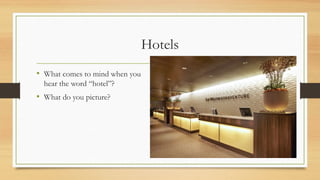
Hotels
• What comes to mind when you
hear the word “hotel”?
• What do you picture?
Founders of the Hotel Industry
• E. M. Statler
• 1863-1928
• First hotel was for Pan American Expo in 1901 – “a simple structure of 5000 rooms to
be torn down after the fair was over”
• Statler’s chain was sold to Hilton in 1954
Founders cont’d.
• Conrad Hilton
• 1887-1979 (after WWI ) in Cisco, TX
• Purchased Mobley Hotel, 1919
• Purchased Chicago Hilton, Palmer House, Plaza, and Waldorf=Astoria hotels (after WWII)
• First major chain in 1954 when he purchased Statler Hotels:
• Marketing, reservations, quality of service
• Food and beverage, housekeeping, accounting
• Brands:
• Hilton Garden Inns
• Doubletree
• Embassy Suites
• Hampton Inns
• Harrison Conference Centers
• Homewood Suites by Hilton
• Red Lion Hotels and Inns
• Conrad International
Founders cont’d.
• William Waldorf Astor and John Jacob Astor IV
• Cousins
• 1893 built hotel for their wealthy friends
• Moved from 34th to Park and Lexington between 49th and 50th Streets
• Waldorf Towers is a hotel within a hotel
• Note the “=” in name
Founders cont’d.
• Kemmons Wilson (died in Jan. 2003)
• Family trip in 1952
• Central reservation system HOLIDEX
• Ray Shultz
• Protégé of Kemmons Wilson
• Started Hampton Inn - 1984
• Limited service concept; cost consciousness
Founders cont’d.
J.W. Marriott
• 1900-1985
• 1957 Twin Bridges Marriott Motor Hotel
• Brands include:
• Courtyard
• Residence Inn
• Renaissance Hotels & Resorts
• Fairfield Inn
• Spring Hill Suites
• Towne Place Suites
• Marriott Hotels, Resorts, and Suites
• JW Marriott Hotels & Resorts
Founders cont’d.
Ernest Henderson and Robert Moore
• First Sheraton in 1937 was Stonehaven, Springfield, MA
• First hotel chain to be listed on NY Stock exchange
• 1968 acquired by ITT Corp.
• Owned by Starwood Hotels
• Brands
• Sheraton
• Westin
• Four Points
• St. Regis
• The Luxury Collection
• W Hotels
Historical Developments
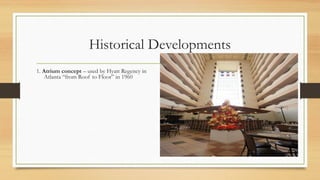
1. Atrium concept – used by Hyatt Regency in
Atlanta “from Roof to Floor” in 1960
Historical Developments
2. Limited-service hotels
- 1980 targeted business market on a limited budget
– ex. Hampton Inn
- Features: spacious comfortable room, limited food &
beverage, first to offer 100% satisfaction guarantee
Historical Developments
Technological Advances
• Recent additions to that list include:
• 1) applications of wireless technology for communication between
departments;
• 2) guests can access email and other documents or printing
those documents as needed from “hot spots” – designated
wireless transmission and reception areas in the hotel.
What other examples can you share?
Historical Developments cont’d.
4. Marketing emphasis – theme 1970’s- guest reservation/ single phone #
5. Total Quality Management (TQM)– a technique that helps managers look at process
used to create products and services with a critical eye on improving those processes
• 1990’s (TQM); 2000’s – “quality assurance” and “service quality”
Historical Developments cont’d.
6. Major Reorganization 1987-88
• Passive losses on real estate no longer deductible
• Japanese wanted buy hotels -> value of hotels increased
• Recession increased and completed
7. Hotel investment
• New incremental income streams – who manages hotels vs. who owns the hotel?
• REIT (Real estate investment trusts)
Historical Developments cont’d.
8. September 11, 2001 Attack on the U.S.
• Decrease in the number of people willing to fly yields a decrease in number of
rooms rented; this resulted in a banding together of tourism partners
• Review marketing plans of post-9/11 corporate traveler.
• Need to review security at front line of hotel who is coming into the hotel
• Community responsibility for security activities
• Review liability implications to repair facilities and guest security for effects of
terrorism
Overview of Lodging Industry cont’d.
Types of lodging facilities –
• A. Hotels
• B. Motels
• C. All-Suites
• D. Limited – Service Hotels
• E. Extended Stay Hotels – continued high occupancy
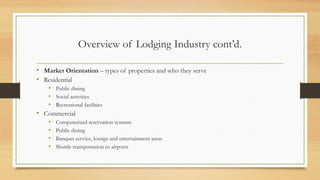
Overview of Lodging Industry cont’d.
• Market Orientation – types of properties and who they serve
• Residential
• Public dining
• Social activities
• Recreational facilities
• Commercial
• Computerized reservation systems
• Public dining
• Banquet service, lounge and entertainment areas
• Shuttle transportation to airports
Lodging Overview cont’d.
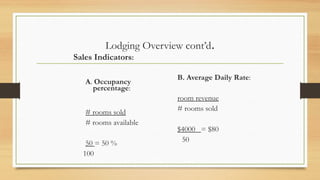
Sales Indicators:
A. Occupancy
percentage:
# rooms sold
# rooms available
50 = 50 %
100
B. Average Daily Rate:
room revenue
# rooms sold
$4000_ = $80
50
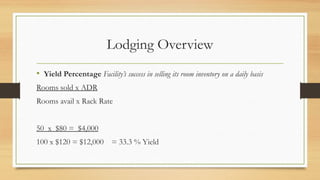
Lodging Overview
• Yield Percentage Facility’s success in selling its room inventory on a daily basis
Rooms sold x ADR
Rooms avail x Rack Rate
50 x $80 = $4,000
100 x $120 = $12,000 = 33.3 % Yield
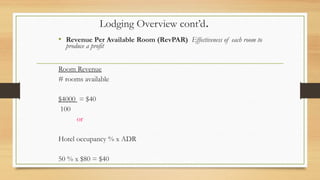
Lodging Overview cont’d.
• Revenue Per Available Room (RevPAR) Effectiveness of each room to
produce a profit
Room Revenue
# rooms available
$4000 = $40
100
or
Hotel occupancy % x ADR
50 % x $80 = $40
Lodging Overview cont’d.
• Levels of Service –
• Full-service –
ex. J.W.Marriott
• reservations
• on-premise dining
• banquet
• meeting facilities
• recreation facilities
• All-Suites –
ex. Embassy Suites
• at-home atmosphere
• separate living and sleeping
areas or working areas
• kitchenette
• wet bars
Lodging Overview cont’d.
• Limited Service
ex. Hampton Inns
• continental breakfast
• sleeping room
• modest furniture
• Extended –Stay
ex. Homewood Suites
• home-away-from-home
• fully equipped kitchen
• spacious bedroom
• living areas
• light breakfast or dinner
Lodging Overview cont’d.
Business Affiliations
• Chain affiliation
• provide operational and marketing services
• reservation systems
• advertising
• operations
• management development
Lodging Overview cont’d.
• Referral Property with a Chain
• Assistance with management
• assistance with marketing, advertising and reservation
• Company-owned Property – hotel owned and operated by the chain
company
• Management Contract Property – operated by a consulting company that
provides operational and marketing expertise and a professional staff
• Independent property
Brands
• Brands – allows a hotel company to create a concept in the mind of a
consumer; a “mind-concept”
Independent Properties
• Independent Property – hotel not associated with a franchise
• Challenges:
• Capital investment
• Consultation and assistance
• Marketing
Trends That Foster Growth
• Leisure time
• 3-day weekends
• Paid vacations
• 40 hour work weeks
• Early retirement
• Me/pleasure concept
• Shift from thinking that recreation
and leisure were a privilege for
wealthy only
• Travel vs. isolated nature of many
jobs
• Discretionary income - money
remaining after necessities of life
are paid
• increase because of two in the
family
• women in the workforce
• not a constant to depend upon:
• Unemployment
• low interest rate make the
purchase of high ticket items
more (homes, cars, boats) more
desirable and make travel less
likely
Trends That Foster Growth cont’d.
• Family size/household size
• Smaller families are more likely to have more discretionary income
• Business travel
• Oil/fuel oil prices/airfare
• Fear
• Business economy
• Conf. call, PicTel
Trends That Foster Growth cont’d.
Female business travel
Increasing segment
Amenities/safety
Female travelers:
Travel as an experience
Education – to follow-up what they have learned
Culture – visit art, theatre, music, opera, ballet,
museums
Sports and nature
Personal development/hobbies
Career Development
1. Establishing Career Goals
Know where you want to go
2. Educational Preparation
Associate
Baccalaureate
Distance Learning
Life-long Learning
3. Work Experience
4. Professional Memberships
Career Development cont’d.
Ports of entry
• Marketing and sales
• Front office
• Food and beverage
• Controller

HFRONTSERV1 Chapter 01

  • 1.
  • 2.
    Chapter 1 –Introduction to Hotel Management • Historical overview of the hotel industry • Hotel classification system • Trends that foster growth and employment in the hotel industry • Career Development
  • 3.
    Hotels • What comesto mind when you hear the word “hotel”? • What do you picture?
  • 4.
    Founders of theHotel Industry • E. M. Statler • 1863-1928 • First hotel was for Pan American Expo in 1901 – “a simple structure of 5000 rooms to be torn down after the fair was over” • Statler’s chain was sold to Hilton in 1954
  • 5.
    Founders cont’d. • ConradHilton • 1887-1979 (after WWI ) in Cisco, TX • Purchased Mobley Hotel, 1919 • Purchased Chicago Hilton, Palmer House, Plaza, and Waldorf=Astoria hotels (after WWII) • First major chain in 1954 when he purchased Statler Hotels: • Marketing, reservations, quality of service • Food and beverage, housekeeping, accounting • Brands: • Hilton Garden Inns • Doubletree • Embassy Suites • Hampton Inns • Harrison Conference Centers • Homewood Suites by Hilton • Red Lion Hotels and Inns • Conrad International
  • 6.
    Founders cont’d. • WilliamWaldorf Astor and John Jacob Astor IV • Cousins • 1893 built hotel for their wealthy friends • Moved from 34th to Park and Lexington between 49th and 50th Streets • Waldorf Towers is a hotel within a hotel • Note the “=” in name
  • 7.
    Founders cont’d. • KemmonsWilson (died in Jan. 2003) • Family trip in 1952 • Central reservation system HOLIDEX • Ray Shultz • Protégé of Kemmons Wilson • Started Hampton Inn - 1984 • Limited service concept; cost consciousness
  • 8.
    Founders cont’d. J.W. Marriott •1900-1985 • 1957 Twin Bridges Marriott Motor Hotel • Brands include: • Courtyard • Residence Inn • Renaissance Hotels & Resorts • Fairfield Inn • Spring Hill Suites • Towne Place Suites • Marriott Hotels, Resorts, and Suites • JW Marriott Hotels & Resorts
  • 9.
    Founders cont’d. Ernest Hendersonand Robert Moore • First Sheraton in 1937 was Stonehaven, Springfield, MA • First hotel chain to be listed on NY Stock exchange • 1968 acquired by ITT Corp. • Owned by Starwood Hotels • Brands • Sheraton • Westin • Four Points • St. Regis • The Luxury Collection • W Hotels
  • 10.
    Historical Developments 1. Atriumconcept – used by Hyatt Regency in Atlanta “from Roof to Floor” in 1960
  • 11.
    Historical Developments 2. Limited-servicehotels - 1980 targeted business market on a limited budget – ex. Hampton Inn - Features: spacious comfortable room, limited food & beverage, first to offer 100% satisfaction guarantee
  • 12.
    Historical Developments Technological Advances •Recent additions to that list include: • 1) applications of wireless technology for communication between departments; • 2) guests can access email and other documents or printing those documents as needed from “hot spots” – designated wireless transmission and reception areas in the hotel. What other examples can you share?
  • 13.
    Historical Developments cont’d. 4.Marketing emphasis – theme 1970’s- guest reservation/ single phone # 5. Total Quality Management (TQM)– a technique that helps managers look at process used to create products and services with a critical eye on improving those processes • 1990’s (TQM); 2000’s – “quality assurance” and “service quality”
  • 14.
    Historical Developments cont’d. 6.Major Reorganization 1987-88 • Passive losses on real estate no longer deductible • Japanese wanted buy hotels -> value of hotels increased • Recession increased and completed 7. Hotel investment • New incremental income streams – who manages hotels vs. who owns the hotel? • REIT (Real estate investment trusts)
  • 15.
    Historical Developments cont’d. 8.September 11, 2001 Attack on the U.S. • Decrease in the number of people willing to fly yields a decrease in number of rooms rented; this resulted in a banding together of tourism partners • Review marketing plans of post-9/11 corporate traveler. • Need to review security at front line of hotel who is coming into the hotel • Community responsibility for security activities • Review liability implications to repair facilities and guest security for effects of terrorism
  • 16.
    Overview of LodgingIndustry cont’d. Types of lodging facilities – • A. Hotels • B. Motels • C. All-Suites • D. Limited – Service Hotels • E. Extended Stay Hotels – continued high occupancy
  • 17.
    Overview of LodgingIndustry cont’d. • Market Orientation – types of properties and who they serve • Residential • Public dining • Social activities • Recreational facilities • Commercial • Computerized reservation systems • Public dining • Banquet service, lounge and entertainment areas • Shuttle transportation to airports
  • 18.
    Lodging Overview cont’d. SalesIndicators: A. Occupancy percentage: # rooms sold # rooms available 50 = 50 % 100 B. Average Daily Rate: room revenue # rooms sold $4000_ = $80 50
  • 19.
    Lodging Overview • YieldPercentage Facility’s success in selling its room inventory on a daily basis Rooms sold x ADR Rooms avail x Rack Rate 50 x $80 = $4,000 100 x $120 = $12,000 = 33.3 % Yield
  • 20.
    Lodging Overview cont’d. •Revenue Per Available Room (RevPAR) Effectiveness of each room to produce a profit Room Revenue # rooms available $4000 = $40 100 or Hotel occupancy % x ADR 50 % x $80 = $40
  • 21.
    Lodging Overview cont’d. •Levels of Service – • Full-service – ex. J.W.Marriott • reservations • on-premise dining • banquet • meeting facilities • recreation facilities • All-Suites – ex. Embassy Suites • at-home atmosphere • separate living and sleeping areas or working areas • kitchenette • wet bars
  • 22.
    Lodging Overview cont’d. •Limited Service ex. Hampton Inns • continental breakfast • sleeping room • modest furniture • Extended –Stay ex. Homewood Suites • home-away-from-home • fully equipped kitchen • spacious bedroom • living areas • light breakfast or dinner
  • 23.
    Lodging Overview cont’d. BusinessAffiliations • Chain affiliation • provide operational and marketing services • reservation systems • advertising • operations • management development
  • 24.
    Lodging Overview cont’d. •Referral Property with a Chain • Assistance with management • assistance with marketing, advertising and reservation • Company-owned Property – hotel owned and operated by the chain company • Management Contract Property – operated by a consulting company that provides operational and marketing expertise and a professional staff • Independent property
  • 25.
    Brands • Brands –allows a hotel company to create a concept in the mind of a consumer; a “mind-concept”
  • 26.
    Independent Properties • IndependentProperty – hotel not associated with a franchise • Challenges: • Capital investment • Consultation and assistance • Marketing
  • 27.
    Trends That FosterGrowth • Leisure time • 3-day weekends • Paid vacations • 40 hour work weeks • Early retirement • Me/pleasure concept • Shift from thinking that recreation and leisure were a privilege for wealthy only • Travel vs. isolated nature of many jobs • Discretionary income - money remaining after necessities of life are paid • increase because of two in the family • women in the workforce • not a constant to depend upon: • Unemployment • low interest rate make the purchase of high ticket items more (homes, cars, boats) more desirable and make travel less likely
  • 28.
    Trends That FosterGrowth cont’d. • Family size/household size • Smaller families are more likely to have more discretionary income • Business travel • Oil/fuel oil prices/airfare • Fear • Business economy • Conf. call, PicTel
  • 29.
    Trends That FosterGrowth cont’d. Female business travel Increasing segment Amenities/safety Female travelers: Travel as an experience Education – to follow-up what they have learned Culture – visit art, theatre, music, opera, ballet, museums Sports and nature Personal development/hobbies
  • 30.
    Career Development 1. EstablishingCareer Goals Know where you want to go 2. Educational Preparation Associate Baccalaureate Distance Learning Life-long Learning 3. Work Experience 4. Professional Memberships
  • 31.
    Career Development cont’d. Portsof entry • Marketing and sales • Front office • Food and beverage • Controller