STRATEGY
QUANTITATIVE
OBJECTIVES
ORGANIZATION &
DECISION-MAKING
PROCESS
PERFORMANCE
CHALLENGES
KEY SUCCESS FACTORS
SUSTAINABLE
COMPETITIVE
ADVANTAGE
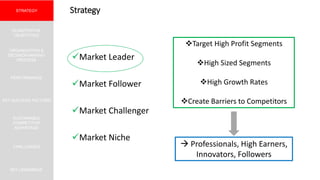
Strategy
KEY LEARNINGS
Market Leader
Market Follower
Market Challenger
Market Niche
Target High Profit Segments
High Sized Segments
High Growth Rates
Create Barriers to Competitors
 Professionals, High Earners,
Innovators, Followers
STRATEGY
QUANTITATIVE
OBJECTIVES
ORGANIZATION &
DECISION-MAKING
PROCESS
PERFORMANCE
CHALLENGES
KEY SUCCESS FACTORS
SUSTAINABLE
COMPETITIVE
ADVANTAGE
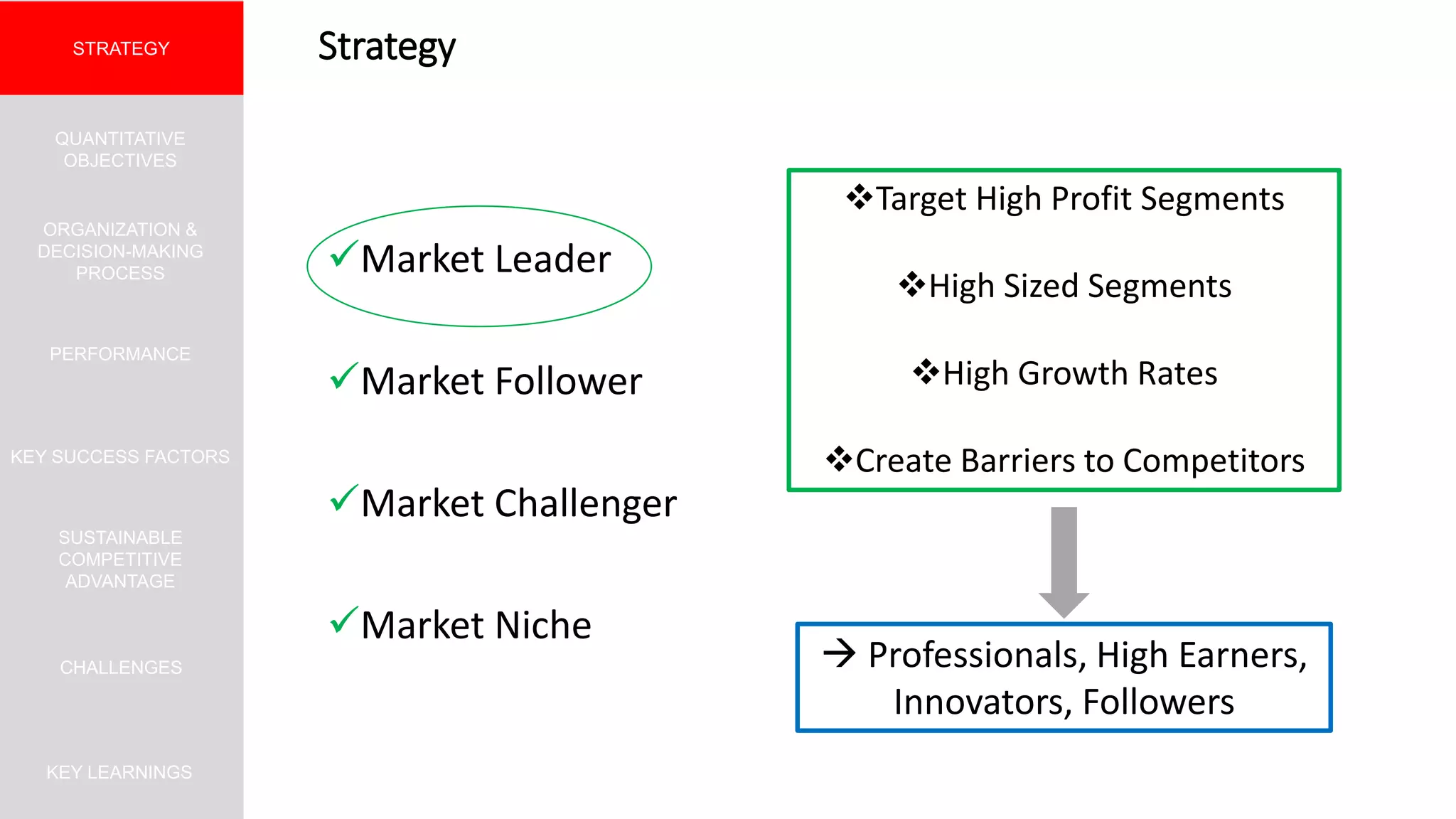
Quantitative objectives
KEY LEARNINGS
Increase Sales
Increase Market Share
Introduce New Products
Advertising
Increase brand awareness and
purchase intentions
Diversify Portfolio
STRATEGY
QUANTITATIVE
OBJECTIVES
ORGANIZATION &
DECISION-MAKING
PROCESS
PERFORMANCE
CHALLENGES
KEY SUCCESS FACTORS
SUSTAINABLE
COMPETITIVE
ADVANTAGE
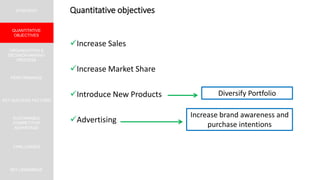
Organization & Decision-making process
KEY LEARNINGS
Brand by Brand decisions
1
• Data analysis and benchmarking (competitors’ analysis)
2
• Calculate prediction for next periods for production levels, product
characteristics (ideal values), distribution channels and sales force, price
changing and advertising
3
• Analyse profitability of each brand
4
• Even though each person has an individual responsibility, all team members
participate in every product decision
STRATEGY
QUANTITATIVE
OBJECTIVES
ORGANIZATION &
DECISION-MAKING
PROCESS
PERFORMANCE
CHALLENGES
KEY SUCCESS FACTORS
SUSTAINABLE
COMPETITIVE
ADVANTAGE
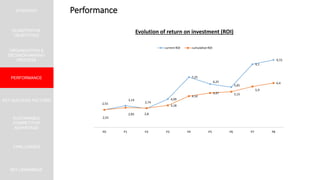
Performance
KEY LEARNINGS
2,55
3,14
2,74
4,09
7,25
6,25
5,81
9,1
9,72
2,55
2,85 2,8
3,18
4,52
4,97 5,15
5,9
6,4
P0 P1 P2 P3 P4 P5 P6 P7 P8
Evolution of return on investment (ROI)
current ROI cumulative ROI
STRATEGY
QUANTITATIVE
OBJECTIVES
ORGANIZATION &
DECISION-MAKING
PROCESS
PERFORMANCE
CHALLENGES
KEY SUCCESS FACTORS
SUSTAINABLE
COMPETITIVE
ADVANTAGE
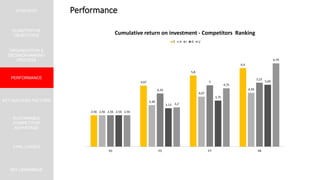
Performance
KEY LEARNINGS
2,56
4,97
5,8
6,4
2,56
3,38
4,07
4,39
2,56
4,33
5
5,21
2,56
3,13
3,75
5,04
2,56
3,2
4,75
6,79
P0 P5 P7 P8
Cumulative return on investment - Competitors Ranking
E A I O U
STRATEGY
QUANTITATIVE
OBJECTIVES
ORGANIZATION &
DECISION-MAKING
PROCESS
PERFORMANCE
CHALLENGES
KEY SUCCESS FACTORS
SUSTAINABLE
COMPETITIVE
ADVANTAGE
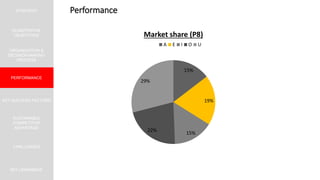
Performance
KEY LEARNINGS
15%
19%
15%
22%
29%
Market share (P8)
A E I O U
²²
STRATEGY
QUANTITATIVE
OBJECTIVES
ORGANIZATION &
DECISION-MAKING
PROCESS
PERFORMANCE
CHALLENGES
KEY SUCCESS FACTORS
SUSTAINABLE
COMPETITIVE
ADVANTAGE
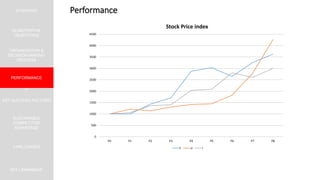
Performance
KEY LEARNINGS
0
500
1000
1500
2000
2500
3000
3500
4000
4500
P0 P1 P2 P3 P4 P5 P6 P7 P8
Stock Price index
E U I
STRATEGY
QUANTITATIVE
OBJECTIVES
ORGANIZATION &
DECISION-MAKING
PROCESS
PERFORMANCE
CHALLENGES
KEY SUCCESS FACTORS
SUSTAINABLE
COMPETITIVE
ADVANTAGE
Performance
KEY LEARNINGS
Product Market
Share
Sales K$ (Revenues) Contribution after
Marketing K$
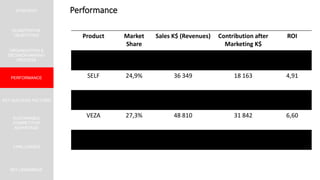
ROI
SEMI (P2) 12,4% 11 937 6 320 4,13
SELF 24,9% 36 349 18 163 4,91
SEKA 45,9% 53 154 32 692 7,74
VEZA 27,3% 48 810 31 842 6,60
VEST 22,8% 132 601 80 745 15,81
STRATEGY
QUANTITATIVE
OBJECTIVES
ORGANIZATION &
DECISION-MAKING
PROCESS
PERFORMANCE
CHALLENGES
KEY SUCCESS FACTORS
SUSTAINABLE
COMPETITIVE
ADVANTAGE
Key Success Factors
KEY LEARNINGS
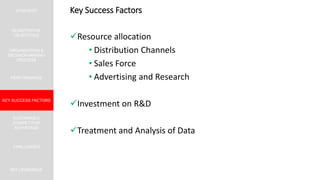
Resource allocation
• Distribution Channels
• Sales Force
• Advertising and Research
Investment on R&D
Treatment and Analysis of Data
STRATEGY
QUANTITATIVE
OBJECTIVES
ORGANIZATION &
DECISION-MAKING
PROCESS
PERFORMANCE
CHALLENGES
KEY SUCCESS FACTORS
SUSTAINABLE
COMPETITIVE
ADVANTAGE
Sustainable Competitive Advantage
KEY LEARNINGS
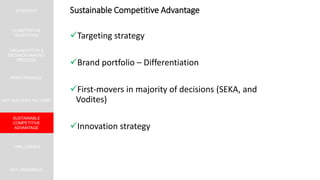
Targeting strategy
Brand portfolio – Differentiation
First-movers in majority of decisions (SEKA, and
Vodites)
Innovation strategy
STRATEGY
QUANTITATIVE
OBJECTIVES
ORGANIZATION &
DECISION-MAKING
PROCESS
PERFORMANCE
CHALLENGES
KEY SUCCESS FACTORS
SUSTAINABLE
COMPETITIVE
ADVANTAGE
Challenges
KEY LEARNINGS
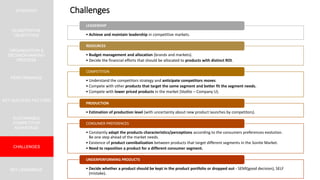
• Achieve and maintain leadership in competitive markets.
LEADERSHIP
• Budget management and allocation (brands and markets).
• Decide the financial efforts that should be allocated to products with distinct ROI.
RESOURCES
• Understand the competitors strategy and anticipate competitors moves.
• Compete with other products that target the same segment and better fit the segment needs.
• Compete with lower priced products in the market (Vodite – Company U).
COMPETITION
• Estimation of production level (with uncertainty about new product launches by competitors).
PRODUCTION
• Constantly adapt the products characteristics/perceptions according to the consumers preferences evolution.
Be one step ahead of the market needs.
• Existence of product cannibalization between products that target different segments in the Sonite Market.
• Need to reposition a product for a different consumer segment.
CONSUMER PREFERENCES
• Decide whether a product should be kept in the product portfolio or dropped out - SEMI(good decision), SELF
(mistake).
UNDERPERFORMING PRODUCTS
STRATEGY
QUANTITATIVE
OBJECTIVES
ORGANIZATION &
DECISION-MAKING
PROCESS
PERFORMANCE
CHALLENGES
KEY SUCCESS FACTORS
SUSTAINABLE
COMPETITIVE
ADVANTAGE
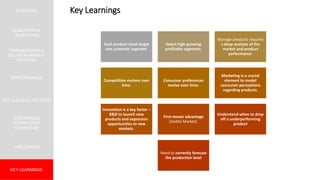
Key Learnings
KEY LEARNINGS
Each product must target
one customer segment.
Select high-growing
profitable segments.
Manage products requires
a deep analysis of the
market and product
performance.
Competition evolves over
time.
Consumer preferences
evolve over time.
Marketing is a crucial
element to model
consumer perceptions
regarding products.
Innovation is a key factor –
R&D to launch new
products and expansion
opportunities to new
markets.
First-mover advantage
(Vodite Market).
Understand when to drop
off a underperforming
product
Need to correctly forecast
the production level
THANK YOU!
BCG
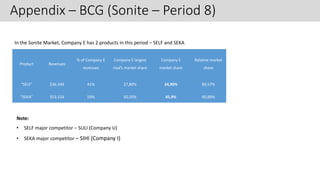
Appendix – BCG (Sonite – Period 8)
Product Revenues
% of Company E
revenues
Company E largest
rival’s market share
Company E
market share
Relative market
share
“SELF" $36.349 41% 27,80% 24,90% 89,57%
“SEKA" $53.154 59% 50,50% 45,9% 90,89%
Note:
• SELF major competitor – SULI (Company U)
• SEKA major competitor – SIHI (Company I)
In the Sonite Market, Company E has 2 products in this period – SELF and SEKA
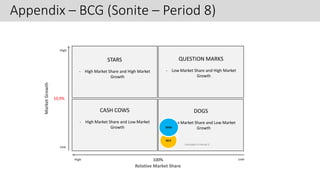
Appendix – BCG (Sonite – Period 8)
STARS
- High Market Share and High Market
Growth
QUESTION MARKS
- Low Market Share and High Market
Growth
CASH COWS
- High Market Share and Low Market
Growth
DOGS
- Low Market Share and Low Market
Growth
High
Low
LowHigh
MarketGrowth
Relative Market Share
SELF
SEKA
Excluded in Period 2
10,9%
100%
Appendix – BCG (Vodite – Period 8)
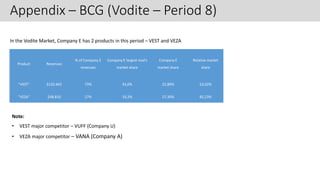
Note:
• VEST major competitor – VUFF (Company U)
• VEZA major competitor – VANA (Company A)
In the Vodite Market, Company E has 2 products in this period – VEST and VEZA
Product Revenues
% of Company E
revenues
Company E largest rival’s
market share
Company E
market share
Relative market
share
“VEST" $132.601 73% 43,0% 22,80% 53,02%
“VEZA" $48.810 27% 33,2% 27,30% 82,23%
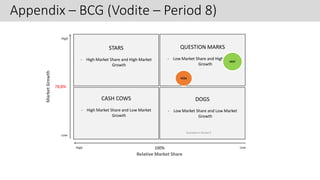
Appendix – BCG (Vodite – Period 8)
STARS
- High Market Share and High Market
Growth
QUESTION MARKS
- Low Market Share and High Market
Growth
CASH COWS
- High Market Share and Low Market
Growth
DOGS
- Low Market Share and Low Market
Growth
High
Low
LowHigh
MarketGrowth
Relative Market Share
VEZA
VEST
Excluded in Period 2
78,8%
100%
Competitive Analysis
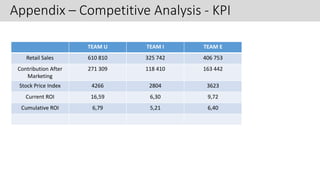
TEAM U TEAM I TEAM E
Retail Sales 610 810 325 742 406 753
Contribution After
Marketing
271 309 118 410 163 442
Stock Price Index 4266 2804 3623
Current ROI 16,59 6,30 9,72
Cumulative ROI 6,79 5,21 6,40
Appendix – Competitive Analysis - KPI
TEAM U TEAM I TEAM E
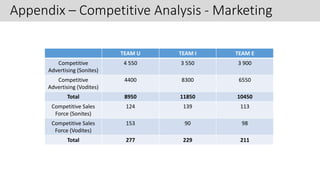
Competitive
Advertising (Sonites)
4 550 3 550 3 900
Competitive
Advertising (Vodites)
4400 8300 6550
Total 8950 11850 10450
Competitive Sales
Force (Sonites)
124 139 113
Competitive Sales
Force (Vodites)
153 90 98
Total 277 229 211
Appendix – Competitive Analysis - Marketing
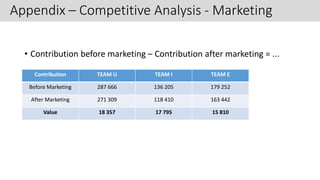
• Contribution before marketing – Contribution after marketing = ...
Contribution TEAM U TEAM I TEAM E
Before Marketing 287 666 136 205 179 252
After Marketing 271 309 118 410 163 442
Value 18 357 17 795 15 810
Appendix – Competitive Analysis - Marketing
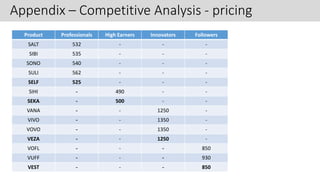
Product Professionals High Earners Innovators Followers
SALT 532 - - -
SIBI 535 - - -
SONO 540 - - -
SULI 562 - - -
SELF 525 - - -
SIHI - 490 - -
SEKA - 500 - -
VANA - - 1250 -
VIVO - - 1350 -
VOVO - - 1350 -
VEZA - - 1250 -
VOFL - - - 850
VUFF - - - 930
VEST - - - 850
Appendix – Competitive Analysis - pricing
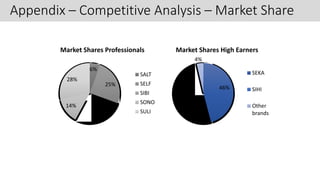
6%
25%
27%
14%
28%
Market Shares Professionals
SALT
SELF
SIBI
SONO
SULI
46%
50%
4%
Market Shares High Earners
SEKA
SIHI
Other
brands
Appendix – Competitive Analysis – Market Share
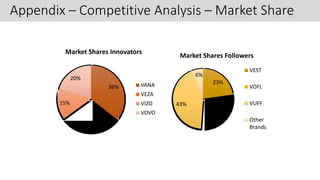
36%
29%
15%
20%
Market Shares Innovators
VANA
VEZA
VIZO
VOVO
23%
28%
43%
6%
Market Shares Followers
VEST
VOFL
VUFF
Other
Brands
Appendix – Competitive Analysis – Market Share
Growth Rate graphs
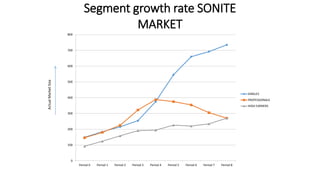
0
100
200
300
400
500
600
700
800
Period 0 Period 1 Period 2 Period 3 Period 4 Period 5 Period 6 Period 7 Period 8
SINGLES
PROFESSIONALS
HIGH EARNERS
Segment growth rate SONITE
MARKET
ActualMarketSize
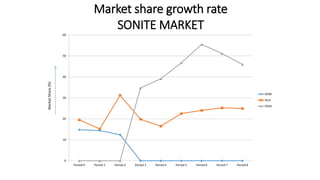
0
10
20
30
40
50
60
Period 0 Period 1 Period 2 Period 3 Period 4 Period 5 Period 6 Period 7 Period 8
SEMI
SELF
SEKA
Market share growth rate
SONITE MARKET
MarketShare(%)
0
200
400
600
800
1000
1200
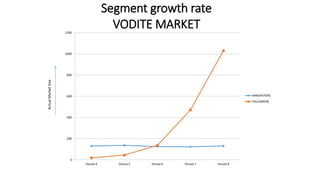
Period 4 Period 5 Period 6 Period 7 Period 8
INNOVATORS
FOLLOWERS
Segment growth rate
VODITE MARKET
ActualMarketSize
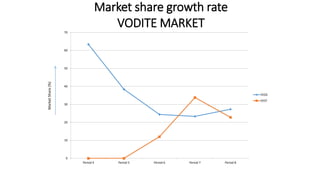
Market share growth rate
VODITE MARKET
0
10
20
30
40
50
60
70
Period 4 Period 5 Period 6 Period 7 Period 8
VEZA
VEST
MarketShare(%)
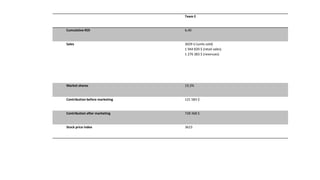
Team E
Cumulative ROI 6,40
Sales 3029 U (units sold)
1 944 839 $ (retail sales)
1 276 383 $ (revenues)
Market shares 19,3%
Contribution before marketing 121 583 $
Contribution after marketing 728 368 $
Stock price index 3623

MarkStrat Simulation report

  • 1.
    STRATEGY QUANTITATIVE OBJECTIVES ORGANIZATION & DECISION-MAKING PROCESS PERFORMANCE CHALLENGES KEY SUCCESSFACTORS SUSTAINABLE COMPETITIVE ADVANTAGE Strategy KEY LEARNINGS Market Leader Market Follower Market Challenger Market Niche Target High Profit Segments High Sized Segments High Growth Rates Create Barriers to Competitors  Professionals, High Earners, Innovators, Followers
  • 2.
    STRATEGY QUANTITATIVE OBJECTIVES ORGANIZATION & DECISION-MAKING PROCESS PERFORMANCE CHALLENGES KEY SUCCESSFACTORS SUSTAINABLE COMPETITIVE ADVANTAGE Quantitative objectives KEY LEARNINGS Increase Sales Increase Market Share Introduce New Products Advertising Increase brand awareness and purchase intentions Diversify Portfolio
  • 3.
    STRATEGY QUANTITATIVE OBJECTIVES ORGANIZATION & DECISION-MAKING PROCESS PERFORMANCE CHALLENGES KEY SUCCESSFACTORS SUSTAINABLE COMPETITIVE ADVANTAGE Organization & Decision-making process KEY LEARNINGS Brand by Brand decisions 1 • Data analysis and benchmarking (competitors’ analysis) 2 • Calculate prediction for next periods for production levels, product characteristics (ideal values), distribution channels and sales force, price changing and advertising 3 • Analyse profitability of each brand 4 • Even though each person has an individual responsibility, all team members participate in every product decision
  • 4.
    STRATEGY QUANTITATIVE OBJECTIVES ORGANIZATION & DECISION-MAKING PROCESS PERFORMANCE CHALLENGES KEY SUCCESSFACTORS SUSTAINABLE COMPETITIVE ADVANTAGE Performance KEY LEARNINGS 2,55 3,14 2,74 4,09 7,25 6,25 5,81 9,1 9,72 2,55 2,85 2,8 3,18 4,52 4,97 5,15 5,9 6,4 P0 P1 P2 P3 P4 P5 P6 P7 P8 Evolution of return on investment (ROI) current ROI cumulative ROI
  • 5.
    STRATEGY QUANTITATIVE OBJECTIVES ORGANIZATION & DECISION-MAKING PROCESS PERFORMANCE CHALLENGES KEY SUCCESSFACTORS SUSTAINABLE COMPETITIVE ADVANTAGE Performance KEY LEARNINGS 2,56 4,97 5,8 6,4 2,56 3,38 4,07 4,39 2,56 4,33 5 5,21 2,56 3,13 3,75 5,04 2,56 3,2 4,75 6,79 P0 P5 P7 P8 Cumulative return on investment - Competitors Ranking E A I O U
  • 6.
    STRATEGY QUANTITATIVE OBJECTIVES ORGANIZATION & DECISION-MAKING PROCESS PERFORMANCE CHALLENGES KEY SUCCESSFACTORS SUSTAINABLE COMPETITIVE ADVANTAGE Performance KEY LEARNINGS 15% 19% 15% 22% 29% Market share (P8) A E I O U
  • 7.
    ²² STRATEGY QUANTITATIVE OBJECTIVES ORGANIZATION & DECISION-MAKING PROCESS PERFORMANCE CHALLENGES KEY SUCCESSFACTORS SUSTAINABLE COMPETITIVE ADVANTAGE Performance KEY LEARNINGS 0 500 1000 1500 2000 2500 3000 3500 4000 4500 P0 P1 P2 P3 P4 P5 P6 P7 P8 Stock Price index E U I
  • 8.
    STRATEGY QUANTITATIVE OBJECTIVES ORGANIZATION & DECISION-MAKING PROCESS PERFORMANCE CHALLENGES KEY SUCCESSFACTORS SUSTAINABLE COMPETITIVE ADVANTAGE Performance KEY LEARNINGS Product Market Share Sales K$ (Revenues) Contribution after Marketing K$ ROI SEMI (P2) 12,4% 11 937 6 320 4,13 SELF 24,9% 36 349 18 163 4,91 SEKA 45,9% 53 154 32 692 7,74 VEZA 27,3% 48 810 31 842 6,60 VEST 22,8% 132 601 80 745 15,81
  • 9.
    STRATEGY QUANTITATIVE OBJECTIVES ORGANIZATION & DECISION-MAKING PROCESS PERFORMANCE CHALLENGES KEY SUCCESSFACTORS SUSTAINABLE COMPETITIVE ADVANTAGE Key Success Factors KEY LEARNINGS Resource allocation • Distribution Channels • Sales Force • Advertising and Research Investment on R&D Treatment and Analysis of Data
  • 10.
    STRATEGY QUANTITATIVE OBJECTIVES ORGANIZATION & DECISION-MAKING PROCESS PERFORMANCE CHALLENGES KEY SUCCESSFACTORS SUSTAINABLE COMPETITIVE ADVANTAGE Sustainable Competitive Advantage KEY LEARNINGS Targeting strategy Brand portfolio – Differentiation First-movers in majority of decisions (SEKA, and Vodites) Innovation strategy
  • 11.
    STRATEGY QUANTITATIVE OBJECTIVES ORGANIZATION & DECISION-MAKING PROCESS PERFORMANCE CHALLENGES KEY SUCCESSFACTORS SUSTAINABLE COMPETITIVE ADVANTAGE Challenges KEY LEARNINGS • Achieve and maintain leadership in competitive markets. LEADERSHIP • Budget management and allocation (brands and markets). • Decide the financial efforts that should be allocated to products with distinct ROI. RESOURCES • Understand the competitors strategy and anticipate competitors moves. • Compete with other products that target the same segment and better fit the segment needs. • Compete with lower priced products in the market (Vodite – Company U). COMPETITION • Estimation of production level (with uncertainty about new product launches by competitors). PRODUCTION • Constantly adapt the products characteristics/perceptions according to the consumers preferences evolution. Be one step ahead of the market needs. • Existence of product cannibalization between products that target different segments in the Sonite Market. • Need to reposition a product for a different consumer segment. CONSUMER PREFERENCES • Decide whether a product should be kept in the product portfolio or dropped out - SEMI(good decision), SELF (mistake). UNDERPERFORMING PRODUCTS
  • 12.
    STRATEGY QUANTITATIVE OBJECTIVES ORGANIZATION & DECISION-MAKING PROCESS PERFORMANCE CHALLENGES KEY SUCCESSFACTORS SUSTAINABLE COMPETITIVE ADVANTAGE Key Learnings KEY LEARNINGS Each product must target one customer segment. Select high-growing profitable segments. Manage products requires a deep analysis of the market and product performance. Competition evolves over time. Consumer preferences evolve over time. Marketing is a crucial element to model consumer perceptions regarding products. Innovation is a key factor – R&D to launch new products and expansion opportunities to new markets. First-mover advantage (Vodite Market). Understand when to drop off a underperforming product Need to correctly forecast the production level
  • 13.
  • 14.
  • 15.
    Appendix – BCG(Sonite – Period 8) Product Revenues % of Company E revenues Company E largest rival’s market share Company E market share Relative market share “SELF" $36.349 41% 27,80% 24,90% 89,57% “SEKA" $53.154 59% 50,50% 45,9% 90,89% Note: • SELF major competitor – SULI (Company U) • SEKA major competitor – SIHI (Company I) In the Sonite Market, Company E has 2 products in this period – SELF and SEKA
  • 16.
    Appendix – BCG(Sonite – Period 8) STARS - High Market Share and High Market Growth QUESTION MARKS - Low Market Share and High Market Growth CASH COWS - High Market Share and Low Market Growth DOGS - Low Market Share and Low Market Growth High Low LowHigh MarketGrowth Relative Market Share SELF SEKA Excluded in Period 2 10,9% 100%
  • 17.
    Appendix – BCG(Vodite – Period 8) Note: • VEST major competitor – VUFF (Company U) • VEZA major competitor – VANA (Company A) In the Vodite Market, Company E has 2 products in this period – VEST and VEZA Product Revenues % of Company E revenues Company E largest rival’s market share Company E market share Relative market share “VEST" $132.601 73% 43,0% 22,80% 53,02% “VEZA" $48.810 27% 33,2% 27,30% 82,23%
  • 18.
    Appendix – BCG(Vodite – Period 8) STARS - High Market Share and High Market Growth QUESTION MARKS - Low Market Share and High Market Growth CASH COWS - High Market Share and Low Market Growth DOGS - Low Market Share and Low Market Growth High Low LowHigh MarketGrowth Relative Market Share VEZA VEST Excluded in Period 2 78,8% 100%
  • 19.
  • 20.
    TEAM U TEAMI TEAM E Retail Sales 610 810 325 742 406 753 Contribution After Marketing 271 309 118 410 163 442 Stock Price Index 4266 2804 3623 Current ROI 16,59 6,30 9,72 Cumulative ROI 6,79 5,21 6,40 Appendix – Competitive Analysis - KPI
  • 21.
    TEAM U TEAMI TEAM E Competitive Advertising (Sonites) 4 550 3 550 3 900 Competitive Advertising (Vodites) 4400 8300 6550 Total 8950 11850 10450 Competitive Sales Force (Sonites) 124 139 113 Competitive Sales Force (Vodites) 153 90 98 Total 277 229 211 Appendix – Competitive Analysis - Marketing
  • 22.
    • Contribution beforemarketing – Contribution after marketing = ... Contribution TEAM U TEAM I TEAM E Before Marketing 287 666 136 205 179 252 After Marketing 271 309 118 410 163 442 Value 18 357 17 795 15 810 Appendix – Competitive Analysis - Marketing
  • 23.
    Product Professionals HighEarners Innovators Followers SALT 532 - - - SIBI 535 - - - SONO 540 - - - SULI 562 - - - SELF 525 - - - SIHI - 490 - - SEKA - 500 - - VANA - - 1250 - VIVO - - 1350 - VOVO - - 1350 - VEZA - - 1250 - VOFL - - - 850 VUFF - - - 930 VEST - - - 850 Appendix – Competitive Analysis - pricing
  • 24.
    6% 25% 27% 14% 28% Market Shares Professionals SALT SELF SIBI SONO SULI 46% 50% 4% MarketShares High Earners SEKA SIHI Other brands Appendix – Competitive Analysis – Market Share
  • 25.
    36% 29% 15% 20% Market Shares Innovators VANA VEZA VIZO VOVO 23% 28% 43% 6% MarketShares Followers VEST VOFL VUFF Other Brands Appendix – Competitive Analysis – Market Share
  • 26.
  • 27.
    0 100 200 300 400 500 600 700 800 Period 0 Period1 Period 2 Period 3 Period 4 Period 5 Period 6 Period 7 Period 8 SINGLES PROFESSIONALS HIGH EARNERS Segment growth rate SONITE MARKET ActualMarketSize
  • 28.
    0 10 20 30 40 50 60 Period 0 Period1 Period 2 Period 3 Period 4 Period 5 Period 6 Period 7 Period 8 SEMI SELF SEKA Market share growth rate SONITE MARKET MarketShare(%)
  • 29.
    0 200 400 600 800 1000 1200 Period 4 Period5 Period 6 Period 7 Period 8 INNOVATORS FOLLOWERS Segment growth rate VODITE MARKET ActualMarketSize
  • 30.
    Market share growthrate VODITE MARKET 0 10 20 30 40 50 60 70 Period 4 Period 5 Period 6 Period 7 Period 8 VEZA VEST MarketShare(%)
  • 31.
    Team E Cumulative ROI6,40 Sales 3029 U (units sold) 1 944 839 $ (retail sales) 1 276 383 $ (revenues) Market shares 19,3% Contribution before marketing 121 583 $ Contribution after marketing 728 368 $ Stock price index 3623