Terry Mosbaugh
Terry Mosbaugh
Value-Driven Product Management
WHAT IS IT?

6-Step Process to Drive Successful
Business Growth
 Product Lines
 Small Businesses
 Start-ups

$$
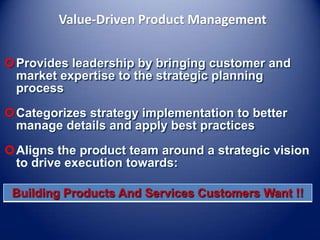
Value-Driven Product Management
Provides thought leadership by bringing
customer and market expertise to the strategic
planning process
Categorizes strategy implementation to better
manage details and apply best practices
Aligns the product team around a strategic vision
to drive execution towards:

Building Products & Services
Customers Want !!
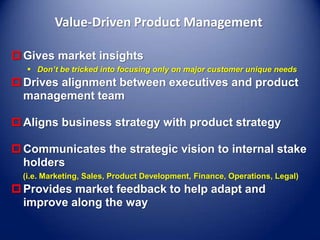
Value-Driven Product Management
 Gives market insights
 Don’t be tricked into focusing only on major customer unique needs

 Drives alignment between executives and product
management team

 Aligns business strategy with product strategy
 Communicates the strategic vision to internal stake
holders
(i.e. Marketing, Sales, Product Development, Finance, Operations, Legal)

 Provides market feedback to help adapt and
improve along the way
Value-Driven Product Management
6 Steps to VDPM:
1. Voice of the Customer [VOC] Assessment
2. Product Profile SWOT Analysis

3. Product Portfolio vs. VOC Gap Strategy
4. Order Fulfillment Strategy
5. Go-To-Market Strategy

6. Infrastructure Review
Apply “Best Practices” within each step
Value-Driven Product Management
1.) Voice of the Customer (VOC) Assessment
- Ask lots of open-ended questions then “Listen”
- Utilize multiple channels for collecting VOC
- Summarize details in a MRD (Market Requirement Document)
 Who are your target customers ?
- Influencers, End-Users, Buyers
- Enterprise, SMB, SOHO, Consumer
 What do they do? What do their customers do?

 What are their “problems, needs, and pains”?
- True requirements may not be obvious at the start
- They mostly emerge during customer interactions
 What VALUE it is to them to address needs and /or eliminate pains?
Value-Driven Product Management
1.) Voice of the Customer [VOC] Assessment (Cont.)
 What is the overall size of the market opportunity?
 Why are customers buying existing products / technology?
 What was their fundamental needs? How did you address their
needs?
 What was their alternative solutions?
 What was their ROI perception?
 Did your products meet, exceed, fall short of customer’s
expectations?
 What prospects did you forecast to purchase products but did not?
 Why?
objections, barriers, competitive solution
 What is your competition [direct and indirect]?
 Do you have a differentiator over competition? Why now?
 What are the major roadblocks to you growing faster? Why?
Value-Driven Product Management
2.) Product Profile SWOT Analysis

SWOT = Strengths, Weaknesses, Opportunities, Threats
 What do you have today ?
 Is it a solution or a product ?

 Does it offer

“Value”

to your customers ?

 How does it compare to competition ?
 Is the product portfolio sustainable (roadmap strategy) ?
 Do you have IP (patents or trade secrets) ?
Value-Driven Product Management
3.) Product Portfolio vs. VOC Gap Strategy

Options to Fill Gaps:






Repackage what you have
Private brand labeling
Create custom product extensions
Develop new products / services
M & A strategy
Value-Driven Product Management
3.) Product Portfolio vs. VOC Gap Strategy (Cont.)
 Regular evaluation of the portfolio and development pipeline to
assign resource priority (what offers the best ROI)
 Invest in product development technologies that improve the agility
and speed of the engineering portion of the product development
lifecycle
 Product Management is key to bridging communications between
Voice of the Customer and Product Development teams
Apply ‘Best Practices’
o LEAN - PD
o Agile Development Methodology
Value-Driven Product Management
4.) Order Fulfillment Strategy

 Manufacture Internally
 Outsource to Contract Manufacturer / ODM
 Private Label
 All of the Above
What is your Vendor, Logistics and Supply Chain Support
Strategy?
Value-Driven Product Management
5.) Go-To-Market Strategy
 Product [Packaging, MOQ’s, Vertical’s]
 Price [Standard, Tiered, Disty, eBusiness)]

 Promotion [Social Media, eMarketing, Lead Gen, PR]
 Placement [Sales Channels]

 Position = “Targeted Value-Add Solutioning”
Value-Driven Product Management
5.) Go-To-Market Strategy (Cont.)
Targeted Value Add Solutioning (Step 1)
1. Promote “Value” not Features / Benefits
 Customers do not buy product features nor benefits
 Focus sales enablement and marketing tools around the
value features and benefits bring to addressing identified
customer’s needs or pains
Value Driven Product Management
5.) Go-To-Market Strategy (Cont.)
Targeted Value Add Solutioning (Step 2)
2. Develop “Solutions” not Products
 Solutions can be a combination of products, services,
messaging, and operational best practices
 Solutions drive differentiating value resulting in greater
revenue and higher margins
 Solutions have less competitive pressures
Targeted Value-Add Solutioning
Targeted Value Add Solutioning (Step 2)
2. Develop “Solutions” not Products (cont.)
 Four Samples of Solutions are:
 Stand Alone: a product and/or service combined with Best-of-Class
Customer Service
 Vertical Market/Niche Market Specific: a product wrapped in value-add
messaging crafted for specific users
 Bundle: a combination of existing discrete products, services, and
operational best practices into a solution possibly with promotional
package pricing

 Integrated Solution: an offering that integrates multiple components
such as products, services, processes, intellectual property, and pricing
that delivers value beyond which each individual component could
provide on its own
Value-Driven Product Management
5.) Go-To-Market Strategy (Cont.)
Targeted Value Add Solutioning (Step 3)
3. Identify “Targeted Customer Needs”
 Be the expert on "Targeted Customer Needs" and how your
products are used to address the needs
 In addition to existing customers be sure to evaluate the
needs of new prospects, vertical marketing teams, sales
engineers, and channel partners (MSP, VAR, SI, Dealers)
 Focusing only on major customer unique needs can be
dangerous
Value-Driven Product Management
5.) Go-To-Market Strategy (Cont.)
Targeted Value Add Solutioning (Step 3)
3. Identify “Targeted Customer Needs” (Cont.)
 Influencers, Users and Buyers all have different needs
 Enterprise customers have different needs than SMB, SOHO
or Consumer

 Specific Vertical Markets have unique different needs
 Hunter sales people have different needs than Farmer sales
people
Value-Driven Product Management
5.) Go-To-Market Strategy (Cont.)
Targeted Value Add Solutioning (Step 3)
3. Identify “Targeted Customer Needs” (Cont.)
 Prioritize Target Customers
 “Execute” on GTM strategy
Value-Driven Product Management
6.) Infrastructure Review
 What infrastructure is required to support Steps 1 through 5?
 Create Org Chart with boxes of functionality

 Assess existing personnel / support groups
 Assign personnel / groups to best functionality
 Recruit / Hire / Train key performers – Fill function gaps
 Develop KPI metrics reporting dashboards
 Lead, Manage, Mentor and Motivate team(s)

Communicate

Communicate

Communicate
Value-Driven Product Management
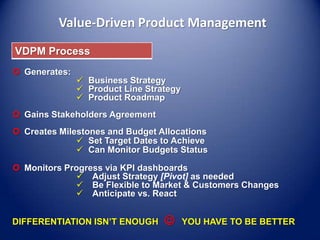
VDPM Process
 Generates:

 Business Strategy
 Product Line Strategy
 Product Roadmap

 Gains Stakeholders Agreement
 Creates Milestones and Budget Allocations
 Set Target Dates to Achieve
 Can Monitor Budgets Status
 Monitors Progress via KPI dashboards
 Adjust Strategy [Pivot] as needed
 Be Flexible to Market & Customers Changes
 Anticipate vs. React
DIFFERENTIATION ISN’T ENOUGH



YOU HAVE TO BE BETTER
Value-Driven Product Management

Jim Brown
VP - Global Product Innovation and Engineering
Aberdeen Group
Value-Driven Product Management
WHAT IS IT?

6-Step Process to Drive Successful
Business Growth
 Product Lines
 Small Businesses
 Start-ups

$$
THANK You
ThankYOU

Terry P. Mosbaugh
terry.mosbaugh@gmail.com

Value Driven Product Management Process by Terry Mosbaugh

  • 1.
  • 2.
  • 3.
    Value-Driven Product Management WHATIS IT? 6-Step Process to Drive Successful Business Growth  Product Lines  Small Businesses  Start-ups $$
  • 4.
    Value-Driven Product Management Providesthought leadership by bringing customer and market expertise to the strategic planning process Categorizes strategy implementation to better manage details and apply best practices Aligns the product team around a strategic vision to drive execution towards: Building Products & Services Customers Want !!
  • 5.
    Value-Driven Product Management Gives market insights  Don’t be tricked into focusing only on major customer unique needs  Drives alignment between executives and product management team  Aligns business strategy with product strategy  Communicates the strategic vision to internal stake holders (i.e. Marketing, Sales, Product Development, Finance, Operations, Legal)  Provides market feedback to help adapt and improve along the way
  • 6.
    Value-Driven Product Management 6Steps to VDPM: 1. Voice of the Customer [VOC] Assessment 2. Product Profile SWOT Analysis 3. Product Portfolio vs. VOC Gap Strategy 4. Order Fulfillment Strategy 5. Go-To-Market Strategy 6. Infrastructure Review Apply “Best Practices” within each step
  • 7.
    Value-Driven Product Management 1.)Voice of the Customer (VOC) Assessment - Ask lots of open-ended questions then “Listen” - Utilize multiple channels for collecting VOC - Summarize details in a MRD (Market Requirement Document)  Who are your target customers ? - Influencers, End-Users, Buyers - Enterprise, SMB, SOHO, Consumer  What do they do? What do their customers do?  What are their “problems, needs, and pains”? - True requirements may not be obvious at the start - They mostly emerge during customer interactions  What VALUE it is to them to address needs and /or eliminate pains?
  • 8.
    Value-Driven Product Management 1.)Voice of the Customer [VOC] Assessment (Cont.)  What is the overall size of the market opportunity?  Why are customers buying existing products / technology?  What was their fundamental needs? How did you address their needs?  What was their alternative solutions?  What was their ROI perception?  Did your products meet, exceed, fall short of customer’s expectations?  What prospects did you forecast to purchase products but did not?  Why? objections, barriers, competitive solution  What is your competition [direct and indirect]?  Do you have a differentiator over competition? Why now?  What are the major roadblocks to you growing faster? Why?
  • 9.
    Value-Driven Product Management 2.)Product Profile SWOT Analysis SWOT = Strengths, Weaknesses, Opportunities, Threats  What do you have today ?  Is it a solution or a product ?  Does it offer “Value” to your customers ?  How does it compare to competition ?  Is the product portfolio sustainable (roadmap strategy) ?  Do you have IP (patents or trade secrets) ?
  • 10.
    Value-Driven Product Management 3.)Product Portfolio vs. VOC Gap Strategy Options to Fill Gaps:      Repackage what you have Private brand labeling Create custom product extensions Develop new products / services M & A strategy
  • 11.
    Value-Driven Product Management 3.)Product Portfolio vs. VOC Gap Strategy (Cont.)  Regular evaluation of the portfolio and development pipeline to assign resource priority (what offers the best ROI)  Invest in product development technologies that improve the agility and speed of the engineering portion of the product development lifecycle  Product Management is key to bridging communications between Voice of the Customer and Product Development teams Apply ‘Best Practices’ o LEAN - PD o Agile Development Methodology
  • 12.
    Value-Driven Product Management 4.)Order Fulfillment Strategy  Manufacture Internally  Outsource to Contract Manufacturer / ODM  Private Label  All of the Above What is your Vendor, Logistics and Supply Chain Support Strategy?
  • 13.
    Value-Driven Product Management 5.)Go-To-Market Strategy  Product [Packaging, MOQ’s, Vertical’s]  Price [Standard, Tiered, Disty, eBusiness)]  Promotion [Social Media, eMarketing, Lead Gen, PR]  Placement [Sales Channels]  Position = “Targeted Value-Add Solutioning”
  • 14.
    Value-Driven Product Management 5.)Go-To-Market Strategy (Cont.) Targeted Value Add Solutioning (Step 1) 1. Promote “Value” not Features / Benefits  Customers do not buy product features nor benefits  Focus sales enablement and marketing tools around the value features and benefits bring to addressing identified customer’s needs or pains
  • 15.
    Value Driven ProductManagement 5.) Go-To-Market Strategy (Cont.) Targeted Value Add Solutioning (Step 2) 2. Develop “Solutions” not Products  Solutions can be a combination of products, services, messaging, and operational best practices  Solutions drive differentiating value resulting in greater revenue and higher margins  Solutions have less competitive pressures
  • 16.
    Targeted Value-Add Solutioning TargetedValue Add Solutioning (Step 2) 2. Develop “Solutions” not Products (cont.)  Four Samples of Solutions are:  Stand Alone: a product and/or service combined with Best-of-Class Customer Service  Vertical Market/Niche Market Specific: a product wrapped in value-add messaging crafted for specific users  Bundle: a combination of existing discrete products, services, and operational best practices into a solution possibly with promotional package pricing  Integrated Solution: an offering that integrates multiple components such as products, services, processes, intellectual property, and pricing that delivers value beyond which each individual component could provide on its own
  • 17.
    Value-Driven Product Management 5.)Go-To-Market Strategy (Cont.) Targeted Value Add Solutioning (Step 3) 3. Identify “Targeted Customer Needs”  Be the expert on "Targeted Customer Needs" and how your products are used to address the needs  In addition to existing customers be sure to evaluate the needs of new prospects, vertical marketing teams, sales engineers, and channel partners (MSP, VAR, SI, Dealers)  Focusing only on major customer unique needs can be dangerous
  • 18.
    Value-Driven Product Management 5.)Go-To-Market Strategy (Cont.) Targeted Value Add Solutioning (Step 3) 3. Identify “Targeted Customer Needs” (Cont.)  Influencers, Users and Buyers all have different needs  Enterprise customers have different needs than SMB, SOHO or Consumer  Specific Vertical Markets have unique different needs  Hunter sales people have different needs than Farmer sales people
  • 19.
    Value-Driven Product Management 5.)Go-To-Market Strategy (Cont.) Targeted Value Add Solutioning (Step 3) 3. Identify “Targeted Customer Needs” (Cont.)  Prioritize Target Customers  “Execute” on GTM strategy
  • 20.
    Value-Driven Product Management 6.)Infrastructure Review  What infrastructure is required to support Steps 1 through 5?  Create Org Chart with boxes of functionality  Assess existing personnel / support groups  Assign personnel / groups to best functionality  Recruit / Hire / Train key performers – Fill function gaps  Develop KPI metrics reporting dashboards  Lead, Manage, Mentor and Motivate team(s) Communicate Communicate Communicate
  • 21.
    Value-Driven Product Management VDPMProcess  Generates:  Business Strategy  Product Line Strategy  Product Roadmap  Gains Stakeholders Agreement  Creates Milestones and Budget Allocations  Set Target Dates to Achieve  Can Monitor Budgets Status  Monitors Progress via KPI dashboards  Adjust Strategy [Pivot] as needed  Be Flexible to Market & Customers Changes  Anticipate vs. React DIFFERENTIATION ISN’T ENOUGH  YOU HAVE TO BE BETTER
  • 22.
    Value-Driven Product Management JimBrown VP - Global Product Innovation and Engineering Aberdeen Group
  • 23.
    Value-Driven Product Management WHATIS IT? 6-Step Process to Drive Successful Business Growth  Product Lines  Small Businesses  Start-ups $$
  • 24.
    THANK You ThankYOU Terry P.Mosbaugh terry.mosbaugh@gmail.com