MARKETPLACE
INNOVATION
Q2 2016
endava.com
ABOUT THIS REPORT
Welcome to the latest edition of the Quarterly Innovation Report. This edition is
packed with contributions from people across Endava and covers many industries.
It contains really cool, innovative projects that span robotics, business intelligence,
security and payments.
These projects are the cutting edge of the industry and we often use these as
inspiration for clients who are embarking on a Digital Transformation programme.
endava.com
FACEBOOK LIVE
Facebook will soon release one of the biggest updates
to the platform, enabling users to update their status
with a live video.
The new feature will be a combination of Snapchat,
Skype and YouTube, and will be fully integrated into the
current web and mobile applications (in the update
status area).
We see this only as a positive step (for Facebook),
making the platform contain even richer content, and in
the near future we expect Facebook to mainly consist of
video content.
Be prepared for lots of people live streaming around you!
Martin Smith
http://bit.ly/1Z94ge4
endava.com
MOZILLA IS FLAILING WHEN
THE INTERNET NEEDS IT
THE MOST
When the Internet was first invented, the thought of a
handful of companies providing tools to access this
content was against the very principle of its ‘openness’.
When Microsoft’s bulldozed their way into the market,
users were forced to use its own web browser, Internet
Explorer, governments stepped in to legislate against
its growth.
Which is why the position Mozilla currently finds itself in,
with an ever decreasing web browser market share and a
tiny mobile browser market share, potential bad news for
all of us. This could be ironic – it’s the population of the
Internet who may need Mozilla the most, yet it is us who
are turning backs on it.
Martin Smith
http://bit.ly/1lDrFWk
endava.com
WEARABLES
We like this article describing the history of wearable
devices, and the infographic that appears at the end.
The article describes how the latest devices are an
evolution of technologies created several years,
sometimes decades ago. The biggest rise of new
technologies occurred in the 1990s – since then,
wearable technologies have focussed on miniaturisa-
tion and convergence, rather than new inventions.
Matt Cloke
http://tcrn.ch/1P7opPK
endava.com
TEACHING THE AI TO SEE
AND UNDERSTAND
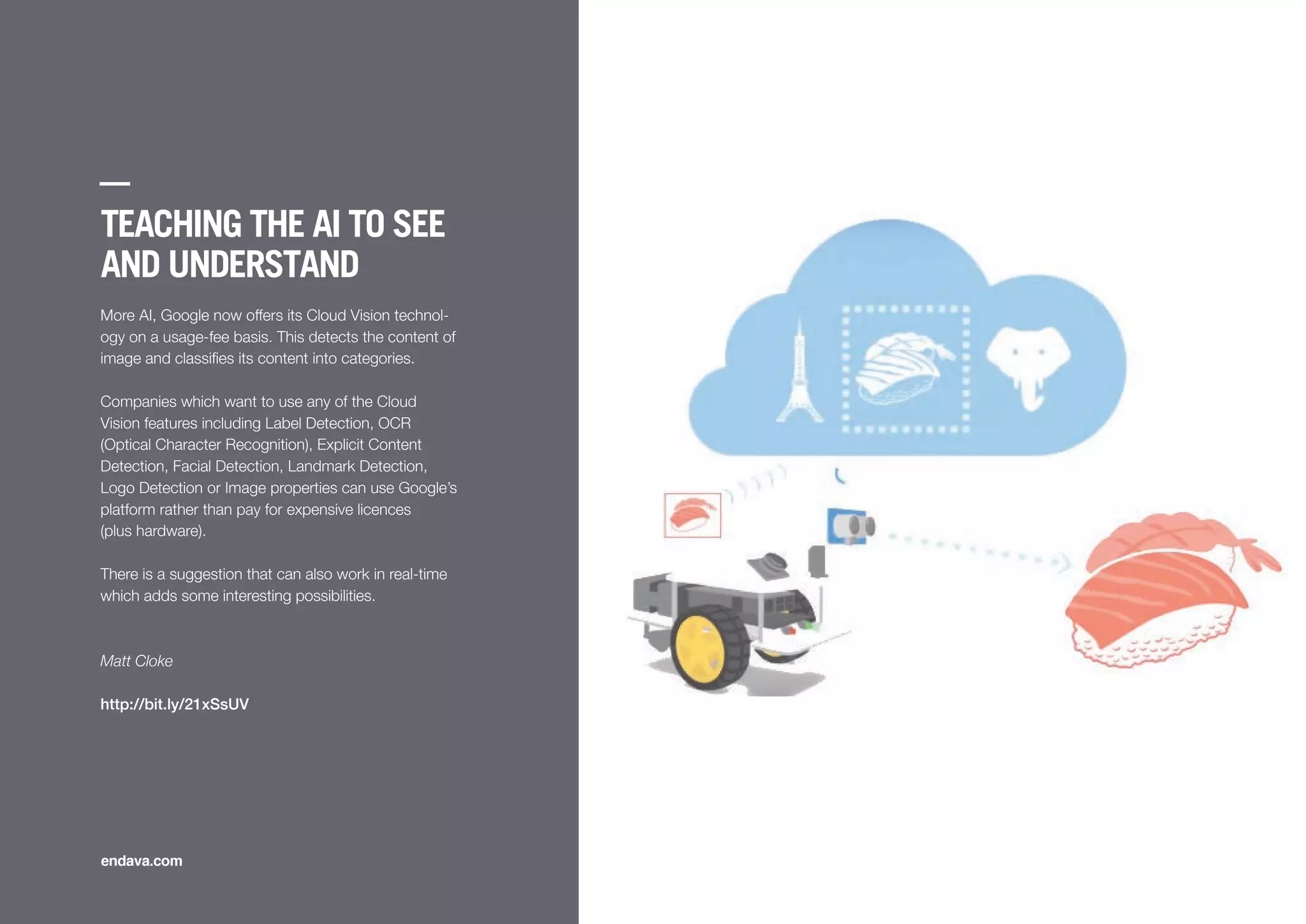
More AI, Google now offers its Cloud Vision technol-
ogy on a usage-fee basis. This detects the content of
image and classifies its content into categories.
Companies which want to use any of the Cloud
Vision features including Label Detection, OCR
(Optical Character Recognition), Explicit Content
Detection, Facial Detection, Landmark Detection,
Logo Detection or Image properties can use Google’s
platform rather than pay for expensive licences
(plus hardware).
There is a suggestion that can also work in real-time
which adds some interesting possibilities.
Matt Cloke
http://bit.ly/21xSsUV
endava.com
OPEN SOURCE AI
AI has been around for some time, but it’s interesting
to see that Google has made one of its key AI
technologies open source, leading to a flurry of
interesting third party applications.
Google uses the technology internally for speech
recognition, Gmail, Google Photos and search.
There are now a range of AI technologies available,
and we could see a new generation of applications
using AI, one of the most interesting computer
discoveries, in the near future.
Martin Smith
http://bit.ly/1SExy0M
http://bit.ly/1MWEhkH
endava.com
MIT
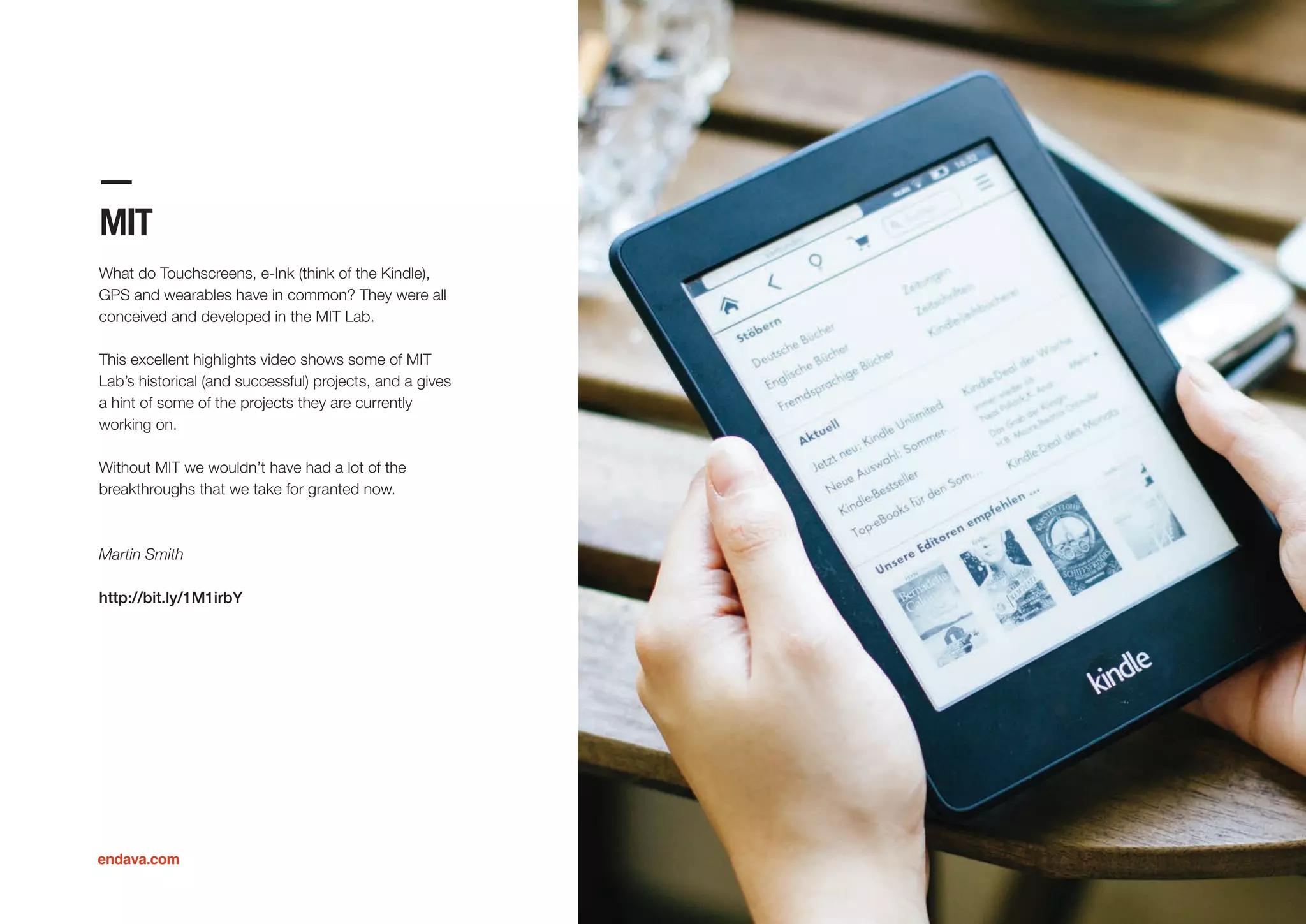
What do Touchscreens, e-Ink (think of the Kindle),
GPS and wearables have in common? They were all
conceived and developed in the MIT Lab.
This excellent highlights video shows some of MIT
Lab’s historical (and successful) projects, and a gives
a hint of some of the projects they are currently
working on.
Without MIT we wouldn’t have had a lot of the
breakthroughs that we take for granted now.
Martin Smith
http://bit.ly/1M1irbY
endava.com
UPGRADE YOUR
BROWSER, OR ELSE
Security standard SHA1 has been known to have vulner-
abilities and has been replaced with SHA256 instead.
The problem is that around 7 percent of browsers
support SHA1 and not SHA256, forcing companies to
choose between higher browser penetration (i.e. more
users) or higher security. Most of these users are based
in developing countries who struggle to get online.
This affects the bigger technology companies the most,
with Facebook blocking access to ‘tens of millions’ of
their users if they switch to SHA256.
Daniel Ciocirlan
http://bit.ly/1QAnoP7
endava.com
IBM WATSON TREND APP
Following on the AI theme, IBM have released a
mobile app (available for Android and iOS) to
showcase its own AI platform, Watson.
The mobile app tries to make useful suggestions
when buying specified items, based on several
data sources.
We like the app itself, but the overall concept of
choosing which item to buy doesn’t seem to be
challenging enough for such a showcase AI platform.
If Watson is supposed to be so artificially intelligent,
perhaps it could help answer more complex questions
such as outcomes in sporting or political events.
Mike King
http://bit.ly/1YKOLbl
http://apple.co/1VGV8Pk
endava.com
HASHCAT IS NOW
OPEN SOURCE
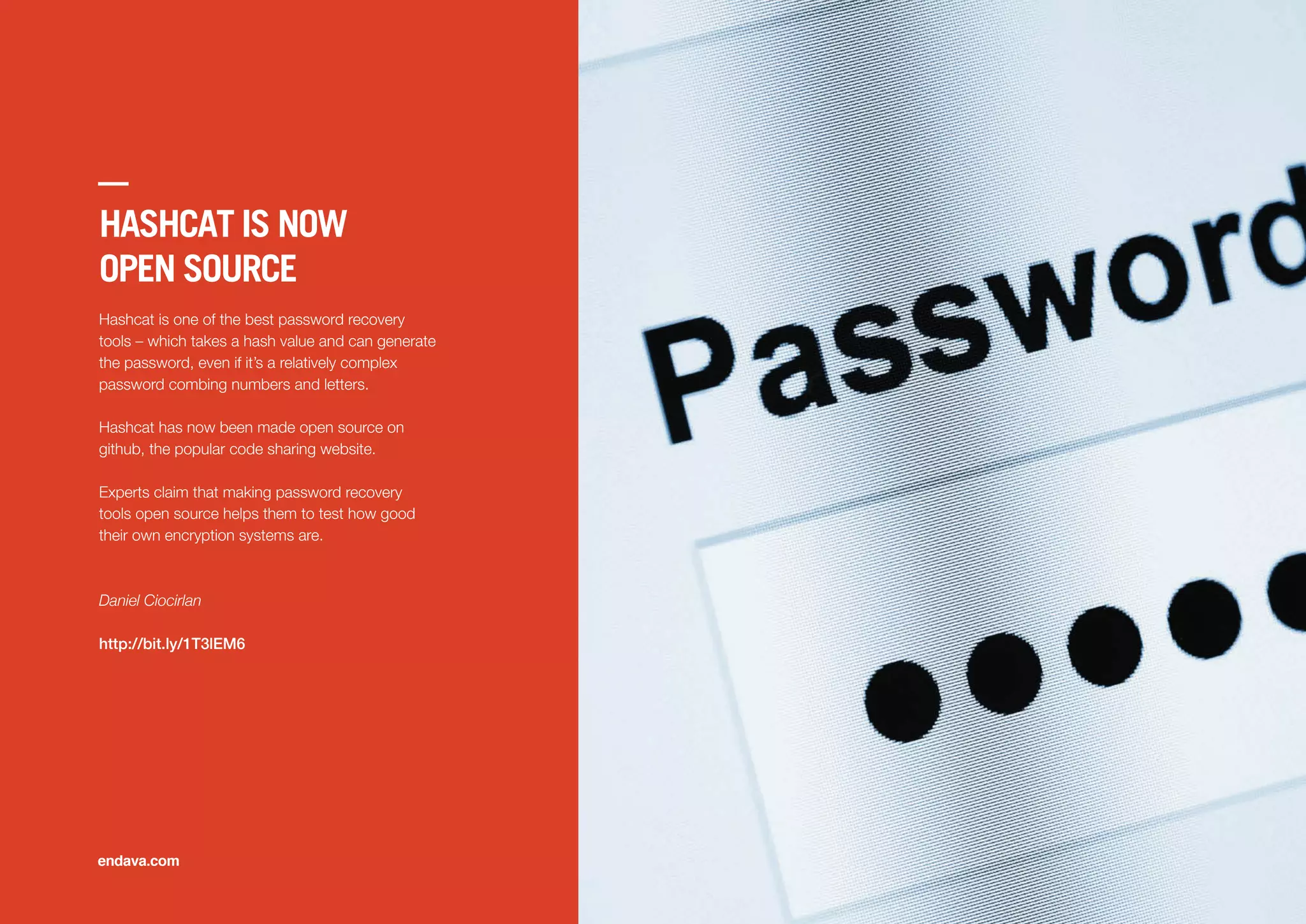
Hashcat is one of the best password recovery
tools – which takes a hash value and can generate
the password, even if it’s a relatively complex
password combing numbers and letters.
Hashcat has now been made open source on
github, the popular code sharing website.
Experts claim that making password recovery
tools open source helps them to test how good
their own encryption systems are.
Daniel Ciocirlan
http://bit.ly/1T3lEM6
endava.com
HTTP/2
Get ready for faster internet browsing. In January we saw
the new release of the major Internet protocol, HTTP/2.
HTTP/2 has been implemented in Chrome and Firefox
(at time of writing). As of February 2016, under 7% of
servers supported HTTP/2.
HTTP/2 promises a speed increase by sending objects to
the browser before they’ve been requested, some data
compression, and parallel requests on a single TCP
connection. Initial tests show some speed benefits.
(Related to the new http/2, which comes with a lot of
interesting improvements, i.e. multiplexing and headers
compression. The downside of it is that it’s binary, so one
needs a special tool to read it…)
Daniel Ciocirlan
http://bit.ly/26jxo74
endava.com
CONTRACTUAL
INNOVATION
Gogo provides the inflight Internet connectivity to
American Airlines. The airline is suing Gogo over poor
Internet performance and its technical limitations.
What caught our eye though, was the contractual
obligation “American notes that its contract with
Gogo permits it to switch providers if Gogo is unable
to match the tech innovations of its competitors”.
This is an astonishing legal clause for a technology
company!
Martin Smith
http://bit.ly/1YKOUvm
endava.com
HOW NETFLIX IS
CHANGING
Over Christmas, Netflix launched a single show “A
Very Murray Christmas”, a departure from securing
cheaper film rights or TV box sets.
The programme demonstrates how Netflix has
become more mainstream with its audience (and
reflects to some degree its audience demographics)
and is competing head to head with traditional TV
broadcasters.
Unfortunately, the reviews didn’t rate the programme
highly, but full marks for trying.
Martin Smith
http://nflx.it/23NZbh7
endava.com
MAINSTREAM
VIRTUAL REALITY
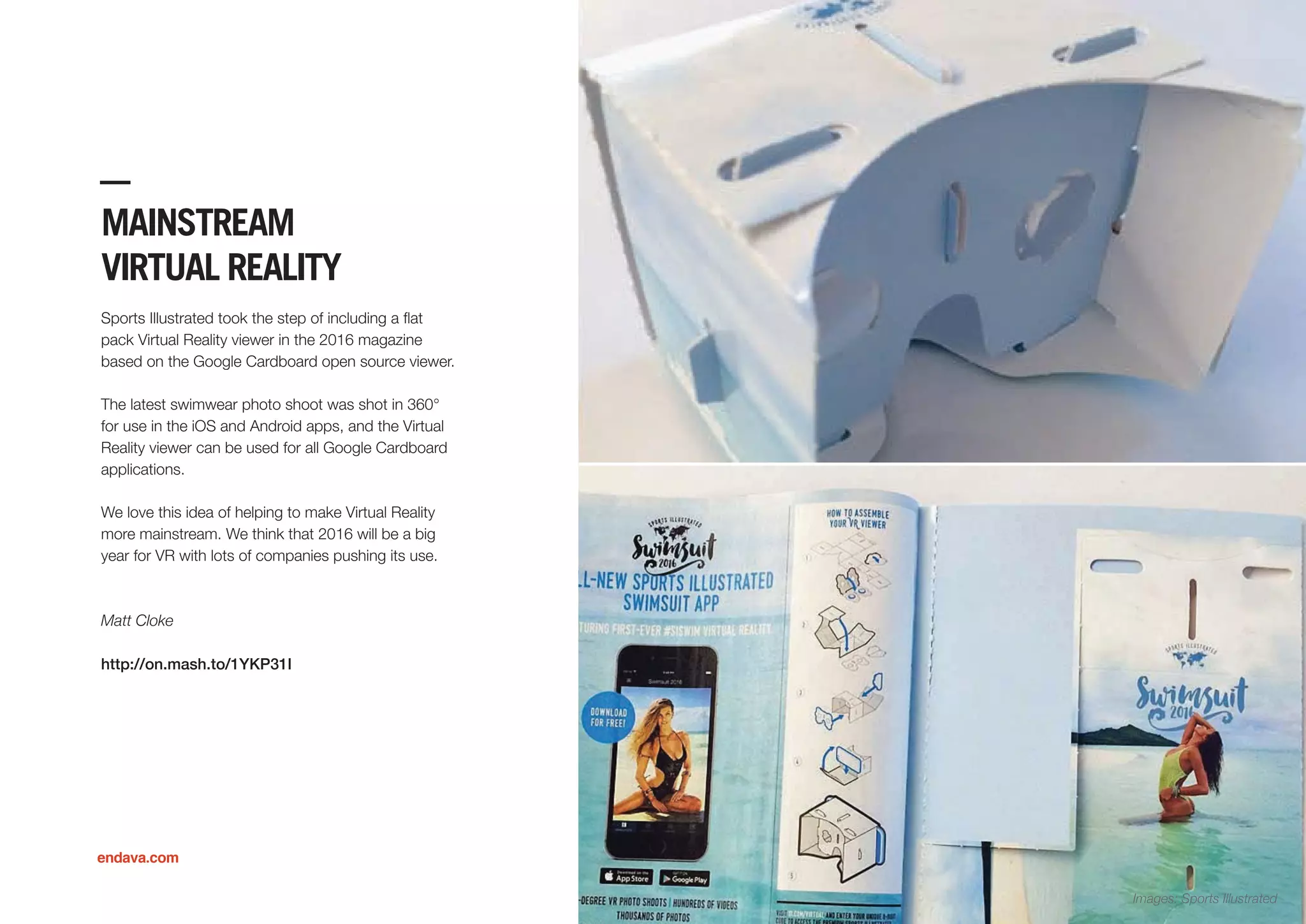
Sports Illustrated took the step of including a flat
pack Virtual Reality viewer in the 2016 magazine
based on the Google Cardboard open source viewer.
The latest swimwear photo shoot was shot in 360°
for use in the iOS and Android apps, and the Virtual
Reality viewer can be used for all Google Cardboard
applications.
We love this idea of helping to make Virtual Reality
more mainstream. We think that 2016 will be a big
year for VR with lots of companies pushing its use.
Matt Cloke
http://on.mash.to/1YKP31I
endava.com
Images: Sports Illustrated
HOLDING A HOSPITAL
RANSOM
Ransomware is when a local computer is encrypted
(usually from a virus) and is only decrypted by
criminals once a ransom has been paid – often in
Bitcoin. There are tales of ransoms being paid and
then repeatedly encrypting systems forcing further
payments.
Currently, hospitals seem to be targeted, for example
the Hollywood Presbyterian Medical Center was
attacked by ransomware in February, which specifi-
cally targeted its Electronic Medical Records System.
The hospital paid $17,000 in Bitcoin straight away, in
order to access its own systems again.
Virus and ransomware attacks are indiscriminate,
with the attack on the Hollywood hospital highlighting
the seriousness.
Martin Smith
http://bit.ly/24bpj3g
endava.com
FUTURE SURVEILLANCE
James Clapper, the US director of national intelli-
gence has announced how the governments around
the world are likely to use IoT (Internet of Things)
devices to spy on people in the future.
“The Internet of Things will connect tens of billions of
new physical devices that could be exploited.
Artificial intelligence will enable computers to make
autonomous decisions about data and physical
systems, and potentially disrupt labour markets,"
Clapper told the Armed Services Committee.
With privacy only now becoming an issue of focus in
the consumer sector, this could have been expected,
but going on record to admit it won’t help the
adoption of IoT devices. Consumers might wish to be
circumspect until more is understood.
Seth Clifford
http://cs.pn/1YKPdX3
endava.com
DYNAMIC PAYMENT CARD
We’ve covered various single card applications over
the years, but Curve sets a new benchmark of simplic-
ity. Curve is a physical Mastercard plastic card which
can change to another other payment card (including
American Express or Visa) controlled from a smart-
phone app.
The application also provides a better interface to
manage transactions across all your cards linked
to Curve.
It does really offer the only card you need to
carry tagline.
Matt Cloke
http://bit.ly/1ROtqNF
endava.com
GOOGLE PAY HANDS FREE
We first covered Google Hands Free last year. It’s
now being trialled in some McDonald’s and Papa
Johns restaurants.
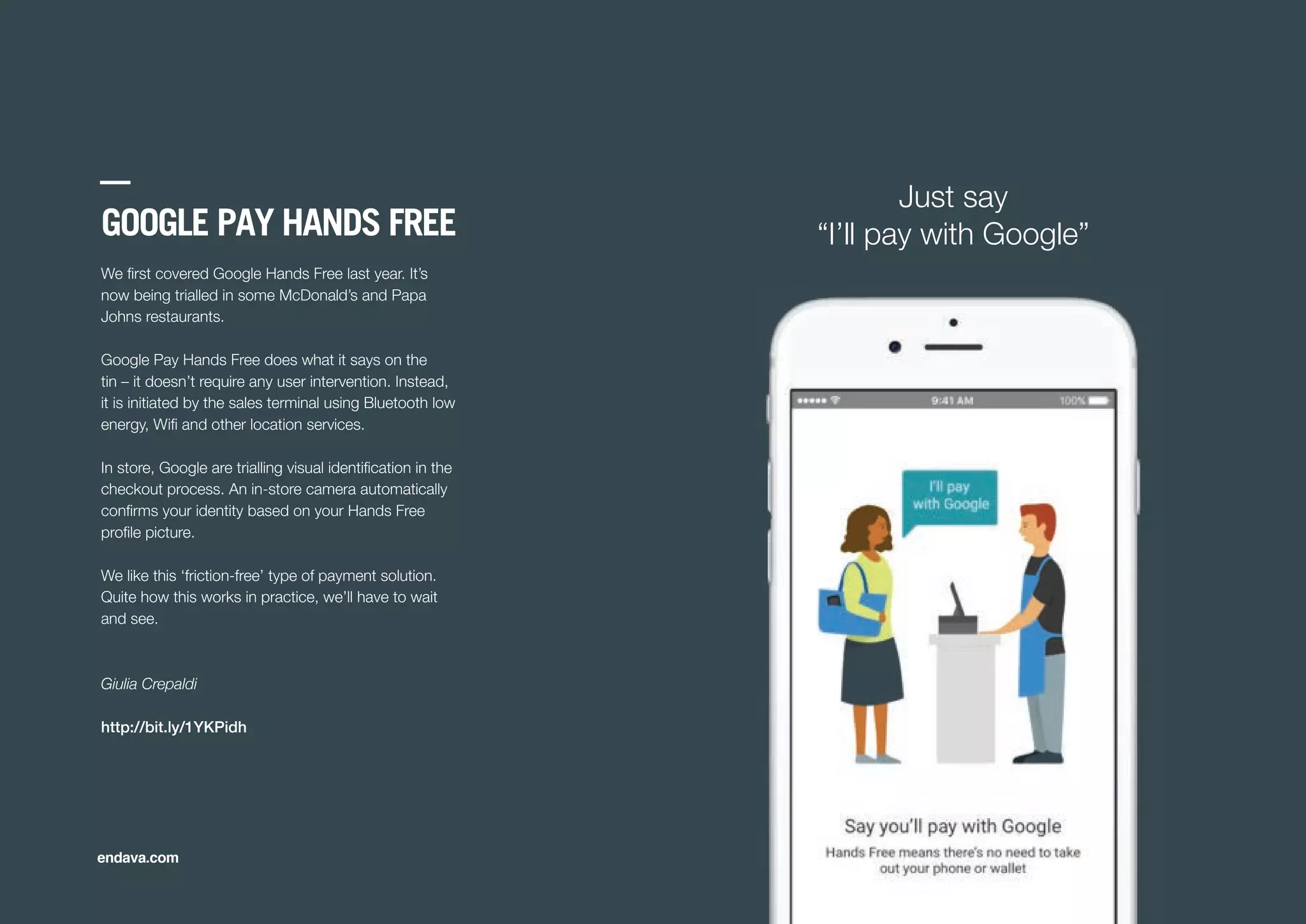
Google Pay Hands Free does what it says on the
tin – it doesn’t require any user intervention. Instead,
it is initiated by the sales terminal using Bluetooth low
energy, Wifi and other location services.
In store, Google are trialling visual identification in the
checkout process. An in-store camera automatically
confirms your identity based on your Hands Free
profile picture.
We like this ‘friction-free’ type of payment solution.
Quite how this works in practice, we’ll have to wait
and see.
Giulia Crepaldi
http://bit.ly/1YKPidh
endava.com
Just say
“I’ll pay with Google”
WEBCAM DIRECTORY
Shodan is a search engine for the Internet of Things
(IoT). Shodan recently launched a new section that
lets users easily browse webcams which do not have
any security settings, enabling anyone to access their
images – many in real-time.
Shodan’s crawling is very simple – it scans IP
addresses, then scans the IP streaming port – Real
Time Streaming Protocol (RTSP, port 554) and if it’s
available, it’s included in the Shodan search results.
On visiting the site, the results are quite shocking.
The lesson learned – if you use a standalone
webcam, make sure it’s secure.
Seth Clifford
http://bit.ly/1PLdJRV
endava.com
SELF-TYING SHOES
FROM NIKE
You might remember the scene from Back to the
Future II where Marty McFly puts on a pair of Nike
trainers which tie themselves.
Some 27 years later, Nike have released a pair of
trainers called HyperAdapt 1.0 which do just as
McFly could do… they tie themselves.
Bradley Howard
http://bit.ly/1RlhxQF
endava.com Image: Nike
MOVIE SEARCH USING
DEEP CONTENT
Ever find yourself trying to explain to a friend “What’s
the name of that film where this and this happened, and
that actor was in it?” Some clever Finns in a startup
called Valossa have produced whatismymovie.com to
help you the next time you’re stuck.
“Valossa Smart Search is based on the company’s
patent-pending, unique deep content models that are
constructed from various descriptive movie data
sources from all over the Web. These models are then
ranked using the company’s proprietary natural
query engine.”
The site is worth a try. We tried some obscure descrip-
tions in the office and it worked every time (including
some rarer films).
Giulia Crepaldi
http://bit.ly/1M41grF
endava.com
ABOUT ENDAVA
Endava is a privately owned IT services company with over 2,500 employees
and offices in New York, Atlanta, New Jersey, London and Frankfurt and 6 delivery
centers across Romania, Moldova, Macedonia and Serbia.
Formed in 2000, Endava works with some of the world’s biggest brands in Finance,
Insurance, Telecommunications, Media, Technology, and Retail, helping them
harness digital technologies and transforming them into more agile, responsive and
valuable businesses.
endava.com
MARTIN SMITH
Head of Delivery, Digital Media
martin.smith@endava.com
BRADLEY HOWARD
Head of Digital Media
bradley.howard@endava.com
endava.com
UK + 44 20 7367 1000
USA + 1 212 920 7240
Germany + 49 69 999 9115 0

Marketplace Innovation Report | Q2, 2016

  • 1.
  • 2.
    ABOUT THIS REPORT Welcometo the latest edition of the Quarterly Innovation Report. This edition is packed with contributions from people across Endava and covers many industries. It contains really cool, innovative projects that span robotics, business intelligence, security and payments. These projects are the cutting edge of the industry and we often use these as inspiration for clients who are embarking on a Digital Transformation programme. endava.com
  • 3.
    FACEBOOK LIVE Facebook willsoon release one of the biggest updates to the platform, enabling users to update their status with a live video. The new feature will be a combination of Snapchat, Skype and YouTube, and will be fully integrated into the current web and mobile applications (in the update status area). We see this only as a positive step (for Facebook), making the platform contain even richer content, and in the near future we expect Facebook to mainly consist of video content. Be prepared for lots of people live streaming around you! Martin Smith http://bit.ly/1Z94ge4 endava.com
  • 4.
    MOZILLA IS FLAILINGWHEN THE INTERNET NEEDS IT THE MOST When the Internet was first invented, the thought of a handful of companies providing tools to access this content was against the very principle of its ‘openness’. When Microsoft’s bulldozed their way into the market, users were forced to use its own web browser, Internet Explorer, governments stepped in to legislate against its growth. Which is why the position Mozilla currently finds itself in, with an ever decreasing web browser market share and a tiny mobile browser market share, potential bad news for all of us. This could be ironic – it’s the population of the Internet who may need Mozilla the most, yet it is us who are turning backs on it. Martin Smith http://bit.ly/1lDrFWk endava.com
  • 5.
    WEARABLES We like thisarticle describing the history of wearable devices, and the infographic that appears at the end. The article describes how the latest devices are an evolution of technologies created several years, sometimes decades ago. The biggest rise of new technologies occurred in the 1990s – since then, wearable technologies have focussed on miniaturisa- tion and convergence, rather than new inventions. Matt Cloke http://tcrn.ch/1P7opPK endava.com
  • 6.
    TEACHING THE AITO SEE AND UNDERSTAND More AI, Google now offers its Cloud Vision technol- ogy on a usage-fee basis. This detects the content of image and classifies its content into categories. Companies which want to use any of the Cloud Vision features including Label Detection, OCR (Optical Character Recognition), Explicit Content Detection, Facial Detection, Landmark Detection, Logo Detection or Image properties can use Google’s platform rather than pay for expensive licences (plus hardware). There is a suggestion that can also work in real-time which adds some interesting possibilities. Matt Cloke http://bit.ly/21xSsUV endava.com
  • 7.
    OPEN SOURCE AI AIhas been around for some time, but it’s interesting to see that Google has made one of its key AI technologies open source, leading to a flurry of interesting third party applications. Google uses the technology internally for speech recognition, Gmail, Google Photos and search. There are now a range of AI technologies available, and we could see a new generation of applications using AI, one of the most interesting computer discoveries, in the near future. Martin Smith http://bit.ly/1SExy0M http://bit.ly/1MWEhkH endava.com
  • 8.
    MIT What do Touchscreens,e-Ink (think of the Kindle), GPS and wearables have in common? They were all conceived and developed in the MIT Lab. This excellent highlights video shows some of MIT Lab’s historical (and successful) projects, and a gives a hint of some of the projects they are currently working on. Without MIT we wouldn’t have had a lot of the breakthroughs that we take for granted now. Martin Smith http://bit.ly/1M1irbY endava.com
  • 9.
    UPGRADE YOUR BROWSER, ORELSE Security standard SHA1 has been known to have vulner- abilities and has been replaced with SHA256 instead. The problem is that around 7 percent of browsers support SHA1 and not SHA256, forcing companies to choose between higher browser penetration (i.e. more users) or higher security. Most of these users are based in developing countries who struggle to get online. This affects the bigger technology companies the most, with Facebook blocking access to ‘tens of millions’ of their users if they switch to SHA256. Daniel Ciocirlan http://bit.ly/1QAnoP7 endava.com
  • 10.
    IBM WATSON TRENDAPP Following on the AI theme, IBM have released a mobile app (available for Android and iOS) to showcase its own AI platform, Watson. The mobile app tries to make useful suggestions when buying specified items, based on several data sources. We like the app itself, but the overall concept of choosing which item to buy doesn’t seem to be challenging enough for such a showcase AI platform. If Watson is supposed to be so artificially intelligent, perhaps it could help answer more complex questions such as outcomes in sporting or political events. Mike King http://bit.ly/1YKOLbl http://apple.co/1VGV8Pk endava.com
  • 11.
    HASHCAT IS NOW OPENSOURCE Hashcat is one of the best password recovery tools – which takes a hash value and can generate the password, even if it’s a relatively complex password combing numbers and letters. Hashcat has now been made open source on github, the popular code sharing website. Experts claim that making password recovery tools open source helps them to test how good their own encryption systems are. Daniel Ciocirlan http://bit.ly/1T3lEM6 endava.com
  • 12.
    HTTP/2 Get ready forfaster internet browsing. In January we saw the new release of the major Internet protocol, HTTP/2. HTTP/2 has been implemented in Chrome and Firefox (at time of writing). As of February 2016, under 7% of servers supported HTTP/2. HTTP/2 promises a speed increase by sending objects to the browser before they’ve been requested, some data compression, and parallel requests on a single TCP connection. Initial tests show some speed benefits. (Related to the new http/2, which comes with a lot of interesting improvements, i.e. multiplexing and headers compression. The downside of it is that it’s binary, so one needs a special tool to read it…) Daniel Ciocirlan http://bit.ly/26jxo74 endava.com
  • 13.
    CONTRACTUAL INNOVATION Gogo provides theinflight Internet connectivity to American Airlines. The airline is suing Gogo over poor Internet performance and its technical limitations. What caught our eye though, was the contractual obligation “American notes that its contract with Gogo permits it to switch providers if Gogo is unable to match the tech innovations of its competitors”. This is an astonishing legal clause for a technology company! Martin Smith http://bit.ly/1YKOUvm endava.com
  • 14.
    HOW NETFLIX IS CHANGING OverChristmas, Netflix launched a single show “A Very Murray Christmas”, a departure from securing cheaper film rights or TV box sets. The programme demonstrates how Netflix has become more mainstream with its audience (and reflects to some degree its audience demographics) and is competing head to head with traditional TV broadcasters. Unfortunately, the reviews didn’t rate the programme highly, but full marks for trying. Martin Smith http://nflx.it/23NZbh7 endava.com
  • 15.
    MAINSTREAM VIRTUAL REALITY Sports Illustratedtook the step of including a flat pack Virtual Reality viewer in the 2016 magazine based on the Google Cardboard open source viewer. The latest swimwear photo shoot was shot in 360° for use in the iOS and Android apps, and the Virtual Reality viewer can be used for all Google Cardboard applications. We love this idea of helping to make Virtual Reality more mainstream. We think that 2016 will be a big year for VR with lots of companies pushing its use. Matt Cloke http://on.mash.to/1YKP31I endava.com Images: Sports Illustrated
  • 16.
    HOLDING A HOSPITAL RANSOM Ransomwareis when a local computer is encrypted (usually from a virus) and is only decrypted by criminals once a ransom has been paid – often in Bitcoin. There are tales of ransoms being paid and then repeatedly encrypting systems forcing further payments. Currently, hospitals seem to be targeted, for example the Hollywood Presbyterian Medical Center was attacked by ransomware in February, which specifi- cally targeted its Electronic Medical Records System. The hospital paid $17,000 in Bitcoin straight away, in order to access its own systems again. Virus and ransomware attacks are indiscriminate, with the attack on the Hollywood hospital highlighting the seriousness. Martin Smith http://bit.ly/24bpj3g endava.com
  • 17.
    FUTURE SURVEILLANCE James Clapper,the US director of national intelli- gence has announced how the governments around the world are likely to use IoT (Internet of Things) devices to spy on people in the future. “The Internet of Things will connect tens of billions of new physical devices that could be exploited. Artificial intelligence will enable computers to make autonomous decisions about data and physical systems, and potentially disrupt labour markets," Clapper told the Armed Services Committee. With privacy only now becoming an issue of focus in the consumer sector, this could have been expected, but going on record to admit it won’t help the adoption of IoT devices. Consumers might wish to be circumspect until more is understood. Seth Clifford http://cs.pn/1YKPdX3 endava.com
  • 18.
    DYNAMIC PAYMENT CARD We’vecovered various single card applications over the years, but Curve sets a new benchmark of simplic- ity. Curve is a physical Mastercard plastic card which can change to another other payment card (including American Express or Visa) controlled from a smart- phone app. The application also provides a better interface to manage transactions across all your cards linked to Curve. It does really offer the only card you need to carry tagline. Matt Cloke http://bit.ly/1ROtqNF endava.com
  • 19.
    GOOGLE PAY HANDSFREE We first covered Google Hands Free last year. It’s now being trialled in some McDonald’s and Papa Johns restaurants. Google Pay Hands Free does what it says on the tin – it doesn’t require any user intervention. Instead, it is initiated by the sales terminal using Bluetooth low energy, Wifi and other location services. In store, Google are trialling visual identification in the checkout process. An in-store camera automatically confirms your identity based on your Hands Free profile picture. We like this ‘friction-free’ type of payment solution. Quite how this works in practice, we’ll have to wait and see. Giulia Crepaldi http://bit.ly/1YKPidh endava.com Just say “I’ll pay with Google”
  • 20.
    WEBCAM DIRECTORY Shodan isa search engine for the Internet of Things (IoT). Shodan recently launched a new section that lets users easily browse webcams which do not have any security settings, enabling anyone to access their images – many in real-time. Shodan’s crawling is very simple – it scans IP addresses, then scans the IP streaming port – Real Time Streaming Protocol (RTSP, port 554) and if it’s available, it’s included in the Shodan search results. On visiting the site, the results are quite shocking. The lesson learned – if you use a standalone webcam, make sure it’s secure. Seth Clifford http://bit.ly/1PLdJRV endava.com
  • 21.
    SELF-TYING SHOES FROM NIKE Youmight remember the scene from Back to the Future II where Marty McFly puts on a pair of Nike trainers which tie themselves. Some 27 years later, Nike have released a pair of trainers called HyperAdapt 1.0 which do just as McFly could do… they tie themselves. Bradley Howard http://bit.ly/1RlhxQF endava.com Image: Nike
  • 22.
    MOVIE SEARCH USING DEEPCONTENT Ever find yourself trying to explain to a friend “What’s the name of that film where this and this happened, and that actor was in it?” Some clever Finns in a startup called Valossa have produced whatismymovie.com to help you the next time you’re stuck. “Valossa Smart Search is based on the company’s patent-pending, unique deep content models that are constructed from various descriptive movie data sources from all over the Web. These models are then ranked using the company’s proprietary natural query engine.” The site is worth a try. We tried some obscure descrip- tions in the office and it worked every time (including some rarer films). Giulia Crepaldi http://bit.ly/1M41grF endava.com
  • 23.
    ABOUT ENDAVA Endava isa privately owned IT services company with over 2,500 employees and offices in New York, Atlanta, New Jersey, London and Frankfurt and 6 delivery centers across Romania, Moldova, Macedonia and Serbia. Formed in 2000, Endava works with some of the world’s biggest brands in Finance, Insurance, Telecommunications, Media, Technology, and Retail, helping them harness digital technologies and transforming them into more agile, responsive and valuable businesses. endava.com
  • 24.
    MARTIN SMITH Head ofDelivery, Digital Media martin.smith@endava.com BRADLEY HOWARD Head of Digital Media bradley.howard@endava.com endava.com UK + 44 20 7367 1000 USA + 1 212 920 7240 Germany + 49 69 999 9115 0