We must plan for the future, because
people who stay in the present will
remain in the past.
Abraham Lincoln
Table of contents
1. The Marketing Mix
2. Market Segmentation
3. The Product Life Cycle
4. The Sales Funnel
5. The Product Diffusion Curve
6. The Ansoff Matrix
7. The Brand Pyramid
8. Kapferer's Brand Identity Prism
9. The Buy-Sell Hierarchy
The Marketing Mix
The Marketing Mix:
Product
• What does the customer want from the
product/service? What needs does it satisfy?
• How and where will the customer use it?
• What does it look like? How will customers
experience it?
• What size(s), color(s), and so on, should it be?
• What is it to be called?
• How is it branded?
• How is it differentiated versus your competitors?
• What is the most it can cost to provide, and still be
sold sufficiently profitably?
The Marketing Mix:
Price
• What is the value of the product or service to the
buyer?
• Are there established price points for products or
services in this area?
• Is the customer price sensitive? Will a small
decrease in price gain you extra market share? Or
will a small increase be indiscernible, and so gain
you extra profit margin?
• What discounts should be offered to trade
customers, or to other specific segments of your
market?
• How will your price compare with your
competitors?
The Marketing Mix:
Promotion
• Where and when can you get across your
marketing messages to your target market?
• Will you reach your audience by advertising in the
press, or on TV, or radio, or on billboards? By
using direct marketing mailshot? Through PR? On
the Internet?
• When is the best time to promote? Is there
seasonality in the market? Are there any wider
environmental issues that suggest or dictate the
timing of your market launch, or the timing of
subsequent promotions?
The Marketing Mix:
Place
• Where do buyers look for your product or
service?
• If they look in a store, what kind? A specialist
boutique or in a supermarket, or both? Or
online? Or direct, via a catalogue?
• How can you access the right distribution
channels?
• Do you need to use a sales force?
• What do you competitors do, and how can you
learn from that and/or differentiate?
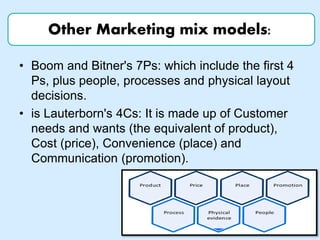
Other Marketing mix models:
• Boom and Bitner's 7Ps: which include the first 4
Ps, plus people, processes and physical layout
decisions.
• is Lauterborn's 4Cs: It is made up of Customer
needs and wants (the equivalent of product),
Cost (price), Convenience (place) and
Communication (promotion).
Market Segmentation
Market Segmentation
Market segmentation is the process that
companies use to divide large,
heterogeneous markets into small markets
that can be reached more efficiently and
effectively with products and services that
match their unique needs.
Market Segmentation
• Segmenting consumer
markets
• Segmenting business
markets
• Segmenting international
markets
• Requirements for effective
segmentation
Market Segmentation
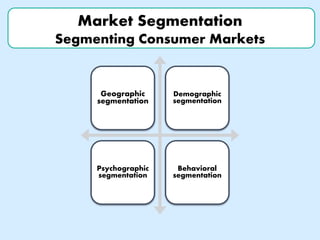
Segmenting Consumer Markets
Geographic
segmentation
Demographic
segmentation
Psychographic
segmentation
Behavioral
segmentation
Market Segmentation
Segmenting Consumer Markets
Geographic segmentation divides the
market into different geographical units
such as nations, regions, states, counties,
or cities.
Market Segmentation
Segmenting Consumer Markets
Demographic
segmentation divides the
market into groups based
on variables such as age,
gender, family size, family
life cycle, income,
occupation, education,
religion, race, generation,
and nationality.
Market Segmentation
Segmenting Consumer Markets
Income segmentation divides the market
into affluent or low-income consumers
Psychographic segmentation divides
buyers into different groups based on
social class, lifestyle, or personality traits.
Market Segmentation
Segmenting Consumer Markets
• Age and life-cycle stage segmentation is
the process of offering different products
or using different marketing approaches
for different age and life-cycle groups .
• Gender segmentation divides the market
based on sex (male or female)
Market Segmentation
Segmenting Consumer Markets
Behavioral segmentation divides buyers
into groups based on their knowledge,
attitudes, uses, or responses to a product
• Occasions
• Benefits sought
• User status
• Usage rate
• Loyalty status
Behavioral Segmentation Breakdown
Market Segmentation
Using Multiple Segmentation Bases
• Multiple segmentation is used to identify
smaller, better-defined target groups.
• Geodemographic segmentation is an
example of multivariable segmentation
that divides groups into consumer lifestyle
patterns.
Market Segmentation
Segmenting International markets
Geographic location Economic factors
Political-legal factors Cultural factors
Market Segmentation
Segmenting Business Markets
Intermarket segmentation divides
consumers into groups with similar needs
and buying behaviors even though they
are located in different countries.
Market Segmentation
Requirements for Effective Segmentation
To be useful, market segments must be:
• Measurable
• Accessible
• Substantial
• Differentiable
• Actionable
The Product Life Cycle
Development stage
• the product goes through testing and a
prototype is developed.
• This is after considerable market research
to identify consumer needs and wants.
• If the product is deemed commercially
viable, may be put into mass production
and launched.
The Product Life Cycle
Introduction stage
• The most expensive
stage
• The size of the market is
small
• Means sales are low
• The costs are very high
The Product Life Cycle
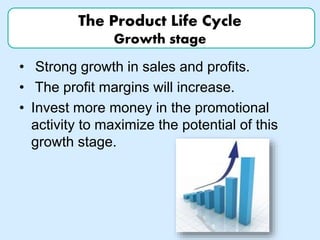
Growth stage
• Strong growth in sales and profits.
• The profit margins will increase.
• Invest more money in the promotional
activity to maximize the potential of this
growth stage.
The Product Life Cycle
Maturity stage
• The product is established.
• The aim is now to maintain the market
share.
• the most competitive time for most
products.
• need to invest wisely in any marketing
process.
The Product Life Cycle
Maturity stage
• The market for a product will start to
shrink.
• Consumers are switching to a different
type of product.
• This decline may be inevitable.
• That is possible to make some profit by
switching to less-expensive production
methods and cheaper markets.
The Sales Funnel
The Sales Funnel
What is it?
• A sales funnel is a visual representation of
the steps required to sell your products or
services.
• That should reveal how many prospects
you have in each stage of your sales
cycle, and also detail your conversion
rates for each stage.
The Sales Funnel
Measures
• Number of opportunities in your funnel (#). You
should also know the rate at which you are
acquiring these opportunities – or arrival rate.
• The total possible value of every deal in your
funnel – or funnel value ($).
• Average amount of time prospects are in the sales
funnel until they are acquired - or flow rate (days).
• Average percentage of closes that your team
effectively navigates through your funnel - or win
rate (%).
The Product Diffusion Curve
Innovators
• know consumers who are willing to take a
risk on a new product.
• They Represent the first 2.5% of people to
adopt a new product.
• They'll most likely be knowledgeable and
self-confident.
The Product Diffusion Curve
Early Adopters
• Members of this group gauge the
response of the Innovators before rushing
in purchasing a new product.
• They'll probably be educated and
somewhat product savvy.
• They represent about 13.5% of the total
consumer population.
The Product Diffusion Curve
Early Majority
• They are more cautious and prefer to
avoid the risk associated with purchasing
an unproven product.
• They accept a product only after it has
been approved by others.
• waiting for the recommendations or
product endorsements.
• they represent 34% of consumers.
The Product Diffusion Curve
Late Majority
• Members of this group are more skeptical.
• They are late to jump on board and do so
only after a new product becomes
mainstream.
• They represent about 34% of consumers.
The Product Diffusion Curve
Laggards
• they generally do not accept a new
product until more traditional alternatives
no longer are available.
• They represent about 16% of consumers.
The Ansoff Matrix
Understanding the Risks of Different
Options
The Ansoff Matrix
Market Development
• Target different geographical markets at
home or abroad.
• Use different sales channels, such as
online or direct sales if you are currently
selling through the trade.
• Target different groups of people, perhaps
different age groups, genders or
demographic profiles from your normal
customers.
The Ansoff Matrix
Diversification
• This strategy is risky.
• There’s often little scope for using existing
expertise or achieving economies of scale.
• Its main advantage is that, should one
business suffer from adverse
circumstances, the other is unlikely to be
affected.
The Ansoff Matrix
Market Penetration
• Advertise, to encourage more people
within your existing market to choose your
product, or to use more of it.
• Introduce a loyalty scheme.
• Launch price or other special offer
promotions.
• Increase your sales force activities.
• Buy a competitor company.
The Ansoff Matrix
Product Development
• Extend your product by producing different
variants, or packaging existing products it in
new ways.
• Develop related products or services (for
example, a domestic plumbing company
might add a tiling service – after all, if they’re
plumbing in a new kitchen, most likely tiling
will be needed!)
• In a service industry, increase your time to
market, customer service.
The Brand Pyramid
The Brand Pyramid
Level 1: Presence
• Customers are aware of your brand, but
little else.
• .They may have tried your products and
services before, but they have little or no
emotional attachment to them.
The Brand Pyramid
Level 2: Relevance
• customers start to think about whether the
brand meets their wants and needs.
• It's here that they begin comparing the cost of
your products with respect to the value these
provide.
• Customers begin asking questions like:
– "Does this brand fit my needs?"
– "Is it in the right price bracket for me?"
– "Is it worth it?"
The Brand Pyramid
Level 3: Performance
• Customers begin comparing the brand
with others, to see whether it delivers on
its potential.
• They're also starting to associate the
brand with a specific identity.
• They're beginning to recognize it and
associate with it.
The Brand Pyramid
Level 4: Advantage
• Customers have determined that there is a
distinct advantage to using the brand,
compared with others.
• They're also beginning to associate the
brand with their emotions and with their
sense of self.
The Brand Pyramid
Level 5: Bonding
• Customers have established a bond with
the brand.
• They have determined that cost,
advantage, and performance are all at
levels that they're happy with.
• They've also formed a strong emotional
attachment to the brand.
• Customers at this level are also likely to be
vocal advocates of the brand,
Kapferer's Brand Identity Prism
Kapferer's Brand Identity Prism:
1. Physique
By the brand’s physique the physical
appearance is meant. This includes a
prototype of the brand: the product that
represents the brand’s qualities.
Kapferer's Brand Identity Prism:
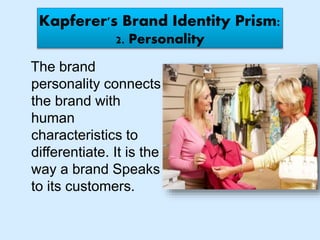
2. Personality
The brand
personality connects
the brand with
human
characteristics to
differentiate. It is the
way a brand Speaks
to its customers.
Kapferer's Brand Identity Prism:
3. Relationship
Every brand tries to build a relationship
with its customers. This relationship is
more obvious for service brands, but
product brands like Porsche and Morgan
build relationships with their clients The
question here is what role does the brand
occupy in the relationship. It could be
being a friend or being dominant.
Kapferer's Brand Identity Prism:
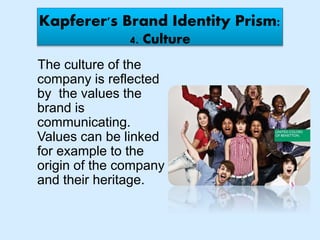
4. Culture
The culture of the
company is reflected
by the values the
brand is
communicating.
Values can be linked
for example to the
origin of the company
and their heritage.
Kapferer's Brand Identity Prism:
5. Reflection
The reflection of a brand can be seen as
the typical user of the product it is the
outward mirror of the brand. It therefore
often gets confused with the target market.
Kapferer's Brand Identity Prism:
6. self-image
The self-image is the
way customers see
themselves when using
the brand and how this
makes them feel.
The Buy-Sell Hierarchy
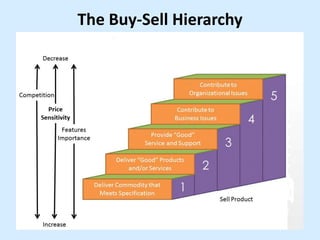
Level 1: Delivers a Commodity That Meets
Specifications
• Customers consider you to be one of
many suppliers.
• There's little sense of a relationship at this
level.
• You have likely won this account based on
price or availability.
• If a competitor makes a better offer, your
customers will switch supplier.
The Buy-Sell Hierarchy
Level 2: Delivers Good Products and Services
• Customers see you as a supplier of "good"
but not "great" products.
• You've understood some of their needs,
• you can't stay at level 2 for long. Once
your competitors learn about the new
aspects of your product, they'll quickly
follow suit.
The Buy-Sell Hierarchy
Level 3: Provides Dedicated Service and
Support
• You demonstrate your commitment to your
customers by investing a lot of time in your
relationships, and by providing close
personal attention.
• competitors can still "up their game" and
match your offering.
The Buy-Sell Hierarchy
Level 4: Contributes to Business Issues
• Customers see you as an ally who helps
them solve business issues, and helps
them be more profitable.
• To reach this level, your customers must
see the connection between your
contribution and their success.
The Buy-Sell Hierarchy
Level 5: Contributes to Organizational Issues
• You have truly become your customers'
partner.
• You work closely together to solve pressing
organizational issues, and they see you as an
expert that they can't do without.
• you have an ironclad competitive advantage,
because you provide solutions that robustly
contribute to your customers' bottom line.
THANK YOU

Marketing strategy tools

  • 2.
    We must planfor the future, because people who stay in the present will remain in the past. Abraham Lincoln
  • 3.
    Table of contents 1.The Marketing Mix 2. Market Segmentation 3. The Product Life Cycle 4. The Sales Funnel 5. The Product Diffusion Curve 6. The Ansoff Matrix 7. The Brand Pyramid 8. Kapferer's Brand Identity Prism 9. The Buy-Sell Hierarchy
  • 4.
  • 5.
    The Marketing Mix: Product •What does the customer want from the product/service? What needs does it satisfy? • How and where will the customer use it? • What does it look like? How will customers experience it? • What size(s), color(s), and so on, should it be? • What is it to be called? • How is it branded? • How is it differentiated versus your competitors? • What is the most it can cost to provide, and still be sold sufficiently profitably?
  • 6.
    The Marketing Mix: Price •What is the value of the product or service to the buyer? • Are there established price points for products or services in this area? • Is the customer price sensitive? Will a small decrease in price gain you extra market share? Or will a small increase be indiscernible, and so gain you extra profit margin? • What discounts should be offered to trade customers, or to other specific segments of your market? • How will your price compare with your competitors?
  • 7.
    The Marketing Mix: Promotion •Where and when can you get across your marketing messages to your target market? • Will you reach your audience by advertising in the press, or on TV, or radio, or on billboards? By using direct marketing mailshot? Through PR? On the Internet? • When is the best time to promote? Is there seasonality in the market? Are there any wider environmental issues that suggest or dictate the timing of your market launch, or the timing of subsequent promotions?
  • 8.
    The Marketing Mix: Place •Where do buyers look for your product or service? • If they look in a store, what kind? A specialist boutique or in a supermarket, or both? Or online? Or direct, via a catalogue? • How can you access the right distribution channels? • Do you need to use a sales force? • What do you competitors do, and how can you learn from that and/or differentiate?
  • 9.
    Other Marketing mixmodels: • Boom and Bitner's 7Ps: which include the first 4 Ps, plus people, processes and physical layout decisions. • is Lauterborn's 4Cs: It is made up of Customer needs and wants (the equivalent of product), Cost (price), Convenience (place) and Communication (promotion).
  • 10.
  • 11.
    Market Segmentation Market segmentationis the process that companies use to divide large, heterogeneous markets into small markets that can be reached more efficiently and effectively with products and services that match their unique needs.
  • 12.
    Market Segmentation • Segmentingconsumer markets • Segmenting business markets • Segmenting international markets • Requirements for effective segmentation
  • 13.
    Market Segmentation Segmenting ConsumerMarkets Geographic segmentation Demographic segmentation Psychographic segmentation Behavioral segmentation
  • 14.
    Market Segmentation Segmenting ConsumerMarkets Geographic segmentation divides the market into different geographical units such as nations, regions, states, counties, or cities.
  • 15.
    Market Segmentation Segmenting ConsumerMarkets Demographic segmentation divides the market into groups based on variables such as age, gender, family size, family life cycle, income, occupation, education, religion, race, generation, and nationality.
  • 16.
    Market Segmentation Segmenting ConsumerMarkets Income segmentation divides the market into affluent or low-income consumers Psychographic segmentation divides buyers into different groups based on social class, lifestyle, or personality traits.
  • 17.
    Market Segmentation Segmenting ConsumerMarkets • Age and life-cycle stage segmentation is the process of offering different products or using different marketing approaches for different age and life-cycle groups . • Gender segmentation divides the market based on sex (male or female)
  • 18.
    Market Segmentation Segmenting ConsumerMarkets Behavioral segmentation divides buyers into groups based on their knowledge, attitudes, uses, or responses to a product • Occasions • Benefits sought • User status • Usage rate • Loyalty status
  • 19.
  • 20.
    Market Segmentation Using MultipleSegmentation Bases • Multiple segmentation is used to identify smaller, better-defined target groups. • Geodemographic segmentation is an example of multivariable segmentation that divides groups into consumer lifestyle patterns.
  • 21.
    Market Segmentation Segmenting Internationalmarkets Geographic location Economic factors Political-legal factors Cultural factors
  • 22.
    Market Segmentation Segmenting BusinessMarkets Intermarket segmentation divides consumers into groups with similar needs and buying behaviors even though they are located in different countries.
  • 23.
    Market Segmentation Requirements forEffective Segmentation To be useful, market segments must be: • Measurable • Accessible • Substantial • Differentiable • Actionable
  • 24.
  • 25.
    The Product LifeCycle Development stage • the product goes through testing and a prototype is developed. • This is after considerable market research to identify consumer needs and wants. • If the product is deemed commercially viable, may be put into mass production and launched.
  • 26.
    The Product LifeCycle Introduction stage • The most expensive stage • The size of the market is small • Means sales are low • The costs are very high
  • 27.
    The Product LifeCycle Growth stage • Strong growth in sales and profits. • The profit margins will increase. • Invest more money in the promotional activity to maximize the potential of this growth stage.
  • 28.
    The Product LifeCycle Maturity stage • The product is established. • The aim is now to maintain the market share. • the most competitive time for most products. • need to invest wisely in any marketing process.
  • 29.
    The Product LifeCycle Maturity stage • The market for a product will start to shrink. • Consumers are switching to a different type of product. • This decline may be inevitable. • That is possible to make some profit by switching to less-expensive production methods and cheaper markets.
  • 30.
  • 31.
    The Sales Funnel Whatis it? • A sales funnel is a visual representation of the steps required to sell your products or services. • That should reveal how many prospects you have in each stage of your sales cycle, and also detail your conversion rates for each stage.
  • 32.
    The Sales Funnel Measures •Number of opportunities in your funnel (#). You should also know the rate at which you are acquiring these opportunities – or arrival rate. • The total possible value of every deal in your funnel – or funnel value ($). • Average amount of time prospects are in the sales funnel until they are acquired - or flow rate (days). • Average percentage of closes that your team effectively navigates through your funnel - or win rate (%).
  • 33.
  • 34.
    The Product DiffusionCurve Innovators • know consumers who are willing to take a risk on a new product. • They Represent the first 2.5% of people to adopt a new product. • They'll most likely be knowledgeable and self-confident.
  • 35.
    The Product DiffusionCurve Early Adopters • Members of this group gauge the response of the Innovators before rushing in purchasing a new product. • They'll probably be educated and somewhat product savvy. • They represent about 13.5% of the total consumer population.
  • 36.
    The Product DiffusionCurve Early Majority • They are more cautious and prefer to avoid the risk associated with purchasing an unproven product. • They accept a product only after it has been approved by others. • waiting for the recommendations or product endorsements. • they represent 34% of consumers.
  • 37.
    The Product DiffusionCurve Late Majority • Members of this group are more skeptical. • They are late to jump on board and do so only after a new product becomes mainstream. • They represent about 34% of consumers.
  • 38.
    The Product DiffusionCurve Laggards • they generally do not accept a new product until more traditional alternatives no longer are available. • They represent about 16% of consumers.
  • 39.
    The Ansoff Matrix Understandingthe Risks of Different Options
  • 40.
    The Ansoff Matrix MarketDevelopment • Target different geographical markets at home or abroad. • Use different sales channels, such as online or direct sales if you are currently selling through the trade. • Target different groups of people, perhaps different age groups, genders or demographic profiles from your normal customers.
  • 41.
    The Ansoff Matrix Diversification •This strategy is risky. • There’s often little scope for using existing expertise or achieving economies of scale. • Its main advantage is that, should one business suffer from adverse circumstances, the other is unlikely to be affected.
  • 42.
    The Ansoff Matrix MarketPenetration • Advertise, to encourage more people within your existing market to choose your product, or to use more of it. • Introduce a loyalty scheme. • Launch price or other special offer promotions. • Increase your sales force activities. • Buy a competitor company.
  • 43.
    The Ansoff Matrix ProductDevelopment • Extend your product by producing different variants, or packaging existing products it in new ways. • Develop related products or services (for example, a domestic plumbing company might add a tiling service – after all, if they’re plumbing in a new kitchen, most likely tiling will be needed!) • In a service industry, increase your time to market, customer service.
  • 44.
  • 45.
    The Brand Pyramid Level1: Presence • Customers are aware of your brand, but little else. • .They may have tried your products and services before, but they have little or no emotional attachment to them.
  • 46.
    The Brand Pyramid Level2: Relevance • customers start to think about whether the brand meets their wants and needs. • It's here that they begin comparing the cost of your products with respect to the value these provide. • Customers begin asking questions like: – "Does this brand fit my needs?" – "Is it in the right price bracket for me?" – "Is it worth it?"
  • 47.
    The Brand Pyramid Level3: Performance • Customers begin comparing the brand with others, to see whether it delivers on its potential. • They're also starting to associate the brand with a specific identity. • They're beginning to recognize it and associate with it.
  • 48.
    The Brand Pyramid Level4: Advantage • Customers have determined that there is a distinct advantage to using the brand, compared with others. • They're also beginning to associate the brand with their emotions and with their sense of self.
  • 49.
    The Brand Pyramid Level5: Bonding • Customers have established a bond with the brand. • They have determined that cost, advantage, and performance are all at levels that they're happy with. • They've also formed a strong emotional attachment to the brand. • Customers at this level are also likely to be vocal advocates of the brand,
  • 50.
  • 51.
    Kapferer's Brand IdentityPrism: 1. Physique By the brand’s physique the physical appearance is meant. This includes a prototype of the brand: the product that represents the brand’s qualities.
  • 52.
    Kapferer's Brand IdentityPrism: 2. Personality The brand personality connects the brand with human characteristics to differentiate. It is the way a brand Speaks to its customers.
  • 53.
    Kapferer's Brand IdentityPrism: 3. Relationship Every brand tries to build a relationship with its customers. This relationship is more obvious for service brands, but product brands like Porsche and Morgan build relationships with their clients The question here is what role does the brand occupy in the relationship. It could be being a friend or being dominant.
  • 54.
    Kapferer's Brand IdentityPrism: 4. Culture The culture of the company is reflected by the values the brand is communicating. Values can be linked for example to the origin of the company and their heritage.
  • 55.
    Kapferer's Brand IdentityPrism: 5. Reflection The reflection of a brand can be seen as the typical user of the product it is the outward mirror of the brand. It therefore often gets confused with the target market.
  • 56.
    Kapferer's Brand IdentityPrism: 6. self-image The self-image is the way customers see themselves when using the brand and how this makes them feel.
  • 57.
  • 58.
    The Buy-Sell Hierarchy Level1: Delivers a Commodity That Meets Specifications • Customers consider you to be one of many suppliers. • There's little sense of a relationship at this level. • You have likely won this account based on price or availability. • If a competitor makes a better offer, your customers will switch supplier.
  • 59.
    The Buy-Sell Hierarchy Level2: Delivers Good Products and Services • Customers see you as a supplier of "good" but not "great" products. • You've understood some of their needs, • you can't stay at level 2 for long. Once your competitors learn about the new aspects of your product, they'll quickly follow suit.
  • 60.
    The Buy-Sell Hierarchy Level3: Provides Dedicated Service and Support • You demonstrate your commitment to your customers by investing a lot of time in your relationships, and by providing close personal attention. • competitors can still "up their game" and match your offering.
  • 61.
    The Buy-Sell Hierarchy Level4: Contributes to Business Issues • Customers see you as an ally who helps them solve business issues, and helps them be more profitable. • To reach this level, your customers must see the connection between your contribution and their success.
  • 62.
    The Buy-Sell Hierarchy Level5: Contributes to Organizational Issues • You have truly become your customers' partner. • You work closely together to solve pressing organizational issues, and they see you as an expert that they can't do without. • you have an ironclad competitive advantage, because you provide solutions that robustly contribute to your customers' bottom line.
  • 63.