You have a product?
Great!
Where’s the market?
Vinod Harith
Founder and Director
CMO Axis Marketing Outsourcing
www.cmoaxis.com
Introductions
Name
Title
Company
Product or service
Key marketing challenge
What is go-to-market?
 Go-to-market process is the
 Strategic and tactical aspects of delivering and supporting a product or
service offering in the marketplace
 This includes product specification, pricing, distribution, marketing
communications, sales, after-market support, and customer experience
management
What we will cover
 Defining a market (what really is a market?)
 Fundamental concepts of marketing
 Segmentation, Targeting and Positioning
 Differentiation, Competitive Advantage and Value proposition
 Sales vs. Marketing, the fundamental difference
 Choosing the channel
 Some key frameworks
 SIVA model
 Blue Ocean strategy
 Core and extended product
 Knowing the ecosystem – your customer does not buy in isolation
 When does the marketing of the product start?
 The ‘immutable laws’
 Some zero-cost marketing tools to get started
 Case study discussions
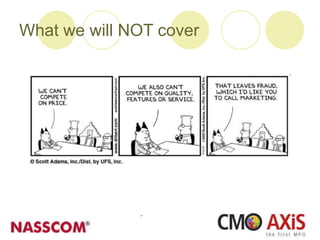
What we will NOT cover
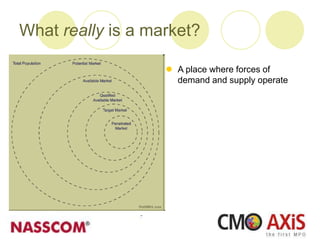
What really is a market?
 A place where forces of
demand and supply operate
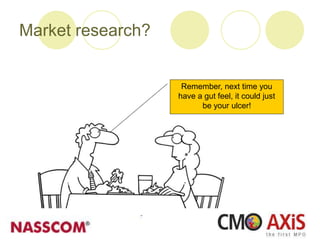
Market research?
Remember, next time you
have a gut feel, it could just
be your ulcer!
What will MR do?
 Provide you with overview of the industry, opportunity and
customers with respect to your product. EXISTING OPPORTUNITY
 Information on customer preferences and needs. This will help in
planning your product portfolio, diversifications etc., POTENTIAL
OPPORTUNITY
 Insights on how customers buy and why they buy. INSIGHTS
Essentials of market research
 What is the size of the market?
 What unique need does your GENRE of product/ services meet?
 How much are customers willing to pay for this product/ service (top/
bottom/average)?
 Is this a price sensitive/ commodity product or premium product?
 Who are the other key players?
 What is the gap un-serviced by current players?
 What is the REAL available market for you?
 How is your product different from competition?
 What is your playing field? (premium/ general/ price warrior)
 What share of this can you reasonably expect to get?
You always don’t need an MR agency
 Talk to the ecosystem
o Buyers
o Users
o Analysts
 Industry media
o Competitors
o VCs
 Where can you find them?
o Your peer network
o Linked-in/ Facebook
o Online communities
o Events and conferences
Fundamental concepts: Segmentation-
Targeting-Positioning
 Who are we?
 Who is our product relevant to?
 Why buy us?/ why not to buy competition
 Where to play
 How to win
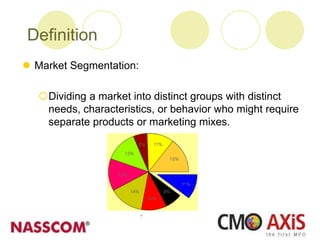
Definition
 Market Segmentation:
Dividing a market into distinct groups with distinct
needs, characteristics, or behavior who might require
separate products or marketing mixes.
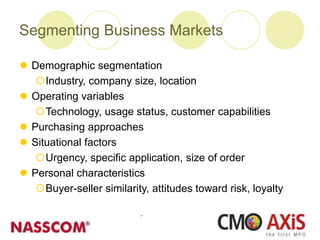
Segmenting Business Markets
 Demographic segmentation
Industry, company size, location
 Operating variables
Technology, usage status, customer capabilities
 Purchasing approaches
 Situational factors
Urgency, specific application, size of order
 Personal characteristics
Buyer-seller similarity, attitudes toward risk, loyalty
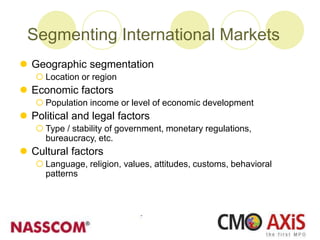
Segmenting International Markets
 Geographic segmentation
 Location or region
 Economic factors
 Population income or level of economic development
 Political and legal factors
 Type / stability of government, monetary regulations,
bureaucracy, etc.
 Cultural factors
 Language, religion, values, attitudes, customs, behavioral
patterns
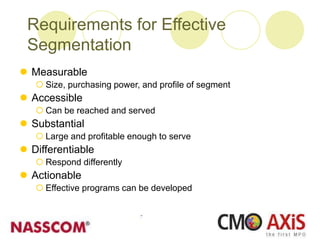
Requirements for Effective
Segmentation
 Measurable
 Size, purchasing power, and profile of segment
 Accessible
 Can be reached and served
 Substantial
 Large and profitable enough to serve
 Differentiable
 Respond differently
 Actionable
 Effective programs can be developed
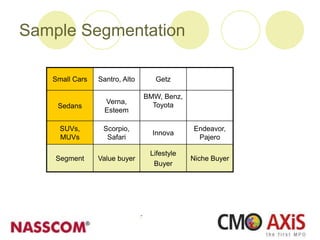
Sample Segmentation
Small Cars Santro, Alto Getz
Sedans
Verna,
Esteem
BMW, Benz,
Toyota
SUVs,
MUVs
Scorpio,
Safari
Innova
Endeavor,
Pajero
Segment Value buyer
Lifestyle
Buyer
Niche Buyer
Target Marketing
Target Market
Consists of a set of buyers who share common
needs or characteristics that the company
decides to serve
Target Marketing
Evaluating Market Segments
Segment size and growth
Segment structural attractiveness
 Level of competition
 Substitute products
 Power of buyers
 Powerful suppliers
Company objectives and resources
Target Marketing
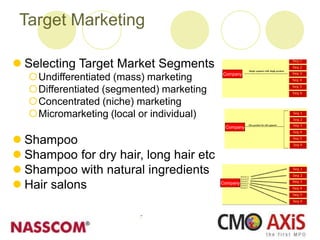
 Selecting Target Market Segments
Undifferentiated (mass) marketing
Differentiated (segmented) marketing
Concentrated (niche) marketing
Micromarketing (local or individual)
 Shampoo
 Shampoo for dry hair, long hair etc
 Shampoo with natural ingredients
 Hair salons
Company
Company
Company
Choosing a Target Marketing
Strategy
Considerations include:
Company resources
The degree of product variability
Product’s life-cycle stage
Market variability
Competitors’ marketing strategies
Positioning
 Positioning
The term 'positioning' refers to the consumer's
perception of a product or service in relation to
its competitors.
Positioning is all about 'perception'.
Perception differs from person to person,
market to market
e.g what you perceive as quality, value for
money, etc, is different to my perception
 Identifying possible
competitive
advantages
 Differentiation can be based on
 Products
 Services
 Channels
 People
 Image
Differentiators
 Which differences make for a
competitive advantage?
 Criteria include
Important
Distinctive
Superior
Communicable
Preemptive
Affordable
Profitable
 Choosing the right
competitive advantage
Competitive Advantage
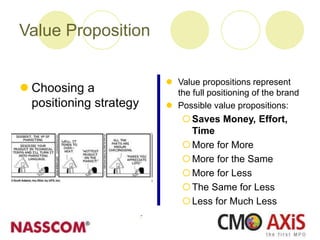
 Value propositions represent
the full positioning of the brand
 Possible value propositions:
Saves Money, Effort,
Time
More for More
More for the Same
More for Less
The Same for Less
Less for Much Less
 Choosing a
positioning strategy
Value Proposition
Choosing the channel
Choose the right sales channels
Direct sales, Online sales, Distributors/ VARs
Alliance marketing
Technology alliances, product alliances
GTM partnerships
Align with complementary brands for joint go-to-
market
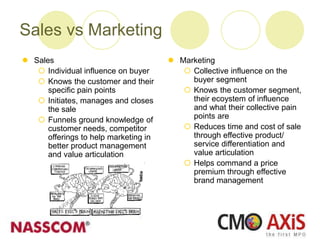
Sales vs Marketing
 Sales
 Individual influence on buyer
 Knows the customer and their
specific pain points
 Initiates, manages and closes
the sale
 Funnels ground knowledge of
customer needs, competitor
offerings to help marketing in
better product management
and value articulation
 Marketing
 Collective influence on the
buyer segment
 Knows the customer segment,
their ecoystem of influence
and what their collective pain
points are
 Reduces time and cost of sale
through effective product/
service differentiation and
value articulation
 Helps command a price
premium through effective
brand management
The SIVA Framework
 Product→Solution
 Promotion→Information
 Price→Value
 Placement→Access
The four elements of the SIVA model are:
 Solution: How appropriate is the solution to the customer's problem/need?
 Information: Does the customer know about the solution? If so, how and
from whom do they know enough to let them make a buying decision?
 Value: Does the customer know the value of the transaction, what it will
cost, what are the benefits, what might they have to sacrifice, what will be
their reward?
 Access: Where can the customer find the solution? How easily/ locally/
remotely can they buy it and take delivery?
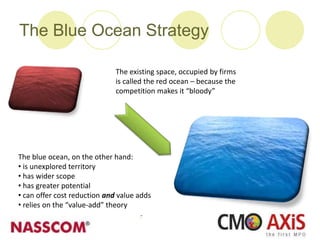
The existing space, occupied by firms
is called the red ocean – because the
competition makes it “bloody”
The blue ocean, on the other hand:
• is unexplored territory
• has wider scope
• has greater potential
• can offer cost reduction and value adds
• relies on the “value-add” theory
The Blue Ocean Strategy
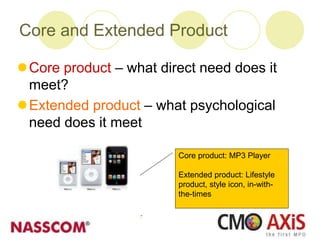
Core and Extended Product
Core product – what direct need does it
meet?
Extended product – what psychological
need does it meet
Core product: MP3 Player
Extended product: Lifestyle
product, style icon, in-with-
the-times
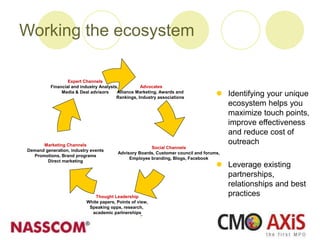
Working the ecosystem
Advocates
Alliance Marketing, Awards and
Rankings, Industry associations
Social Channels
Advisory Boards, Customer council and forums,
Employee branding, Blogs, Facebook
Marketing Channels
Demand generation, industry events
Promotions, Brand programs
Direct marketing
Thought Leadership
White papers, Points of view,
Speaking opps, research,
academic partnerships
Expert Channels
Financial and industry Analysts,
Media & Deal advisors
 Identifying your unique
ecosystem helps you
maximize touch points,
improve effectiveness
and reduce cost of
outreach
 Leverage existing
partnerships,
relationships and best
practices
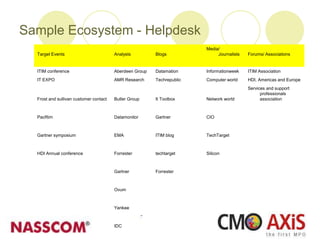
Sample Ecosystem - Helpdesk
Target Events Analysts Blogs
Media/
Journalists Forums/ Associations
ITIM conference Aberdeen Group Datamation Informationweek ITIM Association
IT EXPO AMR Research Techrepublic Computer world HDI, Americas and Europe
Frost and sullivan customer contact Butler Group It Toolbox Network world
Services and support
professionals
association
PacRim Datamonitor Gartner CIO
Gartner symposium EMA ITIM blog TechTarget
HDI Annual conference Forrester techtarget Silicon
Gartner Forrester
Ovum
Yankee
IDC
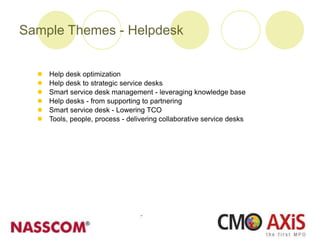
Sample Themes - Helpdesk
 Help desk optimization
 Help desk to strategic service desks
 Smart service desk management - leveraging knowledge base
 Help desks - from supporting to partnering
 Smart service desk - Lowering TCO
 Tools, people, process - delivering collaborative service desks
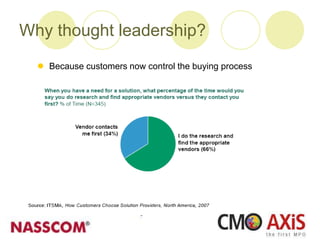
Why thought leadership?
 Because customers now control the buying process
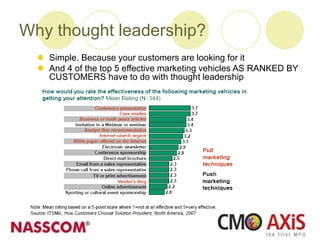
Why thought leadership?
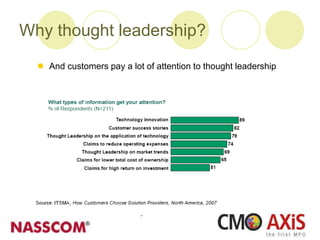
 Simple. Because your customers are looking for it
 And 4 of the top 5 effective marketing vehicles AS RANKED BY
CUSTOMERS have to do with thought leadership
Why thought leadership?
 And customers pay a lot of attention to thought leadership
Why thought leadership?
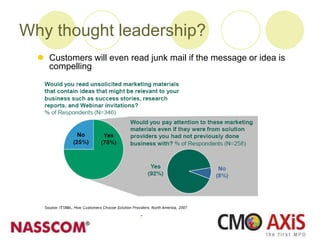
 Customers will even read junk mail if the message or idea is
compelling
What thought leadership marketing
delivers
 Moving beyond being just a cost player with your customer
 Building a strong brand – thereby helping you cut cost/ time of
sale
 Increasing Marketing’s Business Impact
 Improving Competitive Positioning and Differentiation
 Implementing Demand Generation Tactics that Work
 Sharpening Marketing’s Edge
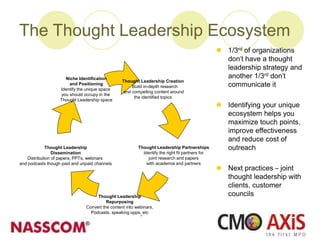
The Thought Leadership Ecosystem
Thought Leadership Creation
Build in-depth research
and compelling content around
the identified topics
Thought Leadership Partnerships
Identify the right fit partners for
joint research and papers
with academia and partners
Thought Leadership
Dissemination
Distribution of papers, PPTs, webinars
and podcasts though paid and unpaid channels
Thought Leadership
Repurposing
Convert the content into webinars,
Podcasts, speaking opps, etc
Niche Identification
and Positioning
Identify the unique space
you should occupy in the
Thought Leadership space
 1/3rd of organizations
don’t have a thought
leadership strategy and
another 1/3rd don’t
communicate it
 Identifying your unique
ecosystem helps you
maximize touch points,
improve effectiveness
and reduce cost of
outreach
 Next practices – joint
thought leadership with
clients, customer
councils
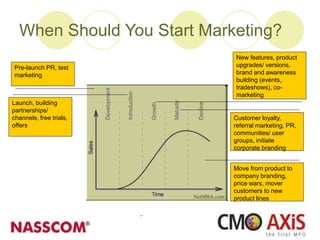
When Should You Start Marketing?
Pre-launch PR, test
marketing
Launch, building
partnerships/
channels, free trials,
offers
New features, product
upgrades/ versions,
brand and awareness
building (events,
tradeshows), co-
marketing
Customer loyalty,
referral marketing, PR,
communities/ user
groups, initiate
corporate branding
Move from product to
company branding,
price wars, mover
customers to new
product lines
Jack Trout and Al Ries’ ‘Immutable
Laws’
 The law of leadership: Is there a category where
you can be the first/ only/ #1?
First indigenous car, First small car
 The law of mindshare and perception: It is
important where you are in your customer’s
mind and how he/ she perceives your product/
service
Santro – modern, Korean, smart, Shah Rukh, Fuel
efficient, good service
Indica – indigenous, diesel, taxi, car from a truck maker,
not refined
Jack Trout and Al Ries’ ‘Immutable
Laws’
The law of focus and exclusivity: What is
the one word you own in the prospect’s
mind?
Hamam – family soap
 Pepsi – drink for Gen-Y
The law of division: Lead a category or
create a division
Mobile phones> Music phones/ Biz (email/
internet) phones/ Touch screen phones
Jack Trout and Al Ries’ ‘Immutable
Laws’
The law of singularity: What is that one
thing you do really well? Don’t push your
luck…
Lifebuoy> Germ-killer or beauty soap?
The law of acceleration: Ride a trend, not
a fad
Sugarfree vs Pro-biotic
Jack Trout and Al Ries’ ‘Immutable
Laws’
The law of resources: What kind of
resources are you putting behind your
product?
Money
Time
Partnerships
Working the ecosystem
Zero-cost Tools
 Blogs
 Communities/ forums
 Industry associations
 Analysts, influencers
 Speaking opportunities
 Awards/ rankings
 Targeted ‘low cost’ marketing
 Alliance marketing
 Co-marketing
 Pay-for-performance marketing tools
Go-to-Market is still evolving
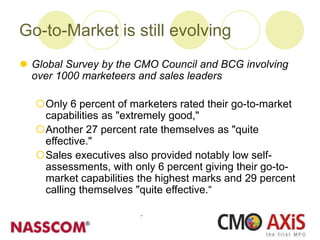
 Global Survey by the CMO Council and BCG involving
over 1000 marketeers and sales leaders
Only 6 percent of marketers rated their go-to-market
capabilities as "extremely good,"
Another 27 percent rate themselves as "quite
effective."
Sales executives also provided notably low self-
assessments, with only 6 percent giving their go-to-
market capabilities the highest marks and 29 percent
calling themselves "quite effective.“
Go-to-Market is still evolving
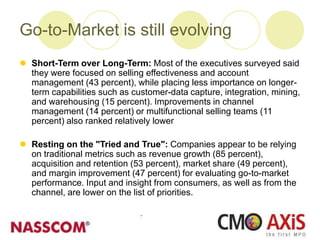
 Short-Term over Long-Term: Most of the executives surveyed said
they were focused on selling effectiveness and account
management (43 percent), while placing less importance on longer-
term capabilities such as customer-data capture, integration, mining,
and warehousing (15 percent). Improvements in channel
management (14 percent) or multifunctional selling teams (11
percent) also ranked relatively lower
 Resting on the "Tried and True": Companies appear to be relying
on traditional metrics such as revenue growth (85 percent),
acquisition and retention (53 percent), market share (49 percent),
and margin improvement (47 percent) for evaluating go-to-market
performance. Input and insight from consumers, as well as from the
channel, are lower on the list of priorities.
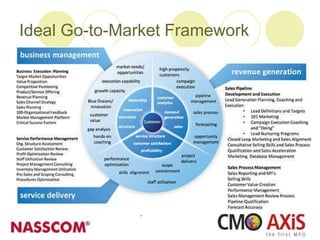
Ideal Go-to-Market Framework
Go-to-market checklist
 Clarify the opportunity
 Sharpen value propositions
 Engage the entire organization
 Develop sharp marketing programs
 Build on initial success – Testimonials
 Build a strong sales support mechanism
 Constantly measure
CONQUER THE MARKET
Case study
 Risk Management Product
Everyone needs risk management
Risk Management beyond the bell-curve
 Ecosystem
Non conventional distribution channels
Blogs and communities
Evaluation copies to experts
Tie-up with Amazon
Tie up with CPA institutes
PR – more accurate event predictions
vinod.harith@cmoaxis.com
http://cmoaxis.blogspot.com
Thank You

Go to Market 101.ppt

  • 1.
    You have aproduct? Great! Where’s the market? Vinod Harith Founder and Director CMO Axis Marketing Outsourcing www.cmoaxis.com
  • 2.
  • 3.
    What is go-to-market? Go-to-market process is the  Strategic and tactical aspects of delivering and supporting a product or service offering in the marketplace  This includes product specification, pricing, distribution, marketing communications, sales, after-market support, and customer experience management
  • 4.
    What we willcover  Defining a market (what really is a market?)  Fundamental concepts of marketing  Segmentation, Targeting and Positioning  Differentiation, Competitive Advantage and Value proposition  Sales vs. Marketing, the fundamental difference  Choosing the channel  Some key frameworks  SIVA model  Blue Ocean strategy  Core and extended product  Knowing the ecosystem – your customer does not buy in isolation  When does the marketing of the product start?  The ‘immutable laws’  Some zero-cost marketing tools to get started  Case study discussions
  • 5.
    What we willNOT cover
  • 6.
    What really isa market?  A place where forces of demand and supply operate
  • 7.
    Market research? Remember, nexttime you have a gut feel, it could just be your ulcer!
  • 8.
    What will MRdo?  Provide you with overview of the industry, opportunity and customers with respect to your product. EXISTING OPPORTUNITY  Information on customer preferences and needs. This will help in planning your product portfolio, diversifications etc., POTENTIAL OPPORTUNITY  Insights on how customers buy and why they buy. INSIGHTS
  • 9.
    Essentials of marketresearch  What is the size of the market?  What unique need does your GENRE of product/ services meet?  How much are customers willing to pay for this product/ service (top/ bottom/average)?  Is this a price sensitive/ commodity product or premium product?  Who are the other key players?  What is the gap un-serviced by current players?  What is the REAL available market for you?  How is your product different from competition?  What is your playing field? (premium/ general/ price warrior)  What share of this can you reasonably expect to get?
  • 10.
    You always don’tneed an MR agency  Talk to the ecosystem o Buyers o Users o Analysts  Industry media o Competitors o VCs  Where can you find them? o Your peer network o Linked-in/ Facebook o Online communities o Events and conferences
  • 11.
    Fundamental concepts: Segmentation- Targeting-Positioning Who are we?  Who is our product relevant to?  Why buy us?/ why not to buy competition  Where to play  How to win
  • 12.
    Definition  Market Segmentation: Dividinga market into distinct groups with distinct needs, characteristics, or behavior who might require separate products or marketing mixes.
  • 13.
    Segmenting Business Markets Demographic segmentation Industry, company size, location  Operating variables Technology, usage status, customer capabilities  Purchasing approaches  Situational factors Urgency, specific application, size of order  Personal characteristics Buyer-seller similarity, attitudes toward risk, loyalty
  • 14.
    Segmenting International Markets Geographic segmentation  Location or region  Economic factors  Population income or level of economic development  Political and legal factors  Type / stability of government, monetary regulations, bureaucracy, etc.  Cultural factors  Language, religion, values, attitudes, customs, behavioral patterns
  • 15.
    Requirements for Effective Segmentation Measurable  Size, purchasing power, and profile of segment  Accessible  Can be reached and served  Substantial  Large and profitable enough to serve  Differentiable  Respond differently  Actionable  Effective programs can be developed
  • 16.
    Sample Segmentation Small CarsSantro, Alto Getz Sedans Verna, Esteem BMW, Benz, Toyota SUVs, MUVs Scorpio, Safari Innova Endeavor, Pajero Segment Value buyer Lifestyle Buyer Niche Buyer
  • 17.
    Target Marketing Target Market Consistsof a set of buyers who share common needs or characteristics that the company decides to serve
  • 18.
    Target Marketing Evaluating MarketSegments Segment size and growth Segment structural attractiveness  Level of competition  Substitute products  Power of buyers  Powerful suppliers Company objectives and resources
  • 19.
    Target Marketing  SelectingTarget Market Segments Undifferentiated (mass) marketing Differentiated (segmented) marketing Concentrated (niche) marketing Micromarketing (local or individual)  Shampoo  Shampoo for dry hair, long hair etc  Shampoo with natural ingredients  Hair salons Company Company Company
  • 20.
    Choosing a TargetMarketing Strategy Considerations include: Company resources The degree of product variability Product’s life-cycle stage Market variability Competitors’ marketing strategies
  • 21.
    Positioning  Positioning The term'positioning' refers to the consumer's perception of a product or service in relation to its competitors. Positioning is all about 'perception'. Perception differs from person to person, market to market e.g what you perceive as quality, value for money, etc, is different to my perception
  • 22.
     Identifying possible competitive advantages Differentiation can be based on  Products  Services  Channels  People  Image Differentiators
  • 23.
     Which differencesmake for a competitive advantage?  Criteria include Important Distinctive Superior Communicable Preemptive Affordable Profitable  Choosing the right competitive advantage Competitive Advantage
  • 24.
     Value propositionsrepresent the full positioning of the brand  Possible value propositions: Saves Money, Effort, Time More for More More for the Same More for Less The Same for Less Less for Much Less  Choosing a positioning strategy Value Proposition
  • 25.
    Choosing the channel Choosethe right sales channels Direct sales, Online sales, Distributors/ VARs Alliance marketing Technology alliances, product alliances GTM partnerships Align with complementary brands for joint go-to- market
  • 26.
    Sales vs Marketing Sales  Individual influence on buyer  Knows the customer and their specific pain points  Initiates, manages and closes the sale  Funnels ground knowledge of customer needs, competitor offerings to help marketing in better product management and value articulation  Marketing  Collective influence on the buyer segment  Knows the customer segment, their ecoystem of influence and what their collective pain points are  Reduces time and cost of sale through effective product/ service differentiation and value articulation  Helps command a price premium through effective brand management
  • 27.
    The SIVA Framework Product→Solution  Promotion→Information  Price→Value  Placement→Access The four elements of the SIVA model are:  Solution: How appropriate is the solution to the customer's problem/need?  Information: Does the customer know about the solution? If so, how and from whom do they know enough to let them make a buying decision?  Value: Does the customer know the value of the transaction, what it will cost, what are the benefits, what might they have to sacrifice, what will be their reward?  Access: Where can the customer find the solution? How easily/ locally/ remotely can they buy it and take delivery?
  • 28.
    The existing space,occupied by firms is called the red ocean – because the competition makes it “bloody” The blue ocean, on the other hand: • is unexplored territory • has wider scope • has greater potential • can offer cost reduction and value adds • relies on the “value-add” theory The Blue Ocean Strategy
  • 29.
    Core and ExtendedProduct Core product – what direct need does it meet? Extended product – what psychological need does it meet Core product: MP3 Player Extended product: Lifestyle product, style icon, in-with- the-times
  • 30.
    Working the ecosystem Advocates AllianceMarketing, Awards and Rankings, Industry associations Social Channels Advisory Boards, Customer council and forums, Employee branding, Blogs, Facebook Marketing Channels Demand generation, industry events Promotions, Brand programs Direct marketing Thought Leadership White papers, Points of view, Speaking opps, research, academic partnerships Expert Channels Financial and industry Analysts, Media & Deal advisors  Identifying your unique ecosystem helps you maximize touch points, improve effectiveness and reduce cost of outreach  Leverage existing partnerships, relationships and best practices
  • 31.
    Sample Ecosystem -Helpdesk Target Events Analysts Blogs Media/ Journalists Forums/ Associations ITIM conference Aberdeen Group Datamation Informationweek ITIM Association IT EXPO AMR Research Techrepublic Computer world HDI, Americas and Europe Frost and sullivan customer contact Butler Group It Toolbox Network world Services and support professionals association PacRim Datamonitor Gartner CIO Gartner symposium EMA ITIM blog TechTarget HDI Annual conference Forrester techtarget Silicon Gartner Forrester Ovum Yankee IDC
  • 32.
    Sample Themes -Helpdesk  Help desk optimization  Help desk to strategic service desks  Smart service desk management - leveraging knowledge base  Help desks - from supporting to partnering  Smart service desk - Lowering TCO  Tools, people, process - delivering collaborative service desks
  • 33.
    Why thought leadership? Because customers now control the buying process
  • 34.
    Why thought leadership? Simple. Because your customers are looking for it  And 4 of the top 5 effective marketing vehicles AS RANKED BY CUSTOMERS have to do with thought leadership
  • 35.
    Why thought leadership? And customers pay a lot of attention to thought leadership
  • 36.
    Why thought leadership? Customers will even read junk mail if the message or idea is compelling
  • 37.
    What thought leadershipmarketing delivers  Moving beyond being just a cost player with your customer  Building a strong brand – thereby helping you cut cost/ time of sale  Increasing Marketing’s Business Impact  Improving Competitive Positioning and Differentiation  Implementing Demand Generation Tactics that Work  Sharpening Marketing’s Edge
  • 38.
    The Thought LeadershipEcosystem Thought Leadership Creation Build in-depth research and compelling content around the identified topics Thought Leadership Partnerships Identify the right fit partners for joint research and papers with academia and partners Thought Leadership Dissemination Distribution of papers, PPTs, webinars and podcasts though paid and unpaid channels Thought Leadership Repurposing Convert the content into webinars, Podcasts, speaking opps, etc Niche Identification and Positioning Identify the unique space you should occupy in the Thought Leadership space  1/3rd of organizations don’t have a thought leadership strategy and another 1/3rd don’t communicate it  Identifying your unique ecosystem helps you maximize touch points, improve effectiveness and reduce cost of outreach  Next practices – joint thought leadership with clients, customer councils
  • 39.
    When Should YouStart Marketing? Pre-launch PR, test marketing Launch, building partnerships/ channels, free trials, offers New features, product upgrades/ versions, brand and awareness building (events, tradeshows), co- marketing Customer loyalty, referral marketing, PR, communities/ user groups, initiate corporate branding Move from product to company branding, price wars, mover customers to new product lines
  • 40.
    Jack Trout andAl Ries’ ‘Immutable Laws’  The law of leadership: Is there a category where you can be the first/ only/ #1? First indigenous car, First small car  The law of mindshare and perception: It is important where you are in your customer’s mind and how he/ she perceives your product/ service Santro – modern, Korean, smart, Shah Rukh, Fuel efficient, good service Indica – indigenous, diesel, taxi, car from a truck maker, not refined
  • 41.
    Jack Trout andAl Ries’ ‘Immutable Laws’ The law of focus and exclusivity: What is the one word you own in the prospect’s mind? Hamam – family soap  Pepsi – drink for Gen-Y The law of division: Lead a category or create a division Mobile phones> Music phones/ Biz (email/ internet) phones/ Touch screen phones
  • 42.
    Jack Trout andAl Ries’ ‘Immutable Laws’ The law of singularity: What is that one thing you do really well? Don’t push your luck… Lifebuoy> Germ-killer or beauty soap? The law of acceleration: Ride a trend, not a fad Sugarfree vs Pro-biotic
  • 43.
    Jack Trout andAl Ries’ ‘Immutable Laws’ The law of resources: What kind of resources are you putting behind your product? Money Time Partnerships Working the ecosystem
  • 44.
    Zero-cost Tools  Blogs Communities/ forums  Industry associations  Analysts, influencers  Speaking opportunities  Awards/ rankings  Targeted ‘low cost’ marketing  Alliance marketing  Co-marketing  Pay-for-performance marketing tools
  • 45.
    Go-to-Market is stillevolving  Global Survey by the CMO Council and BCG involving over 1000 marketeers and sales leaders Only 6 percent of marketers rated their go-to-market capabilities as "extremely good," Another 27 percent rate themselves as "quite effective." Sales executives also provided notably low self- assessments, with only 6 percent giving their go-to- market capabilities the highest marks and 29 percent calling themselves "quite effective.“
  • 46.
    Go-to-Market is stillevolving  Short-Term over Long-Term: Most of the executives surveyed said they were focused on selling effectiveness and account management (43 percent), while placing less importance on longer- term capabilities such as customer-data capture, integration, mining, and warehousing (15 percent). Improvements in channel management (14 percent) or multifunctional selling teams (11 percent) also ranked relatively lower  Resting on the "Tried and True": Companies appear to be relying on traditional metrics such as revenue growth (85 percent), acquisition and retention (53 percent), market share (49 percent), and margin improvement (47 percent) for evaluating go-to-market performance. Input and insight from consumers, as well as from the channel, are lower on the list of priorities.
  • 47.
  • 48.
    Go-to-market checklist  Clarifythe opportunity  Sharpen value propositions  Engage the entire organization  Develop sharp marketing programs  Build on initial success – Testimonials  Build a strong sales support mechanism  Constantly measure CONQUER THE MARKET
  • 49.
    Case study  RiskManagement Product Everyone needs risk management Risk Management beyond the bell-curve  Ecosystem Non conventional distribution channels Blogs and communities Evaluation copies to experts Tie-up with Amazon Tie up with CPA institutes PR – more accurate event predictions
  • 50.