SUSAN SCHOENIAN (Shāy-nē-ŭn)
Sheep & Goat Specialist
Western Maryland Research & Education Center
sschoen@umd.edu - www.sheepandgoat.com
http://www.slideshare.net/schoenian/marketing-sheep-products
SMALL RUMINANT PROGRAM
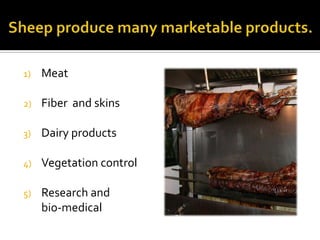
1) Meat
2) Fiber and skins
3) Dairy products
4) Vegetation control
5) Research and
bio-medical
1. Lamb - meat from sheep
under one year of age
[must have 2 break joints]
 U.S. average - 135 lbs.
 Non-traditional - 60 to 100 lbs.
 “Hot house” - 35-50 lbs.
2. Yearling mutton - meat from
a sheep between 1 and 2
years of age.
[has 1 or 2 break joints]
3. Mutton - meat from sheep
over one year of age
[2 spool joints]
Age determined by teeth in live animal.
Age determined by break/spool joints in carcass.
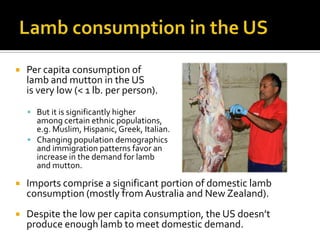
 Per capita consumption of
lamb and mutton in the US
is very low (< 1 lb. per person).
 But it is significantly higher
among certain ethnic populations,
e.g. Muslim, Hispanic,Greek, Italian.
 Changing population demographics
and immigration patterns favor an
increase in the demand for lamb
and mutton.
 Imports comprise a significant portion of domestic lamb
consumption (mostly fromAustralia and New Zealand).
 Despite the low per capita consumption, the US doesn’t
produce enough lamb to meet domestic demand.
1. Federal (USDA)
a) Highest level of inspection
▪ Pre and post-mortem inspection of animal.
▪ HACCP plan(s) required.
b) Can sell properly labeled meat.
2. State
a) Mirrors federal regulations
b) Usually limited to intrastate sales
c) No state inspection in Maryland.
3. Custom-exempt
a) Exempt from state or federal inspection.
b) Facilities, but not animal, inspected
c) Processed for owner of animal
d) Meat stamped “not for re-sale”
4. Personal exemption (on-farm)
a) Exempt from state or federal inspection.
b) Processed by owner (not for re-sale)
c) Some states restrict to farmer who raised animal
 Religious or ritual slaughter
(exempt from humane slaughter laws)
1. Halal - Muslim
2. Kosher - Jewish
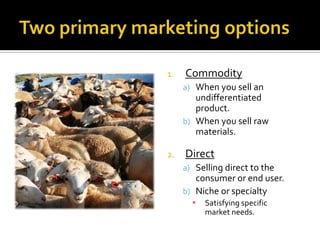
1. Commodity
a) When you sell an
undifferentiated
product.
b) When you sell raw
materials.
2. Direct
a) Selling direct to the
consumer or end user.
b) Niche or specialty
 Satisfying specific
market needs.
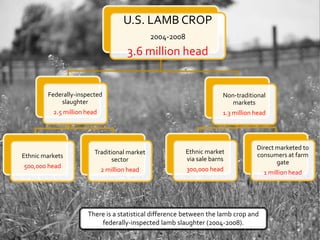
U.S. LAMB CROP
2004-2008
3.6 million head
Federally-inspected
slaughter
2.5 million head
Ethnic markets
500,000 head
Traditional market
sector
2 million head
Non-traditional
markets
1.3 million head
Ethnic market
via sale barns
300,000 head
Direct marketed to
consumers at farm
gate
1 million head
There is a statistical difference between the lamb crop and
federally-inspected lamb slaughter (2004-2008).
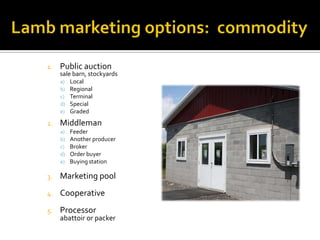
1. Public auction
sale barn, stockyards
a) Local
b) Regional
c) Terminal
d) Special
e) Graded
2. Middleman
a) Feeder
b) Another producer
c) Broker
d) Order buyer
e) Buying station
3. Marketing pool
4. Cooperative
5. Processor
abattoir or packer
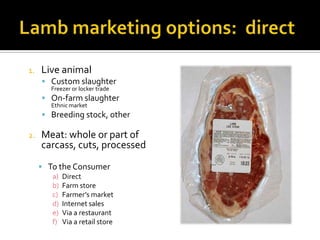
1. Live animal
 Custom slaughter
Freezer or locker trade
 On-farm slaughter
Ethnic market
 Breeding stock, other
2. Meat: whole or part of
carcass, cuts, processed
 To the Consumer
a) Direct
b) Farm store
c) Farmer’s market
d) Internet sales
e) Via a restaurant
f) Via a retail store
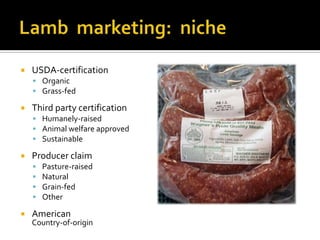
 USDA-certification
 Organic
 Grass-fed
 Third party certification
 Humanely-raised
 Animal welfare approved
 Sustainable
 Producer claim
 Pasture-raised
 Natural
 Grain-fed
 Other
 American
Country-of-origin
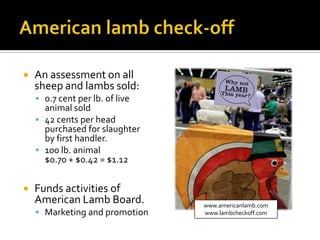
 An assessment on all
sheep and lambs sold:
 0.7 cent per lb. of live
animal sold
 42 cents per head
purchased for slaughter
by first handler.
 100 lb. animal
$0.70 + $0.42 = $1.12
 Funds activities of
American Lamb Board.
 Marketing and promotion
www.americanlamb.com
www.lambcheckoff.com
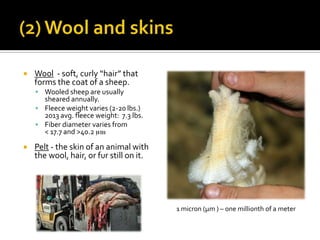
 Wool - soft, curly “hair” that
forms the coat of a sheep.
 Wooled sheep are usually
sheared annually.
 Fleece weight varies (2-20 lbs.)
2013 avg. fleece weight: 7.3 lbs.
 Fiber diameter varies from
< 17.7 and >40.2 µm
 Pelt - the skin of an animal with
the wool, hair, or fur still on it.
1 micron (µm ) – one millionth of a meter
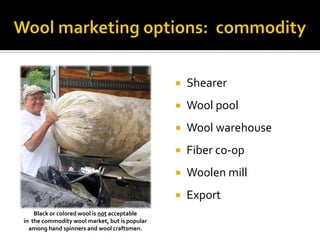
 Shearer
 Wool pool
 Wool warehouse
 Fiber co-op
 Woolen mill
 Export
Black or colored wool is not acceptable
in the commodity wool market, but is popular
among hand spinners and wool craftsmen.
 Every June
 Wool is sorted into grades:
choice, medium, and coarse
whiteface; non-whiteface; and short
 Sold via sealed bid auction.
 Deduction of 5 to 8 cents per pound.
 Maryland Sheep Breeders Association
membership dues deducted on sales
over $40.
 Wool prices are usually less than $1
per pound.
 Size of pool keeps getting smaller
 Low prices
 More hair sheep (no shearing/wool)
 More direct marketing of wool
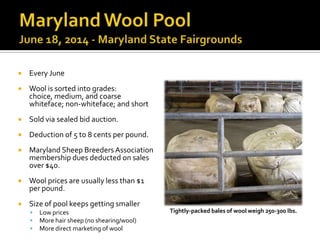
Tightly-packed bales of wool weigh 250-300 lbs.
 Marketing assistance loans
or loan deficiency
payments (LDPs) for shorn
wool or the wool from
unshorn lambs (similar to
program for grains).
 Must own wool in order to
apply for LDP.
 Due to higher wool and
mohair prices, LDPs have
been zero for several years:
thus, no LDP payments are
being made.
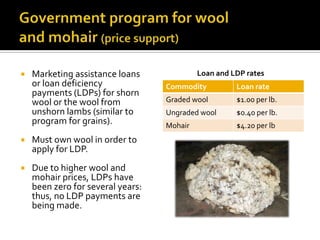
Commodity Loan rate
Graded wool $1.00 per lb.
Ungraded wool $0.40 per lb.
Mohair $4.20 per lb
Loan and LDP rates
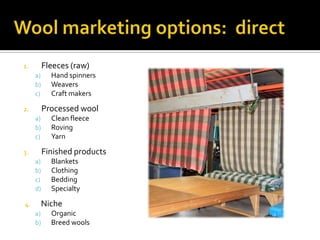
1. Fleeces (raw)
a) Hand spinners
b) Weavers
c) Craft makers
2. Processed wool
a) Clean fleece
b) Roving
c) Yarn
3. Finished products
a) Blankets
b) Clothing
c) Bedding
d) Specialty
4. Niche
a) Organic
b) Breed wools
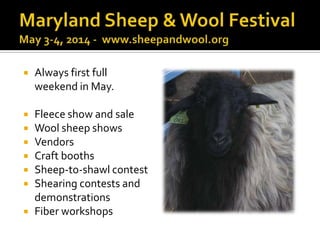
 Always first full
weekend in May.
 Fleece show and sale
 Wool sheep shows
 Vendors
 Craft booths
 Sheep-to-shawl contest
 Shearing contests and
demonstrations
 Fiber workshops
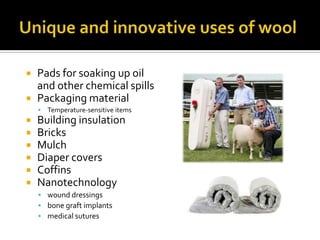
 Pads for soaking up oil
and other chemical spills
 Packaging material
 Temperature-sensitive items
 Building insulation
 Bricks
 Mulch
 Diaper covers
 Coffins
 Nanotechnology
 wound dressings
 bone graft implants
 medical sutures
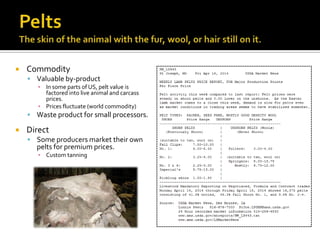
 Commodity
 Valuable by-product
▪ In some parts of US, pelt value is
factored into live animal and carcass
prices.
▪ Prices fluctuate (world commodity)
 Waste product for small processors.
 Direct
 Some producers market their own
pelts for premium prices.
▪ Custom tanning
1. Grade A - fluid milk
Sheep milk is not commonly consumed.
2. Grade B - manufacturing
a) Cheese
b) Yogurt
c) Ice cream
d) Butter
3. Non-inspected
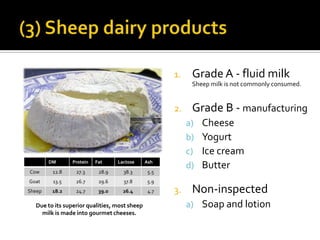
a) Soap and lotionDue to its superior qualities, most sheep
milk is made into gourmet cheeses.
DM Protein Fat Lactose Ash
Cow 12.8 27.3 28.9 38.3 5.5
Goat 13.5 26.7 29.6 37.8 5.9
Sheep 18.2 24.7 39.0 26.4 4.7
 Enforced by State Department
of Health or the State
Department of Agriculture
 Milk sanitation
 Regulations vary by state, but
are generally equivalent to cow
dairies (or more stringent).
 Maryland is in the process of
allowing the manufacture and sale
of raw milk cheese for certain size
operations.
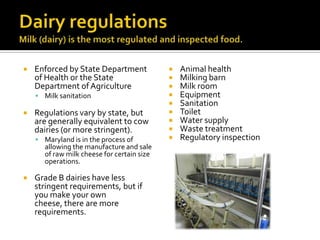
 Grade B dairies have less
stringent requirements, but if
you make your own
cheese, there are more
requirements.
 Animal health
 Milking barn
 Milk room
 Equipment
 Sanitation
 Toilet
 Water supply
 Waste treatment
 Regulatory inspection
 Commodity
 Sell milk to a dairy processing
plant
▪ Picked up by processor
▪ Transport milk to processor
▪ Ship frozen milk to processor
 Direct
 Farmstead dairy processing
 Have cheese or other products
made by a third party vendor.
 Sell via . . .
▪ Farm store
▪ Farmer’s Market
▪ Internet sales
▪ Restaurants
▪ Retail stores
▪ Event
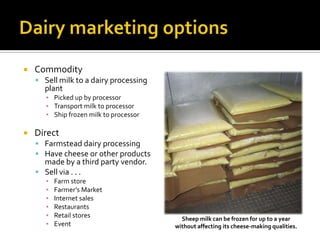
Sheep milk can be frozen for up to a year
without affecting its cheese-making qualities.
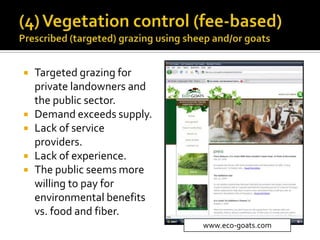
 Targeted grazing for
private landowners and
the public sector.
 Demand exceeds supply.
 Lack of service
providers.
 Lack of experience.
 The public seems more
willing to pay for
environmental benefits
vs. food and fiber.
www.eco-goats.com
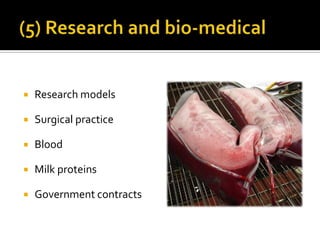
 Research models
 Surgical practice
 Blood
 Milk proteins
 Government contracts
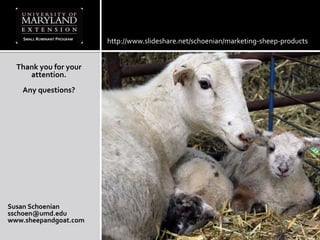
Thank you for your
attention.
Any questions?
Susan Schoenian
sschoen@umd.edu
www.sheepandgoat.com
SMALL RUMINANT PROGRAM
http://www.slideshare.net/schoenian/marketing-sheep-products

Marketing sheep products

  • 1.
    SUSAN SCHOENIAN (Shāy-nē-ŭn) Sheep& Goat Specialist Western Maryland Research & Education Center sschoen@umd.edu - www.sheepandgoat.com http://www.slideshare.net/schoenian/marketing-sheep-products SMALL RUMINANT PROGRAM
  • 2.
    1) Meat 2) Fiberand skins 3) Dairy products 4) Vegetation control 5) Research and bio-medical
  • 3.
    1. Lamb -meat from sheep under one year of age [must have 2 break joints]  U.S. average - 135 lbs.  Non-traditional - 60 to 100 lbs.  “Hot house” - 35-50 lbs. 2. Yearling mutton - meat from a sheep between 1 and 2 years of age. [has 1 or 2 break joints] 3. Mutton - meat from sheep over one year of age [2 spool joints] Age determined by teeth in live animal. Age determined by break/spool joints in carcass.
  • 4.
     Per capitaconsumption of lamb and mutton in the US is very low (< 1 lb. per person).  But it is significantly higher among certain ethnic populations, e.g. Muslim, Hispanic,Greek, Italian.  Changing population demographics and immigration patterns favor an increase in the demand for lamb and mutton.  Imports comprise a significant portion of domestic lamb consumption (mostly fromAustralia and New Zealand).  Despite the low per capita consumption, the US doesn’t produce enough lamb to meet domestic demand.
  • 5.
    1. Federal (USDA) a)Highest level of inspection ▪ Pre and post-mortem inspection of animal. ▪ HACCP plan(s) required. b) Can sell properly labeled meat. 2. State a) Mirrors federal regulations b) Usually limited to intrastate sales c) No state inspection in Maryland. 3. Custom-exempt a) Exempt from state or federal inspection. b) Facilities, but not animal, inspected c) Processed for owner of animal d) Meat stamped “not for re-sale” 4. Personal exemption (on-farm) a) Exempt from state or federal inspection. b) Processed by owner (not for re-sale) c) Some states restrict to farmer who raised animal  Religious or ritual slaughter (exempt from humane slaughter laws) 1. Halal - Muslim 2. Kosher - Jewish
  • 6.
    1. Commodity a) Whenyou sell an undifferentiated product. b) When you sell raw materials. 2. Direct a) Selling direct to the consumer or end user. b) Niche or specialty  Satisfying specific market needs.
  • 7.
    U.S. LAMB CROP 2004-2008 3.6million head Federally-inspected slaughter 2.5 million head Ethnic markets 500,000 head Traditional market sector 2 million head Non-traditional markets 1.3 million head Ethnic market via sale barns 300,000 head Direct marketed to consumers at farm gate 1 million head There is a statistical difference between the lamb crop and federally-inspected lamb slaughter (2004-2008).
  • 9.
    1. Public auction salebarn, stockyards a) Local b) Regional c) Terminal d) Special e) Graded 2. Middleman a) Feeder b) Another producer c) Broker d) Order buyer e) Buying station 3. Marketing pool 4. Cooperative 5. Processor abattoir or packer
  • 10.
    1. Live animal Custom slaughter Freezer or locker trade  On-farm slaughter Ethnic market  Breeding stock, other 2. Meat: whole or part of carcass, cuts, processed  To the Consumer a) Direct b) Farm store c) Farmer’s market d) Internet sales e) Via a restaurant f) Via a retail store
  • 11.
     USDA-certification  Organic Grass-fed  Third party certification  Humanely-raised  Animal welfare approved  Sustainable  Producer claim  Pasture-raised  Natural  Grain-fed  Other  American Country-of-origin
  • 12.
     An assessmenton all sheep and lambs sold:  0.7 cent per lb. of live animal sold  42 cents per head purchased for slaughter by first handler.  100 lb. animal $0.70 + $0.42 = $1.12  Funds activities of American Lamb Board.  Marketing and promotion www.americanlamb.com www.lambcheckoff.com
  • 13.
     Wool -soft, curly “hair” that forms the coat of a sheep.  Wooled sheep are usually sheared annually.  Fleece weight varies (2-20 lbs.) 2013 avg. fleece weight: 7.3 lbs.  Fiber diameter varies from < 17.7 and >40.2 µm  Pelt - the skin of an animal with the wool, hair, or fur still on it. 1 micron (µm ) – one millionth of a meter
  • 14.
     Shearer  Woolpool  Wool warehouse  Fiber co-op  Woolen mill  Export Black or colored wool is not acceptable in the commodity wool market, but is popular among hand spinners and wool craftsmen.
  • 15.
     Every June Wool is sorted into grades: choice, medium, and coarse whiteface; non-whiteface; and short  Sold via sealed bid auction.  Deduction of 5 to 8 cents per pound.  Maryland Sheep Breeders Association membership dues deducted on sales over $40.  Wool prices are usually less than $1 per pound.  Size of pool keeps getting smaller  Low prices  More hair sheep (no shearing/wool)  More direct marketing of wool Tightly-packed bales of wool weigh 250-300 lbs.
  • 16.
     Marketing assistanceloans or loan deficiency payments (LDPs) for shorn wool or the wool from unshorn lambs (similar to program for grains).  Must own wool in order to apply for LDP.  Due to higher wool and mohair prices, LDPs have been zero for several years: thus, no LDP payments are being made. Commodity Loan rate Graded wool $1.00 per lb. Ungraded wool $0.40 per lb. Mohair $4.20 per lb Loan and LDP rates
  • 17.
    1. Fleeces (raw) a)Hand spinners b) Weavers c) Craft makers 2. Processed wool a) Clean fleece b) Roving c) Yarn 3. Finished products a) Blankets b) Clothing c) Bedding d) Specialty 4. Niche a) Organic b) Breed wools
  • 18.
     Always firstfull weekend in May.  Fleece show and sale  Wool sheep shows  Vendors  Craft booths  Sheep-to-shawl contest  Shearing contests and demonstrations  Fiber workshops
  • 19.
     Pads forsoaking up oil and other chemical spills  Packaging material  Temperature-sensitive items  Building insulation  Bricks  Mulch  Diaper covers  Coffins  Nanotechnology  wound dressings  bone graft implants  medical sutures
  • 20.
     Commodity  Valuableby-product ▪ In some parts of US, pelt value is factored into live animal and carcass prices. ▪ Prices fluctuate (world commodity)  Waste product for small processors.  Direct  Some producers market their own pelts for premium prices. ▪ Custom tanning
  • 21.
    1. Grade A- fluid milk Sheep milk is not commonly consumed. 2. Grade B - manufacturing a) Cheese b) Yogurt c) Ice cream d) Butter 3. Non-inspected a) Soap and lotionDue to its superior qualities, most sheep milk is made into gourmet cheeses. DM Protein Fat Lactose Ash Cow 12.8 27.3 28.9 38.3 5.5 Goat 13.5 26.7 29.6 37.8 5.9 Sheep 18.2 24.7 39.0 26.4 4.7
  • 22.
     Enforced byState Department of Health or the State Department of Agriculture  Milk sanitation  Regulations vary by state, but are generally equivalent to cow dairies (or more stringent).  Maryland is in the process of allowing the manufacture and sale of raw milk cheese for certain size operations.  Grade B dairies have less stringent requirements, but if you make your own cheese, there are more requirements.  Animal health  Milking barn  Milk room  Equipment  Sanitation  Toilet  Water supply  Waste treatment  Regulatory inspection
  • 23.
     Commodity  Sellmilk to a dairy processing plant ▪ Picked up by processor ▪ Transport milk to processor ▪ Ship frozen milk to processor  Direct  Farmstead dairy processing  Have cheese or other products made by a third party vendor.  Sell via . . . ▪ Farm store ▪ Farmer’s Market ▪ Internet sales ▪ Restaurants ▪ Retail stores ▪ Event Sheep milk can be frozen for up to a year without affecting its cheese-making qualities.
  • 24.
     Targeted grazingfor private landowners and the public sector.  Demand exceeds supply.  Lack of service providers.  Lack of experience.  The public seems more willing to pay for environmental benefits vs. food and fiber. www.eco-goats.com
  • 25.
     Research models Surgical practice  Blood  Milk proteins  Government contracts
  • 26.
    Thank you foryour attention. Any questions? Susan Schoenian sschoen@umd.edu www.sheepandgoat.com SMALL RUMINANT PROGRAM http://www.slideshare.net/schoenian/marketing-sheep-products