RABBIT FARMING
Presentation By : Ravi Kumar
2012V48B
RABBIT FARMING IS VERY PROFITABLE AND
ENJOYABLE. YOU CAN RAISE RABBITS FOR BOTH
MAKING PROFIT AND AS A PET. RABBITS ARE BEING
REARED IN OUR COUNTRY FROM A LONG TIME AGO.
AND IT IS CONSIDERED AS ONE OF THE BEST ANIMAL
FOR FARMING BUSINESS. WEATHER AND CLIMATE
ALSO VERY SUITABLE FOR COMMERCIAL RABBIT
FARMING IN INDIA.
WHY RABBIT FARMING?
 With available small investment and in a small
place rabbit farming gives more income
 Rabbits eat ordinary feed and convert them into a
protein rich high quality meat
 Apart from meat production they can also be reared
for hide and fur
RABBIT FARMING IS FOR WHOM?
 For landless farmers, uneducated youth and
women, rabbit farming gives an additional income
as a part time job
ADVANTAGES OF RABBIT FARMING
 By rabbit rearing one can produce a quality protein rich meat
for his own family
 Rabbits can be fed with easily available leaves, waste
vegetables, grains available in the home
 Growth rate in broiler rabbits is very high. They attain 2 kgs at
the age of three months
 Litter size (Number of young ones born/ kindling) in rabbits is
high (around 8-12)
 When compared to the other meats rabbit meat contain high
protein (21%) and less fat (8%). So this meat is suitable for all
age groups from adults to children
 Rabbits are small sized animal. So, they require less space,
feed, care and management. You can easily raise rabbits in
your farm, backyard, terrace and even at home.
 Required capital/investment for starting rabbit farming
business is very low. You can start with a very little
investment.
RABBIT BREEDS AND AVAILABILITY
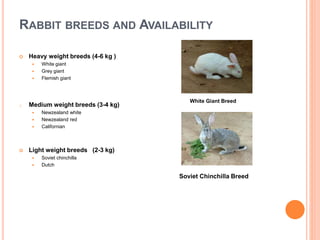
 Heavy weight breeds (4-6 kg )
 White giant
 Grey giant
 Flemish giant
o Medium weight breeds (3-4 kg)
 Newzealand white
 Newzealand red
 Californian
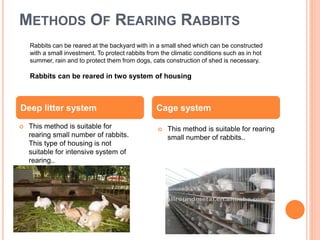
 Light weight breeds (2-3 kg)
 Soviet chinchilla
 Dutch
White Giant Breed
Soviet Chinchilla Breed
METHODS OF REARING RABBITS
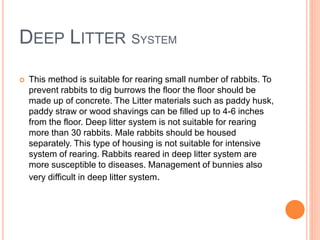
 This method is suitable for
rearing small number of rabbits.
This type of housing is not
suitable for intensive system of
rearing..
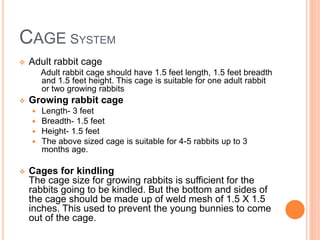
 This method is suitable for rearing
small number of rabbits..
Deep litter system Cage system
Rabbits can be reared at the backyard with in a small shed which can be constructed
with a small investment. To protect rabbits from the climatic conditions such as in hot
summer, rain and to protect them from dogs, cats construction of shed is necessary.
Rabbits can be reared in two system of housing
DEEP LITTER SYSTEM
 This method is suitable for rearing small number of rabbits. To
prevent rabbits to dig burrows the floor the floor should be
made up of concrete. The Litter materials such as paddy husk,
paddy straw or wood shavings can be filled up to 4-6 inches
from the floor. Deep litter system is not suitable for rearing
more than 30 rabbits. Male rabbits should be housed
separately. This type of housing is not suitable for intensive
system of rearing. Rabbits reared in deep litter system are
more susceptible to diseases. Management of bunnies also
very difficult in deep litter system.
CAGE SYSTEM
 Adult rabbit cage
Adult rabbit cage should have 1.5 feet length, 1.5 feet breadth
and 1.5 feet height. This cage is suitable for one adult rabbit
or two growing rabbits
 Growing rabbit cage
 Length- 3 feet
 Breadth- 1.5 feet
 Height- 1.5 feet
 The above sized cage is suitable for 4-5 rabbits up to 3
months age.
 Cages for kindling
The cage size for growing rabbits is sufficient for the
rabbits going to be kindled. But the bottom and sides of
the cage should be made up of weld mesh of 1.5 X 1.5
inches. This used to prevent the young bunnies to come
out of the cage.
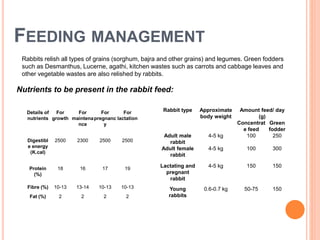
FEEDING MANAGEMENT
Details of
nutrients
For
growth
For
maintena
nce
For
pregnanc
y
For
lactation
Digestibl
e energy
(K.cal)
2500 2300 2500 2500
Protein
(%)
18 16 17 19
Fibre (%) 10-13 13-14 10-13 10-13
Fat (%) 2 2 2 2
Rabbit type Approximate
body weight
Amount feed/ day
(g)
Concentrat
e feed
Green
fodder
Adult male
rabbit
4-5 kg 100 250
Adult female
rabbit
4-5 kg 100 300
Lactating and
pregnant
rabbit
4-5 kg 150 150
Young
rabbits
0.6-0.7 kg 50-75 150
Rabbits relish all types of grains (sorghum, bajra and other grains) and legumes. Green fodders
such as Desmanthus, Lucerne, agathi, kitchen wastes such as carrots and cabbage leaves and
other vegetable wastes are also relished by rabbits.
Nutrients to be present in the rabbit feed:
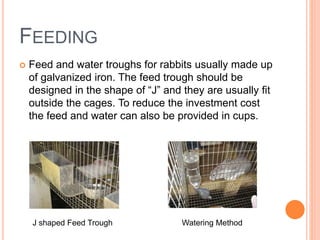
FEEDING
 Feed and water troughs for rabbits usually made up
of galvanized iron. The feed trough should be
designed in the shape of “J” and they are usually fit
outside the cages. To reduce the investment cost
the feed and water can also be provided in cups.
J shaped Feed Trough Watering Method
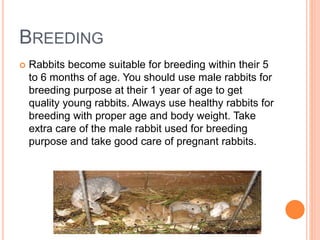
BREEDING
 Rabbits become suitable for breeding within their 5
to 6 months of age. You should use male rabbits for
breeding purpose at their 1 year of age to get
quality young rabbits. Always use healthy rabbits for
breeding with proper age and body weight. Take
extra care of the male rabbit used for breeding
purpose and take good care of pregnant rabbits.
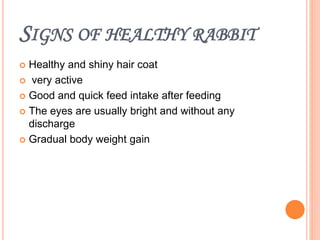
SIGNS OF HEALTHY RABBIT
 Healthy and shiny hair coat
 very active
 Good and quick feed intake after feeding
 The eyes are usually bright and without any
discharge
 Gradual body weight gain
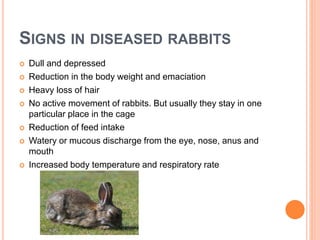
SIGNS IN DISEASED RABBITS
 Dull and depressed
 Reduction in the body weight and emaciation
 Heavy loss of hair
 No active movement of rabbits. But usually they stay in one
particular place in the cage
 Reduction of feed intake
 Watery or mucous discharge from the eye, nose, anus and
mouth
 Increased body temperature and respiratory rate
DISEASES OF RABBITS
 Pasteurellosis
 Poor ventilation, poor hygiene, nutritional deficiency are the risk factors responsible for occurrence of this disease in rabbits. This
disease spreads from dam to young rabbits.
 Enteritis
 There are various microorganisms responsible for producing enteritis in rabbits. Sudden change in the feed,
excess amount of carbohydrate in the feed, immuno depression, unhygienic feed and water are the factors
predispose the rabbits for enteritis caused by various microorganisms. Due to the loss of water due to
diarrhoea which leads to dehydration, rabbits become dull.
 Wry neck disease
 This disease affects the middle ear and the brain of rabbits. Because of the affection of membrane
of the middle ear and pus is discharged from the ear, the rabbit turn its head to one side.
 Mastitis
 Nursing dams are affected with mastitis. Affected udder is hot, reddish and painful to touch. Giving
appropriate antibiotics to rabbits will control the disease.
 Diseases due to fungal infection
 Skin infection is produced in rabbits by Dermatopysis fungus. There is loss of hair around the ear and nose
of rabbits. Because of irritation rabbits continously rub the affected areas results in formation of wounds in
these areas. Later on secondary bacterial infection in these sites results in pus formation.
THANK YOU 

Rabbit Farming

  • 1.
    RABBIT FARMING Presentation By: Ravi Kumar 2012V48B
  • 2.
    RABBIT FARMING ISVERY PROFITABLE AND ENJOYABLE. YOU CAN RAISE RABBITS FOR BOTH MAKING PROFIT AND AS A PET. RABBITS ARE BEING REARED IN OUR COUNTRY FROM A LONG TIME AGO. AND IT IS CONSIDERED AS ONE OF THE BEST ANIMAL FOR FARMING BUSINESS. WEATHER AND CLIMATE ALSO VERY SUITABLE FOR COMMERCIAL RABBIT FARMING IN INDIA.
  • 3.
    WHY RABBIT FARMING? With available small investment and in a small place rabbit farming gives more income  Rabbits eat ordinary feed and convert them into a protein rich high quality meat  Apart from meat production they can also be reared for hide and fur
  • 4.
    RABBIT FARMING ISFOR WHOM?  For landless farmers, uneducated youth and women, rabbit farming gives an additional income as a part time job
  • 5.
    ADVANTAGES OF RABBITFARMING  By rabbit rearing one can produce a quality protein rich meat for his own family  Rabbits can be fed with easily available leaves, waste vegetables, grains available in the home  Growth rate in broiler rabbits is very high. They attain 2 kgs at the age of three months  Litter size (Number of young ones born/ kindling) in rabbits is high (around 8-12)  When compared to the other meats rabbit meat contain high protein (21%) and less fat (8%). So this meat is suitable for all age groups from adults to children  Rabbits are small sized animal. So, they require less space, feed, care and management. You can easily raise rabbits in your farm, backyard, terrace and even at home.  Required capital/investment for starting rabbit farming business is very low. You can start with a very little investment.
  • 6.
    RABBIT BREEDS ANDAVAILABILITY  Heavy weight breeds (4-6 kg )  White giant  Grey giant  Flemish giant o Medium weight breeds (3-4 kg)  Newzealand white  Newzealand red  Californian  Light weight breeds (2-3 kg)  Soviet chinchilla  Dutch White Giant Breed Soviet Chinchilla Breed
  • 7.
    METHODS OF REARINGRABBITS  This method is suitable for rearing small number of rabbits. This type of housing is not suitable for intensive system of rearing..  This method is suitable for rearing small number of rabbits.. Deep litter system Cage system Rabbits can be reared at the backyard with in a small shed which can be constructed with a small investment. To protect rabbits from the climatic conditions such as in hot summer, rain and to protect them from dogs, cats construction of shed is necessary. Rabbits can be reared in two system of housing
  • 8.
    DEEP LITTER SYSTEM This method is suitable for rearing small number of rabbits. To prevent rabbits to dig burrows the floor the floor should be made up of concrete. The Litter materials such as paddy husk, paddy straw or wood shavings can be filled up to 4-6 inches from the floor. Deep litter system is not suitable for rearing more than 30 rabbits. Male rabbits should be housed separately. This type of housing is not suitable for intensive system of rearing. Rabbits reared in deep litter system are more susceptible to diseases. Management of bunnies also very difficult in deep litter system.
  • 9.
    CAGE SYSTEM  Adultrabbit cage Adult rabbit cage should have 1.5 feet length, 1.5 feet breadth and 1.5 feet height. This cage is suitable for one adult rabbit or two growing rabbits  Growing rabbit cage  Length- 3 feet  Breadth- 1.5 feet  Height- 1.5 feet  The above sized cage is suitable for 4-5 rabbits up to 3 months age.  Cages for kindling The cage size for growing rabbits is sufficient for the rabbits going to be kindled. But the bottom and sides of the cage should be made up of weld mesh of 1.5 X 1.5 inches. This used to prevent the young bunnies to come out of the cage.
  • 10.
    FEEDING MANAGEMENT Details of nutrients For growth For maintena nce For pregnanc y For lactation Digestibl eenergy (K.cal) 2500 2300 2500 2500 Protein (%) 18 16 17 19 Fibre (%) 10-13 13-14 10-13 10-13 Fat (%) 2 2 2 2 Rabbit type Approximate body weight Amount feed/ day (g) Concentrat e feed Green fodder Adult male rabbit 4-5 kg 100 250 Adult female rabbit 4-5 kg 100 300 Lactating and pregnant rabbit 4-5 kg 150 150 Young rabbits 0.6-0.7 kg 50-75 150 Rabbits relish all types of grains (sorghum, bajra and other grains) and legumes. Green fodders such as Desmanthus, Lucerne, agathi, kitchen wastes such as carrots and cabbage leaves and other vegetable wastes are also relished by rabbits. Nutrients to be present in the rabbit feed:
  • 11.
    FEEDING  Feed andwater troughs for rabbits usually made up of galvanized iron. The feed trough should be designed in the shape of “J” and they are usually fit outside the cages. To reduce the investment cost the feed and water can also be provided in cups. J shaped Feed Trough Watering Method
  • 12.
    BREEDING  Rabbits becomesuitable for breeding within their 5 to 6 months of age. You should use male rabbits for breeding purpose at their 1 year of age to get quality young rabbits. Always use healthy rabbits for breeding with proper age and body weight. Take extra care of the male rabbit used for breeding purpose and take good care of pregnant rabbits.
  • 13.
    SIGNS OF HEALTHYRABBIT  Healthy and shiny hair coat  very active  Good and quick feed intake after feeding  The eyes are usually bright and without any discharge  Gradual body weight gain
  • 14.
    SIGNS IN DISEASEDRABBITS  Dull and depressed  Reduction in the body weight and emaciation  Heavy loss of hair  No active movement of rabbits. But usually they stay in one particular place in the cage  Reduction of feed intake  Watery or mucous discharge from the eye, nose, anus and mouth  Increased body temperature and respiratory rate
  • 15.
    DISEASES OF RABBITS Pasteurellosis  Poor ventilation, poor hygiene, nutritional deficiency are the risk factors responsible for occurrence of this disease in rabbits. This disease spreads from dam to young rabbits.  Enteritis  There are various microorganisms responsible for producing enteritis in rabbits. Sudden change in the feed, excess amount of carbohydrate in the feed, immuno depression, unhygienic feed and water are the factors predispose the rabbits for enteritis caused by various microorganisms. Due to the loss of water due to diarrhoea which leads to dehydration, rabbits become dull.  Wry neck disease  This disease affects the middle ear and the brain of rabbits. Because of the affection of membrane of the middle ear and pus is discharged from the ear, the rabbit turn its head to one side.  Mastitis  Nursing dams are affected with mastitis. Affected udder is hot, reddish and painful to touch. Giving appropriate antibiotics to rabbits will control the disease.  Diseases due to fungal infection  Skin infection is produced in rabbits by Dermatopysis fungus. There is loss of hair around the ear and nose of rabbits. Because of irritation rabbits continously rub the affected areas results in formation of wounds in these areas. Later on secondary bacterial infection in these sites results in pus formation.
  • 16.