INTRODUCTIO
N TO
MARKETINGPrepared & Presented by
Ms. Himani R.
Layout
◦ Meaning and definition
◦ Goals
◦ Concepts of Marketing
◦ Approaches to Marketing
◦ Functions of Marketing
◦ Recent Trends in Marketing - e-business – Tele-
marketing – M-Business – Green Marketing –
Retailing, Relationship Marketing – Customer
Relationship Management
2Prepared by Ms. Himani R.
What is a Market?
3Prepared by Ms. Himani R.
What is a Market?
◦ Markets are people with money to spend and
the desire to spend it.” – Duddy & Reizan
◦ A market consist of all the existing and
potential consumers sharing a particular
need or want who might be willing and able
to engage in exchange to satisfy that need or
want.
4Prepared by Ms. Himani R.
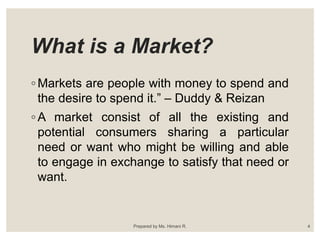
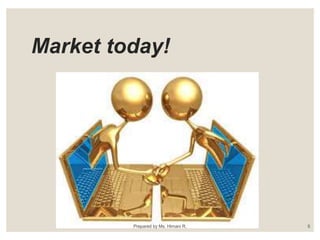
Market today!
5Prepared by Ms. Himani R.
And today…
6Prepared by Ms. Himani R.
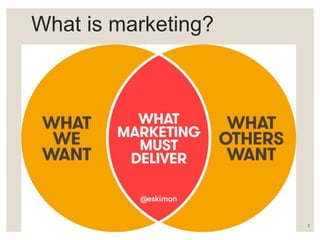
What is marketing?
Prepared by Ms. Himani R. 7
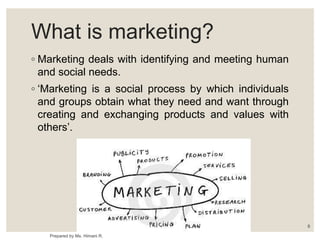
What is marketing?
◦ Marketing deals with identifying and meeting human
and social needs.
◦ ‘Marketing is a social process by which individuals
and groups obtain what they need and want through
creating and exchanging products and values with
others’.
Prepared by Ms. Himani R.
8
Prepared by Ms. Himani R. 9
Definition of Marketing
◦ “The set of human activities directed at
facilitating and consuming exchanges”. –
Philip Kotler
◦ It is a human activity directed at satisfying
needs and wants through exchange
processes.
◦ “Marketing is concerned with people & the
activities involved in the flow of goods &
services from producers to consumers. -
AMA
Prepared by Ms. Himani R. 10
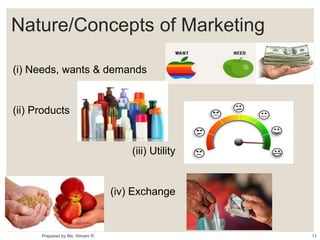
Nature/Concepts of Marketing
(i) Needs, wants & demands
(ii) Products
(iii) Utility
(iv) Exchange
Prepared by Ms. Himani R. 11
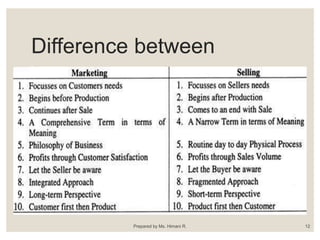
Difference between
Prepared by Ms. Himani R. 12
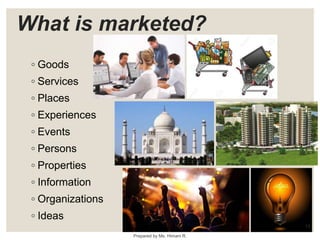
What is marketed?
◦ Goods
◦ Services
◦ Places
◦ Experiences
◦ Events
◦ Persons
◦ Properties
◦ Information
◦ Organizations
◦ Ideas
13
Prepared by Ms. Himani R.
IMPORTANCE OF
MARKETING1. Marketing process brings goods and services to satisfy the needs and
wants of the people.
2. It helps to bring new varieties & quality goods to consumers.
3. By making goods available at all places, it brings equal distribution.
4. Marketing converts latent demand into effective demand.
5. It gives wide employment opportunities.
6. It creates time, place & possession utilities.
7. Efficient marketing results in lower cost of marketing and ultimately
lower prices to consumers.
8. It is vital link between production and consumption and primarily
responsible to keep the wheel of production and consumption
constantly moving.
9. It creates to keep the standard of living of the society.
Prepared by Ms. Himani R. 14
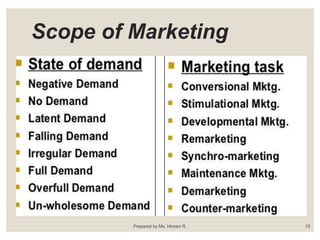
Scope of Marketing
Prepared by Ms. Himani R. 15
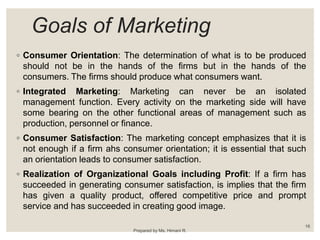
Goals of Marketing
◦ Consumer Orientation: The determination of what is to be produced
should not be in the hands of the firms but in the hands of the
consumers. The firms should produce what consumers want.
◦ Integrated Marketing: Marketing can never be an isolated
management function. Every activity on the marketing side will have
some bearing on the other functional areas of management such as
production, personnel or finance.
◦ Consumer Satisfaction: The marketing concept emphasizes that it is
not enough if a firm ahs consumer orientation; it is essential that such
an orientation leads to consumer satisfaction.
◦ Realization of Organizational Goals including Profit: If a firm has
succeeded in generating consumer satisfaction, is implies that the firm
has given a quality product, offered competitive price and prompt
service and has succeeded in creating good image.
Prepared by Ms. Himani R.
16
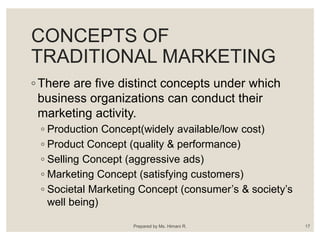
CONCEPTS OF
TRADITIONAL MARKETING
◦ There are five distinct concepts under which
business organizations can conduct their
marketing activity.
◦ Production Concept(widely available/low cost)
◦ Product Concept (quality & performance)
◦ Selling Concept (aggressive ads)
◦ Marketing Concept (satisfying customers)
◦ Societal Marketing Concept (consumer’s & society’s
well being)
Prepared by Ms. Himani R. 17
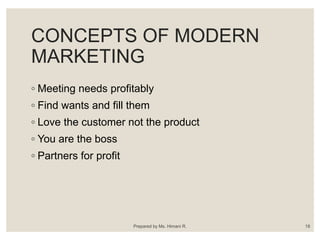
CONCEPTS OF MODERN
MARKETING
◦ Meeting needs profitably
◦ Find wants and fill them
◦ Love the customer not the product
◦ You are the boss
◦ Partners for profit
Prepared by Ms. Himani R. 18
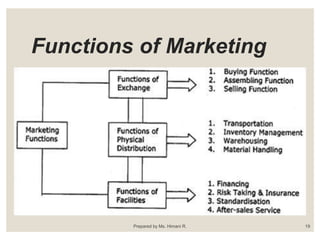
Functions of Marketing
Prepared by Ms. Himani R. 19
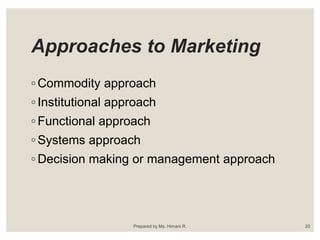
Approaches to Marketing
◦ Commodity approach
◦ Institutional approach
◦ Functional approach
◦ Systems approach
◦ Decision making or management approach
Prepared by Ms. Himani R. 20
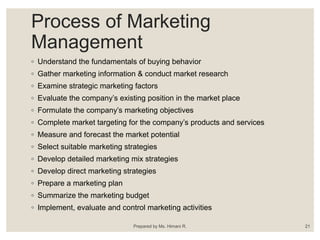
Process of Marketing
Management
◦ Understand the fundamentals of buying behavior
◦ Gather marketing information & conduct market research
◦ Examine strategic marketing factors
◦ Evaluate the company’s existing position in the market place
◦ Formulate the company’s marketing objectives
◦ Complete market targeting for the company’s products and services
◦ Measure and forecast the market potential
◦ Select suitable marketing strategies
◦ Develop detailed marketing mix strategies
◦ Develop direct marketing strategies
◦ Prepare a marketing plan
◦ Summarize the marketing budget
◦ Implement, evaluate and control marketing activities
Prepared by Ms. Himani R. 21
Recent Trends in Marketing
◦ E-business
◦ Tele-marketing
◦ M-Business
◦ Green Marketing
◦ Retailing
◦ Relationship Marketing
◦ Customer Relationship Management
Prepared by Ms. Himani R. 22
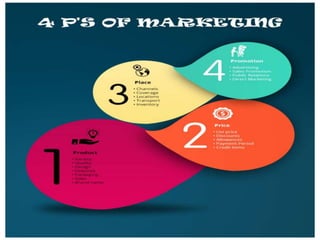
4 Ps of Marketing
Prepared by Ms. Himani R. 23
Prepared by Ms. Himani R. 24

Marketing & Services Management:Unit 1

  • 1.
    INTRODUCTIO N TO MARKETINGPrepared &Presented by Ms. Himani R.
  • 2.
    Layout ◦ Meaning anddefinition ◦ Goals ◦ Concepts of Marketing ◦ Approaches to Marketing ◦ Functions of Marketing ◦ Recent Trends in Marketing - e-business – Tele- marketing – M-Business – Green Marketing – Retailing, Relationship Marketing – Customer Relationship Management 2Prepared by Ms. Himani R.
  • 3.
    What is aMarket? 3Prepared by Ms. Himani R.
  • 4.
    What is aMarket? ◦ Markets are people with money to spend and the desire to spend it.” – Duddy & Reizan ◦ A market consist of all the existing and potential consumers sharing a particular need or want who might be willing and able to engage in exchange to satisfy that need or want. 4Prepared by Ms. Himani R.
  • 5.
  • 6.
  • 7.
    What is marketing? Preparedby Ms. Himani R. 7
  • 8.
    What is marketing? ◦Marketing deals with identifying and meeting human and social needs. ◦ ‘Marketing is a social process by which individuals and groups obtain what they need and want through creating and exchanging products and values with others’. Prepared by Ms. Himani R. 8
  • 9.
    Prepared by Ms.Himani R. 9
  • 10.
    Definition of Marketing ◦“The set of human activities directed at facilitating and consuming exchanges”. – Philip Kotler ◦ It is a human activity directed at satisfying needs and wants through exchange processes. ◦ “Marketing is concerned with people & the activities involved in the flow of goods & services from producers to consumers. - AMA Prepared by Ms. Himani R. 10
  • 11.
    Nature/Concepts of Marketing (i)Needs, wants & demands (ii) Products (iii) Utility (iv) Exchange Prepared by Ms. Himani R. 11
  • 12.
  • 13.
    What is marketed? ◦Goods ◦ Services ◦ Places ◦ Experiences ◦ Events ◦ Persons ◦ Properties ◦ Information ◦ Organizations ◦ Ideas 13 Prepared by Ms. Himani R.
  • 14.
    IMPORTANCE OF MARKETING1. Marketingprocess brings goods and services to satisfy the needs and wants of the people. 2. It helps to bring new varieties & quality goods to consumers. 3. By making goods available at all places, it brings equal distribution. 4. Marketing converts latent demand into effective demand. 5. It gives wide employment opportunities. 6. It creates time, place & possession utilities. 7. Efficient marketing results in lower cost of marketing and ultimately lower prices to consumers. 8. It is vital link between production and consumption and primarily responsible to keep the wheel of production and consumption constantly moving. 9. It creates to keep the standard of living of the society. Prepared by Ms. Himani R. 14
  • 15.
    Scope of Marketing Preparedby Ms. Himani R. 15
  • 16.
    Goals of Marketing ◦Consumer Orientation: The determination of what is to be produced should not be in the hands of the firms but in the hands of the consumers. The firms should produce what consumers want. ◦ Integrated Marketing: Marketing can never be an isolated management function. Every activity on the marketing side will have some bearing on the other functional areas of management such as production, personnel or finance. ◦ Consumer Satisfaction: The marketing concept emphasizes that it is not enough if a firm ahs consumer orientation; it is essential that such an orientation leads to consumer satisfaction. ◦ Realization of Organizational Goals including Profit: If a firm has succeeded in generating consumer satisfaction, is implies that the firm has given a quality product, offered competitive price and prompt service and has succeeded in creating good image. Prepared by Ms. Himani R. 16
  • 17.
    CONCEPTS OF TRADITIONAL MARKETING ◦There are five distinct concepts under which business organizations can conduct their marketing activity. ◦ Production Concept(widely available/low cost) ◦ Product Concept (quality & performance) ◦ Selling Concept (aggressive ads) ◦ Marketing Concept (satisfying customers) ◦ Societal Marketing Concept (consumer’s & society’s well being) Prepared by Ms. Himani R. 17
  • 18.
    CONCEPTS OF MODERN MARKETING ◦Meeting needs profitably ◦ Find wants and fill them ◦ Love the customer not the product ◦ You are the boss ◦ Partners for profit Prepared by Ms. Himani R. 18
  • 19.
  • 20.
    Approaches to Marketing ◦Commodity approach ◦ Institutional approach ◦ Functional approach ◦ Systems approach ◦ Decision making or management approach Prepared by Ms. Himani R. 20
  • 21.
    Process of Marketing Management ◦Understand the fundamentals of buying behavior ◦ Gather marketing information & conduct market research ◦ Examine strategic marketing factors ◦ Evaluate the company’s existing position in the market place ◦ Formulate the company’s marketing objectives ◦ Complete market targeting for the company’s products and services ◦ Measure and forecast the market potential ◦ Select suitable marketing strategies ◦ Develop detailed marketing mix strategies ◦ Develop direct marketing strategies ◦ Prepare a marketing plan ◦ Summarize the marketing budget ◦ Implement, evaluate and control marketing activities Prepared by Ms. Himani R. 21
  • 22.
    Recent Trends inMarketing ◦ E-business ◦ Tele-marketing ◦ M-Business ◦ Green Marketing ◦ Retailing ◦ Relationship Marketing ◦ Customer Relationship Management Prepared by Ms. Himani R. 22
  • 23.
    4 Ps ofMarketing Prepared by Ms. Himani R. 23
  • 24.
    Prepared by Ms.Himani R. 24

Editor's Notes

  • #21 Commodity Approach: The first approach is the commodity approach under which a specific commodity is selected and then its marketing methods and environments are studied in the course of its movement from producer to consumer. In this approach, the subject matter of discussion centers around the specific commodity selected for the study and includes the sources and conditions of supply, nature and extent of demand, the distribution channels used, promotional methods adopted etc. Functional Approach: The second approach is the functional approach under which the study concentrates on the specialized functions or services performed by the marketers and the problems faced by them in performing those functions. Such marketing functions include buying, selling, storage, standardizing, transport, finance, risk-bearing, market information etc. This approach certainly enables one to gain detailed knowledge on various functions of marketing. Institutional Approach: The third approach is the institutional approach under which the main interest centers around the institutions or agencies that perform marketing functions. Such agencies include wholesalers, retailers, mercantile agents and facilitating institutions like transport undertakings, banks, insurance companies etc. This approach helps one to find out the operating methods adopted by these institutions and the various problems faced by them and to know how they work together in fulfilling their objectives. Managerial Approach: In the managerial approach, the focus of marketing study is on the decision-making process involved in the performance of marketing functions at the level of a firm. The study encompasses discussion of the different underlying concepts, decision influencing factors; alternative strategies – their relative importance, strengths and weaknesses, ad techniques and methods of problem-solving. This approach entails the study of marketing at the micro-level of a business firm – of the managerial functions of analysis, planning, implementation, coordination and control in relation to the marketing functions or creating, stimulating, facilitating and valuing transactions. Systems Approach: Modern marketing is complex, vast and sophisticated and it influences the entire economy and standard of living of people. Hence marketing experts have developed one more approach namely ‘System approach’. Under this approach, marketing itself is considered as a sub-system of economic, legal and competitive marketing system. The marketing system operates in an environment of both controllable and uncontrollable forces of the organization. The controllable forces include all aspects of products, price, physical distribution and promotion. The uncontrollable forces include economic, sociological, psychological and political forces. The organization has to develop a suitable marketing programme by taking into consideration both these controllable and uncontrollable forces to meet the changing demands of the society. The systems approach, in fact, examines this aspect and also integrates commodity, functional institutional and managerial approaches. Further, this approach emphasis the importance of the use of ‘market information’ in marketing programmes. Thus, from the foregoing discussion, one could easily understand that the marketing could be studied in any of the above approach and the systems approach is considered to be the best approach as it provides a strong base for logical and orderly analysis and planning of marketing activities.