BY
PROF. PRASHANT
MISHRA
VIMR, KARHI ROAD,
AMOUDHA
SATNA, M.P.
Dove
• Dove’s marketing director Stacie Bright had a moral problem in 2006.
• After years of marketing Dove’s soaps using what the mainstream
considers ‘beautiful’ models Bright realized this was affecting her own
daughter’s self-esteem, and therefore affecting the self-esteem of
everybody’s daughter subjected to this advertising.
• Bright created a mock-up advert using all of the company directors’
daughters with text alongside each image saying how these girls believed
they weren’t beautiful.
• Bright and her team showed it to the executives, confident that this was a
risky but worthwhile move.
• The risk worked. The Dove executives were of course deeply affected, said
a resounding yes through their tears, and completely overhauled
Dove’s marketing strategy, which has continued to this day.
• Dove doubled profits from £1bn to £2bn and turned the business of
THE MARKETING STORY…
THE BASICS…
• MARKET
• MARKET PLACE
• VIRTUAL MARKET
• META MARKET
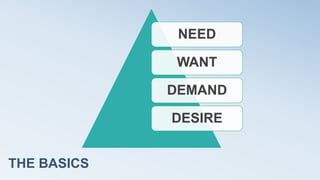
THE BASICS
NEED
WANT
DEMAND
DESIRE
WHAT IS MARKETING?
“Meeting Needs Profitably”
Marketing is an organizational function and
set of processes for creating, communicating
& delivering value to customers and for
managing customer relationships in ways that
benefit the organization & its stakeholders.
DEFINITION…
• Marketing is the process of planning and executing the
conception, pricing, promotion and distribution of ideas,
goods and services to create exchanges that satisfy
individual and organizational objectives.
• Philip Kotler defined marketing as:
"Satisfying needs and wants through an exchange
process".
• A decade later he defines it as:
“A social and managerial process by which individuals
and groups obtain what they want and need through
creating, offering and exchanging products of value with
WHAT IS MARKETING MANAGEMENT?
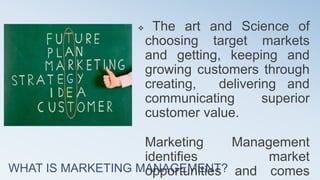
 The art and Science of
choosing target markets
and getting, keeping and
growing customers through
creating, delivering and
communicating superior
customer value.
Marketing Management
identifies market
opportunities and comes
MARKETING MANAGEMENT DEFINITION
• According to Philip Kotler,
“Marketing Management is the art and science of choosing
target markets and building profitable relationship with them.
Marketing management is a process involving analysis,
planning, implementing and control and it covers goods,
services, ideas and the goal is to produce satisfaction to the
parties involved”.
HISTORY…
• Today marketing is known as an advanced blend of strategy and
technology, however, it hasn’t always been this way. The history of
marketing as we know it began with humble beginnings of simply trying
to sell goods and services.
• The ideas of marketing as it is understood in the modern era began
during the time of the Industrial Revolution. This period spanned the
late 18th century and lasted long into the 19th century.
• It was during the Industrial Revolution that purchasing goods began to
be easier for a consumer than make things themselves.
• Mass production created many industries engaged in the same
endeavor to serve the needs of a growing consumer market.
• The infrastructure for transportation as well as mass media took hold.
• It created a need for producers to find better ways to develop products
customers needed and a more sophisticated approach to informing
them about these commodities.
TRADITIONAL MARKETING CONCEPT…
• According to this concept, marketing consists of those
activities which are concerned with the transfer of
ownership of goods from producers to consumers.
• In other words, it is the process by which goods are
made available to ultimate consumers from their place
of origin.
• The traditional concept of marketing corresponds to the
general notion of marketing, which means selling goods
and services after they have been produced.
Marketing Management Involves:
1.The setting of marketing goals and objectives
2. Developing the marketing plan
3. Organizing the marketing function
4. Putting the marketing plan into action
5. Controlling the marketing program.
MARKETING MANAGEMENT CONCEPT
• This concept advocates that a manufacturer should begin
his task with the consumer focus.
• Selling should be preceded by customer study, marketing
research and product development.
• “The aim of marketing is to know and understand the
consumer so well that that the product or service fits him
and sells itself.” – Peter Drucker.
• This concept is also called customer orientation.
• “The Marketing concept is a customer orientation backed
by integrated marketing aimed at generating customer
satisfaction as the key to satisfying organizational goals”. –
BASIS OF MARKETING CONCEPT.
i. Focus on customer needs
ii. Providing consumer satisfaction
iii. Integrated Marketing Management
iv. Achieving organizational goals
v. Innovation
FEATURES OF MARKETING MANAGEMENT.
• It is a Managerial Process.
• It is Consumer Centric.
• It is based on Research Analysis.
• It involves Planning & Development.
• It involves Building Marketing Framework.
• It focuses on Organizational Objectives.
• It is a Promotional & Communication Process.
IMPORTANCE OF MARKETING MANAGEMENT.
1. Analyzing Market Opportunities
2. Determination of Target Market
3. Planning and Decision Making
4. Creation of Customer
5. Helps in Increasing Profit
6. Improvement in Quality of Life
7. Employment Opportunities
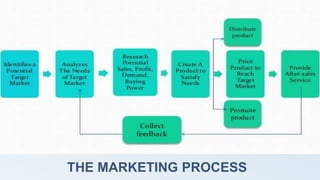
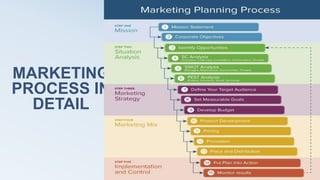
THE MARKETING PROCESS
MARKETING
PROCESS IN
DETAIL
THE MARKETING CONCEPT
• The Production Concept. This concept is the oldest of the concepts in
business. It holds that consumers will prefer products that are widely available and
inexpensive. Managers focusing on this concept concentrate on achieving high
production efficiency, low costs, and mass distribution.
• The Product Concept. This orientation holds that consumers will favor those
products that offer the most quality, performance, or innovative features. Managers
focusing on this concept concentrate on making superior products and improving
them over time. They assume that buyers admire well-made products and can
appraise quality and performance.
• The Selling Concept. This is another common business orientation. It holds that
consumers and businesses, if left alone, will ordinarily not buy enough of the selling
company’s products. The organization must, therefore, undertake an aggressive
selling and promotion effort. It also assumes that the company has a whole battery
of effective selling and promotional tools to stimulate more buying
• The Marketing Concept. This is a business philosophy that challenges the above
three business orientations. Its central tenets crystallized in the 1950s. It holds
that the key to achieving its organizational goals (goals of the selling company)
HOLISTIC MARKETING CONCEPT
• According to holistic marketing concept, even if a business is made of
various departments, the departments have to come together to project
a positive & united business image in the minds of the customer.
Holistic marketing concept involves interconnected marketing activities
to ensure that the customer is likely to purchase their product rather
than competition.
Example of Holistic marketing concept
• An organization will have different departments like sales and
marketing, accounting and finance, R&D and product development and
finally HR and operations. Thus, if you want to implement a holistic
marketing concept in your organization, you need to ensure that R&D
and product development take the feedback from marketing and sales
to launch the product which is most likely to attract customers.
• On the other hand they need to work closely with accounting and
finance to find out the exact budget for the project. Sales and
SOCIETAL MARKETING CONCEPT
• The Societal Marketing Concept puts Human welfare on top before
profits and satisfying the wants.
• Societal Marketing emphasizes on social responsibilities and suggests
that to sustain long-term success, the company should develop a
marketing strategy to provide value to the customers to maintain and
improve both the customers and society’s well being better than the
competitors.
• Societal Marketing creates a favorable image for the company
increases sales. It is not the same as the terms of social marketing and
social media marketing. It is a term closely related to CSR and
sustainable development.
FACTORS AFFECTING MARKETING CONCEPT
• Growth of Population
• Changing Concept of Family
• More Disposable Income
• More Discretionary Income
• TechnologyAdvancement
• Media
• Credit Facility
NATURE OF MARKETING
• It is a legal process by which ownership is
transferred
• It is a system of interacting business
activities
• It is a managerial function of organizing and
directing business activities that facilitates
the movement of goods from producers to
consumers
• It is a Philosophy based on consumer
SCOPE OF MARKETING
Marketers are involved with marketing majorly these ten types
of entities :
• Services
• Events
• Experiences
• Persons
• Places
• Properties
• Organizations
• Information
• Ideas
• Physical Goods
SCOPE OF MARKETING
• Study of Consumer wants and needs
• Study of Buyer Behavior
• Product Planning and development
• Pricing Policies
• Distribution
• Promotion
• Consumer Satisfaction
• Marketing Control
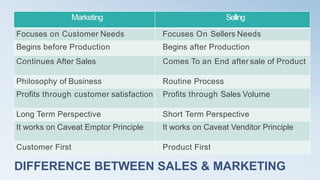
DIFFERENCE BETWEEN SALES & MARKETING
Marketing Selling
Focuses on Customer Needs Focuses On Sellers Needs
Begins before Production Begins after Production
Continues After Sales Comes To an End after sale of Product
Philosophy of Business Routine Process
Profits through customer satisfaction Profits through Sales Volume
Long Term Perspective Short Term Perspective
It works on Caveat Emptor Principle It works on Caveat Venditor Principle
Customer First Product First
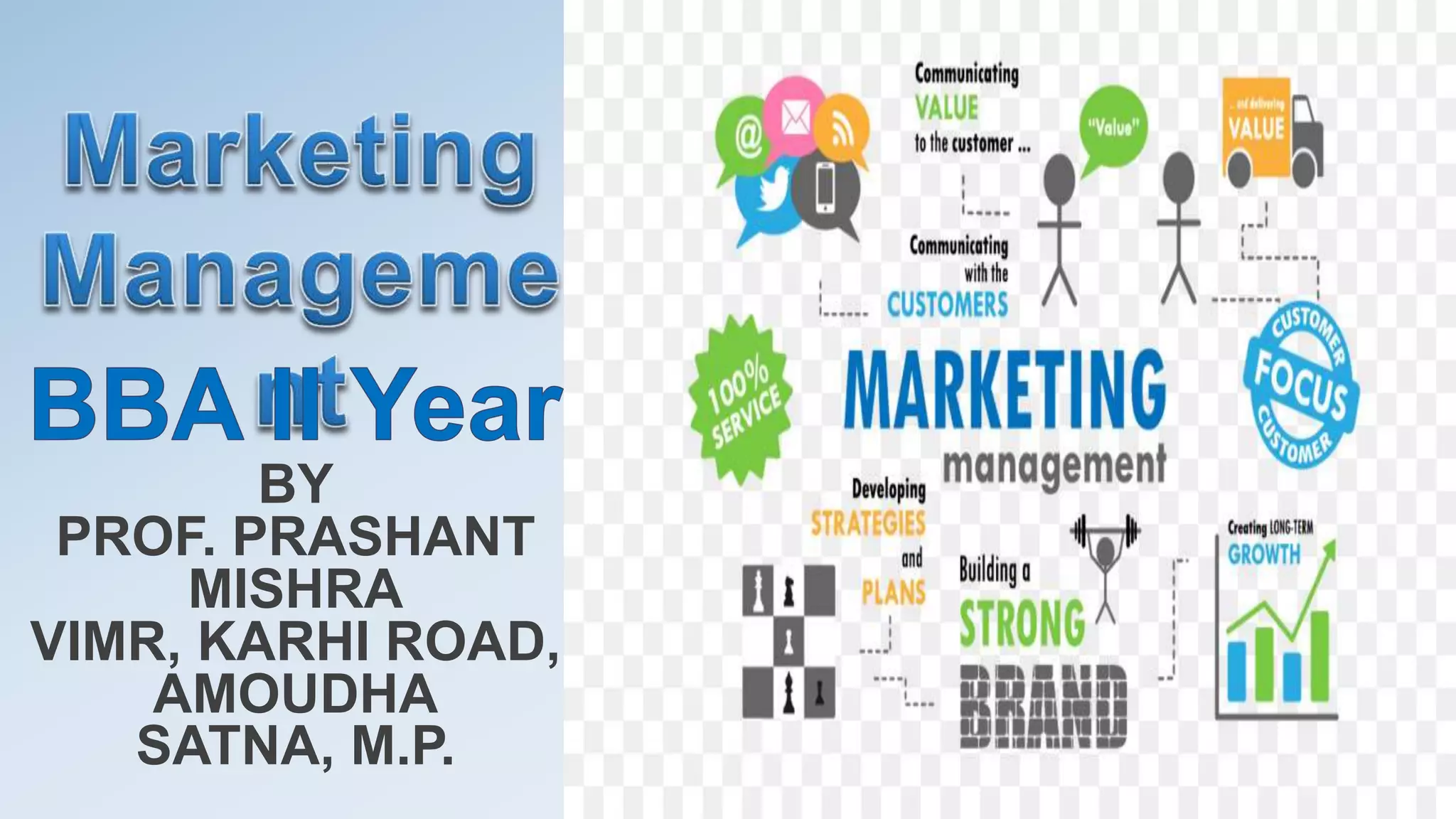
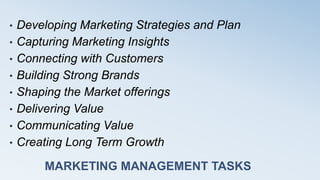
MARKETING MANAGEMENT TASKS
• Developing Marketing Strategies and Plan
• Capturing Marketing Insights
• Connecting with Customers
• Building Strong Brands
• Shaping the Market offerings
• Delivering Value
• Communicating Value
• Creating Long Term Growth
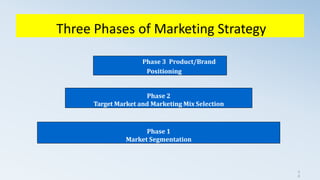
Three Phases of Marketing Strategy
3
0
Phase 2
Target Market and Marketing Mix Selection
Phase 3 Product/Brand
Positioning
Phase 1
Market Segmentation
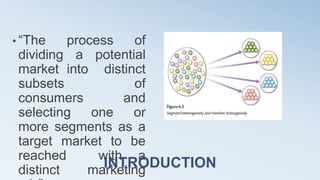
INTRODUCTION
• “The process of
dividing a potential
market into distinct
subsets of
consumers and
selecting one or
more segments as a
target market to be
reached with a
distinct marketing
Definition & Explanation
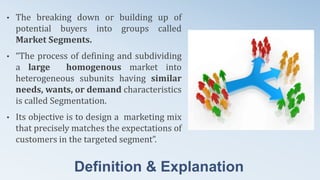
• The breaking down or building up of
potential buyers into groups called
Market Segments.
• “The process of defining and subdividing
a large homogenous market into
heterogeneous subunits having similar
needs, wants, or demand characteristics
is called Segmentation.
• Its objective is to design a marketing mix
that precisely matches the expectations of
customers in the targeted segment”.
Benefits of Segmentation
• Segmentation Studies discover the needs and
wants of groups of consumers to develop
specialized products to satisfy group needs.
• Segmentation Studies used to identify the most
appropriate media for advertising.
• It Identifies opportunities & niches for new
product development.
• It Helps design marketing programs most
effectively for reaching homogenous groups of
buyers
Factors Affecting Market Segmentation
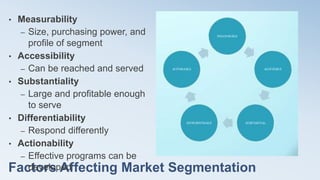
• Measurability
– Size, purchasing power, and
profile of segment
• Accessibility
– Can be reached and served
• Substantiality
– Large and profitable enough
to serve
• Differentiability
– Respond differently
• Actionability
– Effective programs can be
developed
Assignment
• Considering the largest bank in your college’s city or
town:
– How might consumers’ needs differ?
– What types of products might meet their needs?
– What advertising media makes sense for the different
segments of consumers?
10
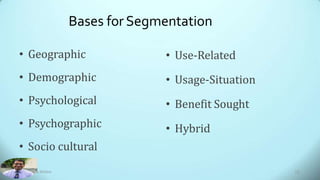
Bases for Segmentation
• Geographic
• Demographic
• Psychological
• Psychographic
• Socio cultural
• Use-Related
• Usage-Situation
• Benefit Sought
• Hybrid
Dr. Amitabh Mishra 12
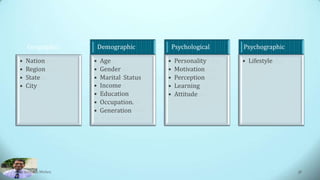
Geographic
• Nation
• Region
• State
• City
Demographic
• Age
• Gender
• Marital Status
• Income
• Education
• Occupation.
• Generation
Psychological
• Personality
• Motivation
• Perception
• Learning
• Attitude
Psychographic
• Lifestyle
Dr. Amitabh Mishra 38
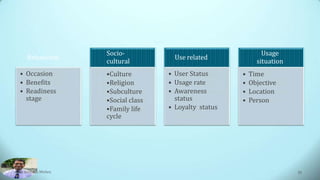
Behavioral
• Occasion
• Benefits
• Readiness
stage
Socio-
cultural
•Culture
•Religion
•Subculture
•Social class
•Family life
cycle
Use related
• User Status
• Usage rate
• Awareness
status
• Loyalty status
Usage
situation
• Time
• Objective
• Location
• Person
Dr. Amitabh Mishra 39
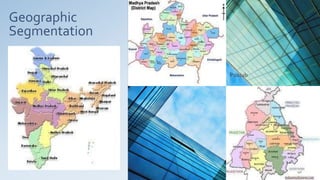
Geographic
Segmentation
Punjab
40
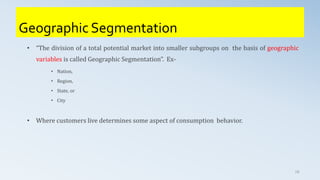
Geographic Segmentation
• “The division of a total potential market into smaller subgroups on the basis of geographic
variables is called Geographic Segmentation”. Ex-
• Nation,
• Region,
• State, or
• City
• Where customers live determines some aspect of consumption behavior.
18
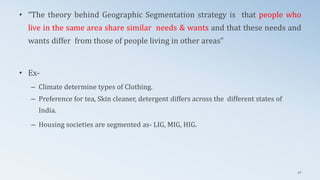
• “The theory behind Geographic Segmentation strategy is that people who
live in the same area share similar needs & wants and that these needs and
wants differ from those of people living in other areas”
• Ex-
– Climate determine types of Clothing.
– Preference for tea, Skin cleaner, detergent differs across the different states of
India.
– Housing societies are segmented as- LIG, MIG, HIG.
42
43
Demographic Segmentation
44
• In demographic segmentation market is divided in to groups on
the basis of variables such as-
– Age.
– Gender.
– Marital Status.
– Income.
– Education.
– Occupation.
– Generation.
• Demographic variables are the most popular bases for
distinguishing customer group. The reasons are-
• Consumer’s want, preferences and usage rate are often associated with
demographic variables.
• It is easiest and most logical way to classify people.
• It is most cost effective.
45
AGE
46
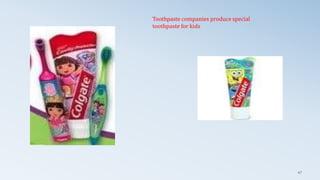
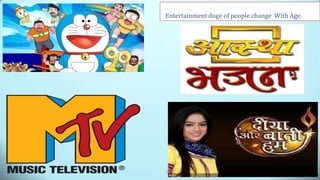
• Products need often vary with consumer’s age.
• Consumer’s wantsand ability to pay changes with
age.
Toothpaste companies produce special
toothpaste for kids
47
Mishra 26
Entertainment doge of people change With Age.
GENDER
49
• Many products and services inherently designed for either Male or
Female.
• Gender segmentation has long been applied in-
– Clothing
– Hairstyling
– Cosmetics
– magazines
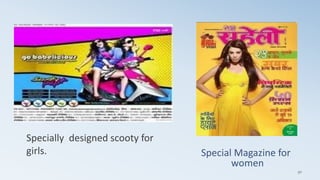
Special Magazine for
women
50
Specially designed scooty for
girls.
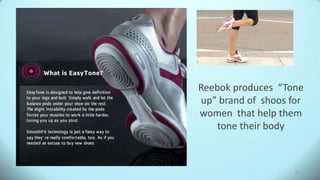
Reebok produces “Tone
up” brand of shoos for
women that help them
tone their body
31
Reebok Toneup
INCOME, EDUCATION & OCCUPATION
52
• Income is an indicator of the ability to pay for a product or a specific version
of a given product.
is in practice for products
• Income segmentation
categories as-
– Automobiles
– Clothing
– Travel
• A person's occupation affects the goods and services bought. For
example-
– Blue-collar workers tend to buy more rugged work clothes, whereas white-
collar workers buy more business suits.
– Computer software companies will design different products for brand
managers, accountants, engineers, lawyers, and doctors.
53
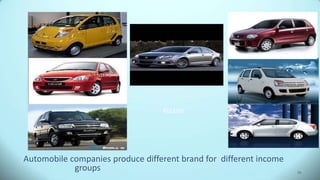
Automobile companies produce different brand for different income
groups
NANO
KIZASHI
SX-4
54
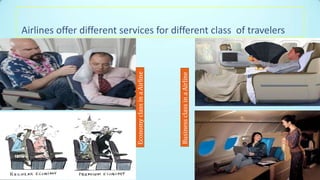
Airlines offer different services for different class of travelers
35
Economy
class
in
a
Airline
Business
class
in
a
Airline
56
• Psychological characteristics refer to the inner and intrinsic
qualities of individual consumers. Consumers can be
segmented in terms of-
– Personality
– Motivation
– Perception
– Learning
– Attitude
Dr. Amitabh Mishra 57
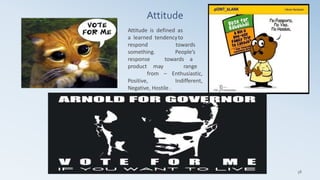
Attitude
Attitude is defined as
a learned tendencyto
towards
People’s
respond
something.
response towards a
product may range
Positive,
from – Enthusiastic,
Indifferent,
Negative, Hostile .
58
Dr. Amitabh Mishra 59
Psychographic
(Lifestyle)
Segmentation
Dr. Amitabh Mishra 60
Psychographic (lifestyle) Segmentation
• Also known as Lifestyle Analysis.
(lifestyle) variables include
• Psychographic
(AIOs)-
– Activities,
– Interests, and
– Opinions.
Dr. Amitabh Mishra 61
•As an approach to construct the psychographic profile, AIO
research seeks consumer’s responses to a large number of
statements that measure activities, interest and opinion.
Dr. Amitabh Mishra 62
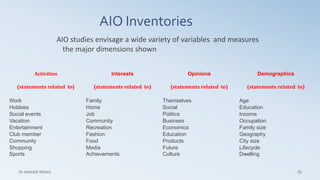
AIO Inventories
Dr. Amitabh Mishra 63
AIO studies envisage a wide variety of variables and measures
the major dimensions shown
Activities
(statements related to)
Interests
(statements related to)
Opinions
(statements related to)
Demographics
(statements related to)
Work Family Themselves Age
Hobbies Home Social Education
Social events Job Politics Income
Vacation Community Business Occupation
Entertainment Recreation Economics Family size
Club member Fashion Education Geography
Community Food Products City size
Shopping Media Future Lifecycle
Sports Achievements Culture Dwelling
Socio-Cultural
Segmentation
Dr. Amitabh Mishra 64
Socio-Cultural Segmentation
Dr. Amitabh Mishra 65
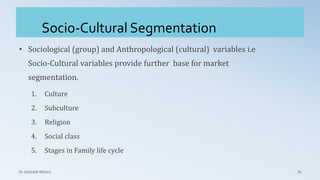
• Sociological (group) and Anthropological (cultural) variables i.e
Socio-Cultural variables provide further base for market
segmentation.
1. Culture
2. Subculture
3. Religion
4. Social class
5. Stages in Family life cycle
Culture
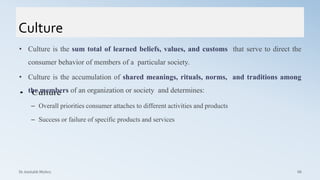
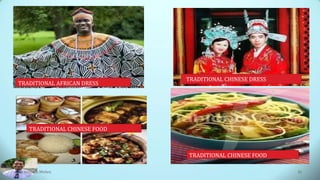
• Culture is the sum total of learned beliefs, values, and customs that serve to direct the
consumer behavior of members of a particular society.
• Culture is the accumulation of shared meanings, rituals, norms, and traditions among
the members of an organization or society and determines:
– Overall priorities consumer attaches to different activities and products
– Success or failure of specific products and services
Dr. Amitabh Mishra 66
TRADITIONAL AFRICAN DRESS
TRADITIONAL CHINESE DRESS
TRADITIONAL CHINESE FOOD
Dr. Amitabh Mishra 67
Subculture
Dr. Amitabh Mishra 68
• “ A distinct cultural group that exists as an identifiable segment within a larger,
more complex society/culture”
• “Subculture is any cultural patterning that preserves important features of the
dominant culture/society but provides for values, norms, and behaviors of its
own”.
Use-Related
Segmentation
Dr. Amitabh Mishra 68
• Such segmentation categorize product,
service or brand usage characteristic,
such as-
1. Rate of Usage
2. User status
3. Awareness Status
4. Brand Loyalty Etc.
69
Rate of Usage
• Customers can be segmented on the basis of usage rate of a product
category.
a) Heavy users
b) Medium users
c) Light users &
d) Non-users
• The profiling of heavy users allows this group to receive most marketing attention (particularly promotion
efforts) on the assumption that brand loyalty among these people will pay heavy dividends.
70
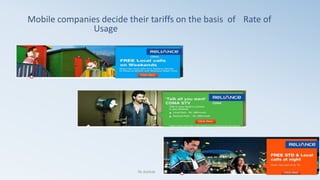
Mobile companies decide their tariffs on the basis of Rate of
Usage
Dr. Amitab h Mishra 71
User status
Dr. Amitabh Mishra 73
• Every product has its-
a) Nonusers,
b) Ex-users,
c) Potential users,
d) First-time users and
e) Regular users.
A company cannot always rely on the regular users, it has to
attract the other types as well. The key too attracting
potential users, or possibly, even non-users, is understanding
the reasons due to which they are not using your product.
Dr. Amitabh Mishra 74
Brand Loyalty
75
• Consumers can be divided in to 4 groups according
to brand loyalty status-
a) Hard core loyal (Who buy one brand all the time)
b) Split loyal (Who are loyal to two or three brands)
c) Shifting loyal (Shift from one brand to another brand)
d) Switchers (Show no loyalty toward any brand)
• Marketers often try to identify characteristics of brand loyal
customers so that they can direct
Dr. Amitabh Mishra 76
their
their
promotional efforts to people with similar characteristics in larger population.
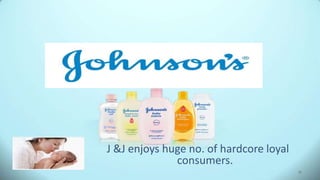
J &J enjoys huge no. of hardcore loyal
consumers.
77
Usage-Situation
Segmentation
78
• Occasions or Situations often determines what
consumers will purchase or consume.
• The consumers are Segmented on the basis of special
occasions or situations. like-
– Time of consumption.
– Objective of consumption.
– Location of consumption.
Dr. Amitabh Mishra 78
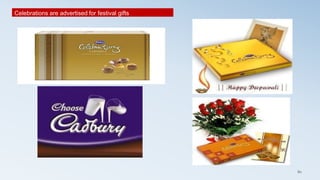
Celebrations are advertised for festival gifts
80
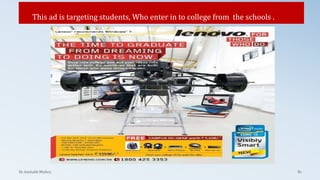
This ad is targeting students, Who enter in to college from the schools .
Dr. Amitabh Mishra 81
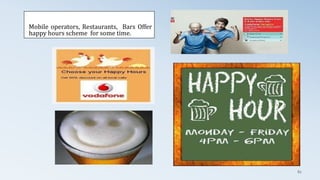
Mobile operators, Restaurants, Bars Offer
happy hours scheme for some time.
82
Benefit
Segmentation
Dr. Amitabh Mishra 83
BenefitSegmentation
• “Segmenting on the basis of the most important and meaningful
benefit of the product or services that will be most meaningful to the
consumers”.
• Benefit segmentation can be used to position various products with in
the same product category.
84
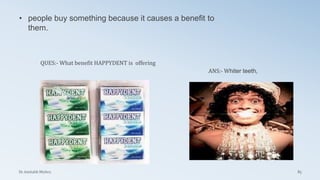
• people buy something because it causes a benefit to
them.
ANS:- Whiter teeth,
Dr. Amitabh Mishra 85
QUES:- What benefit HAPPYDENT is offering
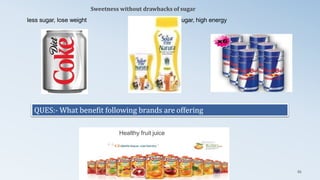
less sugar, lose weight zero sugar, high energy
Healthy fruit juice
Sweetness without drawbacks of sugar
QUES:- What benefit following brands are offering
86
Band-aid
offers “flex” as
a
benefit to
consumers.
87
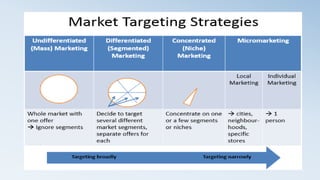
A target market is the market or market segments which form the focus of the firm’s
marketing efforts. Once segments have been identified decisions about how many
and which customer groups to target must be made. The options include the
following.
1. Mass Marketing Strategy
2. Single Segment Strategy
3. Multi Segment Strategy
• Offering on product / service concept to most of the market, across many
market segments. Although scale economies can be achieved, there is a risk
that few customers will be adequately satisfied.
• The underlying assumption of this approach referred to as undifferentiated
marketing, is that all customers in the market have similar needs and wants
and can therefore be satisfied with a single marketing mix – that is, a
standard product or service, similar price levels, one method of distribution
and a promotional mix which is directed at everyone.
•Concentrates on a single segment with a product/ service concept.
•This is relatively cheap in resources, but there is a risk of putting all the eggs in one
basket – if the segment fails the company’s financial strength will rapidly decline.
•Rolex, for example, targets relatively high income consumers with its prestigious
wrist – watches.
•When world economies are buoyant, sales will be good but in times of economic
recession even the better off can change their spending patterns.
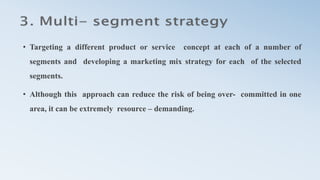
• Targeting a different product or service concept at each of a number of
segments and developing a marketing mix strategy for each of the selected
segments.
• Although this approach can reduce the risk of being over- committed in one
area, it can be extremely resource – demanding.
MARKET POSITIONING
• Market Positioning refers to the ability to influence consumer
perception regarding a brand or product relative to competitors.
• The objective of market positioning is to establish the image or identity of
a brand or product so that consumers perceive it in a certain way.
• For example:
• A handbag maker may position itself as a luxury status symbol
• ATV maker may position itsTV as the most innovative and cutting-edge
• A fast-food restaurant chain may position itself as the provider of cheap
meals
TYPES OF POSITIONING STRATEGIES
• There are several types of positioning strategies. A few examples are
positioning by:
• Product attributes and benefits: Associating your brand/product with
certain characteristics or with certain beneficial value
• Product price: Associating your brand/product with competitive pricing
• Product quality: Associating your brand/product with high quality
• Product use and application: Associating your brand/product with a specific
use
• Competitors: Making consumers think that your brand/product is better than
that of your competitors
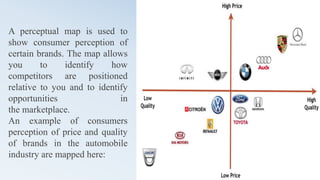
A perceptual map is used to
show consumer perception of
certain brands. The map allows
you to identify how
competitors are positioned
relative to you and to identify
opportunities in
the marketplace.
An example of consumers
perception of price and quality
of brands in the automobile
industry are mapped here:
• Create a positioning statement that will serve to identify your business and how you want the brand to be perceived by consumers.
• For example, the positioning statement of Volvo: “For upscale American families, Volvo is the family automobile that offers maximum
safety.”
• 1. Determine company uniqueness by comparing to competitors
• Compare and contrast differences between your company and competitors to identify opportunities. Focus on your strengths and how
they can exploit these opportunities.
• 2. Identify current market position
• Identify your existing market position and how the new positioning will be beneficial in setting you apart from competitors.
• 3. Competitor positioning analysis
• Identify the conditions of the marketplace and the amount of influence each competitor can have on each other.
• 4. Develop a positioning strategy
• Through the preceding steps, you should achieve an understanding of what your company is, how your company is different from
competitors, the conditions of the marketplace, opportunities in the marketplace, and how your company can position itself.
How to Create an Effective Market Positioning Strategy
1. Among existing users – by the promotion of more varied
uses of a product
2. Among new users – this requires the product to be
presented with a different image to the people who have so
far rejected it.
3. For new users – here one has to search for latent uses of
the product.
 A positioning advantage comes about when an
organization can offer, at a lower cost, a bundle of
benefits perceived as equivalent to those of the
competition.
 This kind of positioning advantage is based upon
occupying a location in product attribute space the
represents for buyers the most preferred
combination of attributes and is one that is not
currently occupied by any competitor.

Marketing Management.ppt

  • 1.
    BY PROF. PRASHANT MISHRA VIMR, KARHIROAD, AMOUDHA SATNA, M.P.
  • 3.
    Dove • Dove’s marketingdirector Stacie Bright had a moral problem in 2006. • After years of marketing Dove’s soaps using what the mainstream considers ‘beautiful’ models Bright realized this was affecting her own daughter’s self-esteem, and therefore affecting the self-esteem of everybody’s daughter subjected to this advertising. • Bright created a mock-up advert using all of the company directors’ daughters with text alongside each image saying how these girls believed they weren’t beautiful. • Bright and her team showed it to the executives, confident that this was a risky but worthwhile move. • The risk worked. The Dove executives were of course deeply affected, said a resounding yes through their tears, and completely overhauled Dove’s marketing strategy, which has continued to this day. • Dove doubled profits from £1bn to £2bn and turned the business of THE MARKETING STORY…
  • 4.
    THE BASICS… • MARKET •MARKET PLACE • VIRTUAL MARKET • META MARKET
  • 5.
  • 6.
    WHAT IS MARKETING? “MeetingNeeds Profitably” Marketing is an organizational function and set of processes for creating, communicating & delivering value to customers and for managing customer relationships in ways that benefit the organization & its stakeholders.
  • 7.
    DEFINITION… • Marketing isthe process of planning and executing the conception, pricing, promotion and distribution of ideas, goods and services to create exchanges that satisfy individual and organizational objectives. • Philip Kotler defined marketing as: "Satisfying needs and wants through an exchange process". • A decade later he defines it as: “A social and managerial process by which individuals and groups obtain what they want and need through creating, offering and exchanging products of value with
  • 8.
    WHAT IS MARKETINGMANAGEMENT?  The art and Science of choosing target markets and getting, keeping and growing customers through creating, delivering and communicating superior customer value. Marketing Management identifies market opportunities and comes
  • 9.
    MARKETING MANAGEMENT DEFINITION •According to Philip Kotler, “Marketing Management is the art and science of choosing target markets and building profitable relationship with them. Marketing management is a process involving analysis, planning, implementing and control and it covers goods, services, ideas and the goal is to produce satisfaction to the parties involved”.
  • 10.
    HISTORY… • Today marketingis known as an advanced blend of strategy and technology, however, it hasn’t always been this way. The history of marketing as we know it began with humble beginnings of simply trying to sell goods and services. • The ideas of marketing as it is understood in the modern era began during the time of the Industrial Revolution. This period spanned the late 18th century and lasted long into the 19th century. • It was during the Industrial Revolution that purchasing goods began to be easier for a consumer than make things themselves. • Mass production created many industries engaged in the same endeavor to serve the needs of a growing consumer market. • The infrastructure for transportation as well as mass media took hold. • It created a need for producers to find better ways to develop products customers needed and a more sophisticated approach to informing them about these commodities.
  • 11.
    TRADITIONAL MARKETING CONCEPT… •According to this concept, marketing consists of those activities which are concerned with the transfer of ownership of goods from producers to consumers. • In other words, it is the process by which goods are made available to ultimate consumers from their place of origin. • The traditional concept of marketing corresponds to the general notion of marketing, which means selling goods and services after they have been produced.
  • 12.
    Marketing Management Involves: 1.Thesetting of marketing goals and objectives 2. Developing the marketing plan 3. Organizing the marketing function 4. Putting the marketing plan into action 5. Controlling the marketing program.
  • 13.
    MARKETING MANAGEMENT CONCEPT •This concept advocates that a manufacturer should begin his task with the consumer focus. • Selling should be preceded by customer study, marketing research and product development. • “The aim of marketing is to know and understand the consumer so well that that the product or service fits him and sells itself.” – Peter Drucker. • This concept is also called customer orientation. • “The Marketing concept is a customer orientation backed by integrated marketing aimed at generating customer satisfaction as the key to satisfying organizational goals”. –
  • 14.
    BASIS OF MARKETINGCONCEPT. i. Focus on customer needs ii. Providing consumer satisfaction iii. Integrated Marketing Management iv. Achieving organizational goals v. Innovation
  • 15.
    FEATURES OF MARKETINGMANAGEMENT. • It is a Managerial Process. • It is Consumer Centric. • It is based on Research Analysis. • It involves Planning & Development. • It involves Building Marketing Framework. • It focuses on Organizational Objectives. • It is a Promotional & Communication Process.
  • 16.
    IMPORTANCE OF MARKETINGMANAGEMENT. 1. Analyzing Market Opportunities 2. Determination of Target Market 3. Planning and Decision Making 4. Creation of Customer 5. Helps in Increasing Profit 6. Improvement in Quality of Life 7. Employment Opportunities
  • 17.
  • 18.
  • 19.
    THE MARKETING CONCEPT •The Production Concept. This concept is the oldest of the concepts in business. It holds that consumers will prefer products that are widely available and inexpensive. Managers focusing on this concept concentrate on achieving high production efficiency, low costs, and mass distribution. • The Product Concept. This orientation holds that consumers will favor those products that offer the most quality, performance, or innovative features. Managers focusing on this concept concentrate on making superior products and improving them over time. They assume that buyers admire well-made products and can appraise quality and performance. • The Selling Concept. This is another common business orientation. It holds that consumers and businesses, if left alone, will ordinarily not buy enough of the selling company’s products. The organization must, therefore, undertake an aggressive selling and promotion effort. It also assumes that the company has a whole battery of effective selling and promotional tools to stimulate more buying • The Marketing Concept. This is a business philosophy that challenges the above three business orientations. Its central tenets crystallized in the 1950s. It holds that the key to achieving its organizational goals (goals of the selling company)
  • 20.
    HOLISTIC MARKETING CONCEPT •According to holistic marketing concept, even if a business is made of various departments, the departments have to come together to project a positive & united business image in the minds of the customer. Holistic marketing concept involves interconnected marketing activities to ensure that the customer is likely to purchase their product rather than competition. Example of Holistic marketing concept • An organization will have different departments like sales and marketing, accounting and finance, R&D and product development and finally HR and operations. Thus, if you want to implement a holistic marketing concept in your organization, you need to ensure that R&D and product development take the feedback from marketing and sales to launch the product which is most likely to attract customers. • On the other hand they need to work closely with accounting and finance to find out the exact budget for the project. Sales and
  • 21.
    SOCIETAL MARKETING CONCEPT •The Societal Marketing Concept puts Human welfare on top before profits and satisfying the wants. • Societal Marketing emphasizes on social responsibilities and suggests that to sustain long-term success, the company should develop a marketing strategy to provide value to the customers to maintain and improve both the customers and society’s well being better than the competitors. • Societal Marketing creates a favorable image for the company increases sales. It is not the same as the terms of social marketing and social media marketing. It is a term closely related to CSR and sustainable development.
  • 22.
    FACTORS AFFECTING MARKETINGCONCEPT • Growth of Population • Changing Concept of Family • More Disposable Income • More Discretionary Income • TechnologyAdvancement • Media • Credit Facility
  • 23.
    NATURE OF MARKETING •It is a legal process by which ownership is transferred • It is a system of interacting business activities • It is a managerial function of organizing and directing business activities that facilitates the movement of goods from producers to consumers • It is a Philosophy based on consumer
  • 24.
    SCOPE OF MARKETING Marketersare involved with marketing majorly these ten types of entities : • Services • Events • Experiences • Persons • Places • Properties • Organizations • Information • Ideas • Physical Goods
  • 25.
    SCOPE OF MARKETING •Study of Consumer wants and needs • Study of Buyer Behavior • Product Planning and development • Pricing Policies • Distribution • Promotion • Consumer Satisfaction • Marketing Control
  • 26.
    DIFFERENCE BETWEEN SALES& MARKETING Marketing Selling Focuses on Customer Needs Focuses On Sellers Needs Begins before Production Begins after Production Continues After Sales Comes To an End after sale of Product Philosophy of Business Routine Process Profits through customer satisfaction Profits through Sales Volume Long Term Perspective Short Term Perspective It works on Caveat Emptor Principle It works on Caveat Venditor Principle Customer First Product First
  • 27.
    MARKETING MANAGEMENT TASKS •Developing Marketing Strategies and Plan • Capturing Marketing Insights • Connecting with Customers • Building Strong Brands • Shaping the Market offerings • Delivering Value • Communicating Value • Creating Long Term Growth
  • 30.
    Three Phases ofMarketing Strategy 3 0 Phase 2 Target Market and Marketing Mix Selection Phase 3 Product/Brand Positioning Phase 1 Market Segmentation
  • 31.
    INTRODUCTION • “The processof dividing a potential market into distinct subsets of consumers and selecting one or more segments as a target market to be reached with a distinct marketing
  • 32.
    Definition & Explanation •The breaking down or building up of potential buyers into groups called Market Segments. • “The process of defining and subdividing a large homogenous market into heterogeneous subunits having similar needs, wants, or demand characteristics is called Segmentation. • Its objective is to design a marketing mix that precisely matches the expectations of customers in the targeted segment”.
  • 33.
    Benefits of Segmentation •Segmentation Studies discover the needs and wants of groups of consumers to develop specialized products to satisfy group needs. • Segmentation Studies used to identify the most appropriate media for advertising. • It Identifies opportunities & niches for new product development. • It Helps design marketing programs most effectively for reaching homogenous groups of buyers
  • 34.
    Factors Affecting MarketSegmentation • Measurability – Size, purchasing power, and profile of segment • Accessibility – Can be reached and served • Substantiality – Large and profitable enough to serve • Differentiability – Respond differently • Actionability – Effective programs can be developed
  • 35.
    Assignment • Considering thelargest bank in your college’s city or town: – How might consumers’ needs differ? – What types of products might meet their needs? – What advertising media makes sense for the different segments of consumers?
  • 36.
  • 37.
    Bases for Segmentation •Geographic • Demographic • Psychological • Psychographic • Socio cultural • Use-Related • Usage-Situation • Benefit Sought • Hybrid Dr. Amitabh Mishra 12
  • 38.
    Geographic • Nation • Region •State • City Demographic • Age • Gender • Marital Status • Income • Education • Occupation. • Generation Psychological • Personality • Motivation • Perception • Learning • Attitude Psychographic • Lifestyle Dr. Amitabh Mishra 38
  • 39.
    Behavioral • Occasion • Benefits •Readiness stage Socio- cultural •Culture •Religion •Subculture •Social class •Family life cycle Use related • User Status • Usage rate • Awareness status • Loyalty status Usage situation • Time • Objective • Location • Person Dr. Amitabh Mishra 39
  • 40.
  • 41.
    Geographic Segmentation • “Thedivision of a total potential market into smaller subgroups on the basis of geographic variables is called Geographic Segmentation”. Ex- • Nation, • Region, • State, or • City • Where customers live determines some aspect of consumption behavior. 18
  • 42.
    • “The theorybehind Geographic Segmentation strategy is that people who live in the same area share similar needs & wants and that these needs and wants differ from those of people living in other areas” • Ex- – Climate determine types of Clothing. – Preference for tea, Skin cleaner, detergent differs across the different states of India. – Housing societies are segmented as- LIG, MIG, HIG. 42
  • 43.
  • 44.
    Demographic Segmentation 44 • Indemographic segmentation market is divided in to groups on the basis of variables such as- – Age. – Gender. – Marital Status. – Income. – Education. – Occupation. – Generation.
  • 45.
    • Demographic variablesare the most popular bases for distinguishing customer group. The reasons are- • Consumer’s want, preferences and usage rate are often associated with demographic variables. • It is easiest and most logical way to classify people. • It is most cost effective. 45
  • 46.
    AGE 46 • Products needoften vary with consumer’s age. • Consumer’s wantsand ability to pay changes with age.
  • 47.
    Toothpaste companies producespecial toothpaste for kids 47
  • 48.
    Mishra 26 Entertainment dogeof people change With Age.
  • 49.
    GENDER 49 • Many productsand services inherently designed for either Male or Female. • Gender segmentation has long been applied in- – Clothing – Hairstyling – Cosmetics – magazines
  • 50.
    Special Magazine for women 50 Speciallydesigned scooty for girls.
  • 51.
    Reebok produces “Tone up”brand of shoos for women that help them tone their body 31 Reebok Toneup
  • 52.
    INCOME, EDUCATION &OCCUPATION 52 • Income is an indicator of the ability to pay for a product or a specific version of a given product. is in practice for products • Income segmentation categories as- – Automobiles – Clothing – Travel
  • 53.
    • A person'soccupation affects the goods and services bought. For example- – Blue-collar workers tend to buy more rugged work clothes, whereas white- collar workers buy more business suits. – Computer software companies will design different products for brand managers, accountants, engineers, lawyers, and doctors. 53
  • 54.
    Automobile companies producedifferent brand for different income groups NANO KIZASHI SX-4 54
  • 55.
    Airlines offer differentservices for different class of travelers 35 Economy class in a Airline Business class in a Airline
  • 56.
  • 57.
    • Psychological characteristicsrefer to the inner and intrinsic qualities of individual consumers. Consumers can be segmented in terms of- – Personality – Motivation – Perception – Learning – Attitude Dr. Amitabh Mishra 57
  • 58.
    Attitude Attitude is definedas a learned tendencyto towards People’s respond something. response towards a product may range Positive, from – Enthusiastic, Indifferent, Negative, Hostile . 58
  • 59.
  • 60.
  • 61.
    Psychographic (lifestyle) Segmentation •Also known as Lifestyle Analysis. (lifestyle) variables include • Psychographic (AIOs)- – Activities, – Interests, and – Opinions. Dr. Amitabh Mishra 61
  • 62.
    •As an approachto construct the psychographic profile, AIO research seeks consumer’s responses to a large number of statements that measure activities, interest and opinion. Dr. Amitabh Mishra 62
  • 63.
    AIO Inventories Dr. AmitabhMishra 63 AIO studies envisage a wide variety of variables and measures the major dimensions shown Activities (statements related to) Interests (statements related to) Opinions (statements related to) Demographics (statements related to) Work Family Themselves Age Hobbies Home Social Education Social events Job Politics Income Vacation Community Business Occupation Entertainment Recreation Economics Family size Club member Fashion Education Geography Community Food Products City size Shopping Media Future Lifecycle Sports Achievements Culture Dwelling
  • 64.
  • 65.
    Socio-Cultural Segmentation Dr. AmitabhMishra 65 • Sociological (group) and Anthropological (cultural) variables i.e Socio-Cultural variables provide further base for market segmentation. 1. Culture 2. Subculture 3. Religion 4. Social class 5. Stages in Family life cycle
  • 66.
    Culture • Culture isthe sum total of learned beliefs, values, and customs that serve to direct the consumer behavior of members of a particular society. • Culture is the accumulation of shared meanings, rituals, norms, and traditions among the members of an organization or society and determines: – Overall priorities consumer attaches to different activities and products – Success or failure of specific products and services Dr. Amitabh Mishra 66
  • 67.
    TRADITIONAL AFRICAN DRESS TRADITIONALCHINESE DRESS TRADITIONAL CHINESE FOOD TRADITIONAL CHINESE FOOD Dr. Amitabh Mishra 67
  • 68.
    Subculture Dr. Amitabh Mishra68 • “ A distinct cultural group that exists as an identifiable segment within a larger, more complex society/culture” • “Subculture is any cultural patterning that preserves important features of the dominant culture/society but provides for values, norms, and behaviors of its own”.
  • 69.
  • 70.
    • Such segmentationcategorize product, service or brand usage characteristic, such as- 1. Rate of Usage 2. User status 3. Awareness Status 4. Brand Loyalty Etc. 69
  • 71.
    Rate of Usage •Customers can be segmented on the basis of usage rate of a product category. a) Heavy users b) Medium users c) Light users & d) Non-users • The profiling of heavy users allows this group to receive most marketing attention (particularly promotion efforts) on the assumption that brand loyalty among these people will pay heavy dividends. 70
  • 72.
    Mobile companies decidetheir tariffs on the basis of Rate of Usage Dr. Amitab h Mishra 71
  • 73.
    User status Dr. AmitabhMishra 73 • Every product has its- a) Nonusers, b) Ex-users, c) Potential users, d) First-time users and e) Regular users.
  • 74.
    A company cannotalways rely on the regular users, it has to attract the other types as well. The key too attracting potential users, or possibly, even non-users, is understanding the reasons due to which they are not using your product. Dr. Amitabh Mishra 74
  • 75.
    Brand Loyalty 75 • Consumerscan be divided in to 4 groups according to brand loyalty status- a) Hard core loyal (Who buy one brand all the time) b) Split loyal (Who are loyal to two or three brands) c) Shifting loyal (Shift from one brand to another brand) d) Switchers (Show no loyalty toward any brand)
  • 76.
    • Marketers oftentry to identify characteristics of brand loyal customers so that they can direct Dr. Amitabh Mishra 76 their their promotional efforts to people with similar characteristics in larger population.
  • 77.
    J &J enjoyshuge no. of hardcore loyal consumers. 77
  • 78.
  • 79.
    • Occasions orSituations often determines what consumers will purchase or consume. • The consumers are Segmented on the basis of special occasions or situations. like- – Time of consumption. – Objective of consumption. – Location of consumption. Dr. Amitabh Mishra 78
  • 80.
    Celebrations are advertisedfor festival gifts 80
  • 81.
    This ad istargeting students, Who enter in to college from the schools . Dr. Amitabh Mishra 81
  • 82.
    Mobile operators, Restaurants,Bars Offer happy hours scheme for some time. 82
  • 83.
  • 84.
    BenefitSegmentation • “Segmenting onthe basis of the most important and meaningful benefit of the product or services that will be most meaningful to the consumers”. • Benefit segmentation can be used to position various products with in the same product category. 84
  • 85.
    • people buysomething because it causes a benefit to them. ANS:- Whiter teeth, Dr. Amitabh Mishra 85 QUES:- What benefit HAPPYDENT is offering
  • 86.
    less sugar, loseweight zero sugar, high energy Healthy fruit juice Sweetness without drawbacks of sugar QUES:- What benefit following brands are offering 86
  • 87.
  • 90.
    A target marketis the market or market segments which form the focus of the firm’s marketing efforts. Once segments have been identified decisions about how many and which customer groups to target must be made. The options include the following. 1. Mass Marketing Strategy 2. Single Segment Strategy 3. Multi Segment Strategy
  • 91.
    • Offering onproduct / service concept to most of the market, across many market segments. Although scale economies can be achieved, there is a risk that few customers will be adequately satisfied. • The underlying assumption of this approach referred to as undifferentiated marketing, is that all customers in the market have similar needs and wants and can therefore be satisfied with a single marketing mix – that is, a standard product or service, similar price levels, one method of distribution and a promotional mix which is directed at everyone.
  • 92.
    •Concentrates on asingle segment with a product/ service concept. •This is relatively cheap in resources, but there is a risk of putting all the eggs in one basket – if the segment fails the company’s financial strength will rapidly decline. •Rolex, for example, targets relatively high income consumers with its prestigious wrist – watches. •When world economies are buoyant, sales will be good but in times of economic recession even the better off can change their spending patterns.
  • 93.
    • Targeting adifferent product or service concept at each of a number of segments and developing a marketing mix strategy for each of the selected segments. • Although this approach can reduce the risk of being over- committed in one area, it can be extremely resource – demanding.
  • 97.
    MARKET POSITIONING • MarketPositioning refers to the ability to influence consumer perception regarding a brand or product relative to competitors. • The objective of market positioning is to establish the image or identity of a brand or product so that consumers perceive it in a certain way. • For example: • A handbag maker may position itself as a luxury status symbol • ATV maker may position itsTV as the most innovative and cutting-edge • A fast-food restaurant chain may position itself as the provider of cheap meals
  • 98.
    TYPES OF POSITIONINGSTRATEGIES • There are several types of positioning strategies. A few examples are positioning by: • Product attributes and benefits: Associating your brand/product with certain characteristics or with certain beneficial value • Product price: Associating your brand/product with competitive pricing • Product quality: Associating your brand/product with high quality • Product use and application: Associating your brand/product with a specific use • Competitors: Making consumers think that your brand/product is better than that of your competitors
  • 99.
    A perceptual mapis used to show consumer perception of certain brands. The map allows you to identify how competitors are positioned relative to you and to identify opportunities in the marketplace. An example of consumers perception of price and quality of brands in the automobile industry are mapped here:
  • 100.
    • Create apositioning statement that will serve to identify your business and how you want the brand to be perceived by consumers. • For example, the positioning statement of Volvo: “For upscale American families, Volvo is the family automobile that offers maximum safety.” • 1. Determine company uniqueness by comparing to competitors • Compare and contrast differences between your company and competitors to identify opportunities. Focus on your strengths and how they can exploit these opportunities. • 2. Identify current market position • Identify your existing market position and how the new positioning will be beneficial in setting you apart from competitors. • 3. Competitor positioning analysis • Identify the conditions of the marketplace and the amount of influence each competitor can have on each other. • 4. Develop a positioning strategy • Through the preceding steps, you should achieve an understanding of what your company is, how your company is different from competitors, the conditions of the marketplace, opportunities in the marketplace, and how your company can position itself. How to Create an Effective Market Positioning Strategy
  • 101.
    1. Among existingusers – by the promotion of more varied uses of a product 2. Among new users – this requires the product to be presented with a different image to the people who have so far rejected it. 3. For new users – here one has to search for latent uses of the product.
  • 102.
     A positioningadvantage comes about when an organization can offer, at a lower cost, a bundle of benefits perceived as equivalent to those of the competition.
  • 103.
     This kindof positioning advantage is based upon occupying a location in product attribute space the represents for buyers the most preferred combination of attributes and is one that is not currently occupied by any competitor.