© 2007 Pearson Education
Chapter 5
Network Design in the Supply
Chain
Supply Chain Management
(3rd Edition)
5-1
© 2007 Pearson Education
Outline
A strategic framework for facility location
Multi-echelon networks
Gravity methods for location
Plant location models
5-2
© 2007 Pearson Education
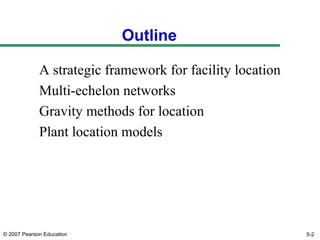
Network Design Decisions
Facility role
Facility location
Capacity allocation
Market and supply allocation
5-3
© 2007 Pearson Education
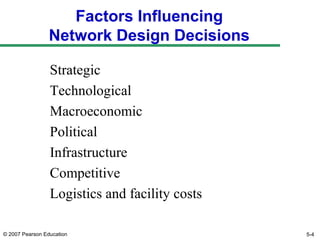
Factors Influencing
Network Design Decisions
Strategic
Technological
Macroeconomic
Political
Infrastructure
Competitive
Logistics and facility costs
5-4
© 2007 Pearson Education
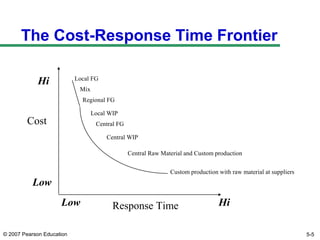
The Cost-Response Time Frontier
Local FG
Mix
Regional FG
Local WIP
Central FG
Central WIP
Central Raw Material and Custom production
Custom production with raw material at suppliers
Cost
Response Time HiLow
Low
Hi
5-5
© 2007 Pearson Education
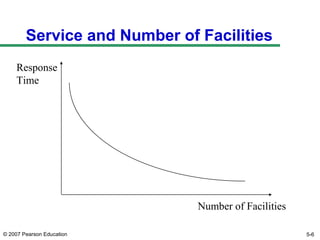
Service and Number of Facilities
Number of Facilities
Response
Time
5-6
© 2007 Pearson Education
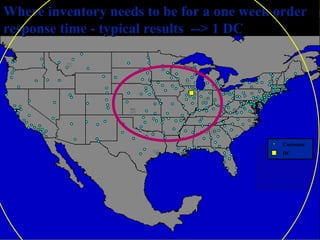
Customer
DC
Where inventory needs to be for a one week orderWhere inventory needs to be for a one week order
response time - typical results --> 1 DCresponse time - typical results --> 1 DC
© 2007 Pearson Education
Customer
DC
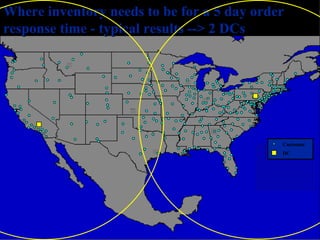
Where inventory needs to be for a 5 day orderWhere inventory needs to be for a 5 day order
response time - typical results --> 2 DCsresponse time - typical results --> 2 DCs
© 2007 Pearson Education
Customer
DC
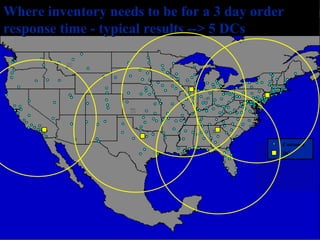
Where inventory needs to be for a 3 day orderWhere inventory needs to be for a 3 day order
response time - typical results --> 5 DCsresponse time - typical results --> 5 DCs
© 2007 Pearson Education
Customer
DC
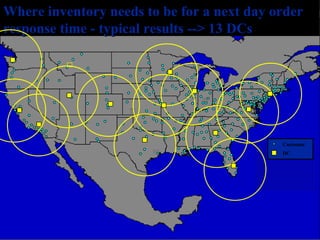
Where inventory needs to be for a next day orderWhere inventory needs to be for a next day order
response time - typical results --> 13 DCsresponse time - typical results --> 13 DCs
© 2007 Pearson Education
Customer
DC
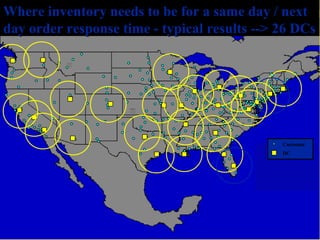
Where inventory needs to be for a same day / nextWhere inventory needs to be for a same day / next
day order response time - typical results --> 26 DCsday order response time - typical results --> 26 DCs
© 2007 Pearson Education
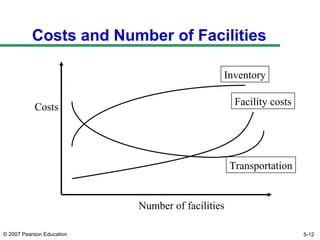
Costs and Number of Facilities
Costs
Number of facilities
Inventory
Transportation
Facility costs
5-12
© 2007 Pearson Education
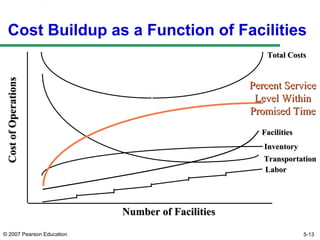
Percent ServicePercent Service
Level WithinLevel Within
Promised TimePromised Time
TransportationTransportation
Cost Buildup as a Function of Facilities
CostofOperationsCostofOperations
Number of FacilitiesNumber of Facilities
InventoryInventory
FacilitiesFacilities
Total CostsTotal Costs
LaborLabor
5-13
© 2007 Pearson Education
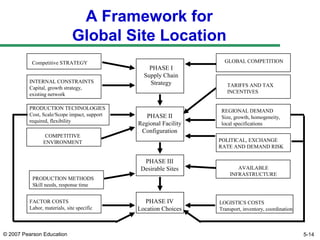
A Framework for
Global Site Location
PHASE I
Supply Chain
Strategy
PHASE II
Regional Facility
Configuration
PHASE III
Desirable Sites
PHASE IV
Location Choices
Competitive STRATEGY
INTERNAL CONSTRAINTS
Capital, growth strategy,
existing network
PRODUCTION TECHNOLOGIES
Cost, Scale/Scope impact, support
required, flexibility
COMPETITIVE
ENVIRONMENT
PRODUCTION METHODS
Skill needs, response time
FACTOR COSTS
Labor, materials, site specific
GLOBAL COMPETITION
TARIFFS AND TAX
INCENTIVES
REGIONAL DEMAND
Size, growth, homogeneity,
local specifications
POLITICAL, EXCHANGE
RATE AND DEMAND RISK
AVAILABLE
INFRASTRUCTURE
LOGISTICS COSTS
Transport, inventory, coordination
5-14
© 2007 Pearson Education
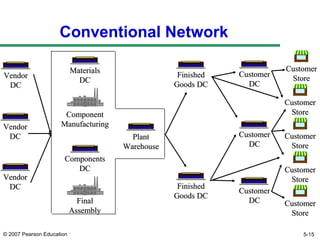
Conventional Network
CustomerCustomer
StoreStore
MaterialsMaterials
DCDC
ComponentComponent
ManufacturingManufacturing
VendorVendor
DCDC
FinalFinal
AssemblyAssembly
FinishedFinished
Goods DCGoods DC
ComponentsComponents
DCDC
VendorVendor
DCDC PlantPlant
WarehouseWarehouse
FinishedFinished
Goods DCGoods DC
CustomerCustomer
DCDC
CustomerCustomer
DCDC
CustomerCustomer
DCDC
CustomerCustomer
StoreStore
CustomerCustomer
StoreStore
CustomerCustomer
StoreStore
CustomerCustomer
StoreStore
VendorVendor
DCDC
5-15
© 2007 Pearson Education
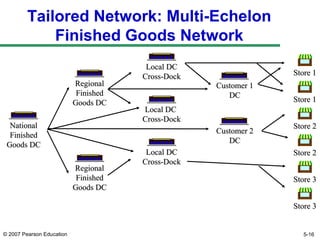
Tailored Network: Multi-Echelon
Finished Goods Network
RegionalRegional
FinishedFinished
Goods DCGoods DC
RegionalRegional
FinishedFinished
Goods DCGoods DC
Customer 1Customer 1
DCDC
Store 1Store 1
NationalNational
FinishedFinished
Goods DCGoods DC
Local DCLocal DC
Cross-DockCross-Dock
Local DCLocal DC
Cross-DockCross-Dock
Local DCLocal DC
Cross-DockCross-Dock
Customer 2Customer 2
DCDC
Store 1Store 1
Store 2Store 2
Store 2Store 2
Store 3Store 3
Store 3Store 3
5-16
© 2007 Pearson Education
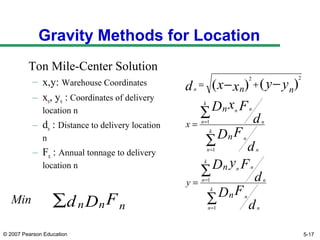
Gravity Methods for Location
Ton Mile-Center Solution
– x,y: Warehouse Coordinates
– xn, yn : Coordinates of delivery
location n
– dn : Distance to delivery location
n
– Fn : Annual tonnage to delivery
location n
∑
∑
∑
∑
−−
=
=
=
=
=
=
+=
k
n n
n
k
n n
nn
k
n n
n
k
n n
nn
n
d
FD
d
FyD
d
FD
d
FxD
yyxxd
n
n
y
n
n
x
nn
1
1
1
1
22
)()(
Min ∑ FDd nn n
5-17
© 2007 Pearson Education
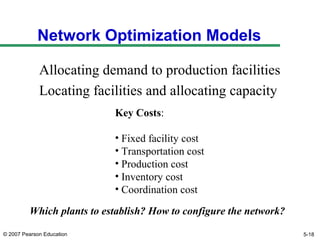
Network Optimization Models
Allocating demand to production facilities
Locating facilities and allocating capacity
Which plants to establish? How to configure the network?
Key Costs:
• Fixed facility cost
• Transportation cost
• Production cost
• Inventory cost
• Coordination cost
5-18
© 2007 Pearson Education
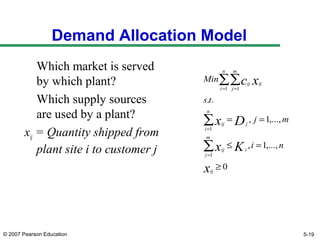
Demand Allocation Model
Which market is served
by which plant?
Which supply sources
are used by a plant?
xij = Quantity shipped from
plant site i to customer j
0
,...,1,
,...,1,
..
1
1
1 1
≥
=≤
==
∑
∑
∑∑
=
=
= =
x
Kx
Dx
xc
ij
i
m
j
ij
j
n
i
ij
n
i
m
j
ijij
ni
mj
ts
Min
5-19
© 2007 Pearson Education
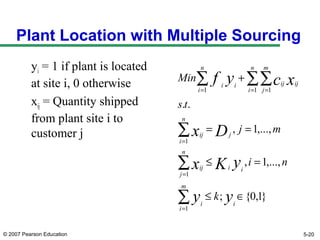
Plant Location with Multiple Sourcing
yi = 1 if plant is located
at site i, 0 otherwise
xij = Quantity shipped
from plant site i to
customer j
}1,0{;
,...,1,
,...,1,
..
1
1
1
1 11
∈≤
=≤
==
+
∑
∑
∑
∑∑∑
=
=
=
= ==
yy
yKx
Dx
xcyf
i
m
i
i
ii
n
j
ij
j
n
i
ij
n
i
m
j
ijiji
n
i
i
k
ni
mj
ts
Min
5-20
© 2007 Pearson Education
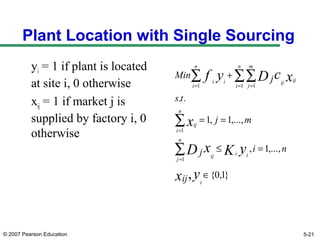
Plant Location with Single Sourcing
yi = 1 if plant is located
at site i, 0 otherwise
xij = 1 if market j is
supplied by factory i, 0
otherwise
}1,0{
,...,1,
,...,1,1
..
,
1
1
1 11
∈
=≤
==
+
∑
∑
∑∑∑
=
=
= ==
yx
yKxD
x
xcDyf
ij
nij
mj
ts
jMin
i
ii
n
j
ij
n
i
ij
n
i
m
j
ijiji
n
i
i
5-21
© 2007 Pearson Education
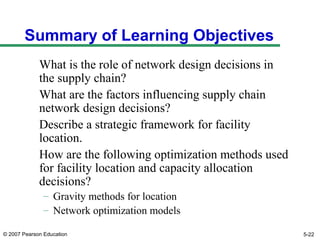
Summary of Learning Objectives
What is the role of network design decisions in
the supply chain?
What are the factors influencing supply chain
network design decisions?
Describe a strategic framework for facility
location.
How are the following optimization methods used
for facility location and capacity allocation
decisions?
– Gravity methods for location
– Network optimization models
5-22

Supply chain management ch05 chopra

  • 1.
    © 2007 PearsonEducation Chapter 5 Network Design in the Supply Chain Supply Chain Management (3rd Edition) 5-1
  • 2.
    © 2007 PearsonEducation Outline A strategic framework for facility location Multi-echelon networks Gravity methods for location Plant location models 5-2
  • 3.
    © 2007 PearsonEducation Network Design Decisions Facility role Facility location Capacity allocation Market and supply allocation 5-3
  • 4.
    © 2007 PearsonEducation Factors Influencing Network Design Decisions Strategic Technological Macroeconomic Political Infrastructure Competitive Logistics and facility costs 5-4
  • 5.
    © 2007 PearsonEducation The Cost-Response Time Frontier Local FG Mix Regional FG Local WIP Central FG Central WIP Central Raw Material and Custom production Custom production with raw material at suppliers Cost Response Time HiLow Low Hi 5-5
  • 6.
    © 2007 PearsonEducation Service and Number of Facilities Number of Facilities Response Time 5-6
  • 7.
    © 2007 PearsonEducation Customer DC Where inventory needs to be for a one week orderWhere inventory needs to be for a one week order response time - typical results --> 1 DCresponse time - typical results --> 1 DC
  • 8.
    © 2007 PearsonEducation Customer DC Where inventory needs to be for a 5 day orderWhere inventory needs to be for a 5 day order response time - typical results --> 2 DCsresponse time - typical results --> 2 DCs
  • 9.
    © 2007 PearsonEducation Customer DC Where inventory needs to be for a 3 day orderWhere inventory needs to be for a 3 day order response time - typical results --> 5 DCsresponse time - typical results --> 5 DCs
  • 10.
    © 2007 PearsonEducation Customer DC Where inventory needs to be for a next day orderWhere inventory needs to be for a next day order response time - typical results --> 13 DCsresponse time - typical results --> 13 DCs
  • 11.
    © 2007 PearsonEducation Customer DC Where inventory needs to be for a same day / nextWhere inventory needs to be for a same day / next day order response time - typical results --> 26 DCsday order response time - typical results --> 26 DCs
  • 12.
    © 2007 PearsonEducation Costs and Number of Facilities Costs Number of facilities Inventory Transportation Facility costs 5-12
  • 13.
    © 2007 PearsonEducation Percent ServicePercent Service Level WithinLevel Within Promised TimePromised Time TransportationTransportation Cost Buildup as a Function of Facilities CostofOperationsCostofOperations Number of FacilitiesNumber of Facilities InventoryInventory FacilitiesFacilities Total CostsTotal Costs LaborLabor 5-13
  • 14.
    © 2007 PearsonEducation A Framework for Global Site Location PHASE I Supply Chain Strategy PHASE II Regional Facility Configuration PHASE III Desirable Sites PHASE IV Location Choices Competitive STRATEGY INTERNAL CONSTRAINTS Capital, growth strategy, existing network PRODUCTION TECHNOLOGIES Cost, Scale/Scope impact, support required, flexibility COMPETITIVE ENVIRONMENT PRODUCTION METHODS Skill needs, response time FACTOR COSTS Labor, materials, site specific GLOBAL COMPETITION TARIFFS AND TAX INCENTIVES REGIONAL DEMAND Size, growth, homogeneity, local specifications POLITICAL, EXCHANGE RATE AND DEMAND RISK AVAILABLE INFRASTRUCTURE LOGISTICS COSTS Transport, inventory, coordination 5-14
  • 15.
    © 2007 PearsonEducation Conventional Network CustomerCustomer StoreStore MaterialsMaterials DCDC ComponentComponent ManufacturingManufacturing VendorVendor DCDC FinalFinal AssemblyAssembly FinishedFinished Goods DCGoods DC ComponentsComponents DCDC VendorVendor DCDC PlantPlant WarehouseWarehouse FinishedFinished Goods DCGoods DC CustomerCustomer DCDC CustomerCustomer DCDC CustomerCustomer DCDC CustomerCustomer StoreStore CustomerCustomer StoreStore CustomerCustomer StoreStore CustomerCustomer StoreStore VendorVendor DCDC 5-15
  • 16.
    © 2007 PearsonEducation Tailored Network: Multi-Echelon Finished Goods Network RegionalRegional FinishedFinished Goods DCGoods DC RegionalRegional FinishedFinished Goods DCGoods DC Customer 1Customer 1 DCDC Store 1Store 1 NationalNational FinishedFinished Goods DCGoods DC Local DCLocal DC Cross-DockCross-Dock Local DCLocal DC Cross-DockCross-Dock Local DCLocal DC Cross-DockCross-Dock Customer 2Customer 2 DCDC Store 1Store 1 Store 2Store 2 Store 2Store 2 Store 3Store 3 Store 3Store 3 5-16
  • 17.
    © 2007 PearsonEducation Gravity Methods for Location Ton Mile-Center Solution – x,y: Warehouse Coordinates – xn, yn : Coordinates of delivery location n – dn : Distance to delivery location n – Fn : Annual tonnage to delivery location n ∑ ∑ ∑ ∑ −− = = = = = = += k n n n k n n nn k n n n k n n nn n d FD d FyD d FD d FxD yyxxd n n y n n x nn 1 1 1 1 22 )()( Min ∑ FDd nn n 5-17
  • 18.
    © 2007 PearsonEducation Network Optimization Models Allocating demand to production facilities Locating facilities and allocating capacity Which plants to establish? How to configure the network? Key Costs: • Fixed facility cost • Transportation cost • Production cost • Inventory cost • Coordination cost 5-18
  • 19.
    © 2007 PearsonEducation Demand Allocation Model Which market is served by which plant? Which supply sources are used by a plant? xij = Quantity shipped from plant site i to customer j 0 ,...,1, ,...,1, .. 1 1 1 1 ≥ =≤ == ∑ ∑ ∑∑ = = = = x Kx Dx xc ij i m j ij j n i ij n i m j ijij ni mj ts Min 5-19
  • 20.
    © 2007 PearsonEducation Plant Location with Multiple Sourcing yi = 1 if plant is located at site i, 0 otherwise xij = Quantity shipped from plant site i to customer j }1,0{; ,...,1, ,...,1, .. 1 1 1 1 11 ∈≤ =≤ == + ∑ ∑ ∑ ∑∑∑ = = = = == yy yKx Dx xcyf i m i i ii n j ij j n i ij n i m j ijiji n i i k ni mj ts Min 5-20
  • 21.
    © 2007 PearsonEducation Plant Location with Single Sourcing yi = 1 if plant is located at site i, 0 otherwise xij = 1 if market j is supplied by factory i, 0 otherwise }1,0{ ,...,1, ,...,1,1 .. , 1 1 1 11 ∈ =≤ == + ∑ ∑ ∑∑∑ = = = == yx yKxD x xcDyf ij nij mj ts jMin i ii n j ij n i ij n i m j ijiji n i i 5-21
  • 22.
    © 2007 PearsonEducation Summary of Learning Objectives What is the role of network design decisions in the supply chain? What are the factors influencing supply chain network design decisions? Describe a strategic framework for facility location. How are the following optimization methods used for facility location and capacity allocation decisions? – Gravity methods for location – Network optimization models 5-22

Editor's Notes