

www.juanjosedelgado.es
Market
research
fundamentals
www.juanjosedelgado.es
What does
market research
mean?
www.juanjosedelgado.es
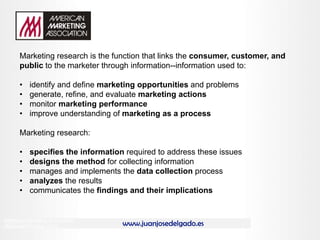
Marketing research is the function that links the consumer, customer, and
public to the marketer through information--information used to:
• identify and define marketing opportunities and problems
• generate, refine, and evaluate marketing actions
• monitor marketing performance
• improve understanding of marketing as a process
Marketing research:
• specifies the information required to address these issues
• designs the method for collecting information
• manages and implements the data collection process
• analyzes the results
• communicates the findings and their implications
American Marketing Association
(Approved October 2004)
www.juanjosedelgado.es
Which
techniques do
you know?
www.juanjosedelgado.es
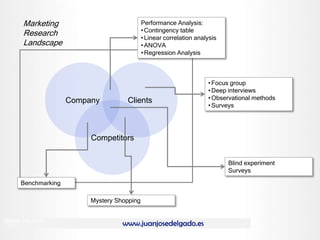
Company Clients
Competitors
•Focus group
•Deep interviews
•Observational methods
•Surveys
Mystery Shopping
Performance Analysis:
•Contingency table
•Linear correlation analysis
•ANOVA
•Regression Analysis
Blind experiment
Surveys
Benchmarking
Marketing
Research
Landscape
Source: The Author
www.juanjosedelgado.es
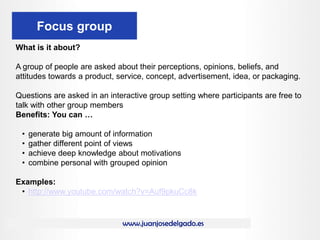
Focus group
What is it about?
A group of people are asked about their perceptions, opinions, beliefs, and
attitudes towards a product, service, concept, advertisement, idea, or packaging.
Questions are asked in an interactive group setting where participants are free to
talk with other group members
Benefits: You can …
• generate big amount of information
• gather different point of views
• achieve deep knowledge about motivations
• combine personal with grouped opinion
Examples:
• http://www.youtube.com/watch?v=Auf9pkuCc8k
www.juanjosedelgado.es
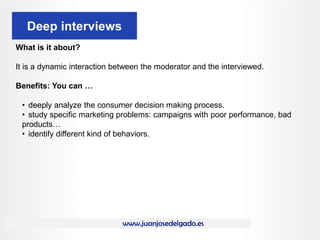
Deep interviews
What is it about?
It is a dynamic interaction between the moderator and the interviewed.
Benefits: You can …
• deeply analyze the consumer decision making process.
• study specific marketing problems: campaigns with poor performance, bad
products…
• identify different kind of behaviors.
www.juanjosedelgado.es
Projective test
What is it about?
A projective test is a personality test designed to let a person respond to
ambiguous stimuli, presumably revealing hidden emotions and internal conflicts.
Benefits: You can …
• stimulate deeply levels of responsiveness
• jump social and cultural barriers and go directly to personal motivators.
Examples:
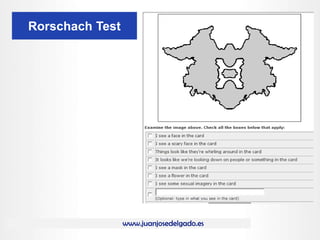
• Rorschach Test
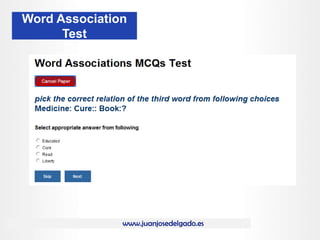
• Word Association Test
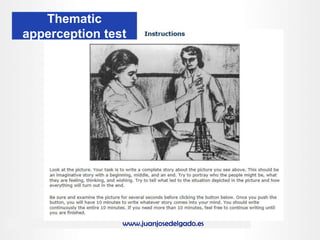
• Thematic apperception test
• Graphology
www.juanjosedelgado.es
Rorschach Test
www.juanjosedelgado.es
Word Association
Test
www.juanjosedelgado.es
Thematic
apperception test
www.juanjosedelgado.es
Observation
What is it about?
Observation technique involves the direct observation of phenomena in their
natural setting.
Benefits: You can …
• Be objective
• Quick
• Easy
• Continuous
Examples:
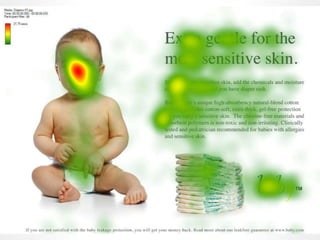
• eye-tracking analysis while subjects watch advertisements oculometers
• electronic checkout scanners - records purchase behavior
• on-site cameras in stores
• Nielsen box for tracking television station watching
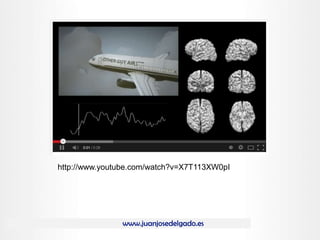
• voice pitch meters - measures emotional reactions
• psycho-galvanometer - measures galvanic skin response
www.juanjosedelgado.es
2.c - Research Instruments
Mechanical devices
www.juanjosedelgado.es
http://www.youtube.com/watch?v=X7T113XW0pI
www.juanjosedelgado.es
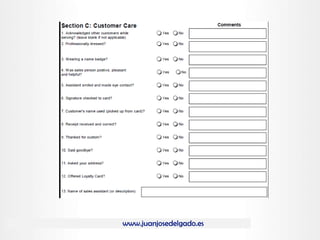
Mystery Shopping
What is it about?
Mystery shoppers perform specific tasks such as purchasing a product, asking
questions, registering complaints or behaving in a certain way, and then provide
detailed reports or feedback about their experiences.
Benefits: You can …
• Compare your own company against competitors.
• measure quality of service, or compliance with regulation, or to gather specific
information about products and services.
www.juanjosedelgado.es
Survey
What is it about?
It is a method for collecting quantitative information about items in a population
Benefits: You can …
• Specific information
• Quick
• Easy to apply
• Flexibility to adapt to other techniques
Examples:
• Face to face surveys
• Telephonically surveys
• Mail surveys
• Online surveys
www.juanjosedelgado.es
Questionnaire
What is it about?
A questionnaire is a research instrument consisting of a series of questions and
other prompts for the purpose of gathering information from respondents.
Four types of response scales for closed-ended questions are distinguished:
• Dichotomous, where the respondent has two options
• Nominal-polytomous, where the respondent has more than two unordered
options
• Ordinal-polytomous, where the respondent has more than two ordered options
• Continuous, where the respondent is presented with a continuous scale
www.juanjosedelgado.es
Questionnaire
10 Basic rules for questionnaire item construction:
1. Use statements which are interpreted in the same way by members of different
subpopulations of the population of interest.
2. Use statements where persons that have different opinions or traits will give different
answers.
3. Think of having an "open" answer category after a list of possible answers.
4. Use only one aspect of the construct you are interested in per item.
5. Use positive statements and avoid negatives or double negatives.
6. Do not make assumptions about the respondent.
7. Use clear and comprehensible wording, easily understandable for all educational levels
8. Use correct spelling, grammar and punctuation.
9. Avoid items that contain more than one question per item (Do you like strawberries and
potatoes?).
10. Question should not be biased or even leading the participant towards an answer.
www.juanjosedelgado.es
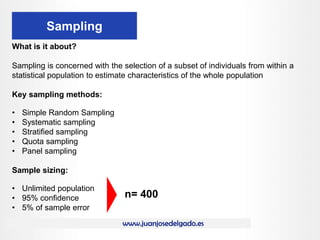
Sampling
What is it about?
Sampling is concerned with the selection of a subset of individuals from within a
statistical population to estimate characteristics of the whole population
Key sampling methods:
• Simple Random Sampling
• Systematic sampling
• Stratified sampling
• Quota sampling
• Panel sampling
Sample sizing:
• Unlimited population
• 95% confidence
• 5% of sample error
n= 400
www.juanjosedelgado.es
The
Marketing
Research
Process
www.juanjosedelgado.es
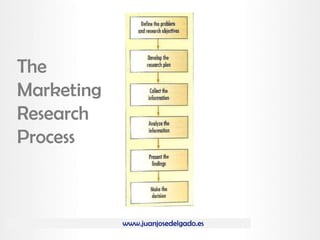
1.- Define the problem, the decision alternatives,
and the research objectives
• Marketing management must be careful not to
define the problem too broadly or too narrowly for
the marketing researcher.
www.juanjosedelgado.es
2.- Develop the research plan
It calls for developing the most efficient plan for gathering
the needed information
a. Data sources
b. Research Approaches
c. Research Instruments
d. Sampling plan
e. Contact methods
www.juanjosedelgado.es
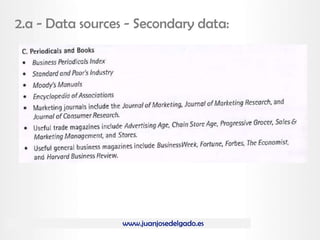
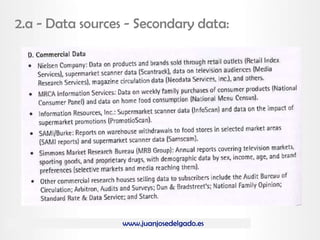
2.a - Data sources
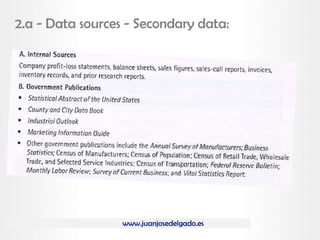
Secondary data:
• Data that were collected for another purpose
and already exist somewhere.
Primary data:
• Data freshly gathered for a specific purpose or
for a specific research project.
www.juanjosedelgado.es
2.a - Data sources - Secondary data:
www.juanjosedelgado.es
2.a - Data sources - Secondary data:
www.juanjosedelgado.es
2.a - Data sources - Secondary data:
www.juanjosedelgado.es
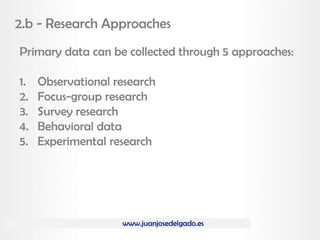
2.b - Research Approaches
Primary data can be collected through 5 approaches:
1. Observational research
2. Focus-group research
3. Survey research
4. Behavioral data
5. Experimental research
www.juanjosedelgado.es
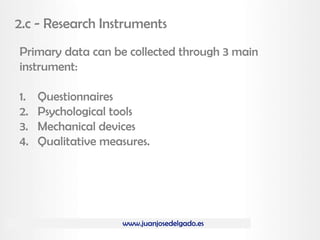
2.c - Research Instruments
Primary data can be collected through 3 main
instrument:
1. Questionnaires
2. Psychological tools
3. Mechanical devices
4. Qualitative measures.
www.juanjosedelgado.es
3.- Collect the information
This phase is generally the most expensive and the most
prone error.
• People are not accessible
• Dishonest answers
• Interviewer can be also dishonest
www.juanjosedelgado.es
4.- Analyze the information
The researcher tabulates the data and develops
frequency distributions.
Averages and measures of dispersion are computed for
the major variables.
www.juanjosedelgado.es
5.- Present the findings
The researcher should present the findings that are
relevant to the major marketing decisions.
www.juanjosedelgado.es
6.- Make the decision
The managers who commissioned the research need to
weight the evidence.
www.linkedin.com/in/juanjosedelgado
www.juanjosedelgado.es
Follow me on:

Market Research Fundamentals

  • 1.
  • 2.
  • 3.
    www.juanjosedelgado.es Marketing research isthe function that links the consumer, customer, and public to the marketer through information--information used to: • identify and define marketing opportunities and problems • generate, refine, and evaluate marketing actions • monitor marketing performance • improve understanding of marketing as a process Marketing research: • specifies the information required to address these issues • designs the method for collecting information • manages and implements the data collection process • analyzes the results • communicates the findings and their implications American Marketing Association (Approved October 2004)
  • 4.
  • 5.
    www.juanjosedelgado.es Company Clients Competitors •Focus group •Deepinterviews •Observational methods •Surveys Mystery Shopping Performance Analysis: •Contingency table •Linear correlation analysis •ANOVA •Regression Analysis Blind experiment Surveys Benchmarking Marketing Research Landscape Source: The Author
  • 6.
    www.juanjosedelgado.es Focus group What isit about? A group of people are asked about their perceptions, opinions, beliefs, and attitudes towards a product, service, concept, advertisement, idea, or packaging. Questions are asked in an interactive group setting where participants are free to talk with other group members Benefits: You can … • generate big amount of information • gather different point of views • achieve deep knowledge about motivations • combine personal with grouped opinion Examples: • http://www.youtube.com/watch?v=Auf9pkuCc8k
  • 7.
    www.juanjosedelgado.es Deep interviews What isit about? It is a dynamic interaction between the moderator and the interviewed. Benefits: You can … • deeply analyze the consumer decision making process. • study specific marketing problems: campaigns with poor performance, bad products… • identify different kind of behaviors.
  • 8.
    www.juanjosedelgado.es Projective test What isit about? A projective test is a personality test designed to let a person respond to ambiguous stimuli, presumably revealing hidden emotions and internal conflicts. Benefits: You can … • stimulate deeply levels of responsiveness • jump social and cultural barriers and go directly to personal motivators. Examples: • Rorschach Test • Word Association Test • Thematic apperception test • Graphology
  • 9.
  • 10.
  • 11.
  • 12.
    www.juanjosedelgado.es Observation What is itabout? Observation technique involves the direct observation of phenomena in their natural setting. Benefits: You can … • Be objective • Quick • Easy • Continuous Examples: • eye-tracking analysis while subjects watch advertisements oculometers • electronic checkout scanners - records purchase behavior • on-site cameras in stores • Nielsen box for tracking television station watching • voice pitch meters - measures emotional reactions • psycho-galvanometer - measures galvanic skin response
  • 13.
    www.juanjosedelgado.es 2.c - ResearchInstruments Mechanical devices
  • 14.
  • 15.
  • 16.
    www.juanjosedelgado.es Mystery Shopping What isit about? Mystery shoppers perform specific tasks such as purchasing a product, asking questions, registering complaints or behaving in a certain way, and then provide detailed reports or feedback about their experiences. Benefits: You can … • Compare your own company against competitors. • measure quality of service, or compliance with regulation, or to gather specific information about products and services.
  • 17.
  • 18.
    www.juanjosedelgado.es Survey What is itabout? It is a method for collecting quantitative information about items in a population Benefits: You can … • Specific information • Quick • Easy to apply • Flexibility to adapt to other techniques Examples: • Face to face surveys • Telephonically surveys • Mail surveys • Online surveys
  • 19.
    www.juanjosedelgado.es Questionnaire What is itabout? A questionnaire is a research instrument consisting of a series of questions and other prompts for the purpose of gathering information from respondents. Four types of response scales for closed-ended questions are distinguished: • Dichotomous, where the respondent has two options • Nominal-polytomous, where the respondent has more than two unordered options • Ordinal-polytomous, where the respondent has more than two ordered options • Continuous, where the respondent is presented with a continuous scale
  • 20.
    www.juanjosedelgado.es Questionnaire 10 Basic rulesfor questionnaire item construction: 1. Use statements which are interpreted in the same way by members of different subpopulations of the population of interest. 2. Use statements where persons that have different opinions or traits will give different answers. 3. Think of having an "open" answer category after a list of possible answers. 4. Use only one aspect of the construct you are interested in per item. 5. Use positive statements and avoid negatives or double negatives. 6. Do not make assumptions about the respondent. 7. Use clear and comprehensible wording, easily understandable for all educational levels 8. Use correct spelling, grammar and punctuation. 9. Avoid items that contain more than one question per item (Do you like strawberries and potatoes?). 10. Question should not be biased or even leading the participant towards an answer.
  • 21.
  • 22.
  • 23.
    www.juanjosedelgado.es Sampling What is itabout? Sampling is concerned with the selection of a subset of individuals from within a statistical population to estimate characteristics of the whole population Key sampling methods: • Simple Random Sampling • Systematic sampling • Stratified sampling • Quota sampling • Panel sampling Sample sizing: • Unlimited population • 95% confidence • 5% of sample error n= 400
  • 24.
  • 25.
    www.juanjosedelgado.es 1.- Define theproblem, the decision alternatives, and the research objectives • Marketing management must be careful not to define the problem too broadly or too narrowly for the marketing researcher.
  • 26.
    www.juanjosedelgado.es 2.- Develop theresearch plan It calls for developing the most efficient plan for gathering the needed information a. Data sources b. Research Approaches c. Research Instruments d. Sampling plan e. Contact methods
  • 27.
    www.juanjosedelgado.es 2.a - Datasources Secondary data: • Data that were collected for another purpose and already exist somewhere. Primary data: • Data freshly gathered for a specific purpose or for a specific research project.
  • 28.
    www.juanjosedelgado.es 2.a - Datasources - Secondary data:
  • 29.
    www.juanjosedelgado.es 2.a - Datasources - Secondary data:
  • 30.
    www.juanjosedelgado.es 2.a - Datasources - Secondary data:
  • 31.
    www.juanjosedelgado.es 2.b - ResearchApproaches Primary data can be collected through 5 approaches: 1. Observational research 2. Focus-group research 3. Survey research 4. Behavioral data 5. Experimental research
  • 32.
    www.juanjosedelgado.es 2.c - ResearchInstruments Primary data can be collected through 3 main instrument: 1. Questionnaires 2. Psychological tools 3. Mechanical devices 4. Qualitative measures.
  • 33.
    www.juanjosedelgado.es 3.- Collect theinformation This phase is generally the most expensive and the most prone error. • People are not accessible • Dishonest answers • Interviewer can be also dishonest
  • 34.
    www.juanjosedelgado.es 4.- Analyze theinformation The researcher tabulates the data and develops frequency distributions. Averages and measures of dispersion are computed for the major variables.
  • 35.
    www.juanjosedelgado.es 5.- Present thefindings The researcher should present the findings that are relevant to the major marketing decisions.
  • 36.
    www.juanjosedelgado.es 6.- Make thedecision The managers who commissioned the research need to weight the evidence.
  • 37.