Chapter Eight
Measurement and Scaling:
Fundamentals and Comparative
Scaling
8-2
Chapter Outline
1) Overview
2) Measurement and Scaling
3) Primary Scales of Measurement
i. Nominal Scale
ii. Ordinal Scale
iii. Interval Scale
iv. Ratio Scale
4) A Comparison of Scaling Techniques
8-3
Chapter Outline
5) Comparative Scaling Techniques
i. Paired Comparison
ii. Rank Order Scaling
iii. Constant Sum Scaling
iv. Q-Sort and Other Procedures
6) Verbal Protocols
7) International Marketing Research
8) Ethics in Marketing Research
8-4
Chapter Outline
9) Internet and Computer Applications
10) Focus on Burke
11) Summary
12) Key Terms and Concepts
8-5
Measurement and Scaling
Measurement means assigning numbers or other
symbols to characteristics of objects according to
certain prespecified rules.
 One-to-one correspondence between the numbers
and the characteristics being measured.
 The rules for assigning numbers should be
standardized and applied uniformly.
 Rules must not change over objects or time.
 
8-6
Measurement and Scaling
Scaling involves creating a continuum upon which
measured objects are located.
Consider an attitude scale from 1 to 100. Each
respondent is assigned a number from 1 to 100, with
1 = Extremely Unfavorable, and 100 = Extremely
Favorable. Measurement is the actual assignment of
a number from 1 to 100 to each respondent. Scaling
is the process of placing the respondents on a
continuum with respect to their attitude toward
department stores.
8-7
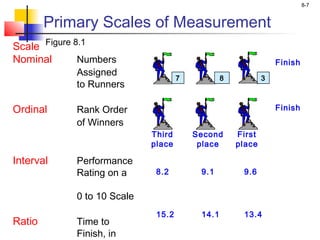
7 38
Primary Scales of Measurement
Scale
Nominal Numbers
Assigned
to Runners
Ordinal Rank Order
of Winners
Interval Performance
Rating on a
0 to 10 Scale
Ratio Time to
Finish, in
Figure 8.1
Third
place
Second
place
First
place
Finish
Finish
8.2 9.1 9.6
15.2 14.1 13.4
8-8
Primary Scales of Measurement
Nominal Scale
 The numbers serve only as labels or tags for
identifying and classifying objects.
 When used for identification, there is a strict one-to-
one correspondence between the numbers and the
objects.
 The numbers do not reflect the amount of the
characteristic possessed by the objects.
 The only permissible operation on the numbers in a
nominal scale is counting.
 Only a limited number of statistics, all of which are
based on frequency counts, are permissible, e.g.,
percentages, and mode.
8-9
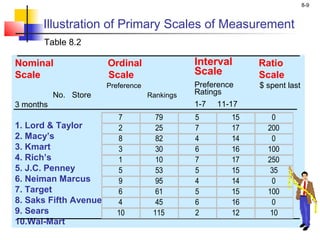
Illustration of Primary Scales of Measurement
Table 8.2
Nominal Ordinal Ratio
Scale Scale Scale
Preference $ spent last
No. Store Rankings
3 months
1. Lord & Taylor
2. Macy’s
3. Kmart
4. Rich’s
5. J.C. Penney
6. Neiman Marcus
7. Target
8. Saks Fifth Avenue
9. Sears
10.Wal-Mart
Interval
Scale
Preference
Ratings
1-7 11-17
7 79 5 15 0
2 25 7 17 200
8 82 4 14 0
3 30 6 16 100
1 10 7 17 250
5 53 5 15 35
9 95 4 14 0
6 61 5 15 100
4 45 6 16 0
10 115 2 12 10
8-10
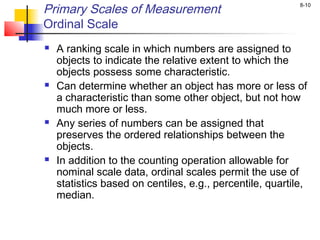
Primary Scales of Measurement
Ordinal Scale
 A ranking scale in which numbers are assigned to
objects to indicate the relative extent to which the
objects possess some characteristic.
 Can determine whether an object has more or less of
a characteristic than some other object, but not how
much more or less.
 Any series of numbers can be assigned that
preserves the ordered relationships between the
objects.
 In addition to the counting operation allowable for
nominal scale data, ordinal scales permit the use of
statistics based on centiles, e.g., percentile, quartile,
median.
8-11
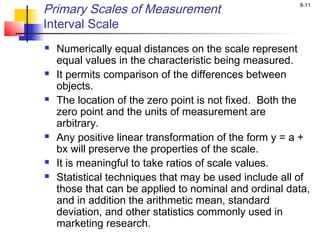
Primary Scales of Measurement
Interval Scale
 Numerically equal distances on the scale represent
equal values in the characteristic being measured.
 It permits comparison of the differences between
objects.
 The location of the zero point is not fixed. Both the
zero point and the units of measurement are
arbitrary.
 Any positive linear transformation of the form y = a +
bx will preserve the properties of the scale.
 It is meaningful to take ratios of scale values.
 Statistical techniques that may be used include all of
those that can be applied to nominal and ordinal data,
and in addition the arithmetic mean, standard
deviation, and other statistics commonly used in
marketing research.
8-12
Primary Scales of Measurement
Ratio Scale
 Possesses all the properties of the nominal, ordinal,
and interval scales.
 It has an absolute zero point.
 It is meaningful to compute ratios of scale values.
 Only proportionate transformations of the form y = bx,
where b is a positive constant, are allowed.
 All statistical techniques can be applied to ratio data.
8-13
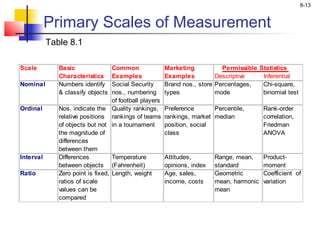
Primary Scales of Measurement
Table 8.1
Scale Basic
Characteristics
Common
Examples
Marketing
Examples
Nominal Numbers identify
& classify objects
Social Security
nos., numbering
of football players
Brand nos., store
types
Percentages,
mode
Chi-square,
binomial test
Ordinal Nos. indicate the
relative positions
of objects but not
the magnitude of
differences
between them
Quality rankings,
rankings of teams
in a tournament
Preference
rankings, market
position, social
class
Percentile,
median
Rank-order
correlation,
Friedman
ANOVA
Ratio Zero point is fixed,
ratios of scale
values can be
compared
Length, weight Age, sales,
income, costs
Geometric
mean, harmonic
mean
Coefficient of
variation
Permissible Statistics
Descriptive Inferential
Interval Differences
between objects
Temperature
(Fahrenheit)
Attitudes,
opinions, index
Range, mean,
standard
Product-
moment
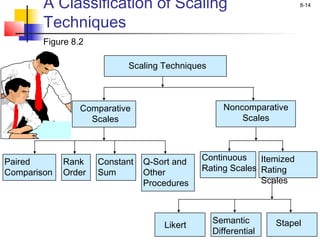
8-14A Classification of Scaling
Techniques
Likert
Semantic
Differential
Stapel
Figure 8.2
Scaling Techniques
Noncomparative
Scales
Comparative
Scales
Paired
Comparison
Rank
Order
Constant
Sum
Q-Sort and
Other
Procedures
Continuous
Rating Scales
Itemized
Rating
Scales
8-15
A Comparison of Scaling Techniques
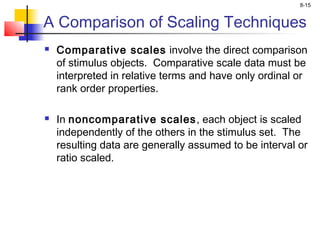
 Comparative scales involve the direct comparison
of stimulus objects. Comparative scale data must be
interpreted in relative terms and have only ordinal or
rank order properties.
 
 In noncomparative scales, each object is scaled
independently of the others in the stimulus set. The
resulting data are generally assumed to be interval or
ratio scaled.
8-16
Relative Advantages of Comparative Scales
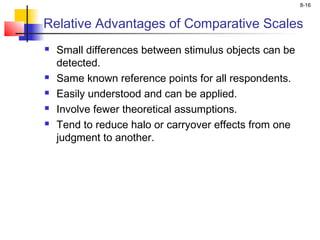
 Small differences between stimulus objects can be
detected.
 Same known reference points for all respondents.
 Easily understood and can be applied.
 Involve fewer theoretical assumptions.
 Tend to reduce halo or carryover effects from one
judgment to another.
8-17
Relative Disadvantages of Comparative
Scales
 Ordinal nature of the data
 Inability to generalize beyond the stimulus objects
scaled.
8-18
Comparative Scaling Techniques
Paired Comparison Scaling
 A respondent is presented with two objects and
asked to select one according to some criterion.
 The data obtained are ordinal in nature.
 Paired comparison scaling is the most widely used
comparative scaling technique.
 With n brands, [n(n - 1) /2] paired comparisons are
required
 Under the assumption of transitivity, it is possible to
convert paired comparison data to a rank order.
8-19
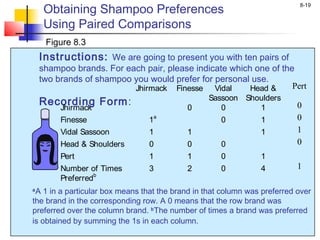
Obtaining Shampoo Preferences
Using Paired Comparisons
Figure 8.3
Instructions: We are going to present you with ten pairs of
shampoo brands. For each pair, please indicate which one of the
two brands of shampoo you would prefer for personal use.
Recording Form:
Jhirmack Finesse Vidal
Sassoon
Head &
Shoulders
Pert
Jhirmack 0 0 1 0
Finesse 1a
0 1 0
Vidal Sassoon 1 1 1 1
Head & Shoulders 0 0 0 0
Pert 1 1 0 1
Number of Times
Preferredb
3 2 0 4 1
a
A 1 in a particular box means that the brand in that column was preferred over
the brand in the corresponding row. A 0 means that the row brand was
preferred over the column brand. b
The number of times a brand was preferred
is obtained by summing the 1s in each column.
8-20
Paired Comparison Selling
The most common method of taste testing is paired comparison. The
consumer is asked to sample two different products and select the one
with the most appealing taste. The test is done in private and a
minimum of 1,000 responses is considered an adequate sample. A blind
taste test for a soft drink, where imagery, self-perception and brand
reputation are very important factors in the consumer’s purchasing
decision, may not be a good indicator of performance in the
marketplace. The introduction of New Coke illustrates this point. New
Coke was heavily favored in blind paired comparison taste tests, but its
introduction was less than successful, because image plays a major role
in the purchase of Coke.
A paired comparison taste
test
8-21
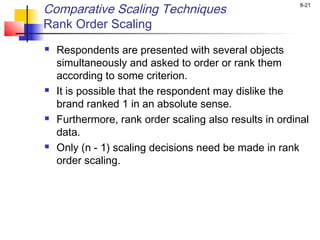
Comparative Scaling Techniques
Rank Order Scaling
 Respondents are presented with several objects
simultaneously and asked to order or rank them
according to some criterion.
 It is possible that the respondent may dislike the
brand ranked 1 in an absolute sense.
 Furthermore, rank order scaling also results in ordinal
data.
 Only (n - 1) scaling decisions need be made in rank
order scaling.
8-22
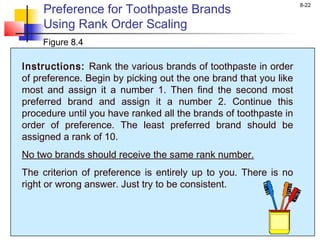
Preference for Toothpaste Brands
Using Rank Order Scaling
Figure 8.4
Instructions: Rank the various brands of toothpaste in order
of preference. Begin by picking out the one brand that you like
most and assign it a number 1. Then find the second most
preferred brand and assign it a number 2. Continue this
procedure until you have ranked all the brands of toothpaste in
order of preference. The least preferred brand should be
assigned a rank of 10.
No two brands should receive the same rank number.
The criterion of preference is entirely up to you. There is no
right or wrong answer. Just try to be consistent.
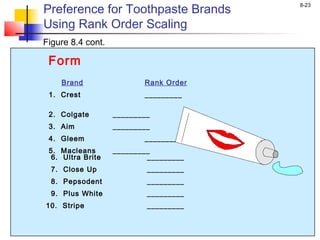
8-23
Brand Rank Order
1. Crest _________
2. Colgate _________
3. Aim _________
4. Gleem _________
5. Macleans _________
6. Ultra Brite _________
7. Close Up _________
8. Pepsodent _________
9. Plus White _________
10. Stripe _________
Preference for Toothpaste Brands
Using Rank Order Scaling
Figure 8.4 cont.
Form
8-24
Comparative Scaling Techniques
Constant Sum Scaling
 Respondents allocate a constant sum of units, such
as 100 points to attributes of a product to reflect their
importance.
 If an attribute is unimportant, the respondent assigns
it zero points.
 If an attribute is twice as important as some other
attribute, it receives twice as many points.
 The sum of all the points is 100. Hence, the name of
the scale.
8-25
Importance of Bathing Soap Attributes
Using a Constant Sum Scale
Figure 8.5
Instructions
On the next slide, there are eight attributes of
bathing soaps. Please allocate 100 points among
the attributes so that your allocation reflects the
relative importance you attach to each attribute.
The more points an attribute receives, the more
important the attribute is. If an attribute is not at all
important, assign it zero points. If an attribute is
twice as important as some other attribute, it
should receive twice as many points.
8-26
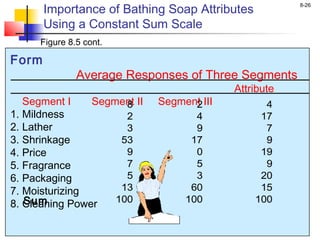
Figure 8.5 cont.
Form
Average Responses of Three Segments
Attribute
Segment I Segment II Segment III
1. Mildness
2. Lather
3. Shrinkage
4. Price
5. Fragrance
6. Packaging
7. Moisturizing
8. Cleaning PowerSum
8 2 4
2 4 17
3 9 7
53 17 9
9 0 19
7 5 9
5 3 20
13 60 15
100 100 100
Importance of Bathing Soap Attributes
Using a Constant Sum Scale

Marketing research ch 8_malhotra

  • 1.
    Chapter Eight Measurement andScaling: Fundamentals and Comparative Scaling
  • 2.
    8-2 Chapter Outline 1) Overview 2)Measurement and Scaling 3) Primary Scales of Measurement i. Nominal Scale ii. Ordinal Scale iii. Interval Scale iv. Ratio Scale 4) A Comparison of Scaling Techniques
  • 3.
    8-3 Chapter Outline 5) ComparativeScaling Techniques i. Paired Comparison ii. Rank Order Scaling iii. Constant Sum Scaling iv. Q-Sort and Other Procedures 6) Verbal Protocols 7) International Marketing Research 8) Ethics in Marketing Research
  • 4.
    8-4 Chapter Outline 9) Internetand Computer Applications 10) Focus on Burke 11) Summary 12) Key Terms and Concepts
  • 5.
    8-5 Measurement and Scaling Measurementmeans assigning numbers or other symbols to characteristics of objects according to certain prespecified rules.  One-to-one correspondence between the numbers and the characteristics being measured.  The rules for assigning numbers should be standardized and applied uniformly.  Rules must not change over objects or time.  
  • 6.
    8-6 Measurement and Scaling Scalinginvolves creating a continuum upon which measured objects are located. Consider an attitude scale from 1 to 100. Each respondent is assigned a number from 1 to 100, with 1 = Extremely Unfavorable, and 100 = Extremely Favorable. Measurement is the actual assignment of a number from 1 to 100 to each respondent. Scaling is the process of placing the respondents on a continuum with respect to their attitude toward department stores.
  • 7.
    8-7 7 38 Primary Scalesof Measurement Scale Nominal Numbers Assigned to Runners Ordinal Rank Order of Winners Interval Performance Rating on a 0 to 10 Scale Ratio Time to Finish, in Figure 8.1 Third place Second place First place Finish Finish 8.2 9.1 9.6 15.2 14.1 13.4
  • 8.
    8-8 Primary Scales ofMeasurement Nominal Scale  The numbers serve only as labels or tags for identifying and classifying objects.  When used for identification, there is a strict one-to- one correspondence between the numbers and the objects.  The numbers do not reflect the amount of the characteristic possessed by the objects.  The only permissible operation on the numbers in a nominal scale is counting.  Only a limited number of statistics, all of which are based on frequency counts, are permissible, e.g., percentages, and mode.
  • 9.
    8-9 Illustration of PrimaryScales of Measurement Table 8.2 Nominal Ordinal Ratio Scale Scale Scale Preference $ spent last No. Store Rankings 3 months 1. Lord & Taylor 2. Macy’s 3. Kmart 4. Rich’s 5. J.C. Penney 6. Neiman Marcus 7. Target 8. Saks Fifth Avenue 9. Sears 10.Wal-Mart Interval Scale Preference Ratings 1-7 11-17 7 79 5 15 0 2 25 7 17 200 8 82 4 14 0 3 30 6 16 100 1 10 7 17 250 5 53 5 15 35 9 95 4 14 0 6 61 5 15 100 4 45 6 16 0 10 115 2 12 10
  • 10.
    8-10 Primary Scales ofMeasurement Ordinal Scale  A ranking scale in which numbers are assigned to objects to indicate the relative extent to which the objects possess some characteristic.  Can determine whether an object has more or less of a characteristic than some other object, but not how much more or less.  Any series of numbers can be assigned that preserves the ordered relationships between the objects.  In addition to the counting operation allowable for nominal scale data, ordinal scales permit the use of statistics based on centiles, e.g., percentile, quartile, median.
  • 11.
    8-11 Primary Scales ofMeasurement Interval Scale  Numerically equal distances on the scale represent equal values in the characteristic being measured.  It permits comparison of the differences between objects.  The location of the zero point is not fixed. Both the zero point and the units of measurement are arbitrary.  Any positive linear transformation of the form y = a + bx will preserve the properties of the scale.  It is meaningful to take ratios of scale values.  Statistical techniques that may be used include all of those that can be applied to nominal and ordinal data, and in addition the arithmetic mean, standard deviation, and other statistics commonly used in marketing research.
  • 12.
    8-12 Primary Scales ofMeasurement Ratio Scale  Possesses all the properties of the nominal, ordinal, and interval scales.  It has an absolute zero point.  It is meaningful to compute ratios of scale values.  Only proportionate transformations of the form y = bx, where b is a positive constant, are allowed.  All statistical techniques can be applied to ratio data.
  • 13.
    8-13 Primary Scales ofMeasurement Table 8.1 Scale Basic Characteristics Common Examples Marketing Examples Nominal Numbers identify & classify objects Social Security nos., numbering of football players Brand nos., store types Percentages, mode Chi-square, binomial test Ordinal Nos. indicate the relative positions of objects but not the magnitude of differences between them Quality rankings, rankings of teams in a tournament Preference rankings, market position, social class Percentile, median Rank-order correlation, Friedman ANOVA Ratio Zero point is fixed, ratios of scale values can be compared Length, weight Age, sales, income, costs Geometric mean, harmonic mean Coefficient of variation Permissible Statistics Descriptive Inferential Interval Differences between objects Temperature (Fahrenheit) Attitudes, opinions, index Range, mean, standard Product- moment
  • 14.
    8-14A Classification ofScaling Techniques Likert Semantic Differential Stapel Figure 8.2 Scaling Techniques Noncomparative Scales Comparative Scales Paired Comparison Rank Order Constant Sum Q-Sort and Other Procedures Continuous Rating Scales Itemized Rating Scales
  • 15.
    8-15 A Comparison ofScaling Techniques  Comparative scales involve the direct comparison of stimulus objects. Comparative scale data must be interpreted in relative terms and have only ordinal or rank order properties.    In noncomparative scales, each object is scaled independently of the others in the stimulus set. The resulting data are generally assumed to be interval or ratio scaled.
  • 16.
    8-16 Relative Advantages ofComparative Scales  Small differences between stimulus objects can be detected.  Same known reference points for all respondents.  Easily understood and can be applied.  Involve fewer theoretical assumptions.  Tend to reduce halo or carryover effects from one judgment to another.
  • 17.
    8-17 Relative Disadvantages ofComparative Scales  Ordinal nature of the data  Inability to generalize beyond the stimulus objects scaled.
  • 18.
    8-18 Comparative Scaling Techniques PairedComparison Scaling  A respondent is presented with two objects and asked to select one according to some criterion.  The data obtained are ordinal in nature.  Paired comparison scaling is the most widely used comparative scaling technique.  With n brands, [n(n - 1) /2] paired comparisons are required  Under the assumption of transitivity, it is possible to convert paired comparison data to a rank order.
  • 19.
    8-19 Obtaining Shampoo Preferences UsingPaired Comparisons Figure 8.3 Instructions: We are going to present you with ten pairs of shampoo brands. For each pair, please indicate which one of the two brands of shampoo you would prefer for personal use. Recording Form: Jhirmack Finesse Vidal Sassoon Head & Shoulders Pert Jhirmack 0 0 1 0 Finesse 1a 0 1 0 Vidal Sassoon 1 1 1 1 Head & Shoulders 0 0 0 0 Pert 1 1 0 1 Number of Times Preferredb 3 2 0 4 1 a A 1 in a particular box means that the brand in that column was preferred over the brand in the corresponding row. A 0 means that the row brand was preferred over the column brand. b The number of times a brand was preferred is obtained by summing the 1s in each column.
  • 20.
    8-20 Paired Comparison Selling Themost common method of taste testing is paired comparison. The consumer is asked to sample two different products and select the one with the most appealing taste. The test is done in private and a minimum of 1,000 responses is considered an adequate sample. A blind taste test for a soft drink, where imagery, self-perception and brand reputation are very important factors in the consumer’s purchasing decision, may not be a good indicator of performance in the marketplace. The introduction of New Coke illustrates this point. New Coke was heavily favored in blind paired comparison taste tests, but its introduction was less than successful, because image plays a major role in the purchase of Coke. A paired comparison taste test
  • 21.
    8-21 Comparative Scaling Techniques RankOrder Scaling  Respondents are presented with several objects simultaneously and asked to order or rank them according to some criterion.  It is possible that the respondent may dislike the brand ranked 1 in an absolute sense.  Furthermore, rank order scaling also results in ordinal data.  Only (n - 1) scaling decisions need be made in rank order scaling.
  • 22.
    8-22 Preference for ToothpasteBrands Using Rank Order Scaling Figure 8.4 Instructions: Rank the various brands of toothpaste in order of preference. Begin by picking out the one brand that you like most and assign it a number 1. Then find the second most preferred brand and assign it a number 2. Continue this procedure until you have ranked all the brands of toothpaste in order of preference. The least preferred brand should be assigned a rank of 10. No two brands should receive the same rank number. The criterion of preference is entirely up to you. There is no right or wrong answer. Just try to be consistent.
  • 23.
    8-23 Brand Rank Order 1.Crest _________ 2. Colgate _________ 3. Aim _________ 4. Gleem _________ 5. Macleans _________ 6. Ultra Brite _________ 7. Close Up _________ 8. Pepsodent _________ 9. Plus White _________ 10. Stripe _________ Preference for Toothpaste Brands Using Rank Order Scaling Figure 8.4 cont. Form
  • 24.
    8-24 Comparative Scaling Techniques ConstantSum Scaling  Respondents allocate a constant sum of units, such as 100 points to attributes of a product to reflect their importance.  If an attribute is unimportant, the respondent assigns it zero points.  If an attribute is twice as important as some other attribute, it receives twice as many points.  The sum of all the points is 100. Hence, the name of the scale.
  • 25.
    8-25 Importance of BathingSoap Attributes Using a Constant Sum Scale Figure 8.5 Instructions On the next slide, there are eight attributes of bathing soaps. Please allocate 100 points among the attributes so that your allocation reflects the relative importance you attach to each attribute. The more points an attribute receives, the more important the attribute is. If an attribute is not at all important, assign it zero points. If an attribute is twice as important as some other attribute, it should receive twice as many points.
  • 26.
    8-26 Figure 8.5 cont. Form AverageResponses of Three Segments Attribute Segment I Segment II Segment III 1. Mildness 2. Lather 3. Shrinkage 4. Price 5. Fragrance 6. Packaging 7. Moisturizing 8. Cleaning PowerSum 8 2 4 2 4 17 3 9 7 53 17 9 9 0 19 7 5 9 5 3 20 13 60 15 100 100 100 Importance of Bathing Soap Attributes Using a Constant Sum Scale