Business Software
Packages
Marketing Information System
Marketing was the first functional area to exhibit an interest in MIS.
The MKIS consists of three input subsystems:
1. AIS
2. Marketing Research
3. Marketing Intelligence
Four ingredients of the marketing mix
1. Product
2. Place
3. Promotion
4. Price
Introduction
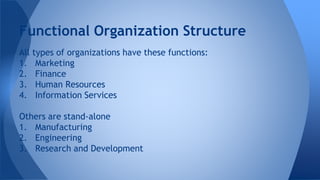
All types of organizations have these functions:
1. Marketing
2. Finance
3. Human Resources
4. Information Services
Others are stand-alone
1. Manufacturing
2. Engineering
3. Research and Development
Functional Organization Structure
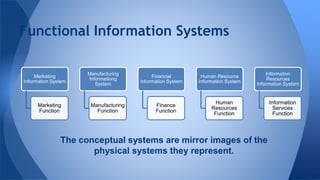
Functional Information Systems
Marketing
Information System
Marketing
Function
Manufacturing
Informationg
System
Manufacturing
Function
Financial
Information System
Finance
Function
Human Resource
Information System
Human
Resources
Function
Information
Resources
Information System
Information
Services
Function
The conceptual systems are mirror images of the
physical systems they represent.
Narrow term:
Marketing includes selling and advertising
Broader term:
Marketing consists of individual and organizational activities that
facilitate and expedite satisfying exchange relationships in a dynamic
environment through the creation, distribution, promotin and pricing
of goods services and ideas.
Marketing Principles
Marketing strategies consist of a mixture of ingredients called the
Marketing mix:
1. Product
Product is what the cutomer buys to satisfy a perceived want or need.
2. Promotion
Promotion is concerned with all the means of encouraging the sale of a product.
3. Place
Place deals with the means of physically distributing the product to the customer
through a channel of distibution
4. Price
Price consists of all the elements relating to what the customer pays for the product
Marketing Mix
1966 – Prof. Philip Kotler of Northwestern University used the term
marketing nerve center to describe a new unit marketing to gather
and process marketing information
He identified the three types of marketing information:
1. Marketing intelligence – information that flows into the firm from
the environment
2. Internal Marketing Information – information that is gathered
within the firm
3. Marketing Communications – information that flows from the
firm outward to the environment
Evolution of the MKIS Concept
EnvironmentFirm
Marketing Intelligence
Marketing Communications
Internal
Marketing
Information
Marketing Information System
- A computer-based system that works in conjunction with other
functional information systems to support the firm’s management
in solving problems that relate to marketing the firm’s products
Two key points in the definition
1. All of the functional systems msut work together
2. Problem Solving support is not limited to marketing managers
MKIS Definition
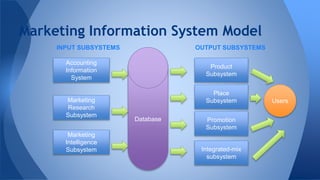
Marketing Information System Model
Database
Accounting
Information
System
Marketing
Research
Subsystem
Marketing
Intelligence
Subsystem
INPUT SUBSYSTEMS OUTPUT SUBSYSTEMS
Product
Subsystem
Place
Subsystem
Promotion
Subsystem
Integrated-mix
subsystem
Users
Output Subsystems
1. Product subsystem
provides information about the firm’s products
2. Place subsystem
provides information about the firm’s distribution network
3. Promotion subsystem
provides information about the firm’s advertising and personal selling activities
4. Price subsystem
helps the manager make pricing decisions
5. Integrated-mix subsystem
enables the manager to develop strategies that consider the combined effects of
the ingredients
1. Accounting Information System
- Data for Preparation of Periodic Reports
- Data for Preparation of Special Reports
- Data for Mathematical Models and Knowledge Based Systems
2. Marketing Research Subsystem
This is used to gather any type of information but most activity aimed a customers and
prospects. Two types of data are gathered: Primary and Secondary Data.
3. Marketing Intelligence Subsystem
Gathers competitor’s data.
Marketing Intelligence refers to the wide range of ethical activities that may be used
to gather information about competitors.
Input Subsystems
End of Topic

Business software packages mkis

  • 1.
  • 2.
  • 3.
    Marketing was thefirst functional area to exhibit an interest in MIS. The MKIS consists of three input subsystems: 1. AIS 2. Marketing Research 3. Marketing Intelligence Four ingredients of the marketing mix 1. Product 2. Place 3. Promotion 4. Price Introduction
  • 4.
    All types oforganizations have these functions: 1. Marketing 2. Finance 3. Human Resources 4. Information Services Others are stand-alone 1. Manufacturing 2. Engineering 3. Research and Development Functional Organization Structure
  • 5.
    Functional Information Systems Marketing InformationSystem Marketing Function Manufacturing Informationg System Manufacturing Function Financial Information System Finance Function Human Resource Information System Human Resources Function Information Resources Information System Information Services Function The conceptual systems are mirror images of the physical systems they represent.
  • 6.
    Narrow term: Marketing includesselling and advertising Broader term: Marketing consists of individual and organizational activities that facilitate and expedite satisfying exchange relationships in a dynamic environment through the creation, distribution, promotin and pricing of goods services and ideas. Marketing Principles
  • 7.
    Marketing strategies consistof a mixture of ingredients called the Marketing mix: 1. Product Product is what the cutomer buys to satisfy a perceived want or need. 2. Promotion Promotion is concerned with all the means of encouraging the sale of a product. 3. Place Place deals with the means of physically distributing the product to the customer through a channel of distibution 4. Price Price consists of all the elements relating to what the customer pays for the product Marketing Mix
  • 8.
    1966 – Prof.Philip Kotler of Northwestern University used the term marketing nerve center to describe a new unit marketing to gather and process marketing information He identified the three types of marketing information: 1. Marketing intelligence – information that flows into the firm from the environment 2. Internal Marketing Information – information that is gathered within the firm 3. Marketing Communications – information that flows from the firm outward to the environment Evolution of the MKIS Concept
  • 9.
  • 10.
    Marketing Information System -A computer-based system that works in conjunction with other functional information systems to support the firm’s management in solving problems that relate to marketing the firm’s products Two key points in the definition 1. All of the functional systems msut work together 2. Problem Solving support is not limited to marketing managers MKIS Definition
  • 11.
    Marketing Information SystemModel Database Accounting Information System Marketing Research Subsystem Marketing Intelligence Subsystem INPUT SUBSYSTEMS OUTPUT SUBSYSTEMS Product Subsystem Place Subsystem Promotion Subsystem Integrated-mix subsystem Users
  • 12.
    Output Subsystems 1. Productsubsystem provides information about the firm’s products 2. Place subsystem provides information about the firm’s distribution network 3. Promotion subsystem provides information about the firm’s advertising and personal selling activities 4. Price subsystem helps the manager make pricing decisions 5. Integrated-mix subsystem enables the manager to develop strategies that consider the combined effects of the ingredients
  • 13.
    1. Accounting InformationSystem - Data for Preparation of Periodic Reports - Data for Preparation of Special Reports - Data for Mathematical Models and Knowledge Based Systems 2. Marketing Research Subsystem This is used to gather any type of information but most activity aimed a customers and prospects. Two types of data are gathered: Primary and Secondary Data. 3. Marketing Intelligence Subsystem Gathers competitor’s data. Marketing Intelligence refers to the wide range of ethical activities that may be used to gather information about competitors. Input Subsystems
  • 14.