FIELD TECHNIQUES
Prabesh Ghimire
Field Epidemiology
Contents
 Development of test instruments
 Methods of collecting information
 Interview techniques and tools
 Observation: concept and observation checklist
 Secondary data analysis
2Compiled by: Prabesh Ghimire
Field Techniques: Concept
Techniques involved in epidemiological
field investigations
Broad array of methods used to
• characterize a disease/health conditions and
events
• describe its distribution and determinants
based on data and analysis of samples
collected in the field.
3Compiled by: Prabesh Ghimire
Methods of collecting information
• Line listing
• Verbal autopsy
• Interview
• Observation
• Focus group discussion (FGD)
• In-depth interview (IDI)
• Key informant interview (KII)
4Compiled by: Prabesh Ghimire
Methods: Line listing
Provides organized information about multiples cases in a
single sheet
In a line listing, each column represents an important
variable, such as name or identification number, age, sex,
case classification, etc., while each row represents a
different case.
Merits
- Can be quickly reviewed and updated
- Quick to administer than individual questionnaire and
useful for field investigations
- Allows for characterization of an outbreak (epidemic
curve)
5Compiled by: Prabesh Ghimire
6Compiled by: Prabesh Ghimire
7Compiled by: Prabesh Ghimire
Verbal autopsy
Field technique to determine the probable cause of death
in case where there was no medical record.
• Maternal death, perinatal death…...
 Primary caregiver (family member) are interviewed to
explore for example “signs and symptoms noted during
the final illness”, history of pregnancy……..
Other family members are allowed to answer verbal
autopsy questions
Recall period of less than one year is preferred.
8Compiled by: Prabesh Ghimire
Interview
One to one conversation where questions are asked and
answers are given
 In field investigations, interview may involve asking
questions to
• Patients/Clients
• Caretakers/ parents
• Health service provider
• Key informants
9Compiled by: Prabesh Ghimire
Techniques of interview
Structured interview
Unstructured interview
10Compiled by: Prabesh Ghimire
Structured Interview
 Formal interview technique
 The questions are asked in a set / standardized
order
 Responses are always predetermined
 Interviewer will not deviate from the interview
schedule or probe beyond the answers received
 Based on structured, closed-ended questions.
11Compiled by: Prabesh Ghimire
Structured Interview
Strengths
• Use of fixed questions, easy to replicate
• Easy to test for reliability
• Quick to conduct- many interviews in small time
Limitations
• Not flexible
• Lack sufficient details
12Compiled by: Prabesh Ghimire
Unstructured Interview
 “Discovery interview” technique
 Guided conversation/ informal interview
 Based on open-ended questions
 Asked in any order
13Compiled by: Prabesh Ghimire
Unstructured Interview
Strengths
• Higher flexibility: questions can be adapted or changed
based on respondent’s answer
• Helps to develop a real sense of a person’s
understanding of a situation
Limitations
• Time consuming
• Certain interviewing skills are essential: establishing
rapport, knowing when to probe….
14Compiled by: Prabesh Ghimire
Structured vs Unstructured Interview
Structured interview Unstructured interview
Meaning Questions to be asked
are determined in
advance
Questions to be asked
are spontaneous
Information desired Quantitative Qualitative
Types of questions
used
Close- ended Open-ended
Application To validate results To explore new details,
in-depth perspective on
a particular topic
15Compiled by: Prabesh Ghimire
Interview tool
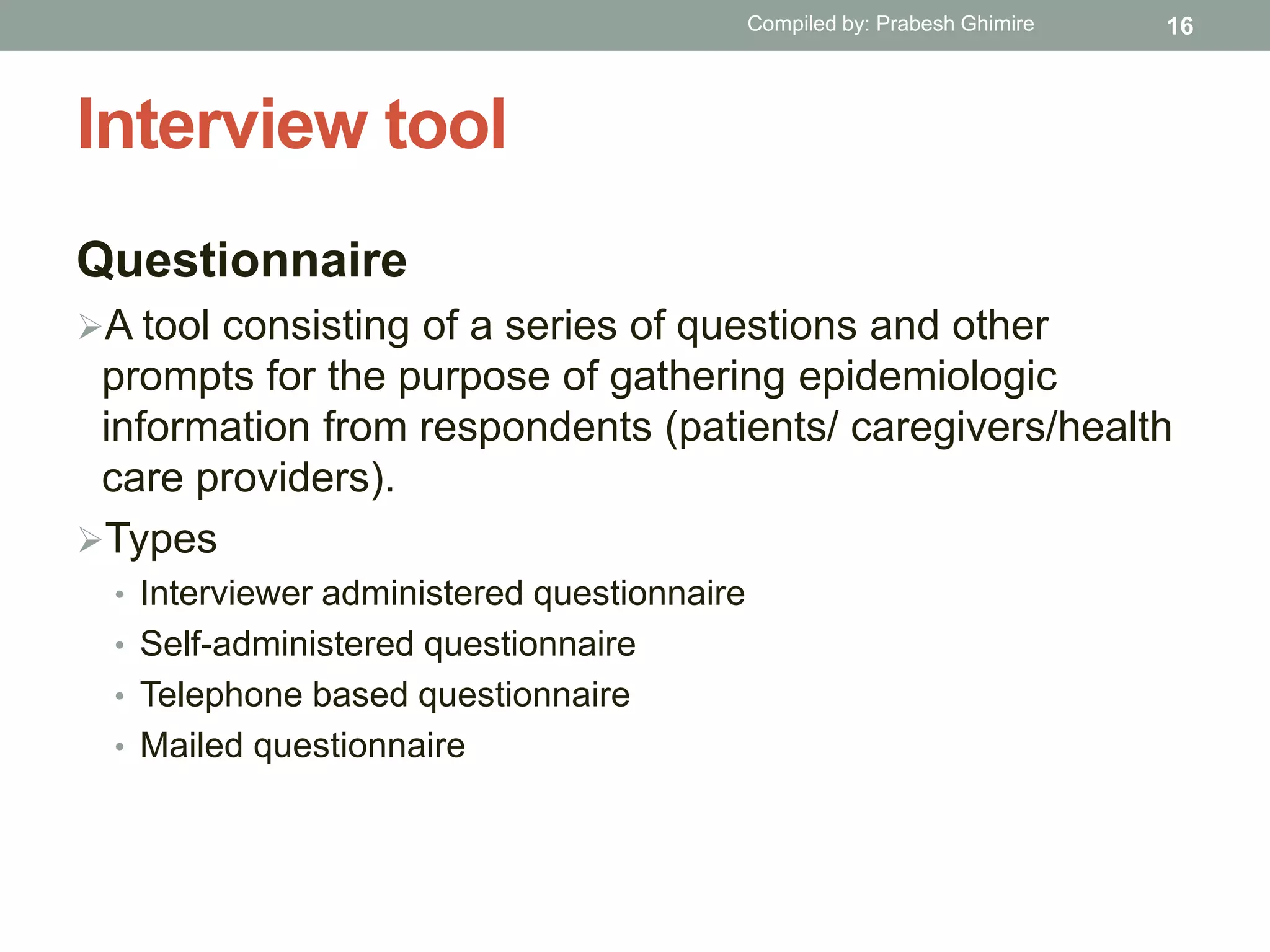
Questionnaire
A tool consisting of a series of questions and other
prompts for the purpose of gathering epidemiologic
information from respondents (patients/ caregivers/health
care providers).
Types
• Interviewer administered questionnaire
• Self-administered questionnaire
• Telephone based questionnaire
• Mailed questionnaire
16Compiled by: Prabesh Ghimire
Qualities of good questionnaire
Limited number of questions
Simple: short and clear questions, no
mathematical questions
Proper order of questions: division into logical
sections
No undesirable questions (offensive/double
barreled/ suggestive questions)
Non-controversial (impartial)
 Clear instructions
17Compiled by: Prabesh Ghimire
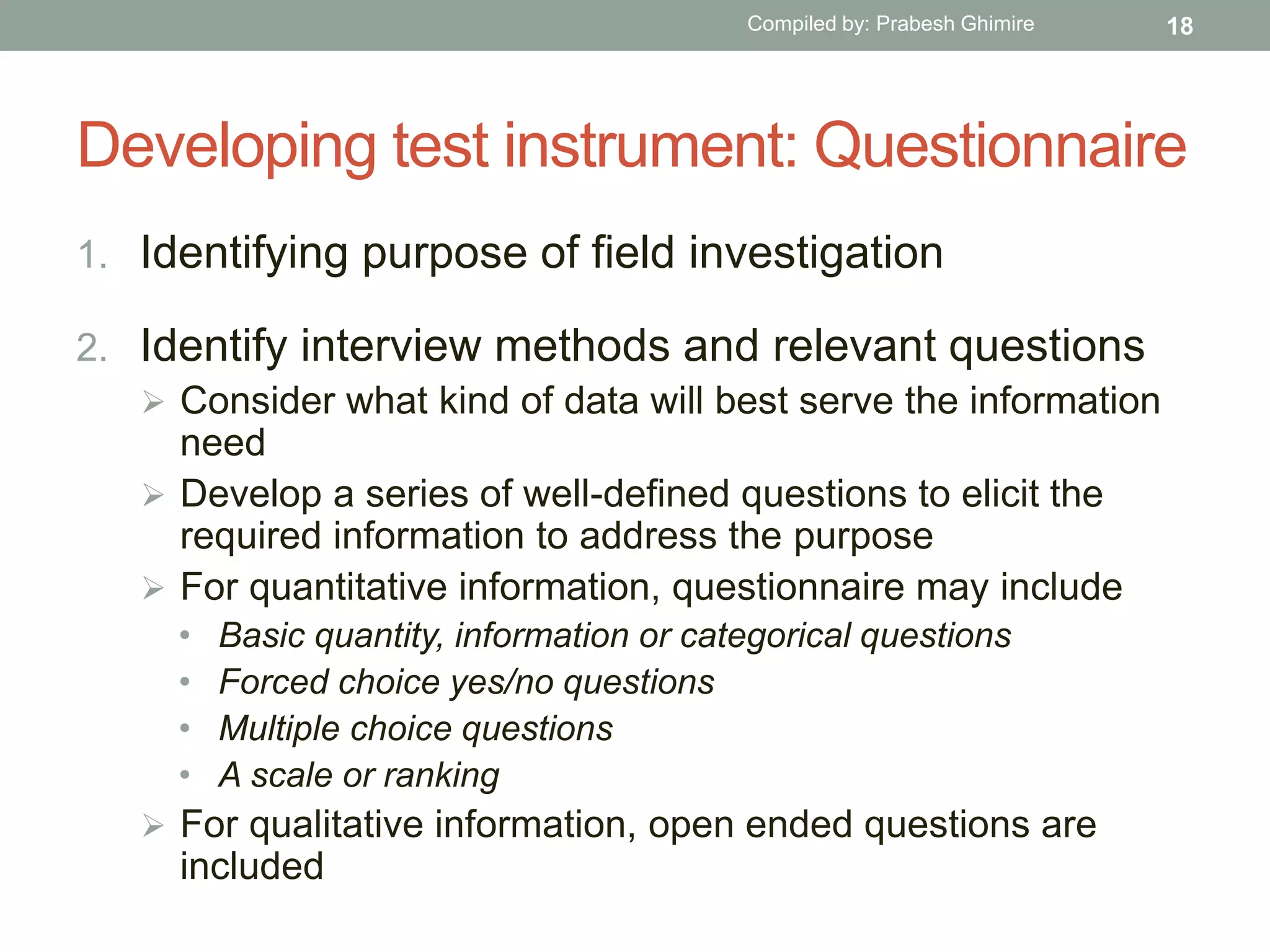
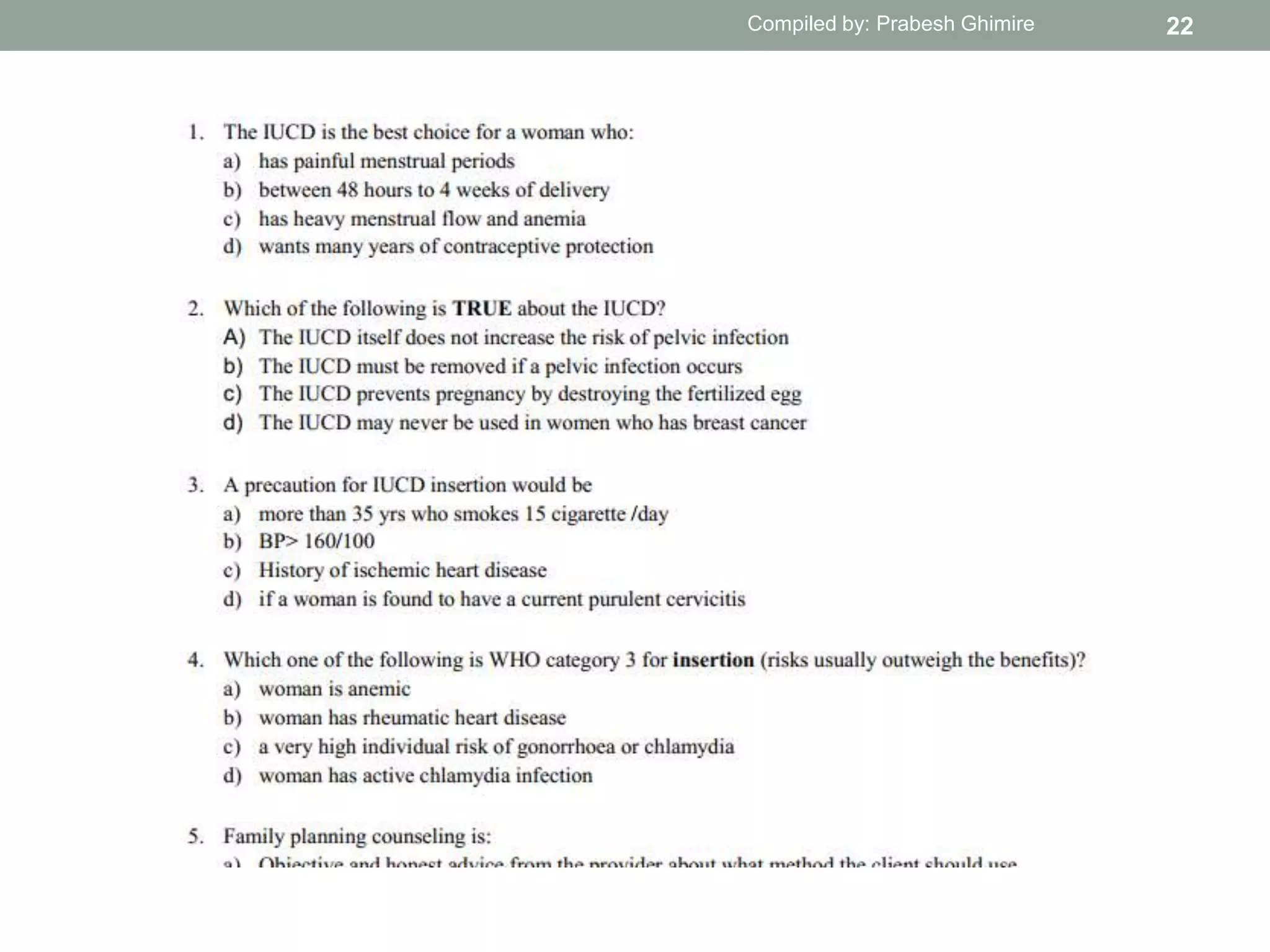
Developing test instrument: Questionnaire
1. Identifying purpose of field investigation
2. Identify interview methods and relevant questions
 Consider what kind of data will best serve the information
need
 Develop a series of well-defined questions to elicit the
required information to address the purpose
 For quantitative information, questionnaire may include
• Basic quantity, information or categorical questions
• Forced choice yes/no questions
• Multiple choice questions
• A scale or ranking
 For qualitative information, open ended questions are
included
18Compiled by: Prabesh Ghimire
Developing test instrument: Questionnaire
3. Sequencing of questions
 Arrange the questions in a logical sequence
 General rule: broadest to narrow and least sensitive
to more sensitive
 Use filter or skipping questions as applicable
4. Length of questionnaire
 Keep the length to minimum in terms of time to
respond
 For long questionnaires, use heading and transition
statements
19Compiled by: Prabesh Ghimire
Developing test instrument: Questionnaire
5. Language and phrasing
 Use culturally appropriate language
 Use precise questions
 Phrasing questions in the positive way
 Avoid leading questions
Do you wash hands with a soap after going to toilet?
 Avoid double barreled questions
How often and how much time do you spend on each visit to a
HF?
 Avoid sensitive questions
Will you take a dowry when you get married? 
Do you think most Nepalese men would take dowry when they get
married? √
20Compiled by: Prabesh Ghimire
Developing test instrument: Questionnaire
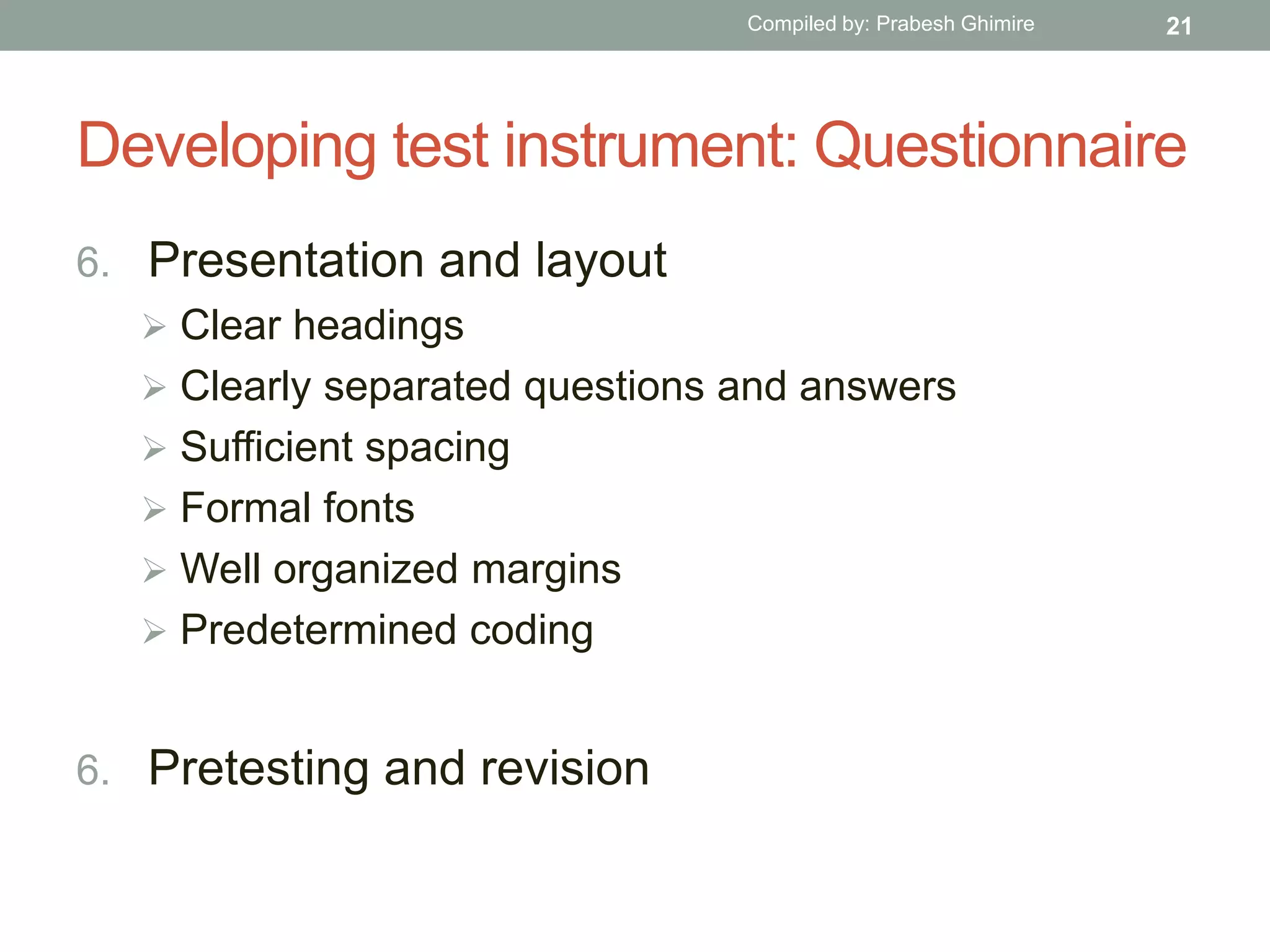
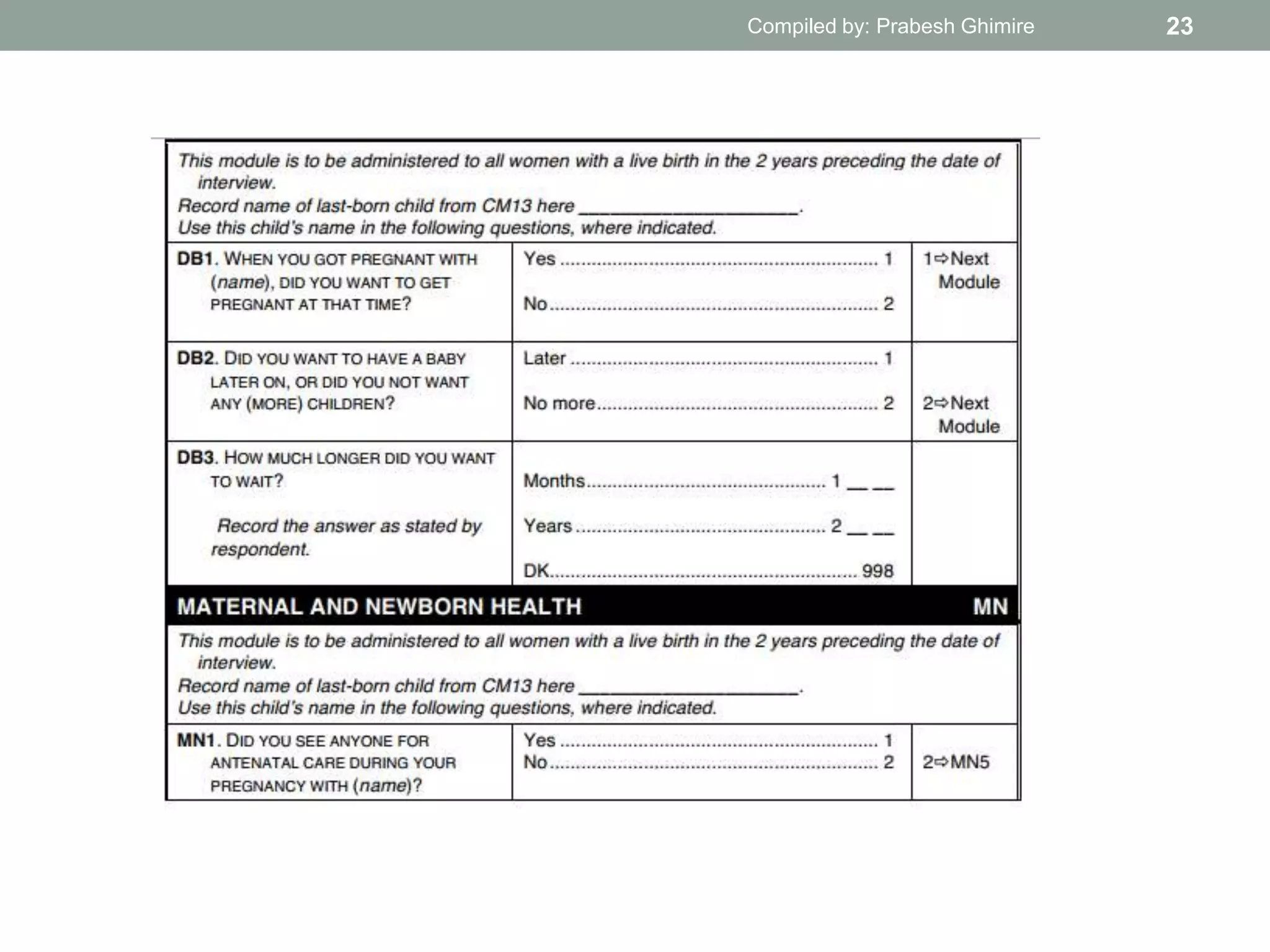
6. Presentation and layout
 Clear headings
 Clearly separated questions and answers
 Sufficient spacing
 Formal fonts
 Well organized margins
 Predetermined coding
6. Pretesting and revision
21Compiled by: Prabesh Ghimire
22Compiled by: Prabesh Ghimire
23Compiled by: Prabesh Ghimire
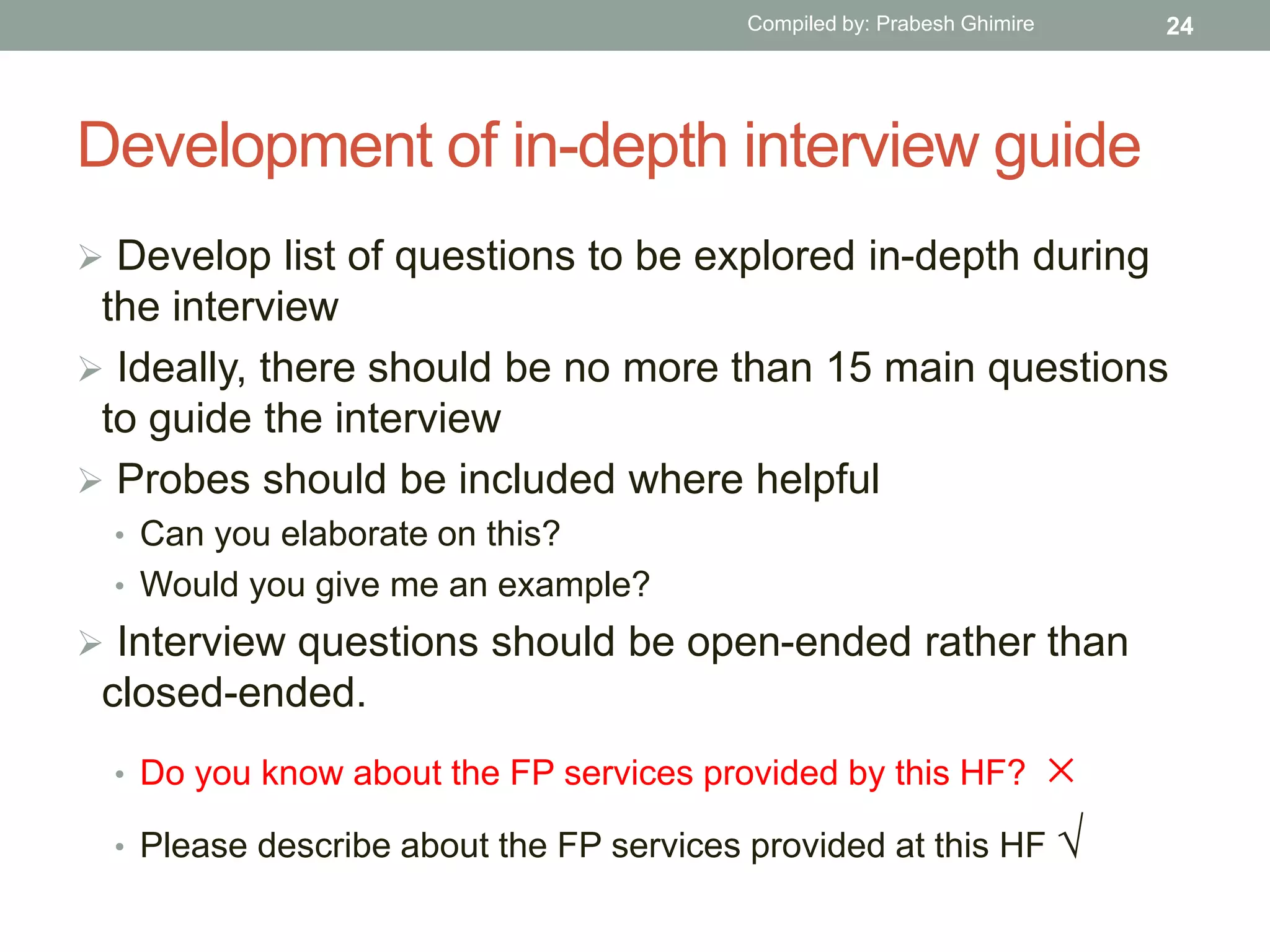
Development of in-depth interview guide
 Develop list of questions to be explored in-depth during
the interview
 Ideally, there should be no more than 15 main questions
to guide the interview
 Probes should be included where helpful
• Can you elaborate on this?
• Would you give me an example?
 Interview questions should be open-ended rather than
closed-ended.
• Do you know about the FP services provided by this HF? 
• Please describe about the FP services provided at this HF √
24Compiled by: Prabesh Ghimire
25Compiled by: Prabesh Ghimire
Observation
 Field investigation technique to collect epidemiologic
information by watching behavior, events or noting
personal characteristics in their natural setting.
 May be overt or covert
 May be direct or indirect
When to use observation
• When trying to understand an ongoing situation or event
• When you are gathering data on individual behaviors
• When it is necessary to know about a physical setting
• When data collection from individual is not a realistic opinion
26Compiled by: Prabesh Ghimire
Type of Observation
 Structured, semi-structured and unstructured
observation
 Participant and non-participant observation
27Compiled by: Prabesh Ghimire
Strengths and Limitations
Strengths
• Interviews during emergency/outbreak may not always be a
feasible option. Observation can collect data when and when
an event or activity is occurring
• Direct insights into how people are behaving and interacting
• Does not rely on people’s willingness or ability to provide
information
Limitations
• Susceptible to observer bias
• Susceptible to ‘hawthrone effect’
• Expensive and time consuming
28Compiled by: Prabesh Ghimire
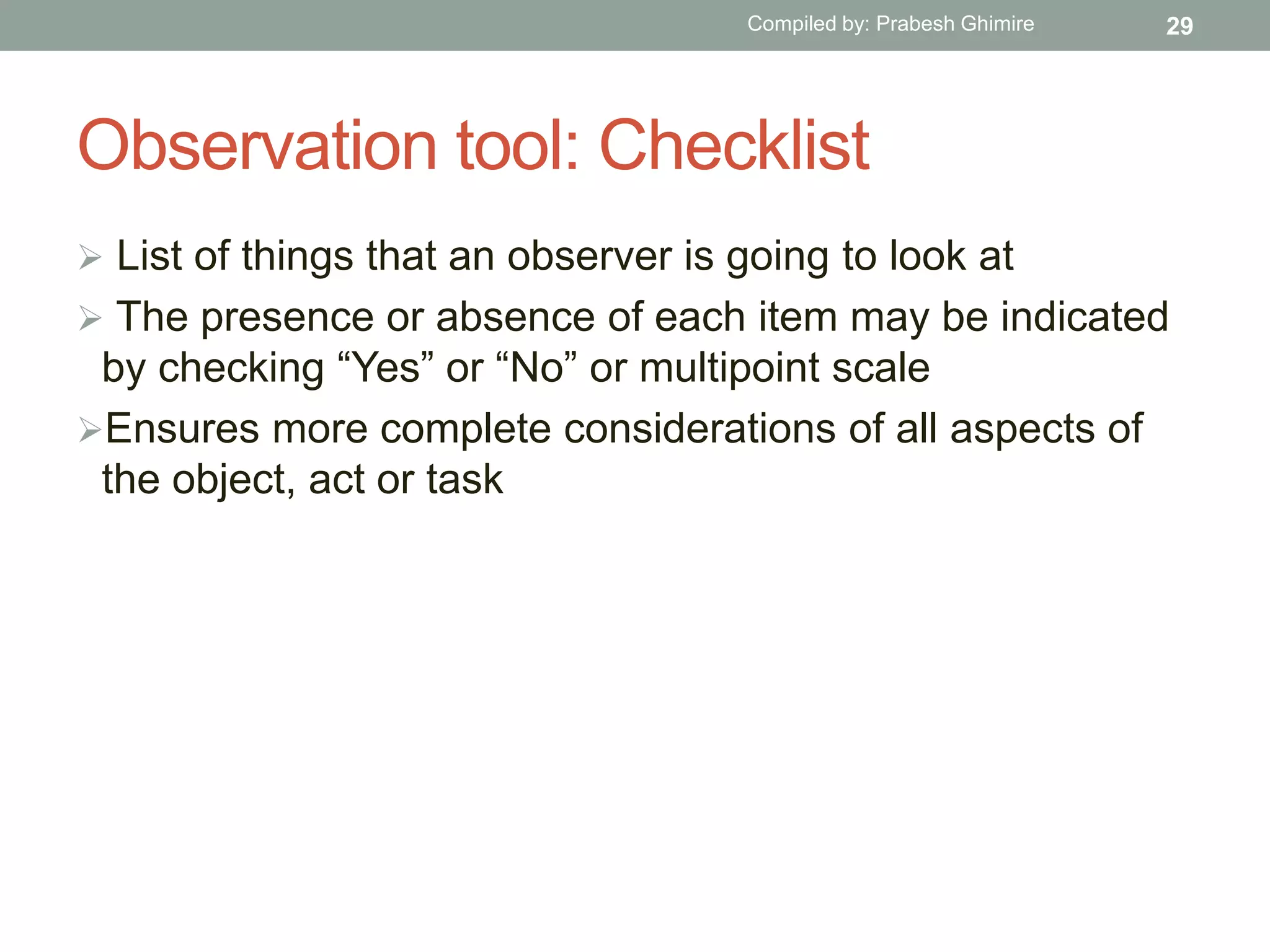
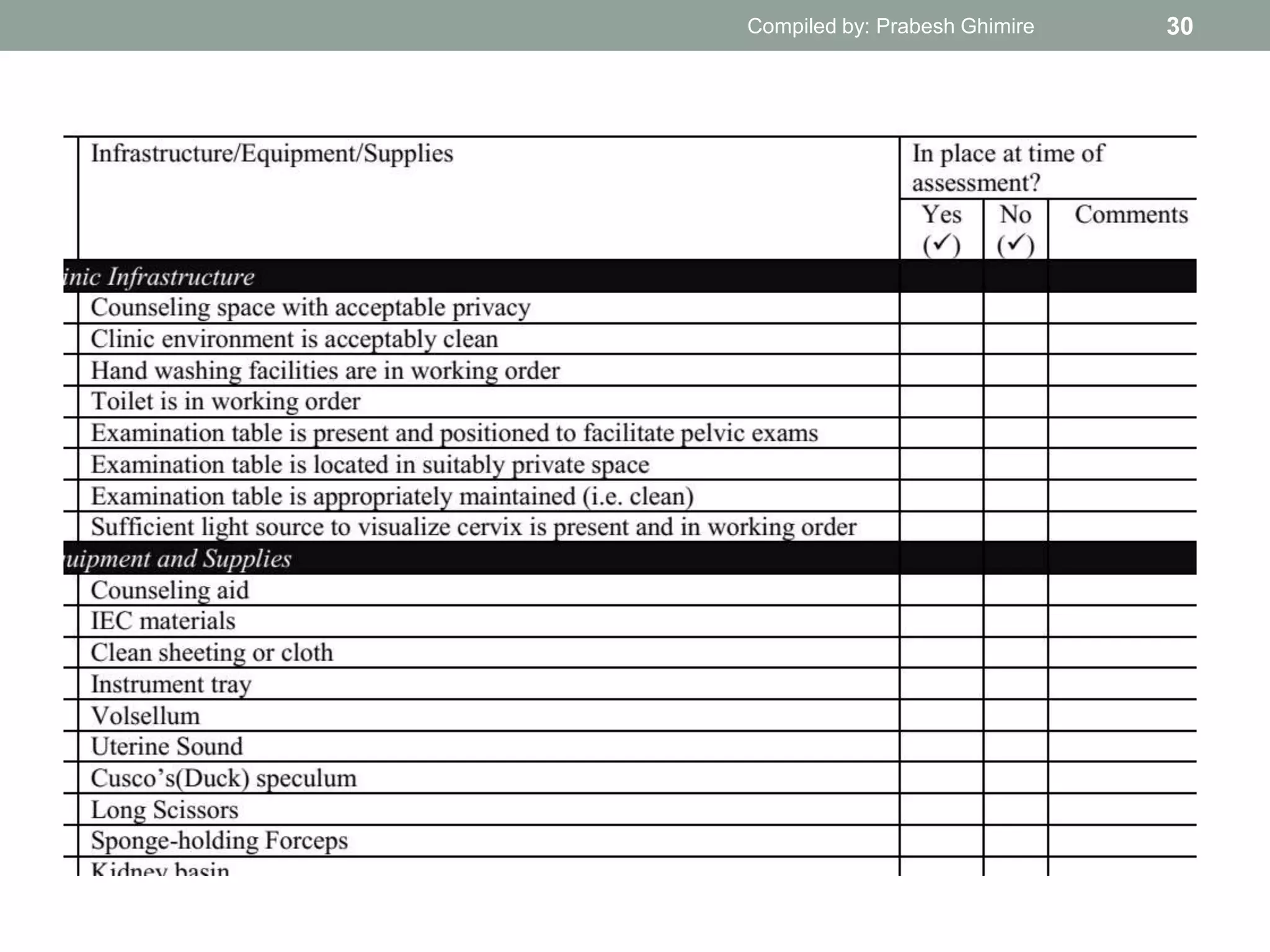
Observation tool: Checklist
 List of things that an observer is going to look at
 The presence or absence of each item may be indicated
by checking “Yes” or “No” or multipoint scale
Ensures more complete considerations of all aspects of
the object, act or task
29Compiled by: Prabesh Ghimire
30Compiled by: Prabesh Ghimire
31Compiled by: Prabesh Ghimire
32
Open Discussion………
Compiled by: Prabesh Ghimire

Field Techniques (Field Epidemiology)

  • 1.
  • 2.
    Contents  Development oftest instruments  Methods of collecting information  Interview techniques and tools  Observation: concept and observation checklist  Secondary data analysis 2Compiled by: Prabesh Ghimire
  • 3.
    Field Techniques: Concept Techniquesinvolved in epidemiological field investigations Broad array of methods used to • characterize a disease/health conditions and events • describe its distribution and determinants based on data and analysis of samples collected in the field. 3Compiled by: Prabesh Ghimire
  • 4.
    Methods of collectinginformation • Line listing • Verbal autopsy • Interview • Observation • Focus group discussion (FGD) • In-depth interview (IDI) • Key informant interview (KII) 4Compiled by: Prabesh Ghimire
  • 5.
    Methods: Line listing Providesorganized information about multiples cases in a single sheet In a line listing, each column represents an important variable, such as name or identification number, age, sex, case classification, etc., while each row represents a different case. Merits - Can be quickly reviewed and updated - Quick to administer than individual questionnaire and useful for field investigations - Allows for characterization of an outbreak (epidemic curve) 5Compiled by: Prabesh Ghimire
  • 6.
  • 7.
  • 8.
    Verbal autopsy Field techniqueto determine the probable cause of death in case where there was no medical record. • Maternal death, perinatal death…...  Primary caregiver (family member) are interviewed to explore for example “signs and symptoms noted during the final illness”, history of pregnancy…….. Other family members are allowed to answer verbal autopsy questions Recall period of less than one year is preferred. 8Compiled by: Prabesh Ghimire
  • 9.
    Interview One to oneconversation where questions are asked and answers are given  In field investigations, interview may involve asking questions to • Patients/Clients • Caretakers/ parents • Health service provider • Key informants 9Compiled by: Prabesh Ghimire
  • 10.
    Techniques of interview Structuredinterview Unstructured interview 10Compiled by: Prabesh Ghimire
  • 11.
    Structured Interview  Formalinterview technique  The questions are asked in a set / standardized order  Responses are always predetermined  Interviewer will not deviate from the interview schedule or probe beyond the answers received  Based on structured, closed-ended questions. 11Compiled by: Prabesh Ghimire
  • 12.
    Structured Interview Strengths • Useof fixed questions, easy to replicate • Easy to test for reliability • Quick to conduct- many interviews in small time Limitations • Not flexible • Lack sufficient details 12Compiled by: Prabesh Ghimire
  • 13.
    Unstructured Interview  “Discoveryinterview” technique  Guided conversation/ informal interview  Based on open-ended questions  Asked in any order 13Compiled by: Prabesh Ghimire
  • 14.
    Unstructured Interview Strengths • Higherflexibility: questions can be adapted or changed based on respondent’s answer • Helps to develop a real sense of a person’s understanding of a situation Limitations • Time consuming • Certain interviewing skills are essential: establishing rapport, knowing when to probe…. 14Compiled by: Prabesh Ghimire
  • 15.
    Structured vs UnstructuredInterview Structured interview Unstructured interview Meaning Questions to be asked are determined in advance Questions to be asked are spontaneous Information desired Quantitative Qualitative Types of questions used Close- ended Open-ended Application To validate results To explore new details, in-depth perspective on a particular topic 15Compiled by: Prabesh Ghimire
  • 16.
    Interview tool Questionnaire A toolconsisting of a series of questions and other prompts for the purpose of gathering epidemiologic information from respondents (patients/ caregivers/health care providers). Types • Interviewer administered questionnaire • Self-administered questionnaire • Telephone based questionnaire • Mailed questionnaire 16Compiled by: Prabesh Ghimire
  • 17.
    Qualities of goodquestionnaire Limited number of questions Simple: short and clear questions, no mathematical questions Proper order of questions: division into logical sections No undesirable questions (offensive/double barreled/ suggestive questions) Non-controversial (impartial)  Clear instructions 17Compiled by: Prabesh Ghimire
  • 18.
    Developing test instrument:Questionnaire 1. Identifying purpose of field investigation 2. Identify interview methods and relevant questions  Consider what kind of data will best serve the information need  Develop a series of well-defined questions to elicit the required information to address the purpose  For quantitative information, questionnaire may include • Basic quantity, information or categorical questions • Forced choice yes/no questions • Multiple choice questions • A scale or ranking  For qualitative information, open ended questions are included 18Compiled by: Prabesh Ghimire
  • 19.
    Developing test instrument:Questionnaire 3. Sequencing of questions  Arrange the questions in a logical sequence  General rule: broadest to narrow and least sensitive to more sensitive  Use filter or skipping questions as applicable 4. Length of questionnaire  Keep the length to minimum in terms of time to respond  For long questionnaires, use heading and transition statements 19Compiled by: Prabesh Ghimire
  • 20.
    Developing test instrument:Questionnaire 5. Language and phrasing  Use culturally appropriate language  Use precise questions  Phrasing questions in the positive way  Avoid leading questions Do you wash hands with a soap after going to toilet?  Avoid double barreled questions How often and how much time do you spend on each visit to a HF?  Avoid sensitive questions Will you take a dowry when you get married?  Do you think most Nepalese men would take dowry when they get married? √ 20Compiled by: Prabesh Ghimire
  • 21.
    Developing test instrument:Questionnaire 6. Presentation and layout  Clear headings  Clearly separated questions and answers  Sufficient spacing  Formal fonts  Well organized margins  Predetermined coding 6. Pretesting and revision 21Compiled by: Prabesh Ghimire
  • 22.
  • 23.
  • 24.
    Development of in-depthinterview guide  Develop list of questions to be explored in-depth during the interview  Ideally, there should be no more than 15 main questions to guide the interview  Probes should be included where helpful • Can you elaborate on this? • Would you give me an example?  Interview questions should be open-ended rather than closed-ended. • Do you know about the FP services provided by this HF?  • Please describe about the FP services provided at this HF √ 24Compiled by: Prabesh Ghimire
  • 25.
  • 26.
    Observation  Field investigationtechnique to collect epidemiologic information by watching behavior, events or noting personal characteristics in their natural setting.  May be overt or covert  May be direct or indirect When to use observation • When trying to understand an ongoing situation or event • When you are gathering data on individual behaviors • When it is necessary to know about a physical setting • When data collection from individual is not a realistic opinion 26Compiled by: Prabesh Ghimire
  • 27.
    Type of Observation Structured, semi-structured and unstructured observation  Participant and non-participant observation 27Compiled by: Prabesh Ghimire
  • 28.
    Strengths and Limitations Strengths •Interviews during emergency/outbreak may not always be a feasible option. Observation can collect data when and when an event or activity is occurring • Direct insights into how people are behaving and interacting • Does not rely on people’s willingness or ability to provide information Limitations • Susceptible to observer bias • Susceptible to ‘hawthrone effect’ • Expensive and time consuming 28Compiled by: Prabesh Ghimire
  • 29.
    Observation tool: Checklist List of things that an observer is going to look at  The presence or absence of each item may be indicated by checking “Yes” or “No” or multipoint scale Ensures more complete considerations of all aspects of the object, act or task 29Compiled by: Prabesh Ghimire
  • 30.
  • 31.
  • 32.

Editor's Notes

  • #27 (e.g. IP status in hospital, sanitary condition of water sources)
  • #28 (e.g. IP status in hospital, sanitary condition of water sources)
  • #29 ‘hawthrone effect’ (people perform better when they know they are being observed)