Introduction
Direct Drive Diesel Engine Power Plants
Power Plants For Auxiliary Power Generation
Geared Diesel Engine Power Plants
Diesel-electric Power Plants
Combined Geared Diesel And Diesel-electric Power Plants
Gas Turbine for Marine Applications
Waste Heat Recovery Systems
Propeller Shafting System
 Choosing a propulsion engines and the most
suitable plant configuration for a new building or
retrofit project is not a simple decision.
 It indicates careful study of the machinery options
available and the operating profile of the ship.
 Today, ships are entering service with direct-
coupled two-stroke engines driving fixed or CP
propellers, geared four-stroke engines or
high/medium speed diesel-electric propulsion
plants.
 Low speed engines are dominant in the
mainstream deep sea tanker, bulk carrier and
container ship sectors.
 Medium speed engines are favored for smaller
cargo ships, ferries, cruise liners, Ro-Ro freight
carriers and diverse specialist tonnage such as
icebreakers, offshore support and research vessels.
 Ship owners may remain loyal to a particular type
or make and model of engine for various reasons,
such as: reliable past operating experience, crew
familiarity, spare inventories and good service
support.
 Much decision-making on the engine focused on
cost considerations not just the initial cost but the
type of fuel which can be reliably burned,
maintenance costs, desirable manning levels and
availability/price of spares.
 The tendency now is to assess the total life cycle
costs rather than the purchase price of the main
engine.
 Key factors influencing the choice of a diesel
engine may be summarized as:
1. Capability to burn heavy fuel of poor quality
without detrimental impact on the engine
components and hence maintenance/spares
costs.
2. The maintenance workload: the number of
cylinders, valves, liners, rings and bearings
requiring periodic attention in relation to the
number of crew carried.
3. Suitability for unattended operation by exploiting
automated controls and monitoring systems.
4. Propulsive efficiency: the ability of the engine or
propeller shaft to be turned at a low enough speed
to drive the largest diameter (and hence most
efficient) propeller.
5. Size and weight of the propulsion machinery.
6. Cost of the engine.
 This is largely governed by the size of the main
engine which may undermine the cargo-carrying
capacity of the ship.
 The available headroom is also important in some
ships.
 Notably ferries with vehicle decks, and insufficient
headroom and surrounding free space may make it
difficult or impossible for some engines to be
installed or overhauled.
 The direct drive of a fixed pitch propeller by a low
speed two-stroke engine remains the most popular
propulsion mode for deep sea cargo ships.
 A slight loss of propulsive efficiency was accepted
for the sake of simplicity.
 However, the introduction of long stroke and, more
recently, super-and ultra-long stroke cross head
engines has reduced such losses.
 It is now possible to specify a direct drive
engine/propeller combination which will yield close
to the optimum propulsive efficiency for a given
ship design.
 Operators prefer an engine with the fewest
possible cylinders, as long as problems with
vibration and balance are not suffered.
 Fewer cylinders influence the size of the engine
and the machinery space, the maintenance
workload, and the amount of spares which need to
be held in stock.
 Larger bore engines also generally return a better
specific fuel consumption than smaller engines and
offer a greater tolerance to heavy fuels of poor
quality.
 A direct-coupled propulsion engine cannot operate
unaided since it requires service pumps for cooling
and lubrication, and fuel/lube oil handling and
treatment systems.
 These ancillaries need electrical power which is
usually provided by generators driven by medium
or high speed diesel engines.
 Many genset engine builders can now offer designs
capable of burning the same heavy fuel grade as
the main engine as well as marine diesel oil or
blended fuel.
 The cost of auxiliary power generation can weigh
heavily in the choice of main machinery.
 Developments have sought to:
 Maximize the exploitation of waste heat recovery
 Supplement electricity supplies at sea,
 Facilitate the use of alternators driven by the main
engine via speed-increasing gearing or mounted
directly in the shaft line,
 Power other machinery from the main engine.
 Gear-based constant frequency generator drives
allow a shaft alternator to be driven by a low speed
engine in a fixed pitch propeller installation.
 Alternatively, a thyristor frequency converter
system can be specified to serve as alternator with
a variable main engine shaft speed input in a fixed
pitch or CP propeller installation.
 It exploits the high thermal efficiency, low specific
fuel consumption and low grade fuel-burning
capability of the ship's diesel prime mover.
 Auxiliary diesel gensets can be shut down, yielding
benefits from reduced running hours in terms of
lower fuel and lubricating oil consumptions,
maintenance demands and spares costs.
 System options for electricity generation have been
extended by the arrival of power turbines.
 These are fed with exhaust gas surplus to the
needs of modern high efficiency turbochargers.
 They can be arranged to drive alternators in
conjunction with the main engine or
independently.
 These small gas turbines are also in service in
integrated systems linking steam turbo-
alternators, shaft alternators and diesel gensets.
 These have been developed over the years by the
major Japanese shipbuilding groups for application
to large tankers and bulk carriers.
 The systems typically exploit waste heat (from low
speed main engine exhaust gas, scavenge air and
cooling water) to serve a steam turbo-alternator,
air conditioning plant, heaters and distillers.
 The new integrated systems, some also
incorporating power gas turbines, maximize the
exploitation of the waste heat available in ships
whose operating profiles and revenues can justify
the added expense and complexity.
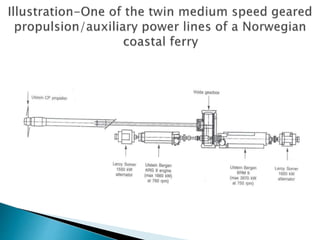
 The most common form of indirect drive of a
propeller features one or more medium speed
four-stroke engines connected through clutches
and coupling to a reduction gearbox to drive either
a fixed pitch or CP propeller.
 The CP propeller eliminates the need for a direct-
reversing engine while the gearing allows a
suitable propeller speed to be selected.
1.Ships with more than one main engine benefit
from enhanced availability through redundancy.
 In the event of one engine breaking down another
can maintain navigation.
 The number of engines engaged can also be varied
to secure the most economical mode for a given
speed or deployment profile.
 In contrast, in similar operational circumstances, a
single direct-coupled engine might have to be run
for long period at reduced output with lower
efficiency.
2. The ability to vary the number of engines
deployed allows an engine to be serviced at sea,
easing maintenance planning.
 This flexibility is particularly valued in an era when
port turn -round times are minimized.
 Engines can also be overhauled in port without the
worry of authorities demanding an unscheduled
shift of berth or sudden departure.
3. By modifying the number of engines per ship and
the cylinder numbers per engine to suit individual
power requirements the propulsion plant for a fleet
can be standardized on a single engine model, with
consequent saving in spares costs and inventories,
and benefits in crew familiarity.
4. Compact machinery spaces with low head rooms
can be created, characteristics particularly valued
for RoRo ferries.
In many propulsion installations a gearbox is
expected to:
 Determine the propeller speed and direction of
rotation, and provide a reversing capability;
 provide a geometric coupling that can connect and
separate the flow of power between the engine and
propeller shaft; and
 Absorb the thrust from the propeller.
 Flexibility is enhanced by the adoption of a so-
called 'father-and-son' (or 'mother-and-daughter')
configuration: a partnership of similar four-stroke
engine models, but with different cylinder
numbers, coupled to a common reduction gearbox
to drive a propeller shaft.
 Father-and-son pairs have been specified to
power large twin-screw cruise vessels.
 An example is provided by the 1995-built P&O
liner Oriana whose 40000 kW propulsion plant is
based on two ninecylinder and two six-cylinder
MAN B&W L58/64 medium speed engines.
 Propulsion can be effected either by: the father-
and-son engines together; the father engines alone
or the son engines alone; and with or without the
shaft alternators operating as propulsion motors
(fed with electrical power by the diesel gensets).
 An increasingly popular form of indirect drive is
diesel-electric propulsion based on multi-medium
speed main gensets.
 Two key AC technologies have emerged to
supersede traditional DC electric drives:
 The Cycloconverter system and
 The Load Commutated Inverter (LCI) or
synchrodrive solution.
 Both are widely used in electric propulsion,
although they present different electrical
characteristics.
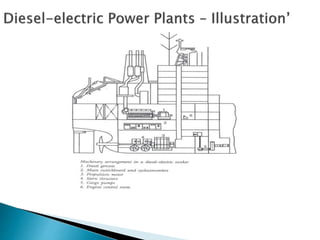
 A variable-speed AC drive system comprises a
propulsion motor and a frequency converter, with
the motor speed controlled by the converter
altering the input frequency to the motor.
 Electric propulsion requires motors to drive the
propellers and gensets to supply the power.
1. Flexibility of layout: the advantage of electric
transmission is that the prime movers and their
associated generators are not constrained to have
any particular relationship with the load. It is
therefore possible to install the main diesel
gensets and their support services in locations
remote from the propeller shaft.
2. Load diversity: certain types of tonnage have a
requirement for substantial amount of power for
ship service when the demands of the propulsion
system are low.
3. Economical part load running: this is best
achieved when there is a central power station
feeding propulsion and ship service. A typical
medium speed diesel-electric installation features
four main gensets and, with parallel operation of
all the sets, it is easy to match the available
generating capacity to the load demand.
4. Ease of control: Electric drives are capable of
meeting the most exacting demands with regard
to dynamic performance, exceeding by a very wide
margin anything that is required of a propulsion
system.
5. Low noise: An electric motor can provide a drive
with very low vibration characteristics, a quality
valued for warships, research vessels and cruise
ships where, for different reasons, a low noise
signature is required.
6. Environmental protection and ship safety:
Controls to curb noxious exhaust gas
emissions-tightening nationally, regionally and
globally.
 Constant speed running of diesel prime movers
optimized to the load is conductive to lower NOx
emission levels.
 An increasing focus on higher ship safety through
redundancy of propulsion plant elements is
another positive factor.
Read on:
 Combined Geared Diesel and Diesel-Electric Power
Plants.
 Waste heat recovery systems: Exhaust gas power
turbine, Distillation plants and Exhaust gas boiler.
Assignment:
 Illustrate the open cycle marine gas turbine system
and discuss 3 advantages and 3 disadvantages of
this system.
 The main propulsion shafting system must
accomplish a number of objectives that are vital to
the ships operation. These include:
 Transmit the power output from the main engines
to the propulsor;
 Support the propulsor;
 Transmit the thrust developed by the propulsor to
the ship’s Hull;
 Safely withstand transient operating loads (e.g.
High-speed maneuvers, quick reversals);
 Be free of deleterious modes of vibration;
 Be a low maintenance system.
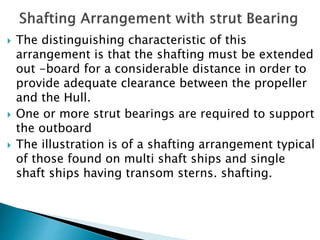
 The distinguishing characteristic of this
arrangement is that the shafting must be extended
out -board for a considerable distance in order to
provide adequate clearance between the propeller
and the Hull.
 One or more strut bearings are required to support
the outboard
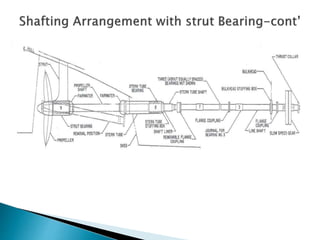
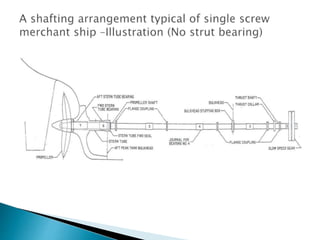
 The illustration is of a shafting arrangement typical
of those found on multi shaft ships and single
shaft ships having transom sterns. shafting.
 The major difference between the shafting
arrangements of various merchant ships is the
location of the main engines.
 When the main engines are located well after, such
as on tankers, there may be as few as one or even
no inboard line shaft bearings.
 When the main engines are located further forward,
which is predominantly the case for naval ships, a
considerable length of inboard shafting may be
required to accommodate the ship arrangement.
 The shafting located inside the ship is termed line
shafting.
 The outboard sections of shafting (wet shafting)
are designated differently depending upon their
location.
 The section to which the propeller is secured is
the propeller shaft or tail shaft.
 The section passing through the stern tube is the
stern tube shaft unless the propeller is supported
by this section in which case it is designated as the
propeller shaft or tail shaft.
 If there is a section of shafting between the
propeller and stern tube shafts, it would be
referred to as an intermediate outboard shaft.
 Shafting sections are connected by means of
bolted flange couplings.
 Bearings are used to support the shafting in
essentially a straight line between the main
propulsion engine and the desired location of the
propeller.
 Bearings inside the ship are known as line shaft
bearings.
 Bearings which support outboard sections of
shafting are called stern tube bearings if they are
located in the stern-tube and strut bearings when
located in struts.
 Out-board bearings may be lubricated by either
seawater or oil; seals having a very high reliability
are required in the event the latter is used.
 In order to control flooding in the event of
casualty, watertight bulkheads are installed within
the ship.
 Stuffing boxes are installed where the shafting
passes through these bulkheads.
 A seal, which is more substantial than a bulkhead
stuffing box, is installed where the shafting
penetrates the watertight boundary of the Hull.
 The propeller thrust is transmitted to the hull by
means of a main thrust bearing.
 When the main engine drives the propeller through
reduction gears, the main thrust bearing may be
located either forward or aft of the slow -speed
gear.
 Direct drive diesel ships have the thrust bearing aft
of the engine, either attached directly to the engine
crankshaft or located farther aft independent of the
engine.

MARINE ENGINE AND POWER PLANT SELECTION.pptx

  • 1.
    Introduction Direct Drive DieselEngine Power Plants Power Plants For Auxiliary Power Generation Geared Diesel Engine Power Plants Diesel-electric Power Plants Combined Geared Diesel And Diesel-electric Power Plants Gas Turbine for Marine Applications Waste Heat Recovery Systems Propeller Shafting System
  • 2.
     Choosing apropulsion engines and the most suitable plant configuration for a new building or retrofit project is not a simple decision.  It indicates careful study of the machinery options available and the operating profile of the ship.  Today, ships are entering service with direct- coupled two-stroke engines driving fixed or CP propellers, geared four-stroke engines or high/medium speed diesel-electric propulsion plants.
  • 3.
     Low speedengines are dominant in the mainstream deep sea tanker, bulk carrier and container ship sectors.  Medium speed engines are favored for smaller cargo ships, ferries, cruise liners, Ro-Ro freight carriers and diverse specialist tonnage such as icebreakers, offshore support and research vessels.  Ship owners may remain loyal to a particular type or make and model of engine for various reasons, such as: reliable past operating experience, crew familiarity, spare inventories and good service support.
  • 4.
     Much decision-makingon the engine focused on cost considerations not just the initial cost but the type of fuel which can be reliably burned, maintenance costs, desirable manning levels and availability/price of spares.  The tendency now is to assess the total life cycle costs rather than the purchase price of the main engine.
  • 5.
     Key factorsinfluencing the choice of a diesel engine may be summarized as: 1. Capability to burn heavy fuel of poor quality without detrimental impact on the engine components and hence maintenance/spares costs. 2. The maintenance workload: the number of cylinders, valves, liners, rings and bearings requiring periodic attention in relation to the number of crew carried.
  • 6.
    3. Suitability forunattended operation by exploiting automated controls and monitoring systems. 4. Propulsive efficiency: the ability of the engine or propeller shaft to be turned at a low enough speed to drive the largest diameter (and hence most efficient) propeller. 5. Size and weight of the propulsion machinery. 6. Cost of the engine.
  • 7.
     This islargely governed by the size of the main engine which may undermine the cargo-carrying capacity of the ship.  The available headroom is also important in some ships.  Notably ferries with vehicle decks, and insufficient headroom and surrounding free space may make it difficult or impossible for some engines to be installed or overhauled.
  • 8.
     The directdrive of a fixed pitch propeller by a low speed two-stroke engine remains the most popular propulsion mode for deep sea cargo ships.  A slight loss of propulsive efficiency was accepted for the sake of simplicity.  However, the introduction of long stroke and, more recently, super-and ultra-long stroke cross head engines has reduced such losses.  It is now possible to specify a direct drive engine/propeller combination which will yield close to the optimum propulsive efficiency for a given ship design.
  • 9.
     Operators preferan engine with the fewest possible cylinders, as long as problems with vibration and balance are not suffered.  Fewer cylinders influence the size of the engine and the machinery space, the maintenance workload, and the amount of spares which need to be held in stock.  Larger bore engines also generally return a better specific fuel consumption than smaller engines and offer a greater tolerance to heavy fuels of poor quality.
  • 10.
     A direct-coupledpropulsion engine cannot operate unaided since it requires service pumps for cooling and lubrication, and fuel/lube oil handling and treatment systems.  These ancillaries need electrical power which is usually provided by generators driven by medium or high speed diesel engines.  Many genset engine builders can now offer designs capable of burning the same heavy fuel grade as the main engine as well as marine diesel oil or blended fuel.
  • 11.
     The costof auxiliary power generation can weigh heavily in the choice of main machinery.  Developments have sought to:  Maximize the exploitation of waste heat recovery  Supplement electricity supplies at sea,  Facilitate the use of alternators driven by the main engine via speed-increasing gearing or mounted directly in the shaft line,  Power other machinery from the main engine.
  • 12.
     Gear-based constantfrequency generator drives allow a shaft alternator to be driven by a low speed engine in a fixed pitch propeller installation.  Alternatively, a thyristor frequency converter system can be specified to serve as alternator with a variable main engine shaft speed input in a fixed pitch or CP propeller installation.
  • 13.
     It exploitsthe high thermal efficiency, low specific fuel consumption and low grade fuel-burning capability of the ship's diesel prime mover.  Auxiliary diesel gensets can be shut down, yielding benefits from reduced running hours in terms of lower fuel and lubricating oil consumptions, maintenance demands and spares costs.
  • 14.
     System optionsfor electricity generation have been extended by the arrival of power turbines.  These are fed with exhaust gas surplus to the needs of modern high efficiency turbochargers.  They can be arranged to drive alternators in conjunction with the main engine or independently.  These small gas turbines are also in service in integrated systems linking steam turbo- alternators, shaft alternators and diesel gensets.
  • 15.
     These havebeen developed over the years by the major Japanese shipbuilding groups for application to large tankers and bulk carriers.  The systems typically exploit waste heat (from low speed main engine exhaust gas, scavenge air and cooling water) to serve a steam turbo-alternator, air conditioning plant, heaters and distillers.  The new integrated systems, some also incorporating power gas turbines, maximize the exploitation of the waste heat available in ships whose operating profiles and revenues can justify the added expense and complexity.
  • 16.
     The mostcommon form of indirect drive of a propeller features one or more medium speed four-stroke engines connected through clutches and coupling to a reduction gearbox to drive either a fixed pitch or CP propeller.  The CP propeller eliminates the need for a direct- reversing engine while the gearing allows a suitable propeller speed to be selected.
  • 18.
    1.Ships with morethan one main engine benefit from enhanced availability through redundancy.  In the event of one engine breaking down another can maintain navigation.  The number of engines engaged can also be varied to secure the most economical mode for a given speed or deployment profile.  In contrast, in similar operational circumstances, a single direct-coupled engine might have to be run for long period at reduced output with lower efficiency.
  • 19.
    2. The abilityto vary the number of engines deployed allows an engine to be serviced at sea, easing maintenance planning.  This flexibility is particularly valued in an era when port turn -round times are minimized.  Engines can also be overhauled in port without the worry of authorities demanding an unscheduled shift of berth or sudden departure.
  • 20.
    3. By modifyingthe number of engines per ship and the cylinder numbers per engine to suit individual power requirements the propulsion plant for a fleet can be standardized on a single engine model, with consequent saving in spares costs and inventories, and benefits in crew familiarity.
  • 21.
    4. Compact machineryspaces with low head rooms can be created, characteristics particularly valued for RoRo ferries. In many propulsion installations a gearbox is expected to:  Determine the propeller speed and direction of rotation, and provide a reversing capability;  provide a geometric coupling that can connect and separate the flow of power between the engine and propeller shaft; and  Absorb the thrust from the propeller.
  • 22.
     Flexibility isenhanced by the adoption of a so- called 'father-and-son' (or 'mother-and-daughter') configuration: a partnership of similar four-stroke engine models, but with different cylinder numbers, coupled to a common reduction gearbox to drive a propeller shaft.  Father-and-son pairs have been specified to power large twin-screw cruise vessels.  An example is provided by the 1995-built P&O liner Oriana whose 40000 kW propulsion plant is based on two ninecylinder and two six-cylinder MAN B&W L58/64 medium speed engines.
  • 23.
     Propulsion canbe effected either by: the father- and-son engines together; the father engines alone or the son engines alone; and with or without the shaft alternators operating as propulsion motors (fed with electrical power by the diesel gensets).
  • 24.
     An increasinglypopular form of indirect drive is diesel-electric propulsion based on multi-medium speed main gensets.  Two key AC technologies have emerged to supersede traditional DC electric drives:  The Cycloconverter system and  The Load Commutated Inverter (LCI) or synchrodrive solution.  Both are widely used in electric propulsion, although they present different electrical characteristics.
  • 25.
     A variable-speedAC drive system comprises a propulsion motor and a frequency converter, with the motor speed controlled by the converter altering the input frequency to the motor.  Electric propulsion requires motors to drive the propellers and gensets to supply the power.
  • 27.
    1. Flexibility oflayout: the advantage of electric transmission is that the prime movers and their associated generators are not constrained to have any particular relationship with the load. It is therefore possible to install the main diesel gensets and their support services in locations remote from the propeller shaft. 2. Load diversity: certain types of tonnage have a requirement for substantial amount of power for ship service when the demands of the propulsion system are low.
  • 28.
    3. Economical partload running: this is best achieved when there is a central power station feeding propulsion and ship service. A typical medium speed diesel-electric installation features four main gensets and, with parallel operation of all the sets, it is easy to match the available generating capacity to the load demand. 4. Ease of control: Electric drives are capable of meeting the most exacting demands with regard to dynamic performance, exceeding by a very wide margin anything that is required of a propulsion system.
  • 29.
    5. Low noise:An electric motor can provide a drive with very low vibration characteristics, a quality valued for warships, research vessels and cruise ships where, for different reasons, a low noise signature is required. 6. Environmental protection and ship safety: Controls to curb noxious exhaust gas emissions-tightening nationally, regionally and globally.  Constant speed running of diesel prime movers optimized to the load is conductive to lower NOx emission levels.
  • 30.
     An increasingfocus on higher ship safety through redundancy of propulsion plant elements is another positive factor.
  • 31.
    Read on:  CombinedGeared Diesel and Diesel-Electric Power Plants.  Waste heat recovery systems: Exhaust gas power turbine, Distillation plants and Exhaust gas boiler. Assignment:  Illustrate the open cycle marine gas turbine system and discuss 3 advantages and 3 disadvantages of this system.
  • 32.
     The mainpropulsion shafting system must accomplish a number of objectives that are vital to the ships operation. These include:  Transmit the power output from the main engines to the propulsor;  Support the propulsor;  Transmit the thrust developed by the propulsor to the ship’s Hull;  Safely withstand transient operating loads (e.g. High-speed maneuvers, quick reversals);  Be free of deleterious modes of vibration;  Be a low maintenance system.
  • 33.
     The distinguishingcharacteristic of this arrangement is that the shafting must be extended out -board for a considerable distance in order to provide adequate clearance between the propeller and the Hull.  One or more strut bearings are required to support the outboard  The illustration is of a shafting arrangement typical of those found on multi shaft ships and single shaft ships having transom sterns. shafting.
  • 35.
     The majordifference between the shafting arrangements of various merchant ships is the location of the main engines.  When the main engines are located well after, such as on tankers, there may be as few as one or even no inboard line shaft bearings.  When the main engines are located further forward, which is predominantly the case for naval ships, a considerable length of inboard shafting may be required to accommodate the ship arrangement.
  • 37.
     The shaftinglocated inside the ship is termed line shafting.  The outboard sections of shafting (wet shafting) are designated differently depending upon their location.  The section to which the propeller is secured is the propeller shaft or tail shaft.  The section passing through the stern tube is the stern tube shaft unless the propeller is supported by this section in which case it is designated as the propeller shaft or tail shaft.
  • 38.
     If thereis a section of shafting between the propeller and stern tube shafts, it would be referred to as an intermediate outboard shaft.  Shafting sections are connected by means of bolted flange couplings.
  • 39.
     Bearings areused to support the shafting in essentially a straight line between the main propulsion engine and the desired location of the propeller.  Bearings inside the ship are known as line shaft bearings.
  • 40.
     Bearings whichsupport outboard sections of shafting are called stern tube bearings if they are located in the stern-tube and strut bearings when located in struts.  Out-board bearings may be lubricated by either seawater or oil; seals having a very high reliability are required in the event the latter is used.
  • 41.
     In orderto control flooding in the event of casualty, watertight bulkheads are installed within the ship.  Stuffing boxes are installed where the shafting passes through these bulkheads.  A seal, which is more substantial than a bulkhead stuffing box, is installed where the shafting penetrates the watertight boundary of the Hull.
  • 42.
     The propellerthrust is transmitted to the hull by means of a main thrust bearing.  When the main engine drives the propeller through reduction gears, the main thrust bearing may be located either forward or aft of the slow -speed gear.  Direct drive diesel ships have the thrust bearing aft of the engine, either attached directly to the engine crankshaft or located farther aft independent of the engine.