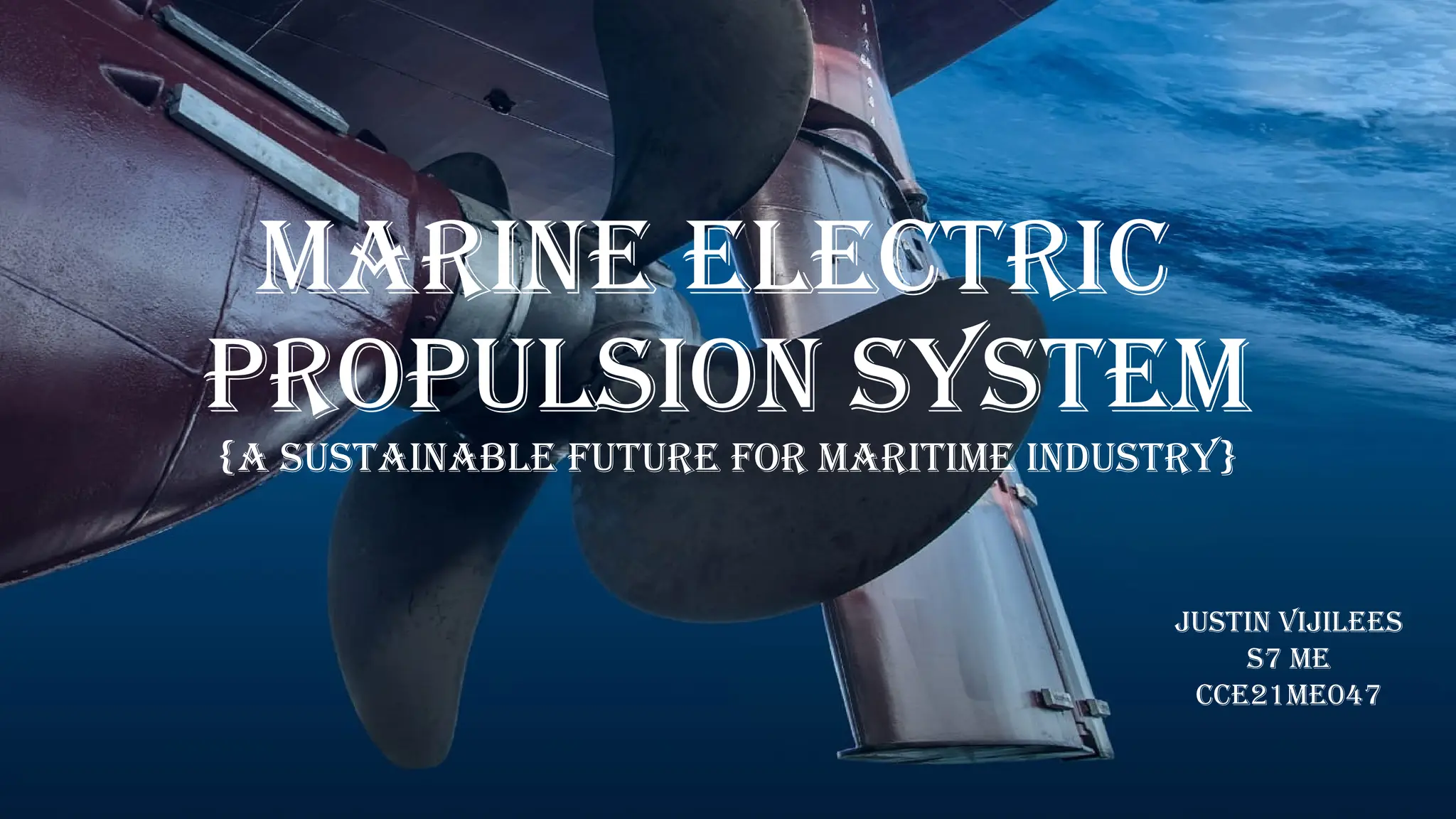
MARINE ELECTRIC
PROPULSION SYSTEM
{A SUSTAINABLE FUTURE FOR MARITIME INDUSTRY}
JUSTIN VIJILEES
S7 ME
CCE21ME047
WHAT DO YOU MEAN BY MARINE
PROPULSION SYSTEM ?
• A marine propulsion system is a machine or mechanism that
generates thrust to move a boat or ship through the water.
• The system converts energy into motion, allowing the vessel
to move.
• A propulsion system consists of three parts :-
-An energy source ( fuel energy, wind or solar power)
-An engine that transforms it to a mechanical form
-Propulsor or thrustor (pushes surrounding water
backwards)
WHY THIS TOPIC ?
 Environmental benefits
-Reduces emissions, noise and vibrations
 Energy efficiency
-Improved energy efficiency, fuel consumption
 Future oriented
-Sustainability, decarbonisation
Technological advancement
Different Propulsion Systems USED
1. Diesel Propulsion
-Uses diesel engines to turn propellers
-High power density, but noisy and emits pollutants
2. Gas Turbine Propulsion
-Employs gas turbines to generate power for propellers
-High power-to-weight ratio, expensive, low efficiency
3. Hybrid Propulsion
-Combines different power sources
-Reduced emissions, complex integration
4. Petrol Propulsion
-Uses petrol engines to turn propellers
- Lower upfront cost, higher fuel consumption, emits pollutants
5. Steam Turbine Propulsion
-Utilizes steam turbines to drive propellers
-High efficiency, high upfront cost
6. Sail Propulsion
-Harnesses wind energy using sails
-Zero emissions, dependent on wind conditions, requires skilled crew
7. Water Jet Propulsion
-Uses a pump to accelerate water, generating thrust
- High speed capability, noise and vibration
ELECTRIC PROPULSION SYSTEM
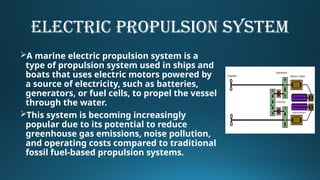
A marine electric propulsion system is a
type of propulsion system used in ships and
boats that uses electric motors powered by
a source of electricity, such as batteries,
generators, or fuel cells, to propel the vessel
through the water.
This system is becoming increasingly
popular due to its potential to reduce
greenhouse gas emissions, noise pollution,
and operating costs compared to traditional
fossil fuel-based propulsion systems.
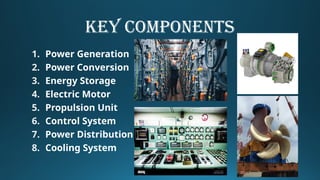
KEY COMPONENTS
1. Power Generation
2. Power Conversion
3. Energy Storage
4. Electric Motor
5. Propulsion Unit
6. Control System
7. Power Distribution
8. Cooling System
WORKING PRINCIPLE
• 1. Power generation: Diesel generators or gas
turbines produce electrical power.
• 2. Power conversion: Rectifiers and inverters
convert power to match motor requirements.
• 3. Energy storage: Batteries or supercapacitors
store excess energy.
• 4. Electric motor: Converts electrical energy into
mechanical energy.
WORKING PRINCIPLE
• 5. Propulsion unit: Converts mechanical energy
into thrust.
• 6. Control system: Monitors and controls MEP
system.
• 7. Power Distribution: Distributes power to motor
and other components.
• 8. Cooling system: Regulates temperature of
electrical components.
TYPES OF MARINE ELECTRIC
PROPULSION SYSTEM
1. Direct Current (DC) Systems-
- Used in small vessels, tugboats, and ferries
- Components: DC motor, battery, and controller
2. Alternating Current (AC) Systems-
- Used in larger vessels, cruise ships, and naval vessels
- Components: AC motor, transformer, rectifier, and inverter
3. Hybrid Electric Propulsion Systems-
-Combines diesel engine with electric motor
-Diesel engine, electric motor, battery& power conversion
system
4. Full Electric Propulsion Systems-
-Electric motor powered by battery or fuel cell
-Electric motor, battery or fuel cell, and power conversion
system
5. Diesel-Electric Propulsion Systems-
-Diesel engine generates electricity for electric motor
-Diesel engine, generator, electric motor & power conversion
system
6. Nuclear Electric Propulsion Systems-
-Nuclear reactor generates electricity for electric motor
- Nuclear reactor, electric motor, and power conversion system
7. Solar Electric Propulsion Systems-
-Solar panels generate electricity for electric motor
- Solar panels, electric motor, battery, and power conversion
system
8. Wind-Assisted Electric Propulsion Systems-
-Wind turbines generate electricity for electric motor
-Wind turbines, electric motor, battery & power conversion
system
9. Hydrogen Fuel Cell Electric Propulsion Systems-
-Hydrogen fuel cells generate electricity for electric motor
-Hydrogen fuel cells, electric motor, and power conversion
system
FUTURE DEVELOPMENT
1. Advanced batteries
2. Fuel cells
3. Hybrid propulsion
4. Renewable energy integration
ADVANTAGES OVER TRADITIONAL
PROPULSION SYSTEM
1. High Efficiency: Electric propulsion systems have higher efficiency
(~60-80%) compared to traditional fossil fuel-based systems (~30-
40%).
2. Low Emissions: Electric propulsion produces zero emissions, reducing
environmental impact and meeting increasingly stringent regulations.
3. Smooth Operation: Electric motors provide smooth, quiet operation,
improving crew comfort and reducing noise pollution.
4. Reduced Maintenance: Electric propulsion systems have fewer
moving parts, reducing maintenance requirements and increasing
reliability.
5. Increased Flexibility: Electric propulsion allows for flexible power
distribution, enabling easier integration of renewable energy sources.
ADVANTAGES OVER TRADITIONAL
PROPULSION SYSTEM
6. Improved Maneuverability: Electric propulsion systems offer precise
control, enhancing vessel maneuverability and station-keeping
capabilities.
7. Reduced Fuel Consumption: Electric propulsion can optimize fuel
consumption, reducing operating costs and dependence on fossil fuels.
8. Scalability: Electric propulsion systems can be scaled for various
vessel sizes and applications.
9. Integration with Renewable Energy: Electric propulsion can be
combined with renewable energy sources (e.g., solar, wind, or hydro
power) for a more sustainable solution.
10. Future-Proof: Electric propulsion positions vessels for future
regulatory requirements and emerging technologies, such as hydrogen
fuel cells or advanced batteries.
LIMITATIONS
1. High Upfront Costs: Initial investment in electric propulsion
systems is higher.
2. Limited Range: Battery capacity limits range and endurance.
3. Charging Time: Longer charging times compared to refueling.
4. Weight: Battery weight affects vessel stability and cargo capacity.
5. Complexity: Requires specialized knowledge for maintenance and
repair.
6. Scalability: Currently limited to smaller vessels or low-power
applications.
7. Infrastructure: Limited charging infrastructure for marine vessels.
8. Safety Concerns: Electrical safety and shock risks
APPLICATIONS
 Ferries
 Offshore supply vessels
 Tugboats
 Fishing vessels
 Luxury yachts
 Naval vessels
 Cruise ships
LITERATURES REFERED
• Potentials and limitations of battery-electric container
ship propulsion systems (Lukas Kistner a, Astrid Bensmann a,
Richard Hanke-Rauschenbach a):-Battery-electric propulsion is
viable for ships with passages under 2,500 km, becoming
economically competitive with diesel engines when factoring
in carbon taxes and future battery advancements.
• Zero-emission propulsion system featuring, Flettner
rotors, batteries and fuel cells, for a merchant ship (Fabian
Thies, Hua-Dong Yao, Jonas W. Ringsberg):-A hybrid hydrogen-
wind-powered propulsion system is proposed to achieve zero-
emission shipping by 2050, retrofitted to existing merchant
ships, combining fuel cells, batteries, and Flettner rotors.
• Comparative analysis and test bench validation of energy
management methods for a hybrid marine propulsion
system powered by batteries and solid oxide fuel cells(Hiba
Youssfi a, Rehan Ahmad Khan a, Santiago Salas Ventura d):-A
hybrid propulsion system powered by fuel cells and batteries,
optimized with machine-learning-based energy management ,
reduces hydrogen consumption by 10% and increases battery
lifespan by 6% compared to conventional methods.
• Live-Life cycle assessment of the electric propulsion ship
using solar PV(Chybyung Park a, Byongug Jeong a, Peilin Zhou
a b, Hayoung Jang a, Seongwan Kim c):-Live-Life Cycle
Assessment, a novel simulation-based methodology, to
evaluate solar-electric propulsion ships' environmental impact,
revealing significant correlations with climate parameters and
national power production methods.
SUMMARY
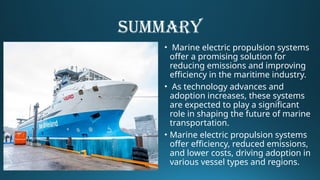
• Marine electric propulsion systems
offer a promising solution for
reducing emissions and improving
efficiency in the maritime industry.
• As technology advances and
adoption increases, these systems
are expected to play a significant
role in shaping the future of marine
transportation.
• Marine electric propulsion systems
offer efficiency, reduced emissions,
and lower costs, driving adoption in
various vessel types and regions.
MARINE ELECTRIC seminar topic for engineers.pptx

MARINE ELECTRIC seminar topic for engineers.pptx

  • 1.
    MARINE ELECTRIC PROPULSION SYSTEM {ASUSTAINABLE FUTURE FOR MARITIME INDUSTRY} JUSTIN VIJILEES S7 ME CCE21ME047
  • 2.
    WHAT DO YOUMEAN BY MARINE PROPULSION SYSTEM ? • A marine propulsion system is a machine or mechanism that generates thrust to move a boat or ship through the water. • The system converts energy into motion, allowing the vessel to move. • A propulsion system consists of three parts :- -An energy source ( fuel energy, wind or solar power) -An engine that transforms it to a mechanical form -Propulsor or thrustor (pushes surrounding water backwards)
  • 3.
    WHY THIS TOPIC?  Environmental benefits -Reduces emissions, noise and vibrations  Energy efficiency -Improved energy efficiency, fuel consumption  Future oriented -Sustainability, decarbonisation Technological advancement
  • 4.
    Different Propulsion SystemsUSED 1. Diesel Propulsion -Uses diesel engines to turn propellers -High power density, but noisy and emits pollutants 2. Gas Turbine Propulsion -Employs gas turbines to generate power for propellers -High power-to-weight ratio, expensive, low efficiency 3. Hybrid Propulsion -Combines different power sources -Reduced emissions, complex integration
  • 5.
    4. Petrol Propulsion -Usespetrol engines to turn propellers - Lower upfront cost, higher fuel consumption, emits pollutants 5. Steam Turbine Propulsion -Utilizes steam turbines to drive propellers -High efficiency, high upfront cost 6. Sail Propulsion -Harnesses wind energy using sails -Zero emissions, dependent on wind conditions, requires skilled crew 7. Water Jet Propulsion -Uses a pump to accelerate water, generating thrust - High speed capability, noise and vibration
  • 6.
    ELECTRIC PROPULSION SYSTEM Amarine electric propulsion system is a type of propulsion system used in ships and boats that uses electric motors powered by a source of electricity, such as batteries, generators, or fuel cells, to propel the vessel through the water. This system is becoming increasingly popular due to its potential to reduce greenhouse gas emissions, noise pollution, and operating costs compared to traditional fossil fuel-based propulsion systems.
  • 7.
    KEY COMPONENTS 1. PowerGeneration 2. Power Conversion 3. Energy Storage 4. Electric Motor 5. Propulsion Unit 6. Control System 7. Power Distribution 8. Cooling System
  • 8.
    WORKING PRINCIPLE • 1.Power generation: Diesel generators or gas turbines produce electrical power. • 2. Power conversion: Rectifiers and inverters convert power to match motor requirements. • 3. Energy storage: Batteries or supercapacitors store excess energy. • 4. Electric motor: Converts electrical energy into mechanical energy.
  • 9.
    WORKING PRINCIPLE • 5.Propulsion unit: Converts mechanical energy into thrust. • 6. Control system: Monitors and controls MEP system. • 7. Power Distribution: Distributes power to motor and other components. • 8. Cooling system: Regulates temperature of electrical components.
  • 10.
    TYPES OF MARINEELECTRIC PROPULSION SYSTEM 1. Direct Current (DC) Systems- - Used in small vessels, tugboats, and ferries - Components: DC motor, battery, and controller 2. Alternating Current (AC) Systems- - Used in larger vessels, cruise ships, and naval vessels - Components: AC motor, transformer, rectifier, and inverter 3. Hybrid Electric Propulsion Systems- -Combines diesel engine with electric motor -Diesel engine, electric motor, battery& power conversion system
  • 11.
    4. Full ElectricPropulsion Systems- -Electric motor powered by battery or fuel cell -Electric motor, battery or fuel cell, and power conversion system 5. Diesel-Electric Propulsion Systems- -Diesel engine generates electricity for electric motor -Diesel engine, generator, electric motor & power conversion system 6. Nuclear Electric Propulsion Systems- -Nuclear reactor generates electricity for electric motor - Nuclear reactor, electric motor, and power conversion system
  • 12.
    7. Solar ElectricPropulsion Systems- -Solar panels generate electricity for electric motor - Solar panels, electric motor, battery, and power conversion system 8. Wind-Assisted Electric Propulsion Systems- -Wind turbines generate electricity for electric motor -Wind turbines, electric motor, battery & power conversion system 9. Hydrogen Fuel Cell Electric Propulsion Systems- -Hydrogen fuel cells generate electricity for electric motor -Hydrogen fuel cells, electric motor, and power conversion system
  • 13.
    FUTURE DEVELOPMENT 1. Advancedbatteries 2. Fuel cells 3. Hybrid propulsion 4. Renewable energy integration
  • 14.
    ADVANTAGES OVER TRADITIONAL PROPULSIONSYSTEM 1. High Efficiency: Electric propulsion systems have higher efficiency (~60-80%) compared to traditional fossil fuel-based systems (~30- 40%). 2. Low Emissions: Electric propulsion produces zero emissions, reducing environmental impact and meeting increasingly stringent regulations. 3. Smooth Operation: Electric motors provide smooth, quiet operation, improving crew comfort and reducing noise pollution. 4. Reduced Maintenance: Electric propulsion systems have fewer moving parts, reducing maintenance requirements and increasing reliability. 5. Increased Flexibility: Electric propulsion allows for flexible power distribution, enabling easier integration of renewable energy sources.
  • 15.
    ADVANTAGES OVER TRADITIONAL PROPULSIONSYSTEM 6. Improved Maneuverability: Electric propulsion systems offer precise control, enhancing vessel maneuverability and station-keeping capabilities. 7. Reduced Fuel Consumption: Electric propulsion can optimize fuel consumption, reducing operating costs and dependence on fossil fuels. 8. Scalability: Electric propulsion systems can be scaled for various vessel sizes and applications. 9. Integration with Renewable Energy: Electric propulsion can be combined with renewable energy sources (e.g., solar, wind, or hydro power) for a more sustainable solution. 10. Future-Proof: Electric propulsion positions vessels for future regulatory requirements and emerging technologies, such as hydrogen fuel cells or advanced batteries.
  • 16.
    LIMITATIONS 1. High UpfrontCosts: Initial investment in electric propulsion systems is higher. 2. Limited Range: Battery capacity limits range and endurance. 3. Charging Time: Longer charging times compared to refueling. 4. Weight: Battery weight affects vessel stability and cargo capacity. 5. Complexity: Requires specialized knowledge for maintenance and repair. 6. Scalability: Currently limited to smaller vessels or low-power applications. 7. Infrastructure: Limited charging infrastructure for marine vessels. 8. Safety Concerns: Electrical safety and shock risks
  • 17.
    APPLICATIONS  Ferries  Offshoresupply vessels  Tugboats  Fishing vessels  Luxury yachts  Naval vessels  Cruise ships
  • 18.
    LITERATURES REFERED • Potentialsand limitations of battery-electric container ship propulsion systems (Lukas Kistner a, Astrid Bensmann a, Richard Hanke-Rauschenbach a):-Battery-electric propulsion is viable for ships with passages under 2,500 km, becoming economically competitive with diesel engines when factoring in carbon taxes and future battery advancements. • Zero-emission propulsion system featuring, Flettner rotors, batteries and fuel cells, for a merchant ship (Fabian Thies, Hua-Dong Yao, Jonas W. Ringsberg):-A hybrid hydrogen- wind-powered propulsion system is proposed to achieve zero- emission shipping by 2050, retrofitted to existing merchant ships, combining fuel cells, batteries, and Flettner rotors.
  • 19.
    • Comparative analysisand test bench validation of energy management methods for a hybrid marine propulsion system powered by batteries and solid oxide fuel cells(Hiba Youssfi a, Rehan Ahmad Khan a, Santiago Salas Ventura d):-A hybrid propulsion system powered by fuel cells and batteries, optimized with machine-learning-based energy management , reduces hydrogen consumption by 10% and increases battery lifespan by 6% compared to conventional methods. • Live-Life cycle assessment of the electric propulsion ship using solar PV(Chybyung Park a, Byongug Jeong a, Peilin Zhou a b, Hayoung Jang a, Seongwan Kim c):-Live-Life Cycle Assessment, a novel simulation-based methodology, to evaluate solar-electric propulsion ships' environmental impact, revealing significant correlations with climate parameters and national power production methods.
  • 20.
    SUMMARY • Marine electricpropulsion systems offer a promising solution for reducing emissions and improving efficiency in the maritime industry. • As technology advances and adoption increases, these systems are expected to play a significant role in shaping the future of marine transportation. • Marine electric propulsion systems offer efficiency, reduced emissions, and lower costs, driving adoption in various vessel types and regions.