2-Propulsive Power
• 2.1 Components of Propulsive Power
• During the course of designing a ship it is necessary to
estimate the power required to propel the ship at a
particular speed. This allows estimates to be made of:
• (a) Machinery masses, which are a function of the installed
power, and
• (b) The expected fuel consumption and tank capacities.
• The power estimate for a new design is obtained by
comparison with an existing similar vessel or from model
tests.
• In either case it is necessary to derive a power estimate for
one size of craft from the power requirement of a different
size of craft.
• That is, it is necessary to be able to scale powering
estimates.
• The different components of the powering problem scale in
different ways and it is therefore necessary to estimate each
component separately and apply the correct scaling laws to
each.
•One fundamental division in conventional
powering methods is to distinguish between the
effective power required to drive the ship and
the power delivered to the propulsion unit(s).
•The power delivered to the propulsion unit
exceeds the effective power by virtue of the
efficiency of the propulsion unit being less than
100%.
•Ship power predictions are made either by
•(1) Model experiments and extrapolation, or
•(2) Use of standard series data (hull resistance
series and propeller series), or
•(3) Theoretical (e.g. components of resistance
and propeller design).
•(4) A mixture of (1) and (2) or (1), (2) and (3).
Propulsion Systems
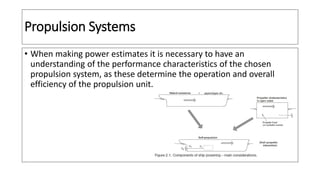
• When making power estimates it is necessary to have an
understanding of the performance characteristics of the chosen
propulsion system, as these determine the operation and overall
efficiency of the propulsion unit.
• A fundamental requirement of any ship propulsion system is the
efficient conversion of the power (P) available from the main
propulsion engine(s) [prime mover] into useful thrust (T) to propel
the ship at the required speed (V),
• There are several forms of main propulsion engines including:
• Diesel.
• Gas turbine.
• Steam turbine.
• Electric.
• (And variants / combinations of these).
• Various propulsors (generally variants of a propeller) which
convert the power into useful thrust, including:
• Propeller, fixed pitch (FP).
• Propeller, controllable pitch (CP).
• Ducted propeller.
• Waterjet.
• Azimuthing podded units.
• (And variants of these).
• Each type of propulsion engine and propulsor has its
own advantages and disadvantages, and applications
and limitations, including such fundamental attributes
as size, cost and efficiency.
• All of the these propulsion options are in current use
and the choice of a particular propulsion engine and
propulsor will depend on the ship type and its design
and operational requirements.
• Propulsors and propulsion machinery are described in
Chapters 11 and 13.
• Each type of propulsion engine and propulsor has its own advantages and
disadvantages, and applications and limitations, including such fundamental
attributes as size, cost and efficiency.
• All of the these propulsion options are in current use and the choice of a
particular propulsion engine and propulsor will depend on the ship type and its
design and operational requirements.
• Propulsors and propulsion machinery are described in Chapters 11 and 13.
• The overall assessment of the marine propulsion system for a
particular vessel will therefore require:
• (1) A knowledge of the required thrust (T) at a speed (V), and its
conversion into required power (P),
• (2) A knowledge and assessment of the physical properties and
efficiencies of the available propulsion engines,
• (3) The assessment of the various propulsors and engine-propulsor
layouts.
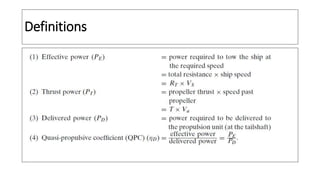
Definitions
• .
• .
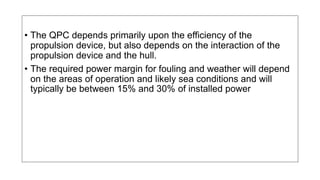
• The QPC depends primarily upon the efficiency of the
propulsion device, but also depends on the interaction of the
propulsion device and the hull.
• The required power margin for fouling and weather will depend
on the areas of operation and likely sea conditions and will
typically be between 15% and 30% of installed power
• .
• .
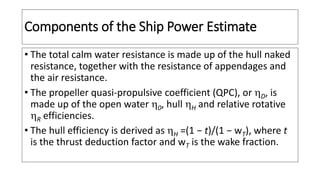
Components of the Ship Power Estimate
• The total calm water resistance is made up of the hull naked
resistance, together with the resistance of appendages and
the air resistance.
• The propeller quasi-propulsive coefficient (QPC), or D, is
made up of the open water 0, hull H and relative rotative
R efficiencies.
• The hull efficiency is derived as H =(1 − t)/(1 − wT), where t
is the thrust deduction factor and wT is the wake fraction.
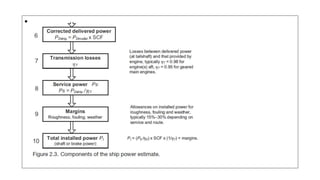
• For clarity, the model-ship correlation allowance is included as a
single-ship correlation factor, SCF, applied to the overall delivered
power.
• Transmission losses, T, between the engine and tailshaft/propeller are
typically about T = 0.98 for direct drive engines aft, and T = 0.95 for
transmission via a gearbox.
• The margins in stage 9 account for the increase in resistance, hence
power, due to roughness, fouling and weather.
• They are derived in a scientific manner for the purpose of installing
propulsion machinery with an adequate reserve of power.
• The total installed power, PI, will typically relate to the MCR
(maximum continuous rating) or CSR (continuous service rating) of
the main propulsion engine, depending on the practice of the ship
operator.
propeller detail main engine
D(m) = 4.000 Pm(kW) = 1750 1750
Ratio= 7.200 Nm(RPM)= 900
Np(RPM)= 125 DUCTED PROPELLER
Vs Pe Pd Pbmin N Nmak
(knots) (kWs) (kWs) (kWs) (RPM) (RPM)
10.0 585 0.279 0.248 1.044 0.624 1.015 0.661 885 917 107 768
10.5 688 0.279 0.248 1.044 0.624 1.015 0.661 1041 1079 113 811
11.0 809 0.279 0.248 1.044 0.623 1.015 0.660 1226 1270 119 855
11.5 950 0.279 0.248 1.044 0.622 1.015 0.659 1442 1494 125 900
12.0 1114 0.279 0.248 1.044 0.620 1.015 0.657 1696 1758 132 948
12.5 1307 0.279 0.248 1.043 0.618 1.015 0.655 1997 2069 139 998
Not: %100 MCR ve deniz marjini olmaksızın asgari makina gücü Pbmin; h tr = 0.965 olarak hesaplanmıştır.
wt t H 0 r d
0
500
1000
1500
2000
2500
3000
3500
4000
7.0 8.0 9.0 10.011.012.013.014.015.0
Power
[kW]
Speed [knots]
Pe
Pbmin
Application for determining the speed
achieved under margins
Engine Margin = 85%
Sea Margin = %10
Shaft&RG Loss = %4.5
Shaft Generator – SG - Ppto = 75 kW

2-Propulsive Power.pptx

  • 1.
    2-Propulsive Power • 2.1Components of Propulsive Power • During the course of designing a ship it is necessary to estimate the power required to propel the ship at a particular speed. This allows estimates to be made of: • (a) Machinery masses, which are a function of the installed power, and • (b) The expected fuel consumption and tank capacities.
  • 2.
    • The powerestimate for a new design is obtained by comparison with an existing similar vessel or from model tests. • In either case it is necessary to derive a power estimate for one size of craft from the power requirement of a different size of craft. • That is, it is necessary to be able to scale powering estimates. • The different components of the powering problem scale in different ways and it is therefore necessary to estimate each component separately and apply the correct scaling laws to each.
  • 3.
    •One fundamental divisionin conventional powering methods is to distinguish between the effective power required to drive the ship and the power delivered to the propulsion unit(s). •The power delivered to the propulsion unit exceeds the effective power by virtue of the efficiency of the propulsion unit being less than 100%.
  • 4.
    •Ship power predictionsare made either by •(1) Model experiments and extrapolation, or •(2) Use of standard series data (hull resistance series and propeller series), or •(3) Theoretical (e.g. components of resistance and propeller design). •(4) A mixture of (1) and (2) or (1), (2) and (3).
  • 5.
    Propulsion Systems • Whenmaking power estimates it is necessary to have an understanding of the performance characteristics of the chosen propulsion system, as these determine the operation and overall efficiency of the propulsion unit.
  • 6.
    • A fundamentalrequirement of any ship propulsion system is the efficient conversion of the power (P) available from the main propulsion engine(s) [prime mover] into useful thrust (T) to propel the ship at the required speed (V), • There are several forms of main propulsion engines including: • Diesel. • Gas turbine. • Steam turbine. • Electric. • (And variants / combinations of these).
  • 7.
    • Various propulsors(generally variants of a propeller) which convert the power into useful thrust, including: • Propeller, fixed pitch (FP). • Propeller, controllable pitch (CP). • Ducted propeller. • Waterjet. • Azimuthing podded units. • (And variants of these).
  • 8.
    • Each typeof propulsion engine and propulsor has its own advantages and disadvantages, and applications and limitations, including such fundamental attributes as size, cost and efficiency. • All of the these propulsion options are in current use and the choice of a particular propulsion engine and propulsor will depend on the ship type and its design and operational requirements. • Propulsors and propulsion machinery are described in Chapters 11 and 13.
  • 9.
    • Each typeof propulsion engine and propulsor has its own advantages and disadvantages, and applications and limitations, including such fundamental attributes as size, cost and efficiency. • All of the these propulsion options are in current use and the choice of a particular propulsion engine and propulsor will depend on the ship type and its design and operational requirements. • Propulsors and propulsion machinery are described in Chapters 11 and 13.
  • 10.
    • The overallassessment of the marine propulsion system for a particular vessel will therefore require: • (1) A knowledge of the required thrust (T) at a speed (V), and its conversion into required power (P), • (2) A knowledge and assessment of the physical properties and efficiencies of the available propulsion engines, • (3) The assessment of the various propulsors and engine-propulsor layouts.
  • 11.
  • 12.
  • 13.
    • The QPCdepends primarily upon the efficiency of the propulsion device, but also depends on the interaction of the propulsion device and the hull. • The required power margin for fouling and weather will depend on the areas of operation and likely sea conditions and will typically be between 15% and 30% of installed power
  • 14.
  • 15.
  • 16.
    Components of theShip Power Estimate • The total calm water resistance is made up of the hull naked resistance, together with the resistance of appendages and the air resistance. • The propeller quasi-propulsive coefficient (QPC), or D, is made up of the open water 0, hull H and relative rotative R efficiencies. • The hull efficiency is derived as H =(1 − t)/(1 − wT), where t is the thrust deduction factor and wT is the wake fraction.
  • 17.
    • For clarity,the model-ship correlation allowance is included as a single-ship correlation factor, SCF, applied to the overall delivered power. • Transmission losses, T, between the engine and tailshaft/propeller are typically about T = 0.98 for direct drive engines aft, and T = 0.95 for transmission via a gearbox. • The margins in stage 9 account for the increase in resistance, hence power, due to roughness, fouling and weather. • They are derived in a scientific manner for the purpose of installing propulsion machinery with an adequate reserve of power. • The total installed power, PI, will typically relate to the MCR (maximum continuous rating) or CSR (continuous service rating) of the main propulsion engine, depending on the practice of the ship operator.
  • 18.
    propeller detail mainengine D(m) = 4.000 Pm(kW) = 1750 1750 Ratio= 7.200 Nm(RPM)= 900 Np(RPM)= 125 DUCTED PROPELLER Vs Pe Pd Pbmin N Nmak (knots) (kWs) (kWs) (kWs) (RPM) (RPM) 10.0 585 0.279 0.248 1.044 0.624 1.015 0.661 885 917 107 768 10.5 688 0.279 0.248 1.044 0.624 1.015 0.661 1041 1079 113 811 11.0 809 0.279 0.248 1.044 0.623 1.015 0.660 1226 1270 119 855 11.5 950 0.279 0.248 1.044 0.622 1.015 0.659 1442 1494 125 900 12.0 1114 0.279 0.248 1.044 0.620 1.015 0.657 1696 1758 132 948 12.5 1307 0.279 0.248 1.043 0.618 1.015 0.655 1997 2069 139 998 Not: %100 MCR ve deniz marjini olmaksızın asgari makina gücü Pbmin; h tr = 0.965 olarak hesaplanmıştır. wt t H 0 r d 0 500 1000 1500 2000 2500 3000 3500 4000 7.0 8.0 9.0 10.011.012.013.014.015.0 Power [kW] Speed [knots] Pe Pbmin
  • 19.
    Application for determiningthe speed achieved under margins Engine Margin = 85% Sea Margin = %10 Shaft&RG Loss = %4.5 Shaft Generator – SG - Ppto = 75 kW