Presentation Created by:
Harlee Morphis
Alena Johnston
Stephanie Rogers
Nicholas Dixon
Edited by:
Ayat Al-Sabban
Table of Contents
 Introduction
 Why is This Important?
 Types of Pollution:
 Oil Spills
 Land Runoff
 Marine Debris
 Noise
 Plastic
 How Can We Fix This?
Why Are Our Oceans Important?
 Release of certain chemicals help invasive plants grow in
abundance
 These plants are not safe to eat
 The plants consume so much oxygen that fish cannot safely
live in these “dead zones” (Erikson, et al.).
 Animals can be harmed from pollutants deposited into the oceans
 The more animals harmed, the more the natural ecosystems
change, and the effects could be disastrous
 Animals can die from pollutants
 “Tens of thousands of penguins die every year from oil
pollution that may occur when ships clean out their bilges,”
says Gary Miller, a consultant that was used during the
production of Happy Feet.
What About Us?
 The oceans serve as our natural oxygen tank
 If we didn’t have the oceans, more carbon would fill the earth’s
atmosphere, making it harder, or impossible, to breathe.
 The oceans are an important food source
 Approximately 16% of the human population depends on seafood
(MarineBio Conservation Society).
 The oceans are important to maintain a healthy economy (National
Ocean Policy Coalition)
 1 out of 6 jobs is marine-related in the USA (NOPC).
 Over 50% of Americans live within 50 miles of the ocean (NOPC).
 The ocean business racks up over $700 billion dollars in the USA, in
gross product. That’s over 1/3 of our national income! (NOPC).
Of course, there are various other pollutants that have been found in the ocean. Among them
are: degradable wastes composed of organic materials that can disintegrate, like agricultural
waste, food processing waste, chemical waste and oil spills, polluting fertilizers, dissipating
waste, like heat or acids, and conservative waste like metals or radioactive materials
(MacInnes and Kahler).
In this presentation we will be focusing on:
• Plastic
• Land Runoff
• Marine Debris
• Oil Spills
Plastic Pollution is defined as pollutants made of plastic that enter
the ocean. Possible entries are: landfill waste, beach litter, and fishing nets.
Marine litter is 60-80% plastic (Lytle).
Plastic can travel long distances and can cause
death to animals who mistake plastic for food.
Animals have been known to suffocate from
plastic waste. Abnormal development of marine
animals can occur when they are stuck in fishing
nets. Plastic chemicals from agricultural waste
enter the food chain, are eaten by zooplankton,
and are then consumed by people and animals
alike. Bisphenol A (BPA) plastic exposure
damages reproductive system of the animals, may
cause breast cancer in pregnant women, erectile
dysfunction and reduced sexual function in men
(Lytle).
- Alena Johnston
Turtle Caught in Plastic Ring. Digital
image. LiberationBC.org. 1 Sept. 2012. Web.
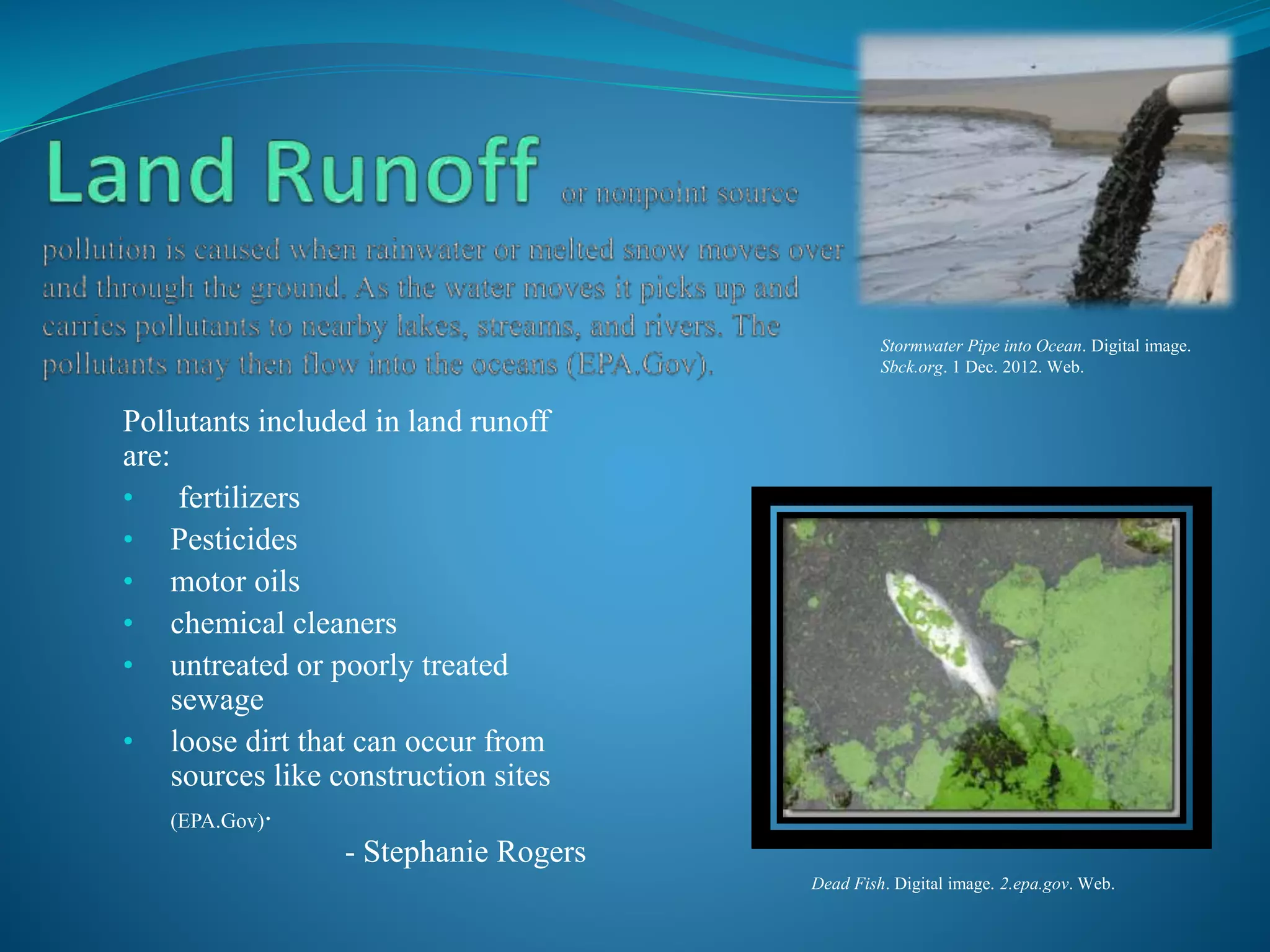
Pollutants included in land runoff
are:
• fertilizers
• Pesticides
• motor oils
• chemical cleaners
• untreated or poorly treated
sewage
• loose dirt that can occur from
sources like construction sites
(EPA.Gov).
- Stephanie Rogers
Stormwater Pipe into Ocean. Digital image.
Sbck.org. 1 Dec. 2012. Web.
Dead Fish. Digital image. 2.epa.gov. Web.
Marine Debris
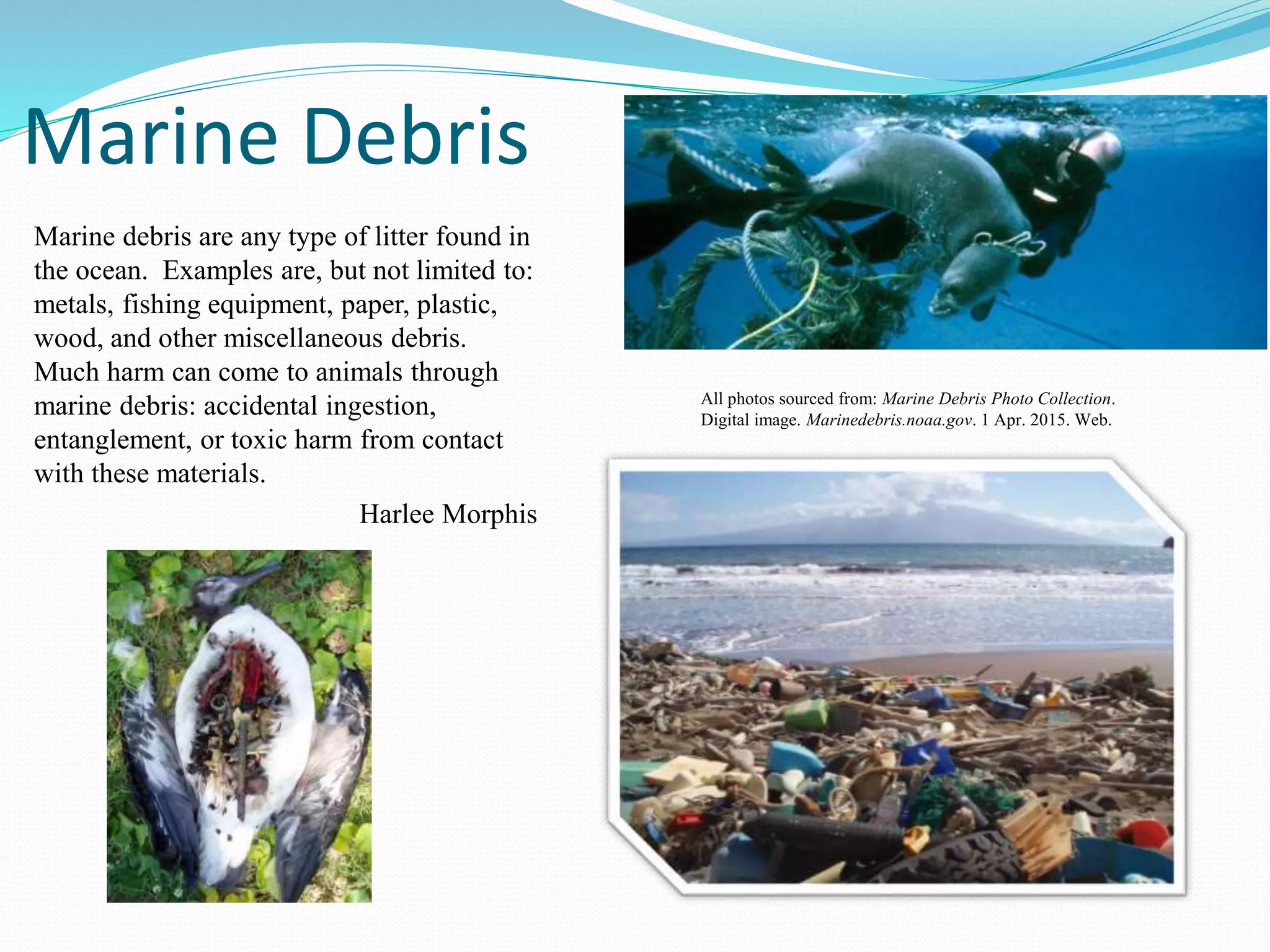
Marine debris are any type of litter found in
the ocean. Examples are, but not limited to:
metals, fishing equipment, paper, plastic,
wood, and other miscellaneous debris.
Much harm can come to animals through
marine debris: accidental ingestion,
entanglement, or toxic harm from contact
with these materials.
Harlee Morphis
All photos sourced from: Marine Debris Photo Collection.
Digital image. Marinedebris.noaa.gov. 1 Apr. 2015. Web.
Deadly Oil Spills
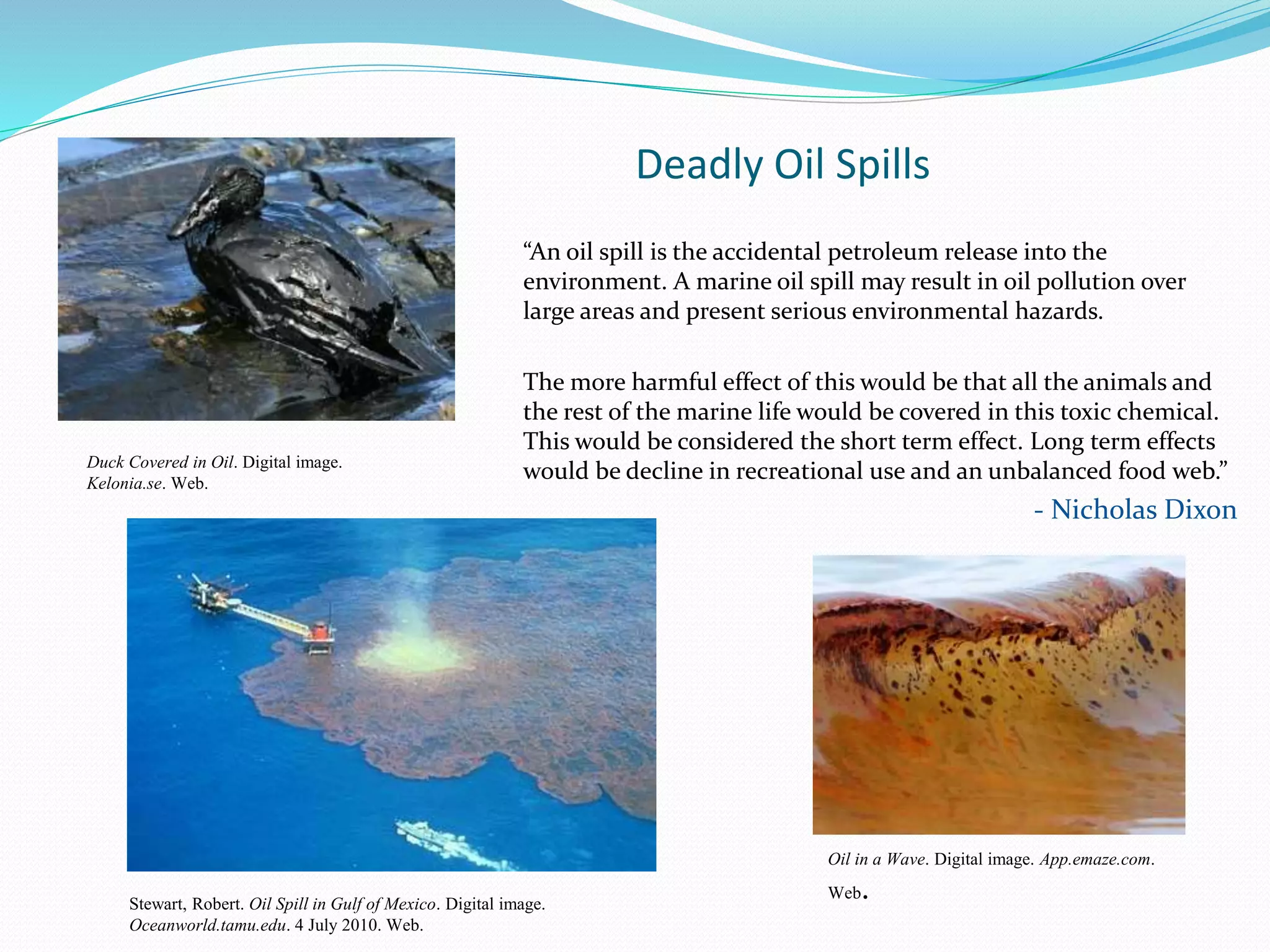
“An oil spill is the accidental petroleum release into the
environment. A marine oil spill may result in oil pollution over
large areas and present serious environmental hazards.
The more harmful effect of this would be that all the animals and
the rest of the marine life would be covered in this toxic chemical.
This would be considered the short term effect. Long term effects
would be decline in recreational use and an unbalanced food web.”
- Nicholas Dixon
Stewart, Robert. Oil Spill in Gulf of Mexico. Digital image.
Oceanworld.tamu.edu. 4 July 2010. Web.
Duck Covered in Oil. Digital image.
Kelonia.se. Web.
Oil in a Wave. Digital image. App.emaze.com.
Web.
Preventing Oil Pollution:
• Mandatory Equipment
Inspections
• Regulate Upgrades to
Equipment
Preventing Runoff Pollution:
• Use Fertilizers Less
• Clean up After Pets
• Properly Dispose of Waste
• Maintain Marine Vehicles Properly
Preventing Plastic Pollution:
• Use Less, Reuse, Recycle!
• More Recycling Facilities
• Invest in Education
• Voluntary Coastal Clean-Ups
Preventing Marine Debris:
• Recycle
• Voluntary Land and Coastal
Cleanups
To Conclude . . .
 As pollution continues to cast its net of harm, it is more
important than ever before to take our oceans health
seriously.
 There are many types of pollution, the main types being:
plastic, land runoff, marine debris, and oil spills.
 These problems can easily be avoided by taking the
solutions that have been suggested.
 Everyone plays a part in the world, make sure your part is
leaving the world a better, cleaner place, so that our
children can live in a safe environment for generations to
come.
Creators of Content and Leaders:
Alena Johnston
Stephanie Rogers
Nicholas Dixon
Harlee Morphis
Ayat Al-Sabban
Edited by: Ayat Al-Sabban
Sources
Eriksen M, Lebreton LCM, Carson HS, Thiel M, Moore CJ, et al. (2014) Plastic Pollution
In the World’s Oceans: More than 5 Trillion Plastic Pieces Weighing over 250,000
Tons Afloat at Sea. PLoS ONE 9(12): e111913. Doi:10.1371/journal.phone.0111913
MarineBio Conservation Society. Ocean Resources – MarineBio.Org. 2015. MarineBio
Conservation Society. Web. 21 Apr. 2015.
"Oceans Impact the Economy." Oceans Impact the Economy. National Ocean Policy
Coalition. Web. 27 Apr. 2015.
MacInnes, David F., Jr., and Karen N. Kahler. “Ocean Pollution.” Salem Press
Encyclopedia (2015): Research Starters. Web. 21 Apr. 2015.
Lytle, Claire Le Guern. "Plastic Pollution." Plastic Pollution. Coastal Care. Web. 27 Apr. 2015.
“Coastal Watershed Factsheets – Oceans and Coastal Protection: Your Coastal Watershed.”
Water: Oceans, Coasts, Estuaries, and Beaches. EPA.Gov. 2 Oct. 2012. Web. 22 April 2015.

Ocean Pollution - ENGL 1020

  • 1.
    Presentation Created by: HarleeMorphis Alena Johnston Stephanie Rogers Nicholas Dixon Edited by: Ayat Al-Sabban
  • 2.
    Table of Contents Introduction  Why is This Important?  Types of Pollution:  Oil Spills  Land Runoff  Marine Debris  Noise  Plastic  How Can We Fix This?
  • 3.
    Why Are OurOceans Important?  Release of certain chemicals help invasive plants grow in abundance  These plants are not safe to eat  The plants consume so much oxygen that fish cannot safely live in these “dead zones” (Erikson, et al.).  Animals can be harmed from pollutants deposited into the oceans  The more animals harmed, the more the natural ecosystems change, and the effects could be disastrous  Animals can die from pollutants  “Tens of thousands of penguins die every year from oil pollution that may occur when ships clean out their bilges,” says Gary Miller, a consultant that was used during the production of Happy Feet.
  • 4.
    What About Us? The oceans serve as our natural oxygen tank  If we didn’t have the oceans, more carbon would fill the earth’s atmosphere, making it harder, or impossible, to breathe.  The oceans are an important food source  Approximately 16% of the human population depends on seafood (MarineBio Conservation Society).  The oceans are important to maintain a healthy economy (National Ocean Policy Coalition)  1 out of 6 jobs is marine-related in the USA (NOPC).  Over 50% of Americans live within 50 miles of the ocean (NOPC).  The ocean business racks up over $700 billion dollars in the USA, in gross product. That’s over 1/3 of our national income! (NOPC).
  • 5.
    Of course, thereare various other pollutants that have been found in the ocean. Among them are: degradable wastes composed of organic materials that can disintegrate, like agricultural waste, food processing waste, chemical waste and oil spills, polluting fertilizers, dissipating waste, like heat or acids, and conservative waste like metals or radioactive materials (MacInnes and Kahler). In this presentation we will be focusing on: • Plastic • Land Runoff • Marine Debris • Oil Spills
  • 6.
    Plastic Pollution isdefined as pollutants made of plastic that enter the ocean. Possible entries are: landfill waste, beach litter, and fishing nets. Marine litter is 60-80% plastic (Lytle). Plastic can travel long distances and can cause death to animals who mistake plastic for food. Animals have been known to suffocate from plastic waste. Abnormal development of marine animals can occur when they are stuck in fishing nets. Plastic chemicals from agricultural waste enter the food chain, are eaten by zooplankton, and are then consumed by people and animals alike. Bisphenol A (BPA) plastic exposure damages reproductive system of the animals, may cause breast cancer in pregnant women, erectile dysfunction and reduced sexual function in men (Lytle). - Alena Johnston Turtle Caught in Plastic Ring. Digital image. LiberationBC.org. 1 Sept. 2012. Web.
  • 7.
    Pollutants included inland runoff are: • fertilizers • Pesticides • motor oils • chemical cleaners • untreated or poorly treated sewage • loose dirt that can occur from sources like construction sites (EPA.Gov). - Stephanie Rogers Stormwater Pipe into Ocean. Digital image. Sbck.org. 1 Dec. 2012. Web. Dead Fish. Digital image. 2.epa.gov. Web.
  • 8.
    Marine Debris Marine debrisare any type of litter found in the ocean. Examples are, but not limited to: metals, fishing equipment, paper, plastic, wood, and other miscellaneous debris. Much harm can come to animals through marine debris: accidental ingestion, entanglement, or toxic harm from contact with these materials. Harlee Morphis All photos sourced from: Marine Debris Photo Collection. Digital image. Marinedebris.noaa.gov. 1 Apr. 2015. Web.
  • 9.
    Deadly Oil Spills “Anoil spill is the accidental petroleum release into the environment. A marine oil spill may result in oil pollution over large areas and present serious environmental hazards. The more harmful effect of this would be that all the animals and the rest of the marine life would be covered in this toxic chemical. This would be considered the short term effect. Long term effects would be decline in recreational use and an unbalanced food web.” - Nicholas Dixon Stewart, Robert. Oil Spill in Gulf of Mexico. Digital image. Oceanworld.tamu.edu. 4 July 2010. Web. Duck Covered in Oil. Digital image. Kelonia.se. Web. Oil in a Wave. Digital image. App.emaze.com. Web.
  • 10.
    Preventing Oil Pollution: •Mandatory Equipment Inspections • Regulate Upgrades to Equipment Preventing Runoff Pollution: • Use Fertilizers Less • Clean up After Pets • Properly Dispose of Waste • Maintain Marine Vehicles Properly Preventing Plastic Pollution: • Use Less, Reuse, Recycle! • More Recycling Facilities • Invest in Education • Voluntary Coastal Clean-Ups Preventing Marine Debris: • Recycle • Voluntary Land and Coastal Cleanups
  • 11.
    To Conclude .. .  As pollution continues to cast its net of harm, it is more important than ever before to take our oceans health seriously.  There are many types of pollution, the main types being: plastic, land runoff, marine debris, and oil spills.  These problems can easily be avoided by taking the solutions that have been suggested.  Everyone plays a part in the world, make sure your part is leaving the world a better, cleaner place, so that our children can live in a safe environment for generations to come.
  • 12.
    Creators of Contentand Leaders: Alena Johnston Stephanie Rogers Nicholas Dixon Harlee Morphis Ayat Al-Sabban Edited by: Ayat Al-Sabban
  • 13.
    Sources Eriksen M, LebretonLCM, Carson HS, Thiel M, Moore CJ, et al. (2014) Plastic Pollution In the World’s Oceans: More than 5 Trillion Plastic Pieces Weighing over 250,000 Tons Afloat at Sea. PLoS ONE 9(12): e111913. Doi:10.1371/journal.phone.0111913 MarineBio Conservation Society. Ocean Resources – MarineBio.Org. 2015. MarineBio Conservation Society. Web. 21 Apr. 2015. "Oceans Impact the Economy." Oceans Impact the Economy. National Ocean Policy Coalition. Web. 27 Apr. 2015. MacInnes, David F., Jr., and Karen N. Kahler. “Ocean Pollution.” Salem Press Encyclopedia (2015): Research Starters. Web. 21 Apr. 2015. Lytle, Claire Le Guern. "Plastic Pollution." Plastic Pollution. Coastal Care. Web. 27 Apr. 2015. “Coastal Watershed Factsheets – Oceans and Coastal Protection: Your Coastal Watershed.” Water: Oceans, Coasts, Estuaries, and Beaches. EPA.Gov. 2 Oct. 2012. Web. 22 April 2015.