
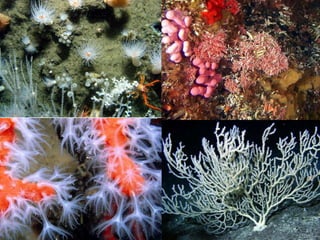
Overfishing
Impacts and Management
Causes for Marine Fishery Declines
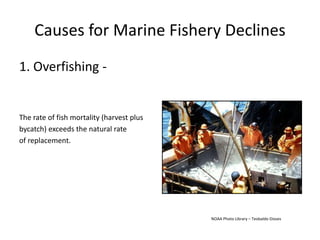
1. Overfishing -
The rate of fish mortality (harvest plus
bycatch) exceeds the natural rate
of replacement.
NOAA Photo Library – Teobaldo Dioses
Causes for Marine Fishery Declines
1. Overfishing
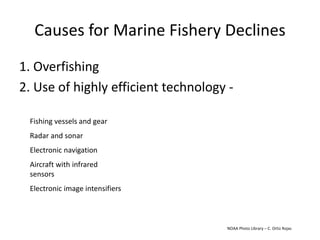
2. Use of highly efficient technology -
Fishing vessels and gear
Radar and sonar
Electronic navigation
Aircraft with infrared
sensors
Electronic image intensifiers
NOAA Photo Library – C. Ortiz Rojas
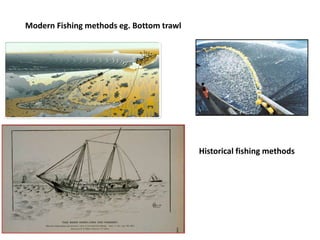
Modern Fishing methods eg. Bottom trawl
Historical fishing methods
Causes for Marine Fishery Declines
1. Overfishing
2. Highly efficient technology
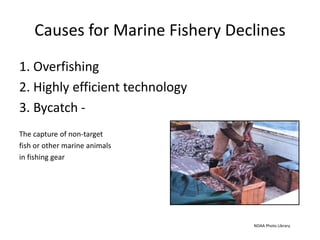
3. Bycatch -
The capture of non-target
fish or other marine animals
in fishing gear
NOAA Photo Library
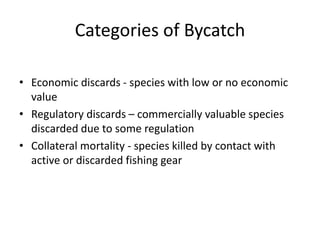
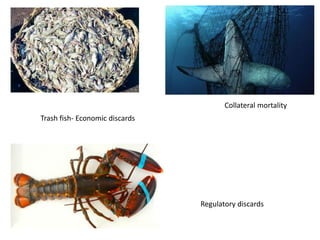
Categories of Bycatch
• Economic discards - species with low or no economic
value
• Regulatory discards – commercially valuable species
discarded due to some regulation
• Collateral mortality - species killed by contact with
active or discarded fishing gear
Collateral mortality
Trash fish- Economic discards
Regulatory discards
Causes for Marine Fishery Declines
1. Overfishing
2. Highly efficient technology
3. Bycatch
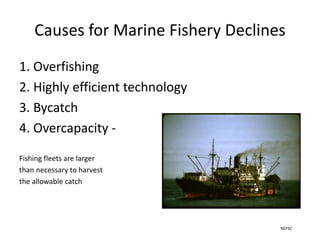
4. Overcapacity -
Fishing fleets are larger
than necessary to harvest
the allowable catch
NEFSC
Causes for Marine Fishery Declines
1. Overfishing
2. Highly efficient technology
3. Bycatch
4. Overcapacity
5. Global Warming
NEFSC
5. The Threat of Global Climate Change
Potential impacts on physical features of oceans:
• Sea surface temperatures
• Sea levels
• Ocean circulation patterns
• Salinity
• pH
Potential impacts on marine fish:
• Migration patterns
• Changes in reproductive patterns
• Food web effects
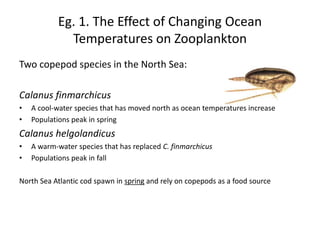
Eg. 1. The Effect of Changing Ocean
Temperatures on Zooplankton
Two copepod species in the North Sea:
Calanus finmarchicus
• A cool-water species that has moved north as ocean temperatures increase
• Populations peak in spring
Calanus helgolandicus
• A warm-water species that has replaced C. finmarchicus
• Populations peak in fall
North Sea Atlantic cod spawn in spring and rely on copepods as a food source
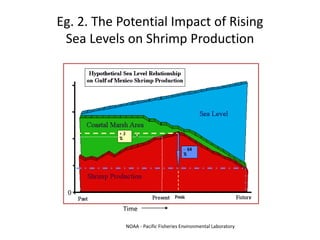
Eg. 2. The Potential Impact of Rising
Sea Levels on Shrimp Production
NOAA - Pacific Fisheries Environmental Laboratory
Time
Causes for Marine Fishery Declines
1. Overfishing
2. Highly efficient technology
3. Bycatch
4. Overcapacity
5. Global Warming
6. Recreational fishing
NEFSC
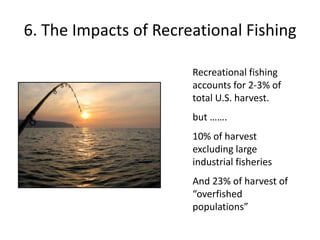
6. The Impacts of Recreational Fishing
Recreational fishing
accounts for 2-3% of
total U.S. harvest.
but …….
10% of harvest
excluding large
industrial fisheries
And 23% of harvest of
“overfished
populations”
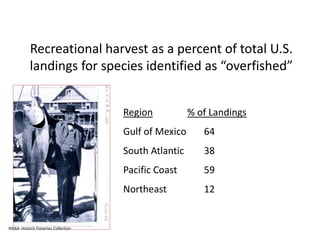
Recreational harvest as a percent of total U.S.
landings for species identified as “overfished”
Region % of Landings
Gulf of Mexico 64
South Atlantic 38
Pacific Coast 59
Northeast 12
NOAA Historic Fisheries Collection
Causes for Marine Fishery Declines
1. Overfishing
2. Highly efficient technology
3. Bycatch
4. Overcapacity
5. Global Warming
6. Recreational fishing
7. Fishing down the marine food webs
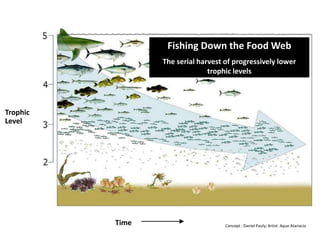
Fishing Down the Food Web
The serial harvest of progressively lower
trophic levels
Time
Trophic
Level
Concept : Daniel Pauly; Artist: Aque Atanacio
Causes for Marine Fishery Declines
1. Overfishing
2. Highly efficient technology
3. Bycatch
4. Overcapacity
5. Global Warming
6. Recreational fishing
7. Community and ecosystem-level impacts of
fishery declines
8. Habitat degradation by fishing gear
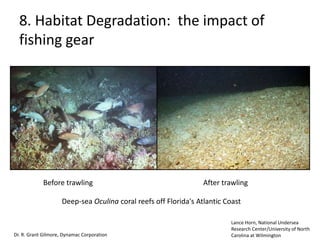
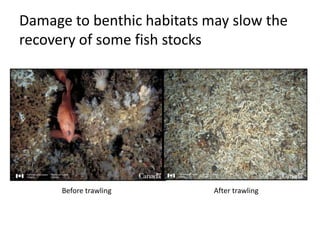
8. Habitat Degradation: the impact of
fishing gear
Dr. R. Grant Gilmore, Dynamac Corporation
Lance Horn, National Undersea
Research Center/University of North
Carolina at Wilmington
Before trawling After trawling
Deep-sea Oculina coral reefs off Florida's Atlantic Coast
Damage to benthic habitats may slow the
recovery of some fish stocks
Before trawling After trawling
Causes for Marine Fishery Declines
1. Overfishing
2. Highly efficient technology
3. Bycatch
4. Overcapacity
5. Global Warming
6. Recreational fishing
7. Community and ecosystem-level impacts of
fishery declines
8. Habitat degradation by fishing gear
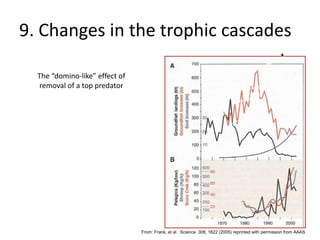
9. Changes in the trophic cascades
The “domino-like” effect of
removal of a top predator
Groundfish
biomass
Groundfish
Landings
Seal
biomass
From: Frank, et al. Science 308, 1622 (2005) reprinted with permission from AAAS
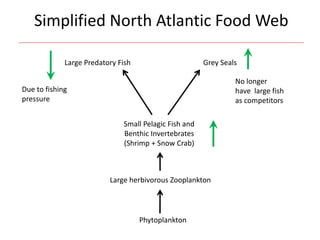
Simplified North Atlantic Food Web
Large Predatory Fish
Due to fishing
pressure
Small Pelagic Fish and
Benthic Invertebrates
(Shrimp + Snow Crab)
Grey Seals
No longer
have large fish
as competitors
Large herbivorous Zooplankton
Phytoplankton
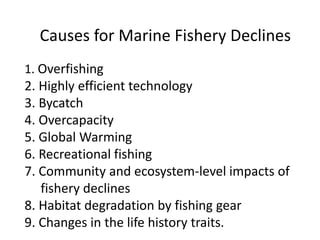
Causes for Marine Fishery Declines
1. Overfishing
2. Highly efficient technology
3. Bycatch
4. Overcapacity
5. Global Warming
6. Recreational fishing
7. Community and ecosystem-level impacts of
fishery declines
8. Habitat degradation by fishing gear
9. Changes in the life history traits.
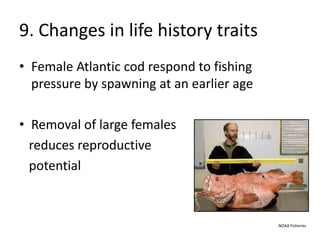
9. Changes in life history traits
• Female Atlantic cod respond to fishing
pressure by spawning at an earlier age
• Removal of large females
reduces reproductive
potential
NOAA Fisheries
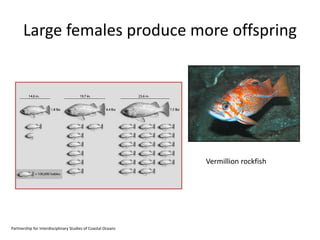
Large females produce more offspring
Vermillion rockfish
Partnership for Interdisciplinary Studies of Coastal Oceans
We know that the fishery in the
coastal zone declines.
What are the factors that accelerate
decline of marine fishery?
4 major factors
1. Government subsidies
2. Increasing demand
3. Shifting baselines
4. Lack of adequate fisheries data
1. Government Subsidies to Fisheries
• Extended unemployment benefits
• Direct payment
• Tax exemptions on fuel, fishing gear or vessels
• Low interest loans or grants
Subsidies encourage individuals and businesses to remain in the
industry when markets indicate otherwise
2. Increasing Demand for Fish Products
• Due to increases in both human population and per capita
consumption
• China’s consumption (in millions of tons):
1961 2003
3.2 25.4
• U.S. consumption increased 2.5X over the same time period
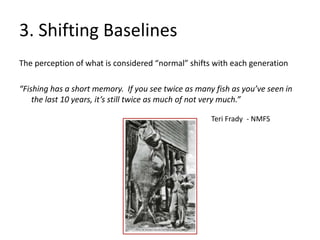
3. Shifting Baselines
The perception of what is considered “normal” shifts with each generation
“Fishing has a short memory. If you see twice as many fish as you’ve seen in
the last 10 years, it’s still twice as much of not very much.”
Teri Frady - NMFS
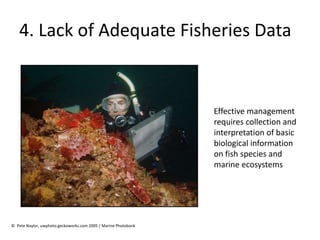
4. Lack of Adequate Fisheries Data
Effective management
requires collection and
interpretation of basic
biological information
on fish species and
marine ecosystems
© Pete Naylor, uwphoto.geckoworks.com 2005 / Marine Photobank
Summary
1. Overfishing is the primary cause of marine fishery declines
2. New technologies, bycatch and overcapacity contribute to fishery
declines
3. Global climate change poses an emerging threat
4. Fisheries declines have community- and ecosystem-level effects
5. Societal factors such as subsidies, increasing demand, shifting
baselines and the lack of fisheries data have allowed fishery
declines to occur.
• End of lecture

Overfishing

  • 1.
  • 2.
    Causes for MarineFishery Declines 1. Overfishing - The rate of fish mortality (harvest plus bycatch) exceeds the natural rate of replacement. NOAA Photo Library – Teobaldo Dioses
  • 3.
    Causes for MarineFishery Declines 1. Overfishing 2. Use of highly efficient technology - Fishing vessels and gear Radar and sonar Electronic navigation Aircraft with infrared sensors Electronic image intensifiers NOAA Photo Library – C. Ortiz Rojas
  • 4.
    Modern Fishing methodseg. Bottom trawl Historical fishing methods
  • 5.
    Causes for MarineFishery Declines 1. Overfishing 2. Highly efficient technology 3. Bycatch - The capture of non-target fish or other marine animals in fishing gear NOAA Photo Library
  • 6.
    Categories of Bycatch •Economic discards - species with low or no economic value • Regulatory discards – commercially valuable species discarded due to some regulation • Collateral mortality - species killed by contact with active or discarded fishing gear
  • 7.
    Collateral mortality Trash fish-Economic discards Regulatory discards
  • 8.
    Causes for MarineFishery Declines 1. Overfishing 2. Highly efficient technology 3. Bycatch 4. Overcapacity - Fishing fleets are larger than necessary to harvest the allowable catch NEFSC
  • 9.
    Causes for MarineFishery Declines 1. Overfishing 2. Highly efficient technology 3. Bycatch 4. Overcapacity 5. Global Warming NEFSC
  • 12.
    5. The Threatof Global Climate Change Potential impacts on physical features of oceans: • Sea surface temperatures • Sea levels • Ocean circulation patterns • Salinity • pH Potential impacts on marine fish: • Migration patterns • Changes in reproductive patterns • Food web effects
  • 13.
    Eg. 1. TheEffect of Changing Ocean Temperatures on Zooplankton Two copepod species in the North Sea: Calanus finmarchicus • A cool-water species that has moved north as ocean temperatures increase • Populations peak in spring Calanus helgolandicus • A warm-water species that has replaced C. finmarchicus • Populations peak in fall North Sea Atlantic cod spawn in spring and rely on copepods as a food source
  • 14.
    Eg. 2. ThePotential Impact of Rising Sea Levels on Shrimp Production NOAA - Pacific Fisheries Environmental Laboratory Time
  • 15.
    Causes for MarineFishery Declines 1. Overfishing 2. Highly efficient technology 3. Bycatch 4. Overcapacity 5. Global Warming 6. Recreational fishing NEFSC
  • 16.
    6. The Impactsof Recreational Fishing Recreational fishing accounts for 2-3% of total U.S. harvest. but ……. 10% of harvest excluding large industrial fisheries And 23% of harvest of “overfished populations”
  • 17.
    Recreational harvest asa percent of total U.S. landings for species identified as “overfished” Region % of Landings Gulf of Mexico 64 South Atlantic 38 Pacific Coast 59 Northeast 12 NOAA Historic Fisheries Collection
  • 18.
    Causes for MarineFishery Declines 1. Overfishing 2. Highly efficient technology 3. Bycatch 4. Overcapacity 5. Global Warming 6. Recreational fishing 7. Fishing down the marine food webs
  • 19.
    Fishing Down theFood Web The serial harvest of progressively lower trophic levels Time Trophic Level Concept : Daniel Pauly; Artist: Aque Atanacio
  • 20.
    Causes for MarineFishery Declines 1. Overfishing 2. Highly efficient technology 3. Bycatch 4. Overcapacity 5. Global Warming 6. Recreational fishing 7. Community and ecosystem-level impacts of fishery declines 8. Habitat degradation by fishing gear
  • 21.
    8. Habitat Degradation:the impact of fishing gear Dr. R. Grant Gilmore, Dynamac Corporation Lance Horn, National Undersea Research Center/University of North Carolina at Wilmington Before trawling After trawling Deep-sea Oculina coral reefs off Florida's Atlantic Coast
  • 23.
    Damage to benthichabitats may slow the recovery of some fish stocks Before trawling After trawling
  • 24.
    Causes for MarineFishery Declines 1. Overfishing 2. Highly efficient technology 3. Bycatch 4. Overcapacity 5. Global Warming 6. Recreational fishing 7. Community and ecosystem-level impacts of fishery declines 8. Habitat degradation by fishing gear 9. Changes in the trophic cascades
  • 25.
    9. Changes inthe trophic cascades The “domino-like” effect of removal of a top predator Groundfish biomass Groundfish Landings Seal biomass From: Frank, et al. Science 308, 1622 (2005) reprinted with permission from AAAS
  • 26.
    Simplified North AtlanticFood Web Large Predatory Fish Due to fishing pressure Small Pelagic Fish and Benthic Invertebrates (Shrimp + Snow Crab) Grey Seals No longer have large fish as competitors Large herbivorous Zooplankton Phytoplankton
  • 27.
    Causes for MarineFishery Declines 1. Overfishing 2. Highly efficient technology 3. Bycatch 4. Overcapacity 5. Global Warming 6. Recreational fishing 7. Community and ecosystem-level impacts of fishery declines 8. Habitat degradation by fishing gear 9. Changes in the life history traits.
  • 28.
    9. Changes inlife history traits • Female Atlantic cod respond to fishing pressure by spawning at an earlier age • Removal of large females reduces reproductive potential NOAA Fisheries
  • 29.
    Large females producemore offspring Vermillion rockfish Partnership for Interdisciplinary Studies of Coastal Oceans
  • 30.
    We know thatthe fishery in the coastal zone declines. What are the factors that accelerate decline of marine fishery? 4 major factors 1. Government subsidies 2. Increasing demand 3. Shifting baselines 4. Lack of adequate fisheries data
  • 31.
    1. Government Subsidiesto Fisheries • Extended unemployment benefits • Direct payment • Tax exemptions on fuel, fishing gear or vessels • Low interest loans or grants Subsidies encourage individuals and businesses to remain in the industry when markets indicate otherwise
  • 32.
    2. Increasing Demandfor Fish Products • Due to increases in both human population and per capita consumption • China’s consumption (in millions of tons): 1961 2003 3.2 25.4 • U.S. consumption increased 2.5X over the same time period
  • 33.
    3. Shifting Baselines Theperception of what is considered “normal” shifts with each generation “Fishing has a short memory. If you see twice as many fish as you’ve seen in the last 10 years, it’s still twice as much of not very much.” Teri Frady - NMFS
  • 34.
    4. Lack ofAdequate Fisheries Data Effective management requires collection and interpretation of basic biological information on fish species and marine ecosystems © Pete Naylor, uwphoto.geckoworks.com 2005 / Marine Photobank
  • 35.
    Summary 1. Overfishing isthe primary cause of marine fishery declines 2. New technologies, bycatch and overcapacity contribute to fishery declines 3. Global climate change poses an emerging threat 4. Fisheries declines have community- and ecosystem-level effects 5. Societal factors such as subsidies, increasing demand, shifting baselines and the lack of fisheries data have allowed fishery declines to occur. • End of lecture