ACCIDENTS ASSOCIATED WITH
MARIINE ENVIRONMENT
RANJEET RAJ
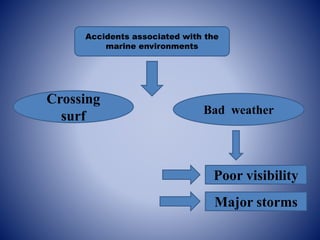
Accidents associated with the
marine environments
Crossing
surf Bad weather
Poor visibility
Major storms
Crossing surf
• Surf crossing has been practiced all over
the world since prehistoric times and
continued after motorization. Today it
takes place wherever natural or
artificial harbours and smaller shelters
are rare, and beaches are low and
physically accessible to beachable craft.
• best-known examples of artisanal
beachable fishing craft are sailing rafts
such as the Brazilian janghadas and
Indian kattumarams, African canoes,
Caribbean pirogues and the outrigger
canoes of Oceania.
Bad weather
1. Poor visibility
In dense fog, small fishing craft are common
victims of collision with large vessels. Small boats
are rarely equipped with radars, radar reflectors or
other means of detection, neither are they able to
signal their presence to large vessels.
• Poor visibility caused by, for example, haze
overlying the horizon and hiding coastal
orientation markers, may result in fishermen
losing their way, running ashore or grounding
fog
2. Major Storms
• Small craft - hurricanes,
cyclones, typhoons and tsunamis.
• Safety aspects:
safety of the ship
safety of crew
safety of cargo
Symptoms of storm
• Sea snake forming coiled structure and
appear as round ball on the surface.
• Water bubbles on the surface.
• White clouds seen below the hills.
• Huge waves in the ocean accompanied by
wind or rain.
• Appearance of large number of sea birds.
• Sometimes there might be strong thunder and
lightning.
Accidents associated with
Navigation
Loss of power at sea
Loss of way
Grounding & Running ashore
Collision
Fire on board
This is a major cause of accidents. Many small
fishing boats are powered by an outboard
motor and do not carry either a spare engine
or sailing rig.
Accidents associated with navigation
1. Loss of power at sea
 a motorized craft fishermen tend
to travel greater distances offshore,
putting them at risk if the engine
fails. Moreover, although they used
to use sails, they have stopped
taking them to sea and the younger
ones are not even trained in their
emergency use and do not know
what to do with them.
2. Loss of way
Loss of way in small fishing craft is dangerous,
because in most cases they do not carry large amounts
of fuel, food or drinking water. In normal conditions,
experienced artisanal fishermen rarely lose their way at
sea, in spite of sailing without navigation instruments,
often even without a magnetic compass.
Dense fog, cloudy nights combined with an unusual
wind direction or abnormal lack of wind, etc., may
bring about temporary or even fatal loss of way.
Because of current
3.Grounding and running ashore
• Severe grounding applies extreme loads
upon ship structures. In less severe
accidents, it might result only in damage to
the hull; however, in most serious accidents,
it might lead to hull breaches, cargo spills,
total loss of the vessel, and, in the worst
cases, human casualties.
Causes
• Current
• Darkness
• Tide
• Visibility
• Waves
• Wind
• Depth of waterway
• Geometry of waterway
• Age of vessel
• Type of vessel
• Speed
• Human & organizational factors
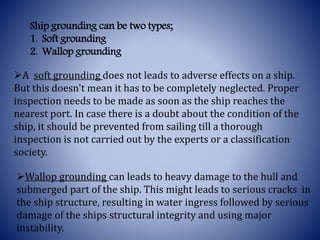
Ship grounding can be two types;
1. Soft grounding
2. Wallop grounding
A soft grounding does not leads to adverse effects on a ship.
But this doesn't mean it has to be completely neglected. Proper
inspection needs to be made as soon as the ship reaches the
nearest port. In case there is a doubt about the condition of the
ship, it should be prevented from sailing till a thorough
inspection is not carried out by the experts or a classification
society.
Wallop grounding can leads to heavy damage to the hull and
submerged part of the ship. This might leads to serious cracks in
the ship structure, resulting in water ingress followed by serious
damage of the ships structural integrity and using major
instability.
First Action to be taken:
• When the vessel goes aground the engine
should be stopped immediately
• The skipper first action on grounding
should be:
a) Sound the general alarm.
b) Exhibit the appropriate signals.
c) Make ready LSA.
d) Send the chief engineer to check
damage.
e) Alert the owner and the nearest
insurance agency.
Small fishing vessels are often involved in
collisions, especially in areas of heavy traffic of
merchant shipping. Collisions and bizarre accidents
involving submarines fouling trawling gear
sometimes end in capsize sinkings and fatalities.
Big merchant or naval vessels may cut a fishing
boat in two and carry on without even being aware
of it.
4. Collisions
Collision with another vessel
Collision with a fixed object
Failure to keep proper lookout
Accidents
• Proper use of a “lookout”
• Knowledge of “Rules of the Road”
• Knowledge of proper boat lighting
• Knowledge of “Aids to Navigation”
Most collisions could be avoided by:
5.fire on board
Fire mainly because of ……….
 Leakage of gas( cooking gas)
Electric spark
Smoking
Leaking of fuel
Lightning
Marine accidents

Marine accidents

  • 1.
    ACCIDENTS ASSOCIATED WITH MARIINEENVIRONMENT RANJEET RAJ
  • 2.
    Accidents associated withthe marine environments Crossing surf Bad weather Poor visibility Major storms
  • 3.
    Crossing surf • Surfcrossing has been practiced all over the world since prehistoric times and continued after motorization. Today it takes place wherever natural or artificial harbours and smaller shelters are rare, and beaches are low and physically accessible to beachable craft.
  • 4.
    • best-known examplesof artisanal beachable fishing craft are sailing rafts such as the Brazilian janghadas and Indian kattumarams, African canoes, Caribbean pirogues and the outrigger canoes of Oceania.
  • 6.
    Bad weather 1. Poorvisibility In dense fog, small fishing craft are common victims of collision with large vessels. Small boats are rarely equipped with radars, radar reflectors or other means of detection, neither are they able to signal their presence to large vessels. • Poor visibility caused by, for example, haze overlying the horizon and hiding coastal orientation markers, may result in fishermen losing their way, running ashore or grounding
  • 7.
  • 8.
    2. Major Storms •Small craft - hurricanes, cyclones, typhoons and tsunamis. • Safety aspects: safety of the ship safety of crew safety of cargo
  • 9.
    Symptoms of storm •Sea snake forming coiled structure and appear as round ball on the surface. • Water bubbles on the surface. • White clouds seen below the hills. • Huge waves in the ocean accompanied by wind or rain. • Appearance of large number of sea birds. • Sometimes there might be strong thunder and lightning.
  • 10.
    Accidents associated with Navigation Lossof power at sea Loss of way Grounding & Running ashore Collision Fire on board
  • 11.
    This is amajor cause of accidents. Many small fishing boats are powered by an outboard motor and do not carry either a spare engine or sailing rig. Accidents associated with navigation 1. Loss of power at sea
  • 12.
     a motorizedcraft fishermen tend to travel greater distances offshore, putting them at risk if the engine fails. Moreover, although they used to use sails, they have stopped taking them to sea and the younger ones are not even trained in their emergency use and do not know what to do with them.
  • 13.
    2. Loss ofway Loss of way in small fishing craft is dangerous, because in most cases they do not carry large amounts of fuel, food or drinking water. In normal conditions, experienced artisanal fishermen rarely lose their way at sea, in spite of sailing without navigation instruments, often even without a magnetic compass. Dense fog, cloudy nights combined with an unusual wind direction or abnormal lack of wind, etc., may bring about temporary or even fatal loss of way. Because of current
  • 16.
    3.Grounding and runningashore • Severe grounding applies extreme loads upon ship structures. In less severe accidents, it might result only in damage to the hull; however, in most serious accidents, it might lead to hull breaches, cargo spills, total loss of the vessel, and, in the worst cases, human casualties.
  • 17.
    Causes • Current • Darkness •Tide • Visibility • Waves • Wind • Depth of waterway • Geometry of waterway • Age of vessel • Type of vessel • Speed • Human & organizational factors
  • 18.
    Ship grounding canbe two types; 1. Soft grounding 2. Wallop grounding A soft grounding does not leads to adverse effects on a ship. But this doesn't mean it has to be completely neglected. Proper inspection needs to be made as soon as the ship reaches the nearest port. In case there is a doubt about the condition of the ship, it should be prevented from sailing till a thorough inspection is not carried out by the experts or a classification society. Wallop grounding can leads to heavy damage to the hull and submerged part of the ship. This might leads to serious cracks in the ship structure, resulting in water ingress followed by serious damage of the ships structural integrity and using major instability.
  • 19.
    First Action tobe taken: • When the vessel goes aground the engine should be stopped immediately • The skipper first action on grounding should be: a) Sound the general alarm. b) Exhibit the appropriate signals. c) Make ready LSA. d) Send the chief engineer to check damage. e) Alert the owner and the nearest insurance agency.
  • 21.
    Small fishing vesselsare often involved in collisions, especially in areas of heavy traffic of merchant shipping. Collisions and bizarre accidents involving submarines fouling trawling gear sometimes end in capsize sinkings and fatalities. Big merchant or naval vessels may cut a fishing boat in two and carry on without even being aware of it. 4. Collisions
  • 22.
  • 23.
    Collision with afixed object
  • 24.
    Failure to keepproper lookout
  • 25.
    Accidents • Proper useof a “lookout” • Knowledge of “Rules of the Road” • Knowledge of proper boat lighting • Knowledge of “Aids to Navigation” Most collisions could be avoided by:
  • 26.
    5.fire on board Firemainly because of ……….  Leakage of gas( cooking gas) Electric spark Smoking Leaking of fuel Lightning