Marginal costing
 Marginal cost is defined as the amount at any
given volume of output by which the
aggregate costs are changed if the volume of
output is increased or decreased by one unit.
 Marginal costing is defined as the
ascertainment, by differentiating between
fixed and variable costs, of the marginal costs
and of the effect on profit of changes in
volume and type of output.
Operating Statement
Sales XXX
Less: marginal cost
Direct material cost XXX
direct labour cost XXX
Direct expenses XXX
Variable overheads XXX XXX
contribution XXX
Less Fixed cost XXX
Profit XXX
Rs
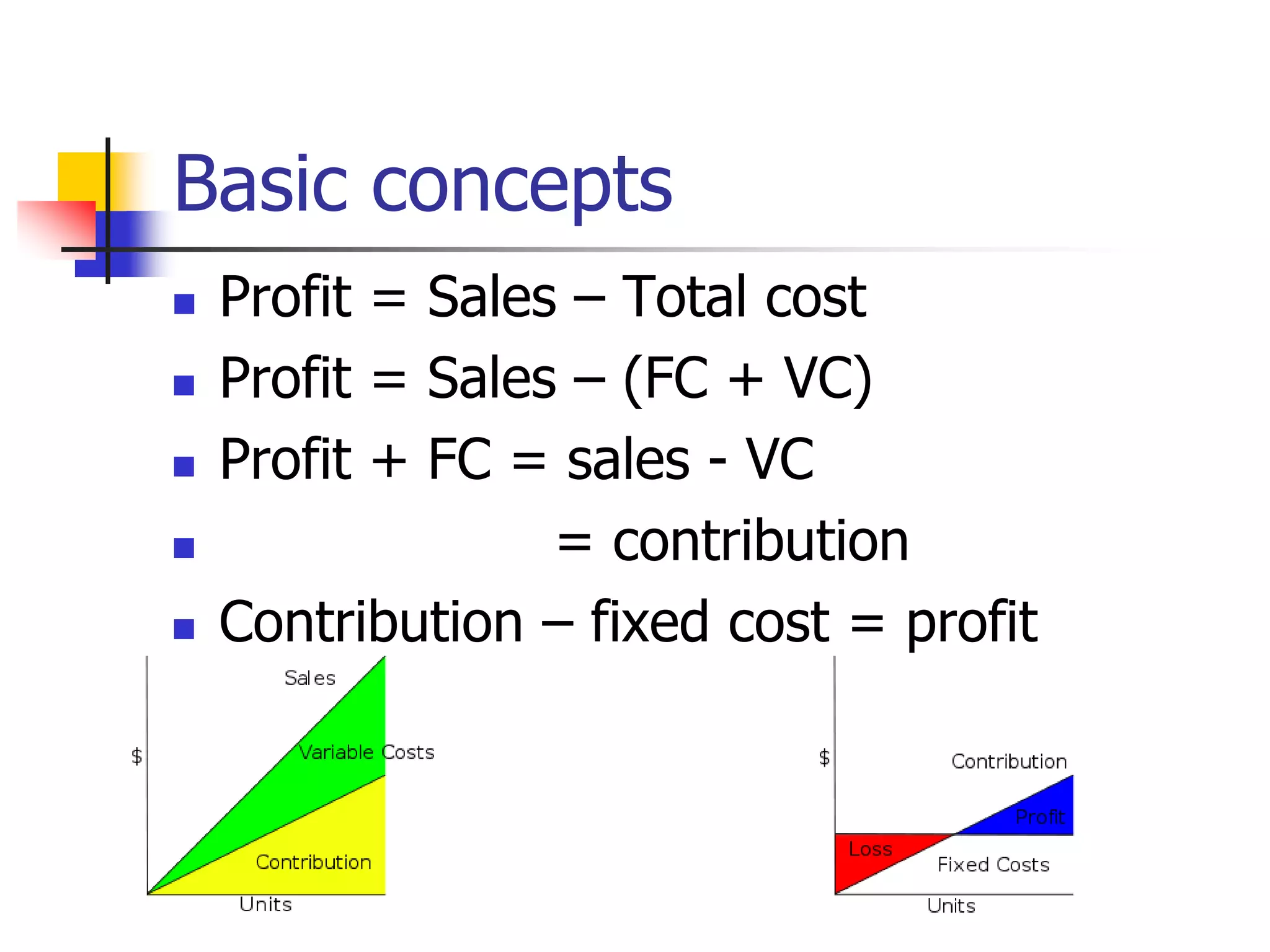
Basic concepts
 Profit = Sales – Total cost
 Profit = Sales – (FC + VC)
 Profit + FC = sales - VC
 = contribution
 Contribution – fixed cost = profit
 Profit volume (P/V) ratio:
 This ratio indicates the contribution earned with
respect to one rupee of sales.
 =(contribution/sales)* 100
 =(change in profit/change in
sales) *100
 Sales * P/V ratio= contribution
 P/V ratio remains constant at all levels of
activities, provided per unit sales price and VC
remains constant.
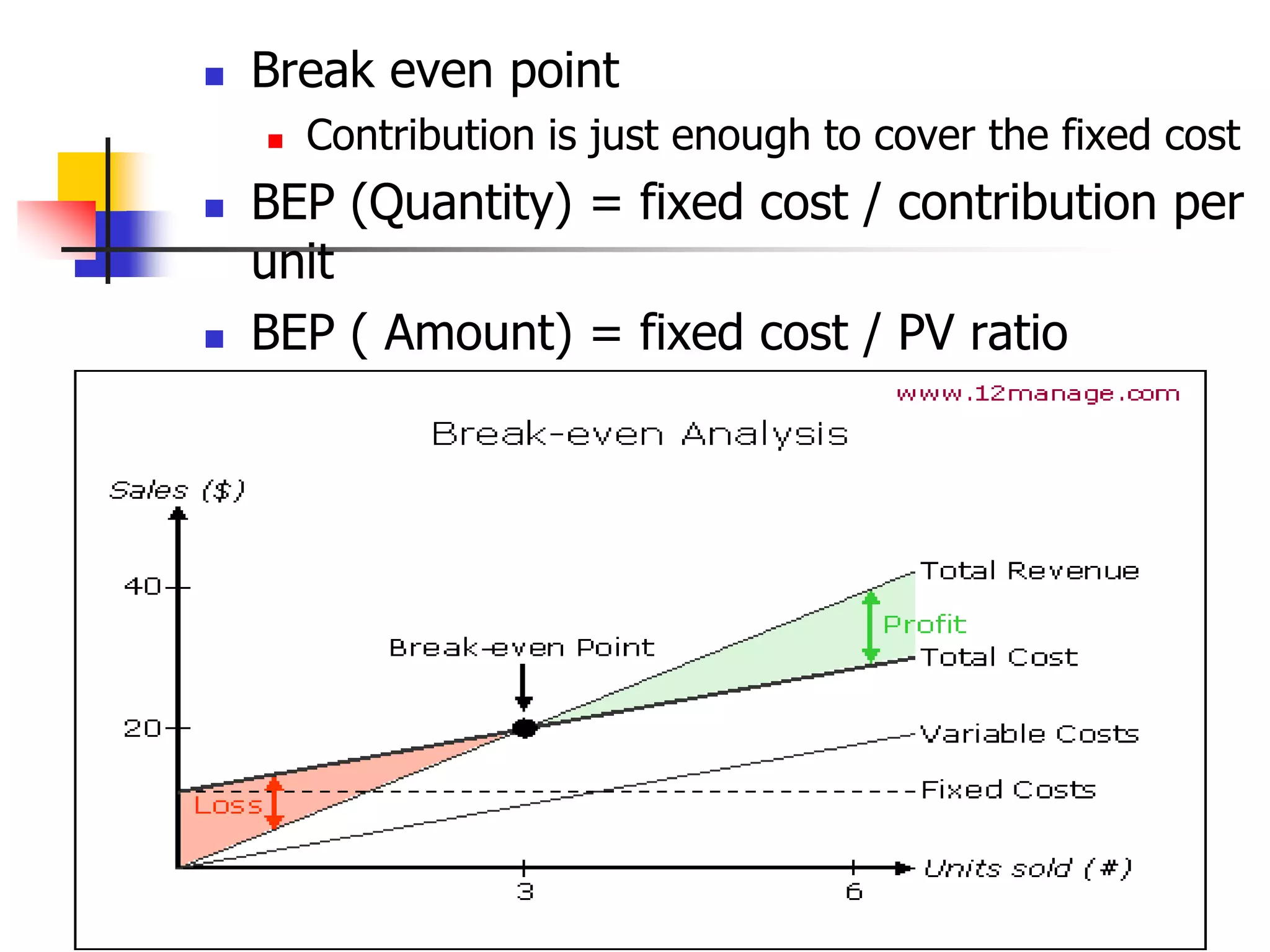
 Break even point
 Contribution is just enough to cover the fixed cost
 BEP (Quantity) = fixed cost / contribution per
unit
 BEP ( Amount) = fixed cost / PV ratio
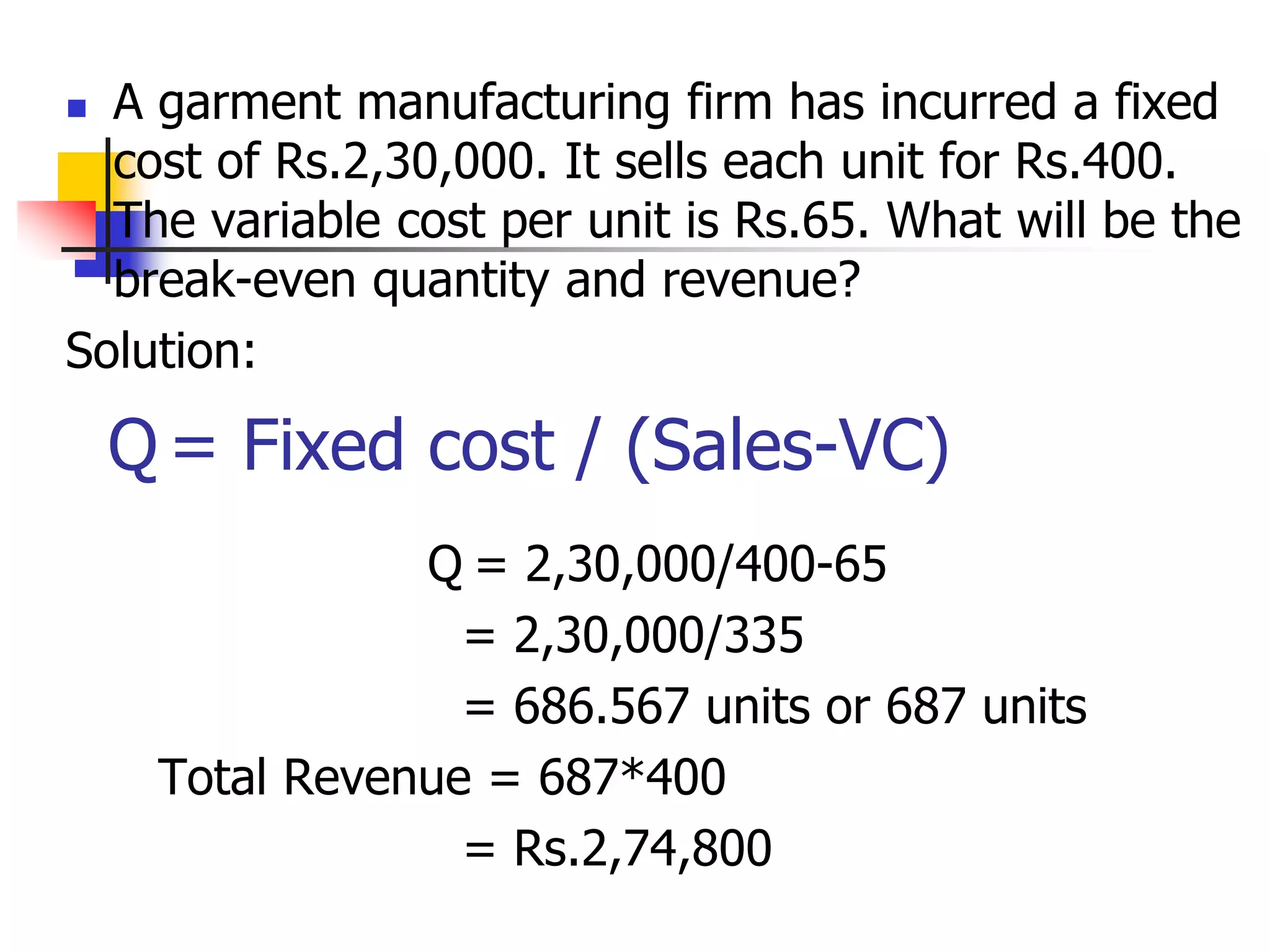
 A garment manufacturing firm has incurred a fixed
cost of Rs.2,30,000. It sells each unit for Rs.400.
The variable cost per unit is Rs.65. What will be the
break-even quantity and revenue?
Solution:
Q = 2,30,000/400-65
= 2,30,000/335
= 686.567 units or 687 units
Total Revenue = 687*400
= Rs.2,74,800
Q = Fixed cost / (Sales-VC)
 Margin of safety
 MoS = Sales – Break even sales
 = sales – ( fixed cost / PV ratio)
 = profit / PV ratio
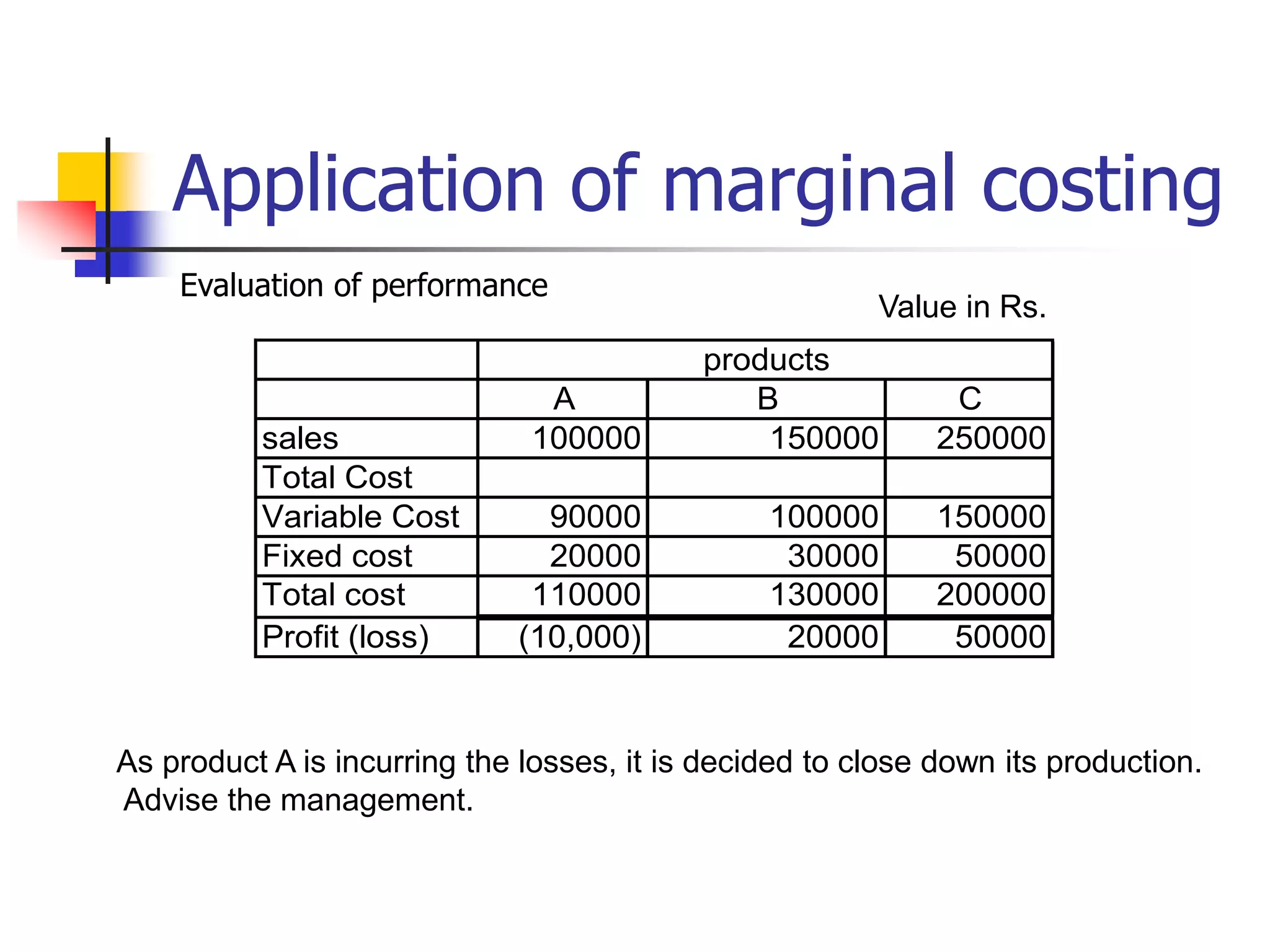
Application of marginal costing
A B C
sales 100000 150000 250000
Total Cost
Variable Cost 90000 100000 150000
Fixed cost 20000 30000 50000
Total cost 110000 130000 200000
Profit (loss) (10,000) 20000 50000
products
As product A is incurring the losses, it is decided to close down its production.
Advise the management.
Value in Rs.
Evaluation of performance
Profit planning
 A company produces and sells socks. Due to competition, the
company proposes to reduce the selling price. If the present
level of profit is to be maintained, indicate the number of units
to be sold if the proposed reduction in price is (a) 10% and (b)
15%.
Rs Rs
Present sales (30000 units) 600000
Variabale cost (30000 units) 360000
Fixed cost 140000
500000
Net profit 100000
Fixation of selling price
 The plant capacity is 100000 units. A customer from
US is desirous of buying 20000 units at a price of Rs
10 / unit. Advice the company whether or not offer
should be accepted?
Rs
sales (80000 units@ Rs 15) 1200000
costs - Variable
material 240000
labour 320000
overheads 160000
720000
Fixed 320000
total Costs 1040000
profit 160000
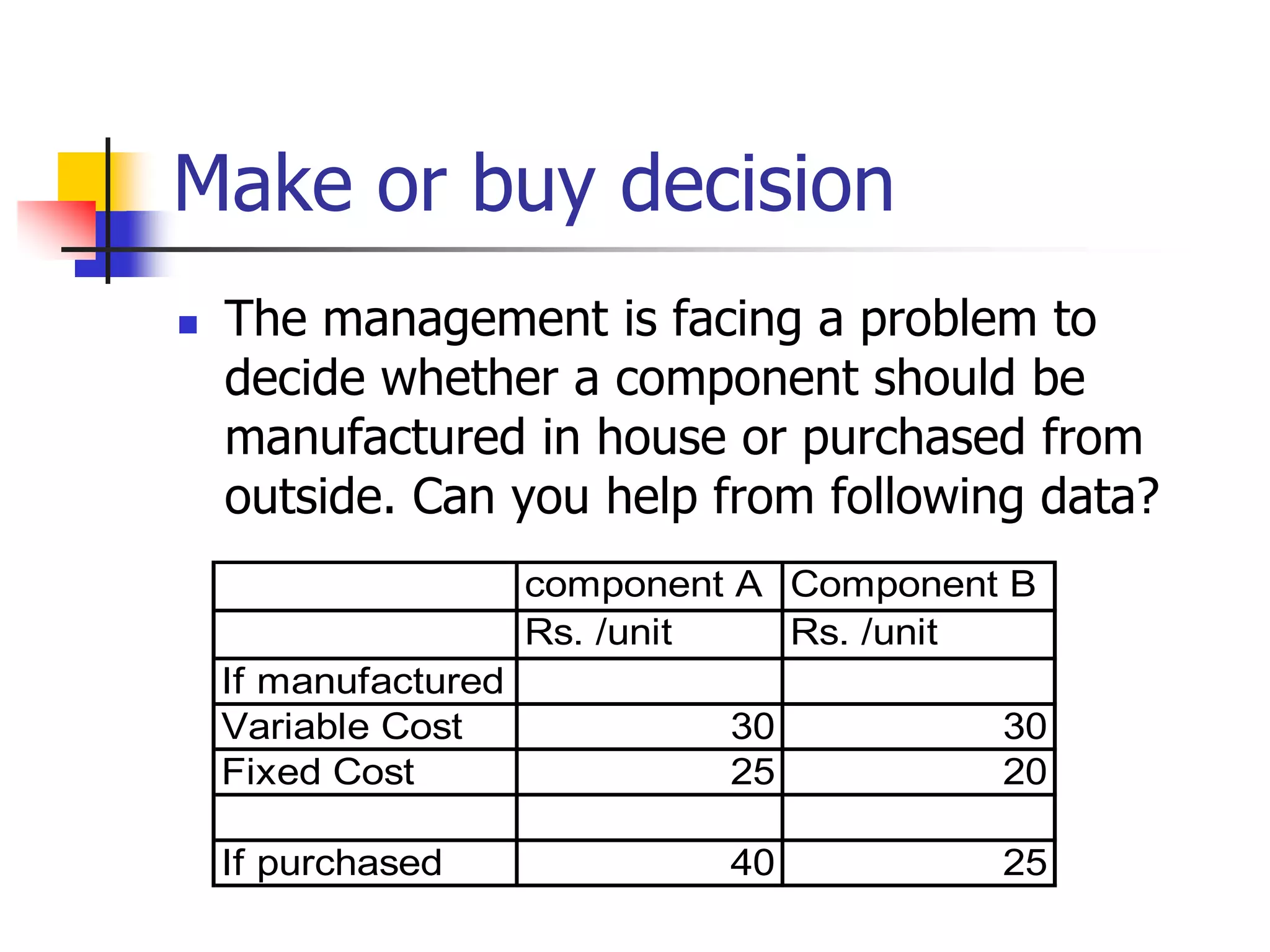
Make or buy decision
 The management is facing a problem to
decide whether a component should be
manufactured in house or purchased from
outside. Can you help from following data?
component A Component B
Rs. /unit Rs. /unit
If manufactured
Variable Cost 30 30
Fixed Cost 25 20
If purchased 40 25
Optimizing product mix
Some info from the cost records of the company about products X
and Y
Direct material per unit --- X – Rs 8 , Y – Rs 6
Direct wages
X 24 hrs @ 25 paise per hr
Y 16 hrs @ 25 paise per hr
Variable overheads 150% of wages
Fixed overheads Rs 750
Selling price X-- Rs 25 and Y – Rs 20
The director wants to decide among the following to maximize
profit.
1. 250 units of X and 250 Units of Y
2. 400 units of Y only
3. 400 units of X and 100 units of Y
4. 150 units of X and 350 units of Y
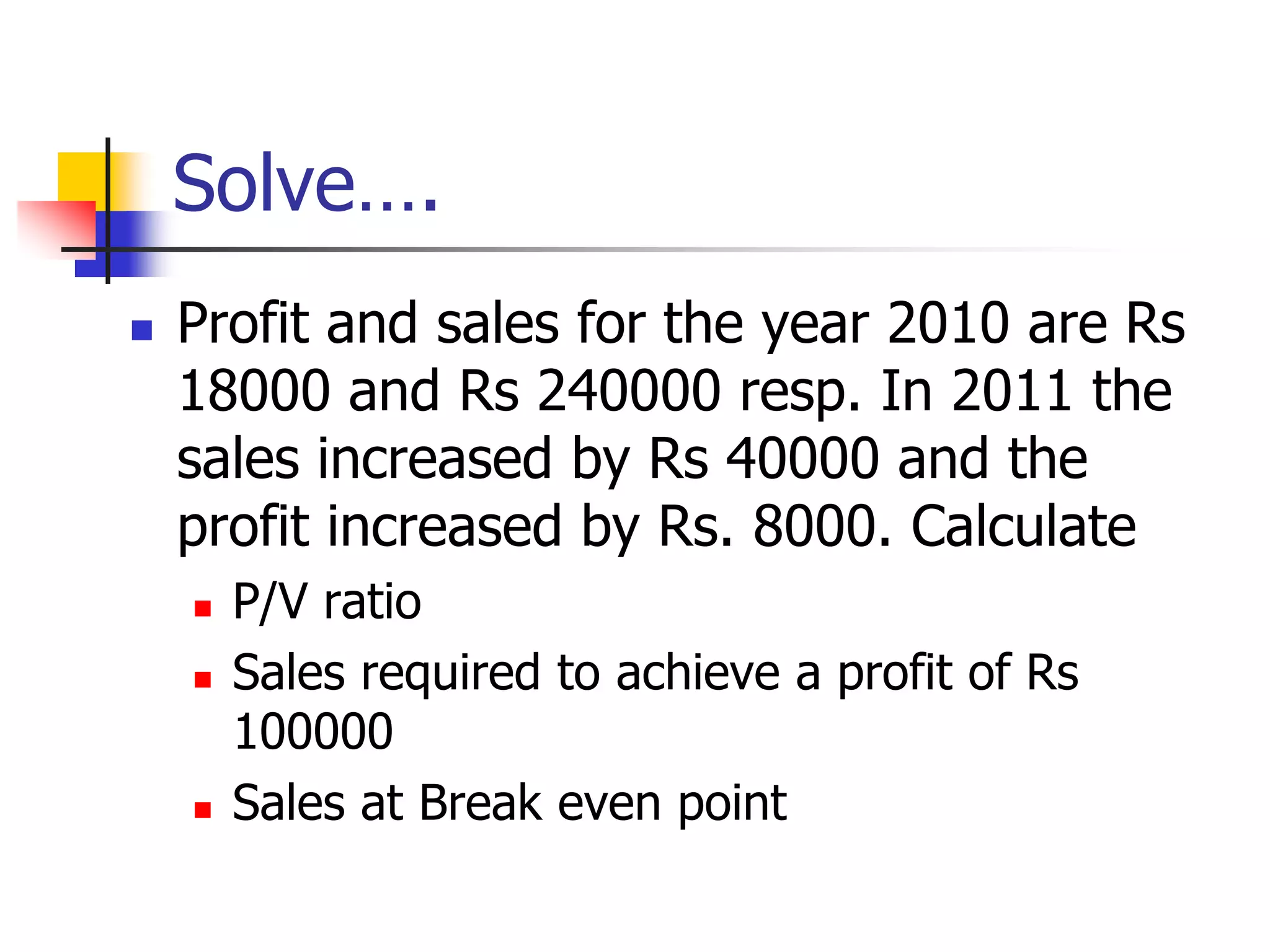
Solve….
 Profit and sales for the year 2010 are Rs
18000 and Rs 240000 resp. In 2011 the
sales increased by Rs 40000 and the
profit increased by Rs. 8000. Calculate
 P/V ratio
 Sales required to achieve a profit of Rs
100000
 Sales at Break even point
 Calculate
 BEP in terms of sales amount
 No of units that must be sold to earn a profit of Rs.
60000 per yr
Rs
sales price (per unit) 20
variable cost per unit 11
variable selling cost (per unit) 3
fixed factory overheads (per yr) 540000
fixed selling cost per yr 252000
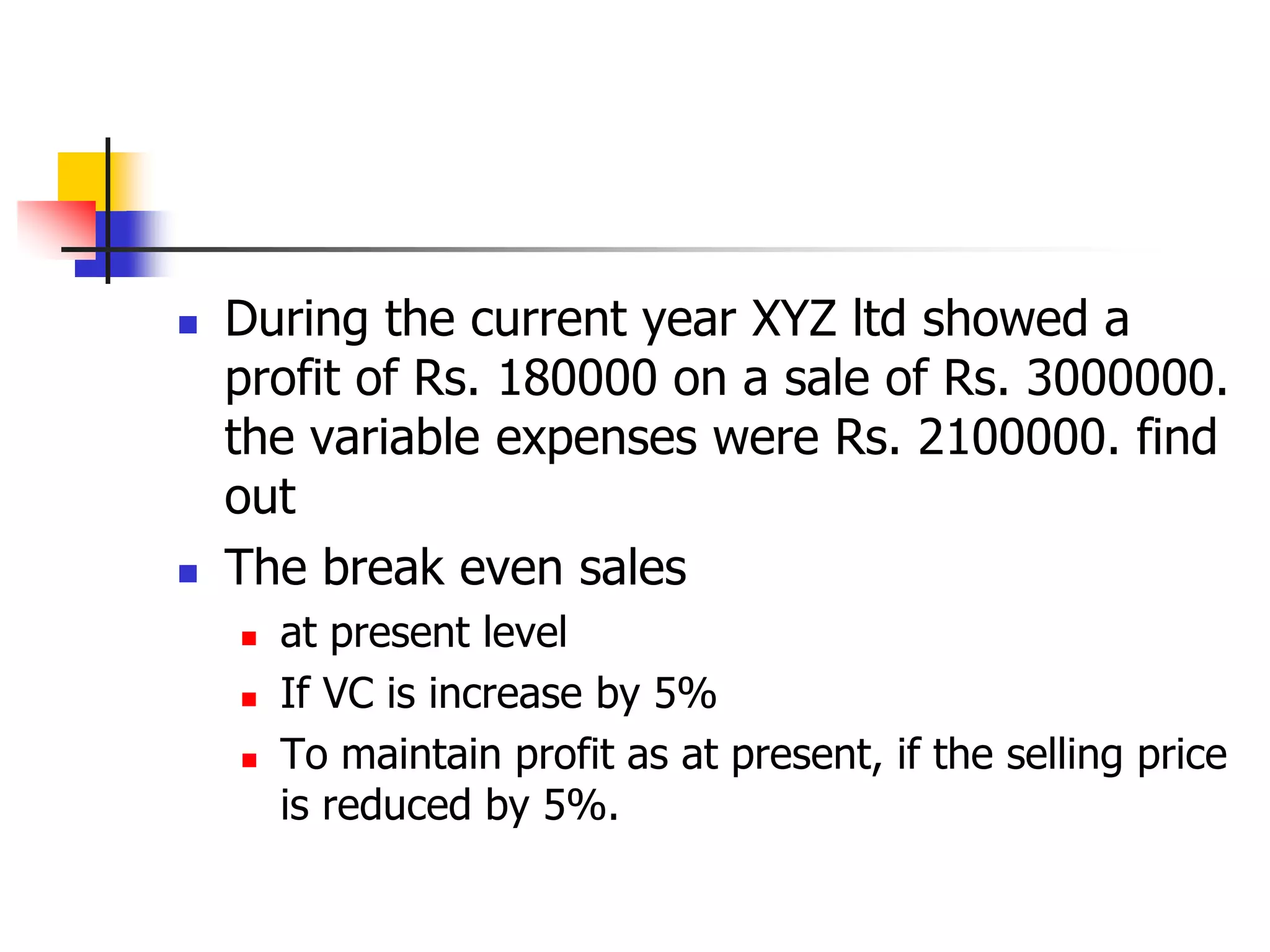
 During the current year XYZ ltd showed a
profit of Rs. 180000 on a sale of Rs. 3000000.
the variable expenses were Rs. 2100000. find
out
 The break even sales
 at present level
 If VC is increase by 5%
 To maintain profit as at present, if the selling price
is reduced by 5%.
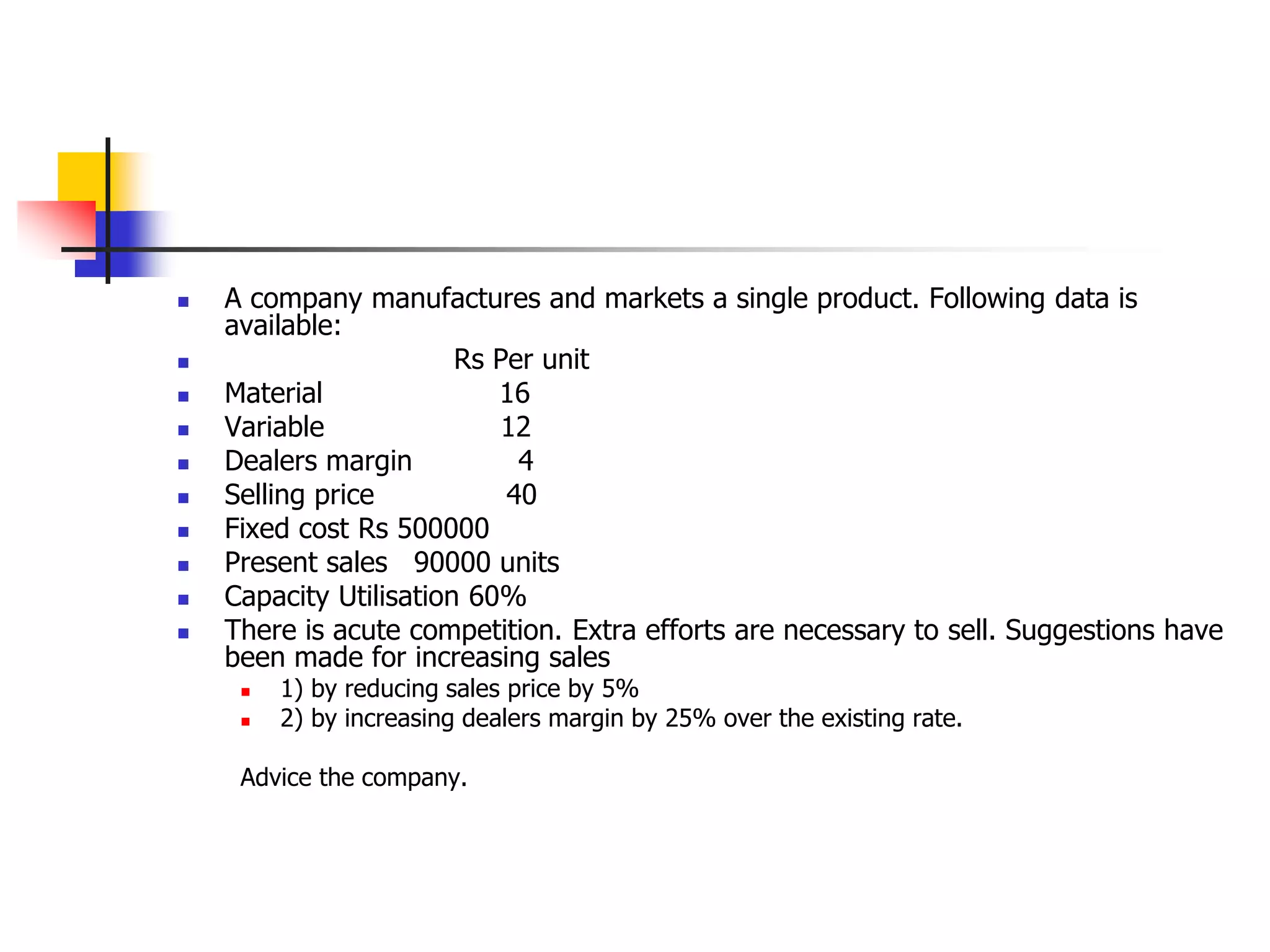
 A company manufactures and markets a single product. Following data is
available:
 Rs Per unit
 Material 16
 Variable 12
 Dealers margin 4
 Selling price 40
 Fixed cost Rs 500000
 Present sales 90000 units
 Capacity Utilisation 60%
 There is acute competition. Extra efforts are necessary to sell. Suggestions have
been made for increasing sales
 1) by reducing sales price by 5%
 2) by increasing dealers margin by 25% over the existing rate.
Advice the company.
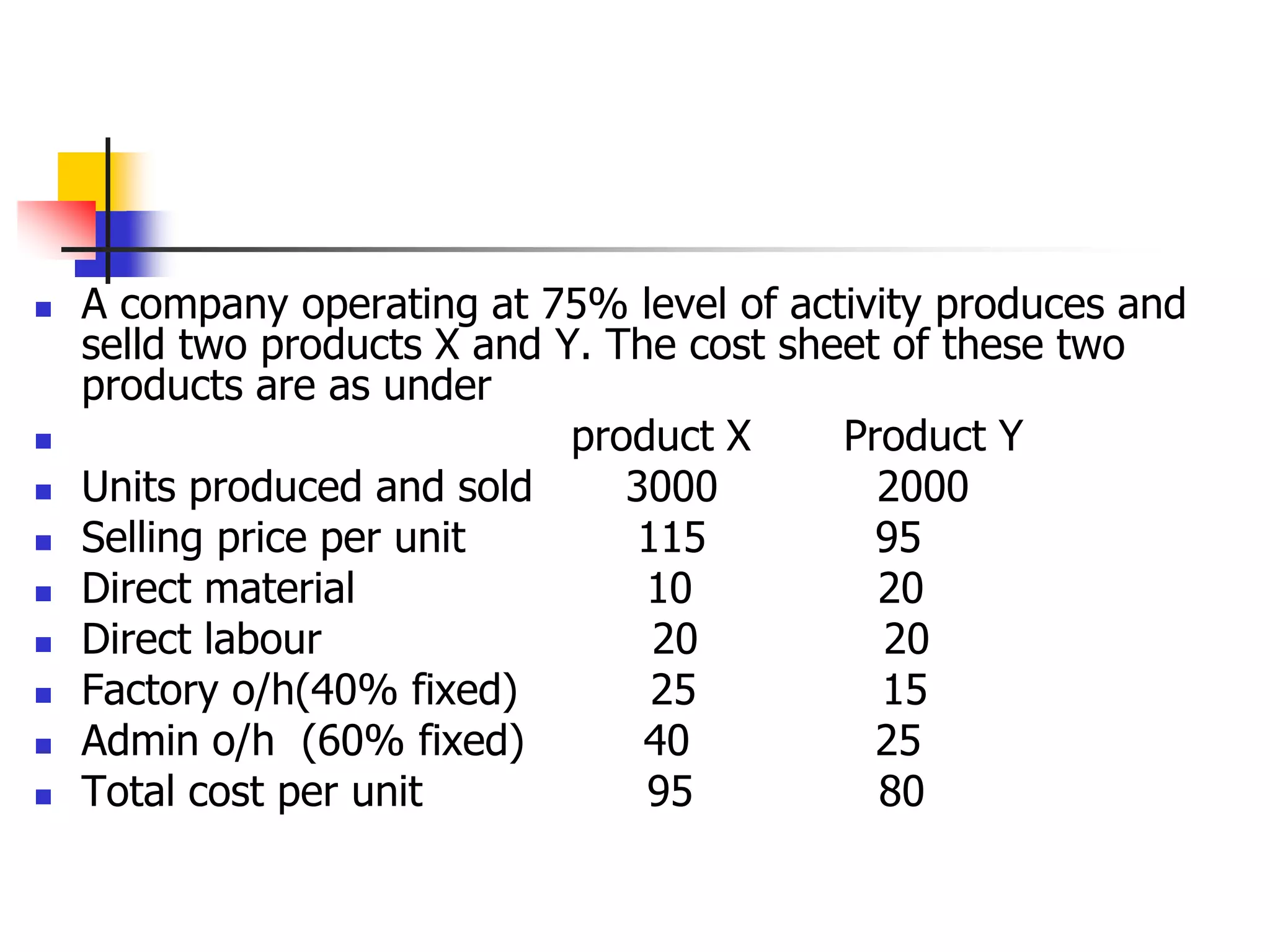
 A company operating at 75% level of activity produces and
selld two products X and Y. The cost sheet of these two
products are as under
 product X Product Y
 Units produced and sold 3000 2000
 Selling price per unit 115 95
 Direct material 10 20
 Direct labour 20 20
 Factory o/h(40% fixed) 25 15
 Admin o/h (60% fixed) 40 25
 Total cost per unit 95 80
 Factory overheads are absorbed on the basis of
machine hour rate which is the limiting factor. The
machine hour rate is Rs 10 Per hour.
 A company receives a offer from Japan for the
purchase of product X at a price of Rs. 87.50 per
unit. Alternatively, the company has another offer
from Bangkok for the purchase of Product Y at a
price of Rs 77.50 per unit. In both the cases, a
special packing charge of Rs 2.50 is included which
has to be borne by company. The company can
accept either of the two exports orders by utilising
the balance capacity
 Advice the company. Calculate the final profit
statement.
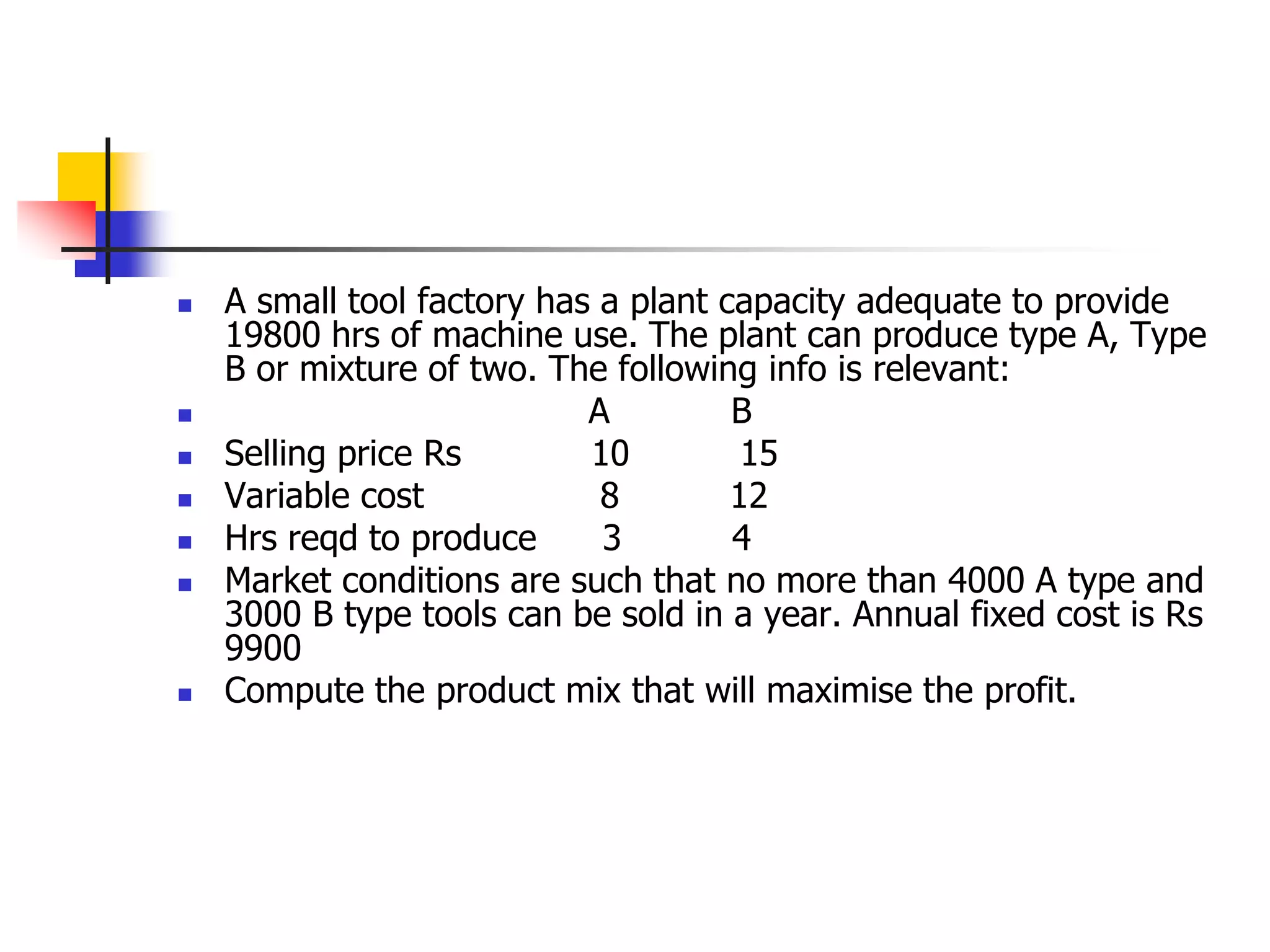
 A small tool factory has a plant capacity adequate to provide
19800 hrs of machine use. The plant can produce type A, Type
B or mixture of two. The following info is relevant:
 A B
 Selling price Rs 10 15
 Variable cost 8 12
 Hrs reqd to produce 3 4
 Market conditions are such that no more than 4000 A type and
3000 B type tools can be sold in a year. Annual fixed cost is Rs
9900
 Compute the product mix that will maximise the profit.
Homework…
 The summarized income statement of Manmohan Ltd is as follows:
 Net income 800000
 Less expenses 880000
(including Rs. 400000 fixed)
net loss 80000
At what sales volume will the company breakeven?
The manager believes that an increase of Rs. 200000 in advertising
outlays will increase sales substantially. His plan was approved by the
chairman of the board. You have to find out-
What additional sales will be required to offset the increase in advertising
outlays?
What sales volume will result in net profit of Rs. 40000?
 Solve 20 more problems on Marginal
costing.
Marginal costing.ppt

Marginal costing.ppt

  • 1.
  • 2.
     Marginal costis defined as the amount at any given volume of output by which the aggregate costs are changed if the volume of output is increased or decreased by one unit.  Marginal costing is defined as the ascertainment, by differentiating between fixed and variable costs, of the marginal costs and of the effect on profit of changes in volume and type of output.
  • 3.
    Operating Statement Sales XXX Less:marginal cost Direct material cost XXX direct labour cost XXX Direct expenses XXX Variable overheads XXX XXX contribution XXX Less Fixed cost XXX Profit XXX Rs
  • 4.
    Basic concepts  Profit= Sales – Total cost  Profit = Sales – (FC + VC)  Profit + FC = sales - VC  = contribution  Contribution – fixed cost = profit
  • 5.
     Profit volume(P/V) ratio:  This ratio indicates the contribution earned with respect to one rupee of sales.  =(contribution/sales)* 100  =(change in profit/change in sales) *100  Sales * P/V ratio= contribution  P/V ratio remains constant at all levels of activities, provided per unit sales price and VC remains constant.
  • 6.
     Break evenpoint  Contribution is just enough to cover the fixed cost  BEP (Quantity) = fixed cost / contribution per unit  BEP ( Amount) = fixed cost / PV ratio
  • 7.
     A garmentmanufacturing firm has incurred a fixed cost of Rs.2,30,000. It sells each unit for Rs.400. The variable cost per unit is Rs.65. What will be the break-even quantity and revenue? Solution: Q = 2,30,000/400-65 = 2,30,000/335 = 686.567 units or 687 units Total Revenue = 687*400 = Rs.2,74,800 Q = Fixed cost / (Sales-VC)
  • 8.
     Margin ofsafety  MoS = Sales – Break even sales  = sales – ( fixed cost / PV ratio)  = profit / PV ratio
  • 9.
    Application of marginalcosting A B C sales 100000 150000 250000 Total Cost Variable Cost 90000 100000 150000 Fixed cost 20000 30000 50000 Total cost 110000 130000 200000 Profit (loss) (10,000) 20000 50000 products As product A is incurring the losses, it is decided to close down its production. Advise the management. Value in Rs. Evaluation of performance
  • 10.
    Profit planning  Acompany produces and sells socks. Due to competition, the company proposes to reduce the selling price. If the present level of profit is to be maintained, indicate the number of units to be sold if the proposed reduction in price is (a) 10% and (b) 15%. Rs Rs Present sales (30000 units) 600000 Variabale cost (30000 units) 360000 Fixed cost 140000 500000 Net profit 100000
  • 11.
    Fixation of sellingprice  The plant capacity is 100000 units. A customer from US is desirous of buying 20000 units at a price of Rs 10 / unit. Advice the company whether or not offer should be accepted? Rs sales (80000 units@ Rs 15) 1200000 costs - Variable material 240000 labour 320000 overheads 160000 720000 Fixed 320000 total Costs 1040000 profit 160000
  • 12.
    Make or buydecision  The management is facing a problem to decide whether a component should be manufactured in house or purchased from outside. Can you help from following data? component A Component B Rs. /unit Rs. /unit If manufactured Variable Cost 30 30 Fixed Cost 25 20 If purchased 40 25
  • 13.
    Optimizing product mix Someinfo from the cost records of the company about products X and Y Direct material per unit --- X – Rs 8 , Y – Rs 6 Direct wages X 24 hrs @ 25 paise per hr Y 16 hrs @ 25 paise per hr Variable overheads 150% of wages Fixed overheads Rs 750 Selling price X-- Rs 25 and Y – Rs 20 The director wants to decide among the following to maximize profit. 1. 250 units of X and 250 Units of Y 2. 400 units of Y only 3. 400 units of X and 100 units of Y 4. 150 units of X and 350 units of Y
  • 14.
    Solve….  Profit andsales for the year 2010 are Rs 18000 and Rs 240000 resp. In 2011 the sales increased by Rs 40000 and the profit increased by Rs. 8000. Calculate  P/V ratio  Sales required to achieve a profit of Rs 100000  Sales at Break even point
  • 15.
     Calculate  BEPin terms of sales amount  No of units that must be sold to earn a profit of Rs. 60000 per yr Rs sales price (per unit) 20 variable cost per unit 11 variable selling cost (per unit) 3 fixed factory overheads (per yr) 540000 fixed selling cost per yr 252000
  • 16.
     During thecurrent year XYZ ltd showed a profit of Rs. 180000 on a sale of Rs. 3000000. the variable expenses were Rs. 2100000. find out  The break even sales  at present level  If VC is increase by 5%  To maintain profit as at present, if the selling price is reduced by 5%.
  • 17.
     A companymanufactures and markets a single product. Following data is available:  Rs Per unit  Material 16  Variable 12  Dealers margin 4  Selling price 40  Fixed cost Rs 500000  Present sales 90000 units  Capacity Utilisation 60%  There is acute competition. Extra efforts are necessary to sell. Suggestions have been made for increasing sales  1) by reducing sales price by 5%  2) by increasing dealers margin by 25% over the existing rate. Advice the company.
  • 18.
     A companyoperating at 75% level of activity produces and selld two products X and Y. The cost sheet of these two products are as under  product X Product Y  Units produced and sold 3000 2000  Selling price per unit 115 95  Direct material 10 20  Direct labour 20 20  Factory o/h(40% fixed) 25 15  Admin o/h (60% fixed) 40 25  Total cost per unit 95 80
  • 19.
     Factory overheadsare absorbed on the basis of machine hour rate which is the limiting factor. The machine hour rate is Rs 10 Per hour.  A company receives a offer from Japan for the purchase of product X at a price of Rs. 87.50 per unit. Alternatively, the company has another offer from Bangkok for the purchase of Product Y at a price of Rs 77.50 per unit. In both the cases, a special packing charge of Rs 2.50 is included which has to be borne by company. The company can accept either of the two exports orders by utilising the balance capacity  Advice the company. Calculate the final profit statement.
  • 20.
     A smalltool factory has a plant capacity adequate to provide 19800 hrs of machine use. The plant can produce type A, Type B or mixture of two. The following info is relevant:  A B  Selling price Rs 10 15  Variable cost 8 12  Hrs reqd to produce 3 4  Market conditions are such that no more than 4000 A type and 3000 B type tools can be sold in a year. Annual fixed cost is Rs 9900  Compute the product mix that will maximise the profit.
  • 21.
    Homework…  The summarizedincome statement of Manmohan Ltd is as follows:  Net income 800000  Less expenses 880000 (including Rs. 400000 fixed) net loss 80000 At what sales volume will the company breakeven? The manager believes that an increase of Rs. 200000 in advertising outlays will increase sales substantially. His plan was approved by the chairman of the board. You have to find out- What additional sales will be required to offset the increase in advertising outlays? What sales volume will result in net profit of Rs. 40000?
  • 22.
     Solve 20more problems on Marginal costing.