Group Members:
Aramish Altaf
Anum Mehmood
Batool Shahid
Khadija Sohail
Maimoona Zaheer
Marva Shahid
INTRODUCTION OF
MANAGERIAL
ECONOMICS
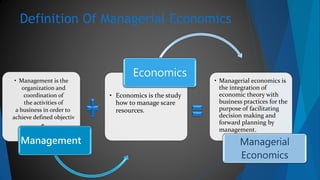
Definition Of Managerial Economics
• Management is the
organization and
coordination of
the activities of
a business in order to
achieve defined objectiv
e.
Management
• Economics is the study
how to manage scare
resources.
Economics
• Managerial economics is
the integration of
economic theory with
business practices for the
purpose of facilitating
decision making and
forward planning by
management.
Managerial
Economics
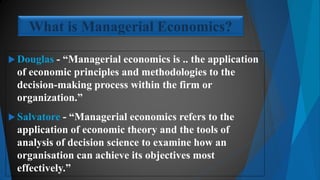
 Douglas - “Managerial economics is .. the application
of economic principles and methodologies to the
decision-making process within the firm or
organization.”
 Salvatore - “Managerial economics refers to the
application of economic theory and the tools of
analysis of decision science to examine how an
organisation can achieve its objectives most
effectively.”
What is Managerial Economics?
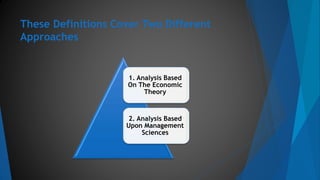
These Definitions Cover Two Different
Approaches
1. Analysis Based
On The Economic
Theory
2. Analysis Based
Upon Management
Sciences
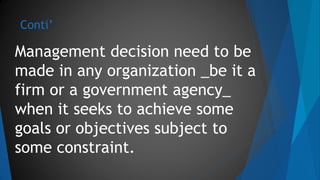
Conti’
Management decision need to be
made in any organization _be it a
firm or a government agency_
when it seeks to achieve some
goals or objectives subject to
some constraint.
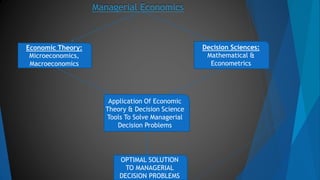
Managerial Economics
Economic Theory:
Microeconomics,
Macroeconomics
Decision Sciences:
Mathematical &
Econometrics
Application Of Economic
Theory & Decision Science
Tools To Solve Managerial
Decision Problems
OPTIMAL SOLUTION
TO MANAGERIAL
DECISION PROBLEMS
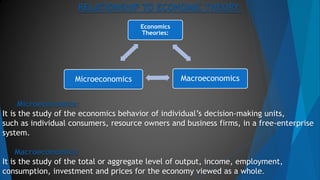
RELATIONSHIP TO ECONOMIC THEORY
Microeconomics:
It is the study of the economics behavior of individual’s decision-making units,
such as individual consumers, resource owners and business firms, in a free-enterprise
system.
Macroeconomics:
It is the study of the total or aggregate level of output, income, employment,
consumption, investment and prices for the economy viewed as a whole.
Economics
Theories:
MacroeconomicsMicroeconomics
Both microeconomic and macroeconomic theories are the most important
element in managerial economic.
Economic theories seeks to predict and explain economic behavior.
Economic theories usually begin with a model, this abstracts from the
many details surrounding an event and seeks to identify a few of the most
important determinates of the events.
The firm uses the models of economic theory to maximize its aim of "
maximizing profit", if this model predicts the behavior of the firm accurately.
The methodology of economics is to accept a theory or model if it predicts
accurately and if the prediction follows logically from the assumption.
RELARTION SHIP TO THE DECESION SCIENCES
Managerial economics, is also closely related to the decision science, these utilize
the tools of mathematical economics and econometrics to construct and estimate
decision models aimed at determining the optimal behavior of the firm.
Mathematical Economics
Mathematical economics "is used to formalize the economic models
postulated by economic theory"
Econometrics
"Econometrics" application of statistical tools particularly regression
analysis "to real world data to estimate the models postulated by
economic theory and forecasting"
RELATIONSHIP TO THE FUNCTIONAL
AREAS OF BUSINESS ADMINISTRATION
STUDIES
Functional areas of business administration studies
include accounting and finance, marketing, human
resource management and production.
These disciplines study the business environment in
which the firm operates and therefore the
background for managerial decision making.
FOR EXAMPLE
 A production department may want to plan and schedule the
level of output for the next quarter,
 the marketing department may want to know what price to
charge and how much to spend on advertising,
 the finance department may want to determine whether to
build a new factory to expand capacity.
 the human resources department may want to know how many
people to hire in the coming period and what it should be
offering to pay them.
 All of these functional areas can apply the theories and
method in the context of the particular situation and tasks
that they have to perform.
Subject Matters
ECONOMICS is an important component
of the core Business Administration
curriculum because economic principles
are behind almost all managerial activity.
Economists at business schools research
and teach about how markets work (and
when they don't work); how scarce
resources get produced, consumed and
allocated; and how various participants in
the economy make optimal decisions.
These issues will be relevant to managers in virtually
all aspects of their work for the rest of their careers.
This is true both at the broadest levels—such as
strategic management, finance, organizational design,
human resources, entrepreneurship and managing
global organizations—and also when they drill down
into more specific areas, such as optimizing prices,
setting employee compensation, regulation and
analyzing how modern managerial practices affect a
firm's performance. It is to give future managers
insights into how to run their businesses more
efficiently and profitably.
Managerial Economics is a developing subject. The
need of managerial economics refers to its area of
study. Managerial economics has its roots in
economic theory.
Managerial economics provides management with
strategic planning tools that can be used to get a clear
perspective of the way the business world works and
what can be done to maintain profitability in an ever
changing environment.
Need of managerial economics
Managerial economics refers to those aspects of
economic theory and application which are directly
relevant to the practice of management and there was the
need of decision making process within the enterprise.
It is needed for Planning and control of capital
expenditures is the basic executive function and for the
profit management.
Accurate estimation of demand, by analyzing the forces
acting on demand of the product produced by the firm.
Cost analysis is yet another function of managerial
economics.

Managerial economics

  • 2.
    Group Members: Aramish Altaf AnumMehmood Batool Shahid Khadija Sohail Maimoona Zaheer Marva Shahid
  • 3.
  • 4.
    Definition Of ManagerialEconomics • Management is the organization and coordination of the activities of a business in order to achieve defined objectiv e. Management • Economics is the study how to manage scare resources. Economics • Managerial economics is the integration of economic theory with business practices for the purpose of facilitating decision making and forward planning by management. Managerial Economics
  • 5.
     Douglas -“Managerial economics is .. the application of economic principles and methodologies to the decision-making process within the firm or organization.”  Salvatore - “Managerial economics refers to the application of economic theory and the tools of analysis of decision science to examine how an organisation can achieve its objectives most effectively.” What is Managerial Economics?
  • 6.
    These Definitions CoverTwo Different Approaches 1. Analysis Based On The Economic Theory 2. Analysis Based Upon Management Sciences
  • 7.
    Conti’ Management decision needto be made in any organization _be it a firm or a government agency_ when it seeks to achieve some goals or objectives subject to some constraint.
  • 8.
    Managerial Economics Economic Theory: Microeconomics, Macroeconomics DecisionSciences: Mathematical & Econometrics Application Of Economic Theory & Decision Science Tools To Solve Managerial Decision Problems OPTIMAL SOLUTION TO MANAGERIAL DECISION PROBLEMS
  • 9.
    RELATIONSHIP TO ECONOMICTHEORY Microeconomics: It is the study of the economics behavior of individual’s decision-making units, such as individual consumers, resource owners and business firms, in a free-enterprise system. Macroeconomics: It is the study of the total or aggregate level of output, income, employment, consumption, investment and prices for the economy viewed as a whole. Economics Theories: MacroeconomicsMicroeconomics
  • 10.
    Both microeconomic andmacroeconomic theories are the most important element in managerial economic. Economic theories seeks to predict and explain economic behavior. Economic theories usually begin with a model, this abstracts from the many details surrounding an event and seeks to identify a few of the most important determinates of the events. The firm uses the models of economic theory to maximize its aim of " maximizing profit", if this model predicts the behavior of the firm accurately. The methodology of economics is to accept a theory or model if it predicts accurately and if the prediction follows logically from the assumption.
  • 11.
    RELARTION SHIP TOTHE DECESION SCIENCES Managerial economics, is also closely related to the decision science, these utilize the tools of mathematical economics and econometrics to construct and estimate decision models aimed at determining the optimal behavior of the firm. Mathematical Economics Mathematical economics "is used to formalize the economic models postulated by economic theory" Econometrics "Econometrics" application of statistical tools particularly regression analysis "to real world data to estimate the models postulated by economic theory and forecasting"
  • 12.
    RELATIONSHIP TO THEFUNCTIONAL AREAS OF BUSINESS ADMINISTRATION STUDIES Functional areas of business administration studies include accounting and finance, marketing, human resource management and production. These disciplines study the business environment in which the firm operates and therefore the background for managerial decision making.
  • 13.
    FOR EXAMPLE  Aproduction department may want to plan and schedule the level of output for the next quarter,  the marketing department may want to know what price to charge and how much to spend on advertising,  the finance department may want to determine whether to build a new factory to expand capacity.  the human resources department may want to know how many people to hire in the coming period and what it should be offering to pay them.  All of these functional areas can apply the theories and method in the context of the particular situation and tasks that they have to perform.
  • 14.
    Subject Matters ECONOMICS isan important component of the core Business Administration curriculum because economic principles are behind almost all managerial activity. Economists at business schools research and teach about how markets work (and when they don't work); how scarce resources get produced, consumed and allocated; and how various participants in the economy make optimal decisions.
  • 15.
    These issues willbe relevant to managers in virtually all aspects of their work for the rest of their careers. This is true both at the broadest levels—such as strategic management, finance, organizational design, human resources, entrepreneurship and managing global organizations—and also when they drill down into more specific areas, such as optimizing prices, setting employee compensation, regulation and analyzing how modern managerial practices affect a firm's performance. It is to give future managers insights into how to run their businesses more efficiently and profitably.
  • 16.
    Managerial Economics isa developing subject. The need of managerial economics refers to its area of study. Managerial economics has its roots in economic theory. Managerial economics provides management with strategic planning tools that can be used to get a clear perspective of the way the business world works and what can be done to maintain profitability in an ever changing environment. Need of managerial economics
  • 17.
    Managerial economics refersto those aspects of economic theory and application which are directly relevant to the practice of management and there was the need of decision making process within the enterprise. It is needed for Planning and control of capital expenditures is the basic executive function and for the profit management. Accurate estimation of demand, by analyzing the forces acting on demand of the product produced by the firm. Cost analysis is yet another function of managerial economics.