© 2009 1
vasantkothari@gmail.com
© 2009 2
vasantkothari@gmail.com
© Copy Righted Material
Session
#01
Syllabus
► Marketing : An Introduction
■ Dimensions of Marketing Activities
■ Marketing Mix
■ Selling Vs Marketing
■ Marketing Environment
■ Functions of Marketing
vasantkothari@gmail.com 3
© 2009
01 02 03 04 05
Session
#01
Session
Session
© 2009 4
vasantkothari@gmail.com
Session
#01
vasantkothari@gmail.com 5
© 2009
What is Marketing?
► A series of activities and experiences
designed to create, plan, price, promote, and
distribute need-satisfying products, services,
and ideas to selected customer groups in order
to achieve the objectives of both the customer
and the organization.
Session
#01
Marketing
► Marketing is the process by which companies
create value for customers and build strong
customer relationships to
capture value from customers
in return
vasantkothari@gmail.com 6
© 2009
Session
#01
Key Concepts
► Need: Recognition of any difference between
a consumer’s actual state and some ideal state
► Want: Desire to satisfy needs in specific ways
that are culturally and socially influenced
vasantkothari@gmail.com 7
© 2009
Session
#01
Key Concepts
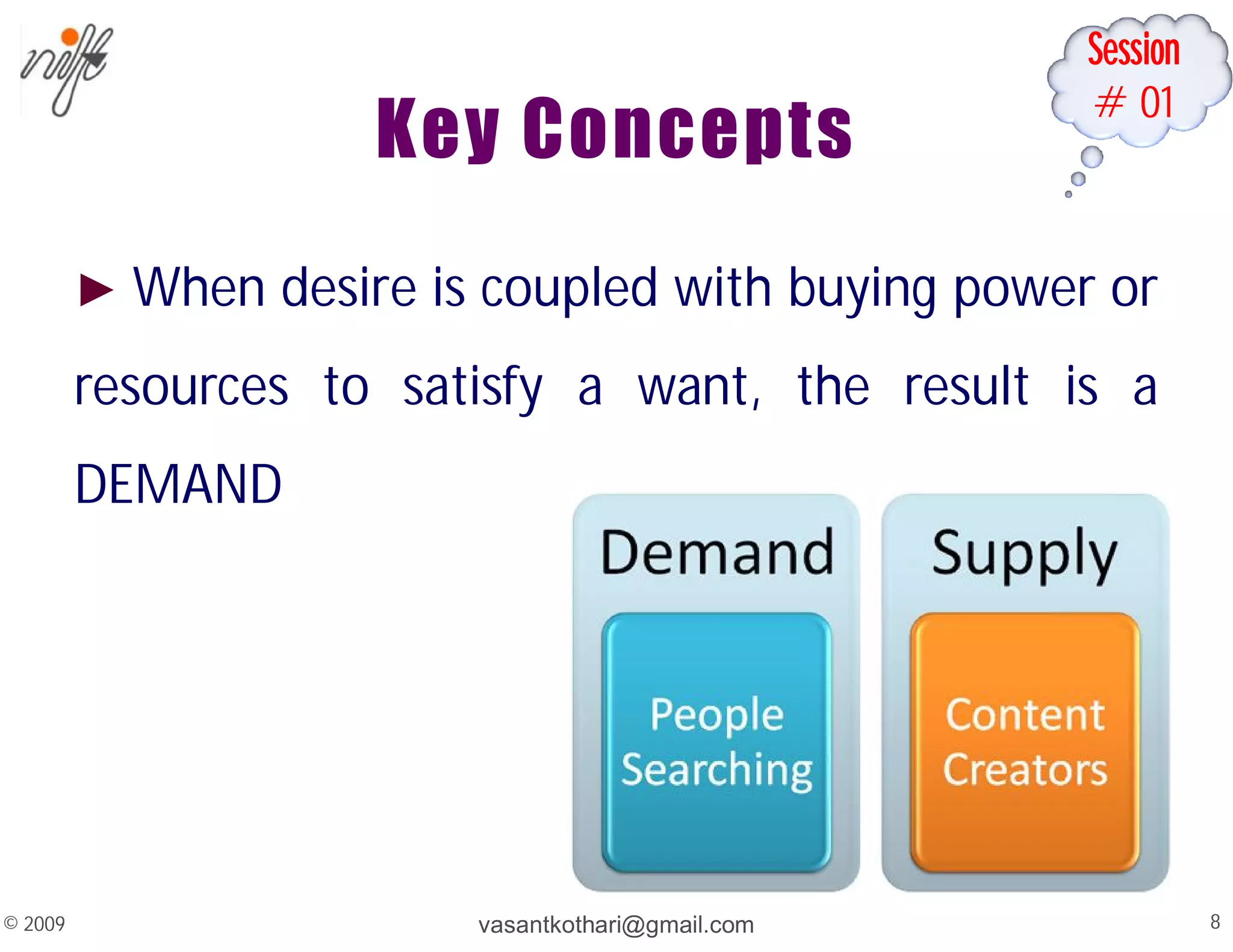
► When desire is coupled with buying power or
resources to satisfy a want, the result is a
DEMAND
vasantkothari@gmail.com 8
© 2009
Session
#01
Key Concepts
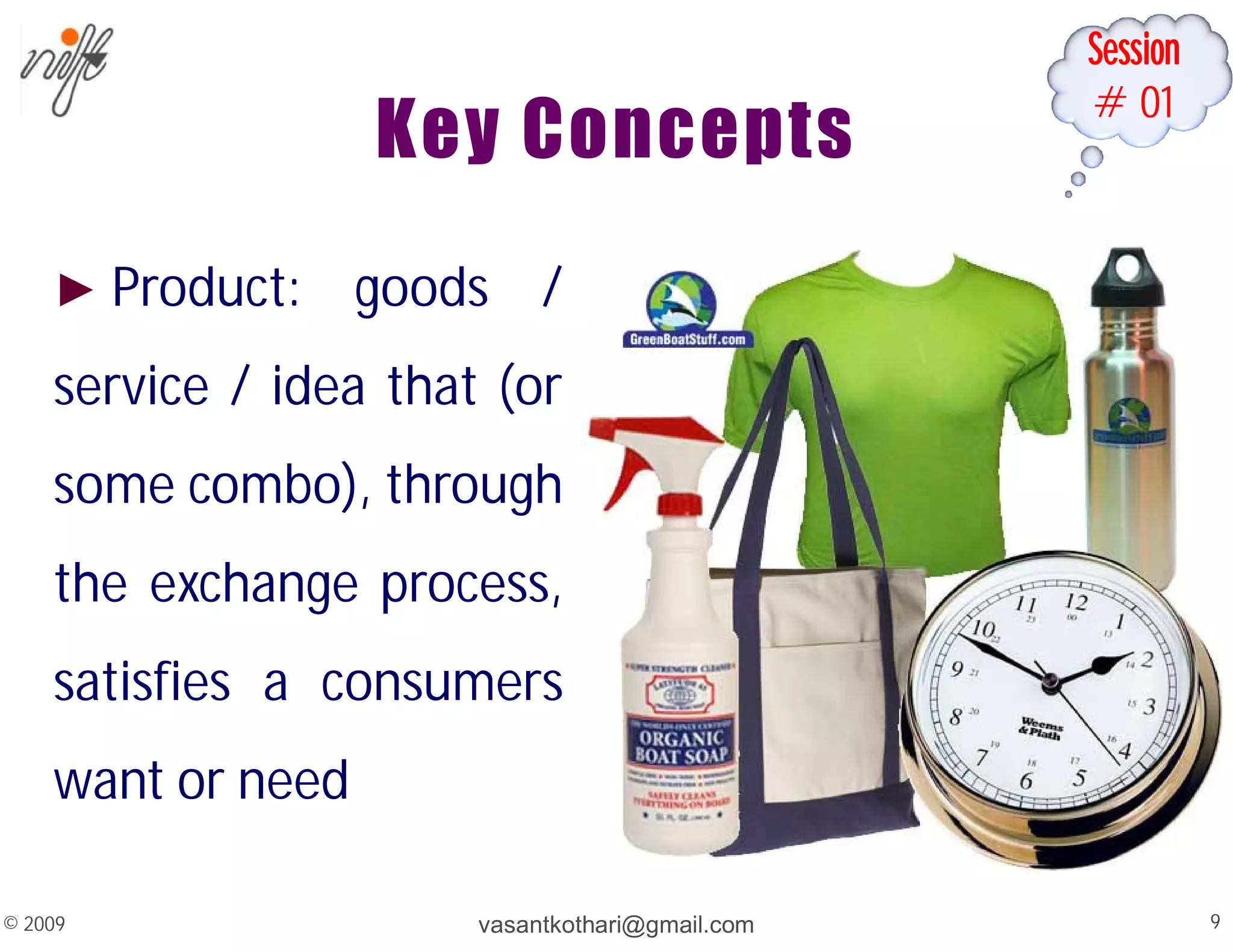
► Product: goods /
service / idea that (or
some combo), through
the exchange process,
satisfies a consumers
want or need
vasantkothari@gmail.com 9
© 2009
Session
#01
Key Concepts
vasantkothari@gmail.com 10
© 2009
► Markets: All the potential customers sharing a
particular need or want, who are willing & able to
engage in exchange to satisfy that need or want
■ Comprised of people who play a series of
roles: decision makers, consumers, purchasers,
and influencers.
Session
#01
vasantkothari@gmail.com 11
© 2009
Session
#01
The Focus of Marketing
So…
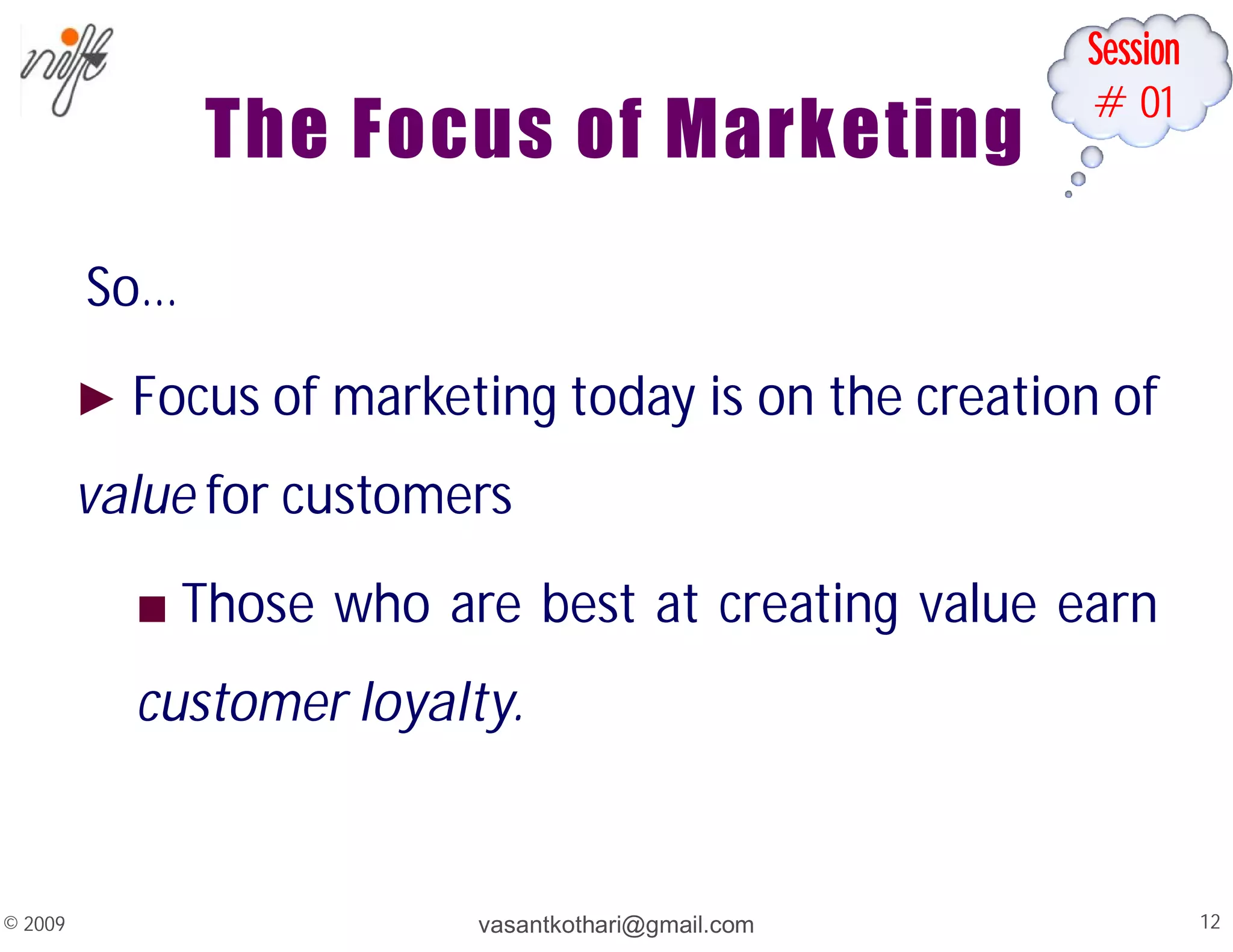
► Focus of marketing today is on the creation of
value for customers
■ Those who are best at creating value earn
customer loyalty.
vasantkothari@gmail.com 12
© 2009
Session
#01
The Marketing Process
► Understand the marketplace and customer
wants and needs
► Design a customer-driven marketing strategy
► Construct a marketing plan that delivers
superior value
vasantkothari@gmail.com 13
© 2009
Session
#01
The Marketing Process
► Build profitable relationships and create
customer satisfaction
► Capture value from customers to create profit
and customer equity
vasantkothari@gmail.com 14
© 2009
Session
#01
What Can Be Marketed?
► Goods
► Services
► Places
► Ideas
► Events
► Persons
► Properties
► Organizations
► Information
► Experiences
vasantkothari@gmail.com 15
© 2009
Session
#01
Evolution of Marketing Thinking
vasantkothari@gmail.com 16
© 2009
Session
#01
Marketing Relationships with
Customers
► Exchange: The transfer of goods, services, or
ideas in return for something of value
vasantkothari@gmail.com 17
© 2009
Session
#01
vasantkothari@gmail.com 18
© 2009
Session
#02
Session
Session
© 2009 19
vasantkothari@gmail.com
Session
#02
The Marketing Mix
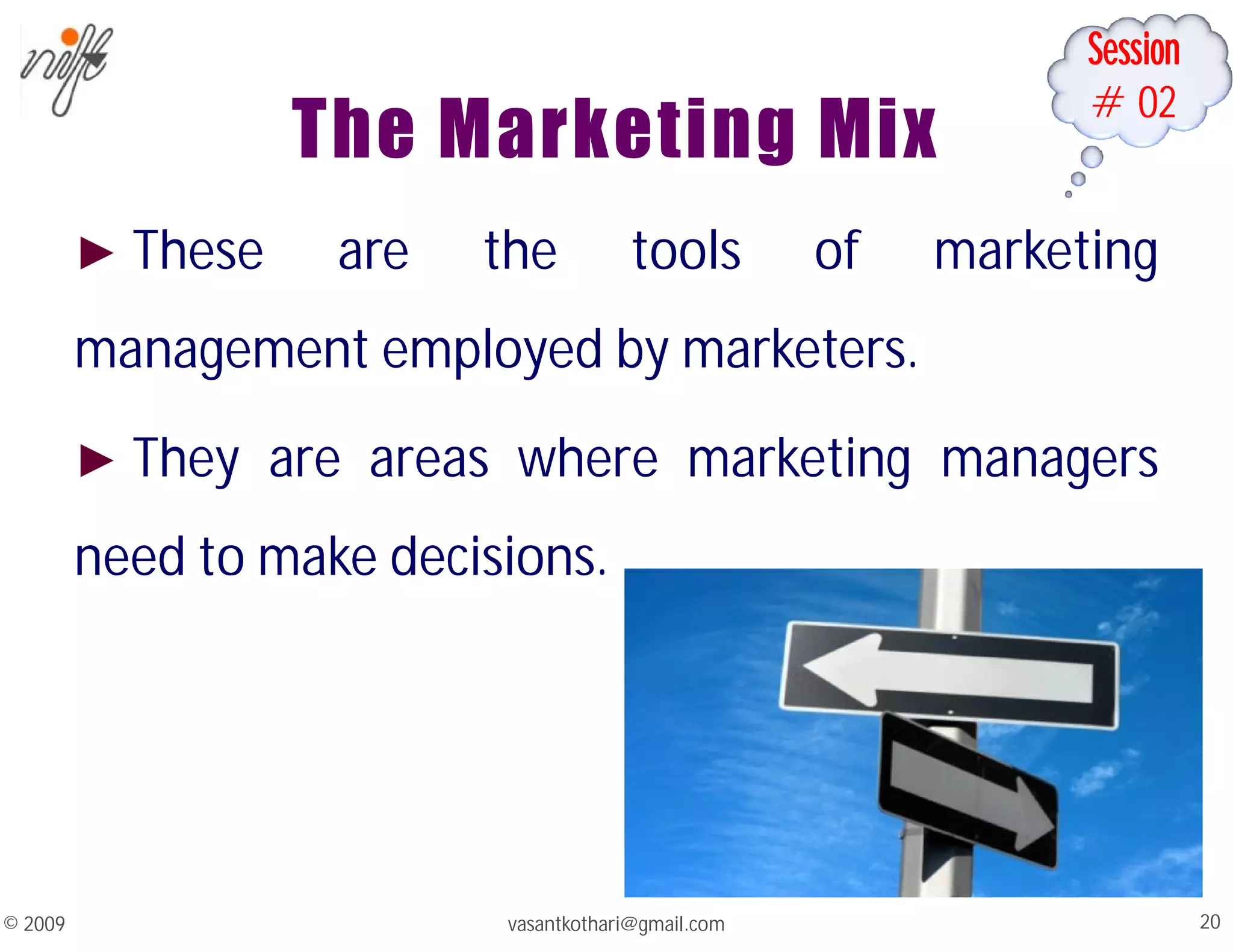
► These are the tools of marketing
management employed by marketers.
► They are areas where marketing managers
need to make decisions.
vasantkothari@gmail.com 20
© 2009
Session
#02
The Marketing Mix
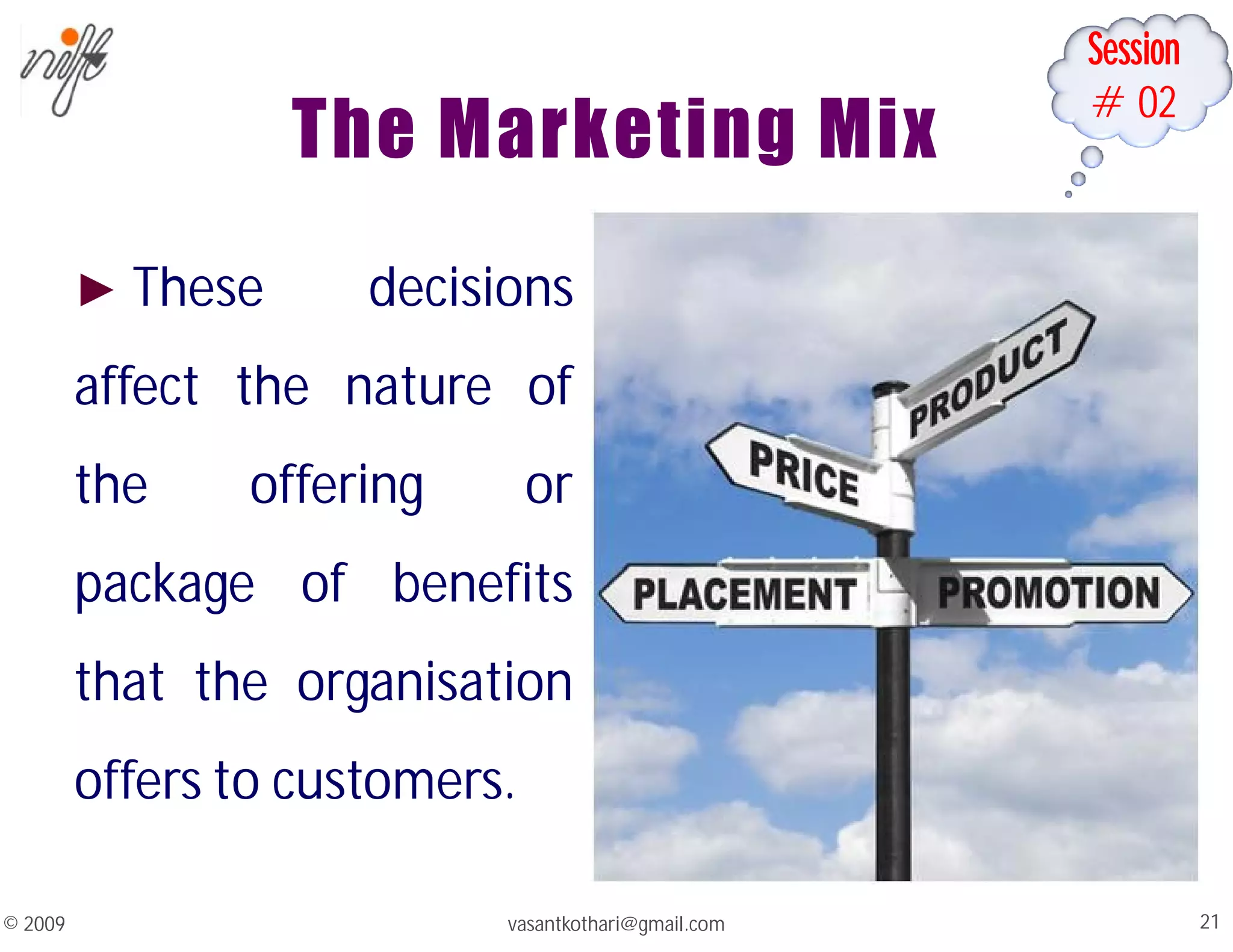
► These decisions
affect the nature of
the offering or
package of benefits
that the organisation
offers to customers.
vasantkothari@gmail.com 21
© 2009
Session
#02
The Marketing Mix
► The term “mix” is used to explain the point
that at any one time the marketer will select a
set of tools from the marketing toolbox or the
marketing mix in specific proportions to solve
specific problems – in the same way one selects
spanners and other tools for a specific job OR
ingredients to bake a particular type of cake.
vasantkothari@gmail.com 22
© 2009
Session
#02
vasantkothari@gmail.com 23
© 2009
The Marketing Mix
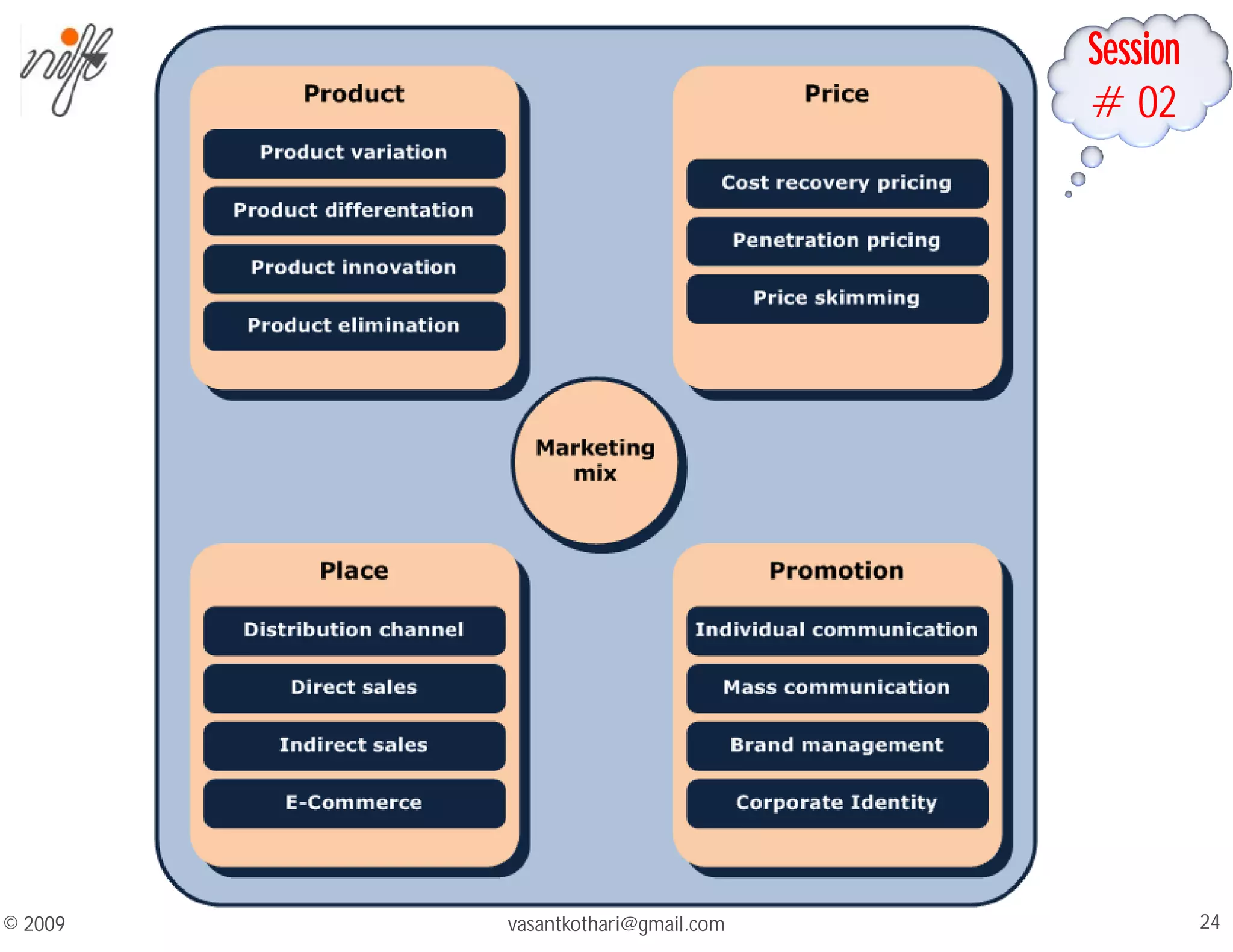
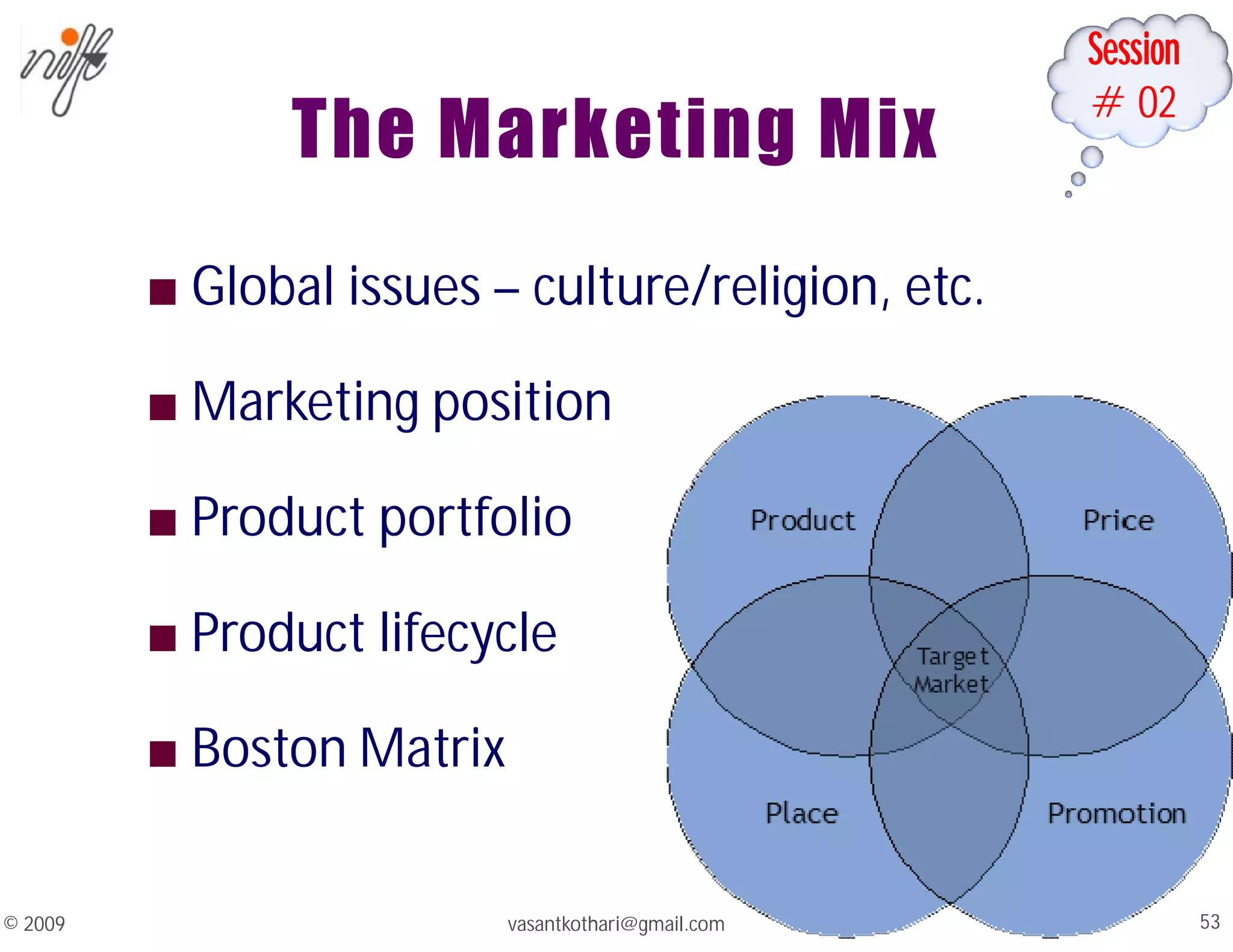
► The marketing mix is the set of tools (four Ps)
the firm uses to implement its marketing
strategy
■ Product
■ Price
■ Promotion
■ Place
Session
#02
vasantkothari@gmail.com 24
© 2009
Session
#02
The Marketing Mix
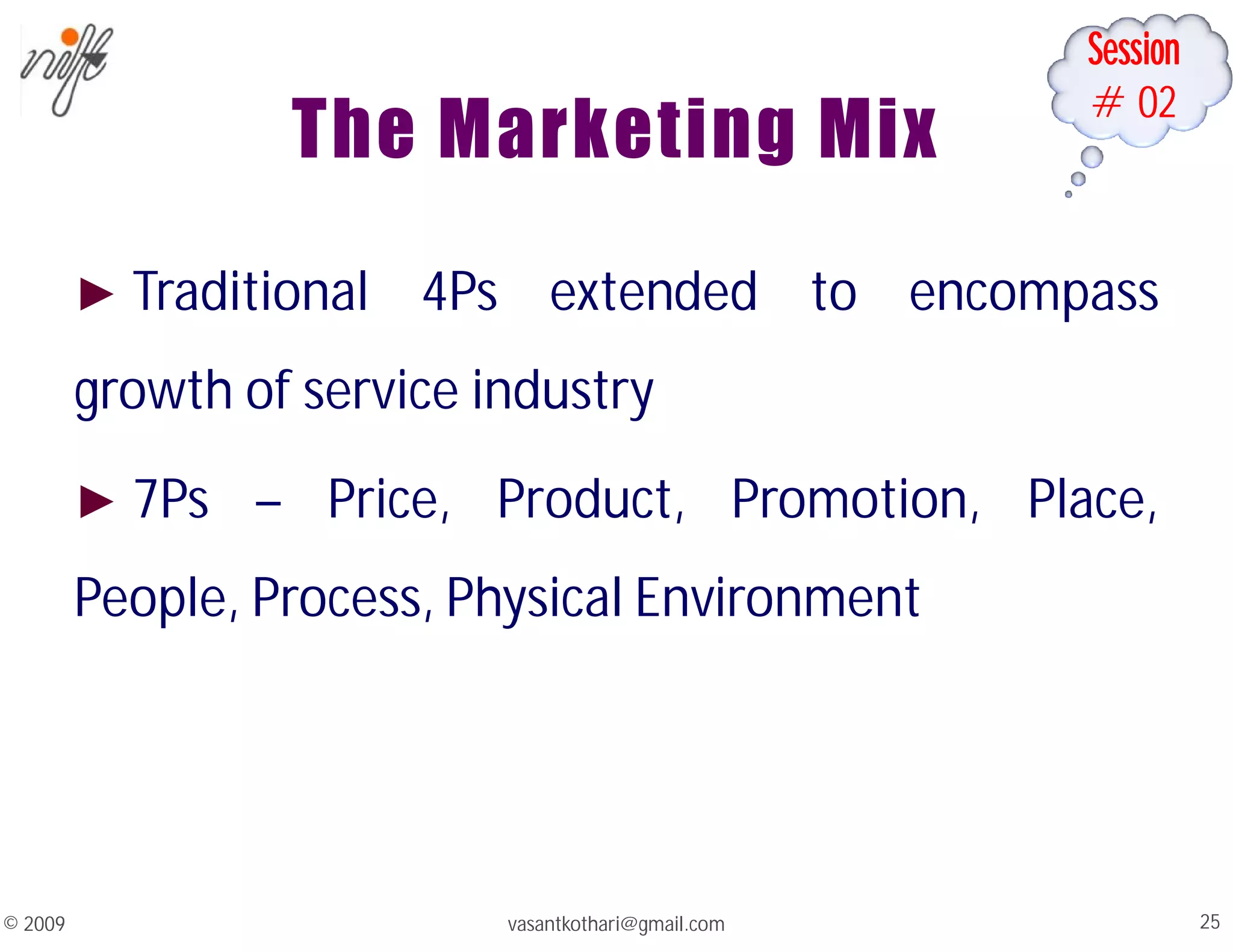
► Traditional 4Ps extended to encompass
growth of service industry
► 7Ps – Price, Product, Promotion, Place,
People, Process, Physical Environment
vasantkothari@gmail.com 25
© 2009
Session
#02
The Seven P’s
► Booms and Bitner extended the traditional 4P
(McCarthy) framework to seven to reflect a
predominantly service economy.
► Extended mix:
■ People
■ Process
■ Physical evidence
vasantkothari@gmail.com 26
© 2009
Session
#02
The Marketing Mix
vasantkothari@gmail.com 27
© 2009
Session
#02
The Marketing Mix
vasantkothari@gmail.com 28
© 2009
Session
#02
The Seven P’s
vasantkothari@gmail.com 29
© 2009
Do Not Copy
Session
#02
The Seven P’s
vasantkothari@gmail.com 30
© 2009
Session
#02
Do Not Copy
Session
#02
Price
© 2009 31
vasantkothari@gmail.com
Do Not Copy
Session
#02
Price
© 2009 32
vasantkothari@gmail.com
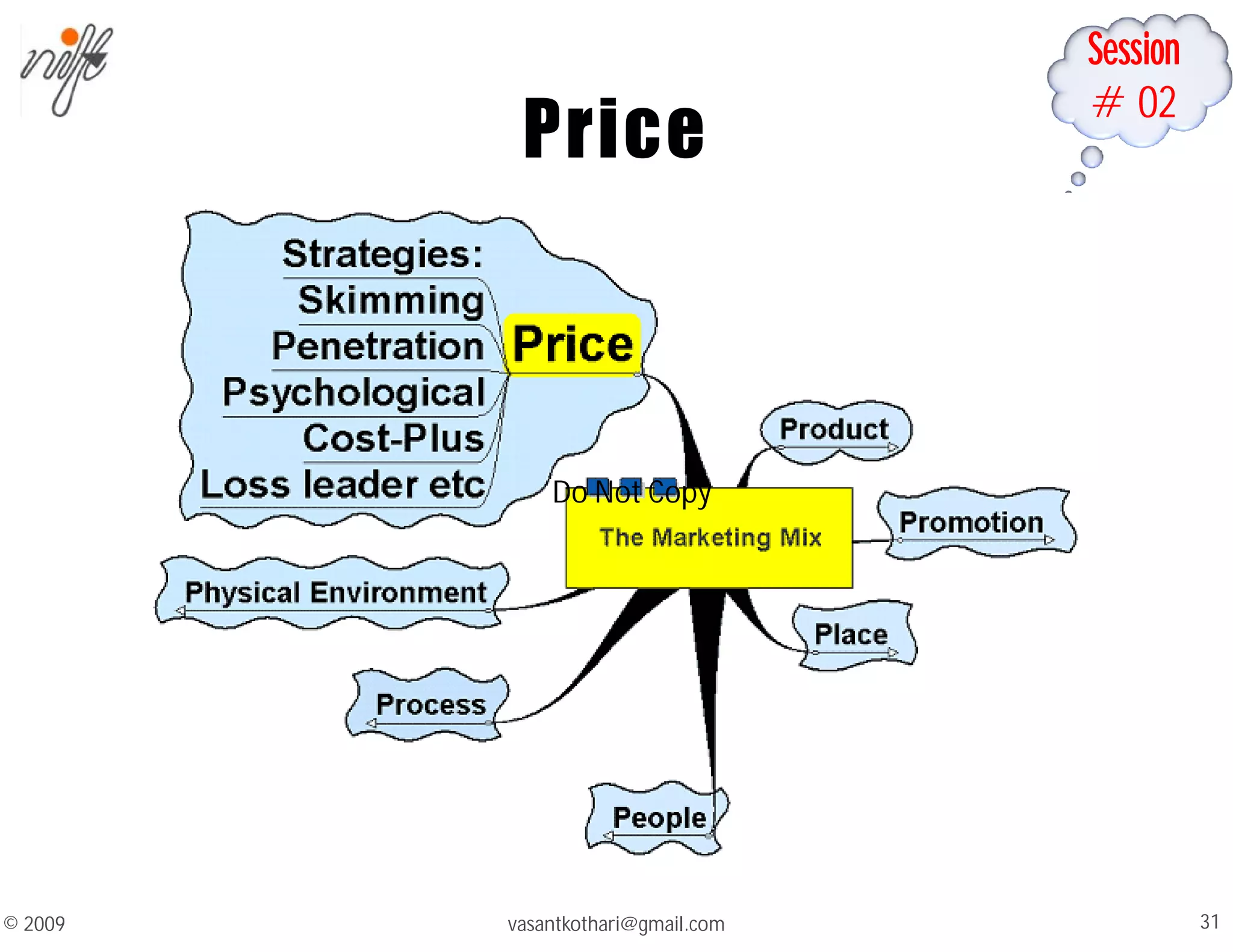
► Pricing Strategy
■ Importance of:
● knowing the market
● elasticity
● keeping an eye on
rivals
Session
#02
Product
© 2009 33
vasantkothari@gmail.com
Do Not Copy
Session
#02
Product
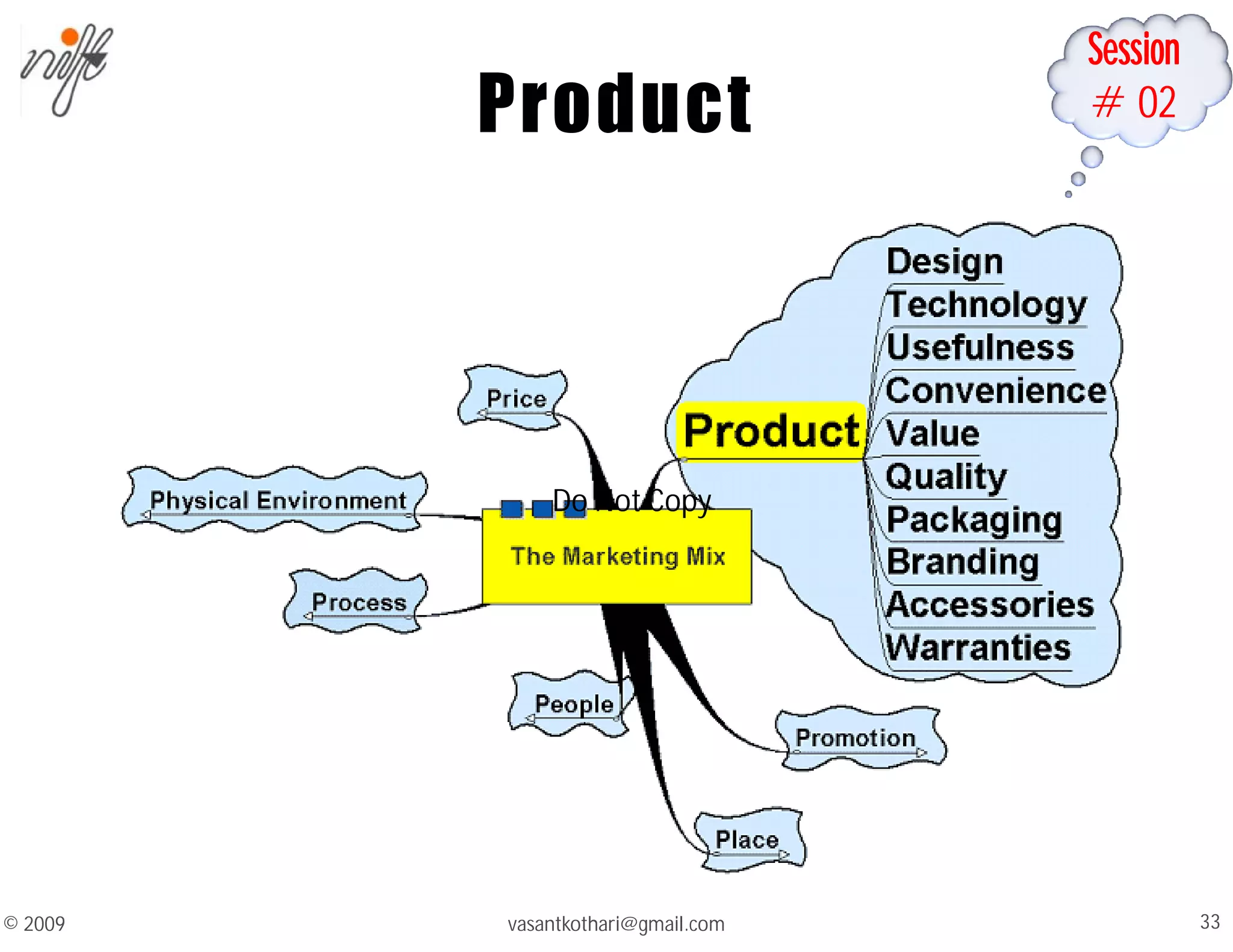
► Methods used to improve/differentiate the
product and increase sales or target sales more
effectively to gain a competitive advantage
► E.g.
© 2009 34
vasantkothari@gmail.com
Session
#02
Product
© 2009 35
vasantkothari@gmail.com
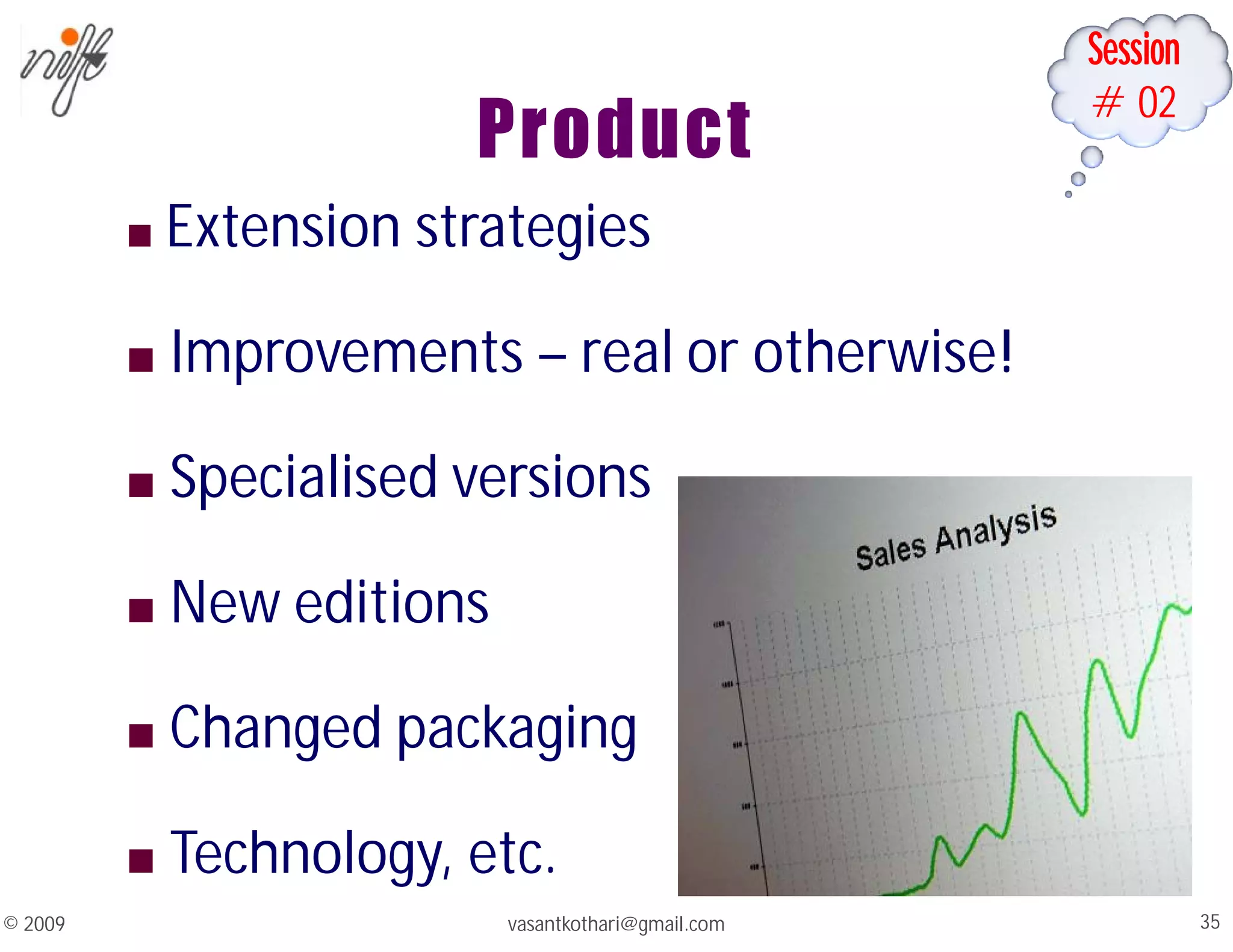
■ Extension strategies
■ Improvements – real or otherwise!
■ Specialised versions
■ New editions
■ Changed packaging
■ Technology, etc.
Session
#02
Promotion
© 2009 36
vasantkothari@gmail.com
Do Not Copy
Session
#02
Promotion
► Strategies to make the consumer aware of
the existence of a product or service
► NOT just advertising
© 2009 37
vasantkothari@gmail.com
Session
#02
Place
© 2009 38
vasantkothari@gmail.com
Do Not Copy
Session
#02
Place
► The means by which products and services
get from producer to consumer and where they
can be accessed by the consumer
► The more places to buy the product and the
easier it is made to buy it, the better for the
business (and the consumer?)
© 2009 39
vasantkothari@gmail.com
Session
#02
People
© 2009 40
vasantkothari@gmail.com
Do Not Copy
Session
#02
People
► People represent the business
► The image they present can be important
► First contact often human – what is the
lasting image they provide to the customer?
© 2009 41
vasantkothari@gmail.com
Session
#02
People
► Extent of training and knowledge of the
product/service concerned
► Mission statement – how relevant?
► Do staff represent the desired culture of
the business?
© 2009 42
vasantkothari@gmail.com
Session
#02
People
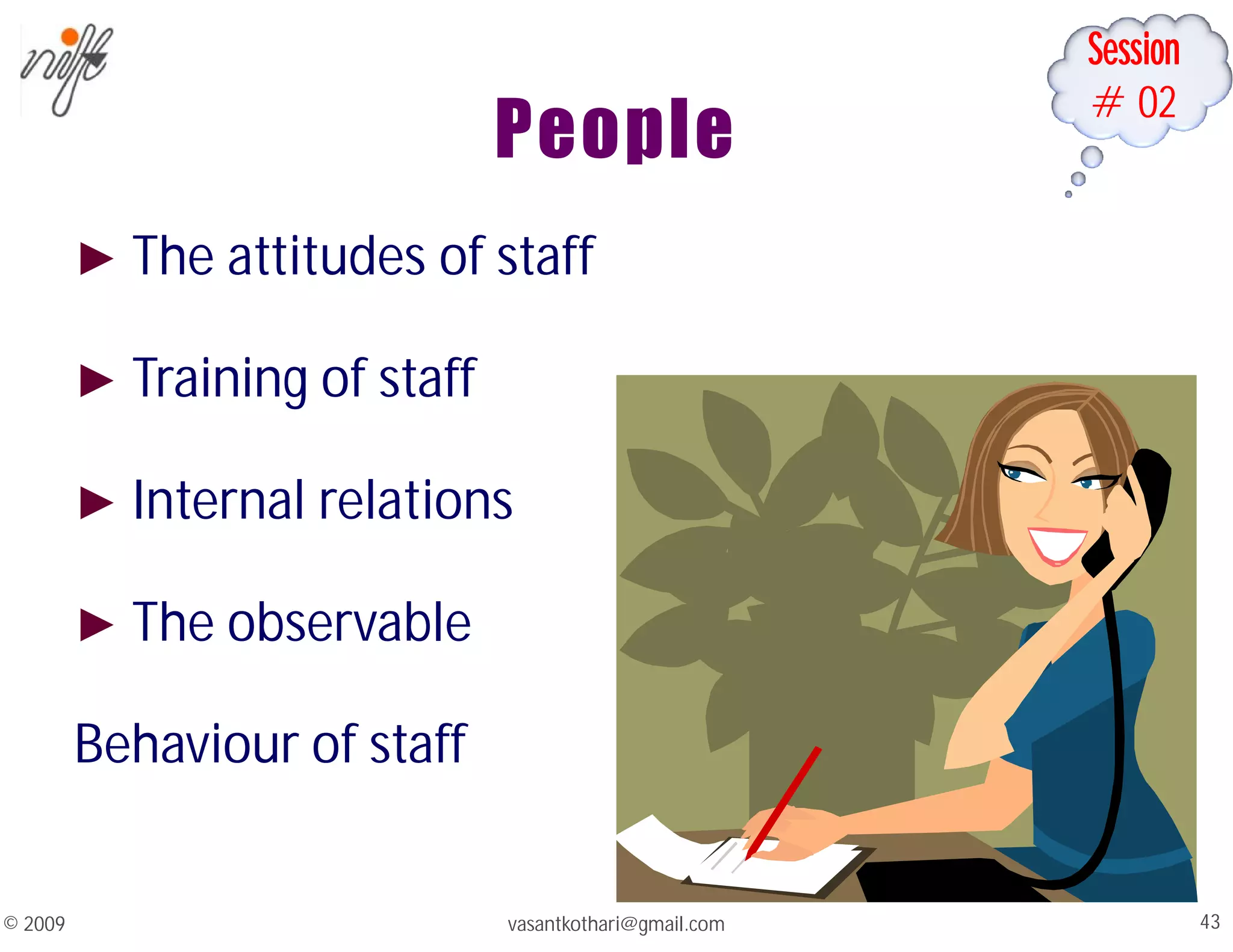
► The attitudes of staff
► Training of staff
► Internal relations
► The observable
Behaviour of staff
vasantkothari@gmail.com 43
© 2009
Session
#02
People
► The level of service-mindedness in the
organization
► The consistency of appearance of staff
► The accessibility of people
► Customer-customer contacts
vasantkothari@gmail.com 44
© 2009
Session
#02
Process
© 2009 45
vasantkothari@gmail.com
Do Not Copy
Session
#02
Process
► The manner in which the service is delivered
► Degree of customer contact
► Quality control standards
► Quality assurance
vasantkothari@gmail.com 46
© 2009
Session
#02
Process
► Payment methods (degree of convenience)
► Queuing systems for customers
► Waiting times
vasantkothari@gmail.com 47
© 2009
Session
#02
Physical Environment
© 2009 48
vasantkothari@gmail.com
Do Not Copy
Session
#02
Physical Environment
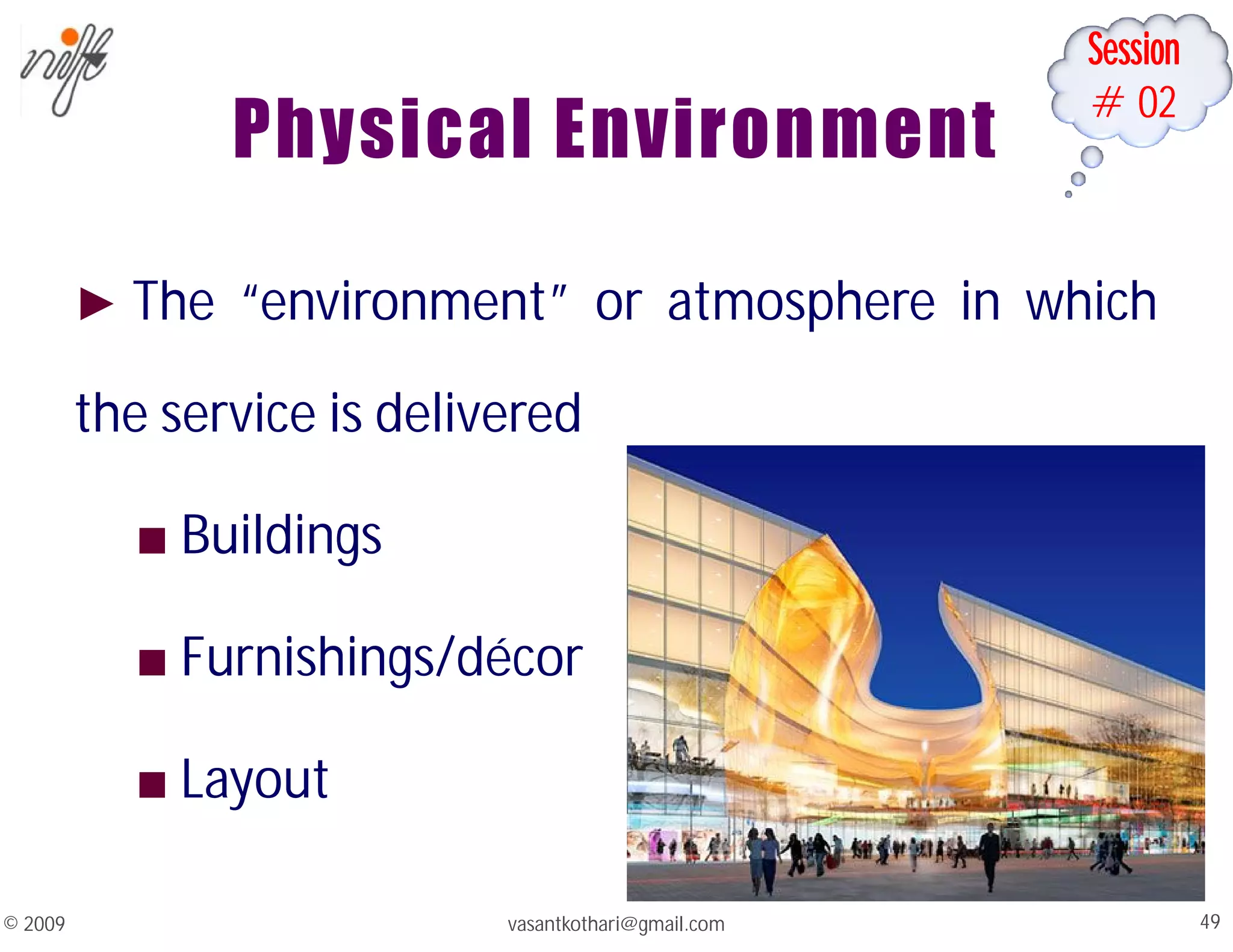
► The “environment” or atmosphere in which
the service is delivered
■ Buildings
■ Furnishings/décor
■ Layout
vasantkothari@gmail.com 49
© 2009
Session
#02
Physical Environment
► Goods associated with the service e.g. carrier
bags, tickets, brochures
► All the above can help shape customers’
perceptions of the service
vasantkothari@gmail.com 50
© 2009
Session
#02
Combining the Mix
► This is the essence of marketing: identifying,
anticipating, and satisfying customer needs in
the most profitable way possible: delivering
profits to the organization and value to
customers at the same time!
vasantkothari@gmail.com 51
© 2009
Session
#02
The Marketing Mix
►Blend of the mix depends upon:
■ Marketing objectives
■ Type of product
■ Target market
■ Market structure
■ Rivals’ behaviour
© 2009 52
vasantkothari@gmail.com
Session
#02
The Marketing Mix
■ Global issues – culture/religion, etc.
■ Marketing position
■ Product portfolio
■ Product lifecycle
■ Boston Matrix
© 2009 53
vasantkothari@gmail.com
Session
#03
Session
Session
© 2009 54
vasantkothari@gmail.com
Session
#03
Selling Vs Marketing
vasantkothari@gmail.com 55
© 2009
•What and
how to sell
Marketing
Marketing
•moving the
product
Selling
Selling
Session
#03
vasantkothari@gmail.com 56
© 2009
Selling Vs Marketing
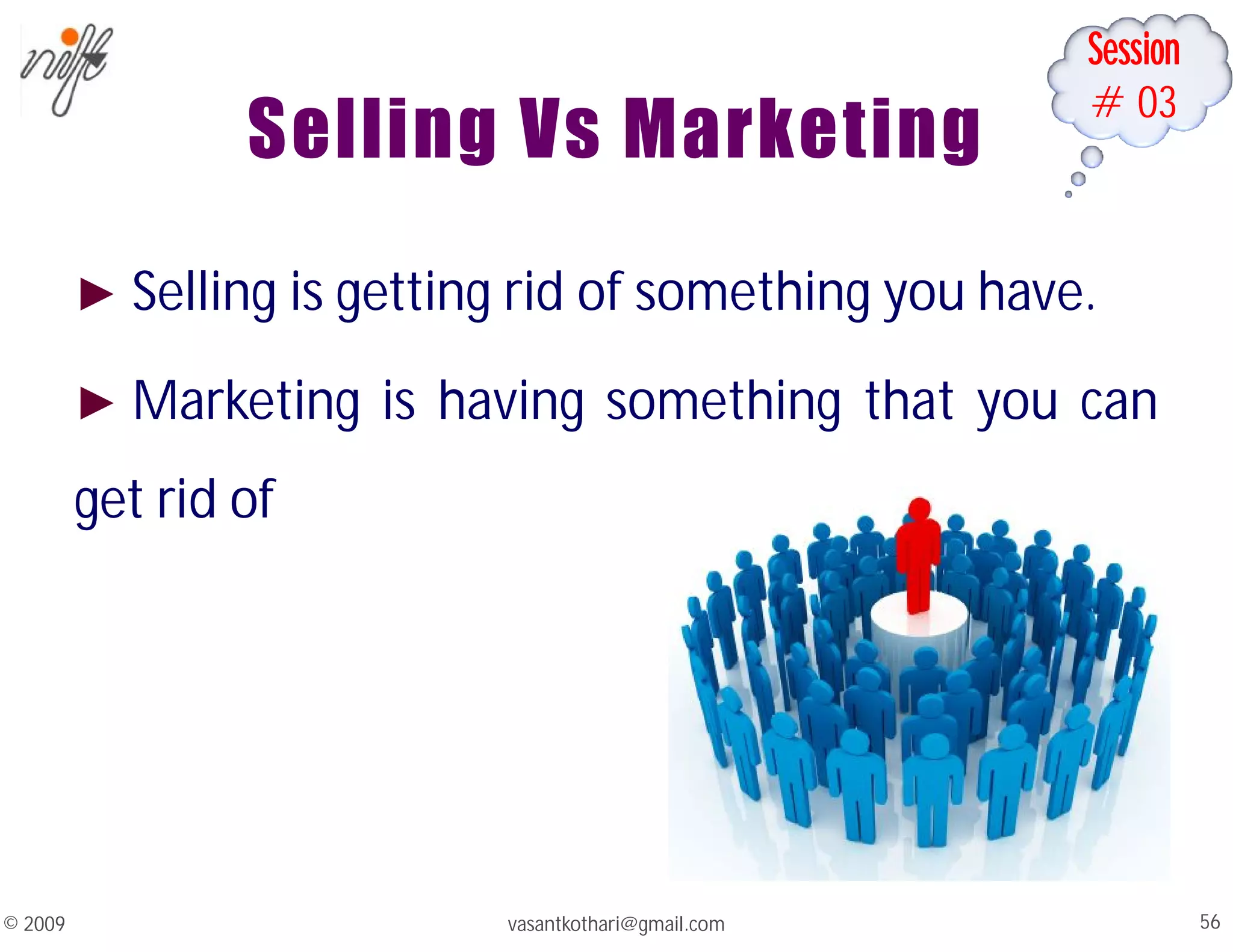
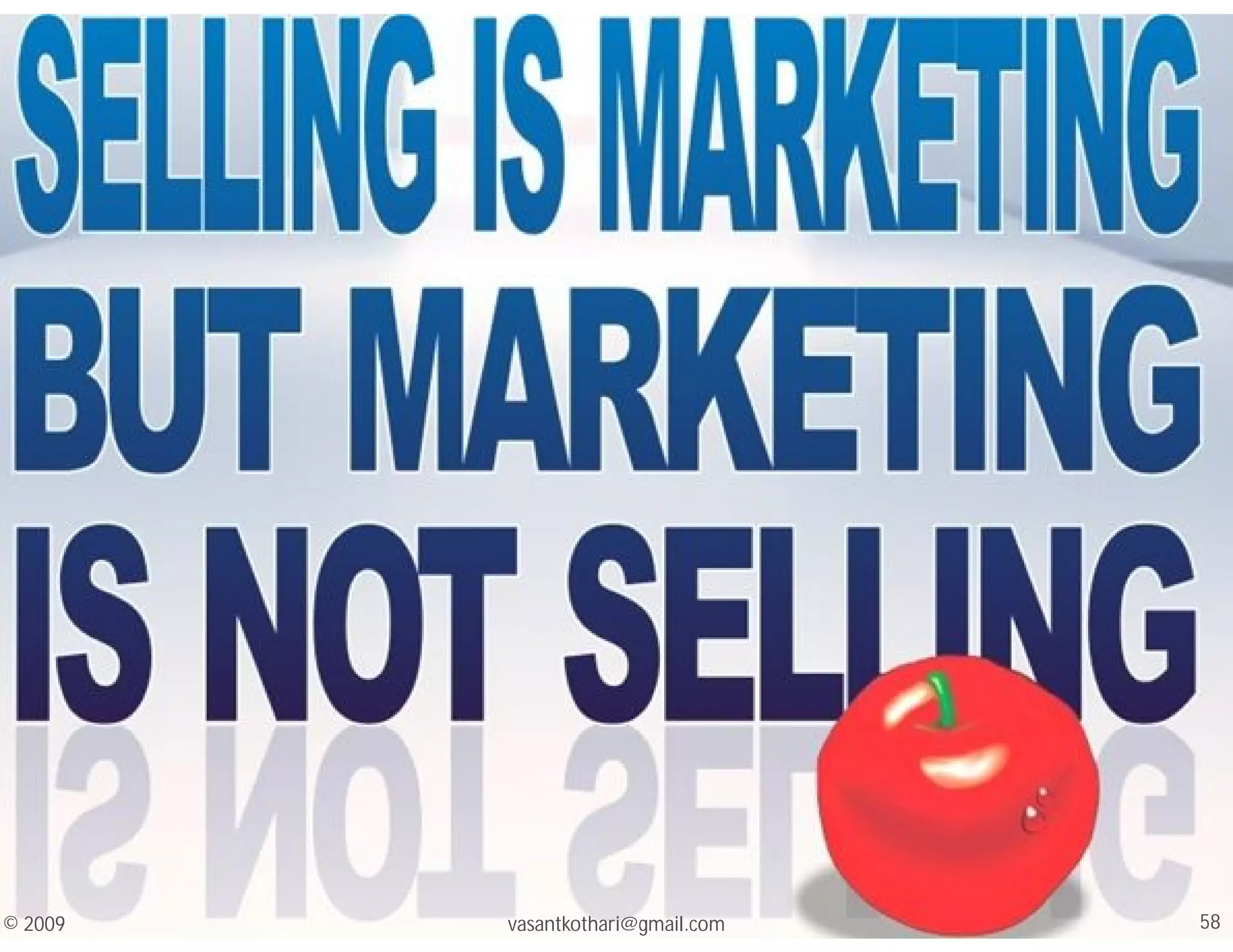
► Selling is getting rid of something you have.
► Marketing is having something that you can
get rid of
Session
#03
Selling Vs Marketing
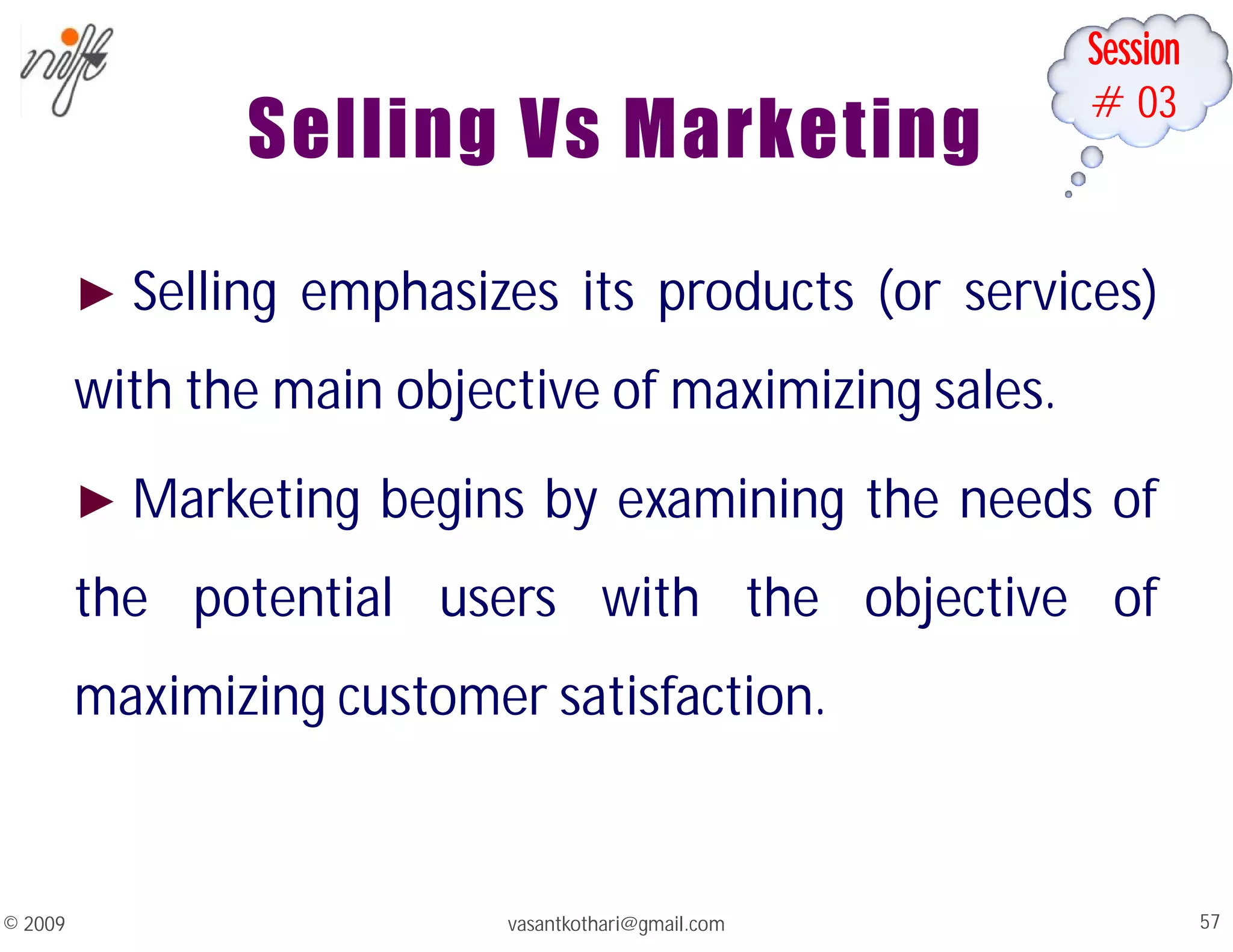
► Selling emphasizes its products (or services)
with the main objective of maximizing sales.
► Marketing begins by examining the needs of
the potential users with the objective of
maximizing customer satisfaction.
vasantkothari@gmail.com 57
© 2009
Session
#03
vasantkothari@gmail.com 58
© 2009
Session
#03
vasantkothari@gmail.com 59
© 2009
Session
#03
vasantkothari@gmail.com 60
© 2009
Session
#03
vasantkothari@gmail.com 61
© 2009
Session
#03
vasantkothari@gmail.com 62
© 2009
Session
#03
vasantkothari@gmail.com 63
© 2009
Session
#03
Selling Vs Marketing
vasantkothari@gmail.com 64
© 2009
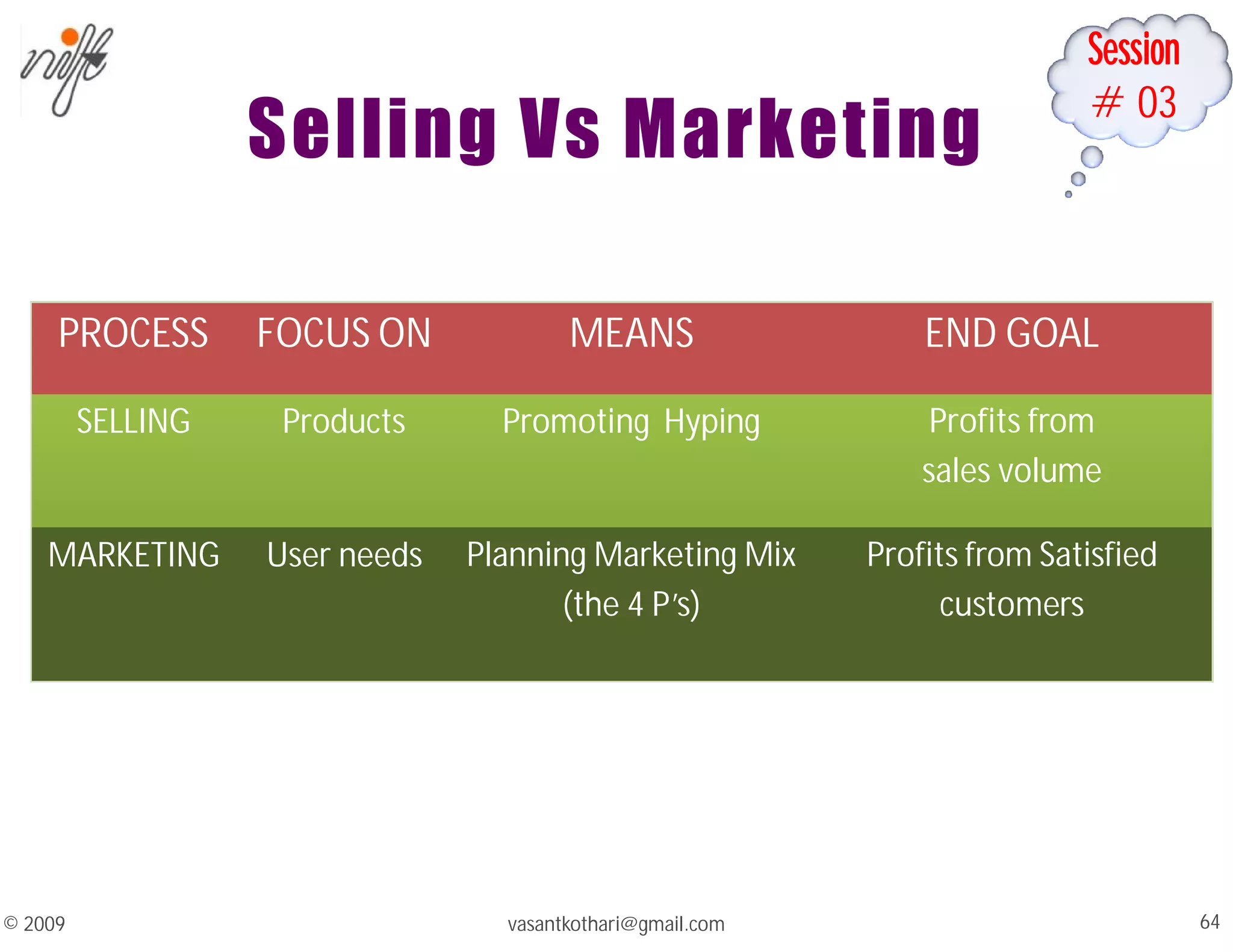
PROCESS FOCUS ON MEANS END GOAL
SELLING Products Promoting Hyping Profits from
sales volume
MARKETING User needs Planning Marketing Mix
(the 4 P’s)
Profits from Satisfied
customers
Session
#03
Selling Vs Marketing
vasantkothari@gmail.com 65
© 2009
Session
#03
Selling Vs Marketing
vasantkothari@gmail.com 66
© 2009
Session
#03
Selling vs Marketing
vasantkothari@gmail.com 67
© 2009
► Selling
■ Emphasis on product
■ Make product, then sell it
■ Sales volume orientated
■ Short-run orientated
■ Focus on seller’s needs
Session
#03
Selling vs Marketing
► Marketing
■ Emphasis on customer
■ Determine customer wants, then make product
■ Profit orientated
■ Long-run orientated
■ Focus on buyer’s needs
vasantkothari@gmail.com 68
© 2009
Session
#04
Session
Session
© 2009 69
vasantkothari@gmail.com
Session
#04
vasantkothari@gmail.com 70
© 2009
Marketing Environment
► Successful companies take an outside-inside
view of their business.
► They recognize that the marketing environment
is constantly spinning new opportunities & threats
& understand the importance of continuously
monitoring & adapting to that environment.
Session
#04
Marketing Environment
► The marketing environment surrounds and
impacts upon the organization.
► There are three key perspectives on the
marketing environment, namely
■ the 'macro-environment,‘
■ the 'micro-environment' and
■ the 'internal environment'.
vasantkothari@gmail.com 71
© 2009
Session
#04
Marketing Environment
vasantkothari@gmail.com 72
© 2009
Session
#04
Macro Environment
► This includes all
factors that can
influence and
organization, but
that are out of their
direct control.
vasantkothari@gmail.com 73
© 2009
Session
#04
Macro Environment
► A company does not generally influence any
laws.
► It is continuously changing, and the company
needs to be flexible to adapt.
► There may be aggressive competition and
rivalry in a market.
vasantkothari@gmail.com 74
© 2009
Session
#04
Macro Environment
► Globalization means that there is always the
threat of substitute products and new entrants.
► The wider environment is also ever changing,
and the marketer needs to compensate for
changes in culture, politics, economics and
technology.
vasantkothari@gmail.com 75
© 2009
Session
#04
Micro-environment
► This environment influences the organization
directly.
► It includes suppliers that deal directly or
indirectly, consumers and customers, and other
local stakeholders.
vasantkothari@gmail.com 76
© 2009
Session
#04
Micro-environment
► In this context, micro describes the
relationship between firms and the driving
forces that control this relationship.
► It is a more local relationship, and the firm
may exercise a degree of influence.
vasantkothari@gmail.com 77
© 2009
Session
#04
External Micro-Environment
► Market
■ People or organizations with wants to
satisfy, money to spend, and the willingness
to spend it
vasantkothari@gmail.com 78
© 2009
Session
#04
External Micro-Environment
► Suppliers
■ Provide goods and/or services and affect
the prices a marketer must charge as well as
their ability to satisfy their customers
vasantkothari@gmail.com 79
© 2009
Session
#04
External Micro-Environment
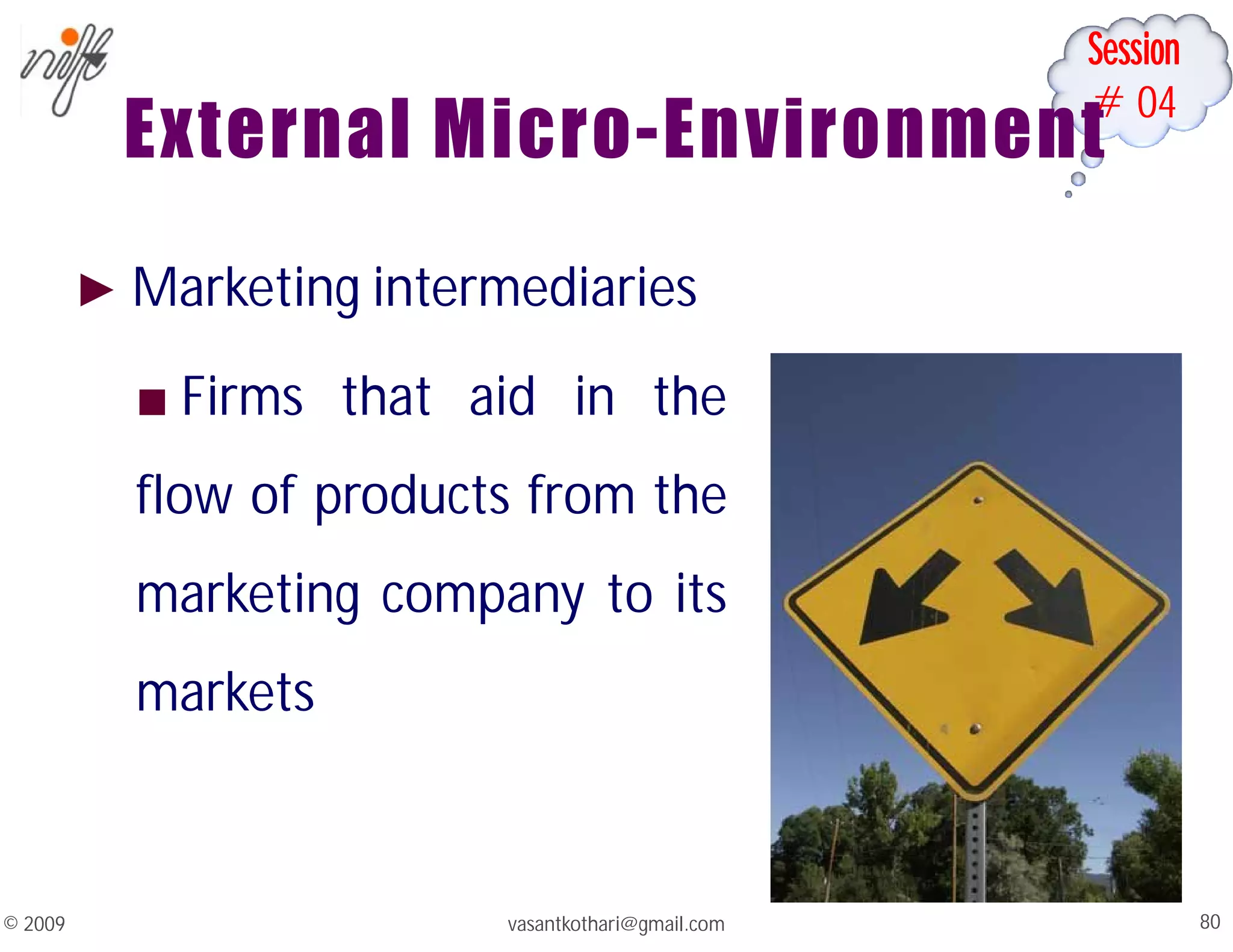
► Marketing intermediaries
■ Firms that aid in the
flow of products from the
marketing company to its
markets
vasantkothari@gmail.com 80
© 2009
Session
#04
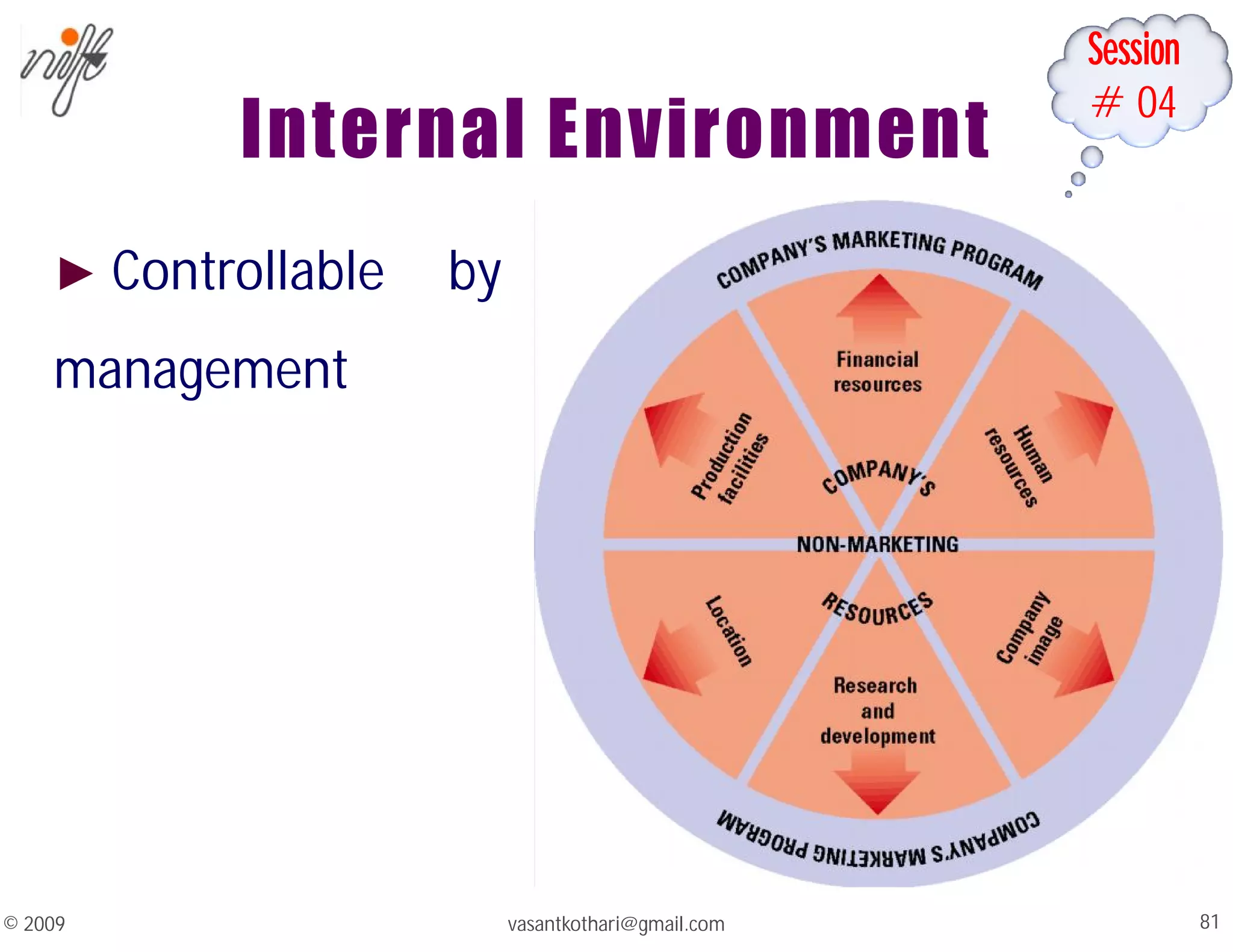
Internal Environment
► Controllable by
management
vasantkothari@gmail.com 81
© 2009
Session
#04
Internal Environment
► All factors that are internal to the
organization are known as the 'internal
environment'.
► They are generally audited by applying the
'Five Ms' which are Men, Money, Machinery,
Materials and Markets.
vasantkothari@gmail.com 82
© 2009
Session
#04
Internal Environment
vasantkothari@gmail.com 83
© 2009
Session
#04
Session
#05
Session
Session
© 2009 84
vasantkothari@gmail.com
Session
#05
vasantkothari@gmail.com 85
© 2009
Functions of Marketing
► The mission of marketing is satisfying
customer needs.
► Marketing has a
connective function in
society.
Session
#05
vasantkothari@gmail.com 86
© 2009
Functions of Marketing
► It connects supply and demand or production
and consumption.
► At micro-level, marketing builds and
maintains the relationship between producer
and consumer.
Session
#05
vasantkothari@gmail.com 87
© 2009
Functions of Marketing
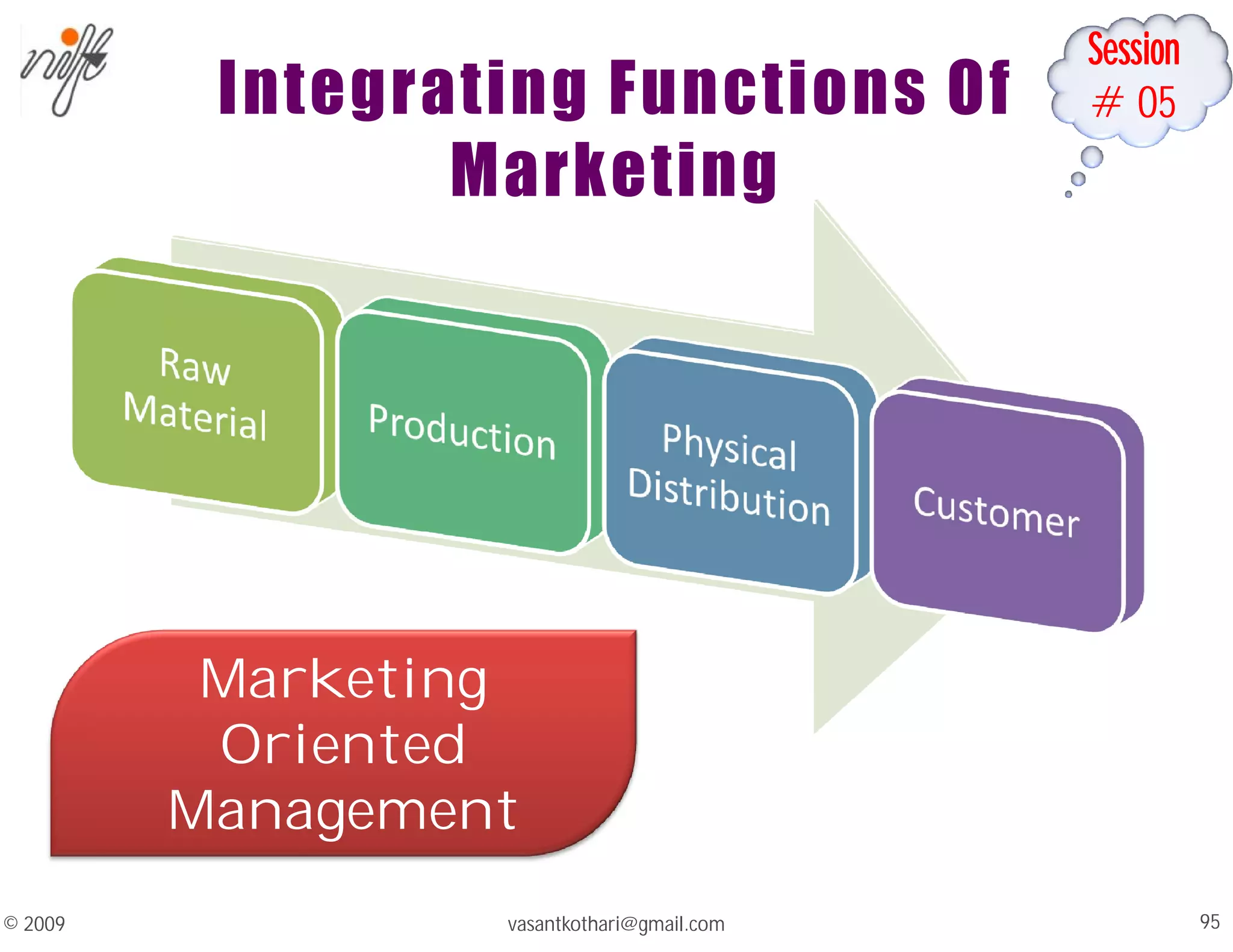
► At business unit level, marketing can have an
integrative function.
► It integrates all the functions and parts of a
company to serve the markets.
Session
#05
vasantkothari@gmail.com 88
© 2009
Functions of Marketing
► The narrowest definition is to see marketing
as a function of a business enterprise between
production and markets taking care that
products move smoothly from production to
customers.
Session
#05
vasantkothari@gmail.com 89
© 2009
Societal Function of Marketing
► In modern society production and
consumption are apart from each other.
Marketing connects them.
► From the societal point of view, marketing is a
philosophy which shows how to create effective
production systems & consequently prosperity.
Session
#05
Societal Function of Marketing
► Business is a subsystem of society, which has
both a social and an economic role. Thus, a
company must operate in a way that will make
possible the production of benefits for society
and, at the same time, produce profits for the
company itself.
vasantkothari@gmail.com 90
© 2009
Session
#05
Societal Function of Marketing
► The role of marketing in society means also
responsibilities. In addition to economic and
social responsibility, ecological responsibility is
nowadays emphasized.
vasantkothari@gmail.com 91
© 2009
Session
#05
Traditional & Integrating
Functions Of Marketing
vasantkothari@gmail.com 92
© 2009
Session
#05
Functions Of Marketing
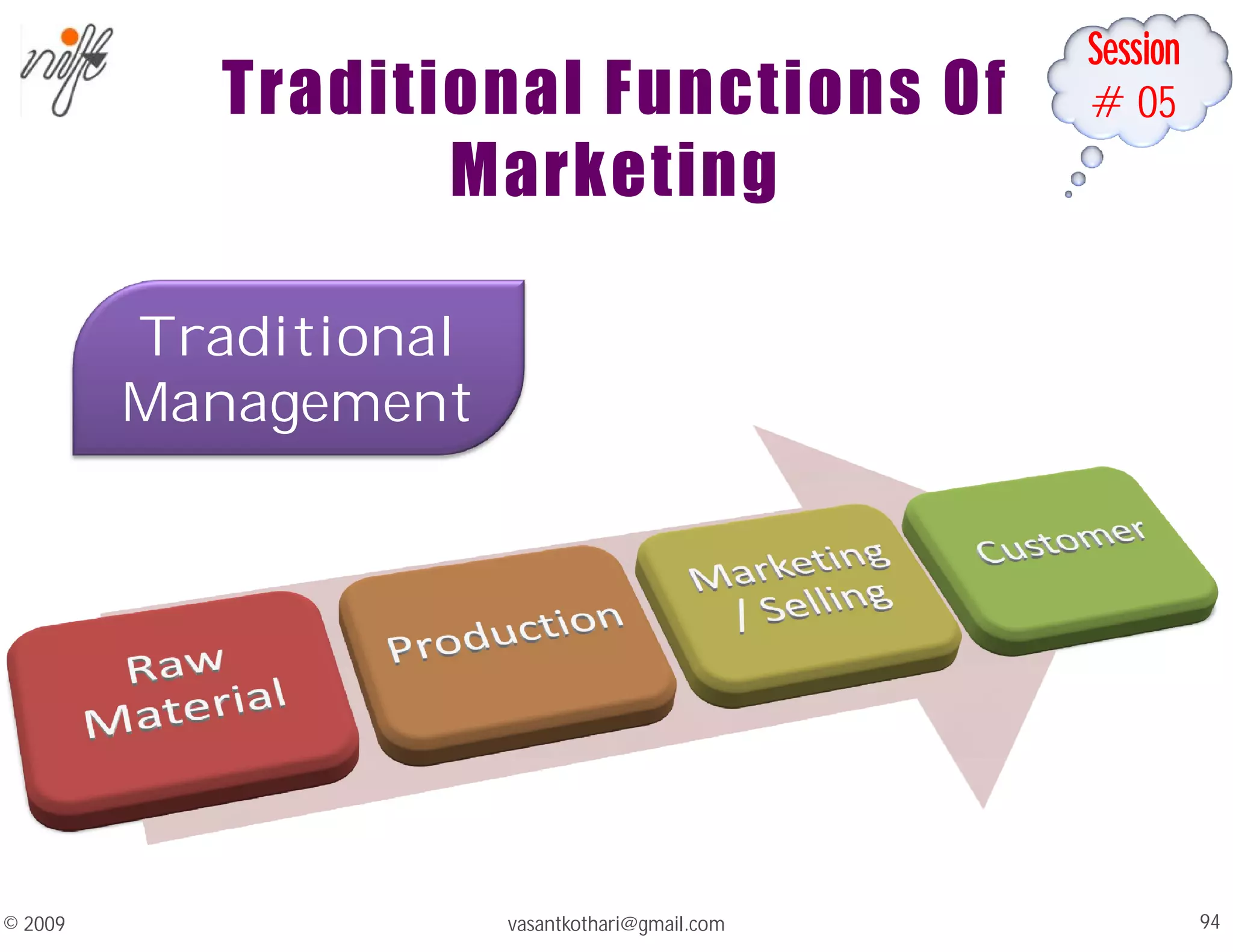
► Traditionally, marketing has been seen as a
link between production and customer.
► The situation could be captured better by
using the term selling.
vasantkothari@gmail.com 93
© 2009
Session
#05
Traditional Functions Of
Marketing
vasantkothari@gmail.com 94
© 2009
Traditional
Management
Session
#05
Integrating Functions Of
Marketing
vasantkothari@gmail.com 95
© 2009
Marketing
Oriented
Management
Session
#05
Marketing Functions
► Marketing was born out of a need to take
better into consideration the demand factors in
production planning.
► The function of marketing is to channel
information of consumer needs to production &
satisfaction of needs to consumers.
vasantkothari@gmail.com 96
© 2009
Session
#05
Marketing Functions
► The basic power of marketing is the aspiration
to produce and sell only that kind of products
which have demand.
► Marketing integrates the whole company to
serve this demand.
vasantkothari@gmail.com 97
© 2009
Session
#05
Marketing Functions
► Marketing aims at effective production
systems, where information is transmitted
effectively between production and
consumption.
vasantkothari@gmail.com 98
© 2009

1 - 5.pdf