Notes by Prof. M. B. Thakoor


                 MARGINAL COSTING
                     SYNOPSIS

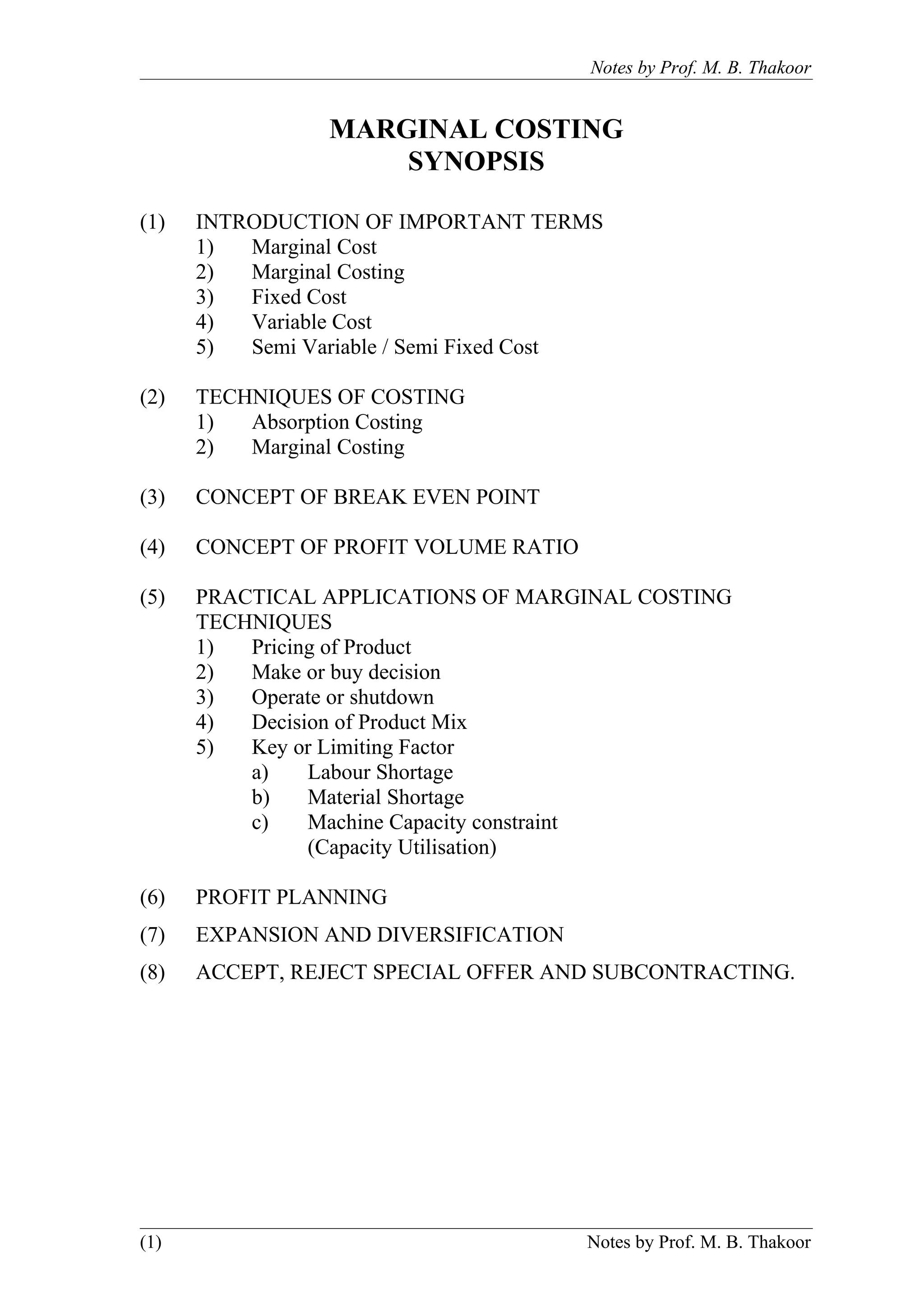
(1)   INTRODUCTION OF IMPORTANT TERMS
      1)  Marginal Cost
      2)  Marginal Costing
      3)  Fixed Cost
      4)  Variable Cost
      5)  Semi Variable / Semi Fixed Cost

(2)   TECHNIQUES OF COSTING
      1)  Absorption Costing
      2)  Marginal Costing

(3)   CONCEPT OF BREAK EVEN POINT

(4)   CONCEPT OF PROFIT VOLUME RATIO

(5)   PRACTICAL APPLICATIONS OF MARGINAL COSTING
      TECHNIQUES
      1)  Pricing of Product
      2)  Make or buy decision
      3)  Operate or shutdown
      4)  Decision of Product Mix
      5)  Key or Limiting Factor
          a)    Labour Shortage
          b)    Material Shortage
          c)    Machine Capacity constraint
                (Capacity Utilisation)

(6)   PROFIT PLANNING
(7)   EXPANSION AND DIVERSIFICATION
(8)   ACCEPT, REJECT SPECIAL OFFER AND SUBCONTRACTING.


(1)                                    Notes by Prof. M. B. Thakoor
Notes by Prof. M. B. Thakoor


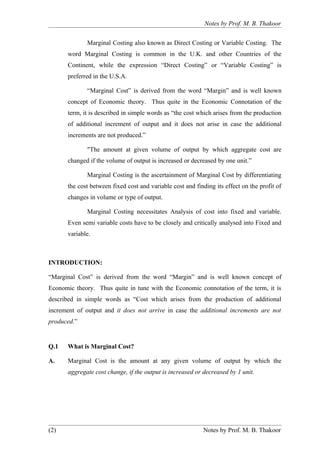
             Marginal Costing also known as Direct Costing or Variable Costing. The
      word Marginal Costing is common in the U.K. and other Countries of the
      Continent, while the expression “Direct Costing” or “Variable Costing” is
      preferred in the U.S.A.

             “Marginal Cost” is derived from the word “Margin” and is well known
      concept of Economic theory. Thus quite in the Economic Connotation of the
      term, it is described in simple words as “the cost which arises from the production
      of additional increment of output and it does not arise in case the additional
      increments are not produced.”

             "The amount at given volume of output by which aggregate cost are
      changed if the volume of output is increased or decreased by one unit.”

             Marginal Costing is the ascertainment of Marginal Cost by differentiating
      the cost between fixed cost and variable cost and finding its effect on the profit of
      changes in volume or type of output.

             Marginal Costing necessitates Analysis of cost into fixed and variable.
      Even semi variable costs have to be closely and critically analysed into Fixed and
      variable.


INTRODUCTION:

“Marginal Cost” is derived from the word “Margin” and is well known concept of
Economic theory. Thus quite in tune with the Economic connotation of the term, it is
described in simple words as “Cost which arises from the production of additional
increment of output and it does not arrive in case the additional increments are not
produced.”


Q.1   What is Marginal Cost?

A.    Marginal Cost is the amount at any given volume of output by which the
      aggregate cost change, if the output is increased or decreased by 1 unit.


(2)                                                        Notes by Prof. M. B. Thakoor
Notes by Prof. M. B. Thakoor


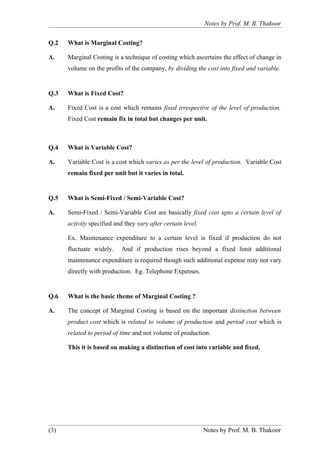
Q.2   What is Marginal Costing?

A.    Marginal Costing is a technique of costing which ascertains the effect of change in
      volume on the profits of the company, by dividing the cost into fixed and variable.


Q.3   What is Fixed Cost?

A.    Fixed Cost is a cost which remains fixed irrespective of the level of production.
      Fixed Cost remain fix in total but changes per unit.


Q.4   What is Variable Cost?

A.    Variable Cost is a cost which varies as per the level of production. Variable Cost
      remain fixed per unit but it varies in total.


Q.5   What is Semi-Fixed / Semi-Variable Cost?

A.    Semi-Fixed / Semi-Variable Cost are basically fixed cost upto a certain level of
      activity specified and they vary after certain level.

      Ex. Maintenance expenditure to a certain level is fixed if production do not
      fluctuate widely.    And if production rises beyond a fixed limit additional
      maintenance expenditure is required though such additional expense may not vary
      directly with production. Eg. Telephone Expenses.


Q.6   What is the basic theme of Marginal Costing ?

A.    The concept of Marginal Costing is based on the important distinction between
      product cost which is related to volume of production and period cost which is
      related to period of time and not volume of production.

      This it is based on making a distinction of cost into variable and fixed.


(3)                                                           Notes by Prof. M. B. Thakoor
Notes by Prof. M. B. Thakoor


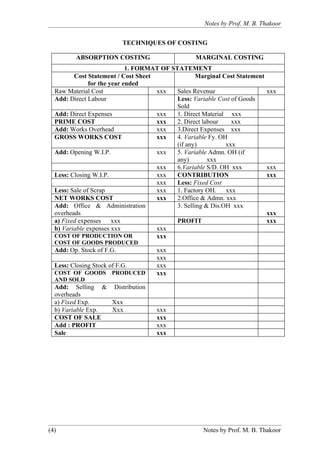
                           TECHNIQUES OF COSTING

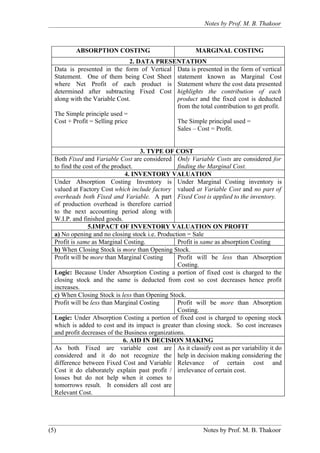
          ABSORPTION COSTING                      MARGINAL COSTING
                             1. FORMAT OF STATEMENT
         Cost Statement / Cost Sheet               Marginal Cost Statement
               for the year ended
  Raw Material Cost                  xxx    Sales Revenue                    xxx
  Add: Direct Labour                        Less: Variable Cost of Goods
                                            Sold
  Add: Direct Expenses               xxx    1. Direct Material xxx
  PRIME COST                         xxx    2. Direct labour    xxx
  Add: Works Overhead                xxx    3.Direct Expenses xxx
  GROSS WORKS COST                   xxx    4. Variable Fy. OH
                                            (if any)          xxx
  Add: Opening W.I.P.                xxx    5. Variable Admn. OH (if
                                            any)        xxx
                                     xxx    6.Variable S/D. OH xxx           xxx
  Less: Closing W.I.P.               xxx    CONTRIBUTION                     xxx
                                     xxx    Less: Fixed Cost
  Less: Sale of Scrap                xxx    1. Factory OH.    xxx
  NET WORKS COST                     xxx    2.Office & Admn. xxx
  Add: Office & Administration              3. Selling & Dis.OH xxx
  overheads                                                                  xxx
  a) Fixed expenses     xxx                 PROFIT                           xxx
  b) Variable expenses xxx           xxx
  COST OF PRODUCTION OR              xxx
  COST OF GOODS PRODUCED
  Add: Op. Stock of F.G.             xxx
                                     xxx
  Less: Closing Stock of F.G.        xxx
  COST OF GOODS PRODUCED             xxx
  AND SOLD
  Add: Selling & Distribution
  overheads
  a) Fixed Exp.    Xxx
  b) Variable Exp. Xxx               xxx
  COST OF SALE                       xxx
  Add : PROFIT                       xxx
  Sale                               xxx


(4)                                                  Notes by Prof. M. B. Thakoor
Notes by Prof. M. B. Thakoor


          ABSORPTION COSTING                           MARGINAL COSTING
                                2. DATA PRESENTATION
  Data is presented in the form of Vertical Data is presented in the form of vertical
  Statement. One of them being Cost Sheet statement known as Marginal Cost
  where Net Profit of each product is Statement where the cost data presented
  determined after subtracting Fixed Cost highlights the contribution of each
  along with the Variable Cost.              product and the fixed cost is deducted
                                             from the total contribution to get profit.
  The Simple principle used =
  Cost + Profit = Selling price              The Simple principal used =
                                             Sales – Cost = Profit.


                                    3. TYPE OF COST
  Both Fixed and Variable Cost are considered Only Variable Costs are considered for
  to find the cost of the product.                finding the Marginal Cost.
                               4. INVENTORY VALUATION
  Under Absorption Costing Inventory is Under Marginal Costing inventory is
  valued at Factory Cost which include factory valued at Variable Cost and no part of
  overheads both Fixed and Variable. A part Fixed Cost is applied to the inventory.
  of production overhead is therefore carried
  to the next accounting period along with
  W.I.P. and finished goods.
                5.IMPACT OF INVENTORY VALUATION ON PROFIT
  a) No opening and no closing stock i.e. Production = Sale
  Profit is same as Marginal Costing.             Profit is same as absorption Costing
  b) When Closing Stock is more than Opening Stock.
  Profit will be more than Marginal Costing       Profit will be less than Absorption
                                                  Costing.
  Logic: Because Under Absorption Costing a portion of fixed cost is charged to the
  closing stock and the same is deducted from cost so cost decreases hence profit
  increases.
  c) When Closing Stock is less than Opening Stock.
  Profit will be less than Marginal Costing       Profit will be more than Absorption
                                                  Costing.
  Logic: Under Absorption Costing a portion of fixed cost is charged to opening stock
  which is added to cost and its impact is greater than closing stock. So cost increases
  and profit decreases of the Business organizations.
                              6. AID IN DECISION MAKING
  As both Fixed are variable cost are As it classify cost as per variability it do
  considered and it do not recognize the help in decision making considering the
  difference between Fixed Cost and Variable Relevance of certain cost and
  Cost it do elaborately explain past profit / irrelevance of certain cost.
  losses but do not help when it comes to
  tomorrows result. It considers all cost are
  Relevant Cost.


(5)                                                       Notes by Prof. M. B. Thakoor
Notes by Prof. M. B. Thakoor


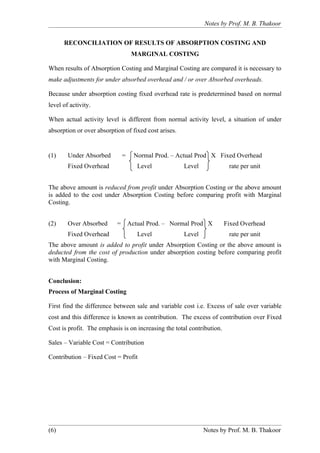
      RECONCILIATION OF RESULTS OF ABSORPTION COSTING AND
                                 MARGINAL COSTING

When results of Absorption Costing and Marginal Costing are compared it is necessary to
make adjustments for under absorbed overhead and / or over Absorbed overheads.

Because under absorption costing fixed overhead rate is predetermined based on normal
level of activity.

When actual activity level is different from normal activity level, a situation of under
absorption or over absorption of fixed cost arises.


(1)     Under Absorbed       =   Normal Prod. – Actual Prod X Fixed Overhead
        Fixed Overhead             Level              Level              rate per unit


The above amount is reduced from profit under Absorption Costing or the above amount
is added to the cost under Absorption Costing before comparing profit with Marginal
Costing.


(2)     Over Absorbed      = Actual Prod. – Normal Prod X               Fixed Overhead
        Fixed Overhead             Level              Level              rate per unit
The above amount is added to profit under Absorption Costing or the above amount is
deducted from the cost of production under absorption costing before comparing profit
with Marginal Costing.


Conclusion:
Process of Marginal Costing

First find the difference between sale and variable cost i.e. Excess of sale over variable
cost and this difference is known as contribution. The excess of contribution over Fixed
Cost is profit. The emphasis is on increasing the total contribution.

Sales – Variable Cost = Contribution

Contribution – Fixed Cost = Profit


(6)                                                           Notes by Prof. M. B. Thakoor
Notes by Prof. M. B. Thakoor


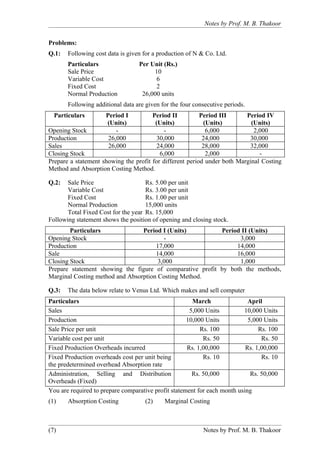
Problems:
Q.1:   Following cost data is given for a production of N & Co. Ltd.
       Particulars                Per Unit (Rs.)
       Sale Price                      10
       Variable Cost                    6
       Fixed Cost                       2
       Normal Production           26,000 units
       Following additional data are given for the four consecutive periods.
  Particulars        Period I          Period II          Period III      Period IV
                     (Units)            (Units)            (Units)          (Units)
Opening Stock            -                  -               6,000            2,000
Production            26,000             30,000            24,000          30,000
Sales                 26,000             24,000            28,000          32,000
Closing Stock                             6,000             2,000              -
Prepare a statement showing the profit for different period under both Marginal Costing
Method and Absorption Costing Method.

Q.2:   Sale Price                    Rs. 5.00 per unit
       Variable Cost                 Rs. 3.00 per unit
       Fixed Cost                    Rs. 1.00 per unit
       Normal Production             15,000 units
       Total Fixed Cost for the year Rs. 15,000
Following statement shows the position of opening and closing stock.
        Particulars              Period I (Units)          Period II (Units)
Opening Stock                            -                       3,000
Production                            17,000                    14,000
Sale                                  14,000                    16,000
Closing Stock                          3,000                     1,000
Prepare statement showing the figure of comparative profit by both the methods,
Marginal Costing method and Absorption Costing Method.

Q.3:   The data below relate to Venus Ltd. Which makes and sell computer
Particulars                                            March                April
Sales                                                 5,000 Units         10,000 Units
Production                                           10,000 Units           5,000 Units
Sale Price per unit                                       Rs. 100               Rs. 100
Variable cost per unit                                     Rs. 50                Rs. 50
Fixed Production Overheads incurred                  Rs. 1,00,000          Rs. 1,00,000
Fixed Production overheads cost per unit being             Rs. 10                Rs. 10
the predetermined overhead Absorption rate
Administration, Selling and Distribution               Rs. 50,000            Rs. 50,000
Overheads (Fixed)
You are required to prepare comparative profit statement for each month using
(1)    Absorption Costing            (2)    Marginal Costing


(7)                                                        Notes by Prof. M. B. Thakoor
Notes by Prof. M. B. Thakoor


Steps for Problems i.e. Q.1. Q.2. Q.3.
(I)     Find the Units sold by the following formula
                                 Quarter I     Quarter II      Quarter III   Quarter IV
                                  (Units)       (Units)         (Units)       (Units)
Opening Stock                       XXX           XXX            XXX           XXX
Add: Production                     XXX           XXX            XXX           XXX
                                    XXX           XXX            XXX           XXX
Less: Closing Stock                 XXX           XXX            XXX           XXX
Units Sold                          XXX           XXX            XXX           XXX


(II)    Under Absorption Costing:
                                 Quarter I     Quarter II      Quarter III   Quarter IV
                                  (Units)       (Units)         (Units)       (Units)
Sales (Units Sold X S.P.)           XXX           XXX            XXX           XXX
Less: 1. Variable Cost              XXX           XXX            XXX           XXX
(Units Sold x V.C. Per Unit)
      2. Fixed Cost                 XXX           XXX            XXX           XXX
(Units Sold x F.C. Per Unit)
Profit [Sale – (V.C. + F.C.)]       XXX           XXX            XXX           XXX
Add: Over absorption                XXX                          XXX
(Actual Prodn. – Normal
Prodn.) X Overhead rate
                                    XXX           XXX            XXX           XXX
Less: Under Absorption                            XXX                          XXX
(Normal Prodn. – Actual
Prodn.) X Overhead rate
Final Profit                        XXX           XXX            XXX           XXX


(III)   Under Marginal Costing
                                 Quarter I     Quarter II      Quarter III   Quarter IV
                                  (Units)       (Units)         (Units)       (Units)
Sales (Units Sold X S.P.)           XXX           XXX            XXX           XXX
Less: Variable Cost                 XXX           XXX            XXX           XXX
(Units Sold x V.C. Per Unit)
Contribution                        XXX           XXX            XXX           XXX
Less: Fixed Cost                    XXX           XXX            XXX           XXX
(For Normal Prodn. Or
Fixed Amount Given but
not the absorption rate)
Profit                              XXX           XXX            XXX           XXX


(8)                                                         Notes by Prof. M. B. Thakoor
Notes by Prof. M. B. Thakoor


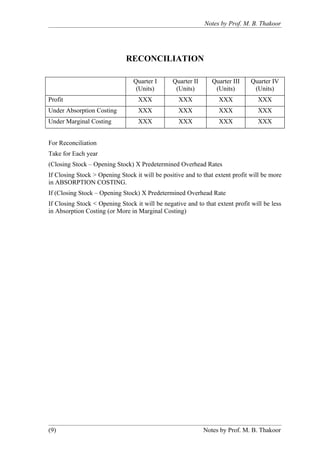
                              RECONCILIATION

                                 Quarter I      Quarter II      Quarter III    Quarter IV
                                  (Units)        (Units)         (Units)        (Units)
Profit                             XXX            XXX             XXX            XXX
Under Absorption Costing           XXX            XXX             XXX            XXX
Under Marginal Costing             XXX            XXX             XXX            XXX


For Reconciliation
Take for Each year
(Closing Stock – Opening Stock) X Predetermined Overhead Rates
If Closing Stock > Opening Stock it will be positive and to that extent profit will be more
in ABSORPTION COSTING.
If (Closing Stock – Opening Stock) X Predetermined Overhead Rate
If Closing Stock < Opening Stock it will be negative and to that extent profit will be less
in Absorption Costing (or More in Marginal Costing)


(9)                                                          Notes by Prof. M. B. Thakoor
Notes by Prof. M. B. Thakoor


                             Marginal Costing
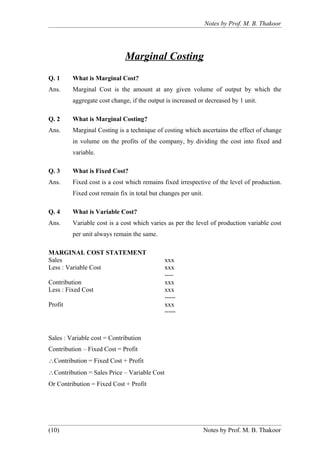
Q. 1     What is Marginal Cost?
Ans.     Marginal Cost is the amount at any given volume of output by which the
         aggregate cost change, if the output is increased or decreased by 1 unit.

Q. 2     What is Marginal Costing?
Ans.     Marginal Costing is a technique of costing which ascertains the effect of change
         in volume on the profits of the company, by dividing the cost into fixed and
         variable.

Q. 3     What is Fixed Cost?
Ans.     Fixed cost is a cost which remains fixed irrespective of the level of production.
         Fixed cost remain fix in total but changes per unit.

Q. 4     What is Variable Cost?
Ans.     Variable cost is a cost which varies as per the level of production variable cost
         per unit always remain the same.

MARGINAL COST STATEMENT
Sales                                         xxx
Less : Variable Cost                          xxx
                                              ----
Contribution                                  xxx
Less : Fixed Cost                             xxx
                                              -----
Profit                                        xxx
                                              ===


Sales : Variable cost = Contribution
Contribution – Fixed Cost = Profit
∴Contribution = Fixed Cost + Profit
∴Contribution = Sales Price – Variable Cost
Or Contribution = Fixed Cost + Profit


(10)                                                            Notes by Prof. M. B. Thakoor
Notes by Prof. M. B. Thakoor


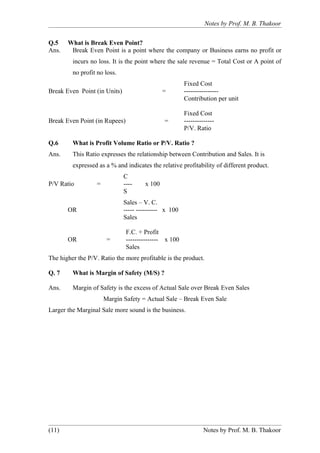
Q.5    What is Break Even Point?
Ans.    Break Even Point is a point where the company or Business earns no profit or
         incurs no loss. It is the point where the sale revenue = Total Cost or A point of
         no profit no loss.
                                                       Fixed Cost
Break Even Point (in Units)                   =        ----------------
                                                       Contribution per unit

                                                       Fixed Cost
Break Even Point (in Rupees)                  =        --------------
                                                       P/V. Ratio

Q.6      What is Profit Volume Ratio or P/V. Ratio ?
Ans.     This Ratio expresses the relationship between Contribution and Sales. It is
         expressed as a % and indicates the relative profitability of different product.
                              C
P/V Ratio         =           ----    x 100
                              S
                              Sales – V. C.
       OR                     ----- ---------- x 100
                              Sales

                               F.C. + Profit
       OR              =       --------------- x 100
                               Sales
The higher the P/V. Ratio the more profitable is the product.

Q. 7     What is Margin of Safety (M/S) ?

Ans.     Margin of Safety is the excess of Actual Sale over Break Even Sales
                      Margin Safety = Actual Sale – Break Even Sale
Larger the Marginal Sale more sound is the business.


(11)                                                            Notes by Prof. M. B. Thakoor

Marginal costing synopsis notes

  • 1.
    Notes by Prof.M. B. Thakoor MARGINAL COSTING SYNOPSIS (1) INTRODUCTION OF IMPORTANT TERMS 1) Marginal Cost 2) Marginal Costing 3) Fixed Cost 4) Variable Cost 5) Semi Variable / Semi Fixed Cost (2) TECHNIQUES OF COSTING 1) Absorption Costing 2) Marginal Costing (3) CONCEPT OF BREAK EVEN POINT (4) CONCEPT OF PROFIT VOLUME RATIO (5) PRACTICAL APPLICATIONS OF MARGINAL COSTING TECHNIQUES 1) Pricing of Product 2) Make or buy decision 3) Operate or shutdown 4) Decision of Product Mix 5) Key or Limiting Factor a) Labour Shortage b) Material Shortage c) Machine Capacity constraint (Capacity Utilisation) (6) PROFIT PLANNING (7) EXPANSION AND DIVERSIFICATION (8) ACCEPT, REJECT SPECIAL OFFER AND SUBCONTRACTING. (1) Notes by Prof. M. B. Thakoor
  • 2.
    Notes by Prof.M. B. Thakoor Marginal Costing also known as Direct Costing or Variable Costing. The word Marginal Costing is common in the U.K. and other Countries of the Continent, while the expression “Direct Costing” or “Variable Costing” is preferred in the U.S.A. “Marginal Cost” is derived from the word “Margin” and is well known concept of Economic theory. Thus quite in the Economic Connotation of the term, it is described in simple words as “the cost which arises from the production of additional increment of output and it does not arise in case the additional increments are not produced.” "The amount at given volume of output by which aggregate cost are changed if the volume of output is increased or decreased by one unit.” Marginal Costing is the ascertainment of Marginal Cost by differentiating the cost between fixed cost and variable cost and finding its effect on the profit of changes in volume or type of output. Marginal Costing necessitates Analysis of cost into fixed and variable. Even semi variable costs have to be closely and critically analysed into Fixed and variable. INTRODUCTION: “Marginal Cost” is derived from the word “Margin” and is well known concept of Economic theory. Thus quite in tune with the Economic connotation of the term, it is described in simple words as “Cost which arises from the production of additional increment of output and it does not arrive in case the additional increments are not produced.” Q.1 What is Marginal Cost? A. Marginal Cost is the amount at any given volume of output by which the aggregate cost change, if the output is increased or decreased by 1 unit. (2) Notes by Prof. M. B. Thakoor
  • 3.
    Notes by Prof.M. B. Thakoor Q.2 What is Marginal Costing? A. Marginal Costing is a technique of costing which ascertains the effect of change in volume on the profits of the company, by dividing the cost into fixed and variable. Q.3 What is Fixed Cost? A. Fixed Cost is a cost which remains fixed irrespective of the level of production. Fixed Cost remain fix in total but changes per unit. Q.4 What is Variable Cost? A. Variable Cost is a cost which varies as per the level of production. Variable Cost remain fixed per unit but it varies in total. Q.5 What is Semi-Fixed / Semi-Variable Cost? A. Semi-Fixed / Semi-Variable Cost are basically fixed cost upto a certain level of activity specified and they vary after certain level. Ex. Maintenance expenditure to a certain level is fixed if production do not fluctuate widely. And if production rises beyond a fixed limit additional maintenance expenditure is required though such additional expense may not vary directly with production. Eg. Telephone Expenses. Q.6 What is the basic theme of Marginal Costing ? A. The concept of Marginal Costing is based on the important distinction between product cost which is related to volume of production and period cost which is related to period of time and not volume of production. This it is based on making a distinction of cost into variable and fixed. (3) Notes by Prof. M. B. Thakoor
  • 4.
    Notes by Prof.M. B. Thakoor TECHNIQUES OF COSTING ABSORPTION COSTING MARGINAL COSTING 1. FORMAT OF STATEMENT Cost Statement / Cost Sheet Marginal Cost Statement for the year ended Raw Material Cost xxx Sales Revenue xxx Add: Direct Labour Less: Variable Cost of Goods Sold Add: Direct Expenses xxx 1. Direct Material xxx PRIME COST xxx 2. Direct labour xxx Add: Works Overhead xxx 3.Direct Expenses xxx GROSS WORKS COST xxx 4. Variable Fy. OH (if any) xxx Add: Opening W.I.P. xxx 5. Variable Admn. OH (if any) xxx xxx 6.Variable S/D. OH xxx xxx Less: Closing W.I.P. xxx CONTRIBUTION xxx xxx Less: Fixed Cost Less: Sale of Scrap xxx 1. Factory OH. xxx NET WORKS COST xxx 2.Office & Admn. xxx Add: Office & Administration 3. Selling & Dis.OH xxx overheads xxx a) Fixed expenses xxx PROFIT xxx b) Variable expenses xxx xxx COST OF PRODUCTION OR xxx COST OF GOODS PRODUCED Add: Op. Stock of F.G. xxx xxx Less: Closing Stock of F.G. xxx COST OF GOODS PRODUCED xxx AND SOLD Add: Selling & Distribution overheads a) Fixed Exp. Xxx b) Variable Exp. Xxx xxx COST OF SALE xxx Add : PROFIT xxx Sale xxx (4) Notes by Prof. M. B. Thakoor
  • 5.
    Notes by Prof.M. B. Thakoor ABSORPTION COSTING MARGINAL COSTING 2. DATA PRESENTATION Data is presented in the form of Vertical Data is presented in the form of vertical Statement. One of them being Cost Sheet statement known as Marginal Cost where Net Profit of each product is Statement where the cost data presented determined after subtracting Fixed Cost highlights the contribution of each along with the Variable Cost. product and the fixed cost is deducted from the total contribution to get profit. The Simple principle used = Cost + Profit = Selling price The Simple principal used = Sales – Cost = Profit. 3. TYPE OF COST Both Fixed and Variable Cost are considered Only Variable Costs are considered for to find the cost of the product. finding the Marginal Cost. 4. INVENTORY VALUATION Under Absorption Costing Inventory is Under Marginal Costing inventory is valued at Factory Cost which include factory valued at Variable Cost and no part of overheads both Fixed and Variable. A part Fixed Cost is applied to the inventory. of production overhead is therefore carried to the next accounting period along with W.I.P. and finished goods. 5.IMPACT OF INVENTORY VALUATION ON PROFIT a) No opening and no closing stock i.e. Production = Sale Profit is same as Marginal Costing. Profit is same as absorption Costing b) When Closing Stock is more than Opening Stock. Profit will be more than Marginal Costing Profit will be less than Absorption Costing. Logic: Because Under Absorption Costing a portion of fixed cost is charged to the closing stock and the same is deducted from cost so cost decreases hence profit increases. c) When Closing Stock is less than Opening Stock. Profit will be less than Marginal Costing Profit will be more than Absorption Costing. Logic: Under Absorption Costing a portion of fixed cost is charged to opening stock which is added to cost and its impact is greater than closing stock. So cost increases and profit decreases of the Business organizations. 6. AID IN DECISION MAKING As both Fixed are variable cost are As it classify cost as per variability it do considered and it do not recognize the help in decision making considering the difference between Fixed Cost and Variable Relevance of certain cost and Cost it do elaborately explain past profit / irrelevance of certain cost. losses but do not help when it comes to tomorrows result. It considers all cost are Relevant Cost. (5) Notes by Prof. M. B. Thakoor
  • 6.
    Notes by Prof.M. B. Thakoor RECONCILIATION OF RESULTS OF ABSORPTION COSTING AND MARGINAL COSTING When results of Absorption Costing and Marginal Costing are compared it is necessary to make adjustments for under absorbed overhead and / or over Absorbed overheads. Because under absorption costing fixed overhead rate is predetermined based on normal level of activity. When actual activity level is different from normal activity level, a situation of under absorption or over absorption of fixed cost arises. (1) Under Absorbed = Normal Prod. – Actual Prod X Fixed Overhead Fixed Overhead Level Level rate per unit The above amount is reduced from profit under Absorption Costing or the above amount is added to the cost under Absorption Costing before comparing profit with Marginal Costing. (2) Over Absorbed = Actual Prod. – Normal Prod X Fixed Overhead Fixed Overhead Level Level rate per unit The above amount is added to profit under Absorption Costing or the above amount is deducted from the cost of production under absorption costing before comparing profit with Marginal Costing. Conclusion: Process of Marginal Costing First find the difference between sale and variable cost i.e. Excess of sale over variable cost and this difference is known as contribution. The excess of contribution over Fixed Cost is profit. The emphasis is on increasing the total contribution. Sales – Variable Cost = Contribution Contribution – Fixed Cost = Profit (6) Notes by Prof. M. B. Thakoor
  • 7.
    Notes by Prof.M. B. Thakoor Problems: Q.1: Following cost data is given for a production of N & Co. Ltd. Particulars Per Unit (Rs.) Sale Price 10 Variable Cost 6 Fixed Cost 2 Normal Production 26,000 units Following additional data are given for the four consecutive periods. Particulars Period I Period II Period III Period IV (Units) (Units) (Units) (Units) Opening Stock - - 6,000 2,000 Production 26,000 30,000 24,000 30,000 Sales 26,000 24,000 28,000 32,000 Closing Stock 6,000 2,000 - Prepare a statement showing the profit for different period under both Marginal Costing Method and Absorption Costing Method. Q.2: Sale Price Rs. 5.00 per unit Variable Cost Rs. 3.00 per unit Fixed Cost Rs. 1.00 per unit Normal Production 15,000 units Total Fixed Cost for the year Rs. 15,000 Following statement shows the position of opening and closing stock. Particulars Period I (Units) Period II (Units) Opening Stock - 3,000 Production 17,000 14,000 Sale 14,000 16,000 Closing Stock 3,000 1,000 Prepare statement showing the figure of comparative profit by both the methods, Marginal Costing method and Absorption Costing Method. Q.3: The data below relate to Venus Ltd. Which makes and sell computer Particulars March April Sales 5,000 Units 10,000 Units Production 10,000 Units 5,000 Units Sale Price per unit Rs. 100 Rs. 100 Variable cost per unit Rs. 50 Rs. 50 Fixed Production Overheads incurred Rs. 1,00,000 Rs. 1,00,000 Fixed Production overheads cost per unit being Rs. 10 Rs. 10 the predetermined overhead Absorption rate Administration, Selling and Distribution Rs. 50,000 Rs. 50,000 Overheads (Fixed) You are required to prepare comparative profit statement for each month using (1) Absorption Costing (2) Marginal Costing (7) Notes by Prof. M. B. Thakoor
  • 8.
    Notes by Prof.M. B. Thakoor Steps for Problems i.e. Q.1. Q.2. Q.3. (I) Find the Units sold by the following formula Quarter I Quarter II Quarter III Quarter IV (Units) (Units) (Units) (Units) Opening Stock XXX XXX XXX XXX Add: Production XXX XXX XXX XXX XXX XXX XXX XXX Less: Closing Stock XXX XXX XXX XXX Units Sold XXX XXX XXX XXX (II) Under Absorption Costing: Quarter I Quarter II Quarter III Quarter IV (Units) (Units) (Units) (Units) Sales (Units Sold X S.P.) XXX XXX XXX XXX Less: 1. Variable Cost XXX XXX XXX XXX (Units Sold x V.C. Per Unit) 2. Fixed Cost XXX XXX XXX XXX (Units Sold x F.C. Per Unit) Profit [Sale – (V.C. + F.C.)] XXX XXX XXX XXX Add: Over absorption XXX XXX (Actual Prodn. – Normal Prodn.) X Overhead rate XXX XXX XXX XXX Less: Under Absorption XXX XXX (Normal Prodn. – Actual Prodn.) X Overhead rate Final Profit XXX XXX XXX XXX (III) Under Marginal Costing Quarter I Quarter II Quarter III Quarter IV (Units) (Units) (Units) (Units) Sales (Units Sold X S.P.) XXX XXX XXX XXX Less: Variable Cost XXX XXX XXX XXX (Units Sold x V.C. Per Unit) Contribution XXX XXX XXX XXX Less: Fixed Cost XXX XXX XXX XXX (For Normal Prodn. Or Fixed Amount Given but not the absorption rate) Profit XXX XXX XXX XXX (8) Notes by Prof. M. B. Thakoor
  • 9.
    Notes by Prof.M. B. Thakoor RECONCILIATION Quarter I Quarter II Quarter III Quarter IV (Units) (Units) (Units) (Units) Profit XXX XXX XXX XXX Under Absorption Costing XXX XXX XXX XXX Under Marginal Costing XXX XXX XXX XXX For Reconciliation Take for Each year (Closing Stock – Opening Stock) X Predetermined Overhead Rates If Closing Stock > Opening Stock it will be positive and to that extent profit will be more in ABSORPTION COSTING. If (Closing Stock – Opening Stock) X Predetermined Overhead Rate If Closing Stock < Opening Stock it will be negative and to that extent profit will be less in Absorption Costing (or More in Marginal Costing) (9) Notes by Prof. M. B. Thakoor
  • 10.
    Notes by Prof.M. B. Thakoor Marginal Costing Q. 1 What is Marginal Cost? Ans. Marginal Cost is the amount at any given volume of output by which the aggregate cost change, if the output is increased or decreased by 1 unit. Q. 2 What is Marginal Costing? Ans. Marginal Costing is a technique of costing which ascertains the effect of change in volume on the profits of the company, by dividing the cost into fixed and variable. Q. 3 What is Fixed Cost? Ans. Fixed cost is a cost which remains fixed irrespective of the level of production. Fixed cost remain fix in total but changes per unit. Q. 4 What is Variable Cost? Ans. Variable cost is a cost which varies as per the level of production variable cost per unit always remain the same. MARGINAL COST STATEMENT Sales xxx Less : Variable Cost xxx ---- Contribution xxx Less : Fixed Cost xxx ----- Profit xxx === Sales : Variable cost = Contribution Contribution – Fixed Cost = Profit ∴Contribution = Fixed Cost + Profit ∴Contribution = Sales Price – Variable Cost Or Contribution = Fixed Cost + Profit (10) Notes by Prof. M. B. Thakoor
  • 11.
    Notes by Prof.M. B. Thakoor Q.5 What is Break Even Point? Ans. Break Even Point is a point where the company or Business earns no profit or incurs no loss. It is the point where the sale revenue = Total Cost or A point of no profit no loss. Fixed Cost Break Even Point (in Units) = ---------------- Contribution per unit Fixed Cost Break Even Point (in Rupees) = -------------- P/V. Ratio Q.6 What is Profit Volume Ratio or P/V. Ratio ? Ans. This Ratio expresses the relationship between Contribution and Sales. It is expressed as a % and indicates the relative profitability of different product. C P/V Ratio = ---- x 100 S Sales – V. C. OR ----- ---------- x 100 Sales F.C. + Profit OR = --------------- x 100 Sales The higher the P/V. Ratio the more profitable is the product. Q. 7 What is Margin of Safety (M/S) ? Ans. Margin of Safety is the excess of Actual Sale over Break Even Sales Margin Safety = Actual Sale – Break Even Sale Larger the Marginal Sale more sound is the business. (11) Notes by Prof. M. B. Thakoor