Developing Marketing
Strategies and Plans
Dr. Gopal Thapa
Tribhuvan University
Marketing and Customer Value
2
Value Creation and Delivery
1. Assessing market opportunity and customer value
Environment scanning and study of consumers’ needs etc.
2. Choosing the right ‘customer value’
Value proposition – STP
3. Designing value
Product/ brand strategy, pricing
4. Delivering the value
Distribution
5. Communicating the value
IMC
6. Sustain and growth
3
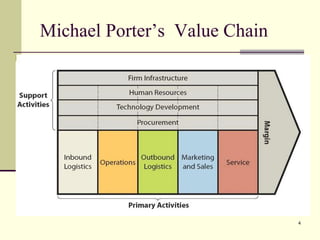
Michael Porter’s Value Chain
4
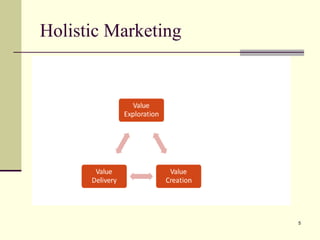
Holistic Marketing
5
Strategic Planning
6
Four organizational levels
 The corporate level
 The division level
 The business unit level
 The product level
7
Corporate & Division Strategic
Planning
Defining the corporate mission
Establishing strategic business unit (SBU)
Assigning resources to each SBU
Assessing growth opportunities
8
Strategic Business Unit
Prof. Deepa Rohit,LLIM 9
• SBU Characteristics
• It is single business or collection of related businesses that can be planned
separately from the rest of the company
• It has its own set of competitors
• It has a manager responsible for strategic planning and profit
performance, who control most of the factors affecting profit
• Purpose of identifying SBU
• Todevelop separate strategies and assign appropriate funding
9
Corporate & Division Strategic
Planning
a 10
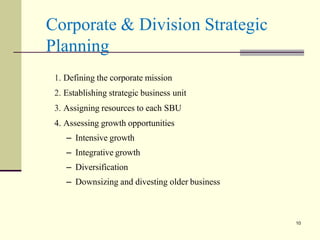
1. Defining the corporate mission
2. Establishing strategic business unit
3. Assigning resources to each SBU
4. Assessing growth opportunities
– Intensive growth
– Integrative growth
– Diversification
– Downsizing and divesting older business
10
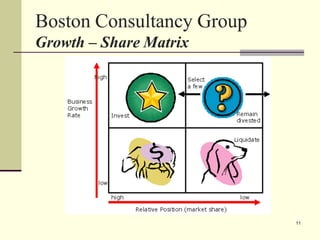
Boston Consultancy Group
Growth – Share Matrix
11
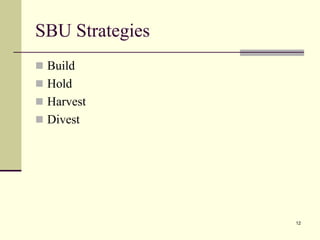
SBU Strategies
 Build
 Hold
 Harvest
 Divest
12
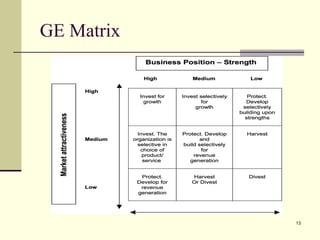
GE Matrix
13
Corporate & Division Strategic
Planning
1. Defining the corporate mission
2. Establishing strategic business unit
3. Assigning resources to each SBU
4. Assessing growth opportunities
14
4. Assessing Growth Opportunities
 Planning new businesses, downsizing, and
terminating older businesses
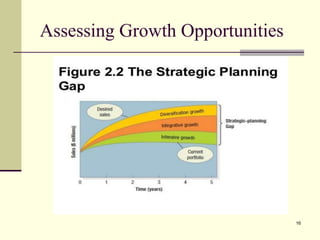
 If there is gap between future desired sales and
projected sales then corporate management will
need to develop or acquire new businesses to fill it
15
Assessing Growth Opportunities
16
Business Unit
Strategic Planning
17
Business Unit Strategic Planning
19
Prof. Deepa Rohit,LLIM
Business Unit Strategic Planning
PROF. DEEPA ROHIT, LLIM 20
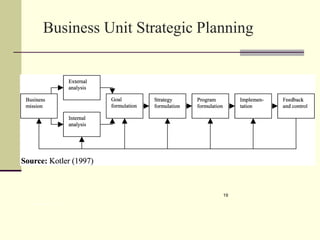
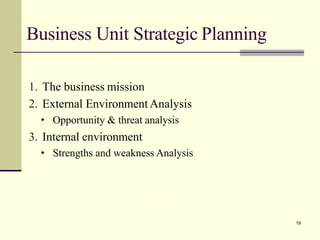
1. The business mission
2. External Environment Analysis
• Opportunity & threat analysis
3. Internal environment
• Strengths and weakness Analysis
19
Marketing Opportunity
Prof. Deepa Rohit,LLIM 21
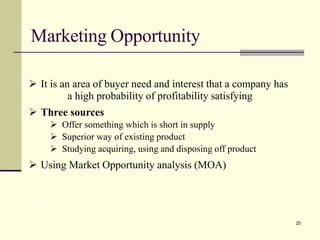
➢ It is an area of buyer need and interest that a company has
a high probability of profitability satisfying
➢ Three sources
➢ Offer something which is short in supply
➢ Superior way of existing product
➢ Studying acquiring, using and disposing off product
➢ Using Market Opportunity analysis (MOA)
20
Business Unit Strategic Planning
PROF. DEEPA ROHIT, LLIM 22
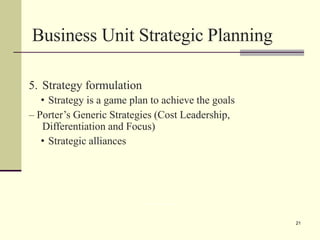
5. Strategy formulation
• Strategy is a game plan to achieve the goals
– Porter’s Generic Strategies (Cost Leadership,
Differentiation and Focus)
• Strategic alliances
21
Product Planning and Marketing Plan
22
Marketing Plan
25
PROF. DEEPA ROHIT, LLIM
A Marketing plan is a written document that summarizes
what the marketer has learnt about the market place and
indicates how the firm plans to reach its marketing
objectives
Contents of Marketing Plan
26
PROF. DEEPA ROHIT, LLIM
–Executive summary and table of contents
–Situation analysis
–Objectives
–Marketing strategy
–Financial projections
–Implementation control
Thank
you
25

Developing Marketing Strategies and Plan

  • 1.
    Developing Marketing Strategies andPlans Dr. Gopal Thapa Tribhuvan University
  • 2.
  • 3.
    Value Creation andDelivery 1. Assessing market opportunity and customer value Environment scanning and study of consumers’ needs etc. 2. Choosing the right ‘customer value’ Value proposition – STP 3. Designing value Product/ brand strategy, pricing 4. Delivering the value Distribution 5. Communicating the value IMC 6. Sustain and growth 3
  • 4.
  • 5.
  • 6.
  • 7.
    Four organizational levels The corporate level  The division level  The business unit level  The product level 7
  • 8.
    Corporate & DivisionStrategic Planning Defining the corporate mission Establishing strategic business unit (SBU) Assigning resources to each SBU Assessing growth opportunities 8
  • 9.
    Strategic Business Unit Prof.Deepa Rohit,LLIM 9 • SBU Characteristics • It is single business or collection of related businesses that can be planned separately from the rest of the company • It has its own set of competitors • It has a manager responsible for strategic planning and profit performance, who control most of the factors affecting profit • Purpose of identifying SBU • Todevelop separate strategies and assign appropriate funding 9
  • 10.
    Corporate & DivisionStrategic Planning a 10 1. Defining the corporate mission 2. Establishing strategic business unit 3. Assigning resources to each SBU 4. Assessing growth opportunities – Intensive growth – Integrative growth – Diversification – Downsizing and divesting older business 10
  • 11.
  • 12.
    SBU Strategies  Build Hold  Harvest  Divest 12
  • 13.
  • 14.
    Corporate & DivisionStrategic Planning 1. Defining the corporate mission 2. Establishing strategic business unit 3. Assigning resources to each SBU 4. Assessing growth opportunities 14
  • 15.
    4. Assessing GrowthOpportunities  Planning new businesses, downsizing, and terminating older businesses  If there is gap between future desired sales and projected sales then corporate management will need to develop or acquire new businesses to fill it 15
  • 16.
  • 17.
  • 18.
    Business Unit StrategicPlanning 19 Prof. Deepa Rohit,LLIM
  • 19.
    Business Unit StrategicPlanning PROF. DEEPA ROHIT, LLIM 20 1. The business mission 2. External Environment Analysis • Opportunity & threat analysis 3. Internal environment • Strengths and weakness Analysis 19
  • 20.
    Marketing Opportunity Prof. DeepaRohit,LLIM 21 ➢ It is an area of buyer need and interest that a company has a high probability of profitability satisfying ➢ Three sources ➢ Offer something which is short in supply ➢ Superior way of existing product ➢ Studying acquiring, using and disposing off product ➢ Using Market Opportunity analysis (MOA) 20
  • 21.
    Business Unit StrategicPlanning PROF. DEEPA ROHIT, LLIM 22 5. Strategy formulation • Strategy is a game plan to achieve the goals – Porter’s Generic Strategies (Cost Leadership, Differentiation and Focus) • Strategic alliances 21
  • 22.
    Product Planning andMarketing Plan 22
  • 23.
    Marketing Plan 25 PROF. DEEPAROHIT, LLIM A Marketing plan is a written document that summarizes what the marketer has learnt about the market place and indicates how the firm plans to reach its marketing objectives
  • 24.
    Contents of MarketingPlan 26 PROF. DEEPA ROHIT, LLIM –Executive summary and table of contents –Situation analysis –Objectives –Marketing strategy –Financial projections –Implementation control
  • 25.