Company and
Marketing Strategy:
Partnering to Build
Customer Relationships
Chapter 2Chapter 2
Objectives
• Understand company-wide strategicUnderstand company-wide strategic
planning and its four steps.planning and its four steps.
• Learn how to design businessLearn how to design business
portfolios and develop strategies forportfolios and develop strategies for
growth and downsizing.growth and downsizing.
• Understand marketing’s role inUnderstand marketing’s role in
strategic planning and howstrategic planning and how
marketers partner with others.marketers partner with others.
Objectives
• Be able to describe theBe able to describe the
marketing process and themarketing process and the
forces that influence it.forces that influence it.
• Learn the marketingLearn the marketing
management functions,management functions,
including the elements of theincluding the elements of the
marketing plan.marketing plan.
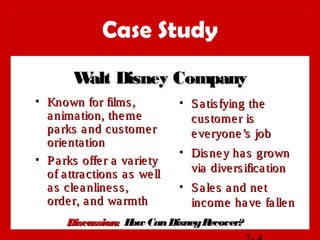
Case Study
• Known for films,Known for films,
animation, themeanimation, theme
parks and customerparks and customer
orientationorientation
• Parks offer a varietyParks offer a variety
of attractions as wellof attractions as well
as cleanliness,as cleanliness,
order, and warmthorder, and warmth
• Satisfying theSatisfying the
customer iscustomer is
everyone’s jobeveryone’s job
• Disney has grownDisney has grown
via diversificationvia diversification
• Sales and netSales and net
income have fallenincome have fallen
Walt Disney CompanyWalt Disney Company
Discussion:Discussion: How CanDisneyRecover?How CanDisneyRecover?
Strategic Planning
• Strategic planning is defined as:Strategic planning is defined as:
 ““The process of developing andThe process of developing and
maintaining a strategic fit betweenmaintaining a strategic fit between
the organization’s goals andthe organization’s goals and
capabilities and its changingcapabilities and its changing
marketing opportunities.”marketing opportunities.”
Strategic Planning
• Planning activities occur at thePlanning activities occur at the
business unit, product, and marketbusiness unit, product, and market
levels, and include:levels, and include:
 Defining the purpose and missionDefining the purpose and mission
 Setting objectives and goalsSetting objectives and goals
 Designing the business portfolioDesigning the business portfolio
 Developing detailed marketing andDeveloping detailed marketing and
departmental plansdepartmental plans
Strategic Planning
• Mission statements should . . .Mission statements should . . .
 serve as a guide for what theserve as a guide for what the
organization wants to accomplish.organization wants to accomplish.
 be “market-oriented” rather thanbe “market-oriented” rather than
“product-oriented”.“product-oriented”.
 be neither too narrow, nor too broad.be neither too narrow, nor too broad.
 fit with the market environment.fit with the market environment.
 be motivating.be motivating.
Strategic Planning
• Mission statements guide theMission statements guide the
development of objectives anddevelopment of objectives and
goals.goals.
 Objectives are developed at eachObjectives are developed at each
level in the organizationlevel in the organization
hierarchy.hierarchy.
 Strategies are developed toStrategies are developed to
accomplish these objectives.accomplish these objectives.
Strategic Planning
• Busine ss po rtfo lio :Busine ss po rtfo lio :
“the collection of businesses“the collection of businesses
and products that make upand products that make up
the company.”the company.”
• Designing the business portfolioDesigning the business portfolio
is a key element of the strategicis a key element of the strategic
planning process.planning process.
Strategic Planning
• Ste p 1 :Ste p 1 :
Analyz e theAnalyz e the
curre nt busine sscurre nt busine ss
po rtfo liopo rtfo lio
• Ste p 2:Ste p 2:
Shape the futureShape the future
busine ss po rtfo liobusine ss po rtfo lio
• Identify strategicIdentify strategic
business units (SBUs)business units (SBUs)
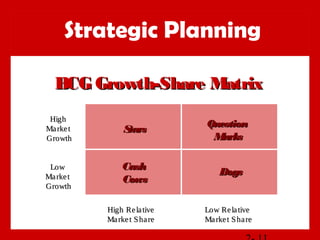
• Assess each SBU:Assess each SBU:
 The BCG growth-The BCG growth-
share matrixshare matrix
classifies SBUs intoclassifies SBUs into
one of fourone of four
categories using the:categories using the:
 Marke t g ro wth rateMarke t g ro wth rate
 SBU’s re lativeSBU’s re lative
m arke t share withinm arke t share within
the m arke t.the m arke t.
Portfolio DesignPortfolio Design
BCG Growth-Share MatrixBCG Growth-Share Matrix
Strategic Planning
High RelativeHigh Relative
Market ShareMarket Share
HighHigh
MarketMarket
GrowthGrowth
LowLow
MarketMarket
GrowthGrowth
StarsStars
CashCash
CowsCows
QuestionQuestion
MarksMarks
DogsDogs
Low RelativeLow Relative
Market ShareMarket Share
Strategic Planning
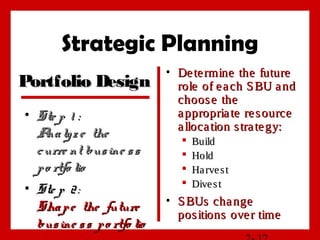
• Ste p 1 :Ste p 1 :
Analyz e theAnalyz e the
curre nt busine sscurre nt busine ss
po rtfo liopo rtfo lio
• Ste p 2:Ste p 2:
Shape the futureShape the future
busine ss po rtfo liobusine ss po rtfo lio
• Determine the futureDetermine the future
role of each SBU androle of each SBU and
choose thechoose the
appropriate resourceappropriate resource
allocation strategy:allocation strategy:
 BuildBuild
 HoldHold
 HarvestHarvest
 DivestDivest
• SBUs changeSBUs change
positions over timepositions over time
Portfolio DesignPortfolio Design
Strategic Planning
• Matrix approaches to formalMatrix approaches to formal
planning share many problems:planning share many problems:
 Difficult, time-consuming, andDifficult, time-consuming, and
costly to implement.costly to implement.
 Focus only on current businesses.Focus only on current businesses.
 Too strongly emphasize marketToo strongly emphasize market
share growth or growth viashare growth or growth via
diversification.diversification.
Strategic Planning
• Designing the business portfolioDesigning the business portfolio
also involves:also involves:
 Developing strategies for growth byDeveloping strategies for growth by
identifying, evaluating, andidentifying, evaluating, and
selecting promising new marketselecting promising new market
opportunities.opportunities.
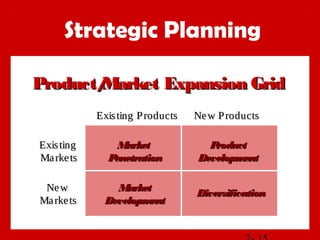
 Pro duct/m arke t e xpansio n g ridPro duct/m arke t e xpansio n g rid
 Developing strategies forDeveloping strategies for
downsizing the business portfolio.downsizing the business portfolio.
Product/Market Expansion GridProduct/Market Expansion Grid
Strategic Planning
Existing ProductsExisting Products New ProductsNew Products
ExistingExisting
MarketsMarkets
NewNew
MarketsMarkets
MarketMarket
PenetrationPenetration
MarketMarket
DevelopmentDevelopment
ProductProduct
DevelopmentDevelopment
DiversificationDiversification
Planning Marketing
• Marketing plays a key role in theMarketing plays a key role in the
strategic planning process.strategic planning process.
• Marketers must practice CRMMarketers must practice CRM andand
Partner Relationship Management.Partner Relationship Management.
 Partnering with otherdepartmentsPartnering with otherdepartments
in the company as well as otherin the company as well as other
firms in the marketing systemhelpsfirms in the marketing systemhelps
to build a superiorto build a superior valuedelivery-valuedelivery-
networknetwork..
The Marketing Process
• The strategic planningThe strategic planning
and business portfolioand business portfolio
analysis processesanalysis processes
help to identify andhelp to identify and
evaluate marketingevaluate marketing
opportunities.opportunities.
• The purpose of theThe purpose of the
marketing process is tomarketing process is to
help the firm plan howhelp the firm plan how
to capitalize on theseto capitalize on these
opportunities.opportunities.
• Analyzing m arke tingAnalyzing m arke ting
o ppo rtunitie so ppo rtunitie s
• Se le cting targ e tSe le cting targ e t
m arke tsm arke ts
• De ve lo ping theDe ve lo ping the
m arke ting m ixm arke ting m ix
• Manag ing theManag ing the
m arke ting e ffo rtm arke ting e ffo rt
Key ElementsKey Elements
The Marketing Process
• The segmentationThe segmentation
process divides theprocess divides the
total market intototal market into
m arke t se g m e nts.m arke t se g m e nts.
• Targ e t m arke tingTarg e t m arke ting
determines whichdetermines which
segment(s) aresegment(s) are
pursued.pursued.
• TheThe m arke t po sitio ningm arke t po sitio ning
for the product is thenfor the product is then
determined.determined.
• Analyzing m arke tingAnalyzing m arke ting
o ppo rtunitie so ppo rtunitie s
• Se le cting targ e tSe le cting targ e t
m arke tsm arke ts
• De ve lo ping theDe ve lo ping the
m arke ting m ixm arke ting m ix
• Manag ing theManag ing the
m arke ting e ffo rtm arke ting e ffo rt
Key ElementsKey Elements
The Marketing Process
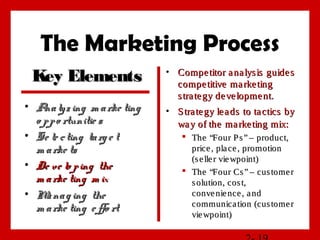
• Competitor analysis guidesCompetitor analysis guides
competitive marketingcompetitive marketing
strategy development.strategy development.
• Strategy leads to tactics byStrategy leads to tactics by
way of the marketing mix:way of the marketing mix:
 The “Four Ps” – product,The “Four Ps” – product,
price, place, promotionprice, place, promotion
(seller viewpoint)(seller viewpoint)
 The “Four Cs” – customerThe “Four Cs” – customer
solution, cost,solution, cost,
convenience, andconvenience, and
communication (customercommunication (customer
viewpoint)viewpoint)
• Analyzing m arke tingAnalyzing m arke ting
o ppo rtunitie so ppo rtunitie s
• Se le cting targ e tSe le cting targ e t
m arke tsm arke ts
• De ve lo ping theDe ve lo ping the
m arke ting m ixm arke ting m ix
• Manag ing theManag ing the
m arke ting e ffo rtm arke ting e ffo rt
Key ElementsKey Elements
The Marketing Process
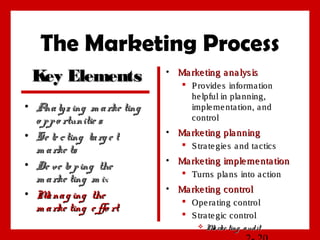
• Marketing analysisMarketing analysis
 Provides informationProvides information
helpful in planning,helpful in planning,
implementation, andimplementation, and
controlcontrol
• Marketing planningMarketing planning
 Strategies and tacticsStrategies and tactics
• Marketing implementationMarketing implementation
 Turns plans into actionTurns plans into action
• Marketing controlMarketing control
 Operating controlOperating control
 Strategic controlStrategic control
 Marke ting auditMarke ting audit
• Analyzing m arke tingAnalyzing m arke ting
o ppo rtunitie so ppo rtunitie s
• Se le cting targ e tSe le cting targ e t
m arke tsm arke ts
• De ve lo ping theDe ve lo ping the
m arke ting m ixm arke ting m ix
• Manag ing theManag ing the
m arke ting e ffo rtm arke ting e ffo rt
Key ElementsKey Elements

marketing strategy

  • 1.
    Company and Marketing Strategy: Partneringto Build Customer Relationships Chapter 2Chapter 2
  • 2.
    Objectives • Understand company-widestrategicUnderstand company-wide strategic planning and its four steps.planning and its four steps. • Learn how to design businessLearn how to design business portfolios and develop strategies forportfolios and develop strategies for growth and downsizing.growth and downsizing. • Understand marketing’s role inUnderstand marketing’s role in strategic planning and howstrategic planning and how marketers partner with others.marketers partner with others.
  • 3.
    Objectives • Be ableto describe theBe able to describe the marketing process and themarketing process and the forces that influence it.forces that influence it. • Learn the marketingLearn the marketing management functions,management functions, including the elements of theincluding the elements of the marketing plan.marketing plan.
  • 4.
    Case Study • Knownfor films,Known for films, animation, themeanimation, theme parks and customerparks and customer orientationorientation • Parks offer a varietyParks offer a variety of attractions as wellof attractions as well as cleanliness,as cleanliness, order, and warmthorder, and warmth • Satisfying theSatisfying the customer iscustomer is everyone’s jobeveryone’s job • Disney has grownDisney has grown via diversificationvia diversification • Sales and netSales and net income have fallenincome have fallen Walt Disney CompanyWalt Disney Company Discussion:Discussion: How CanDisneyRecover?How CanDisneyRecover?
  • 5.
    Strategic Planning • Strategicplanning is defined as:Strategic planning is defined as:  ““The process of developing andThe process of developing and maintaining a strategic fit betweenmaintaining a strategic fit between the organization’s goals andthe organization’s goals and capabilities and its changingcapabilities and its changing marketing opportunities.”marketing opportunities.”
  • 6.
    Strategic Planning • Planningactivities occur at thePlanning activities occur at the business unit, product, and marketbusiness unit, product, and market levels, and include:levels, and include:  Defining the purpose and missionDefining the purpose and mission  Setting objectives and goalsSetting objectives and goals  Designing the business portfolioDesigning the business portfolio  Developing detailed marketing andDeveloping detailed marketing and departmental plansdepartmental plans
  • 7.
    Strategic Planning • Missionstatements should . . .Mission statements should . . .  serve as a guide for what theserve as a guide for what the organization wants to accomplish.organization wants to accomplish.  be “market-oriented” rather thanbe “market-oriented” rather than “product-oriented”.“product-oriented”.  be neither too narrow, nor too broad.be neither too narrow, nor too broad.  fit with the market environment.fit with the market environment.  be motivating.be motivating.
  • 8.
    Strategic Planning • Missionstatements guide theMission statements guide the development of objectives anddevelopment of objectives and goals.goals.  Objectives are developed at eachObjectives are developed at each level in the organizationlevel in the organization hierarchy.hierarchy.  Strategies are developed toStrategies are developed to accomplish these objectives.accomplish these objectives.
  • 9.
    Strategic Planning • Business po rtfo lio :Busine ss po rtfo lio : “the collection of businesses“the collection of businesses and products that make upand products that make up the company.”the company.” • Designing the business portfolioDesigning the business portfolio is a key element of the strategicis a key element of the strategic planning process.planning process.
  • 10.
    Strategic Planning • Step 1 :Ste p 1 : Analyz e theAnalyz e the curre nt busine sscurre nt busine ss po rtfo liopo rtfo lio • Ste p 2:Ste p 2: Shape the futureShape the future busine ss po rtfo liobusine ss po rtfo lio • Identify strategicIdentify strategic business units (SBUs)business units (SBUs) • Assess each SBU:Assess each SBU:  The BCG growth-The BCG growth- share matrixshare matrix classifies SBUs intoclassifies SBUs into one of fourone of four categories using the:categories using the:  Marke t g ro wth rateMarke t g ro wth rate  SBU’s re lativeSBU’s re lative m arke t share withinm arke t share within the m arke t.the m arke t. Portfolio DesignPortfolio Design
  • 11.
    BCG Growth-Share MatrixBCGGrowth-Share Matrix Strategic Planning High RelativeHigh Relative Market ShareMarket Share HighHigh MarketMarket GrowthGrowth LowLow MarketMarket GrowthGrowth StarsStars CashCash CowsCows QuestionQuestion MarksMarks DogsDogs Low RelativeLow Relative Market ShareMarket Share
  • 12.
    Strategic Planning • Step 1 :Ste p 1 : Analyz e theAnalyz e the curre nt busine sscurre nt busine ss po rtfo liopo rtfo lio • Ste p 2:Ste p 2: Shape the futureShape the future busine ss po rtfo liobusine ss po rtfo lio • Determine the futureDetermine the future role of each SBU androle of each SBU and choose thechoose the appropriate resourceappropriate resource allocation strategy:allocation strategy:  BuildBuild  HoldHold  HarvestHarvest  DivestDivest • SBUs changeSBUs change positions over timepositions over time Portfolio DesignPortfolio Design
  • 13.
    Strategic Planning • Matrixapproaches to formalMatrix approaches to formal planning share many problems:planning share many problems:  Difficult, time-consuming, andDifficult, time-consuming, and costly to implement.costly to implement.  Focus only on current businesses.Focus only on current businesses.  Too strongly emphasize marketToo strongly emphasize market share growth or growth viashare growth or growth via diversification.diversification.
  • 14.
    Strategic Planning • Designingthe business portfolioDesigning the business portfolio also involves:also involves:  Developing strategies for growth byDeveloping strategies for growth by identifying, evaluating, andidentifying, evaluating, and selecting promising new marketselecting promising new market opportunities.opportunities.  Pro duct/m arke t e xpansio n g ridPro duct/m arke t e xpansio n g rid  Developing strategies forDeveloping strategies for downsizing the business portfolio.downsizing the business portfolio.
  • 15.
    Product/Market Expansion GridProduct/MarketExpansion Grid Strategic Planning Existing ProductsExisting Products New ProductsNew Products ExistingExisting MarketsMarkets NewNew MarketsMarkets MarketMarket PenetrationPenetration MarketMarket DevelopmentDevelopment ProductProduct DevelopmentDevelopment DiversificationDiversification
  • 16.
    Planning Marketing • Marketingplays a key role in theMarketing plays a key role in the strategic planning process.strategic planning process. • Marketers must practice CRMMarketers must practice CRM andand Partner Relationship Management.Partner Relationship Management.  Partnering with otherdepartmentsPartnering with otherdepartments in the company as well as otherin the company as well as other firms in the marketing systemhelpsfirms in the marketing systemhelps to build a superiorto build a superior valuedelivery-valuedelivery- networknetwork..
  • 17.
    The Marketing Process •The strategic planningThe strategic planning and business portfolioand business portfolio analysis processesanalysis processes help to identify andhelp to identify and evaluate marketingevaluate marketing opportunities.opportunities. • The purpose of theThe purpose of the marketing process is tomarketing process is to help the firm plan howhelp the firm plan how to capitalize on theseto capitalize on these opportunities.opportunities. • Analyzing m arke tingAnalyzing m arke ting o ppo rtunitie so ppo rtunitie s • Se le cting targ e tSe le cting targ e t m arke tsm arke ts • De ve lo ping theDe ve lo ping the m arke ting m ixm arke ting m ix • Manag ing theManag ing the m arke ting e ffo rtm arke ting e ffo rt Key ElementsKey Elements
  • 18.
    The Marketing Process •The segmentationThe segmentation process divides theprocess divides the total market intototal market into m arke t se g m e nts.m arke t se g m e nts. • Targ e t m arke tingTarg e t m arke ting determines whichdetermines which segment(s) aresegment(s) are pursued.pursued. • TheThe m arke t po sitio ningm arke t po sitio ning for the product is thenfor the product is then determined.determined. • Analyzing m arke tingAnalyzing m arke ting o ppo rtunitie so ppo rtunitie s • Se le cting targ e tSe le cting targ e t m arke tsm arke ts • De ve lo ping theDe ve lo ping the m arke ting m ixm arke ting m ix • Manag ing theManag ing the m arke ting e ffo rtm arke ting e ffo rt Key ElementsKey Elements
  • 19.
    The Marketing Process •Competitor analysis guidesCompetitor analysis guides competitive marketingcompetitive marketing strategy development.strategy development. • Strategy leads to tactics byStrategy leads to tactics by way of the marketing mix:way of the marketing mix:  The “Four Ps” – product,The “Four Ps” – product, price, place, promotionprice, place, promotion (seller viewpoint)(seller viewpoint)  The “Four Cs” – customerThe “Four Cs” – customer solution, cost,solution, cost, convenience, andconvenience, and communication (customercommunication (customer viewpoint)viewpoint) • Analyzing m arke tingAnalyzing m arke ting o ppo rtunitie so ppo rtunitie s • Se le cting targ e tSe le cting targ e t m arke tsm arke ts • De ve lo ping theDe ve lo ping the m arke ting m ixm arke ting m ix • Manag ing theManag ing the m arke ting e ffo rtm arke ting e ffo rt Key ElementsKey Elements
  • 20.
    The Marketing Process •Marketing analysisMarketing analysis  Provides informationProvides information helpful in planning,helpful in planning, implementation, andimplementation, and controlcontrol • Marketing planningMarketing planning  Strategies and tacticsStrategies and tactics • Marketing implementationMarketing implementation  Turns plans into actionTurns plans into action • Marketing controlMarketing control  Operating controlOperating control  Strategic controlStrategic control  Marke ting auditMarke ting audit • Analyzing m arke tingAnalyzing m arke ting o ppo rtunitie so ppo rtunitie s • Se le cting targ e tSe le cting targ e t m arke tsm arke ts • De ve lo ping theDe ve lo ping the m arke ting m ixm arke ting m ix • Manag ing theManag ing the m arke ting e ffo rtm arke ting e ffo rt Key ElementsKey Elements