DEVELOPING MARKETING STRATEGIES & PLANS Company and Marketing Strategy:  Partnering to Build Customer Relationships
Planning The process of anticipating future events and determining strategies to achieve organizational objectives in the future. Strategic Planning The process of developing and maintaining a strategic fit between the organization’s goals and capabilities and its changing marketing opportunities The Nature of Strategic Planning
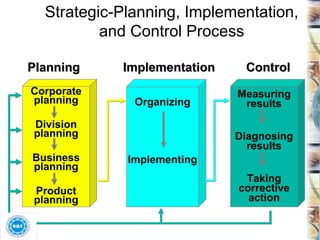
Strategic-Planning, Implementation, and Control Process Planning Measuring results Diagnosing results Taking corrective action Implementation Corporate planning Division planning Business planning Product planning Organizing Implementing Control
Four Steps of Organizational Strategic Plan Defining the company mission Setting company objectives and goals Designing the business portfolio and Planning the marketing and other functional activities. Strategic planning covers the entire activities of the organization, including all of the strategic business units (SBUs) and each functional area. Developing functional strategies and plans is the fourth step in the strategic planning process. One technique for identifying opportunities is to seek strategic windows. A strategic window is the identification of an opportunity for a limited period in the future and managing the organization's resources so that there is a fit between the key market needs and the ability of the organization to meet those needs at an optimum level.
Strategic Business Units (SBUs)  Individual units within the firm that operate like separate businesses, with each having its own mission, business objectives, resources, managers, and competitors.
Characteristics of SBUs It is a single business or collection of related businesses It has its own set of competitors It has a leader responsible for: Strategic planning Profitability Efficiency
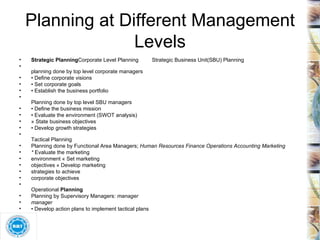
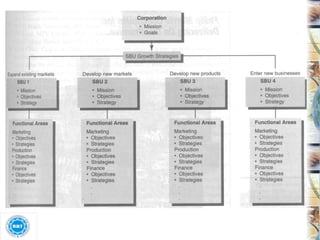
Planning at Different Management Levels Strategic Planning Corporate Level Planning  Strategic Business Unit(SBU) Planning planning done by top level corporate managers •  Define corporate visions •  Set corporate goals •  Establish the business portfolio Planning done by top level SBU managers •  Define the business mission •  Evaluate the environment (SWOT analysis) » State business objectives •  Develop growth strategies Tactical Planning Planning done by Functional Area Managers;  Human Resources Finance Operations Accounting Marketing *  Evaluate the marketing environment « Set marketing objectives « Develop marketing strategies to achieve corporate objectives Operational  Planning Planning by Supervisory Managers:  manager manager •  Develop action plans to implement tactical plans
Three Levels of Planning Tactical (Functional) Planning  : A decision process that concentrates on developing detailed plans for strategies and tactics for the short term that support an organization's long-term strategic plan. Accomplished by various functional areas of firm.  Typically includes a broad 5-year plan to support strategic plan and a detailed annual plan Example: to gain 40% of a particular market with three new products during coming year Operational Planning:  A decision process that focuses on developing detailed plans for day-to-day activities that carry out an organization's tactical plans. First-line managers focus on day-to-day execution of functional plans. Such planning includes detailed annual, semiannual, or quarterly plans Example: units of a product a salesperson needs to  sell per month
Three Levels of Planning Cross-Functional : An approach to tactical planning in which managers  work  together in developing tactical plans for each functional area in the firm so that each plan considers the objectives of the other areas.
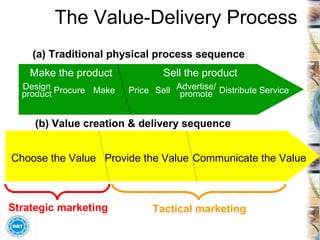
The Value-Delivery Process (a) Traditional physical process sequence (b) Value creation & delivery sequence Sell the product Make the product Procure Design product Make Price Sell Advertise/ promote Distribute Service Choose the Value Provide the Value Tactical marketing Strategic marketing Communicate the Value
Strategic Planning at Co-operate Level To develop strategic plans, top-level corporate managers follow  three  steps: 1. They develop a mission or vision for the total corporation,  2. Establish the corporation's long-term goals or objectives,  3. Allocate resources to the different SBUs to maximize growth and profits.
Strategic Planning at Co-operate Level 1. Mission Statement :  A formal statement in an organization's strategic plan that describes the overall purpose of the organization and what it intends to achieve in terms of its customers, products, and resources. The Quaker Oats Company:  To meet the needs of consumers through innovative marketing and manufacturing of healthful, good-tasting products that contribute to a healthy lifestyle and consumer well-being around the world, yielding above-average returns over time for our shareholders, (www.quakeroats.com/about/goal.htm)  Analysts use the term  marketing myopia  to describe firms that develop shortsighted visions
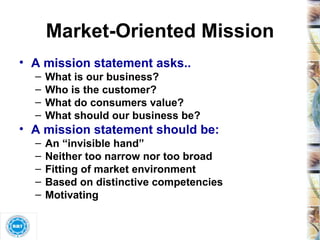
Market-Oriented Mission A mission statement asks.. What is our business? Who is the customer? What do consumers value? What should our business be? A mission statement should be: An “invisible hand”  Neither too narrow nor too broad Fitting of market environment Based on distinctive competencies Motivating
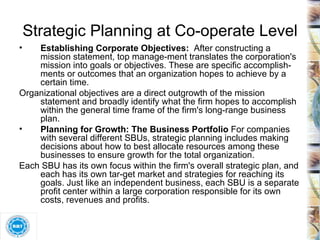
Establishing Corporate Objectives:  After constructing a mission statement, top manage­ment translates the corporation's mission into goals or objectives. These are specific accomplish­ments or outcomes that an organization hopes to achieve by a certain time.  Organizational objectives are a direct outgrowth of the mission statement and broadly identify what the firm hopes to accomplish within the general time frame of the firm's long-range business plan. Planning for Growth: The Business Portfolio  For companies with several different SBUs, strategic planning includes making decisions about how to best allocate resources among these businesses to ensure growth for the total organization. Each SBU has its own focus within the firm's overall strategic plan, and each has its own tar­get market and strategies for reaching its goals. Just like an independent business, each SBU is a separate profit center within a large corporation responsible for its own costs, revenues and profits. Strategic Planning at Co-operate Level
 
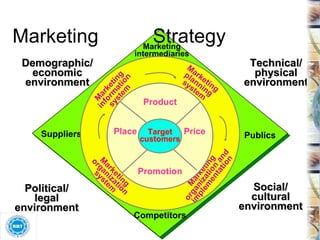
Factors Influencing Company   Marketing  Strategy Target customers Competitors Marketing intermediaries Publics Suppliers Marketing information system Marketing planning system Marketing organization system Marketing organization and implementation Product Promotion Place Price Demographic/ economic environment Social/ cultural environment Technical/ physical environment Political/ legal environment
MARKETING PLANNING Company and Marketing Strategy:  Partnering to Build Customer Relationships
The Business Portfolio A business portfolio is the collection of businesses and products that make up the company Business portfolio planning involves two steps: Analyzing the current business portfolio  Shaping the future portfolio by developing strategies Portfolio analysis: a management tool for evaluating a firms business mix and assessing the potential of an organizations strategic business units.
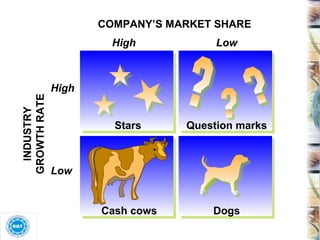
BCG Growth Market Share Matrix A portfolio analysis model developed by the Boston consulting group that assesses the potential of successful product to generate cash that a firm can then use to invest in new products. The vertical axis represents the attractiveness of the market, the market growth rate “high” and “low” as measurements, marketers might ask whether the total market for the product is growing 10 percent, 50 percent, 100 percent, or 200 percent annually. The horizontal axis shows the company’s current strength in the market through its relative market share. The marketers might ask whether the firm has 5 percent, 25 percent, or perhaps 75 percent of the current market. Combining the two axes creates four quadrants representing four different types of products or businesses.
3-7 Stars Cash cows Dogs Question marks High Low High Low COMPANY’S MARKET SHARE INDUSTRY GROWTH RATE
Each Cell in the Grid BCG Growth Share Matrix Stars:  Stars are SBUs with products that have a dominant market share in high-growth markets. Because the SBU has a dominant share of the market, stars generate large revenues, but they also require large amounts of funding to keep up with production and promotion demands. Because the market has a large growth potential, managers design strategies to maximize market share in the face of increasing competition.  Cash Cows:  Cash cows have a dominant market share in a low-growth potential market. Because there's not much opportunity for new products, competitors don't‘ often enter the market. At the same time, the product is well established and enjoys a high market share that the firm can sustain with minimal funding. Firms usually milk cash cows of their profits to fund the growth of other products in a portfolio Of course, if the firm's goal is to increase revenues, having too many cash cows with little or no growth potential can become a liability.
Each Cell in the Grid BCG Growth Share Matrix Question Marks:  Question marks—sometimes called problem children—are products with low market shares in fast-growth markets. When a business unit is a question mark, it suggests that the firm has failed to compete successfully. Perhaps the product! offers fewer benefits than competing products. Maybe its price is too high, its distributors are ineffective, or its advertising is too weak. The firm could pump more money into marketing the product and hope that market share will improve. But the firm may find itself "throwing good money after bad," gaining nothing but a negative cash flow and disappointment.  Dogs:  Dog lovers should not be offended; this label really refers to a mongrel—a product nobody wants. Dogs have a small share of a slow-growth market.
SWOT Analysis An analysis of an organization’s strengths (S) and weaknesses (W)  and the opportunities (O) and threats (T) in the external environment All controllable elements inside a firm that influence how well the firm operates Strengths and weaknesses Technologies, physical facilities, financial stability, corporate reputation, quality products, strong brands, employees Elements outside the firm that may affect it either positively or negatively Opportunities and threats The economy, competition, technology, law, ethics, and sociocultural trends Firm cannot directly control external factors but can respond to them via planning
Analyzing the Current Business Portfolio Build Increase market share Works well for question marks Hold Preserve market share Good for cash cow Harvest Increases short-term cash flow Good for weak cash cows, question marks and dogs Divest Sell or liquidate Good for dogs and question marks
Marketing’s Role  in Strategic Planning Provide a guiding philosophy Identify attractive opportunities Design effective strategies  Build strong value chains Form superior value delivery networks
Establish the Business Portfolio Business portfolio: the group of different products or brands owned by an organization and having different income-generating and growth capabilities Portfolio analysis: assessing the potential of a firm’s strategic business units Helps decisions regarding which SBUs should receive more or less of the firm’s resources
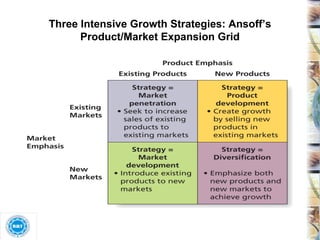
Three Intensive Growth Strategies: Ansoff’s Product/Market Expansion Grid
Marketing Strategy Customers grouped by: Geographic Demographic Psychographic Behavioral Market segment is a groups of consumers who respond in similar ways to marketing efforts. Market Segmentation Target marketing Market Positioning Strategy
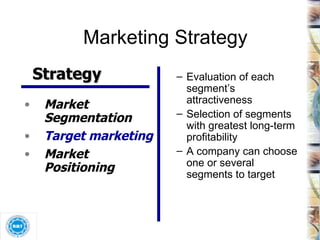
Marketing Strategy Evaluation of each segment’s attractiveness Selection of segments with greatest long-term profitability A company can choose one or several segments to target Strategy Market Segmentation Target marketing Market Positioning
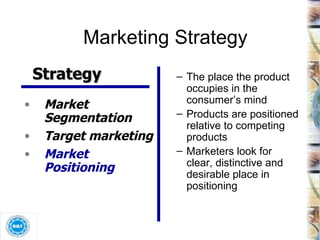
Marketing Strategy The place the product occupies in the consumer’s mind Products are positioned relative to competing products Marketers look for clear, distinctive and desirable place in positioning Strategy Market Segmentation Target marketing Market Positioning
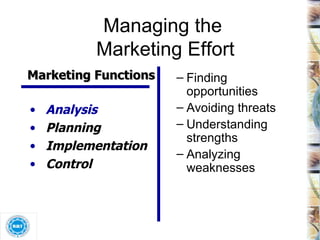
Managing the  Marketing Effort Finding opportunities Avoiding threats Understanding strengths Analyzing weaknesses Analysis Planning Implementation Control Marketing Functions
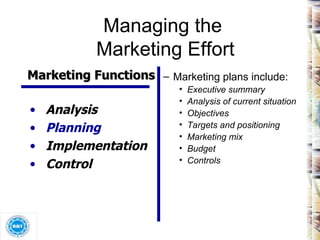
Managing the  Marketing Effort Marketing plans include:  Executive summary Analysis of current situation Objectives Targets and positioning Marketing mix Budget Controls Marketing Functions Analysis Planning Implementation Control
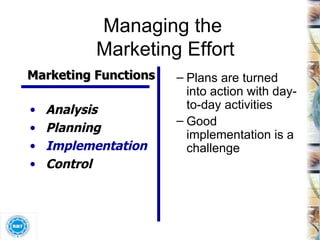
Managing the  Marketing Effort Plans are turned into action with day-to-day activities  Good implementation is a challenge Marketing Functions Analysis Planning Implementation Control
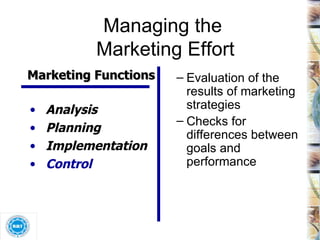
Managing the  Marketing Effort Evaluation of the results of marketing strategies Checks for differences between goals and performance Marketing Functions Analysis Planning Implementation Control
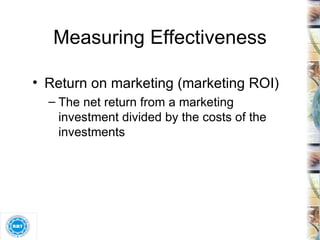
Measuring Effectiveness Return on marketing (marketing ROI) The net return from a marketing investment divided by the costs of the investments
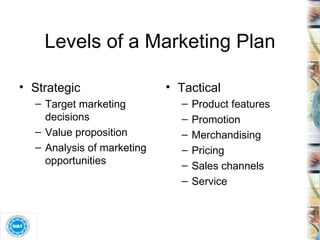
Levels of a Marketing Plan Strategic Target marketing decisions Value proposition Analysis of marketing opportunities Tactical Product features Promotion Merchandising Pricing Sales channels Service
Porter’s Generic Strategies Overall cost leadership Differentiation Focus
 

Developing Marketing Strategies and Plans

  • 1.
    DEVELOPING MARKETING STRATEGIES& PLANS Company and Marketing Strategy: Partnering to Build Customer Relationships
  • 2.
    Planning The processof anticipating future events and determining strategies to achieve organizational objectives in the future. Strategic Planning The process of developing and maintaining a strategic fit between the organization’s goals and capabilities and its changing marketing opportunities The Nature of Strategic Planning
  • 3.
    Strategic-Planning, Implementation, andControl Process Planning Measuring results Diagnosing results Taking corrective action Implementation Corporate planning Division planning Business planning Product planning Organizing Implementing Control
  • 4.
    Four Steps ofOrganizational Strategic Plan Defining the company mission Setting company objectives and goals Designing the business portfolio and Planning the marketing and other functional activities. Strategic planning covers the entire activities of the organization, including all of the strategic business units (SBUs) and each functional area. Developing functional strategies and plans is the fourth step in the strategic planning process. One technique for identifying opportunities is to seek strategic windows. A strategic window is the identification of an opportunity for a limited period in the future and managing the organization's resources so that there is a fit between the key market needs and the ability of the organization to meet those needs at an optimum level.
  • 5.
    Strategic Business Units(SBUs) Individual units within the firm that operate like separate businesses, with each having its own mission, business objectives, resources, managers, and competitors.
  • 6.
    Characteristics of SBUsIt is a single business or collection of related businesses It has its own set of competitors It has a leader responsible for: Strategic planning Profitability Efficiency
  • 7.
    Planning at DifferentManagement Levels Strategic Planning Corporate Level Planning Strategic Business Unit(SBU) Planning planning done by top level corporate managers • Define corporate visions • Set corporate goals • Establish the business portfolio Planning done by top level SBU managers • Define the business mission • Evaluate the environment (SWOT analysis) » State business objectives • Develop growth strategies Tactical Planning Planning done by Functional Area Managers; Human Resources Finance Operations Accounting Marketing * Evaluate the marketing environment « Set marketing objectives « Develop marketing strategies to achieve corporate objectives Operational Planning Planning by Supervisory Managers: manager manager • Develop action plans to implement tactical plans
  • 8.
    Three Levels ofPlanning Tactical (Functional) Planning : A decision process that concentrates on developing detailed plans for strategies and tactics for the short term that support an organization's long-term strategic plan. Accomplished by various functional areas of firm. Typically includes a broad 5-year plan to support strategic plan and a detailed annual plan Example: to gain 40% of a particular market with three new products during coming year Operational Planning: A decision process that focuses on developing detailed plans for day-to-day activities that carry out an organization's tactical plans. First-line managers focus on day-to-day execution of functional plans. Such planning includes detailed annual, semiannual, or quarterly plans Example: units of a product a salesperson needs to sell per month
  • 9.
    Three Levels ofPlanning Cross-Functional : An approach to tactical planning in which managers work together in developing tactical plans for each functional area in the firm so that each plan considers the objectives of the other areas.
  • 10.
    The Value-Delivery Process(a) Traditional physical process sequence (b) Value creation & delivery sequence Sell the product Make the product Procure Design product Make Price Sell Advertise/ promote Distribute Service Choose the Value Provide the Value Tactical marketing Strategic marketing Communicate the Value
  • 11.
    Strategic Planning atCo-operate Level To develop strategic plans, top-level corporate managers follow three steps: 1. They develop a mission or vision for the total corporation, 2. Establish the corporation's long-term goals or objectives, 3. Allocate resources to the different SBUs to maximize growth and profits.
  • 12.
    Strategic Planning atCo-operate Level 1. Mission Statement : A formal statement in an organization's strategic plan that describes the overall purpose of the organization and what it intends to achieve in terms of its customers, products, and resources. The Quaker Oats Company: To meet the needs of consumers through innovative marketing and manufacturing of healthful, good-tasting products that contribute to a healthy lifestyle and consumer well-being around the world, yielding above-average returns over time for our shareholders, (www.quakeroats.com/about/goal.htm) Analysts use the term marketing myopia to describe firms that develop shortsighted visions
  • 13.
    Market-Oriented Mission Amission statement asks.. What is our business? Who is the customer? What do consumers value? What should our business be? A mission statement should be: An “invisible hand” Neither too narrow nor too broad Fitting of market environment Based on distinctive competencies Motivating
  • 14.
    Establishing Corporate Objectives: After constructing a mission statement, top manage­ment translates the corporation's mission into goals or objectives. These are specific accomplish­ments or outcomes that an organization hopes to achieve by a certain time. Organizational objectives are a direct outgrowth of the mission statement and broadly identify what the firm hopes to accomplish within the general time frame of the firm's long-range business plan. Planning for Growth: The Business Portfolio For companies with several different SBUs, strategic planning includes making decisions about how to best allocate resources among these businesses to ensure growth for the total organization. Each SBU has its own focus within the firm's overall strategic plan, and each has its own tar­get market and strategies for reaching its goals. Just like an independent business, each SBU is a separate profit center within a large corporation responsible for its own costs, revenues and profits. Strategic Planning at Co-operate Level
  • 15.
  • 16.
    Factors Influencing Company Marketing Strategy Target customers Competitors Marketing intermediaries Publics Suppliers Marketing information system Marketing planning system Marketing organization system Marketing organization and implementation Product Promotion Place Price Demographic/ economic environment Social/ cultural environment Technical/ physical environment Political/ legal environment
  • 17.
    MARKETING PLANNING Companyand Marketing Strategy: Partnering to Build Customer Relationships
  • 18.
    The Business PortfolioA business portfolio is the collection of businesses and products that make up the company Business portfolio planning involves two steps: Analyzing the current business portfolio Shaping the future portfolio by developing strategies Portfolio analysis: a management tool for evaluating a firms business mix and assessing the potential of an organizations strategic business units.
  • 19.
    BCG Growth MarketShare Matrix A portfolio analysis model developed by the Boston consulting group that assesses the potential of successful product to generate cash that a firm can then use to invest in new products. The vertical axis represents the attractiveness of the market, the market growth rate “high” and “low” as measurements, marketers might ask whether the total market for the product is growing 10 percent, 50 percent, 100 percent, or 200 percent annually. The horizontal axis shows the company’s current strength in the market through its relative market share. The marketers might ask whether the firm has 5 percent, 25 percent, or perhaps 75 percent of the current market. Combining the two axes creates four quadrants representing four different types of products or businesses.
  • 20.
    3-7 Stars Cashcows Dogs Question marks High Low High Low COMPANY’S MARKET SHARE INDUSTRY GROWTH RATE
  • 21.
    Each Cell inthe Grid BCG Growth Share Matrix Stars: Stars are SBUs with products that have a dominant market share in high-growth markets. Because the SBU has a dominant share of the market, stars generate large revenues, but they also require large amounts of funding to keep up with production and promotion demands. Because the market has a large growth potential, managers design strategies to maximize market share in the face of increasing competition. Cash Cows: Cash cows have a dominant market share in a low-growth potential market. Because there's not much opportunity for new products, competitors don't‘ often enter the market. At the same time, the product is well established and enjoys a high market share that the firm can sustain with minimal funding. Firms usually milk cash cows of their profits to fund the growth of other products in a portfolio Of course, if the firm's goal is to increase revenues, having too many cash cows with little or no growth potential can become a liability.
  • 22.
    Each Cell inthe Grid BCG Growth Share Matrix Question Marks: Question marks—sometimes called problem children—are products with low market shares in fast-growth markets. When a business unit is a question mark, it suggests that the firm has failed to compete successfully. Perhaps the product! offers fewer benefits than competing products. Maybe its price is too high, its distributors are ineffective, or its advertising is too weak. The firm could pump more money into marketing the product and hope that market share will improve. But the firm may find itself "throwing good money after bad," gaining nothing but a negative cash flow and disappointment. Dogs: Dog lovers should not be offended; this label really refers to a mongrel—a product nobody wants. Dogs have a small share of a slow-growth market.
  • 23.
    SWOT Analysis Ananalysis of an organization’s strengths (S) and weaknesses (W) and the opportunities (O) and threats (T) in the external environment All controllable elements inside a firm that influence how well the firm operates Strengths and weaknesses Technologies, physical facilities, financial stability, corporate reputation, quality products, strong brands, employees Elements outside the firm that may affect it either positively or negatively Opportunities and threats The economy, competition, technology, law, ethics, and sociocultural trends Firm cannot directly control external factors but can respond to them via planning
  • 24.
    Analyzing the CurrentBusiness Portfolio Build Increase market share Works well for question marks Hold Preserve market share Good for cash cow Harvest Increases short-term cash flow Good for weak cash cows, question marks and dogs Divest Sell or liquidate Good for dogs and question marks
  • 25.
    Marketing’s Role in Strategic Planning Provide a guiding philosophy Identify attractive opportunities Design effective strategies Build strong value chains Form superior value delivery networks
  • 26.
    Establish the BusinessPortfolio Business portfolio: the group of different products or brands owned by an organization and having different income-generating and growth capabilities Portfolio analysis: assessing the potential of a firm’s strategic business units Helps decisions regarding which SBUs should receive more or less of the firm’s resources
  • 27.
    Three Intensive GrowthStrategies: Ansoff’s Product/Market Expansion Grid
  • 28.
    Marketing Strategy Customersgrouped by: Geographic Demographic Psychographic Behavioral Market segment is a groups of consumers who respond in similar ways to marketing efforts. Market Segmentation Target marketing Market Positioning Strategy
  • 29.
    Marketing Strategy Evaluationof each segment’s attractiveness Selection of segments with greatest long-term profitability A company can choose one or several segments to target Strategy Market Segmentation Target marketing Market Positioning
  • 30.
    Marketing Strategy Theplace the product occupies in the consumer’s mind Products are positioned relative to competing products Marketers look for clear, distinctive and desirable place in positioning Strategy Market Segmentation Target marketing Market Positioning
  • 31.
    Managing the Marketing Effort Finding opportunities Avoiding threats Understanding strengths Analyzing weaknesses Analysis Planning Implementation Control Marketing Functions
  • 32.
    Managing the Marketing Effort Marketing plans include: Executive summary Analysis of current situation Objectives Targets and positioning Marketing mix Budget Controls Marketing Functions Analysis Planning Implementation Control
  • 33.
    Managing the Marketing Effort Plans are turned into action with day-to-day activities Good implementation is a challenge Marketing Functions Analysis Planning Implementation Control
  • 34.
    Managing the Marketing Effort Evaluation of the results of marketing strategies Checks for differences between goals and performance Marketing Functions Analysis Planning Implementation Control
  • 35.
    Measuring Effectiveness Returnon marketing (marketing ROI) The net return from a marketing investment divided by the costs of the investments
  • 36.
    Levels of aMarketing Plan Strategic Target marketing decisions Value proposition Analysis of marketing opportunities Tactical Product features Promotion Merchandising Pricing Sales channels Service
  • 37.
    Porter’s Generic StrategiesOverall cost leadership Differentiation Focus
  • 38.