There are three commonly used methods to
translate main memory addresses to cache
memory addresses.
• Direct-Mapping
• Associative Mapping
• Set-Associative Mapping
Fixed sized packet of information that
moves back and forth between a cache
and main memory.
Container in a cache that stores a
block as well as other information such as the
valid bit and tag bits.
Collection of one or more lines.
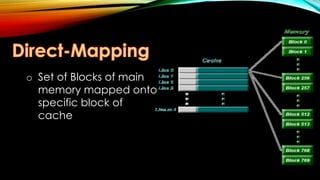
o Set of Blocks of main
memory mapped onto
specific block of
cache
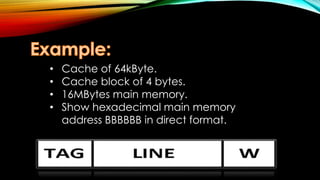
• Cache of 64kByte.
• Cache block of 4 bytes.
• 16MBytes main memory.
• Show hexadecimal main memory
address BBBBBB in direct format.
• The tag memory is much smaller than in
associative mapped cache.
• It is less costly compare to other
mapping technique.
• It is easy to implement.
• It is not flexible.
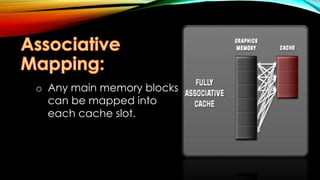
o Any main memory blocks
can be mapped into
each cache slot.
• Cache of 64kByte.
• Cache block of 4 bytes.
• 16MBytes main memory.
• Show hexadecimal main memory
address BBBBBB in associate format.
• Flexibility. Main Memory block can be
mapped anywhere in Cache Memory.
• Regardless of how irregular the data and
program references are, if a slot is
available for the block, it can be stored in
the cache.
• Slow or expensive.
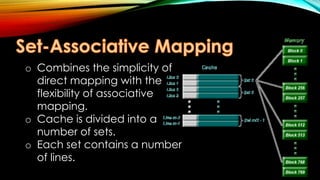
o Combines the simplicity of
direct mapping with the
flexibility of associative
mapping.
o Cache is divided into a
number of sets.
o Each set contains a number
of lines.
• 2-way set-associative.
• Cache of 64kByte.
• Cache block of 4 bytes.
• 16MBytes main memory.
• Show hexadecimal main memory
address BBBBBB in set-associate
format.
• Minimize the over-head in Direct and
Associate mapping.
• In our example the tag memory increases
only slightly from the direct mapping and
only two tags need to be searched for
each memory reference.
• The set-associative cache is widely used
in today’s microprocessors.
• Least Recently used (LRU)
e.g. in 2 way set associative Which of the 2
block is LRU?
• First in first out (FIFO)
replace block that has been in cache longest
• Least frequently used
replace block which has had fewest hits
• Random
Mapping

Mapping

  • 2.
    There are threecommonly used methods to translate main memory addresses to cache memory addresses. • Direct-Mapping • Associative Mapping • Set-Associative Mapping
  • 3.
    Fixed sized packetof information that moves back and forth between a cache and main memory. Container in a cache that stores a block as well as other information such as the valid bit and tag bits. Collection of one or more lines.
  • 4.
    o Set ofBlocks of main memory mapped onto specific block of cache
  • 5.
    • Cache of64kByte. • Cache block of 4 bytes. • 16MBytes main memory. • Show hexadecimal main memory address BBBBBB in direct format.
  • 6.
    • The tagmemory is much smaller than in associative mapped cache. • It is less costly compare to other mapping technique. • It is easy to implement. • It is not flexible.
  • 7.
    o Any mainmemory blocks can be mapped into each cache slot.
  • 8.
    • Cache of64kByte. • Cache block of 4 bytes. • 16MBytes main memory. • Show hexadecimal main memory address BBBBBB in associate format.
  • 9.
    • Flexibility. MainMemory block can be mapped anywhere in Cache Memory. • Regardless of how irregular the data and program references are, if a slot is available for the block, it can be stored in the cache. • Slow or expensive.
  • 10.
    o Combines thesimplicity of direct mapping with the flexibility of associative mapping. o Cache is divided into a number of sets. o Each set contains a number of lines.
  • 11.
    • 2-way set-associative. •Cache of 64kByte. • Cache block of 4 bytes. • 16MBytes main memory. • Show hexadecimal main memory address BBBBBB in set-associate format.
  • 12.
    • Minimize theover-head in Direct and Associate mapping. • In our example the tag memory increases only slightly from the direct mapping and only two tags need to be searched for each memory reference. • The set-associative cache is widely used in today’s microprocessors.
  • 13.
    • Least Recentlyused (LRU) e.g. in 2 way set associative Which of the 2 block is LRU? • First in first out (FIFO) replace block that has been in cache longest • Least frequently used replace block which has had fewest hits • Random