Land Pooling: A Possible Alternative to
     Eminent Domain and Tool for
   Equitable Urban Redevelopment

   May 11, 2011, 9:00 am – 12:00 pm
About MAPC

The mission of the Metropolitan Area Planning Council
(MAPC) is to promote smart growth and regional
collaboration in Metropolitan Boston, through public policy
research and advocacy, technical assistance, mapping and
analysis, and regional planning. Our work is guided by our
regional plan, "MetroFuture: Making a Greater Boston
Region."

The MAPC planning area consists of 22 cities and 79 towns
that include coastal communities, older industrial centers,
rural towns and modern cities.
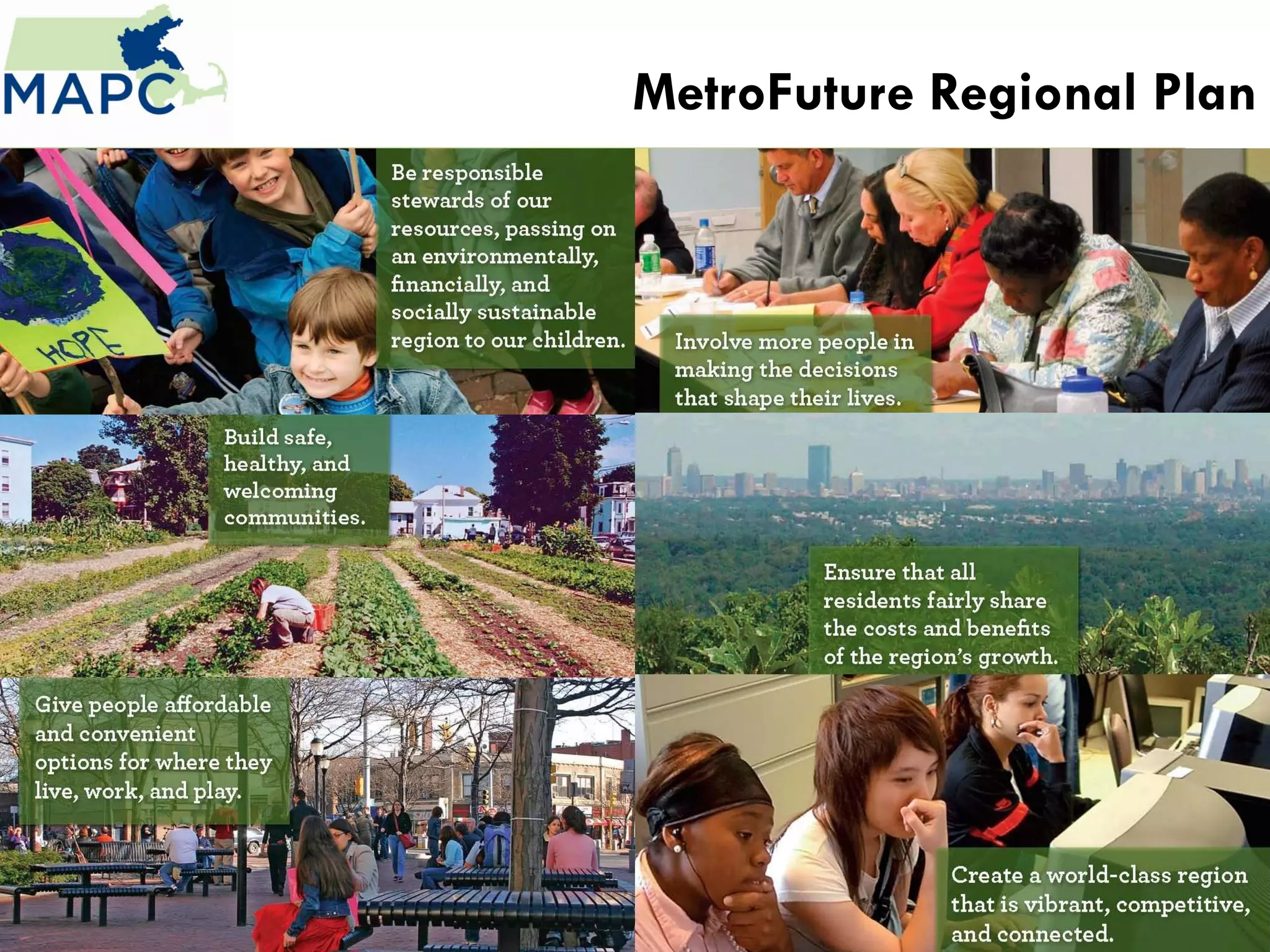
MetroFuture Regional Plan
About Lincoln Institute of
                                        Land Policy

The Lincoln Institute of Land Policy is a leading
resource for key issues concerning the use,
regulation, and taxation of land. Providing high-
quality education and research, the Institute strives
to improve public dialogue and decisions about land
policy.
Agenda
•   Welcome (10 minutes)
•   Overview of Land Pooling (40-45 minutes)
•   Land Pooling Process in a U.S. Context (40-45 minutes)
•   Break (10 minutes)
•   Land Pooling in Massachusetts: Discussion and Q & A
    (40-50 minutes)
•   Next Steps (10-15 minutes)
Why Land Pooling?

• Cities must transition in order to meet current
  needs and future demands
• We need options that engage – not marginalize
  – property owners
• We need solutions that create less opposition on
  compensation and other matters important to
  residents
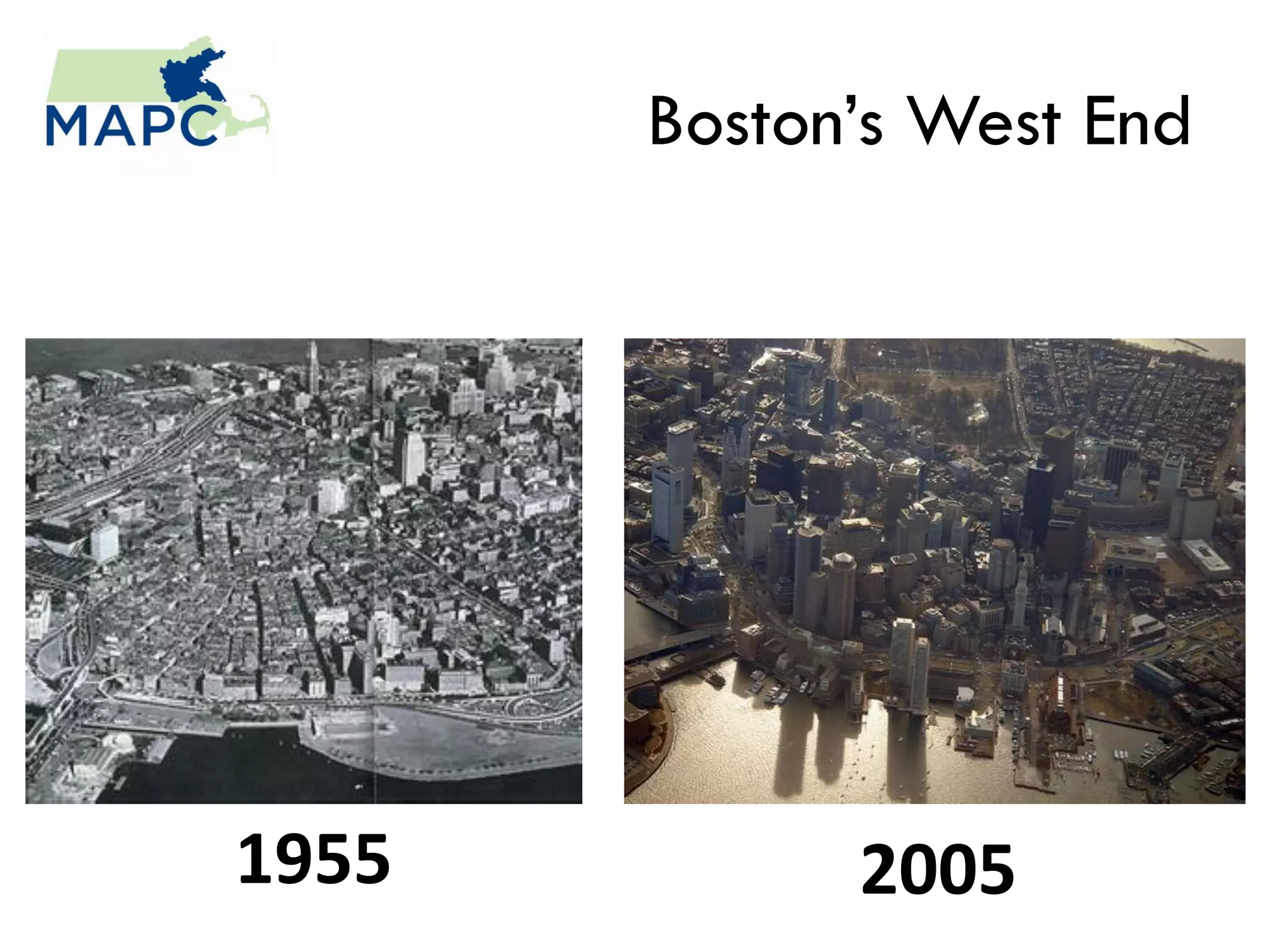
Boston’s West End


1955         2005
Land Pooling for Economic Development

Eminent Domain              Land Pooling
• Top-down: government      • Bottom-up: stakeholder
  driven                      driven
• cash based: property      • Equity-based: property
  owners paid out             owners contribute in
• Judicial-administrative   • Democratic-participatory
  Process                     process
Overview of Land Pooling

           William A. Doebele
Author and Professor of Urban Planning and Design
           Emeritus, Harvard University
Overview of Land Pooling

Land pooling is a land assembly process that is
used for developing and redeveloping real estate.

Other names:

   • Land Readjustment (South Korea and Japan)
   • Land Consolidation (Europe)
   • Land Pooling (Australia)

Google “Land Readjustment” for a literature review on the topic
Overview of Land Pooling

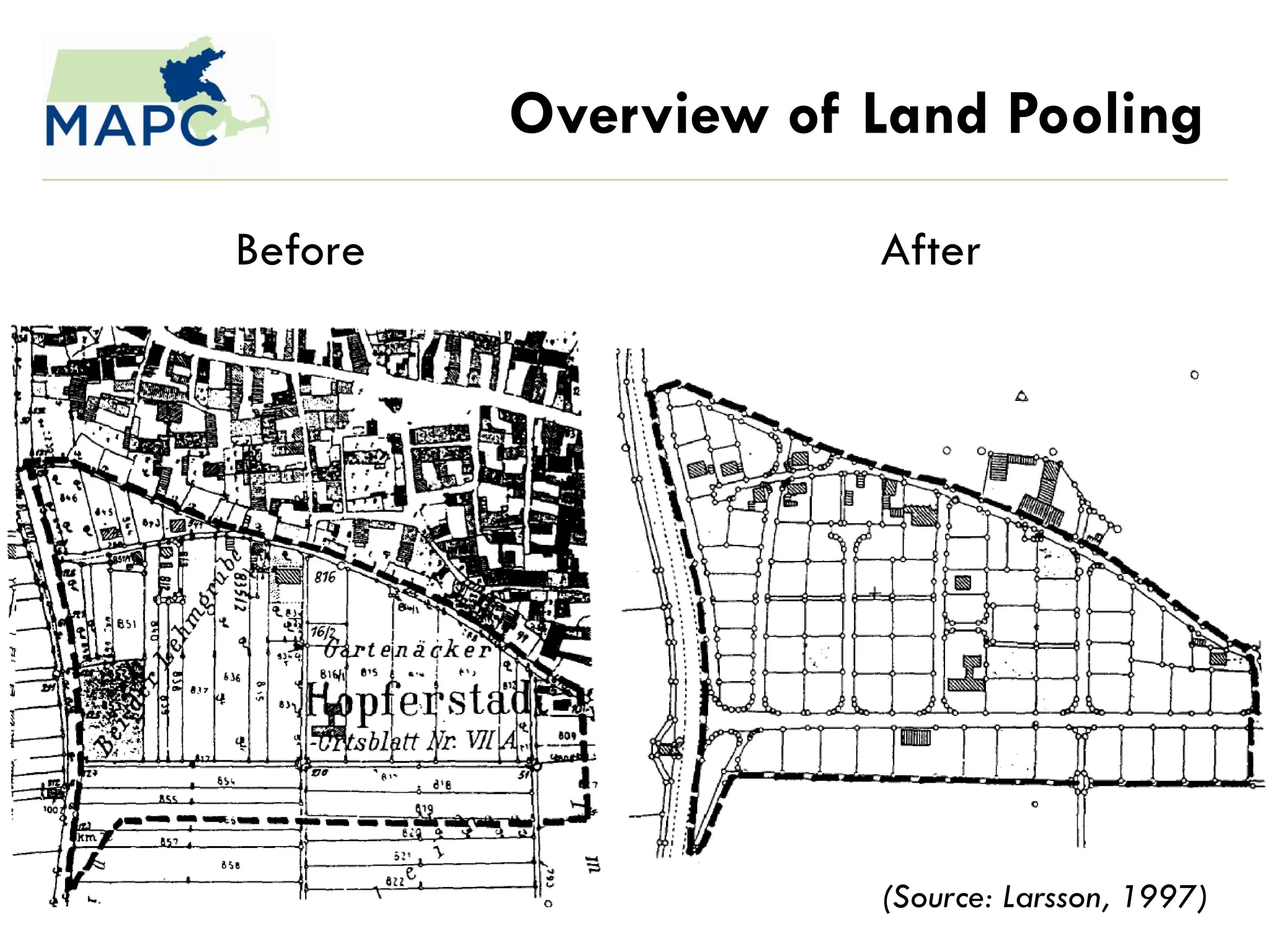
Before               After


                     (Source: Larsson, 1997)
Overview of Land Pooling

Property owners work with local government or
developers to reconfigure parcels for more
optimal development and redevelopment in such
a way that increases total land value.

During an actual land pooling process, a number
of private parcels is temporarily put into
common ownership and later reallocated to a
new highest and best use.
Overview of Land Pooling
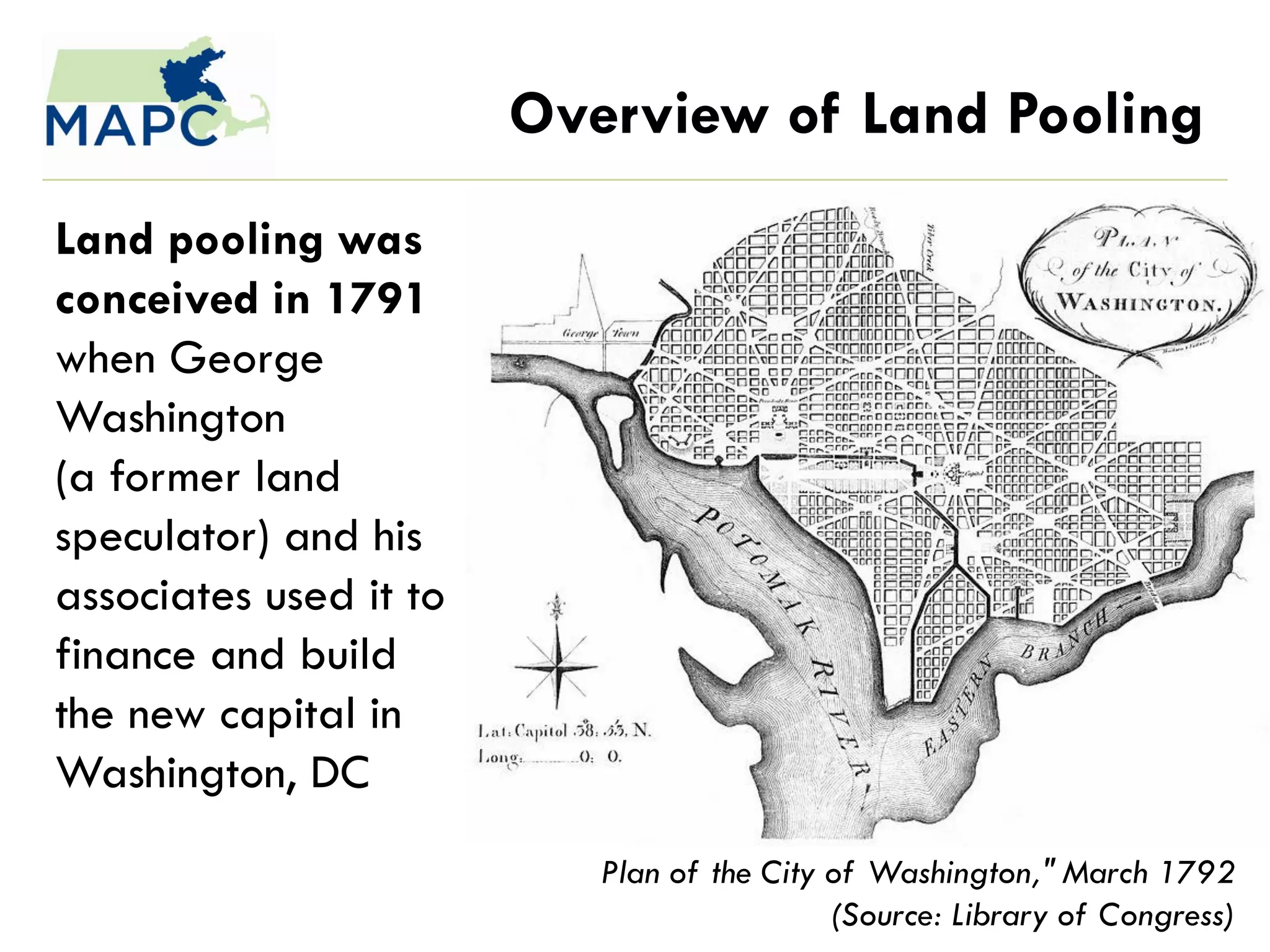
Land pooling was
conceived in 1791
when George
Washington
(a former land
speculator) and his
associates used it to
finance and build
the new capital in
Washington, DC
                           Plan of the City of Washington," March 1792
                                            (Source: Library of Congress)
Overview of Land Pooling

1791 Land Pooling Process in Washington, DC:

• Farm owners transferred titles to Mr. Washington in trust
• Mr. Washington authorized a plan outlining street
  layout, public sites, private urban lots, etc.
• Federal government paid landowners for sites of public
  buildings
• Half of remaining lots were returned to original owners;
  half were retained by the federal government
Overview of Land Pooling
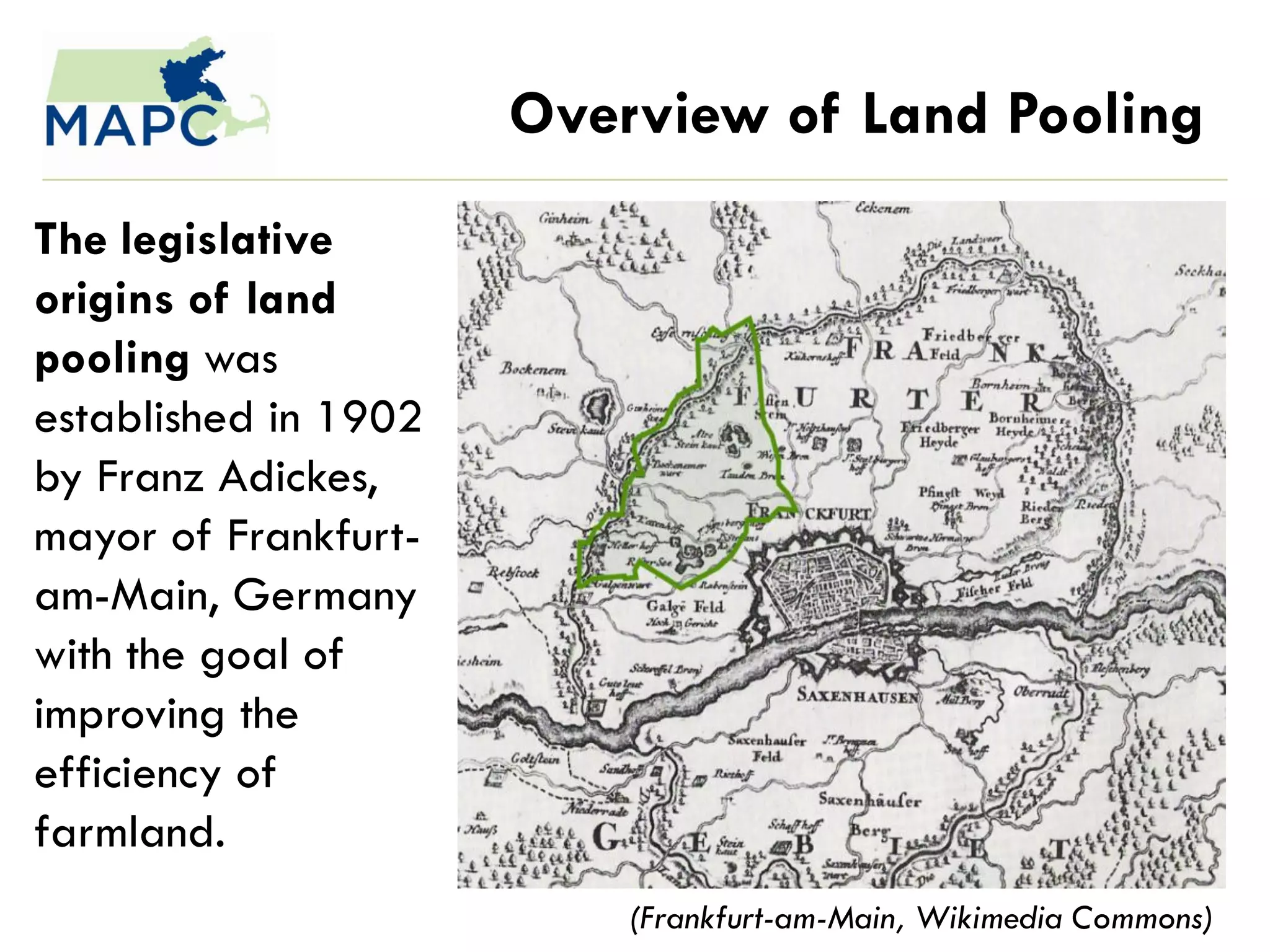
The legislative
origins of land
pooling was
established in 1902
by Franz Adickes,
mayor of Frankfurt-
am-Main, Germany
with the goal of
improving the
efficiency of
farmland.
                          (Frankfurt-am-Main, Wikimedia Commons)
Overview of Land Pooling

Land pooling process for farmland in Germany:

• Farmers temporarily put land titles in a common
  pool
• Plan for more rational farmland boundaries was
  made
• Titles were assigned back to farmers according to
  the plan
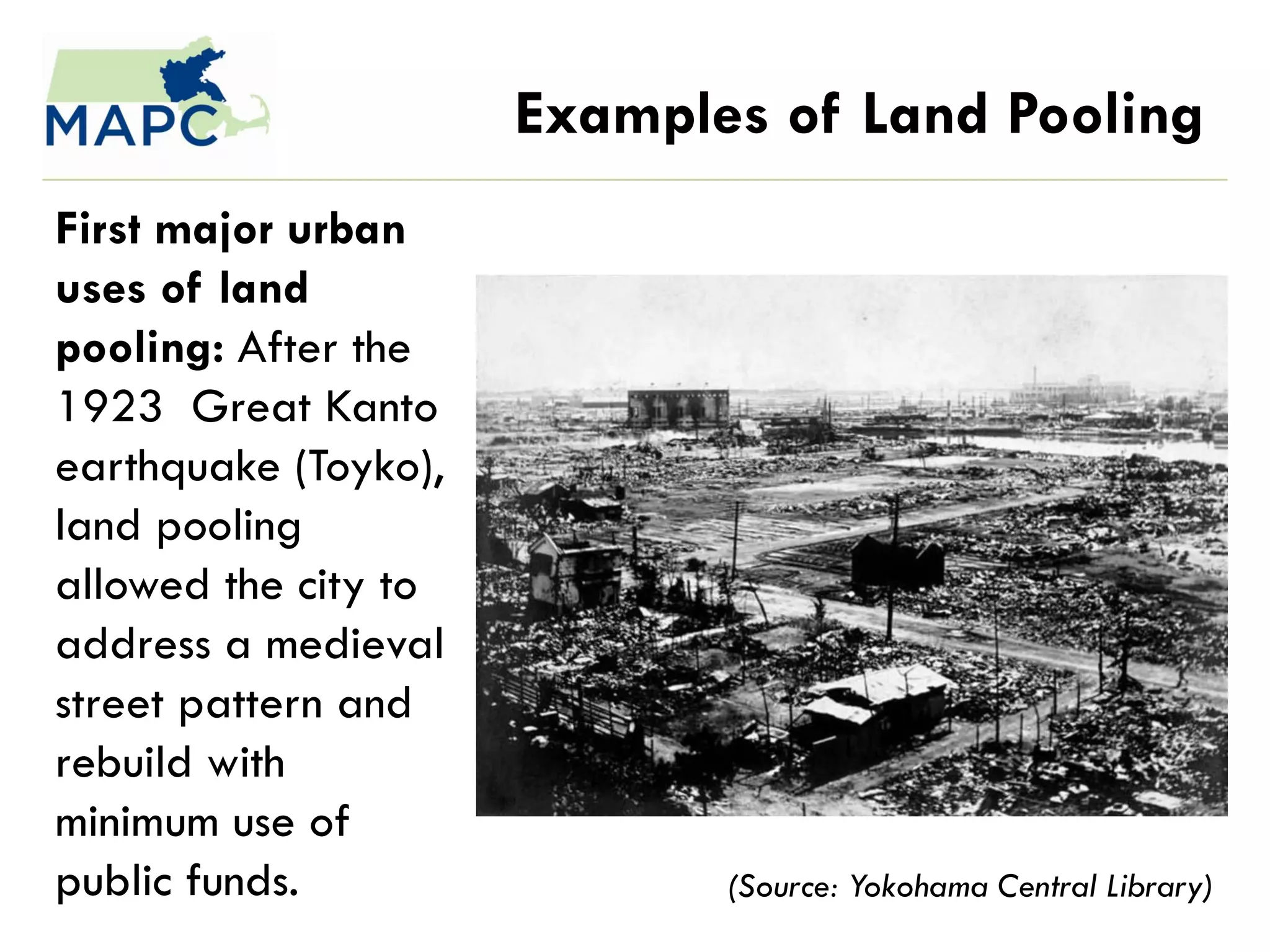
Examples of Land Pooling
First major urban
uses of land
pooling: After the
1923 Great Kanto
earthquake (Toyko),
land pooling
allowed the city to
address a medieval
street pattern and
rebuild with
minimum use of
public funds.                (Source: Yokohama Central Library)
Examples of Land Pooling
First major urban uses of land pooling (continued)

• Japan: Rebuilding of Nagoya, Osaka, Hiroshima and
  Yokohama after World War II. It was also used for land
  acquisition for ―Bullet Train‖ lines and stations.
• South Korea:
   • 60% of the urban expansion of Seoul was
     accomplished through land pooling (1984 data).
   • 30% of the urban expansion of Daegu was
     accomplished through land pooling.
   • Today, 35% of the urban expansion in Korea (1990
     data) is accomplished through land pooling.
Overview of Land Pooling

Land Pooling has also been used in Bhutan, France,
Finland, Germany, India, Indonesia, Israel/Palestine,
Nepal, the Netherlands, Sweden, Taiwan, Thailand, and in
many other parts of the world.

Historically it is has been used as a means to:

   • Capture land value increments to cover urban
     development costs
   • Adjust outmoded property boundaries
Overview of Land Pooling

It has also been recognized as a tool to:

   • Facilitate land acquisition for urban development –
     speeding up the development process
   • Allow existing landowners to share the wealth
     generated from urban development
   • Promote housing development
   • Avoid gentrification
                                      (Home, 2002 and Hong, 2010)
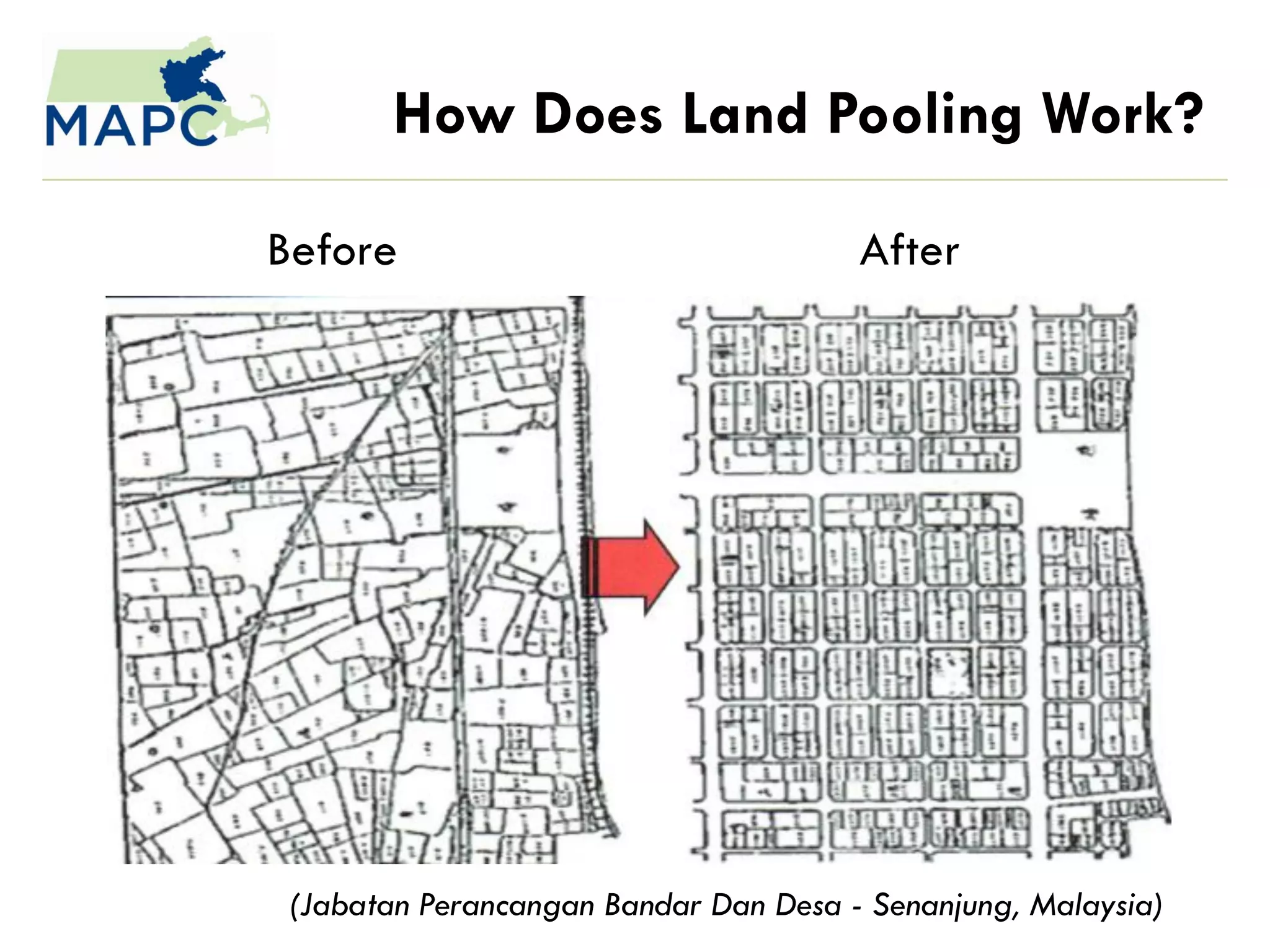
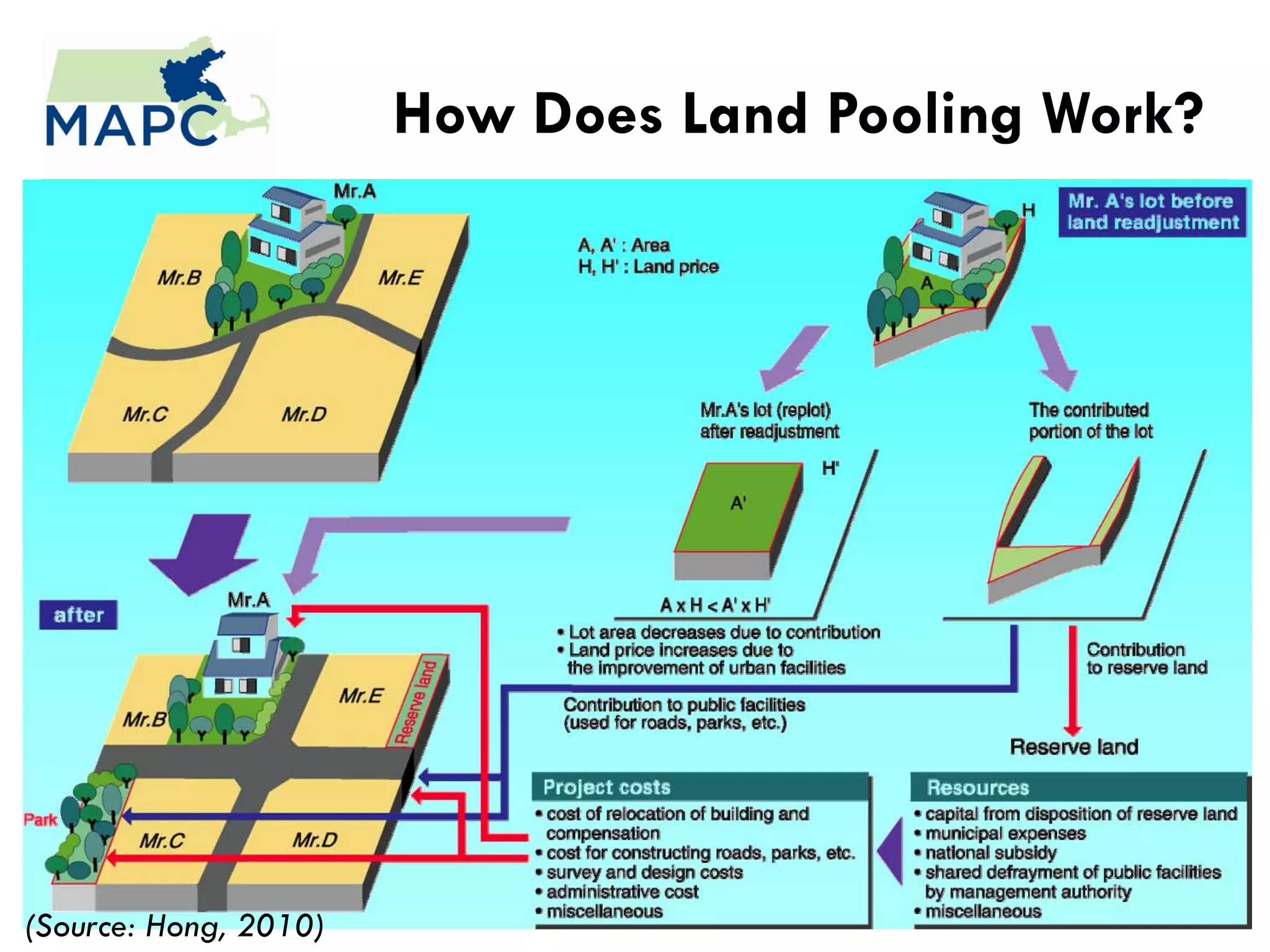
How Does Land Pooling Work?

Before                                After


(Jabatan Perancangan Bandar Dan Desa - Senanjung, Malaysia)
How Does Land Pooling Work?


(Source: Hong, 2010)
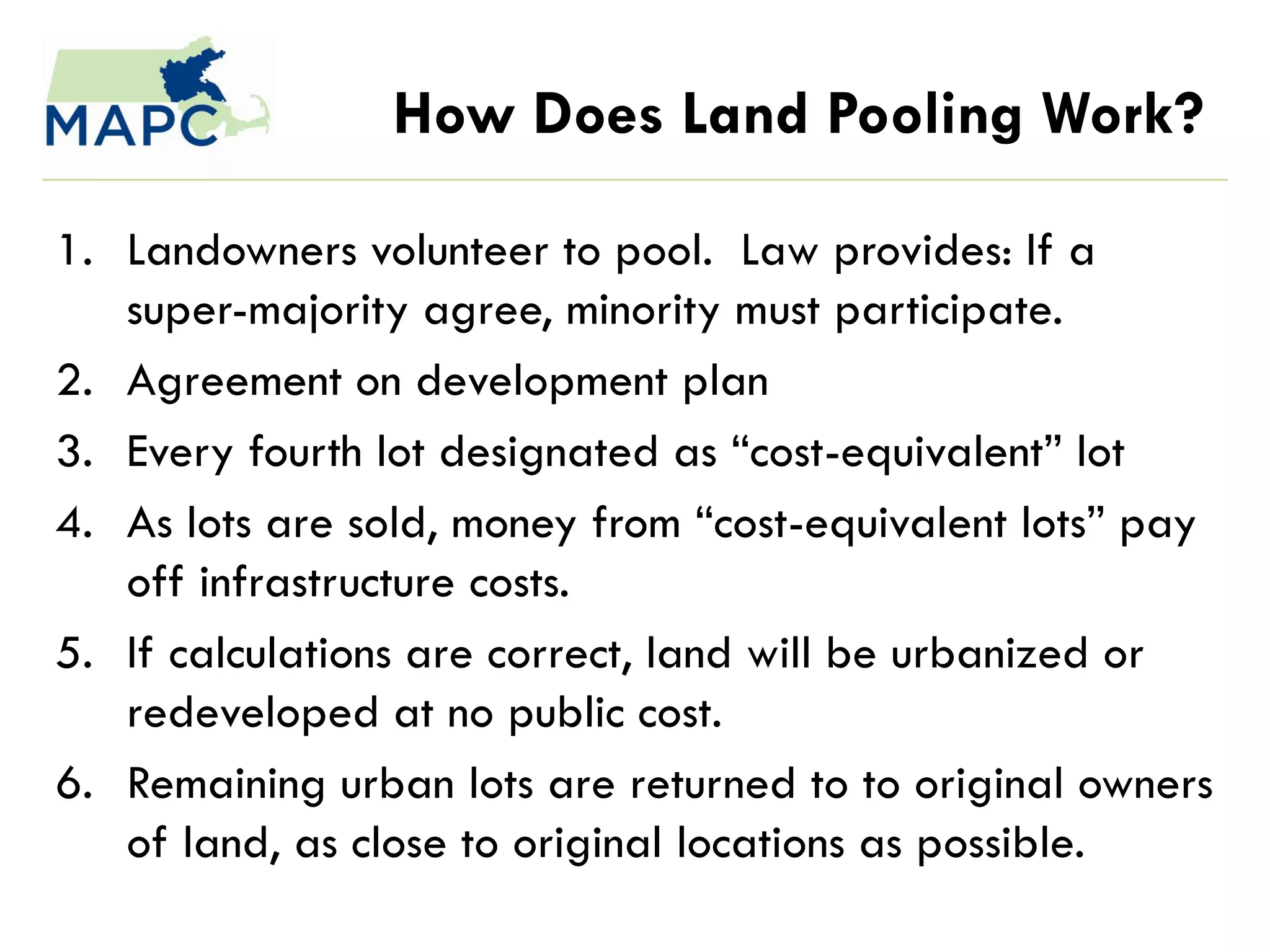
How Does Land Pooling Work?

1. Landowners volunteer to pool. Law provides: If a
   super-majority agree, minority must participate.
2. Agreement on development plan
3. Every fourth lot designated as ―cost-equivalent‖ lot
4. As lots are sold, money from ―cost-equivalent lots‖ pay
   off infrastructure costs.
5. If calculations are correct, land will be urbanized or
   redeveloped at no public cost.
6. Remaining urban lots are returned to to original owners
   of land, as close to original locations as possible.
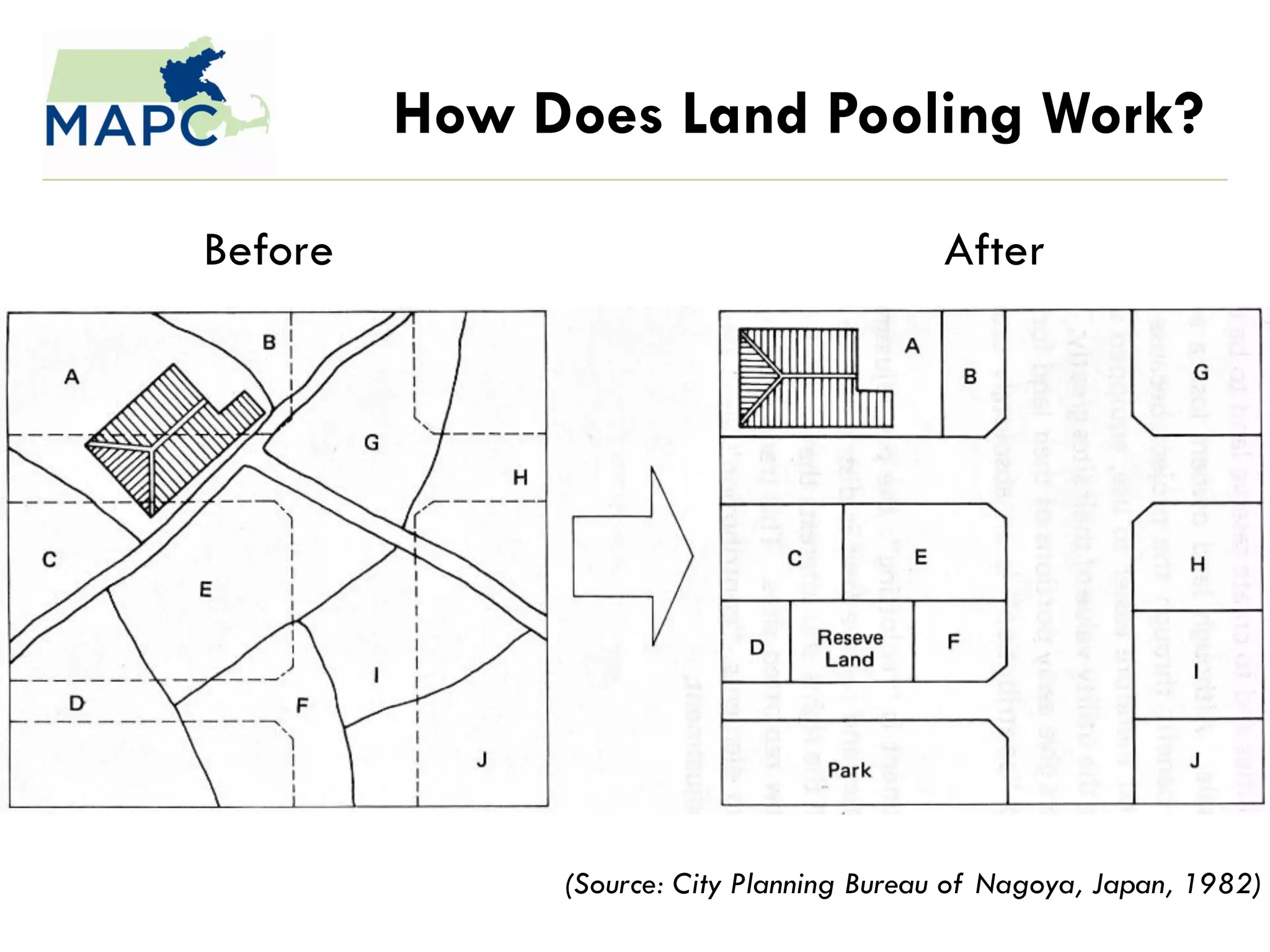
How Does Land Pooling Work?

Before                                    After


              (Source: City Planning Bureau of Nagoya, Japan, 1982)
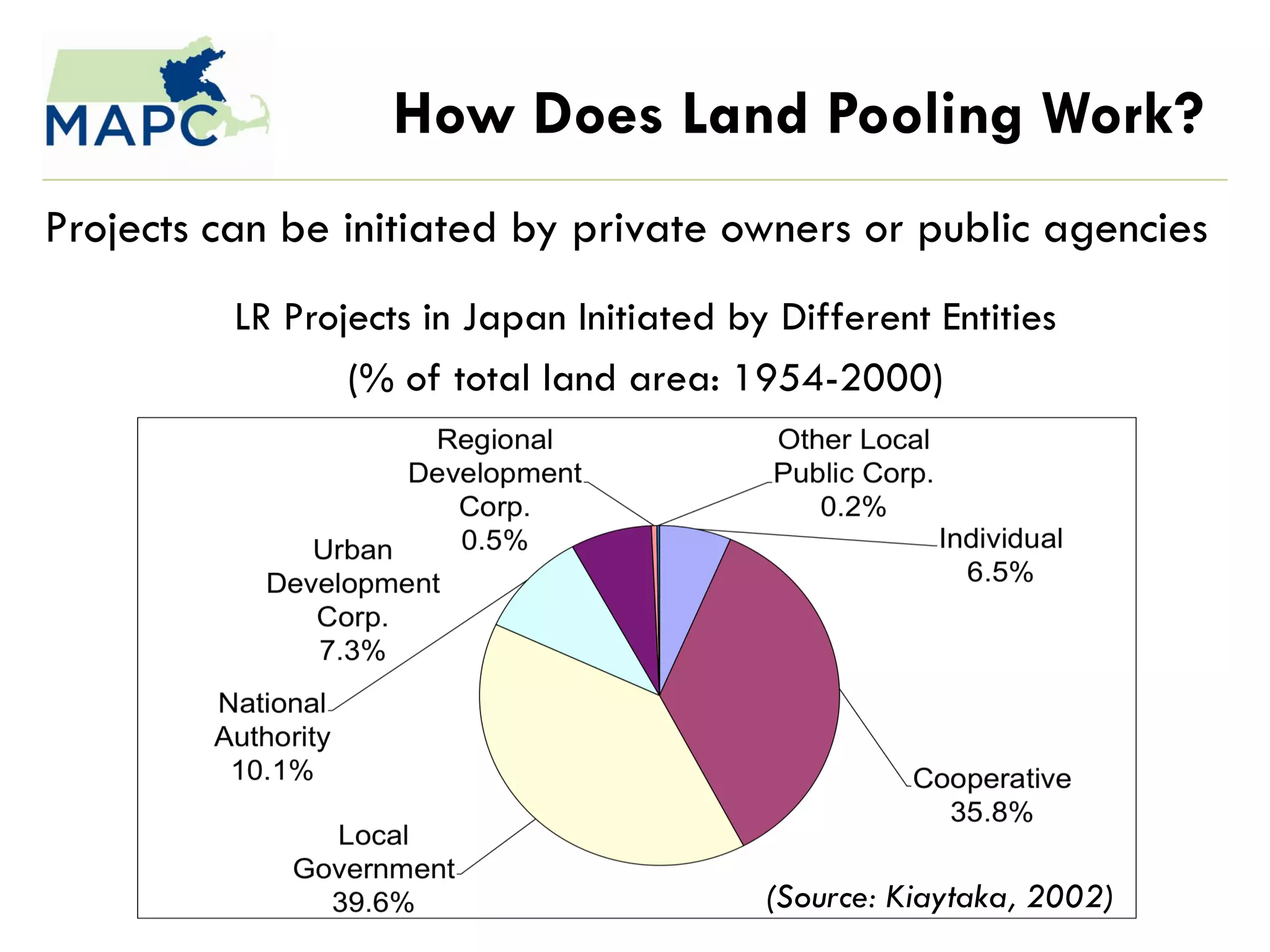
How Does Land Pooling Work?
Projects can be initiated by private owners or public agencies
          LR Projects in Japan Initiated by Different Entities
                 (% of total land area: 1954-2000)


                                           (Source: Kiaytaka, 2002)
How Does Land Pooling Work?

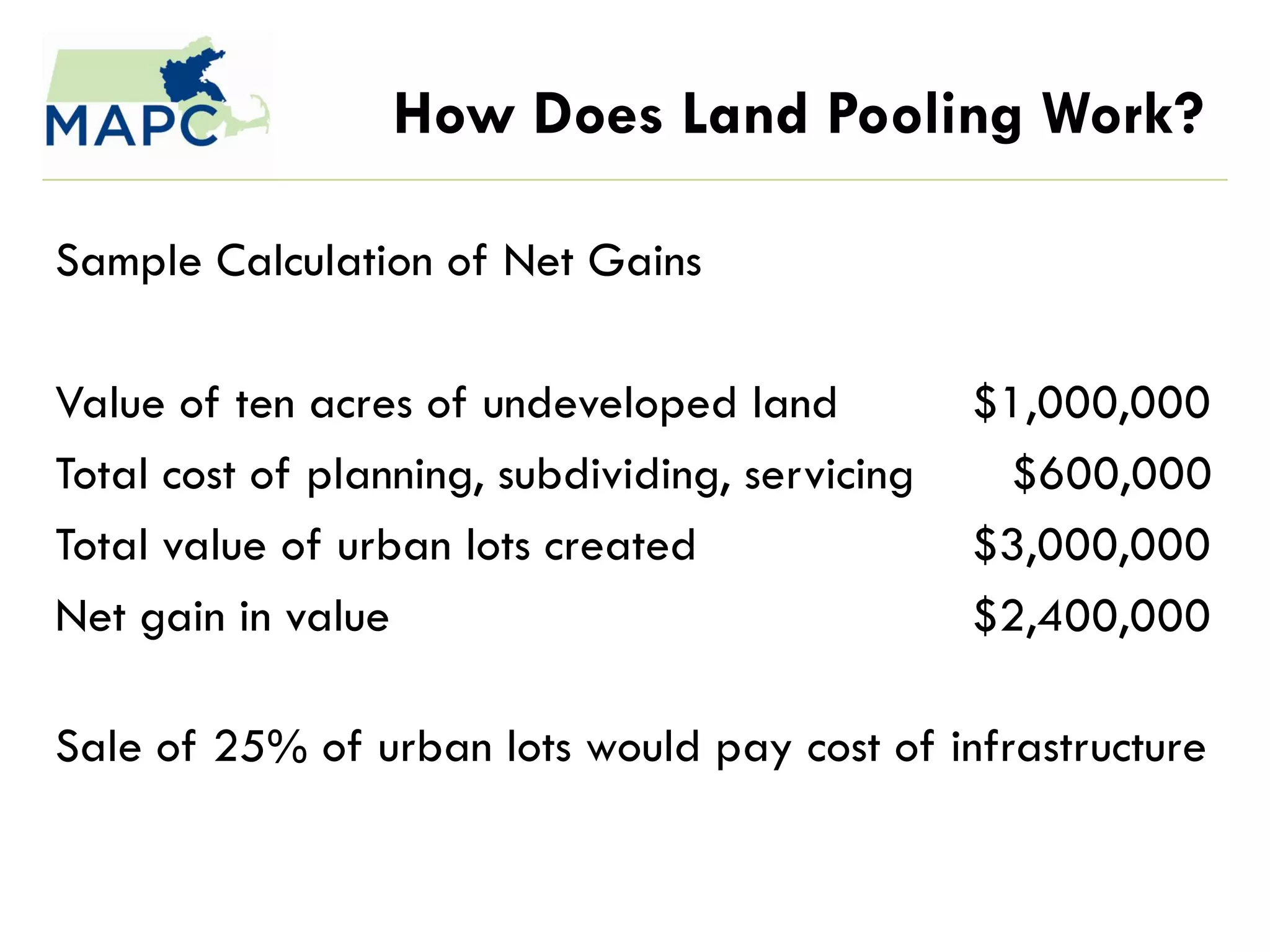
Sample Calculation of Net Gains

Value of ten acres of undeveloped land           $1,000,000
Total cost of planning, subdividing, servicing    $600,000
Total value of urban lots created                $3,000,000
Net gain in value                                $2,400,000

Sale of 25% of urban lots would pay cost of infrastructure
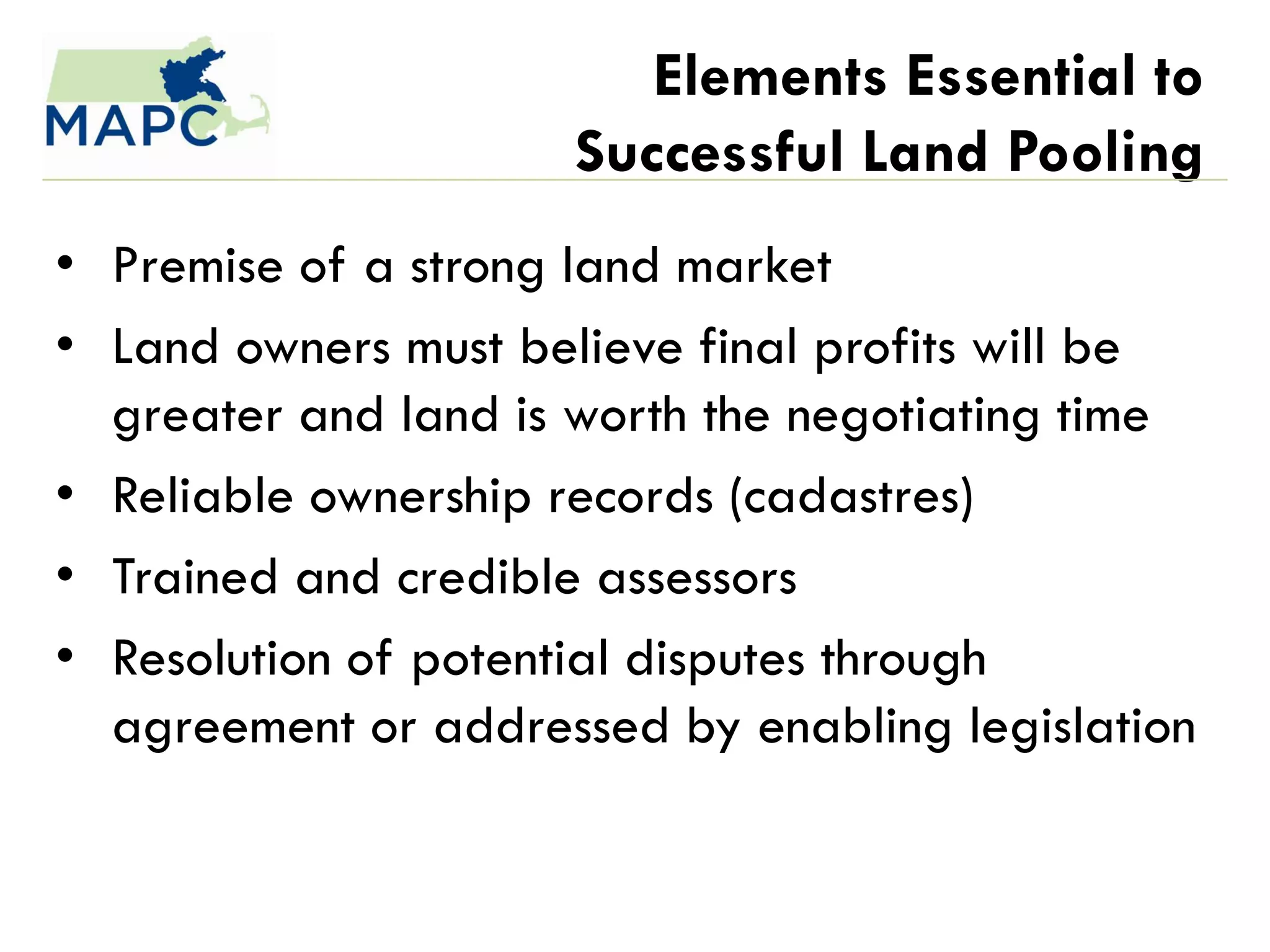
Elements Essential to
                     Successful Land Pooling
• Premise of a strong land market
• Land owners must believe final profits will be
  greater and land is worth the negotiating time
• Reliable ownership records (cadastres)
• Trained and credible assessors
• Resolution of potential disputes through
  agreement or addressed by enabling legislation
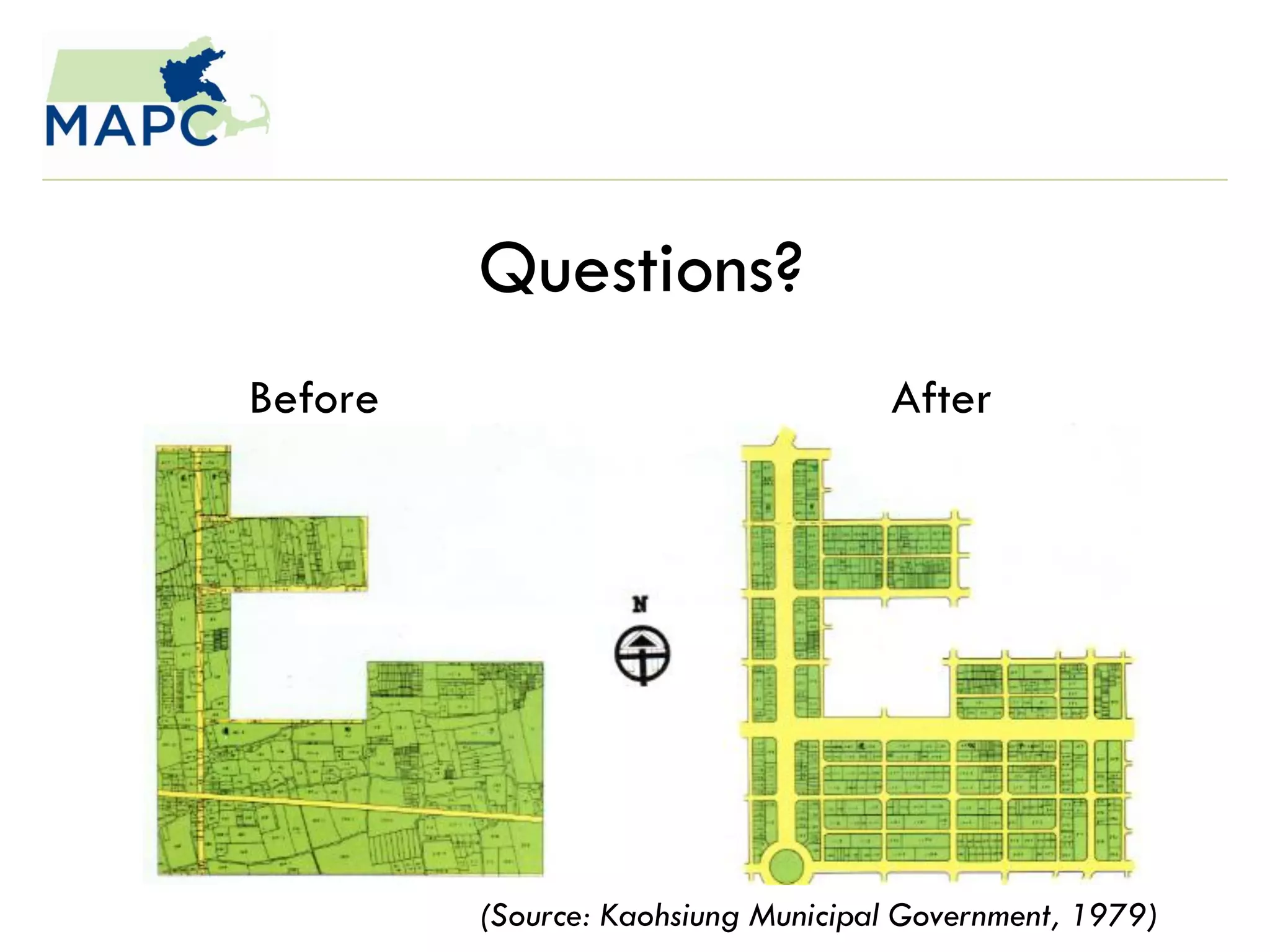
Questions?
Before                              After


         (Source: Kaohsiung Municipal Government, 1979)
Land Pooling in a U.S. Context
                     James Freas
  Regional Planner, Metropolitan Area Planning Council

                   Yu-Hung Hong
Senior Fellow, Lincoln Institute of Land Policy and Assistant
  Visiting Professor, Massachusetts Institute of Technology
Land Pooling in a U.S. Context

Case Study: Land Pooling in Hampton, VA

Goals:
  1. Illustrate the various features of land pooling
  2. Explore the applicability of the ideas in a U.S.
       context
Background: Hampton, VA


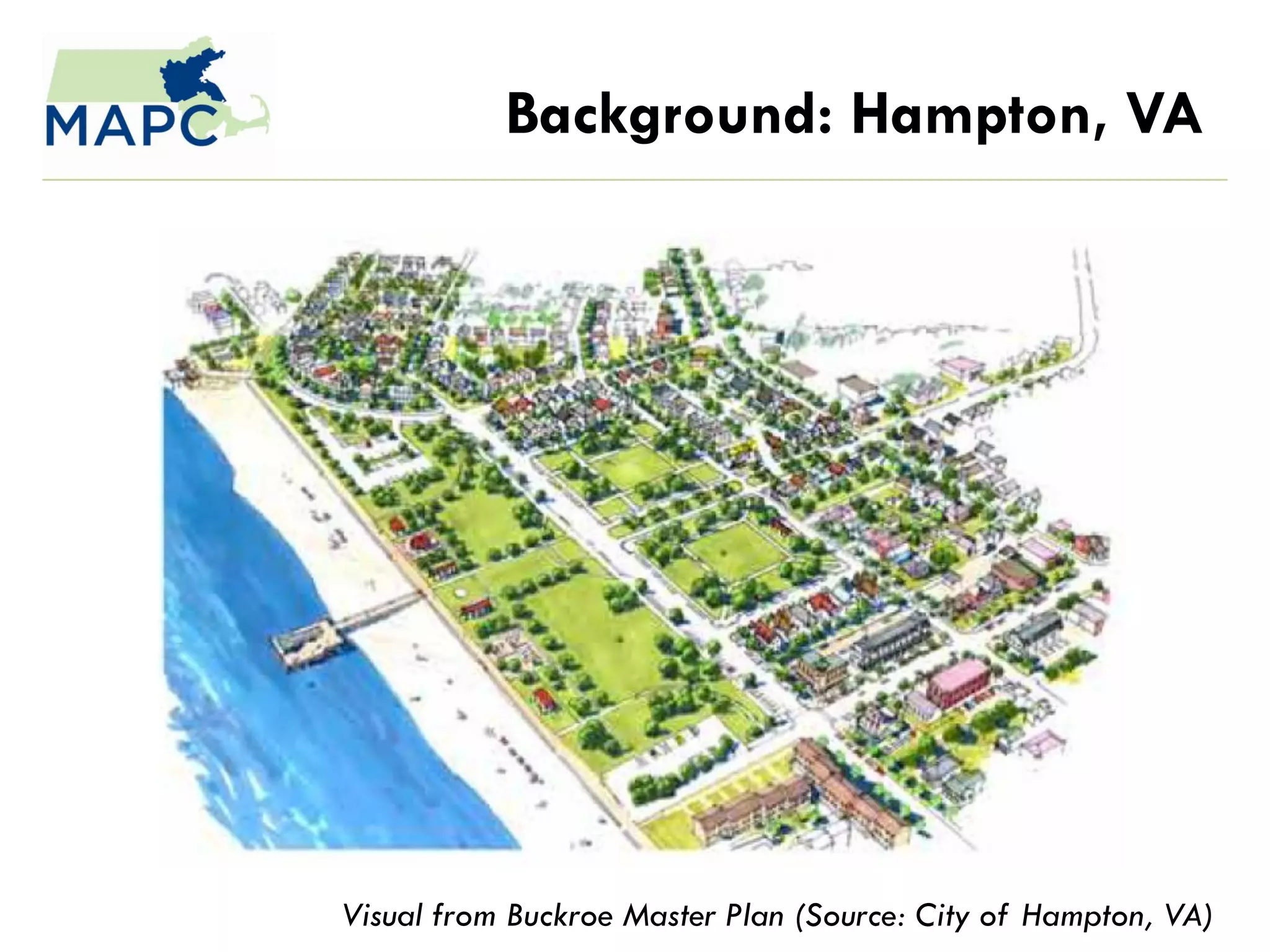
Visual from Buckroe Master Plan (Source: City of Hampton, VA)
Background: Hampton, VA


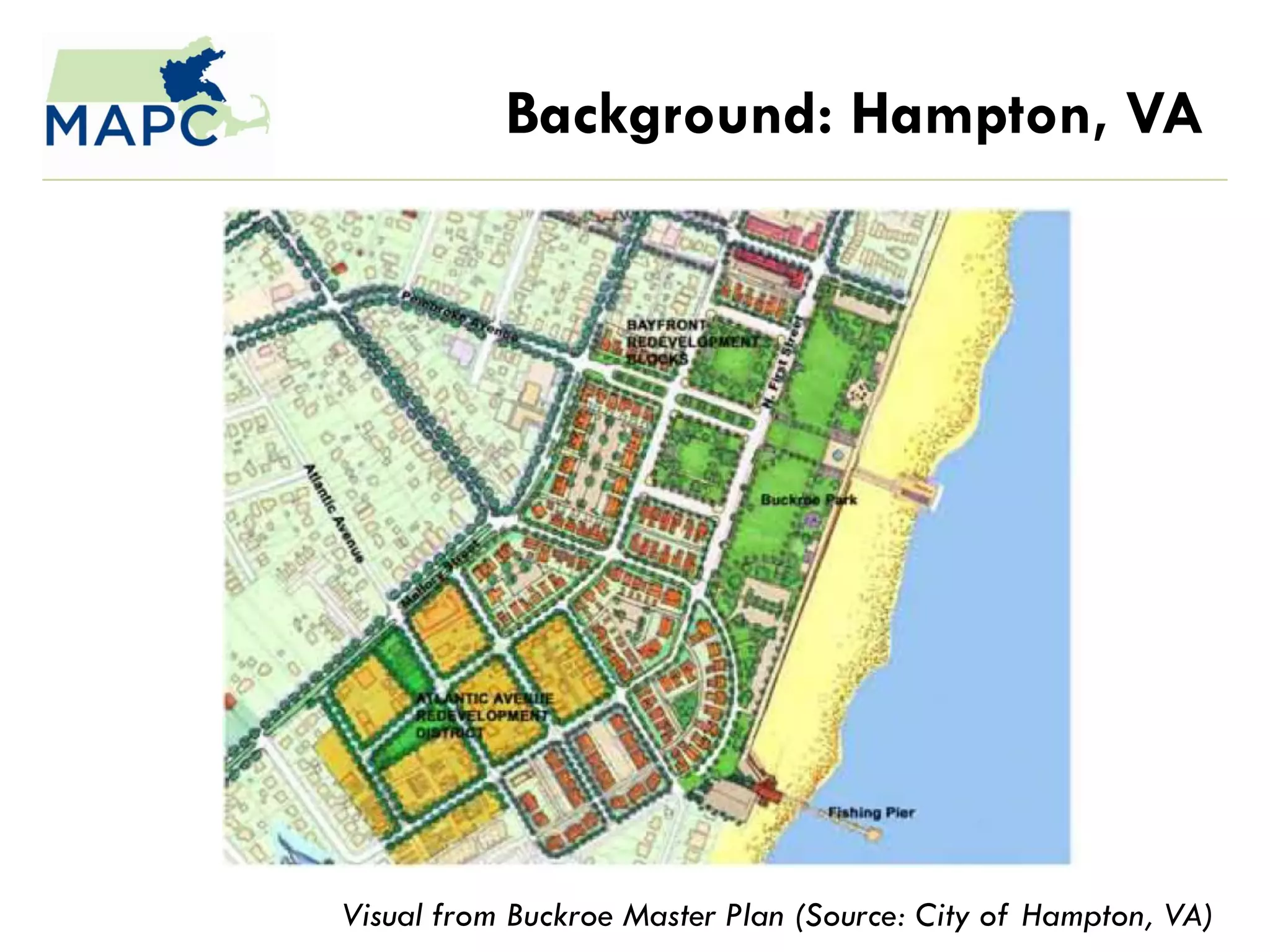
Visual from Buckroe Master Plan (Source: City of Hampton, VA)
Background: Hampton, VA

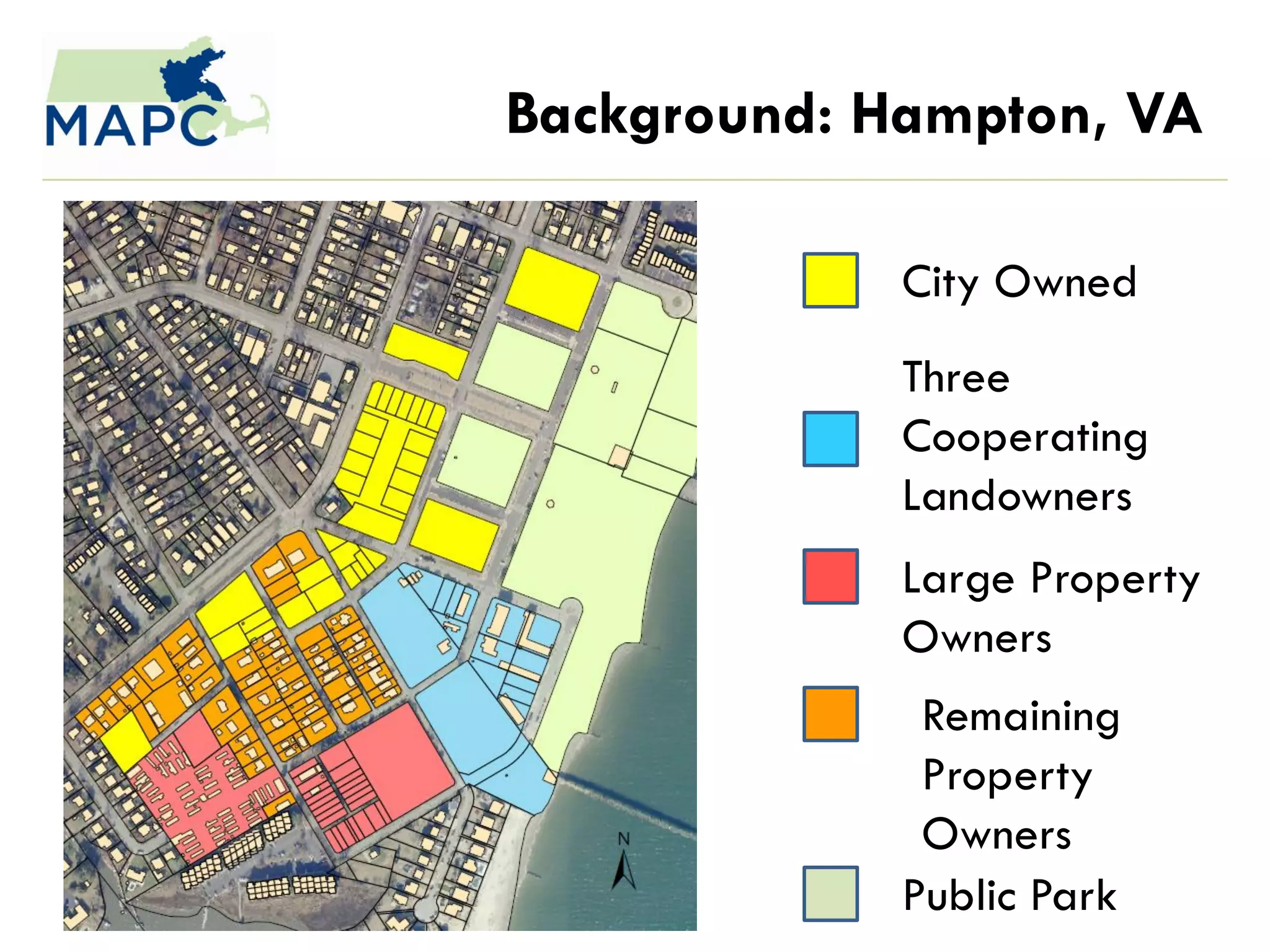
             City Owned
             Three
             Cooperating
             Landowners
             Large Property
             Owners
              Remaining
              Property
              Owners
             Public Park
Enabling Conditions for LP in Hampton
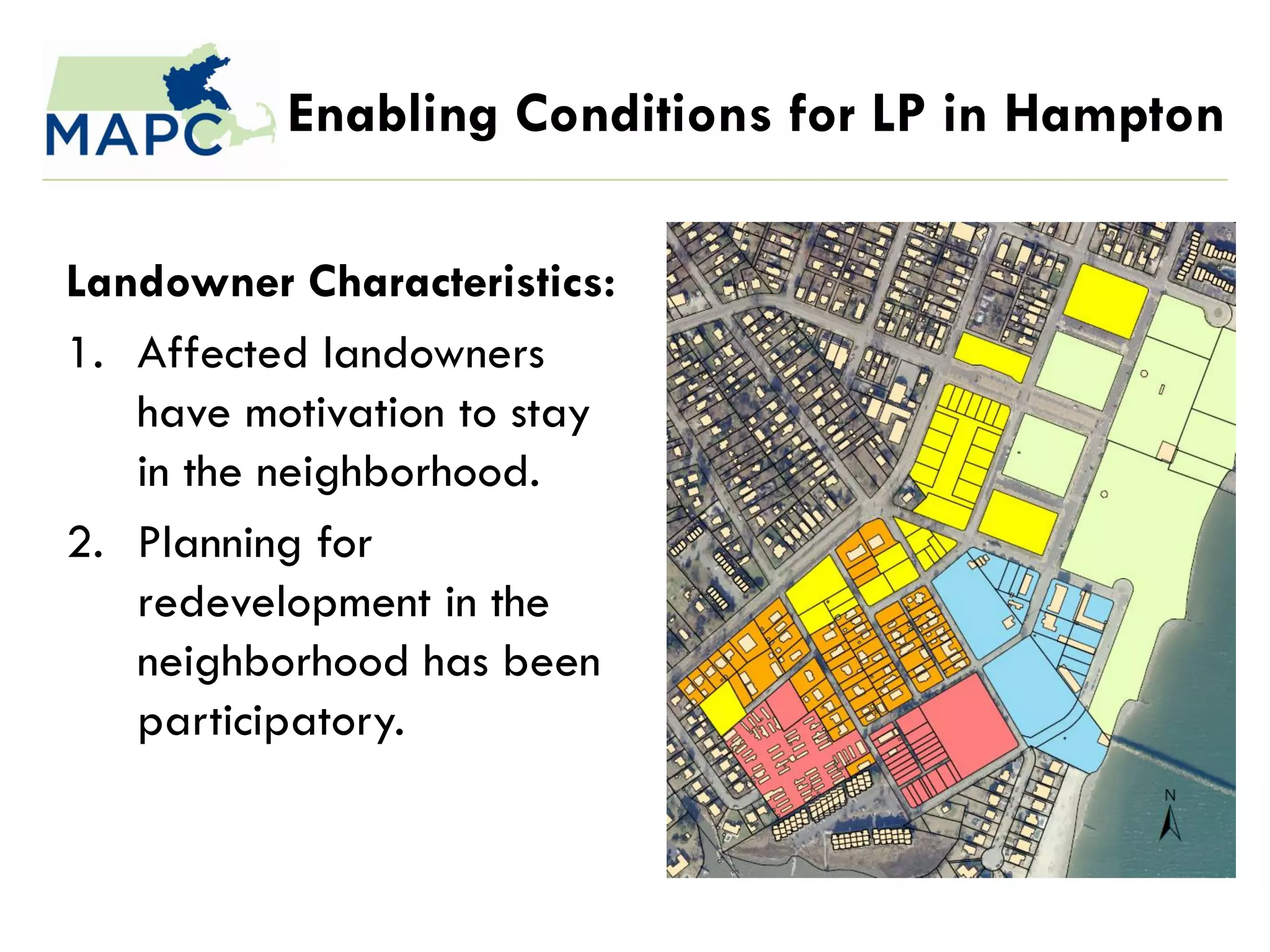
Property Characteristics:
1. High differential increments in
   land values before and after
   land pooling project.
2. Government already owns
   area in yellow
3. Major landowners in blue
   agreed to sell land together.
4. Landownership (in blue,
   orange and red) is fairly
   concentrated. Two major
   property owners own area in
   red.
Enabling Conditions for LP in Hampton

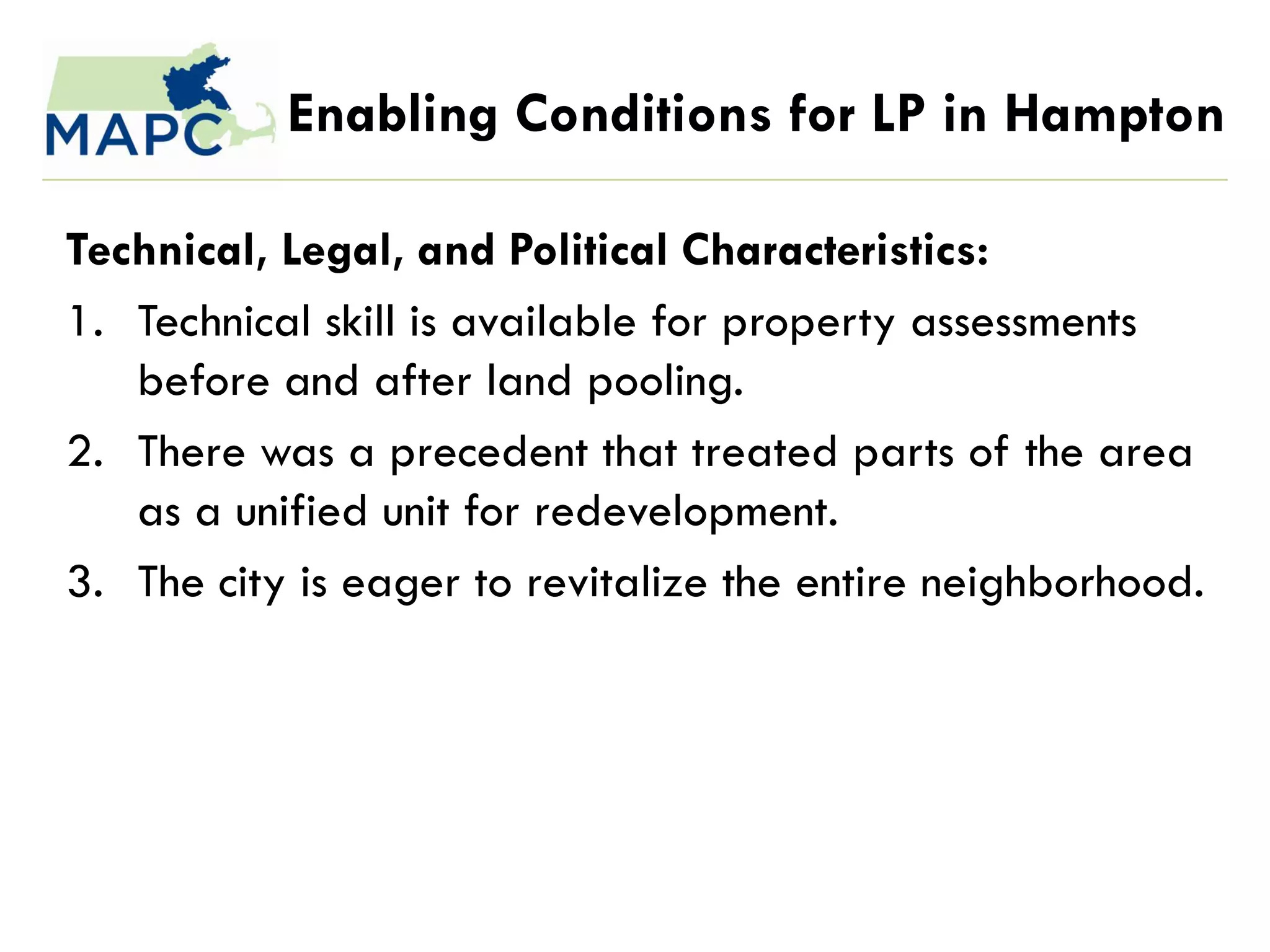
Landowner Characteristics:
1. Affected landowners
   have motivation to stay
   in the neighborhood.
2. Planning for
   redevelopment in the
   neighborhood has been
   participatory.
Enabling Conditions for LP in Hampton

Technical, Legal, and Political Characteristics:
1. Technical skill is available for property assessments
   before and after land pooling.
2. There was a precedent that treated parts of the area
   as a unified unit for redevelopment.
3. The city is eager to revitalize the entire neighborhood.
Reflection
Strengths
1. Developers with real estate development expertise
    can be involved in the early stage of redevelopment.
2. Land Pooling that requires the approval of the
    majority of landowners to execute land assembly is
    more democratic than is eminent domain.
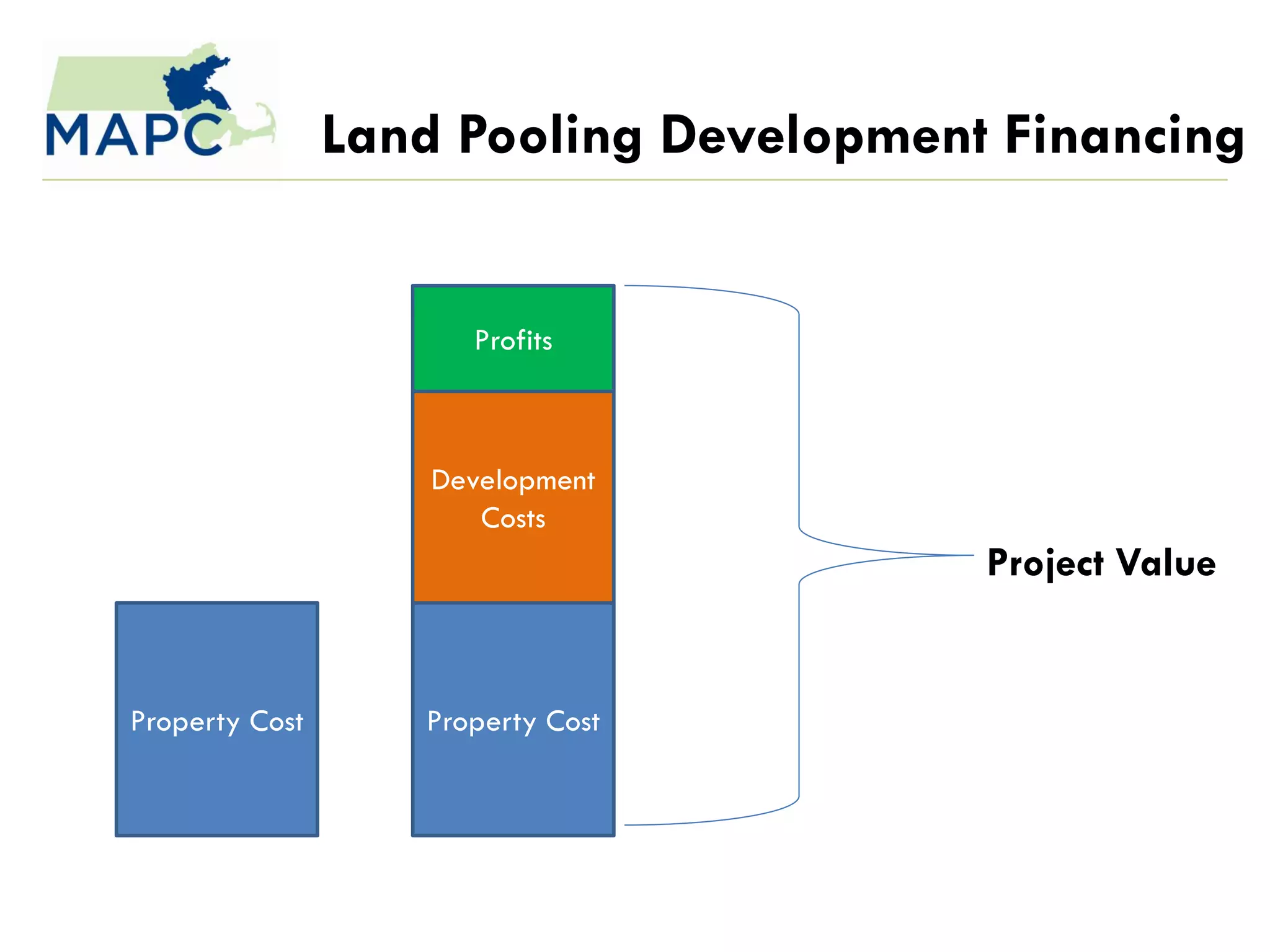
3. Land pooling can avoid the heavy up-front capital
    requirement for property acquisitions by the local
    government.
4. Land pooling may allow urban redevelopment to be
    self-financing.
Land Pooling Development Financing


                      Profits


                    Development
                       Costs
                                        Project Value


Property Cost      Property Cost
Reflection
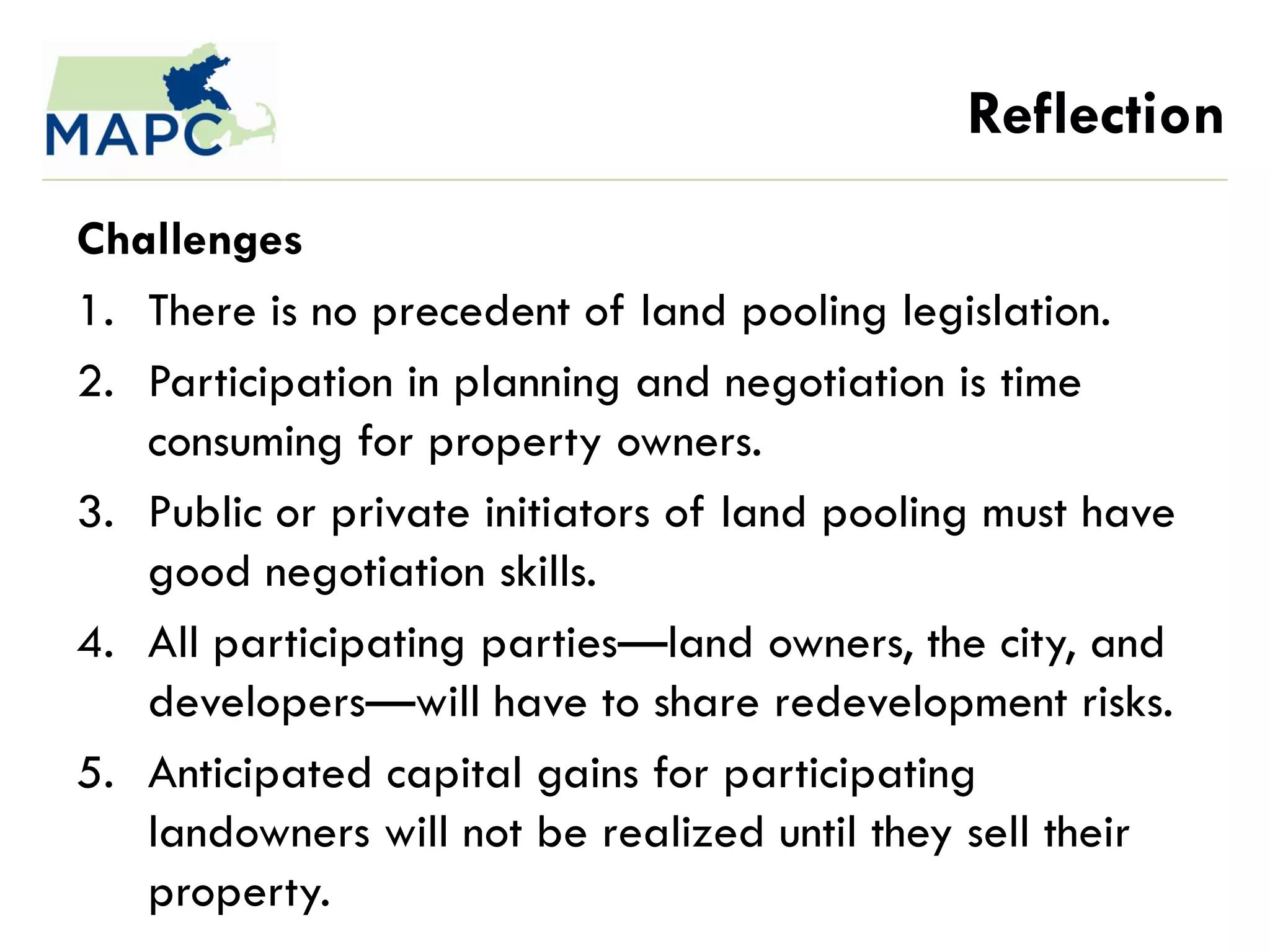
Challenges
1. There is no precedent of land pooling legislation.
2. Participation in planning and negotiation is time
   consuming for property owners.
3. Public or private initiators of land pooling must have
   good negotiation skills.
4. All participating parties—land owners, the city, and
   developers—will have to share redevelopment risks.
5. Anticipated capital gains for participating
   landowners will not be realized until they sell their
   property.
Reflection


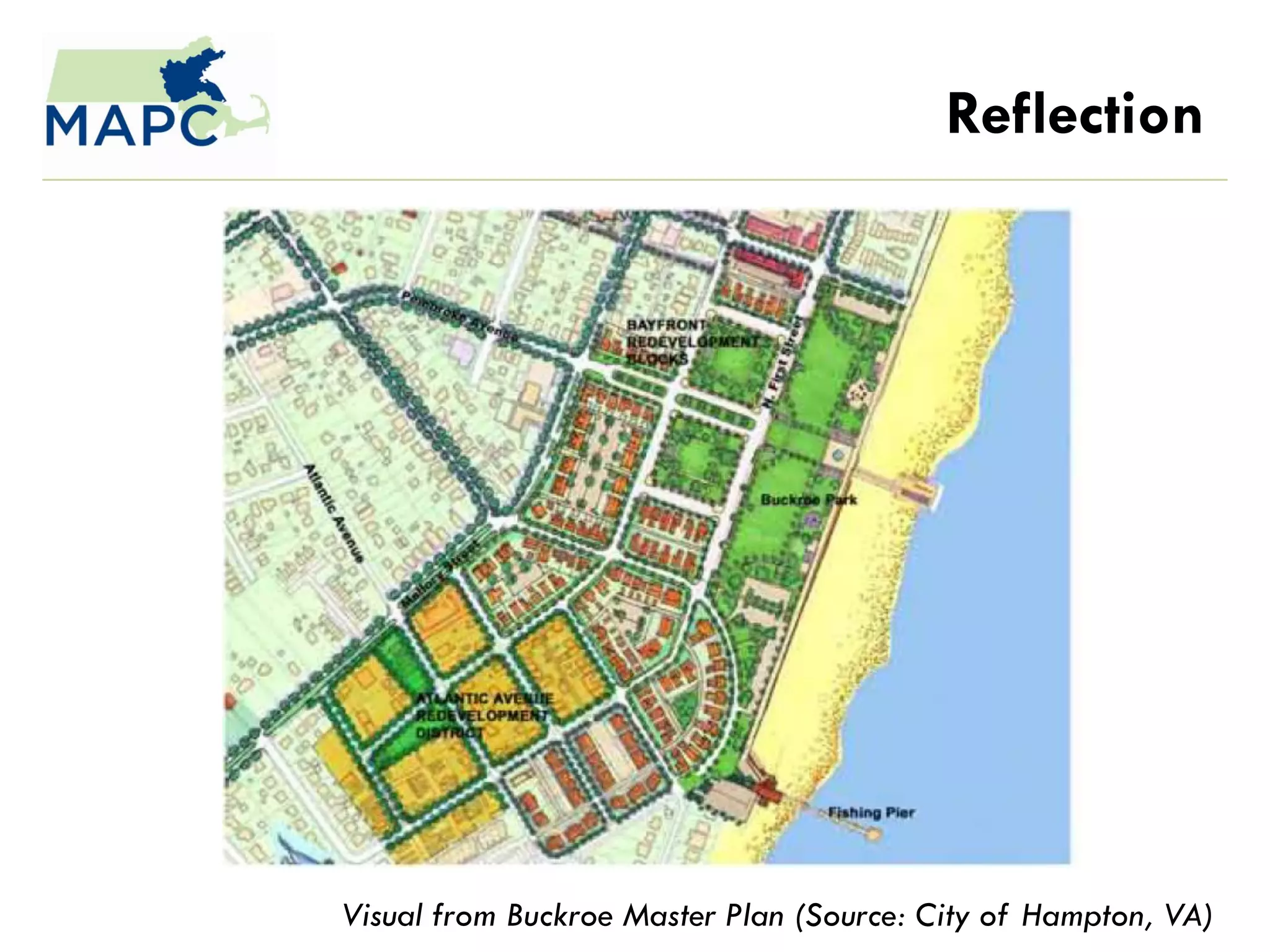
Visual from Buckroe Master Plan (Source: City of Hampton, VA)
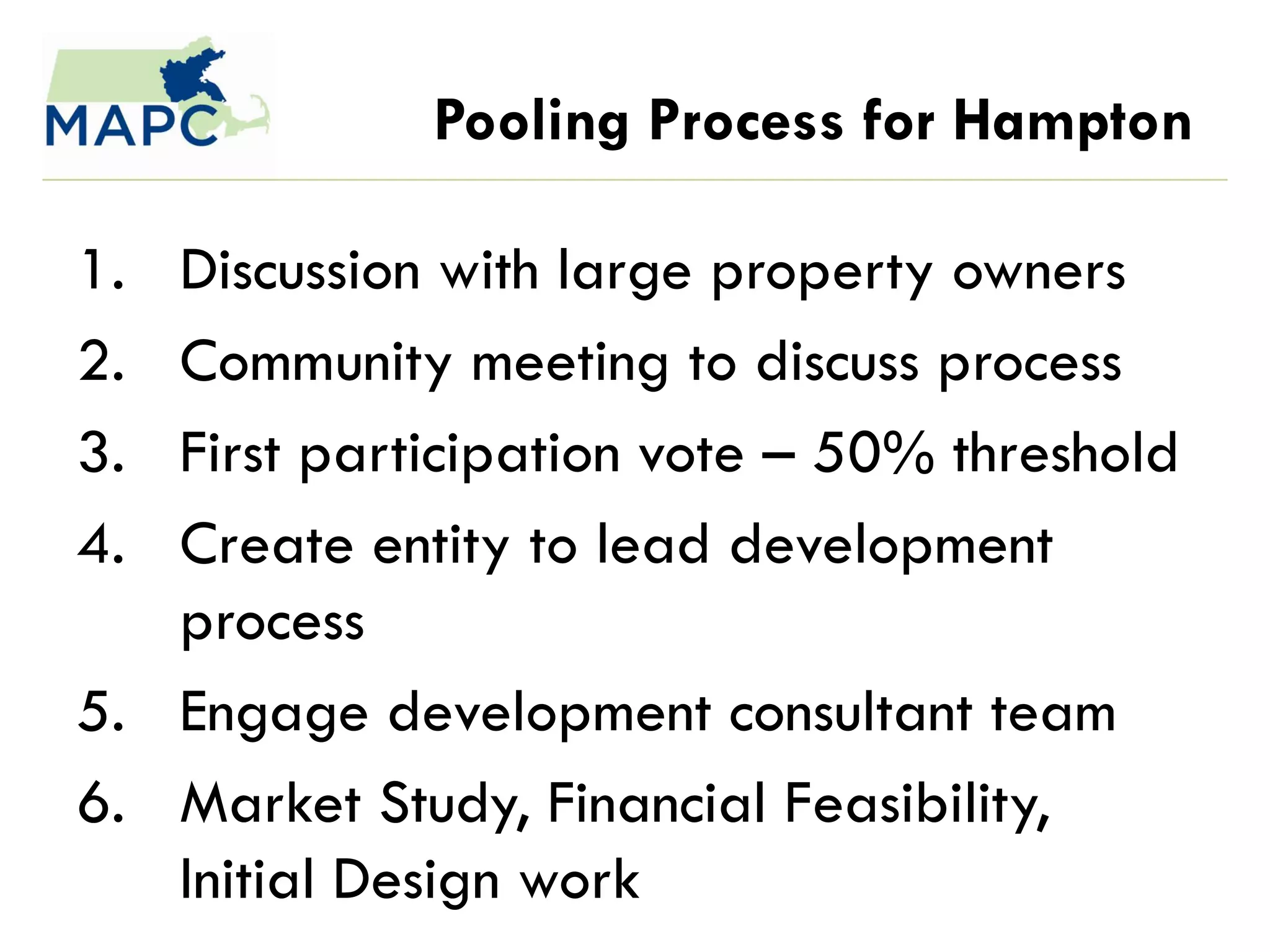
Pooling Process for Hampton

1. Discussion with large property owners
2. Community meeting to discuss process
3. First participation vote – 50% threshold
4. Create entity to lead development
   process
5. Engage development consultant team
6. Market Study, Financial Feasibility,
   Initial Design work
Pooling Process for Hampton

7. Draft development pro-forma
8. Final participation Vote – 75%
9. Final development plan, contracts
    signed, land titles pooled
10. After redevelopment, property owners
    receive final compensation and Land
    Pool entity dissolved
Break (10 minutes)
Next on the Agenda:
• Land Pooling in Massachusetts:
  Discussion and Q & A (40-50 minutes)
• Next Steps (10-15 minutes)
Land Pooling Symposium


Land Pooling in Massachusetts:
    Discussion and Q & A
Land Pooling Symposium


Next Steps
Resources


           MAPC Land Pooling Toolkit
    http://www.mapc.org/resources/lptoolkit

MAPC – James Freas et. al: landpooling@mapc.org

Lincoln Institute – Yu-Hung Hong: hong@lincolninst.edu

MAPC land pooling symposium presentation 5 11 2011

  • 1.
    Land Pooling: APossible Alternative to Eminent Domain and Tool for Equitable Urban Redevelopment May 11, 2011, 9:00 am – 12:00 pm
  • 2.
    About MAPC The missionof the Metropolitan Area Planning Council (MAPC) is to promote smart growth and regional collaboration in Metropolitan Boston, through public policy research and advocacy, technical assistance, mapping and analysis, and regional planning. Our work is guided by our regional plan, "MetroFuture: Making a Greater Boston Region." The MAPC planning area consists of 22 cities and 79 towns that include coastal communities, older industrial centers, rural towns and modern cities.
  • 3.
  • 4.
    About Lincoln Instituteof Land Policy The Lincoln Institute of Land Policy is a leading resource for key issues concerning the use, regulation, and taxation of land. Providing high- quality education and research, the Institute strives to improve public dialogue and decisions about land policy.
  • 5.
    Agenda • Welcome (10 minutes) • Overview of Land Pooling (40-45 minutes) • Land Pooling Process in a U.S. Context (40-45 minutes) • Break (10 minutes) • Land Pooling in Massachusetts: Discussion and Q & A (40-50 minutes) • Next Steps (10-15 minutes)
  • 6.
    Why Land Pooling? •Cities must transition in order to meet current needs and future demands • We need options that engage – not marginalize – property owners • We need solutions that create less opposition on compensation and other matters important to residents
  • 7.
  • 8.
    Land Pooling forEconomic Development Eminent Domain Land Pooling • Top-down: government • Bottom-up: stakeholder driven driven • cash based: property • Equity-based: property owners paid out owners contribute in • Judicial-administrative • Democratic-participatory Process process
  • 9.
    Overview of LandPooling William A. Doebele Author and Professor of Urban Planning and Design Emeritus, Harvard University
  • 10.
    Overview of LandPooling Land pooling is a land assembly process that is used for developing and redeveloping real estate. Other names: • Land Readjustment (South Korea and Japan) • Land Consolidation (Europe) • Land Pooling (Australia) Google “Land Readjustment” for a literature review on the topic
  • 11.
    Overview of LandPooling Before After (Source: Larsson, 1997)
  • 12.
    Overview of LandPooling Property owners work with local government or developers to reconfigure parcels for more optimal development and redevelopment in such a way that increases total land value. During an actual land pooling process, a number of private parcels is temporarily put into common ownership and later reallocated to a new highest and best use.
  • 13.
    Overview of LandPooling Land pooling was conceived in 1791 when George Washington (a former land speculator) and his associates used it to finance and build the new capital in Washington, DC Plan of the City of Washington," March 1792 (Source: Library of Congress)
  • 14.
    Overview of LandPooling 1791 Land Pooling Process in Washington, DC: • Farm owners transferred titles to Mr. Washington in trust • Mr. Washington authorized a plan outlining street layout, public sites, private urban lots, etc. • Federal government paid landowners for sites of public buildings • Half of remaining lots were returned to original owners; half were retained by the federal government
  • 15.
    Overview of LandPooling The legislative origins of land pooling was established in 1902 by Franz Adickes, mayor of Frankfurt- am-Main, Germany with the goal of improving the efficiency of farmland. (Frankfurt-am-Main, Wikimedia Commons)
  • 16.
    Overview of LandPooling Land pooling process for farmland in Germany: • Farmers temporarily put land titles in a common pool • Plan for more rational farmland boundaries was made • Titles were assigned back to farmers according to the plan
  • 17.
    Examples of LandPooling First major urban uses of land pooling: After the 1923 Great Kanto earthquake (Toyko), land pooling allowed the city to address a medieval street pattern and rebuild with minimum use of public funds. (Source: Yokohama Central Library)
  • 18.
    Examples of LandPooling First major urban uses of land pooling (continued) • Japan: Rebuilding of Nagoya, Osaka, Hiroshima and Yokohama after World War II. It was also used for land acquisition for ―Bullet Train‖ lines and stations. • South Korea: • 60% of the urban expansion of Seoul was accomplished through land pooling (1984 data). • 30% of the urban expansion of Daegu was accomplished through land pooling. • Today, 35% of the urban expansion in Korea (1990 data) is accomplished through land pooling.
  • 19.
    Overview of LandPooling Land Pooling has also been used in Bhutan, France, Finland, Germany, India, Indonesia, Israel/Palestine, Nepal, the Netherlands, Sweden, Taiwan, Thailand, and in many other parts of the world. Historically it is has been used as a means to: • Capture land value increments to cover urban development costs • Adjust outmoded property boundaries
  • 20.
    Overview of LandPooling It has also been recognized as a tool to: • Facilitate land acquisition for urban development – speeding up the development process • Allow existing landowners to share the wealth generated from urban development • Promote housing development • Avoid gentrification (Home, 2002 and Hong, 2010)
  • 21.
    How Does LandPooling Work? Before After (Jabatan Perancangan Bandar Dan Desa - Senanjung, Malaysia)
  • 22.
    How Does LandPooling Work? (Source: Hong, 2010)
  • 23.
    How Does LandPooling Work? 1. Landowners volunteer to pool. Law provides: If a super-majority agree, minority must participate. 2. Agreement on development plan 3. Every fourth lot designated as ―cost-equivalent‖ lot 4. As lots are sold, money from ―cost-equivalent lots‖ pay off infrastructure costs. 5. If calculations are correct, land will be urbanized or redeveloped at no public cost. 6. Remaining urban lots are returned to to original owners of land, as close to original locations as possible.
  • 24.
    How Does LandPooling Work? Before After (Source: City Planning Bureau of Nagoya, Japan, 1982)
  • 25.
    How Does LandPooling Work? Projects can be initiated by private owners or public agencies LR Projects in Japan Initiated by Different Entities (% of total land area: 1954-2000) (Source: Kiaytaka, 2002)
  • 26.
    How Does LandPooling Work? Sample Calculation of Net Gains Value of ten acres of undeveloped land $1,000,000 Total cost of planning, subdividing, servicing $600,000 Total value of urban lots created $3,000,000 Net gain in value $2,400,000 Sale of 25% of urban lots would pay cost of infrastructure
  • 27.
    Elements Essential to Successful Land Pooling • Premise of a strong land market • Land owners must believe final profits will be greater and land is worth the negotiating time • Reliable ownership records (cadastres) • Trained and credible assessors • Resolution of potential disputes through agreement or addressed by enabling legislation
  • 28.
    Questions? Before After (Source: Kaohsiung Municipal Government, 1979)
  • 29.
    Land Pooling ina U.S. Context James Freas Regional Planner, Metropolitan Area Planning Council Yu-Hung Hong Senior Fellow, Lincoln Institute of Land Policy and Assistant Visiting Professor, Massachusetts Institute of Technology
  • 30.
    Land Pooling ina U.S. Context Case Study: Land Pooling in Hampton, VA Goals: 1. Illustrate the various features of land pooling 2. Explore the applicability of the ideas in a U.S. context
  • 31.
    Background: Hampton, VA Visualfrom Buckroe Master Plan (Source: City of Hampton, VA)
  • 32.
    Background: Hampton, VA Visualfrom Buckroe Master Plan (Source: City of Hampton, VA)
  • 33.
    Background: Hampton, VA City Owned Three Cooperating Landowners Large Property Owners Remaining Property Owners Public Park
  • 34.
    Enabling Conditions forLP in Hampton Property Characteristics: 1. High differential increments in land values before and after land pooling project. 2. Government already owns area in yellow 3. Major landowners in blue agreed to sell land together. 4. Landownership (in blue, orange and red) is fairly concentrated. Two major property owners own area in red.
  • 35.
    Enabling Conditions forLP in Hampton Landowner Characteristics: 1. Affected landowners have motivation to stay in the neighborhood. 2. Planning for redevelopment in the neighborhood has been participatory.
  • 36.
    Enabling Conditions forLP in Hampton Technical, Legal, and Political Characteristics: 1. Technical skill is available for property assessments before and after land pooling. 2. There was a precedent that treated parts of the area as a unified unit for redevelopment. 3. The city is eager to revitalize the entire neighborhood.
  • 37.
    Reflection Strengths 1. Developers withreal estate development expertise can be involved in the early stage of redevelopment. 2. Land Pooling that requires the approval of the majority of landowners to execute land assembly is more democratic than is eminent domain. 3. Land pooling can avoid the heavy up-front capital requirement for property acquisitions by the local government. 4. Land pooling may allow urban redevelopment to be self-financing.
  • 38.
    Land Pooling DevelopmentFinancing Profits Development Costs Project Value Property Cost Property Cost
  • 39.
    Reflection Challenges 1. There isno precedent of land pooling legislation. 2. Participation in planning and negotiation is time consuming for property owners. 3. Public or private initiators of land pooling must have good negotiation skills. 4. All participating parties—land owners, the city, and developers—will have to share redevelopment risks. 5. Anticipated capital gains for participating landowners will not be realized until they sell their property.
  • 40.
    Reflection Visual from BuckroeMaster Plan (Source: City of Hampton, VA)
  • 41.
    Pooling Process forHampton 1. Discussion with large property owners 2. Community meeting to discuss process 3. First participation vote – 50% threshold 4. Create entity to lead development process 5. Engage development consultant team 6. Market Study, Financial Feasibility, Initial Design work
  • 42.
    Pooling Process forHampton 7. Draft development pro-forma 8. Final participation Vote – 75% 9. Final development plan, contracts signed, land titles pooled 10. After redevelopment, property owners receive final compensation and Land Pool entity dissolved
  • 43.
    Break (10 minutes) Nexton the Agenda: • Land Pooling in Massachusetts: Discussion and Q & A (40-50 minutes) • Next Steps (10-15 minutes)
  • 44.
    Land Pooling Symposium LandPooling in Massachusetts: Discussion and Q & A
  • 45.
  • 46.
    Resources MAPC Land Pooling Toolkit http://www.mapc.org/resources/lptoolkit MAPC – James Freas et. al: landpooling@mapc.org Lincoln Institute – Yu-Hung Hong: hong@lincolninst.edu