Land Pooling Policy has been
permitted by the Ministry of
Urban Development; vide
S.O.No - 2687(E), on 5th
September 2013. This policy
purpose to avoid, selling of land
without the owner’s approval.
This policy assures
fundamental changes in the
way of attainment and
development of land in Delhi.
DDA LPP
 The first Master Plan of Delhi
was formulated in the year
1961. The policy then of
DDA’s was to acquire large
chunks of land, directly from
the land owners, at a price
determined by DDA. DDA
would then undertake the
master planning and then sell
/ develop the land, piece by
piece. When the land
valuations were nominal, this
process was suitable.
http://www.dreamzresidency.co.in
Land Pooling Policy
 In the 1960’s, the private sector
wasn’t strong enough in the
economy to shoulder the
responsibility of urbanization
& housing. Hence, the
government took on the liability,
and the land acquisition became
the norm. From the 1980’s, the
private sector through their
incremental ability rightfully
started seeking a larger role. In the
past couple decades, the demand
surge from the customers really
made the supply from the
government stable insufficient, and
hence, the majority of supply was
created by the private sector.
http://www.dreamzresidency.co.in
Land Pooling Policy
 The land valuations rose amazingly under
this increased demand, as well as the
higher spend & investment appetite.
The government continued to rest on the
provisions of the Land acquisition Bill
1894, which was seemingly unfair to the
land owners, for compensation as well as
analysis. With the many instances which
happened in West Bengal, Andhra
Pradesh, Haryana, NOIDA etc, it became
increasingly clear to the government that
forceful acquisition cannot be a tenable
& legal method.
 Also, the private sector wanted a more free
market methodology, as the government
acquisition could potentially be a delaying
factor for projects.
http://www.dreamzresidency.co.in
Land Pooling Policy
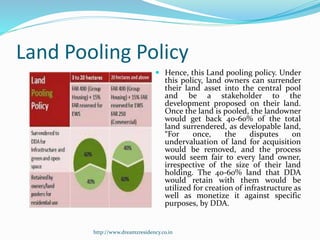
 Hence, this Land pooling policy. Under
this policy, land owners can surrender
their land asset into the central pool
and be a stakeholder to the
development proposed on their land.
Once the land is pooled, the landowner
would get back 40-60% of the total
land surrendered, as developable land,
“For once, the disputes on
undervaluation of land for acquisition
would be removed, and the process
would seem fair to every land owner,
irrespective of the size of their land
holding. The 40-60% land that DDA
would retain with them would be
utilized for creation of infrastructure as
well as monetize it against specific
purposes, by DDA.
http://www.dreamzresidency.co.in
DDA LPP
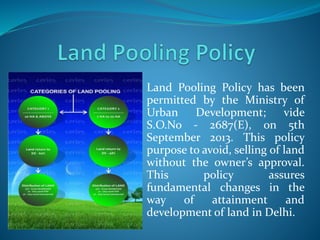
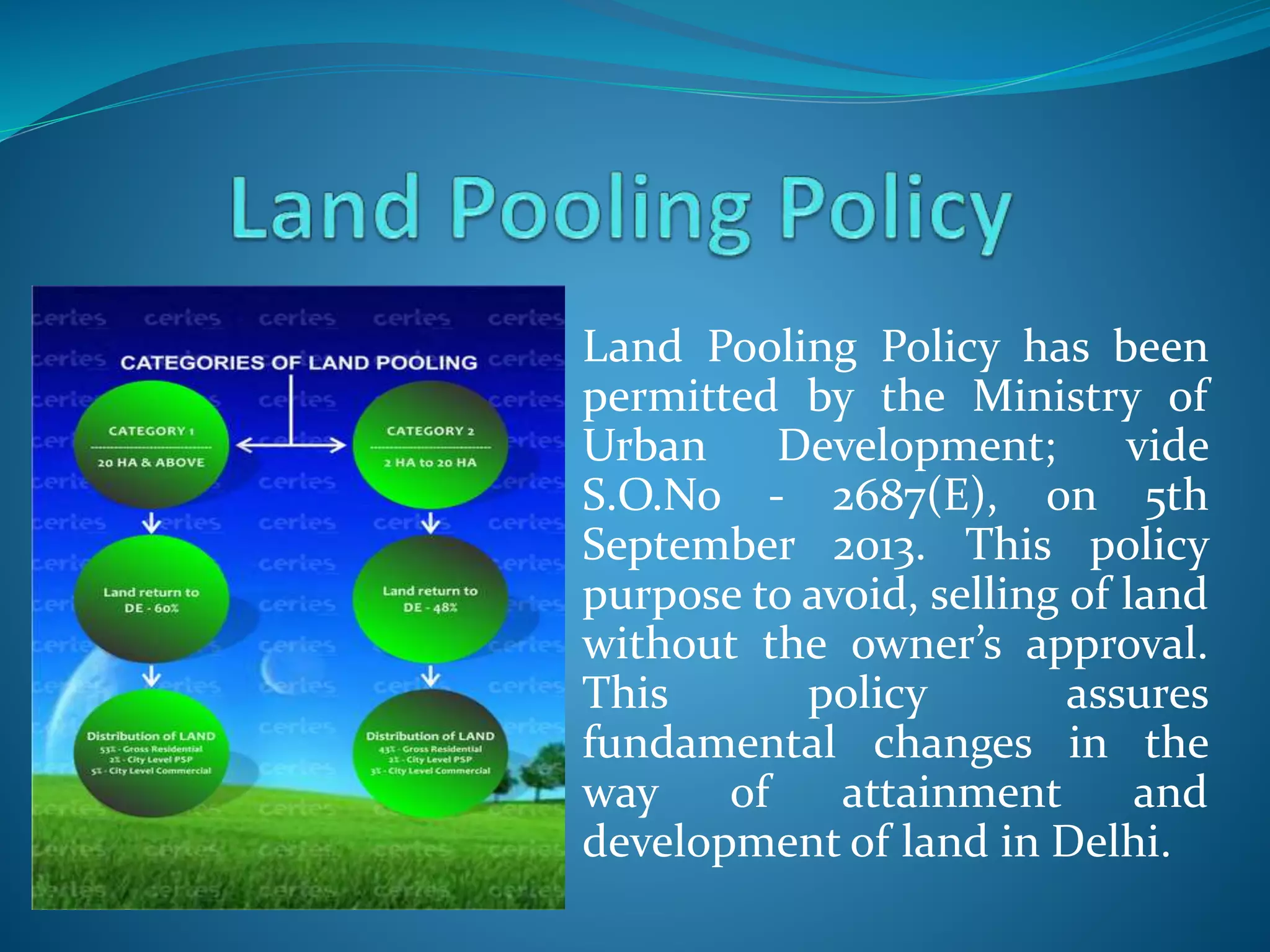
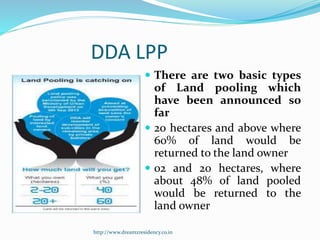
 There are two basic types
of Land pooling which
have been announced so
far
 20 hectares and above where
60% of land would be
returned to the land owner
 02 and 20 hectares, where
about 48% of land pooled
would be returned to the
land owner
http://www.dreamzresidency.co.in
Land Pooling Policy
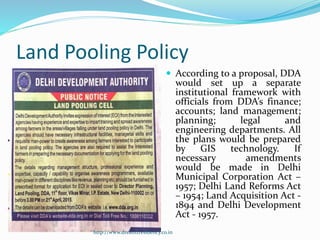
 According to a proposal, DDA
would set up a separate
institutional framework with
officials from DDA’s finance;
accounts; land management;
planning; legal and
engineering departments. All
the plans would be prepared
by GIS technology. If
necessary amendments
would be made in Delhi
Municipal Corporation Act –
1957; Delhi Land Reforms Act
– 1954; Land Acquisition Act -
1894 and Delhi Development
Act - 1957.
http://www.dreamzresidency.co.in
Delhi Master Plan 2021
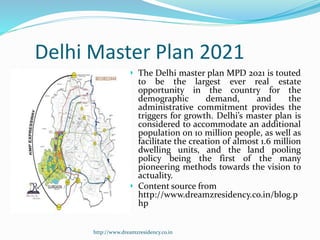
 The Delhi master plan MPD 2021 is touted
to be the largest ever real estate
opportunity in the country for the
demographic demand, and the
administrative commitment provides the
triggers for growth. Delhi’s master plan is
considered to accommodate an additional
population on 10 million people, as well as
facilitate the creation of almost 1.6 million
dwelling units, and the land pooling
policy being the first of the many
pioneering methods towards the vision to
actuality.
 Content source from
http://www.dreamzresidency.co.in/blog.p
hp
http://www.dreamzresidency.co.in

DDA Land Pooling Policy

  • 1.
    Land Pooling Policyhas been permitted by the Ministry of Urban Development; vide S.O.No - 2687(E), on 5th September 2013. This policy purpose to avoid, selling of land without the owner’s approval. This policy assures fundamental changes in the way of attainment and development of land in Delhi.
  • 2.
    DDA LPP  Thefirst Master Plan of Delhi was formulated in the year 1961. The policy then of DDA’s was to acquire large chunks of land, directly from the land owners, at a price determined by DDA. DDA would then undertake the master planning and then sell / develop the land, piece by piece. When the land valuations were nominal, this process was suitable. http://www.dreamzresidency.co.in
  • 3.
    Land Pooling Policy In the 1960’s, the private sector wasn’t strong enough in the economy to shoulder the responsibility of urbanization & housing. Hence, the government took on the liability, and the land acquisition became the norm. From the 1980’s, the private sector through their incremental ability rightfully started seeking a larger role. In the past couple decades, the demand surge from the customers really made the supply from the government stable insufficient, and hence, the majority of supply was created by the private sector. http://www.dreamzresidency.co.in
  • 4.
    Land Pooling Policy The land valuations rose amazingly under this increased demand, as well as the higher spend & investment appetite. The government continued to rest on the provisions of the Land acquisition Bill 1894, which was seemingly unfair to the land owners, for compensation as well as analysis. With the many instances which happened in West Bengal, Andhra Pradesh, Haryana, NOIDA etc, it became increasingly clear to the government that forceful acquisition cannot be a tenable & legal method.  Also, the private sector wanted a more free market methodology, as the government acquisition could potentially be a delaying factor for projects. http://www.dreamzresidency.co.in
  • 5.
    Land Pooling Policy Hence, this Land pooling policy. Under this policy, land owners can surrender their land asset into the central pool and be a stakeholder to the development proposed on their land. Once the land is pooled, the landowner would get back 40-60% of the total land surrendered, as developable land, “For once, the disputes on undervaluation of land for acquisition would be removed, and the process would seem fair to every land owner, irrespective of the size of their land holding. The 40-60% land that DDA would retain with them would be utilized for creation of infrastructure as well as monetize it against specific purposes, by DDA. http://www.dreamzresidency.co.in
  • 6.
    DDA LPP  Thereare two basic types of Land pooling which have been announced so far  20 hectares and above where 60% of land would be returned to the land owner  02 and 20 hectares, where about 48% of land pooled would be returned to the land owner http://www.dreamzresidency.co.in
  • 7.
    Land Pooling Policy According to a proposal, DDA would set up a separate institutional framework with officials from DDA’s finance; accounts; land management; planning; legal and engineering departments. All the plans would be prepared by GIS technology. If necessary amendments would be made in Delhi Municipal Corporation Act – 1957; Delhi Land Reforms Act – 1954; Land Acquisition Act - 1894 and Delhi Development Act - 1957. http://www.dreamzresidency.co.in
  • 8.
    Delhi Master Plan2021  The Delhi master plan MPD 2021 is touted to be the largest ever real estate opportunity in the country for the demographic demand, and the administrative commitment provides the triggers for growth. Delhi’s master plan is considered to accommodate an additional population on 10 million people, as well as facilitate the creation of almost 1.6 million dwelling units, and the land pooling policy being the first of the many pioneering methods towards the vision to actuality.  Content source from http://www.dreamzresidency.co.in/blog.p hp http://www.dreamzresidency.co.in

Editor's Notes

  • #9 Dreamz Residency Multistate Housing Co-Operative Society offers E-Homes in India First Smart City Delhi with land pooling policy.