Ms. Mandakini Sampat Holkar
(M. Pharm.)
For Second Year B. Pharm. Program as
per PCI syllabus, New Delhi
Size Reduction
Size Reduction
Size Reduction:
Objectives, Mechanisms & Laws governing size reduction,
factors affecting size reduction, principles, construction,
working, uses, merits and demerits of Hammer mill, ball
mill, fluid energy mill, Edge runner mill & end runner
mill.
Syllabus
Size reduction is process of reducing Large solid unit masses
in to small unit masses,coarse particles or fine particles.
Normally pharmaceutical powders are polydisperse i.e.
consisting particles of different sizes.polydisperse powders
create considerable difficulties in production of dosage forms.
Particle of monosize maybe ideal for pharmaceutical
purposes.
Size reduction process is also termed as comminution or
pulverisation
Size reduction achieved by two methods
Precipitation
methods
Mechanical process
Advantages/Objectives of Size reduction
v Content Uniformity
vUniform flow
vEffective extraction of drug
vEffective drying
vImproved physical stability
vImproves dissolution rate
vImproved rate of absorption
Disadvantages of Size reduction
v Drug degradation
vPoor mixing
vContamination
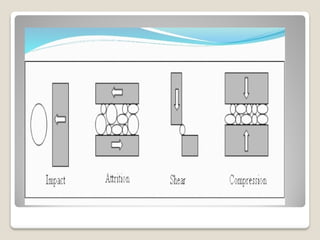
Modes of Stress Applied in Size reduction
1.Cutting
2.Compression
3.Impact
4.Attrition
Classification of Size reduction
A. Crushers,examples are edge runner mail,end runner mail.
B. Grinders:
(1) impact mill,exampale is hammer mill.
(2) rolling-compression, example is roller mill.
(3)attrition mills, example is attrition mill.
(4)tumbling mills,examle is ball mill.
C. Ultrafine grinder, example is fluid energy mill.
D. Cutting machine, example is cutter mill.
Hammer Mill
Hammer Mill
Uses-
Used to mill dry materials
Fine to moderate grinding of powders may be obtained depending up on
speed of hammer.
Ball Mill
Ball Mill
These are also known as tumbling mills.
Principle-
Work on principle of impact between rapidly moving balls
and the powder material, both enclosed in a hollow cylinder.
At low speeds the ball roll over each other and attrition will
be predominant mode of action.
thus in ball mill Impact or attrition or both are responsible
for the size reduction.
Ball Mill
Construction-
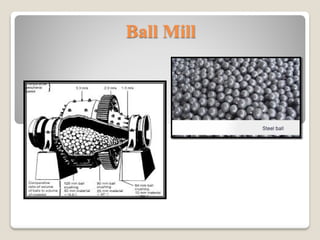
Ball mill consist of hollow cylinder which is mounted on a metallic
frame in such way that it can be rotated on its longitudinal axis.
Cylinder is made of the metal and usually lined with rubber or
porcelain.
Cylinder contains balls that occupy 30 to 50% of the mill volume.
Weight of balls is kept constant. ball size depends on the size of
feed and the diameter of mills.
Ball are made of steel, iron or stoneware. these act as the grinding
medium.
Ball Mill
Working-
First step- material to be crushed is introduced along with
stainless steel balls in ball mill cylinder
Ball used in the ball mill for size reduction must be selected on
the basis of nature and size of material i.e. Large balls are used
for coarse material and small balls are used for finer particles.
Second step- drum will rotate at desired speed to crush the
material.
At optimum centrifugal force provides attrition as well impact
on the balls which is transferred to material to be crushed.
Ball Mill
Working-
At very high speed very less compression force is provided by
balls to the material because centrifugal force will force the
balls to the walls of the ball mill.
At very slow speed centrifugal force produced by the mill will
provide only attrition to the ball and they will slide over each
other which is insufficient to break the material.
So optimum speed of machine is needed for providing
optimum centrifugal force to break the particles by impact and
attrition.
Ball Mill
Third and last step-crushed material is sieved and desired sized fine
particles are collected for formulation development.
Fluid Energy Mill
Fluid Energy Mill
Also Known as Jet mill or Micronizers or Ultrafine grinders
Fluid energy mill operates on the principle of impact and attrition.
In this equipment the feedstock is suspended within a high velocity
air stream.
Milling takes place because of high velocity collisions between the
suspended particles.
Fluid Energy Mill
Consist of elliptical pipe-height 2 meters and diameter ranging from
20 to 200 milimeters.
Mill surface made of soft stainless steel or tough ceramics
Consist of Grinding nozzel( usually 2-6) placed tangential or opposed
to initial flow path of powder.
Normally compressed air is used at 600 kilopascale to 1.0
megapascales.
Inert gases are used- minimize the oxidation of susceptible
compounds.
Fluid Energy Mill
An outlet with classifer isfitted to allow the escape of air.
Powder is introduced through the inlet.The air entering thrugh
the grinding nozzles transport the powder in the elliptical or
circular track of the mill.in the turbulent stream of air the
suspended particles collide with each other and break.
Thus impact and attrition force operate in size reduction.
The resultant small particles are carried to oulet and removed
by cyclone or filters.
Courser particles undergo re-circulation in the chamber on
account of its own weight.
Fluid Energy Mill
These re-circulated particles collide again with new in-coming
feed stock particles.the powder remains in the mill untill its
size is reduced sufficiently.
Small particle are removed by cyclone separator or filter bag
Uses- used to reduce the particle size of most of dug such as
antibiotics and vitamins.
Ultrafine grinding can be achieved.
When strict quality control is desirable for purpose of better
absorption this mill is preferred one.
Fluid Energy Mill
Advantages-
1.It has no moving parts hence is not produced during milling.
therfore heat-labile susbstances can be milled
2. It is a rapid and an efficient method for reducing powders to 30
mm or less30
3.There is no wear of mill, contamination is not possible.
Disadvantages-
1.Fluid energy mill is not possible for milling of soft,tacky and
fibrous materials.
2. The equipment is expensive because it needs additional
accessories particularly fluid energy source and dust collection.
Introduction-
Edge runner mill, also known as Chilean mill or Roller stone mill.
These mill were developed in chin in 3rd century and still today these are
used all over the world.
Edge runner mill is nothing but the mechanized forms or automatic mortar
and pestle.
Initially this mill was formed by large
circular stones but currently these stones
replaced by iron or steel disks
Principle- The basic principle behind edge runner mill is compression and
shear.
Compression is provided by weight roller,wheels or stone shear is applied
to feed during the movement of any one of these.
Construction-
Made up of two heavy rollers and a bed made up of stones or granite.
One shaft is present at the centre which revolve them on their axis
One electric motor is fitted at the base of mill for the rotation of rollers.
Working-
First step-material to be crushed is kept on the bed.
Second step- rollers revolves on its central axis and at the same time they
also moves on their horizontal axis for providing compression as well as
shear force on the material.
Third step- After a definite time crushed material is sieved and collected
Uses- used for fine grinding
Non-sticky , Brittle and friable material are crushed with the help of this
mill
Advantages-
Does not require attention during operation
Disadvantages-Edge runner mill occupy more space
Contamination of product
Time consuming
Not used for sticky materials
Energy consumption is quite high
Principle-
Size reduction is done by crushing (Compression ) due to heavy weight of
steel pestle.
Shearing stress is also involved during the movement of mortar and pestle.
Construction-
It is mechanical mortar and pestle.
It consist of a steel Mortar, Which is to a flanged plate.
Pestle situated at the end runner mill is very heavy and placed vertically at
the corner of mortar.
Size reduction takes place due to compression force apllied by heavy pestle
and shear stress applied beacuse friction produced by movement of mortar
and pestle.
Working
1 step-material placed in mortar.
2 step-rotation of pestle is started with the help of motor. Scraper is used for
guiding movement of material between mortar and pestle.
3 step-Crushed material is sieved and collected

Size reduction

  • 1.
    Ms. Mandakini SampatHolkar (M. Pharm.) For Second Year B. Pharm. Program as per PCI syllabus, New Delhi Size Reduction
  • 2.
    Size Reduction Size Reduction: Objectives,Mechanisms & Laws governing size reduction, factors affecting size reduction, principles, construction, working, uses, merits and demerits of Hammer mill, ball mill, fluid energy mill, Edge runner mill & end runner mill. Syllabus
  • 3.
    Size reduction isprocess of reducing Large solid unit masses in to small unit masses,coarse particles or fine particles. Normally pharmaceutical powders are polydisperse i.e. consisting particles of different sizes.polydisperse powders create considerable difficulties in production of dosage forms. Particle of monosize maybe ideal for pharmaceutical purposes. Size reduction process is also termed as comminution or pulverisation
  • 4.
    Size reduction achievedby two methods Precipitation methods Mechanical process
  • 5.
    Advantages/Objectives of Sizereduction v Content Uniformity vUniform flow vEffective extraction of drug vEffective drying vImproved physical stability vImproves dissolution rate vImproved rate of absorption
  • 6.
    Disadvantages of Sizereduction v Drug degradation vPoor mixing vContamination
  • 7.
    Modes of StressApplied in Size reduction 1.Cutting 2.Compression 3.Impact 4.Attrition
  • 8.
    Classification of Sizereduction A. Crushers,examples are edge runner mail,end runner mail. B. Grinders: (1) impact mill,exampale is hammer mill. (2) rolling-compression, example is roller mill. (3)attrition mills, example is attrition mill. (4)tumbling mills,examle is ball mill. C. Ultrafine grinder, example is fluid energy mill. D. Cutting machine, example is cutter mill.
  • 9.
  • 10.
    Hammer Mill Uses- Used tomill dry materials Fine to moderate grinding of powders may be obtained depending up on speed of hammer.
  • 12.
  • 13.
    Ball Mill These arealso known as tumbling mills. Principle- Work on principle of impact between rapidly moving balls and the powder material, both enclosed in a hollow cylinder. At low speeds the ball roll over each other and attrition will be predominant mode of action. thus in ball mill Impact or attrition or both are responsible for the size reduction.
  • 14.
    Ball Mill Construction- Ball millconsist of hollow cylinder which is mounted on a metallic frame in such way that it can be rotated on its longitudinal axis. Cylinder is made of the metal and usually lined with rubber or porcelain. Cylinder contains balls that occupy 30 to 50% of the mill volume. Weight of balls is kept constant. ball size depends on the size of feed and the diameter of mills. Ball are made of steel, iron or stoneware. these act as the grinding medium.
  • 15.
    Ball Mill Working- First step-material to be crushed is introduced along with stainless steel balls in ball mill cylinder Ball used in the ball mill for size reduction must be selected on the basis of nature and size of material i.e. Large balls are used for coarse material and small balls are used for finer particles. Second step- drum will rotate at desired speed to crush the material. At optimum centrifugal force provides attrition as well impact on the balls which is transferred to material to be crushed.
  • 16.
    Ball Mill Working- At veryhigh speed very less compression force is provided by balls to the material because centrifugal force will force the balls to the walls of the ball mill. At very slow speed centrifugal force produced by the mill will provide only attrition to the ball and they will slide over each other which is insufficient to break the material. So optimum speed of machine is needed for providing optimum centrifugal force to break the particles by impact and attrition.
  • 17.
    Ball Mill Third andlast step-crushed material is sieved and desired sized fine particles are collected for formulation development.
  • 18.
  • 19.
    Fluid Energy Mill AlsoKnown as Jet mill or Micronizers or Ultrafine grinders Fluid energy mill operates on the principle of impact and attrition. In this equipment the feedstock is suspended within a high velocity air stream. Milling takes place because of high velocity collisions between the suspended particles.
  • 20.
    Fluid Energy Mill Consistof elliptical pipe-height 2 meters and diameter ranging from 20 to 200 milimeters. Mill surface made of soft stainless steel or tough ceramics Consist of Grinding nozzel( usually 2-6) placed tangential or opposed to initial flow path of powder. Normally compressed air is used at 600 kilopascale to 1.0 megapascales. Inert gases are used- minimize the oxidation of susceptible compounds.
  • 21.
    Fluid Energy Mill Anoutlet with classifer isfitted to allow the escape of air. Powder is introduced through the inlet.The air entering thrugh the grinding nozzles transport the powder in the elliptical or circular track of the mill.in the turbulent stream of air the suspended particles collide with each other and break. Thus impact and attrition force operate in size reduction. The resultant small particles are carried to oulet and removed by cyclone or filters. Courser particles undergo re-circulation in the chamber on account of its own weight.
  • 22.
    Fluid Energy Mill Thesere-circulated particles collide again with new in-coming feed stock particles.the powder remains in the mill untill its size is reduced sufficiently. Small particle are removed by cyclone separator or filter bag Uses- used to reduce the particle size of most of dug such as antibiotics and vitamins. Ultrafine grinding can be achieved. When strict quality control is desirable for purpose of better absorption this mill is preferred one.
  • 23.
    Fluid Energy Mill Advantages- 1.Ithas no moving parts hence is not produced during milling. therfore heat-labile susbstances can be milled 2. It is a rapid and an efficient method for reducing powders to 30 mm or less30 3.There is no wear of mill, contamination is not possible. Disadvantages- 1.Fluid energy mill is not possible for milling of soft,tacky and fibrous materials. 2. The equipment is expensive because it needs additional accessories particularly fluid energy source and dust collection.
  • 25.
    Introduction- Edge runner mill,also known as Chilean mill or Roller stone mill. These mill were developed in chin in 3rd century and still today these are used all over the world. Edge runner mill is nothing but the mechanized forms or automatic mortar and pestle. Initially this mill was formed by large circular stones but currently these stones replaced by iron or steel disks
  • 26.
    Principle- The basicprinciple behind edge runner mill is compression and shear. Compression is provided by weight roller,wheels or stone shear is applied to feed during the movement of any one of these. Construction- Made up of two heavy rollers and a bed made up of stones or granite. One shaft is present at the centre which revolve them on their axis One electric motor is fitted at the base of mill for the rotation of rollers.
  • 27.
    Working- First step-material tobe crushed is kept on the bed. Second step- rollers revolves on its central axis and at the same time they also moves on their horizontal axis for providing compression as well as shear force on the material. Third step- After a definite time crushed material is sieved and collected Uses- used for fine grinding Non-sticky , Brittle and friable material are crushed with the help of this mill
  • 28.
    Advantages- Does not requireattention during operation Disadvantages-Edge runner mill occupy more space Contamination of product Time consuming Not used for sticky materials Energy consumption is quite high
  • 29.
    Principle- Size reduction isdone by crushing (Compression ) due to heavy weight of steel pestle. Shearing stress is also involved during the movement of mortar and pestle. Construction- It is mechanical mortar and pestle. It consist of a steel Mortar, Which is to a flanged plate. Pestle situated at the end runner mill is very heavy and placed vertically at the corner of mortar. Size reduction takes place due to compression force apllied by heavy pestle and shear stress applied beacuse friction produced by movement of mortar and pestle.
  • 30.
    Working 1 step-material placedin mortar. 2 step-rotation of pestle is started with the help of motor. Scraper is used for guiding movement of material between mortar and pestle. 3 step-Crushed material is sieved and collected