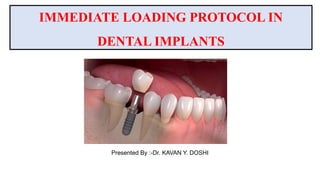
IMMEDIATE LOADING PROTOCOL IN
DENTAL IMPLANTS
Presented By :-Dr. KAVAN Y. DOSHI
 INDEX
 Introduction
 Advantage and disadvantage
 Indication and contraindication
 Rational for immediate loading
 Factor affecting immediate loading
 Diagnosis and treatment planning for immediate loading
 Clinical procedure for immediate loading implant
 Conclusion
 References
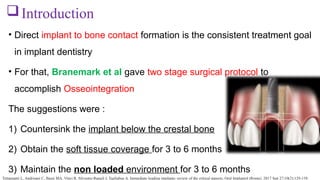
• Direct implant to bone contact formation is the consistent treatment goal
in implant dentistry
• For that, Branemark et al gave two stage surgical protocol to
accomplish Osseointegration
The suggestions were :
1) Countersink the implant below the crestal bone
2) Obtain the soft tissue coverage for 3 to 6 months
3) Maintain the non loaded environment for 3 to 6 months
Introduction
Tettamanti L, Andrisani C, Bassi MA, Vinci R, Silvestre-Rangil J, Tagliabue A. Immediate loading implants: review of the critical aspects. Oral Implantol (Rome). 2017 Sep 27;10(2):129-139.
The reasons behind were :
1) To reduce bacterial infection
2) To prevent apical migration of the oral epithelium along with implant body
3) To reduce the risk of early implant loading during bone remodeling
• In this procedure, the 2nd
stage surgery is necessary and a high degree of
long term clinical rigid fixation has been reported
Tettamanti L, Andrisani C, Bassi MA, Vinci R, Silvestre-Rangil J, Tagliabue A. Immediate loading implants: review of the critical aspects. Oral Implantol (Rome). 2017 Sep 27;10(2):129-139.
• In the last decades, a deeper understanding of bone biology and
advance in implant technology allowed a significant evolution of
surgical and prosthetic protocols.
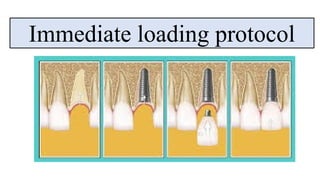
• Immediate loading protocols have been introduced to reduce the
total treatment time and to accommodate new patient needs.
Babbush C. Dental Implants. Implant Dentistry. 1993;2(1):59
Immediate loading protocol
• Esposito et al. (49) have defined 3 protocols for implant load timing:
1. immediate loading implants (ILI), within 1 week from implant
placement;
2. early loading implants (ELI), between 1 week and 2 months; and
3. conventional loading implants (CLI), after 2-3 months from
implant placement.
Tettamanti L, Andrisani C, Bassi MA, Vinci R, Silvestre-Rangil J, Tagliabue A. Immediate loading implants: review of the critical aspects. Oral Implantol (Rome). 2017 Sep 27;10(2):129-139.
• During last several years, several authors have reported that the
implants may osseointegrated even though they are not submerged &
reside above the bone through the soft tissue. This surgical approach
is called a one stage or non submerged implant procedure
• Immediate loading of a dental implant not only include a non
submerged one stage surgery but also actually loads the implants with
the provisional prosthesis at the same appointment of surgery or
shortly thereafter
Babbush C. Dental Implants. Implant Dentistry. 1993;2(1):59
• Adequate bone quality (Types D1,D2 or D3)
• Sufficient bone height (ie, approximately 12mm) for a minimum
length 10mm implant
• Sufficient bone width (ie, approximately 6mm)
• Ability to achieve an adequate anterior-posterior (AP) spread
between the implants.
INDICATIONS
• Schneider RL, Higginbottom FL, Webber H, Sones AD: For your patients receiving endosseous implants for immediate loading, how are the implant-supported crowns or the prosthesis initially put into occlusal function, and what
instructions are given for their use. Int J Oral Maxillofac Imp 2002; 17:881-4.
• Bhola, M., Neely, A. L., & Kolhatkar, S Immediate Implant Placement: Clinical Decisions, Advantages, and Disadvantages. Journal of Prosthodontics, 2008 17(7), 576–581.
CONTRAINDICATIONS
 Poor systemic health
 Inadequate bone volume for correct implant placement
 Bone height less than 12 mm
 Bone width less than 6 mm
 Very poor bone density (D4)
 Severe parafunction such as bruxism, clenching, tongue thrust.
• Schneider RL, Higginbottom FL, Webber H, Sones AD: For your patients receiving endosseous implants for immediate loading, how are the implant-supported crowns or the prosthesis initially put into occlusal function, and what
instructions are given for their use. Int J Oral Maxillofac Imp 2002; 17:881-4.
• Bhola, M., Neely, A. L., & Kolhatkar, S Immediate Implant Placement: Clinical Decisions, Advantages, and Disadvantages. Journal of Prosthodontics, 2008 17(7), 576–581.
• Reduction in Time of Therapy.
• One stage surgical approach
• Patient does not need to wear removable prosthesis during
osseointegration
• Preservation of The Bone and Gingival Tissues. [facilitates soft tissue
shaping ]
• Psychological factors, function & stability also enhanced
ADVANTAGES
• Schneider RL, Higginbottom FL, Webber H, Sones AD: For your patients receiving endosseous implants for immediate loading, how are the implant-supported crowns or the prosthesis initially put into occlusal function, and what
instructions are given for their use. Int J Oral Maxillofac Imp 2002; 17:881-4.
• Bhola, M., Neely, A. L., & Kolhatkar, S Immediate Implant Placement: Clinical Decisions, Advantages, and Disadvantages. Journal of Prosthodontics, 2008 17(7), 576–581.
DISADVANTAGES
 More patient co-operation is needed.
 Inadequate Soft Tissue Coverage.
 Parafunctional from tongue or foreign bodies [pen biting ] may cause
trauma and crestal bone loss
 Peri-implant bone reaction is highest after surgical trauma due to
immediate loading.
 Difficulty Obtaining Primary Stability.
 Too soft bone ,small implant diameters or implant design with less
surface area ,may cause too great crestal bone stress contours and
cause bone loss or implant failure
• Schneider RL, Higginbottom FL, Webber H, Sones AD: For your patients receiving endosseous implants for immediate loading, how are the implant-supported crowns or the prosthesis initially put into occlusal function, and what
instructions are given for their use. Int J Oral Maxillofac Imp 2002; 17:881-4.
• Bhola, M., Neely, A. L., & Kolhatkar, S Immediate Implant Placement: Clinical Decisions, Advantages, and Disadvantages. Journal of Prosthodontics, 2008 17(7), 576–581.
RATIONALE FOR
IMMEDIATE LOADING
• One goal for immediately loaded implant prosthesis is
to decrease the risk of occlusal overload and
its resultant increase in the remodeling rate of bone.
1. Surgical Trauma
2. Bone Loading Trauma
primary stability
• Chiapasco M, Abati S, Romeo E: Implant-retained mandibular overdentures with Branemark System MK II implants. A prospective comparative study between delayed and immediate loading. Int J Oral Maxillofac
Imp 2001;16: 537-546.
• Emanuelli M, Knutsen BM: Immediate placement of implants: A Study on 86 immediately placed and loaded implants. J Prosthet Dent 2005; 94:242-58.
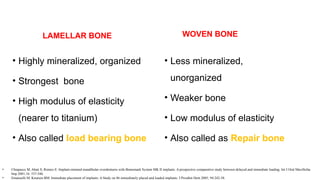
LAMELLAR BONE
• Highly mineralized, organized
• Strongest bone
• High modulus of elasticity
(nearer to titanium)
• Also called load bearing bone
WOVEN BONE
• Less mineralized,
unorganized
• Weaker bone
• Low modulus of elasticity
• Also called as Repair bone
• Chiapasco M, Abati S, Romeo E: Implant-retained mandibular overdentures with Branemark System MK II implants. A prospective comparative study between delayed and immediate loading. Int J Oral Maxillofac
Imp 2001;16: 537-546.
• Emanuelli M, Knutsen BM: Immediate placement of implants: A Study on 86 immediately placed and loaded implants. J Prosthet Dent 2005; 94:242-58.
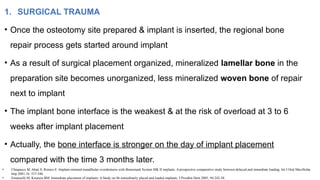
1. SURGICAL TRAUMA
• Once the osteotomy site prepared & implant is inserted, the regional bone
repair process gets started around implant
• As a result of surgical placement organized, mineralized lamellar bone in the
preparation site becomes unorganized, less mineralized woven bone of repair
next to implant
• The implant bone interface is the weakest & at the risk of overload at 3 to 6
weeks after implant placement
• Actually, the bone interface is stronger on the day of implant placement
compared with the time 3 months later.
• Chiapasco M, Abati S, Romeo E: Implant-retained mandibular overdentures with Branemark System MK II implants. A prospective comparative study between delayed and immediate loading. Int J Oral Maxillofac
Imp 2001;16: 537-546.
• Emanuelli M, Knutsen BM: Immediate placement of implants: A Study on 86 immediately placed and loaded implants. J Prosthet Dent 2005; 94:242-58.
• Buchs et al found that immediately loaded implants fail mostly at 3
to 5 week time period
• One method to decrease the immediate overload is to reduce the
surgical trauma as much as possible, so the amount of bone
remodeling & woven bone will also reduced
• Cause of the trauma includes:
Thermal injury
• Chiapasco M, Abati S, Romeo E: Implant-retained mandibular overdentures with Branemark System MK II implants. A prospective comparative study between delayed and immediate loading. Int J Oral Maxillofac
Imp 2001;16: 537-546.
• Emanuelli M, Knutsen BM: Immediate placement of implants: A Study on 86 immediately placed and loaded implants. J Prosthet Dent 2005; 94:242-58.
 THERMAL INJURY
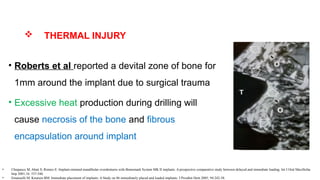
• Roberts et al reported a devital zone of bone for
1mm around the implant due to surgical trauma
• Excessive heat production during drilling will
cause necrosis of the bone and fibrous
encapsulation around implant
• Chiapasco M, Abati S, Romeo E: Implant-retained mandibular overdentures with Branemark System MK II implants. A prospective comparative study between delayed and immediate loading. Int J Oral Maxillofac
Imp 2001;16: 537-546.
• Emanuelli M, Knutsen BM: Immediate placement of implants: A Study on 86 immediately placed and loaded implants. J Prosthet Dent 2005; 94:242-58.
• Temperature should be 38-41°c and not more than that during
osteotomy preparation (C.E.Misch, N.Wellner 2002)
• Slow intermittent pressure with internal irrigation should be done
• Sharp drills should be used
• This will reduce the risk of fibrous tissue formation
• Chiapasco M, Abati S, Romeo E: Implant-retained mandibular overdentures with Branemark System MK II implants. A prospective comparative study between delayed and immediate loading. Int J Oral Maxillofac
Imp 2001;16: 537-546.
• Emanuelli M, Knutsen BM: Immediate placement of implants: A Study on 86 immediately placed and loaded implants. J Prosthet Dent 2005; 94:242-58.
 MICRO-FRACTURE OF BONE
• Implant should be non mobile on insertion but excess strain from
additional torque may increase microdamage
• Increased microdamage will increase remodeling of the bone and
immediate loading will not be possible
• Excessive torque should be avoided
2.BONE LOADING TRAUMA
• Chiapasco M, Abati S, Romeo E: Implant-retained mandibular overdentures with Branemark System MK II implants. A prospective comparative study between delayed and immediate loading. Int J Oral Maxillofac
Imp 2001;16: 537-546.
• Emanuelli M, Knutsen BM: Immediate placement of implants: A Study on 86 immediately placed and loaded implants. J Prosthet Dent 2005; 94:242-58.
FACTORS AFFECTING
IMMEDIATE LOADING
The implant related factors include Increased surface area and
Decreased force conditions
• Implant number
• Implant size
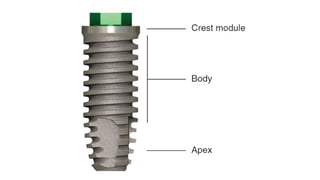
• Implant body design
• Implant surface condition
The patient related factors include:
• Habits
• Diet and oral hygiene
• Misch CE, Wang HL, Misch CM, Sharawy M, Lemons J, Judy KM: Rationale for the application of immediate load in implant dentistry: Part I. Implant Dent 2004;13:207-217
• Misch CE, Wang HL, Misch CM, Sharawy M, Lemons J, Judy KM: Rationale for the application of immediate load in implant dentistry: Part II. Implant Dent 2004; 13:310-321
1 Increased surface area
 Implant number
 Functional surface area can be increased by increasing the number of
implants
• More implants increase retention
• More implants increase force distribution area
• More implants decrease number of pontics
• Decrease in number of pontics will decrease the chance of prosthesis
fracture
• Misch CE, Wang HL, Misch CM, Sharawy M, Lemons J, Judy KM: Rationale for the application of immediate load in implant dentistry: Part I. Implant Dent 2004;13:207-217
• Misch CE, Wang HL, Misch CM, Sharawy M, Lemons J, Judy KM: Rationale for the application of immediate load in implant dentistry: Part II. Implant Dent 2004; 13:310-321
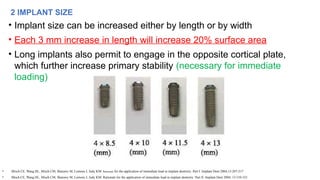
2 IMPLANT SIZE
• Implant size can be increased either by length or by width
• Each 3 mm increase in length will increase 20% surface area
• Long implants also permit to engage in the opposite cortical plate,
which further increase primary stability (necessary for immediate
loading)
• Misch CE, Wang HL, Misch CM, Sharawy M, Lemons J, Judy KM: Rationale for the application of immediate load in implant dentistry: Part I. Implant Dent 2004;13:207-217
• Misch CE, Wang HL, Misch CM, Sharawy M, Lemons J, Judy KM: Rationale for the application of immediate load in implant dentistry: Part II. Implant Dent 2004; 13:310-321
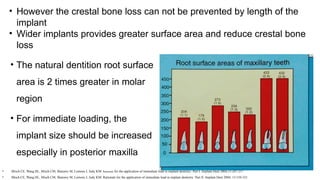
• The natural dentition root surface
area is 2 times greater in molar
region
• For immediate loading, the
implant size should be increased
especially in posterior maxilla
• However the crestal bone loss can not be prevented by length of the
implant
• Wider implants provides greater surface area and reduce crestal bone
loss
• Misch CE, Wang HL, Misch CM, Sharawy M, Lemons J, Judy KM: Rationale for the application of immediate load in implant dentistry: Part I. Implant Dent 2004;13:207-217
• Misch CE, Wang HL, Misch CM, Sharawy M, Lemons J, Judy KM: Rationale for the application of immediate load in implant dentistry: Part II. Implant Dent 2004; 13:310-321
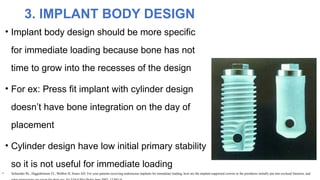
• Implant body design should be more specific
for immediate loading because bone has not
time to grow into the recesses of the design
• For ex: Press fit implant with cylinder design
doesn’t have bone integration on the day of
placement
• Cylinder design have low initial primary stability
so it is not useful for immediate loading
3. IMPLANT BODY DESIGN
• Schneider RL, Higginbottom FL, Webber H, Sones AD: For your patients receiving endosseous implants for immediate loading, how are the implant-supported crowns or the prosthesis initially put into occlusal function, and
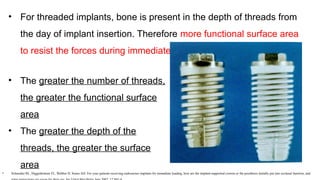
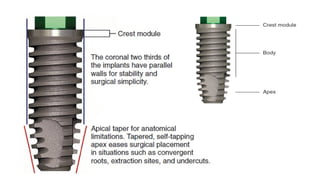
• For threaded implants, bone is present in the depth of threads from
the day of implant insertion. Therefore more functional surface area
to resist the forces during immediate loading
• The greater the number of threads,
the greater the functional surface
area
• The greater the depth of the
threads, the greater the surface
area
• Schneider RL, Higginbottom FL, Webber H, Sones AD: For your patients receiving endosseous implants for immediate loading, how are the implant-supported crowns or the prosthesis initially put into occlusal function, and
d. Implant surface condition
• Implant surface condition may affect the rate of bone contact and
lamellar bone formation
• Hydroxyapatite coating has been shown to reduce the bone remodeling
rate during occlusal loading
• Less bone remodeling is beneficial in immediate loading.
• Schneider RL, Higginbottom FL, Webber H, Sones AD: For your patients receiving endosseous implants for immediate loading, how are the implant-supported crowns or the prosthesis initially put into occlusal function, and
B) PATIENT FACTORS
1. Habits
• Bruxism and clenching are parafunctional forces that represent significant forces,
because the magnitudes of the forces are high, the duration of the forces are
extensive, and the direction of the forces are more horizontal than axial to the
implants.
• Balshi et al reported that 75% of immediate loading failures occurs in patient of
bruxism
• Parafunctional loads also increase the risk of abutment screw loosening, unretained
prosthesis, or fracture of the transitional restoration used for immediate loading
• Schneider RL, Higginbottom FL, Webber H, Sones AD: For your patients receiving endosseous implants for immediate loading, how are the implant-supported crowns or the prosthesis initially put into occlusal function, and
2. Diet and oral hygiene
• The hygiene procedures usually consist of a regimen of Chlorhexidine rinses
twice daily beginning immediately.
• The surgical site may be brushed with a very soft tooth brush or “tooth Ette”-
type sponge applicator usually seven days after the implant placement.
• Following the initial soft tissue healing (2 weeks), the patient may assume a
more normal diet; they are cautioned not to function directly on the immediately
placed provisional for another 4 weeks.
• Schneider RL, Higginbottom FL, Webber H, Sones AD: For your patients receiving endosseous implants for immediate loading, how are the implant-supported crowns or the prosthesis initially put into occlusal function, and
DIAGNOSIS AND TREATMENT
PLANNING IN IMMEDIATE
LOADING
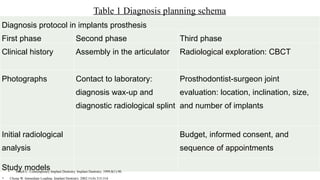
Diagnosis protocol in implants prosthesis
First phase Second phase Third phase
Clinical history Assembly in the articulator Radiological exploration: CBCT
Photographs Contact to laboratory:
diagnosis wax-up and
diagnostic radiological splint
Prosthodontist-surgeon joint
evaluation: location, inclination, size,
and number of implants
Initial radiological
analysis
Budget, informed consent, and
sequence of appointments
Study models
Table 1 Diagnosis planning schema
• Misch C. Contemporary Implant Dentistry. Implant Dentistry. 1999;8(1):90.
• Chong W. Immediate Loading. Implant Dentistry. 2002;11(4):315-316
• The physical examination prior to implant treatment :-
The extraoral evaluation includes the exam of the perioral soft tissues,
the lips, the nasolabial groove, the mouth corners, the facial symmetry,
and the smile line.
The intraoral evaluation includes the inspection of oral mucosa and
periodontal tissues, the palpation of target sites, the evaluation of the
residual teeth, the vestibular fornix, and the shape of the edentulous
alveolar ridge.
Misch C. Contemporary Implant Dentistry. Implant Dentistry. 1999;8(1):90.
• Chong W. Immediate Loading. Implant Dentistry. 2002;11(4):315-316
• Immediate loading provides functional and esthetic advantages,
improving the quality of life of the patient during the osseointegration
period.
• The three key parameters that should be evaluated for prosthetic
planning of the totally edentulous patient are prosthetic space, lip
support, and smile line.
• The radiographic evaluation should include a prosthetic reference or
guide that allows relating the alveolar process axis with the ideal
prosthetic axis.
• Misch C. Contemporary Implant Dentistry. Implant Dentistry. 1999;8(1):90.
Fourth Planning Phase: Decision-Making
• Primary stability depends on bone quality and quantity, surgical
technique, and implant selection.
• Implant features such as dimensions and micro- and macro-design
might influence immediate loading success.
• Appropriate selection of implant type, number, and position must be part
of the surgical diagnosis and treatment planning workflow
• Misch C. Contemporary Implant Dentistry. Implant Dentistry. 1999;8(1):90.
MAXILLA
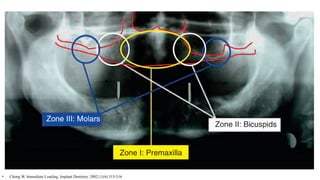
• According to Bedrossian et al. [2008], the maxilla can be divided into three zones:
zone 1, the premaxilla; zone 2, the premolar area; and zone 3, the molar area
• CBCT can be used to determine the amount of bone in these zones as well as in
the zygomatic arch, in both horizontal and vertical dimensions. Moreover, any
pathology in these areas, as well as in the maxillary sinuses, needs to be verified
preoperatively.
• Misch C. Contemporary Implant Dentistry. Implant Dentistry. 1999;8(1):90.
• Chong W. Immediate Loading. Implant Dentistry. 2002;11(4):315-316
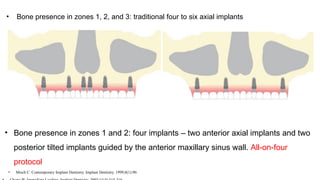
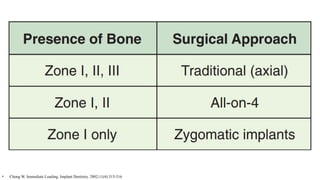
• Bone presence in zones 1, 2, and 3: traditional four to six axial implants
• Bone presence in zones 1 and 2: four implants – two anterior axial implants and two
posterior tilted implants guided by the anterior maxillary sinus wall. All-on-four
protocol
• Misch C. Contemporary Implant Dentistry. Implant Dentistry. 1999;8(1):90.
• Chong W. Immediate Loading. Implant Dentistry. 2002;11(4):315-316
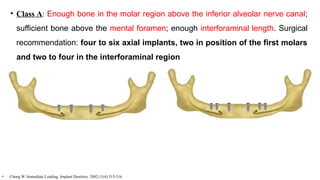
• Class A: Enough bone in the molar region above the inferior alveolar nerve canal;
sufficient bone above the mental foramen; enough interforaminal length. Surgical
recommendation: four to six axial implants, two in position of the first molars
and two to four in the interforaminal region
• Chong W. Immediate Loading. Implant Dentistry. 2002;11(4):315-316
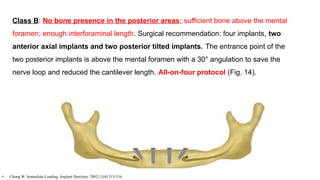
Class B: No bone presence in the posterior areas; sufficient bone above the mental
foramen; enough interforaminal length. Surgical recommendation: four implants, two
anterior axial implants and two posterior tilted implants. The entrance point of the
two posterior implants is above the mental foramen with a 30° angulation to save the
nerve loop and reduced the cantilever length. All-on-four protocol (Fig. 14).
• Chong W. Immediate Loading. Implant Dentistry. 2002;11(4):315-316
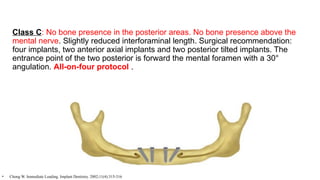
Class C: No bone presence in the posterior areas. No bone presence above the
mental nerve. Slightly reduced interforaminal length. Surgical recommendation:
four implants, two anterior axial implants and two posterior tilted implants. The
entrance point of the two posterior is forward the mental foramen with a 30°
angulation. All-on-four protocol .
• Chong W. Immediate Loading. Implant Dentistry. 2002;11(4):315-316
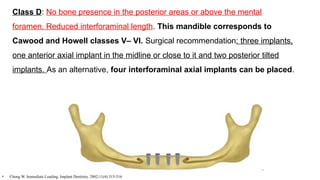
Class D: No bone presence in the posterior areas or above the mental
foramen. Reduced interforaminal length. This mandible corresponds to
Cawood and Howell classes V– VI. Surgical recommendation: three implants,
one anterior axial implant in the midline or close to it and two posterior tilted
implants. As an alternative, four interforaminal axial implants can be placed.
• Chong W. Immediate Loading. Implant Dentistry. 2002;11(4):315-316
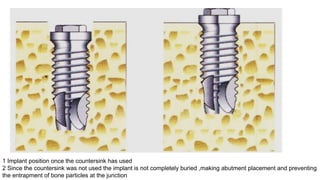
1 Implant position once the countersink has used
2 Since the countersink was not used the implant is not completely buried ,making abutment placement and preventing
the entrapment of bone particles at the junction
Immediate implant loading ?
• Wang H, Ormianer Z, Palti A, Perel M, Trisi P, Sammartino G. Consensus Conference on
Immediate Loading: The Single Tooth and Partial Edentulous Areas. Implant Dentistry.
2006;15(4):324-333
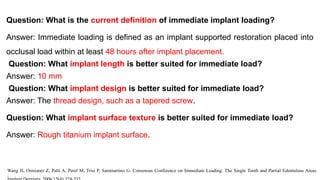
Question: What is the current definition of immediate implant loading?
Answer: Immediate loading is defined as an implant supported restoration placed into
occlusal load within at least 48 hours after implant placement.
Question: What implant length is better suited for immediate load?
Answer: 10 mm
Question: What implant design is better suited for immediate load?
Answer: The thread design, such as a tapered screw.
Question: What implant surface texture is better suited for immediate load?
Answer: Rough titanium implant surface.
Wang H, Ormianer Z, Palti A, Perel M, Trisi P, Sammartino G. Consensus Conference on Immediate Loading: The Single Tooth and Partial Edentulous Areas.
Question: Is there any difference upon implant survival rates between tooth
type/location for immediate implant loading on a single tooth?
Answer:
A. Premolars (either maxillary or mandibular) had the highest success rates.
B. Incisors and molars may not be the best candidates for immediate implant occlusal
loading, but they are suggested for immediate non occlusal (restoration) loading.
Question: What implant diameter is better suited for immediate load?
Answer: At this time, it appears that a minimum of 3.5-mm implant diameter is
required.
Wang H, Ormianer Z, Palti A, Perel M, Trisi P, Sammartino G. Consensus Conference on Immediate Loading: The Single Tooth and Partial Edentulous Areas.
Implant Dentistry. 2006;15(4):324-333.
Question: What are the conditions that are not recommended for implant
immediate load on a single tooth restoration?
Answers: Heavy occlusion (eg bruxism, parafunctional habits); lack of primary implant
stability (poor quality bone; eg D4); shorter implant length; smooth surface; press-fit
implants; poor crown/implant ratio (1:1); and poor oral hygiene.
Question. What is the condition of the patient’s oral hygiene?
immediate implant loading is not advisable for patients with poor oral hygiene. It can
affect periodontal health, quality of bone, and directly affect the osseointegration
potential of an implant.3
Wang H, Ormianer Z, Palti A, Perel M, Trisi P, Sammartino G. Consensus Conference on Immediate Loading: The Single Tooth and Partial Edentulous Areas.
Implant Dentistry. 2006;15(4):324-333.
Question : When should you use each protocol?
It can be difficult to establish which loading protocol is better, and the choice for
implant loading varies with each patient. Research has shown that immediate
implant loading may be successful in the following clinical situations:
1. Edentulous maxilla—when fixed prostheses are used
2. Edentulous mandible—treatment is successful with both removable and fixed
appliances
3. Single-tooth replacement in esthetically critical zones
4. Short-span fixed partial dentures
Wang H, Ormianer Z, Palti A, Perel M, Trisi P, Sammartino G. Consensus Conference on Immediate Loading: The Single Tooth and Partial Edentulous Areas.
Implant Dentistry. 2006;15(4):324-333.
Implant number
increase
• increase the surface area
• increase retention
• increase force distribution area
• Decrease in number of pontics will decrease the chance of
prosthesis fracture
Implant size can
be increased
either by length
or by width
• Wider implants provides greater surface area and reduce
crestal bone loss
• Long implants also permit to engage in the opposite cortical
plate, which further increase primary stability
Implant body
design
• greater the number of depth and threads, the greater the
functional surface area
Implant surface
condition
• Hydroxyapatite –coated implants in poor density types
• Rough versus smooth or machine surface condition implants
in good bone density situations [D2,D3]
CONCLUSION
 REFERENCES
• Wang H, Ormianer Z, Palti A, Perel M, Trisi P, Sammartino G. Consensus Conference
on Immediate Loading: The Single Tooth and Partial Edentulous Areas. Implant
Dentistry. 2006;15(4):324-333.
• Tettamanti L, Andrisani C, Bassi MA, Vinci R, Silvestre-Rangil J, Tagliabue A.
Immediate loading implants: review of the critical aspects. Oral Implantol (Rome). 2017
Sep 27;10(2):129-139
• Babbush C. Dental Implants. Implant Dentistry. 1993;2(1):59
• Bhola, M., Neely, A. L., & Kolhatkar, S Immediate Implant Placement: Clinical
Decisions, Advantages, and Disadvantages. Journal of Prosthodontics, 2008 17(7),
576–581.
• Chiapasco M, Abati S, Romeo E: Implant-retained mandibular overdentures with
Branemark System MK II implants. A prospective comparative study between delayed
and immediate loading. Int J Oral Maxillofac Imp 2001;16: 537-546.
• Emanuelli M, Knutsen BM: Immediate placement of implants: A Study on 86
immediately placed and loaded implants. J Prosthet Dent 2005; 94:242-58.
• Misch CE, Wang HL, Misch CM, Sharawy M, Lemons J, Judy KM: Rationale for the
application of immediate load in implant dentistry: Part I. Implant Dent 2004;13:207-217
• Misch CE, Wang HL, Misch CM, Sharawy M, Lemons J, Judy KM: Rationale for the
application of immediate load in implant dentistry: Part II. Implant Dent 2004; 13:310-
321
• Schneider RL, Higginbottom FL, Webber H, Sones AD: For your patients receiving
endosseous implants for immediate loading, how are the implant-supported crowns or
the prosthesis initially put into occlusal function, and what instructions are given for their
use. Int J Oral Maxillofac Imp 2002; 17:881-4.
• Misch C. Contemporary Implant Dentistry. Implant Dentistry. 1999;8(1):90.
• Chong W. Immediate Loading. Implant Dentistry. 2002;11(4):315-316
• Schneider RL, Higginbottom FL, Webber H, Sones AD: For your patients receiving
endosseous implants for immediate loading, how are the implant-supported crowns or
the prosthesis initially put into occlusal function, and what instructions are given for their
use. Int J Oral Maxillofac Imp 2002; 17:881-4.
THANK YOU

Immediate implant loading protocols.pptx

  • 1.
    IMMEDIATE LOADING PROTOCOLIN DENTAL IMPLANTS Presented By :-Dr. KAVAN Y. DOSHI
  • 2.
     INDEX  Introduction Advantage and disadvantage  Indication and contraindication  Rational for immediate loading  Factor affecting immediate loading  Diagnosis and treatment planning for immediate loading  Clinical procedure for immediate loading implant  Conclusion  References
  • 3.
    • Direct implantto bone contact formation is the consistent treatment goal in implant dentistry • For that, Branemark et al gave two stage surgical protocol to accomplish Osseointegration The suggestions were : 1) Countersink the implant below the crestal bone 2) Obtain the soft tissue coverage for 3 to 6 months 3) Maintain the non loaded environment for 3 to 6 months Introduction Tettamanti L, Andrisani C, Bassi MA, Vinci R, Silvestre-Rangil J, Tagliabue A. Immediate loading implants: review of the critical aspects. Oral Implantol (Rome). 2017 Sep 27;10(2):129-139.
  • 4.
    The reasons behindwere : 1) To reduce bacterial infection 2) To prevent apical migration of the oral epithelium along with implant body 3) To reduce the risk of early implant loading during bone remodeling • In this procedure, the 2nd stage surgery is necessary and a high degree of long term clinical rigid fixation has been reported Tettamanti L, Andrisani C, Bassi MA, Vinci R, Silvestre-Rangil J, Tagliabue A. Immediate loading implants: review of the critical aspects. Oral Implantol (Rome). 2017 Sep 27;10(2):129-139.
  • 5.
    • In thelast decades, a deeper understanding of bone biology and advance in implant technology allowed a significant evolution of surgical and prosthetic protocols. • Immediate loading protocols have been introduced to reduce the total treatment time and to accommodate new patient needs. Babbush C. Dental Implants. Implant Dentistry. 1993;2(1):59
  • 6.
  • 7.
    • Esposito etal. (49) have defined 3 protocols for implant load timing: 1. immediate loading implants (ILI), within 1 week from implant placement; 2. early loading implants (ELI), between 1 week and 2 months; and 3. conventional loading implants (CLI), after 2-3 months from implant placement. Tettamanti L, Andrisani C, Bassi MA, Vinci R, Silvestre-Rangil J, Tagliabue A. Immediate loading implants: review of the critical aspects. Oral Implantol (Rome). 2017 Sep 27;10(2):129-139.
  • 8.
    • During lastseveral years, several authors have reported that the implants may osseointegrated even though they are not submerged & reside above the bone through the soft tissue. This surgical approach is called a one stage or non submerged implant procedure • Immediate loading of a dental implant not only include a non submerged one stage surgery but also actually loads the implants with the provisional prosthesis at the same appointment of surgery or shortly thereafter Babbush C. Dental Implants. Implant Dentistry. 1993;2(1):59
  • 9.
    • Adequate bonequality (Types D1,D2 or D3) • Sufficient bone height (ie, approximately 12mm) for a minimum length 10mm implant • Sufficient bone width (ie, approximately 6mm) • Ability to achieve an adequate anterior-posterior (AP) spread between the implants. INDICATIONS • Schneider RL, Higginbottom FL, Webber H, Sones AD: For your patients receiving endosseous implants for immediate loading, how are the implant-supported crowns or the prosthesis initially put into occlusal function, and what instructions are given for their use. Int J Oral Maxillofac Imp 2002; 17:881-4. • Bhola, M., Neely, A. L., & Kolhatkar, S Immediate Implant Placement: Clinical Decisions, Advantages, and Disadvantages. Journal of Prosthodontics, 2008 17(7), 576–581.
  • 10.
    CONTRAINDICATIONS  Poor systemichealth  Inadequate bone volume for correct implant placement  Bone height less than 12 mm  Bone width less than 6 mm  Very poor bone density (D4)  Severe parafunction such as bruxism, clenching, tongue thrust. • Schneider RL, Higginbottom FL, Webber H, Sones AD: For your patients receiving endosseous implants for immediate loading, how are the implant-supported crowns or the prosthesis initially put into occlusal function, and what instructions are given for their use. Int J Oral Maxillofac Imp 2002; 17:881-4. • Bhola, M., Neely, A. L., & Kolhatkar, S Immediate Implant Placement: Clinical Decisions, Advantages, and Disadvantages. Journal of Prosthodontics, 2008 17(7), 576–581.
  • 11.
    • Reduction inTime of Therapy. • One stage surgical approach • Patient does not need to wear removable prosthesis during osseointegration • Preservation of The Bone and Gingival Tissues. [facilitates soft tissue shaping ] • Psychological factors, function & stability also enhanced ADVANTAGES • Schneider RL, Higginbottom FL, Webber H, Sones AD: For your patients receiving endosseous implants for immediate loading, how are the implant-supported crowns or the prosthesis initially put into occlusal function, and what instructions are given for their use. Int J Oral Maxillofac Imp 2002; 17:881-4. • Bhola, M., Neely, A. L., & Kolhatkar, S Immediate Implant Placement: Clinical Decisions, Advantages, and Disadvantages. Journal of Prosthodontics, 2008 17(7), 576–581.
  • 12.
    DISADVANTAGES  More patientco-operation is needed.  Inadequate Soft Tissue Coverage.  Parafunctional from tongue or foreign bodies [pen biting ] may cause trauma and crestal bone loss  Peri-implant bone reaction is highest after surgical trauma due to immediate loading.  Difficulty Obtaining Primary Stability.  Too soft bone ,small implant diameters or implant design with less surface area ,may cause too great crestal bone stress contours and cause bone loss or implant failure • Schneider RL, Higginbottom FL, Webber H, Sones AD: For your patients receiving endosseous implants for immediate loading, how are the implant-supported crowns or the prosthesis initially put into occlusal function, and what instructions are given for their use. Int J Oral Maxillofac Imp 2002; 17:881-4. • Bhola, M., Neely, A. L., & Kolhatkar, S Immediate Implant Placement: Clinical Decisions, Advantages, and Disadvantages. Journal of Prosthodontics, 2008 17(7), 576–581.
  • 13.
  • 14.
    • One goalfor immediately loaded implant prosthesis is to decrease the risk of occlusal overload and its resultant increase in the remodeling rate of bone. 1. Surgical Trauma 2. Bone Loading Trauma primary stability • Chiapasco M, Abati S, Romeo E: Implant-retained mandibular overdentures with Branemark System MK II implants. A prospective comparative study between delayed and immediate loading. Int J Oral Maxillofac Imp 2001;16: 537-546. • Emanuelli M, Knutsen BM: Immediate placement of implants: A Study on 86 immediately placed and loaded implants. J Prosthet Dent 2005; 94:242-58.
  • 15.
    LAMELLAR BONE • Highlymineralized, organized • Strongest bone • High modulus of elasticity (nearer to titanium) • Also called load bearing bone WOVEN BONE • Less mineralized, unorganized • Weaker bone • Low modulus of elasticity • Also called as Repair bone • Chiapasco M, Abati S, Romeo E: Implant-retained mandibular overdentures with Branemark System MK II implants. A prospective comparative study between delayed and immediate loading. Int J Oral Maxillofac Imp 2001;16: 537-546. • Emanuelli M, Knutsen BM: Immediate placement of implants: A Study on 86 immediately placed and loaded implants. J Prosthet Dent 2005; 94:242-58.
  • 16.
    1. SURGICAL TRAUMA •Once the osteotomy site prepared & implant is inserted, the regional bone repair process gets started around implant • As a result of surgical placement organized, mineralized lamellar bone in the preparation site becomes unorganized, less mineralized woven bone of repair next to implant • The implant bone interface is the weakest & at the risk of overload at 3 to 6 weeks after implant placement • Actually, the bone interface is stronger on the day of implant placement compared with the time 3 months later. • Chiapasco M, Abati S, Romeo E: Implant-retained mandibular overdentures with Branemark System MK II implants. A prospective comparative study between delayed and immediate loading. Int J Oral Maxillofac Imp 2001;16: 537-546. • Emanuelli M, Knutsen BM: Immediate placement of implants: A Study on 86 immediately placed and loaded implants. J Prosthet Dent 2005; 94:242-58.
  • 17.
    • Buchs etal found that immediately loaded implants fail mostly at 3 to 5 week time period • One method to decrease the immediate overload is to reduce the surgical trauma as much as possible, so the amount of bone remodeling & woven bone will also reduced • Cause of the trauma includes: Thermal injury • Chiapasco M, Abati S, Romeo E: Implant-retained mandibular overdentures with Branemark System MK II implants. A prospective comparative study between delayed and immediate loading. Int J Oral Maxillofac Imp 2001;16: 537-546. • Emanuelli M, Knutsen BM: Immediate placement of implants: A Study on 86 immediately placed and loaded implants. J Prosthet Dent 2005; 94:242-58.
  • 18.
     THERMAL INJURY •Roberts et al reported a devital zone of bone for 1mm around the implant due to surgical trauma • Excessive heat production during drilling will cause necrosis of the bone and fibrous encapsulation around implant • Chiapasco M, Abati S, Romeo E: Implant-retained mandibular overdentures with Branemark System MK II implants. A prospective comparative study between delayed and immediate loading. Int J Oral Maxillofac Imp 2001;16: 537-546. • Emanuelli M, Knutsen BM: Immediate placement of implants: A Study on 86 immediately placed and loaded implants. J Prosthet Dent 2005; 94:242-58.
  • 19.
    • Temperature shouldbe 38-41°c and not more than that during osteotomy preparation (C.E.Misch, N.Wellner 2002) • Slow intermittent pressure with internal irrigation should be done • Sharp drills should be used • This will reduce the risk of fibrous tissue formation • Chiapasco M, Abati S, Romeo E: Implant-retained mandibular overdentures with Branemark System MK II implants. A prospective comparative study between delayed and immediate loading. Int J Oral Maxillofac Imp 2001;16: 537-546. • Emanuelli M, Knutsen BM: Immediate placement of implants: A Study on 86 immediately placed and loaded implants. J Prosthet Dent 2005; 94:242-58.
  • 20.
     MICRO-FRACTURE OFBONE • Implant should be non mobile on insertion but excess strain from additional torque may increase microdamage • Increased microdamage will increase remodeling of the bone and immediate loading will not be possible • Excessive torque should be avoided 2.BONE LOADING TRAUMA • Chiapasco M, Abati S, Romeo E: Implant-retained mandibular overdentures with Branemark System MK II implants. A prospective comparative study between delayed and immediate loading. Int J Oral Maxillofac Imp 2001;16: 537-546. • Emanuelli M, Knutsen BM: Immediate placement of implants: A Study on 86 immediately placed and loaded implants. J Prosthet Dent 2005; 94:242-58.
  • 21.
  • 22.
    The implant relatedfactors include Increased surface area and Decreased force conditions • Implant number • Implant size • Implant body design • Implant surface condition The patient related factors include: • Habits • Diet and oral hygiene • Misch CE, Wang HL, Misch CM, Sharawy M, Lemons J, Judy KM: Rationale for the application of immediate load in implant dentistry: Part I. Implant Dent 2004;13:207-217 • Misch CE, Wang HL, Misch CM, Sharawy M, Lemons J, Judy KM: Rationale for the application of immediate load in implant dentistry: Part II. Implant Dent 2004; 13:310-321
  • 23.
    1 Increased surfacearea  Implant number  Functional surface area can be increased by increasing the number of implants • More implants increase retention • More implants increase force distribution area • More implants decrease number of pontics • Decrease in number of pontics will decrease the chance of prosthesis fracture • Misch CE, Wang HL, Misch CM, Sharawy M, Lemons J, Judy KM: Rationale for the application of immediate load in implant dentistry: Part I. Implant Dent 2004;13:207-217 • Misch CE, Wang HL, Misch CM, Sharawy M, Lemons J, Judy KM: Rationale for the application of immediate load in implant dentistry: Part II. Implant Dent 2004; 13:310-321
  • 24.
    2 IMPLANT SIZE •Implant size can be increased either by length or by width • Each 3 mm increase in length will increase 20% surface area • Long implants also permit to engage in the opposite cortical plate, which further increase primary stability (necessary for immediate loading) • Misch CE, Wang HL, Misch CM, Sharawy M, Lemons J, Judy KM: Rationale for the application of immediate load in implant dentistry: Part I. Implant Dent 2004;13:207-217 • Misch CE, Wang HL, Misch CM, Sharawy M, Lemons J, Judy KM: Rationale for the application of immediate load in implant dentistry: Part II. Implant Dent 2004; 13:310-321
  • 25.
    • The naturaldentition root surface area is 2 times greater in molar region • For immediate loading, the implant size should be increased especially in posterior maxilla • However the crestal bone loss can not be prevented by length of the implant • Wider implants provides greater surface area and reduce crestal bone loss • Misch CE, Wang HL, Misch CM, Sharawy M, Lemons J, Judy KM: Rationale for the application of immediate load in implant dentistry: Part I. Implant Dent 2004;13:207-217 • Misch CE, Wang HL, Misch CM, Sharawy M, Lemons J, Judy KM: Rationale for the application of immediate load in implant dentistry: Part II. Implant Dent 2004; 13:310-321
  • 27.
    • Implant bodydesign should be more specific for immediate loading because bone has not time to grow into the recesses of the design • For ex: Press fit implant with cylinder design doesn’t have bone integration on the day of placement • Cylinder design have low initial primary stability so it is not useful for immediate loading 3. IMPLANT BODY DESIGN • Schneider RL, Higginbottom FL, Webber H, Sones AD: For your patients receiving endosseous implants for immediate loading, how are the implant-supported crowns or the prosthesis initially put into occlusal function, and
  • 28.
    • For threadedimplants, bone is present in the depth of threads from the day of implant insertion. Therefore more functional surface area to resist the forces during immediate loading • The greater the number of threads, the greater the functional surface area • The greater the depth of the threads, the greater the surface area • Schneider RL, Higginbottom FL, Webber H, Sones AD: For your patients receiving endosseous implants for immediate loading, how are the implant-supported crowns or the prosthesis initially put into occlusal function, and
  • 29.
    d. Implant surfacecondition • Implant surface condition may affect the rate of bone contact and lamellar bone formation • Hydroxyapatite coating has been shown to reduce the bone remodeling rate during occlusal loading • Less bone remodeling is beneficial in immediate loading. • Schneider RL, Higginbottom FL, Webber H, Sones AD: For your patients receiving endosseous implants for immediate loading, how are the implant-supported crowns or the prosthesis initially put into occlusal function, and
  • 31.
    B) PATIENT FACTORS 1.Habits • Bruxism and clenching are parafunctional forces that represent significant forces, because the magnitudes of the forces are high, the duration of the forces are extensive, and the direction of the forces are more horizontal than axial to the implants. • Balshi et al reported that 75% of immediate loading failures occurs in patient of bruxism • Parafunctional loads also increase the risk of abutment screw loosening, unretained prosthesis, or fracture of the transitional restoration used for immediate loading • Schneider RL, Higginbottom FL, Webber H, Sones AD: For your patients receiving endosseous implants for immediate loading, how are the implant-supported crowns or the prosthesis initially put into occlusal function, and
  • 32.
    2. Diet andoral hygiene • The hygiene procedures usually consist of a regimen of Chlorhexidine rinses twice daily beginning immediately. • The surgical site may be brushed with a very soft tooth brush or “tooth Ette”- type sponge applicator usually seven days after the implant placement. • Following the initial soft tissue healing (2 weeks), the patient may assume a more normal diet; they are cautioned not to function directly on the immediately placed provisional for another 4 weeks. • Schneider RL, Higginbottom FL, Webber H, Sones AD: For your patients receiving endosseous implants for immediate loading, how are the implant-supported crowns or the prosthesis initially put into occlusal function, and
  • 33.
  • 34.
    Diagnosis protocol inimplants prosthesis First phase Second phase Third phase Clinical history Assembly in the articulator Radiological exploration: CBCT Photographs Contact to laboratory: diagnosis wax-up and diagnostic radiological splint Prosthodontist-surgeon joint evaluation: location, inclination, size, and number of implants Initial radiological analysis Budget, informed consent, and sequence of appointments Study models Table 1 Diagnosis planning schema • Misch C. Contemporary Implant Dentistry. Implant Dentistry. 1999;8(1):90. • Chong W. Immediate Loading. Implant Dentistry. 2002;11(4):315-316
  • 35.
    • The physicalexamination prior to implant treatment :- The extraoral evaluation includes the exam of the perioral soft tissues, the lips, the nasolabial groove, the mouth corners, the facial symmetry, and the smile line. The intraoral evaluation includes the inspection of oral mucosa and periodontal tissues, the palpation of target sites, the evaluation of the residual teeth, the vestibular fornix, and the shape of the edentulous alveolar ridge. Misch C. Contemporary Implant Dentistry. Implant Dentistry. 1999;8(1):90. • Chong W. Immediate Loading. Implant Dentistry. 2002;11(4):315-316
  • 36.
    • Immediate loadingprovides functional and esthetic advantages, improving the quality of life of the patient during the osseointegration period. • The three key parameters that should be evaluated for prosthetic planning of the totally edentulous patient are prosthetic space, lip support, and smile line. • The radiographic evaluation should include a prosthetic reference or guide that allows relating the alveolar process axis with the ideal prosthetic axis. • Misch C. Contemporary Implant Dentistry. Implant Dentistry. 1999;8(1):90.
  • 37.
    Fourth Planning Phase:Decision-Making • Primary stability depends on bone quality and quantity, surgical technique, and implant selection. • Implant features such as dimensions and micro- and macro-design might influence immediate loading success. • Appropriate selection of implant type, number, and position must be part of the surgical diagnosis and treatment planning workflow • Misch C. Contemporary Implant Dentistry. Implant Dentistry. 1999;8(1):90.
  • 38.
    MAXILLA • According toBedrossian et al. [2008], the maxilla can be divided into three zones: zone 1, the premaxilla; zone 2, the premolar area; and zone 3, the molar area • CBCT can be used to determine the amount of bone in these zones as well as in the zygomatic arch, in both horizontal and vertical dimensions. Moreover, any pathology in these areas, as well as in the maxillary sinuses, needs to be verified preoperatively. • Misch C. Contemporary Implant Dentistry. Implant Dentistry. 1999;8(1):90. • Chong W. Immediate Loading. Implant Dentistry. 2002;11(4):315-316
  • 39.
    • Chong W.Immediate Loading. Implant Dentistry. 2002;11(4):315-316
  • 40.
    • Bone presencein zones 1, 2, and 3: traditional four to six axial implants • Bone presence in zones 1 and 2: four implants – two anterior axial implants and two posterior tilted implants guided by the anterior maxillary sinus wall. All-on-four protocol • Misch C. Contemporary Implant Dentistry. Implant Dentistry. 1999;8(1):90.
  • 41.
    • Chong W.Immediate Loading. Implant Dentistry. 2002;11(4):315-316
  • 42.
    • Class A:Enough bone in the molar region above the inferior alveolar nerve canal; sufficient bone above the mental foramen; enough interforaminal length. Surgical recommendation: four to six axial implants, two in position of the first molars and two to four in the interforaminal region • Chong W. Immediate Loading. Implant Dentistry. 2002;11(4):315-316
  • 43.
    Class B: Nobone presence in the posterior areas; sufficient bone above the mental foramen; enough interforaminal length. Surgical recommendation: four implants, two anterior axial implants and two posterior tilted implants. The entrance point of the two posterior implants is above the mental foramen with a 30° angulation to save the nerve loop and reduced the cantilever length. All-on-four protocol (Fig. 14). • Chong W. Immediate Loading. Implant Dentistry. 2002;11(4):315-316
  • 44.
    Class C: Nobone presence in the posterior areas. No bone presence above the mental nerve. Slightly reduced interforaminal length. Surgical recommendation: four implants, two anterior axial implants and two posterior tilted implants. The entrance point of the two posterior is forward the mental foramen with a 30° angulation. All-on-four protocol . • Chong W. Immediate Loading. Implant Dentistry. 2002;11(4):315-316
  • 45.
    Class D: Nobone presence in the posterior areas or above the mental foramen. Reduced interforaminal length. This mandible corresponds to Cawood and Howell classes V– VI. Surgical recommendation: three implants, one anterior axial implant in the midline or close to it and two posterior tilted implants. As an alternative, four interforaminal axial implants can be placed. • Chong W. Immediate Loading. Implant Dentistry. 2002;11(4):315-316
  • 47.
    1 Implant positiononce the countersink has used 2 Since the countersink was not used the implant is not completely buried ,making abutment placement and preventing the entrapment of bone particles at the junction
  • 48.
    Immediate implant loading? • Wang H, Ormianer Z, Palti A, Perel M, Trisi P, Sammartino G. Consensus Conference on Immediate Loading: The Single Tooth and Partial Edentulous Areas. Implant Dentistry. 2006;15(4):324-333
  • 49.
    Question: What isthe current definition of immediate implant loading? Answer: Immediate loading is defined as an implant supported restoration placed into occlusal load within at least 48 hours after implant placement. Question: What implant length is better suited for immediate load? Answer: 10 mm Question: What implant design is better suited for immediate load? Answer: The thread design, such as a tapered screw. Question: What implant surface texture is better suited for immediate load? Answer: Rough titanium implant surface. Wang H, Ormianer Z, Palti A, Perel M, Trisi P, Sammartino G. Consensus Conference on Immediate Loading: The Single Tooth and Partial Edentulous Areas.
  • 50.
    Question: Is thereany difference upon implant survival rates between tooth type/location for immediate implant loading on a single tooth? Answer: A. Premolars (either maxillary or mandibular) had the highest success rates. B. Incisors and molars may not be the best candidates for immediate implant occlusal loading, but they are suggested for immediate non occlusal (restoration) loading. Question: What implant diameter is better suited for immediate load? Answer: At this time, it appears that a minimum of 3.5-mm implant diameter is required. Wang H, Ormianer Z, Palti A, Perel M, Trisi P, Sammartino G. Consensus Conference on Immediate Loading: The Single Tooth and Partial Edentulous Areas. Implant Dentistry. 2006;15(4):324-333.
  • 51.
    Question: What arethe conditions that are not recommended for implant immediate load on a single tooth restoration? Answers: Heavy occlusion (eg bruxism, parafunctional habits); lack of primary implant stability (poor quality bone; eg D4); shorter implant length; smooth surface; press-fit implants; poor crown/implant ratio (1:1); and poor oral hygiene. Question. What is the condition of the patient’s oral hygiene? immediate implant loading is not advisable for patients with poor oral hygiene. It can affect periodontal health, quality of bone, and directly affect the osseointegration potential of an implant.3 Wang H, Ormianer Z, Palti A, Perel M, Trisi P, Sammartino G. Consensus Conference on Immediate Loading: The Single Tooth and Partial Edentulous Areas. Implant Dentistry. 2006;15(4):324-333.
  • 52.
    Question : Whenshould you use each protocol? It can be difficult to establish which loading protocol is better, and the choice for implant loading varies with each patient. Research has shown that immediate implant loading may be successful in the following clinical situations: 1. Edentulous maxilla—when fixed prostheses are used 2. Edentulous mandible—treatment is successful with both removable and fixed appliances 3. Single-tooth replacement in esthetically critical zones 4. Short-span fixed partial dentures Wang H, Ormianer Z, Palti A, Perel M, Trisi P, Sammartino G. Consensus Conference on Immediate Loading: The Single Tooth and Partial Edentulous Areas. Implant Dentistry. 2006;15(4):324-333.
  • 53.
    Implant number increase • increasethe surface area • increase retention • increase force distribution area • Decrease in number of pontics will decrease the chance of prosthesis fracture Implant size can be increased either by length or by width • Wider implants provides greater surface area and reduce crestal bone loss • Long implants also permit to engage in the opposite cortical plate, which further increase primary stability Implant body design • greater the number of depth and threads, the greater the functional surface area Implant surface condition • Hydroxyapatite –coated implants in poor density types • Rough versus smooth or machine surface condition implants in good bone density situations [D2,D3] CONCLUSION
  • 54.
     REFERENCES • WangH, Ormianer Z, Palti A, Perel M, Trisi P, Sammartino G. Consensus Conference on Immediate Loading: The Single Tooth and Partial Edentulous Areas. Implant Dentistry. 2006;15(4):324-333. • Tettamanti L, Andrisani C, Bassi MA, Vinci R, Silvestre-Rangil J, Tagliabue A. Immediate loading implants: review of the critical aspects. Oral Implantol (Rome). 2017 Sep 27;10(2):129-139 • Babbush C. Dental Implants. Implant Dentistry. 1993;2(1):59 • Bhola, M., Neely, A. L., & Kolhatkar, S Immediate Implant Placement: Clinical Decisions, Advantages, and Disadvantages. Journal of Prosthodontics, 2008 17(7), 576–581.
  • 55.
    • Chiapasco M,Abati S, Romeo E: Implant-retained mandibular overdentures with Branemark System MK II implants. A prospective comparative study between delayed and immediate loading. Int J Oral Maxillofac Imp 2001;16: 537-546. • Emanuelli M, Knutsen BM: Immediate placement of implants: A Study on 86 immediately placed and loaded implants. J Prosthet Dent 2005; 94:242-58. • Misch CE, Wang HL, Misch CM, Sharawy M, Lemons J, Judy KM: Rationale for the application of immediate load in implant dentistry: Part I. Implant Dent 2004;13:207-217 • Misch CE, Wang HL, Misch CM, Sharawy M, Lemons J, Judy KM: Rationale for the application of immediate load in implant dentistry: Part II. Implant Dent 2004; 13:310- 321
  • 56.
    • Schneider RL,Higginbottom FL, Webber H, Sones AD: For your patients receiving endosseous implants for immediate loading, how are the implant-supported crowns or the prosthesis initially put into occlusal function, and what instructions are given for their use. Int J Oral Maxillofac Imp 2002; 17:881-4. • Misch C. Contemporary Implant Dentistry. Implant Dentistry. 1999;8(1):90. • Chong W. Immediate Loading. Implant Dentistry. 2002;11(4):315-316 • Schneider RL, Higginbottom FL, Webber H, Sones AD: For your patients receiving endosseous implants for immediate loading, how are the implant-supported crowns or the prosthesis initially put into occlusal function, and what instructions are given for their use. Int J Oral Maxillofac Imp 2002; 17:881-4.
  • 57.

Editor's Notes

  • #1 Before sta rrimg immediate loDING HAVE TO UNDER STAND NORMAL PROGWESSIVE LODNG PROTOCOL
  • #2 Before start immediate loading protocol we
  • #3 Immediate loading on implants at present is gaining a lot of importance due to various reasons. Beacause order to satisfy patient’s increasing expectations in terms of comfort, aesthetic and shorter treatment period
  • #8 So can we say that immediate implant loading its one stage surgical with non submergimplant procdure doing wodh imediatr provisional restoration
  • #9 Immediate loading protocol should be limited to the patients who have the most to gain and the least to lose. For example, patients who cannot tolerate a removable prosthesis due to social or psychological reasons. Patients who cannot wait for 3 months for the prosthesis. The greater the benefit or the lower the risk, the more likely immediate loading is considered
  • #11 Psychological Advantages. Although Many Patients Readily Accept Delayed Implant Placement, Some Find It Difficult to Face the Prospect of Waiting Up to 6 Months for an Extraction Site to Heal Followed by an Additional 3 To 6 Months for The Implant to Osseointegrated. Greater Rate of Bone Resorption Occurs During the First 6 Months Following Tooth Extraction, unless an Implant Is Placed or A Socket Augmentation Procedure Performed.
  • #12 The Added Cost of Bone Grafting. While All the Disadvantages Listed Are Not Present in Every Situation, Any Can Result in A Compromised Case. Inability to Inspect All Aspects of the Extraction Site for Defects or Infection. More bone loss compared to delayed loading
  • #14  The primary stability of the fixture is a prime requisite for the success of any implant. It is influenced by two factors:
  • #16 The immediate implant loading concept challenges the conventional healing time of 3 to 6 months of no loading before the restoration of the implant
  • #19 Preventing excessive heat generation and avoiding temperatures higher than 39° C by maintaining a maximum speed control of 2000 rpm during creation of the osteotomy and 15 to 20 rpm during implant insertion5,20-22
  • #20 Countershanq drill
  • #23 Dentist may increase the surface area for immediate loading by increasing the number of implantsWhen 10 to 13 implants were inserted and splinted together per arch, implant survival rate was more than 97%
  • #24 But, in immediate loading, the implant is loaded before establishment of the histologic interface (osseointegration), thus implant length is more relevant in immediate loading (especially in D3 and D4)
  • #28 In some threaded implants, the depth is 0.2 mm and in other it is 0.42 Thus, overall surface area will be doubled for the implants of the same length and width
  • #29 Reduce woven bone formation and increase lamenner bone formation
  • #30 the goal behind using tapered implant was to exercise a degree of compression of the surrounding bone during the insertion phase, and the decrease of their apical diameter allows to accommodate them in area with small bone volume available, like the labial concavity or between adjacent roots
  • #31 These forces are horizontal and shear forces which are harmful for implants
  • #32 If the immediate loaded prosthesis becomes partially uncemented or fractures, the remaining implants holding the restoration are at increased risk of overload failure. Therefore, the diet of the patient should be limited to only soft foods during the immediate load process.
  • #35 Appropriate patient selection and careful surgical and prosthetic planning are essential to achieve predictable outcomes of immediately loaded implants
  • #38 The clinician should determine the availability of bone in all three zones.
  • #44 If the apexes of the posterior implants are going to stay very close to the apexes of the axial implants, or even in risk of contact, due to the interforaminal reduced length, it is possible to tilt the anterior implants medially, in the same direction as the posterior implants.
  • #45 The inferior alveolar nerve is commonly dehisced and is usually on top of the ridge, where it can easily be reflected with a little manipulation. The implant site preparation can then begin in the foramen concavity itself to improve the A/P spread
  • #46 AFTER implant insertion , surgical site was close with suture and within 48 hour coping is place over fixture to take impression and
  • #50 Question: What type of occlusion should an immediate loaded implant possess? Answer: Non occlusal contact in full closure (maximum interocclusal contact) without any lateral (proximal) contacts.
  • #52 When plan removable prosthesis in maxilla its not success full
  • #53 achieving good implant primary stability is key condition to ILI success . Primary implant stability is influenced by many factors including local bone quality and quantity, implant macro-design and surgical technique Avoid surgical and bon micro fracture trauma use sharp drill and give less intermiiten pressure so bone have less strain and foces so that will help in formation of lamenner boneand its also known as load bearing bone .