

Managing Transitions
Authors: William Bridges and Susan
Bridges
IT ISN’T CHANGE IT’S THE
TRANSITION
Transition- a three step process
people go through as they
internalize and come to terms with
the details of the new situation that
change brings.
Transition is psychological.
THE THREE PHASES OF
TRANSITION
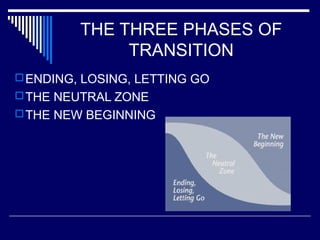
ENDING, LOSING, LETTING GO
THE NEUTRAL ZONE
THE NEW BEGINNING
How to Get People to Let Go
 You start by identifying who will suffer losses and try to
understand them.
 You sympathize publicly and permit people to grieve. Find
ways to compensate (non-financial) for the losses, if
possible.
 Of course, communication is a top priority, clearly defining
details over and over is important.
 Ceremonies to “mark the ending” are appropriate to honor
the past.
 Get people through the denial stage.
 Describe the change with plenty of details (be specific).
Emotions and Transition
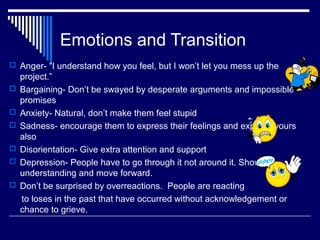
 Anger- “I understand how you feel, but I won’t let you mess up the
project.”
 Bargaining- Don’t be swayed by desperate arguments and impossible
promises
 Anxiety- Natural, don’t make them feel stupid
 Sadness- encourage them to express their feelings and express yours
also
 Disorientation- Give extra attention and support
 Depression- People have to go through it not around it. Show
understanding and move forward.
 Don’t be surprised by overreactions. People are reacting
to loses in the past that have occurred without acknowledgement or
chance to grieve.
Leading People Through the
Neutral Zone
Anxiety and self-doubt are up; motivation and
efficiency are down.
Many people miss work; medical and disability
claims are up.
Old weaknesses such as confused priorities or
miscommunications reemerge.
It is also a creative time. People are more
hospitable to new ideas. Since there are less clear
systems, new ones can be built.
Normalize the Neutral Zone
 Create temporary systems for special projects, temporary
assignments, overloads, and increase training—such as
in problem-solving, team-building, and transition
management tactics.
 Look at new roles and relationships.
 Set short-term goals, interim checkpoints, and realistic
output objectives.
 You want to strengthen communications as much as
possible with newsletters, encouraging letters to the
editor, etc.
 Using a Transition Monitoring Team, a cross-section,
single purpose team, is also a good idea.
Neutral Zone (Get Creative)
It is a time to come up with creative solutions to the
organization’s difficulties.
Use retreats, policy reviews, surveys, and
suggestion campaigns.
Take ideas seriously.
Encourage experimentation.
Expect losses and setbacks.
Take risks.
Launching a New Beginning
THE FOUR P’S
 Purpose-Explain the logic behind the change
 Picture-Paint it of the outcome (video, floor plan,
organizational chart, visits to see others)
 Plan-Step by Step (ceremonies, training, deadlines,
brainstorming sessions, etc). Have a transition plan and
a change plan.
 Part-The part they will play in the change or transition.
Everyone should be involved in sharing of problems and
apart of the decision making process.
Change Management Plan vs.
Transition Management Plan
The Transition Management Plan
More detailed plan that address the
change on the personal level rather than
the collective level.
Supports are given on the process level
not just the outcome.
Starts where the people are and works
forward, step by step, leaving the past
behind. Involves staff in the plan.
Reinforce the New Beginning
Be Consistent. All polices, procedures, and
priorities should send consistent messages. Your
actions must match your words, and rewards (both
monetary and non-monetary) must match what you
preach.
Ensure Quick Successes. Look for sure wins to
“reassure the believers, convince the doubters,
and confound the critics.”
Reinforce New Beginning Cont.
Symbolize the New Identity. Understand why small
things can be symbolically very important to
people, so you can use it to your advantage and
not get tripped up by it.
 Celebrate the Successes. This can be small or
large, behind the scenes or in public, with
mementoes of transition progress.

Managing transitions (1)

  • 1.
    Managing Transitions Authors: WilliamBridges and Susan Bridges
  • 2.
    IT ISN’T CHANGEIT’S THE TRANSITION Transition- a three step process people go through as they internalize and come to terms with the details of the new situation that change brings. Transition is psychological.
  • 3.
    THE THREE PHASESOF TRANSITION ENDING, LOSING, LETTING GO THE NEUTRAL ZONE THE NEW BEGINNING
  • 4.
    How to GetPeople to Let Go  You start by identifying who will suffer losses and try to understand them.  You sympathize publicly and permit people to grieve. Find ways to compensate (non-financial) for the losses, if possible.  Of course, communication is a top priority, clearly defining details over and over is important.  Ceremonies to “mark the ending” are appropriate to honor the past.  Get people through the denial stage.  Describe the change with plenty of details (be specific).
  • 5.
    Emotions and Transition Anger- “I understand how you feel, but I won’t let you mess up the project.”  Bargaining- Don’t be swayed by desperate arguments and impossible promises  Anxiety- Natural, don’t make them feel stupid  Sadness- encourage them to express their feelings and express yours also  Disorientation- Give extra attention and support  Depression- People have to go through it not around it. Show understanding and move forward.  Don’t be surprised by overreactions. People are reacting to loses in the past that have occurred without acknowledgement or chance to grieve.
  • 6.
    Leading People Throughthe Neutral Zone Anxiety and self-doubt are up; motivation and efficiency are down. Many people miss work; medical and disability claims are up. Old weaknesses such as confused priorities or miscommunications reemerge. It is also a creative time. People are more hospitable to new ideas. Since there are less clear systems, new ones can be built.
  • 7.
    Normalize the NeutralZone  Create temporary systems for special projects, temporary assignments, overloads, and increase training—such as in problem-solving, team-building, and transition management tactics.  Look at new roles and relationships.  Set short-term goals, interim checkpoints, and realistic output objectives.  You want to strengthen communications as much as possible with newsletters, encouraging letters to the editor, etc.  Using a Transition Monitoring Team, a cross-section, single purpose team, is also a good idea.
  • 8.
    Neutral Zone (GetCreative) It is a time to come up with creative solutions to the organization’s difficulties. Use retreats, policy reviews, surveys, and suggestion campaigns. Take ideas seriously. Encourage experimentation. Expect losses and setbacks. Take risks.
  • 9.
    Launching a NewBeginning THE FOUR P’S  Purpose-Explain the logic behind the change  Picture-Paint it of the outcome (video, floor plan, organizational chart, visits to see others)  Plan-Step by Step (ceremonies, training, deadlines, brainstorming sessions, etc). Have a transition plan and a change plan.  Part-The part they will play in the change or transition. Everyone should be involved in sharing of problems and apart of the decision making process.
  • 10.
    Change Management Planvs. Transition Management Plan The Transition Management Plan More detailed plan that address the change on the personal level rather than the collective level. Supports are given on the process level not just the outcome. Starts where the people are and works forward, step by step, leaving the past behind. Involves staff in the plan.
  • 11.
    Reinforce the NewBeginning Be Consistent. All polices, procedures, and priorities should send consistent messages. Your actions must match your words, and rewards (both monetary and non-monetary) must match what you preach. Ensure Quick Successes. Look for sure wins to “reassure the believers, convince the doubters, and confound the critics.”
  • 12.
    Reinforce New BeginningCont. Symbolize the New Identity. Understand why small things can be symbolically very important to people, so you can use it to your advantage and not get tripped up by it.  Celebrate the Successes. This can be small or large, behind the scenes or in public, with mementoes of transition progress.

Editor's Notes

  • #6 Expect and accept the signs of grieving it is a natural process.
  • #11 Change Management Plan focuses on the outcome and then works backwards, step by step to create the necessary preconditions for that outcome.