Leading Change
Presenter: Stephanie Flanagan
slm114@psu.edu
2015
Discussion Takeaways
• Understand the connection between change and
transition—and why it matters!
• Identify self-management strategies to successfully
move through the change and transition process
• Identify ways to support others (including colleagues
and customers) to help them successfully move
through the change and transition process
• Exhibit a proactive approach to leading change
3
Change- Where are You?
“Change?
Oh no, not again!”
“Change? Sounds like
fun! I’m ready, willing
and able!”
https://www.youtube.com/watch?t=186&v=__IlYNMdV9E
Definition
“It isn’t the changes that do you in, it’s the transitions.
Change is not the same as transition. Change is
situational: the new site, the new boss, the new team
roles, and the new policy. Transition is the psychological
process people go through to come to terms with the
new situation. Change is external; transition is internal.”
--William Bridges
Managing Transitions: Managing the Most of Change
Two Types of Change
• Initiated
• Inherited
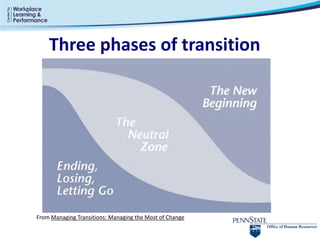
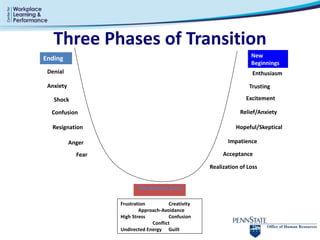
Three phases of transition
From Managing Transitions: Managing the Most of Change
Three Phases of Transition
The Neutral Zone
Denial
Anxiety
Shock
Confusion
Resignation
Anger
Fear
Trusting
Excitement
Impatience
Acceptance
Realization of Loss
Frustration Creativity
Approach-Avoidance
High Stress Confusion
Conflict
Undirected Energy Guilt
Ending New
Beginnings
Relief/Anxiety
Hopeful/Skeptical
Enthusiasm
Four Stages of Self-Management
1. Identify the phase you are in.
2. Focus on opportunities.
3. Ask questions.
4. Employ strategies.
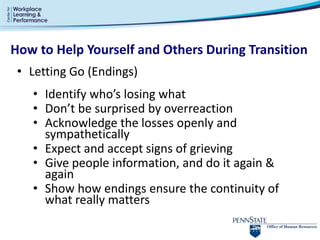
How to Help Yourself and Others During Transition
• Letting Go (Endings)
• Identify who’s losing what
• Don’t be surprised by overreaction
• Acknowledge the losses openly and
sympathetically
• Expect and accept signs of grieving
• Give people information, and do it again &
again
• Show how endings ensure the continuity of
what really matters
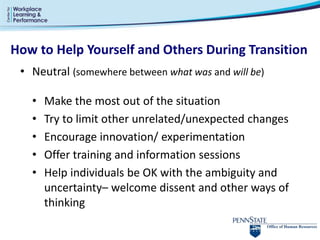
How to Help Yourself and Others During Transition
• Neutral (somewhere between what was and will be)
• Make the most out of the situation
• Try to limit other unrelated/unexpected changes
• Encourage innovation/ experimentation
• Offer training and information sessions
• Help individuals be OK with the ambiguity and
uncertainty– welcome dissent and other ways of
thinking
How to Help Yourself and Others During Transition
• New Beginnings
• Be consistent in your messages and your actions
• Ensure quick successes: Reassure the believers,
convince the doubters, and confound the critics
• Symbolize the new identity
• Celebrate the success
14
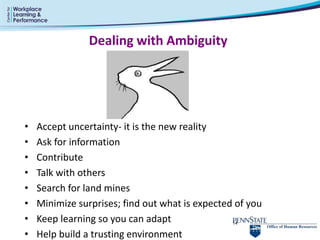
Dealing with Ambiguity
• Accept uncertainty- it is the new reality
• Ask for information
• Contribute
• Talk with others
• Search for land mines
• Minimize surprises; find out what is expected of you
• Keep learning so you can adapt
• Help build a trusting environment
15
Overcoming Resistance to Change:
Isn’t It Obvious?
http://www.youtube.com/watch?v=wU3bTkqHoXc&feature=related
Change
(+) (-)
No Change
(+) (-)
Demonstrate gains Eliminate pains
Reduce comfort
with status quo
Emphasize current
issues with status quo
Source: Eliyahu Goldratt
Dewitt’s Advice
•Realize that change
is possibility.
• Learn to live with
uncertainty, yet
act with
confidence.
• Challenge the order
in your life.
Personal Choices
A Simple Change Manifesto
• Stop being afraid
• Drop old habits
• Roll with the punches
21
Action Planning
As a result of today’s conversation, how will
you help yourself and others create positive
and lasting change within your work and
your life?

Leading-Change-PPT-2015-updated.pptx

  • 1.
    Leading Change Presenter: StephanieFlanagan slm114@psu.edu 2015
  • 2.
    Discussion Takeaways • Understandthe connection between change and transition—and why it matters! • Identify self-management strategies to successfully move through the change and transition process • Identify ways to support others (including colleagues and customers) to help them successfully move through the change and transition process • Exhibit a proactive approach to leading change
  • 3.
    3 Change- Where areYou? “Change? Oh no, not again!” “Change? Sounds like fun! I’m ready, willing and able!” https://www.youtube.com/watch?t=186&v=__IlYNMdV9E
  • 4.
    Definition “It isn’t thechanges that do you in, it’s the transitions. Change is not the same as transition. Change is situational: the new site, the new boss, the new team roles, and the new policy. Transition is the psychological process people go through to come to terms with the new situation. Change is external; transition is internal.” --William Bridges Managing Transitions: Managing the Most of Change
  • 6.
    Two Types ofChange • Initiated • Inherited
  • 7.
    Three phases oftransition From Managing Transitions: Managing the Most of Change
  • 8.
    Three Phases ofTransition The Neutral Zone Denial Anxiety Shock Confusion Resignation Anger Fear Trusting Excitement Impatience Acceptance Realization of Loss Frustration Creativity Approach-Avoidance High Stress Confusion Conflict Undirected Energy Guilt Ending New Beginnings Relief/Anxiety Hopeful/Skeptical Enthusiasm
  • 9.
    Four Stages ofSelf-Management 1. Identify the phase you are in. 2. Focus on opportunities. 3. Ask questions. 4. Employ strategies.
  • 11.
    How to HelpYourself and Others During Transition • Letting Go (Endings) • Identify who’s losing what • Don’t be surprised by overreaction • Acknowledge the losses openly and sympathetically • Expect and accept signs of grieving • Give people information, and do it again & again • Show how endings ensure the continuity of what really matters
  • 12.
    How to HelpYourself and Others During Transition • Neutral (somewhere between what was and will be) • Make the most out of the situation • Try to limit other unrelated/unexpected changes • Encourage innovation/ experimentation • Offer training and information sessions • Help individuals be OK with the ambiguity and uncertainty– welcome dissent and other ways of thinking
  • 13.
    How to HelpYourself and Others During Transition • New Beginnings • Be consistent in your messages and your actions • Ensure quick successes: Reassure the believers, convince the doubters, and confound the critics • Symbolize the new identity • Celebrate the success
  • 14.
    14 Dealing with Ambiguity •Accept uncertainty- it is the new reality • Ask for information • Contribute • Talk with others • Search for land mines • Minimize surprises; find out what is expected of you • Keep learning so you can adapt • Help build a trusting environment
  • 15.
    15 Overcoming Resistance toChange: Isn’t It Obvious? http://www.youtube.com/watch?v=wU3bTkqHoXc&feature=related Change (+) (-) No Change (+) (-) Demonstrate gains Eliminate pains Reduce comfort with status quo Emphasize current issues with status quo Source: Eliyahu Goldratt
  • 16.
    Dewitt’s Advice •Realize thatchange is possibility. • Learn to live with uncertainty, yet act with confidence. • Challenge the order in your life.
  • 18.
  • 19.
    A Simple ChangeManifesto • Stop being afraid • Drop old habits • Roll with the punches
  • 21.
    21 Action Planning As aresult of today’s conversation, how will you help yourself and others create positive and lasting change within your work and your life?