Developed by:
Jane Pettit, M.S.
UMHS Human Resources
janep@umich.edu
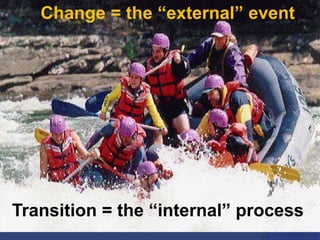
Change = the “external” event
Transition = the “internal” process
“It isn’t the changes that do you in,
it’s the transitions. Change is not
the same as transition. Change is
external, transition is internal.”
-William Bridges
Managing Transitions: Making the Most of Change
Transition:
the human side of change
 Change is situational: the new
site, the new boss, the new team
roles, the new policy, the new
process…
 What is changing for you?
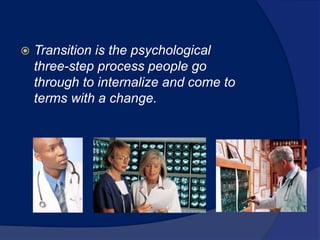
 Transition is the psychological
three-step process people go
through to internalize and come to
terms with a change.
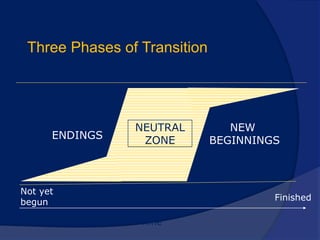
Three Phases of Transition
ENDINGS
NEUTRAL
ZONE
NEW
BEGINNINGS
Not yet
begun
Finished
Time
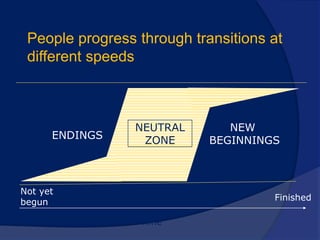
People progress through transitions at
different speeds
ENDINGS
NEUTRAL
ZONE
NEW
BEGINNINGS
Not yet
begun
Finished
Time
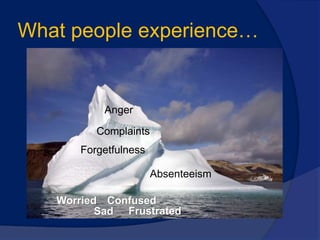
What people experience…
Absenteeism
Complaints
Anger
Forgetfulness
Worried Confused
Frustrated
Sad
Activity
Reflect on a major change in your life:
1. As you made this change in your life, what ended?
security, turf, status, influence, memberships, meaningful work, identity,
control, relationships, etc.
2. How did that make you feel?
angry, scared, lonely, excited, relieved, wondering
3. What helped (or might have helped) to make the transition easier?
(talk to someone, time, information, knowing others were going through the
same thing, ) What did you learn to avoid in the future?
4. What kind of outcome did you have? What helped create a good
outcome? What would you do differently to avoid a bad outcome?
 Communicate, Communicate,
Communicate
 frequently and less formally
 the good news and the bad
 acknowledge the emotional impact caused
by the change
http://www.med.umich.edu/i/integration/
Communicating During Times of
Change
Communicating During Times
of Change
 Be open
 willing to share an honest expression of your
own personal experience
 with an "owner's" view, not a "victim's" view
of the circumstances
 listen and legitimize others' feelings and
reactions
Communicating During Times
of Change
 Give support
 practice skills for listening and
understanding others' point of view
 work together to create short term plans to
address issues
 set up regular ongoing ways of working
together
Communicating During Times
of Change
 Experiment
 hear/accept new ideas from others.
 encourage experimentation and accept
mistakes.
 elicit ideas from others on how to help the
change process.
Managing the Transitions
What will you
do to make this
transition a
success?
Genuine beginnings begin within us, even when they are
brought to our attention by external opportunities.
- William Bridges

Change and Transiiton ppt.pptx

  • 1.
    Developed by: Jane Pettit,M.S. UMHS Human Resources janep@umich.edu
  • 2.
    Change = the“external” event Transition = the “internal” process
  • 3.
    “It isn’t thechanges that do you in, it’s the transitions. Change is not the same as transition. Change is external, transition is internal.” -William Bridges Managing Transitions: Making the Most of Change Transition: the human side of change
  • 4.
     Change issituational: the new site, the new boss, the new team roles, the new policy, the new process…  What is changing for you?
  • 5.
     Transition isthe psychological three-step process people go through to internalize and come to terms with a change.
  • 6.
    Three Phases ofTransition ENDINGS NEUTRAL ZONE NEW BEGINNINGS Not yet begun Finished Time
  • 7.
    People progress throughtransitions at different speeds ENDINGS NEUTRAL ZONE NEW BEGINNINGS Not yet begun Finished Time
  • 8.
  • 9.
    Activity Reflect on amajor change in your life: 1. As you made this change in your life, what ended? security, turf, status, influence, memberships, meaningful work, identity, control, relationships, etc. 2. How did that make you feel? angry, scared, lonely, excited, relieved, wondering 3. What helped (or might have helped) to make the transition easier? (talk to someone, time, information, knowing others were going through the same thing, ) What did you learn to avoid in the future? 4. What kind of outcome did you have? What helped create a good outcome? What would you do differently to avoid a bad outcome?
  • 10.
     Communicate, Communicate, Communicate frequently and less formally  the good news and the bad  acknowledge the emotional impact caused by the change http://www.med.umich.edu/i/integration/ Communicating During Times of Change
  • 11.
    Communicating During Times ofChange  Be open  willing to share an honest expression of your own personal experience  with an "owner's" view, not a "victim's" view of the circumstances  listen and legitimize others' feelings and reactions
  • 12.
    Communicating During Times ofChange  Give support  practice skills for listening and understanding others' point of view  work together to create short term plans to address issues  set up regular ongoing ways of working together
  • 13.
    Communicating During Times ofChange  Experiment  hear/accept new ideas from others.  encourage experimentation and accept mistakes.  elicit ideas from others on how to help the change process.
  • 14.
    Managing the Transitions Whatwill you do to make this transition a success?
  • 15.
    Genuine beginnings beginwithin us, even when they are brought to our attention by external opportunities. - William Bridges