A Siegel+Gale webinar
July 23, 2014
Managing the
Hospital In-Patient
Experience
2
Our promise


S+G is the simplicity company.
We define, design and deliver
compelling brand experiences
that are both unexpectedly
fresh and remarkably clear.

3
We create

simplicity


Research
Brand strategy
Brand architecture
Experience strategy
Simplification
Content strategy
Content development
Naming
Visual identity
Environments
Global implementation
Employee engagement
Digital experiences
4
Rolf M. Wulfsberg, PhD 

Global Director, Quantitative Research 
•  Nationally recognized expert in survey
research with 44 years of experience
•  Author of the book Fact-Based Branding in
the Real World: A Simple Survival Guide for
CMOs and Brand Managers.
•  PhD and MA in statistics from the American
University and BA in mathematics and
economics from Luther College (summa cum
laude)
•  Former Rhodes candidate and Woodrow
Wilson scholar
•  Served as an expert witness before the U.S.
House of Representatives and the
Pennsylvania Supreme Court
!
5
Rolf M. Wulfsberg, PhD 

Global Director, Quantitative Research
6
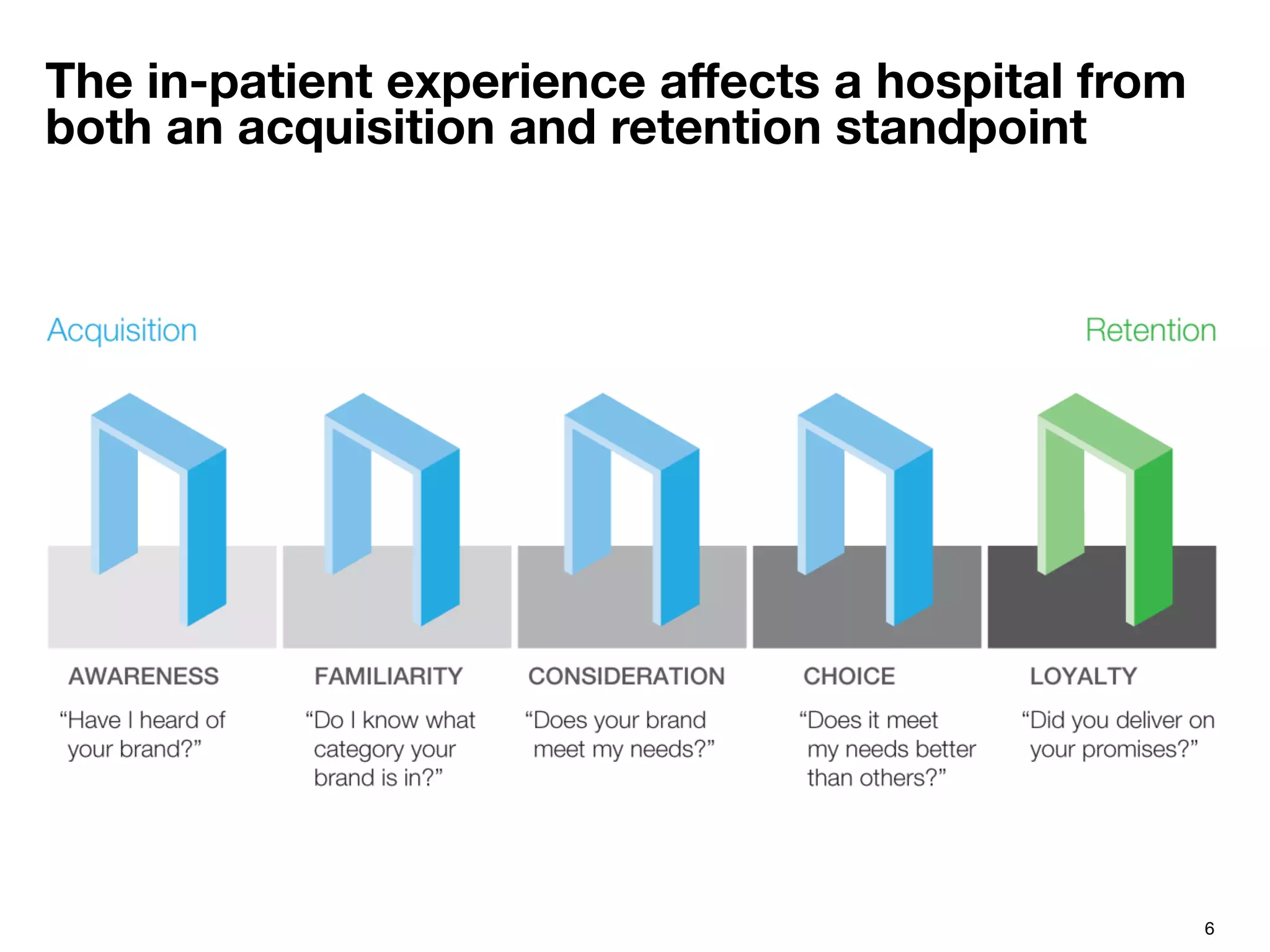
The in-patient experience affects a hospital from
both an acquisition and retention standpoint
7
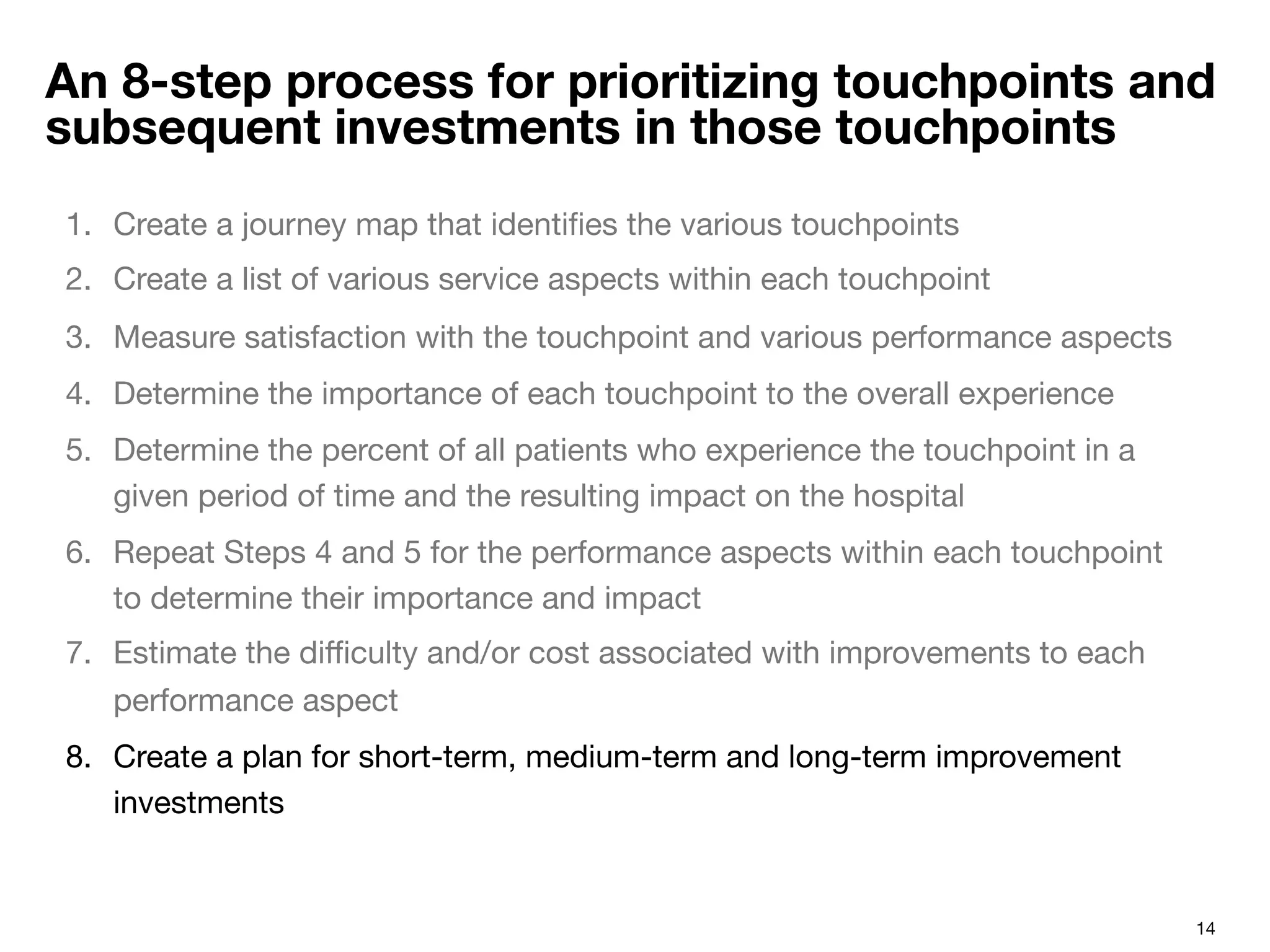
An 8-step process for prioritizing touchpoints and
subsequent investments in those touchpoints
1.  Create a journey map that identifies the various touchpoints
8
An 8-step process for prioritizing touchpoints and
subsequent investments in those touchpoints
1.  Create a journey map that identifies the various touchpoints 
2.  Create a list of various service aspects within each touchpoint
9
An 8-step process for prioritizing touchpoints and
subsequent investments in those touchpoints
1.  Create a journey map that identifies the various touchpoints 
2.  Create a list of various service aspects within each touchpoint
3.  Measure satisfaction with the touchpoint and various performance aspects
10
An 8-step process for prioritizing touchpoints and
subsequent investments in those touchpoints
1.  Create a journey map that identifies the various touchpoints 
2.  Create a list of various service aspects within each touchpoint
3.  Measure satisfaction with the touchpoint and various performance aspects
4.  Determine the importance of each touchpoint to the overall experience
11
An 8-step process for prioritizing touchpoints and
subsequent investments in those touchpoints
1.  Create a journey map that identifies the various touchpoints 
2.  Create a list of various service aspects within each touchpoint
3.  Measure satisfaction with the touchpoint and various performance aspects
4.  Determine the importance of each touchpoint to the overall experience
5.  Determine the percent of all patients who experience the touchpoint in a
given period of time and the resulting impact on the hospital
12
An 8-step process for prioritizing touchpoints and
subsequent investments in those touchpoints
1.  Create a journey map that identifies the various touchpoints 
2.  Create a list of various service aspects within each touchpoint
3.  Measure satisfaction with the touchpoint and various performance aspects
4.  Determine the importance of each touchpoint to the overall experience
5.  Determine the percent of all patients who experience the touchpoint in a
given period of time and the resulting impact on the hospital
6.  Repeat Steps 4 and 5 for the performance aspects within each touchpoint
to determine their importance and impact
13
An 8-step process for prioritizing touchpoints and
subsequent investments in those touchpoints
1.  Create a journey map that identifies the various touchpoints 
2.  Create a list of various service aspects within each touchpoint
3.  Measure satisfaction with the touchpoint and various performance aspects
4.  Determine the importance of each touchpoint to the overall experience
5.  Determine the percent of all patients who experience the touchpoint in a
given period of time and the resulting impact on the hospital
6.  Repeat Steps 4 and 5 for the performance aspects within each touchpoint
to determine their importance and impact
7.  Estimate the difficulty and/or cost associated with improvements to each
performance aspect
14
An 8-step process for prioritizing touchpoints and
subsequent investments in those touchpoints
1.  Create a journey map that identifies the various touchpoints 
2.  Create a list of various service aspects within each touchpoint
3.  Measure satisfaction with the touchpoint and various performance aspects
4.  Determine the importance of each touchpoint to the overall experience
5.  Determine the percent of all patients who experience the touchpoint in a
given period of time and the resulting impact on the hospital
6.  Repeat Steps 4 and 5 for the performance aspects within each touchpoint
to determine their importance and impact
7.  Estimate the difficulty and/or cost associated with improvements to each
performance aspect
8.  Create a plan for short-term, medium-term and long-term improvement
investments
15
Step 1: 

Create a journey
map that identifies
the various
touchpoints
16
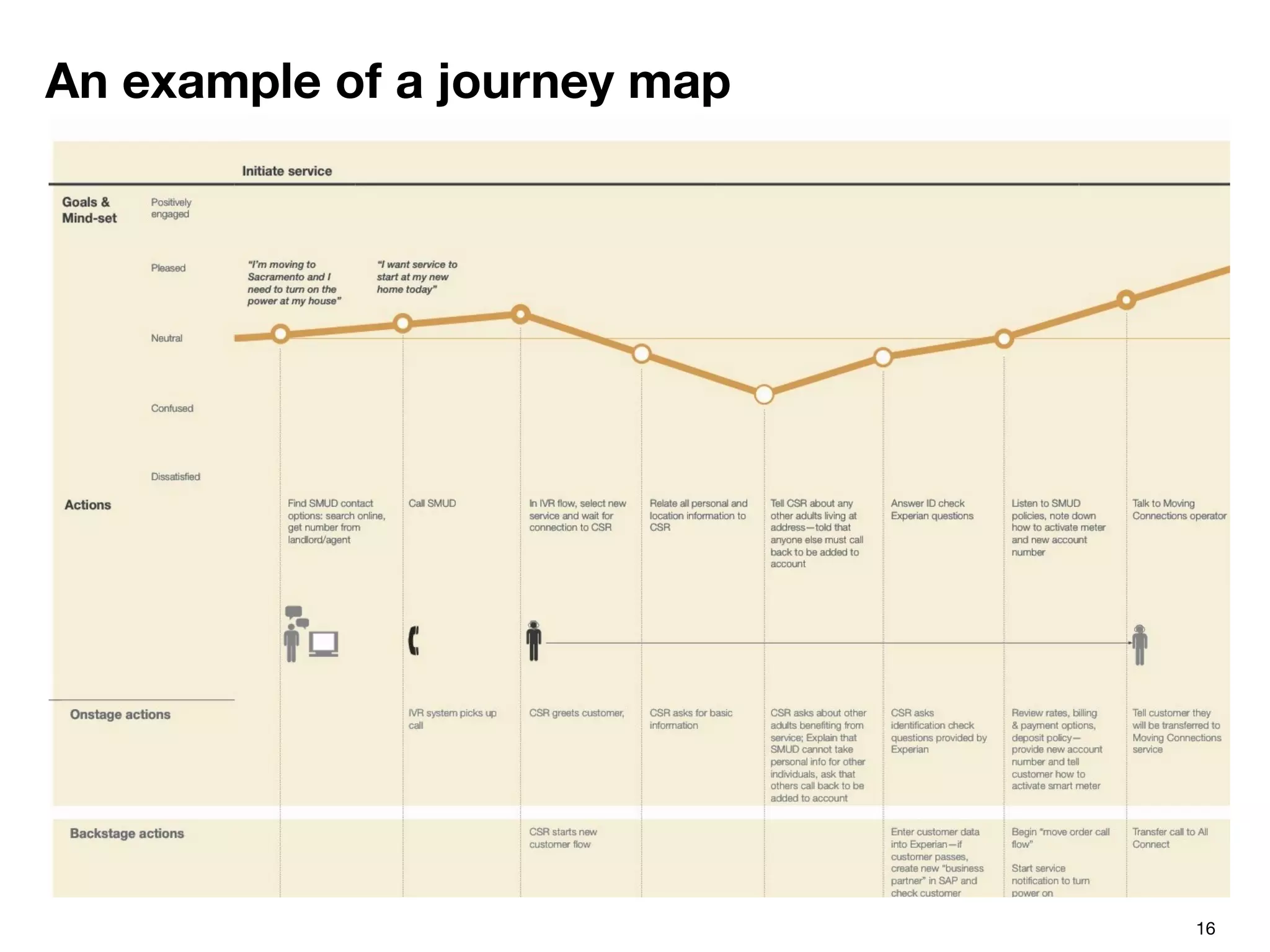
An example of a journey map
17
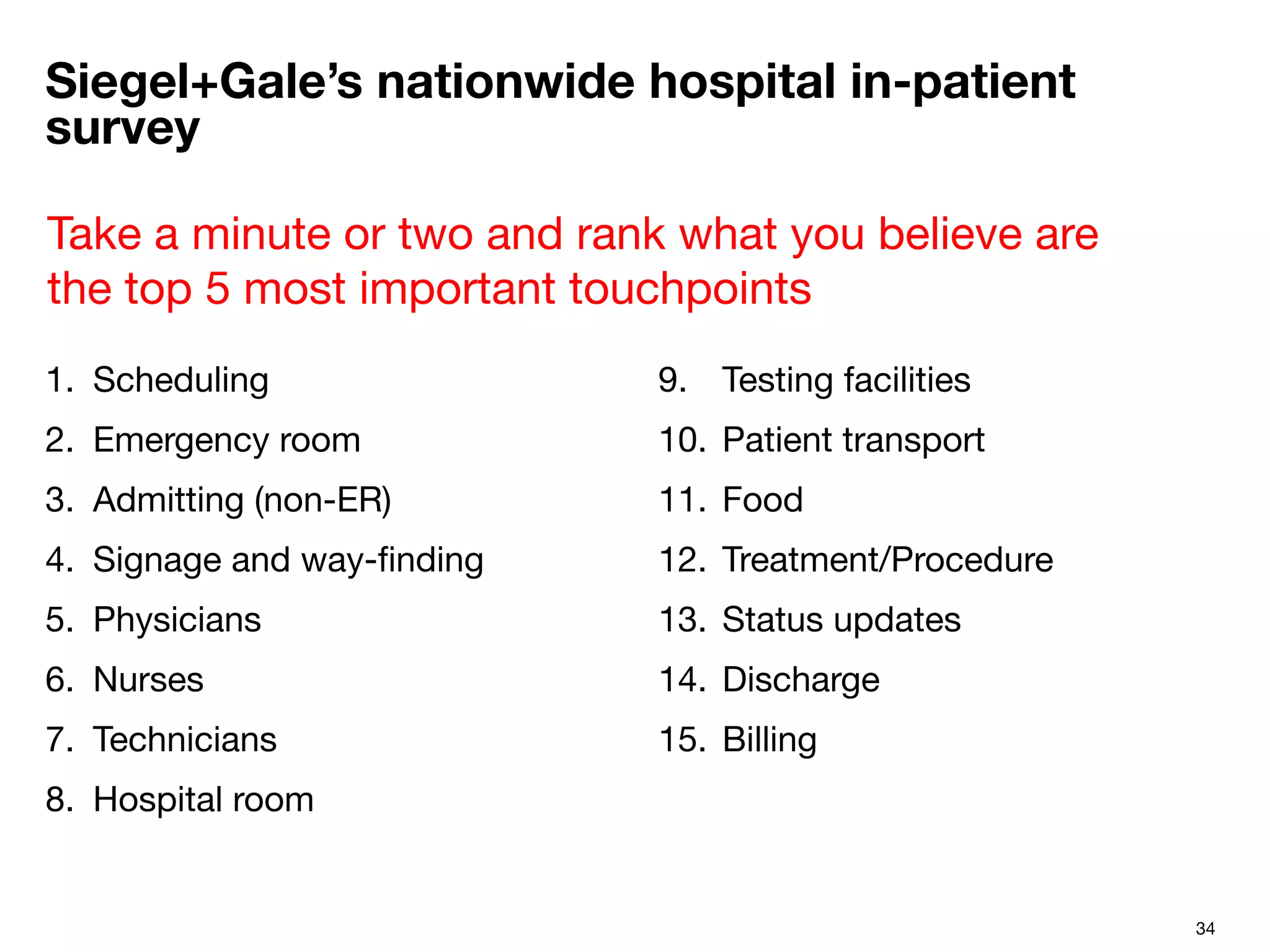
Siegel+Gale’s nationwide hospital in-patient
survey
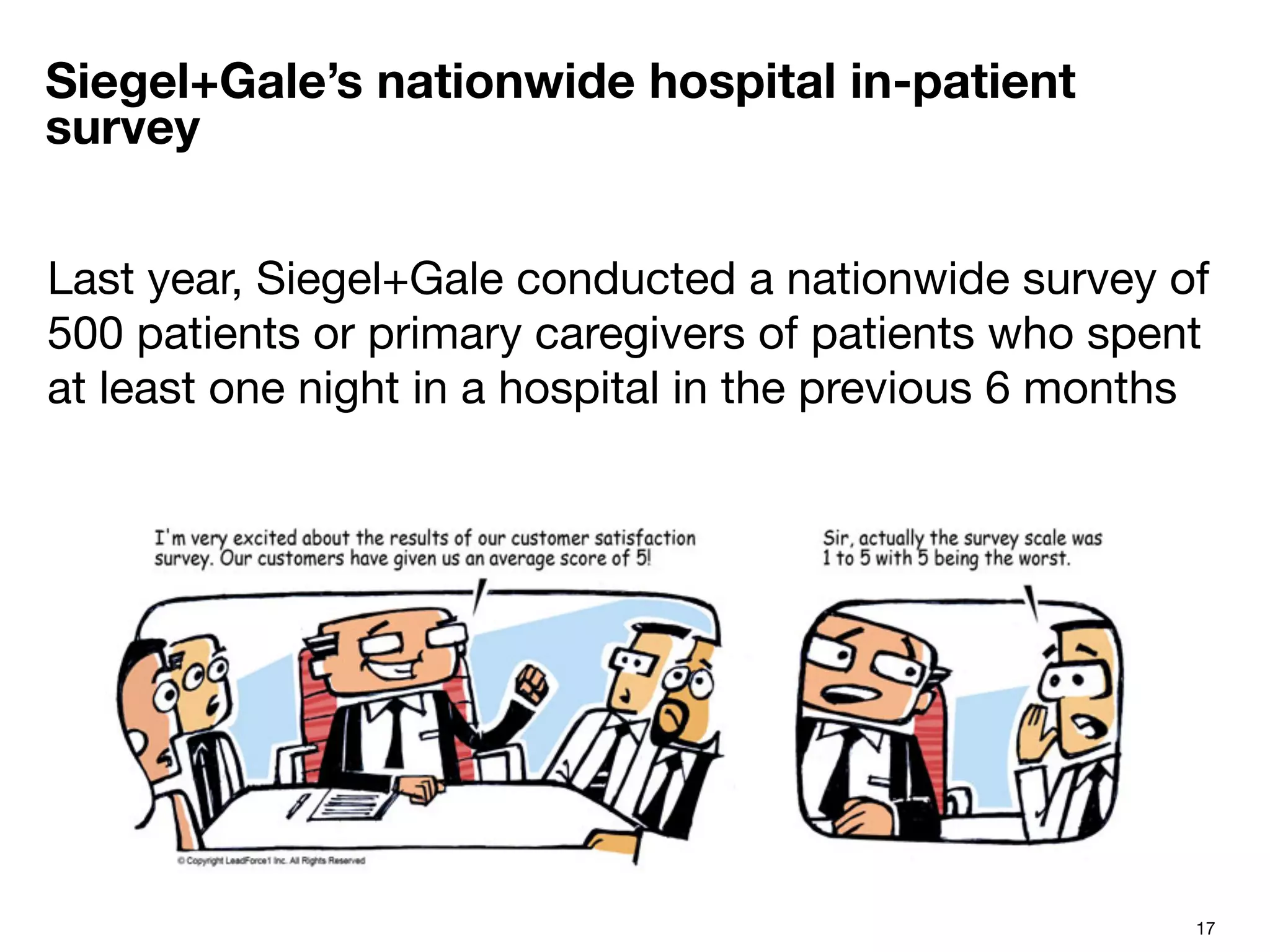
Last year, Siegel+Gale conducted a nationwide survey of
500 patients or primary caregivers of patients who spent
at least one night in a hospital in the previous 6 months
18
Siegel+Gale’s nationwide hospital in-patient
survey
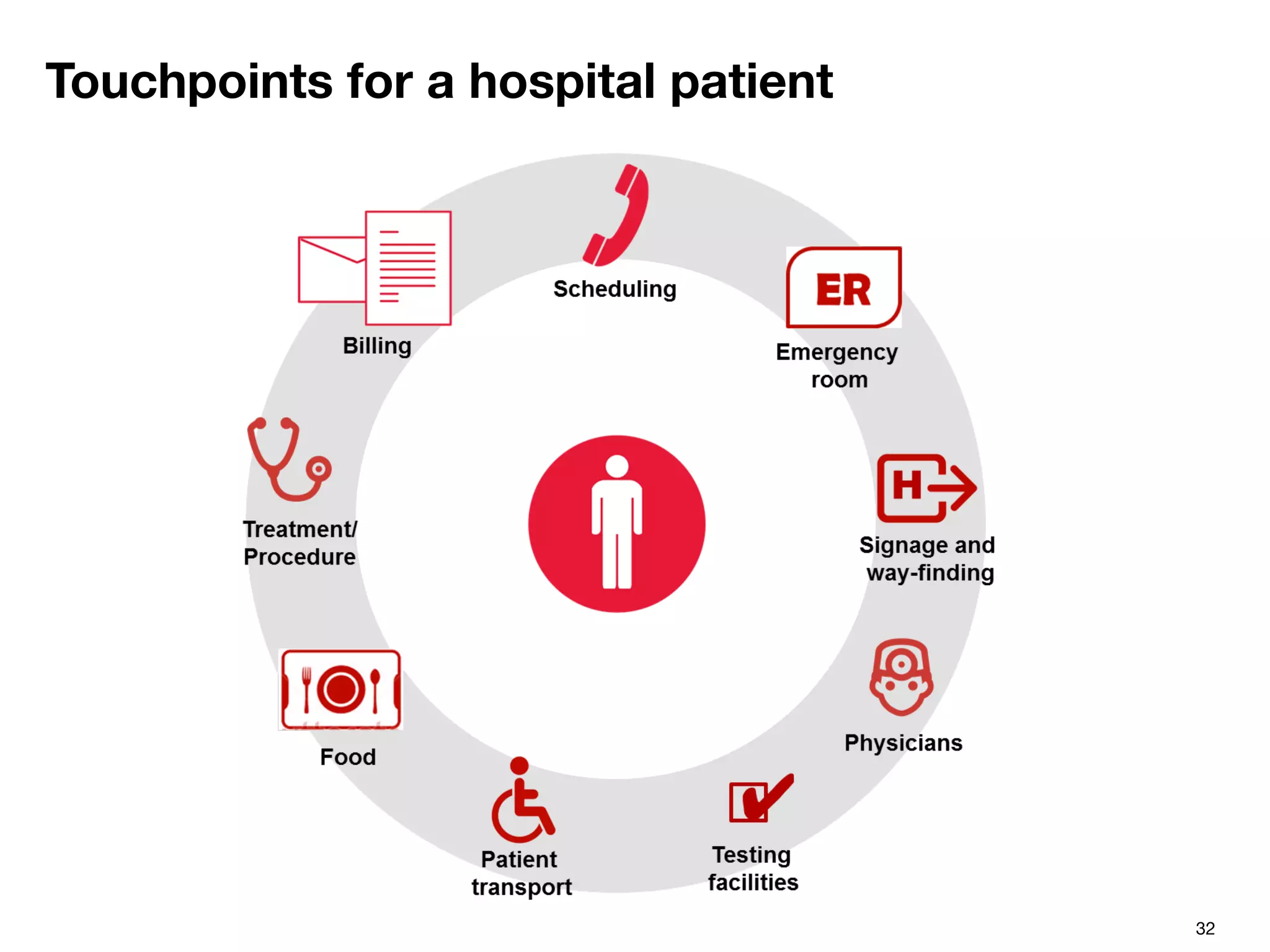
1.  Scheduling
2.  Emergency room
3.  Admitting (non-ER)
4.  Signage and way-finding
5.  Physicians
6.  Nurses
7.  Technicians
8.  Hospital room
9.  Testing facilities
10.  Patient transport
11.  Food
12.  Treatment/Procedure
13.  Status updates
14.  Discharge
15.  Billing

The survey explored the in-patient experience with
15 touchpoints:
19
Step 2: 

Create a list of
various service
aspects within
each touchpoint
20
Example of service aspects for the hospital
room touchpoint
a.  Level of privacy I/my family
member was provided
b.  Comfort of the room
c.  Cleanliness of the room
d.  Bathroom facilities
e.  Amount of room for visitors/
family
f.  Noise level in the room
g.  Availability of a working TV in
the room
h.  Temperature in the room
i.  Comfort of the bed
j.  Adequacy of storage for
personal items
k.  Lighting in the room
l.  Visitor policies/visiting hours
m.  Accessibility of call button
and intercom to summon
assistance
21
Step 3: 

Measure the
satisfaction with
each touchpoint
and each aspect of
service within the
touchpoint
22
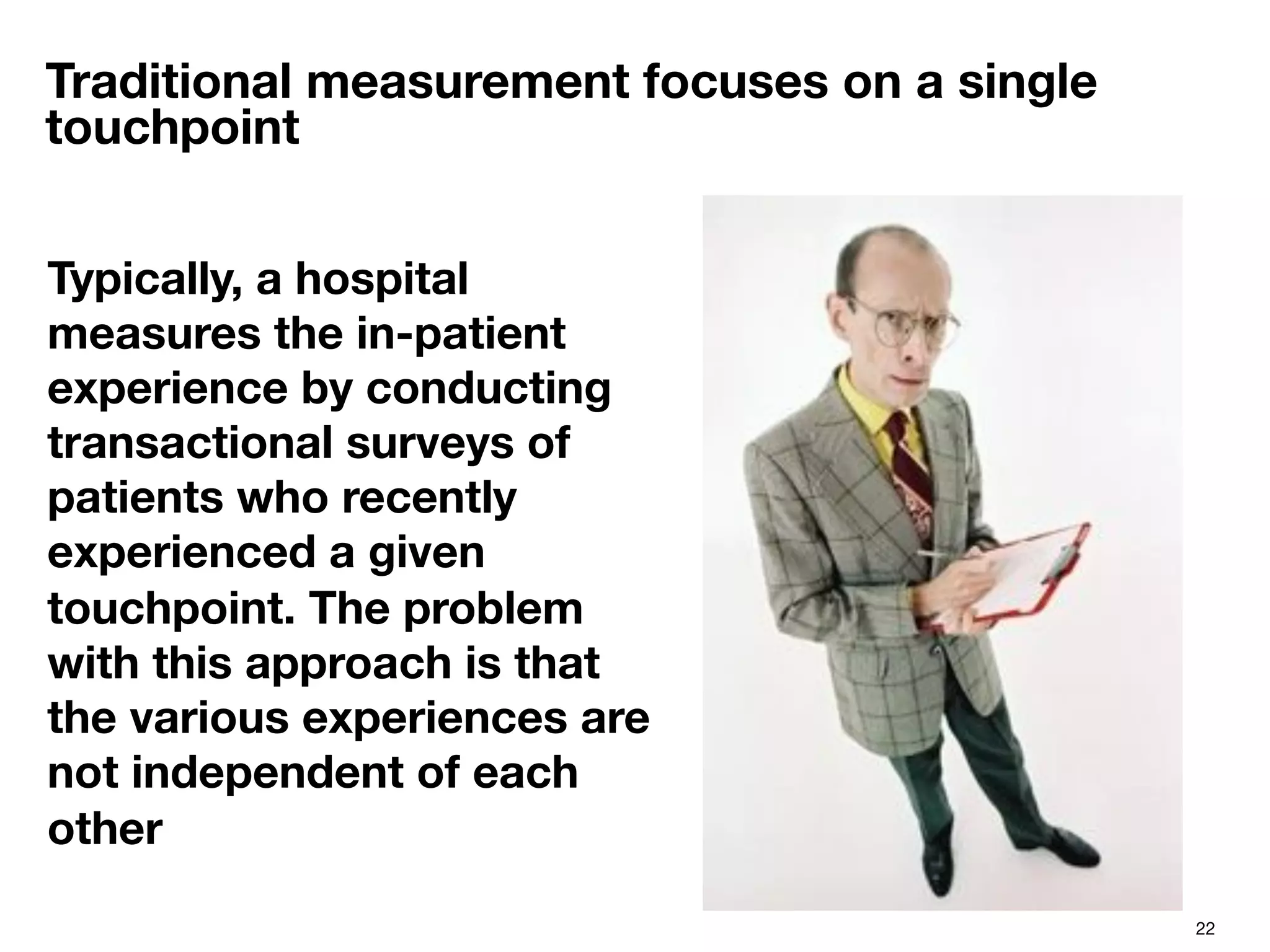
Traditional measurement focuses on a single
touchpoint
Typically, a hospital
measures the in-patient
experience by conducting
transactional surveys of
patients who recently
experienced a given
touchpoint. The problem
with this approach is that
the various experiences are
not independent of each
other
23
Consider the following example of a business
traveler on her way to an important meeting
1. After being delayed in
traffic, she arrived at
the kiosks to pick up
her ticket only to learn
that she has to see a
representative at the
counter
24
Consider the following example of a business
traveler on her way to an important meeting
2. After a long wait in
the counter line, she
learns that the ticket
was issued incorrectly
and has to be reissued
25
Consider the following example of a business
traveler on her way to an important meeting
3. She then encounters
horribly long lines at the
airport security checkpoint
26
Consider the following example of a business
traveler on her way to an important meeting
4. Once through
security, she realizes
that her gate is at the
end of a very long
corridor
27
Consider the following example of a business
traveler on her way to an important meeting
5. Upon arrival at her
gate, she sees that her
plane has already
departed
28
Consider the following example of a business
traveler on her way to an important meeting
6. She calls the airline
customer service
number to complain,
but the damage has
already been done: she
missed her meeting
29
The result is an angry customer, but which
touchpoint is to blame? If multiple touchpoints,
how do you quantify how much each contributed?
•  The initial reservations
representative?
•  The counter agent?
•  TSA?
•  The customer service
representative?
•  Someone or something
else?
30
Step 4: 

Determine the
importance of
each touchpoint
31
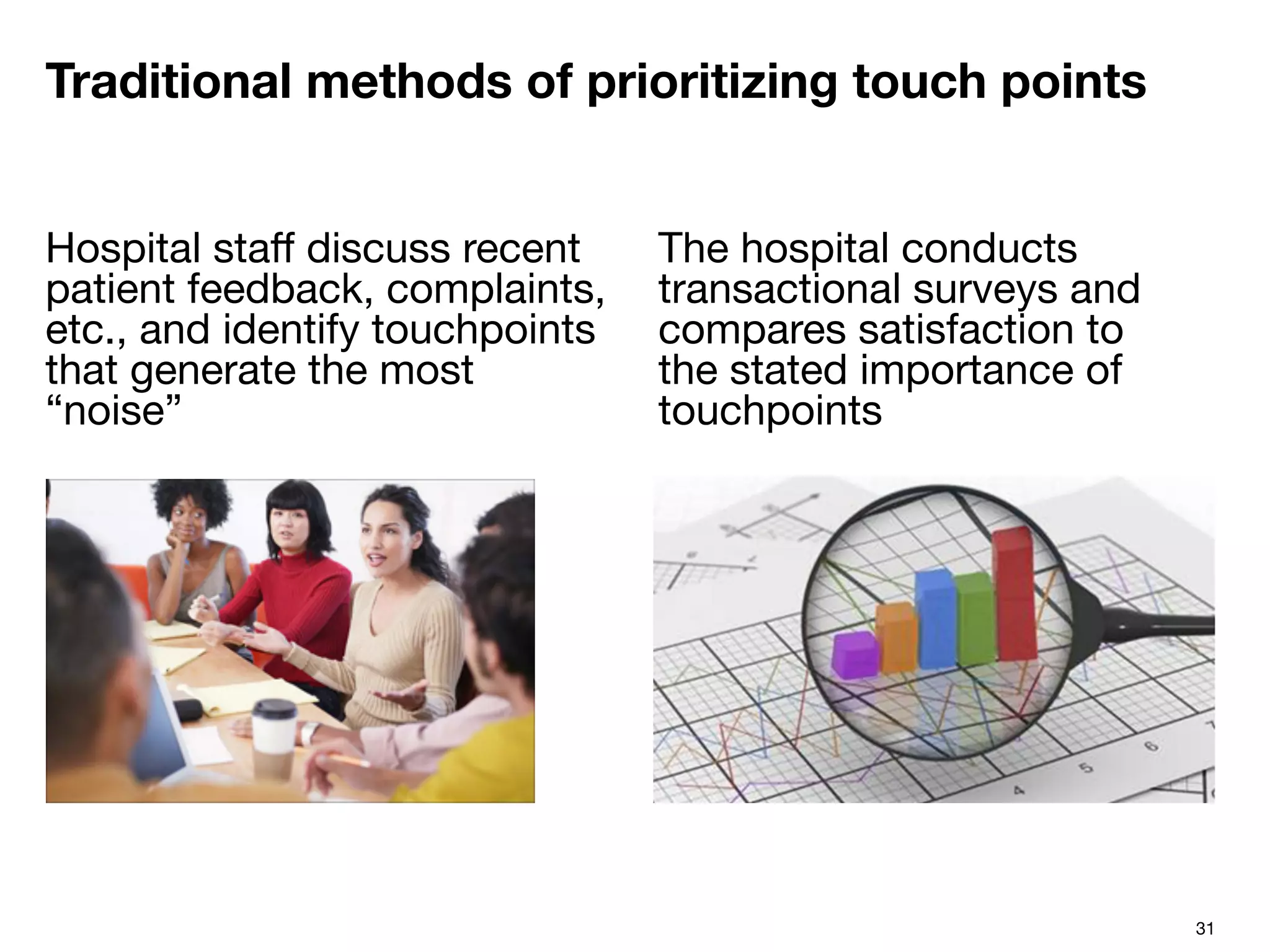
Traditional methods of prioritizing touch points
Hospital staff discuss recent
patient feedback, complaints,
etc., and identify touchpoints
that generate the most
“noise”

The hospital conducts
transactional surveys and
compares satisfaction to
the stated importance of
touchpoints
32
Touchpoints for a hospital patient
33
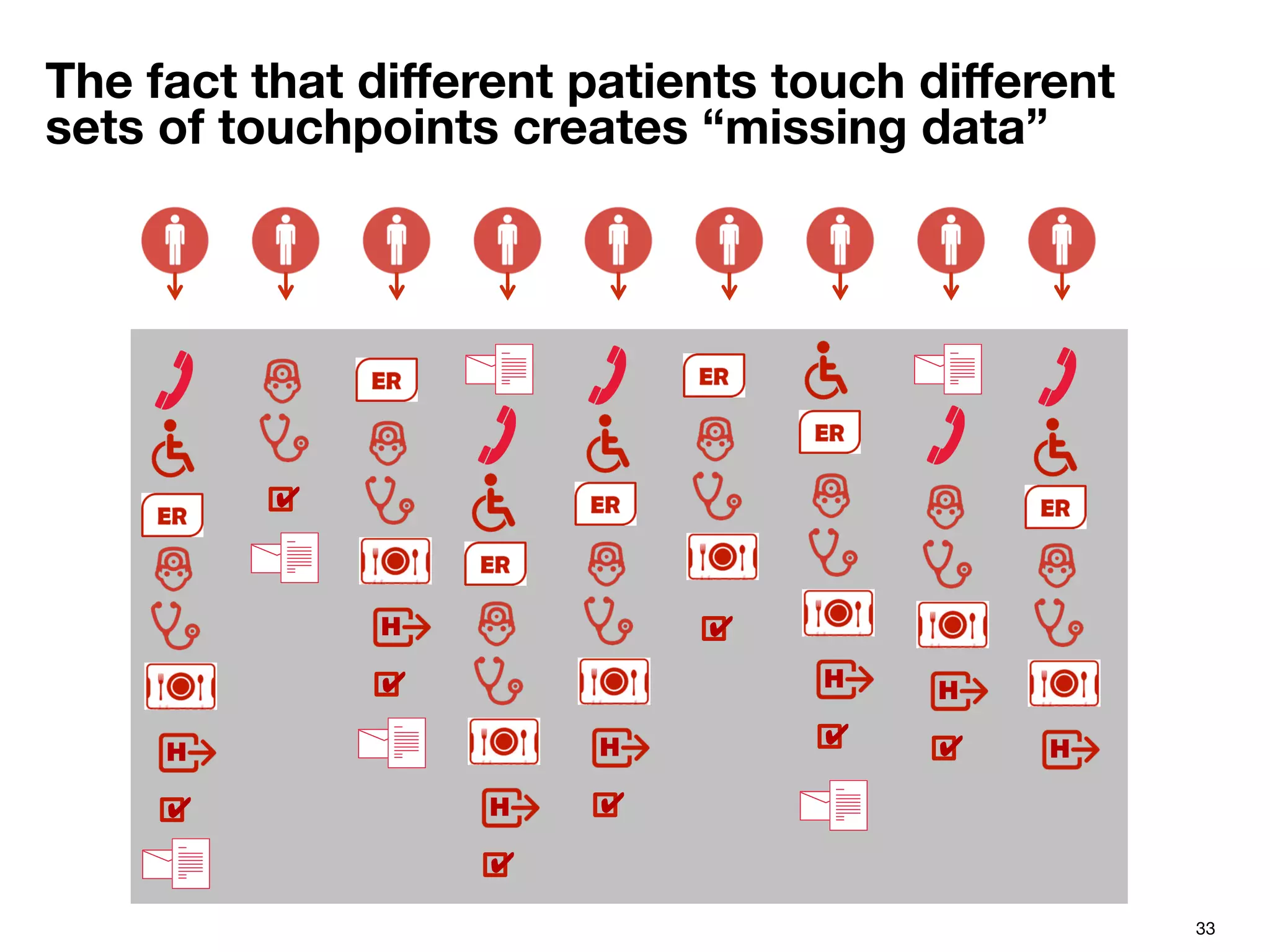
The fact that different patients touch different
sets of touchpoints creates “missing data”
✔
H
✔
✔
H
✔
H ✔
H
✔
✔
H
✔
H
H
34
Siegel+Gale’s nationwide hospital in-patient
survey
1.  Scheduling
2.  Emergency room
3.  Admitting (non-ER)
4.  Signage and way-finding
5.  Physicians
6.  Nurses
7.  Technicians
8.  Hospital room

9.  Testing facilities
10.  Patient transport
11.  Food
12.  Treatment/Procedure
13.  Status updates
14.  Discharge
15.  Billing

Take a minute or two and rank what you believe are
the top 5 most important touchpoints
35
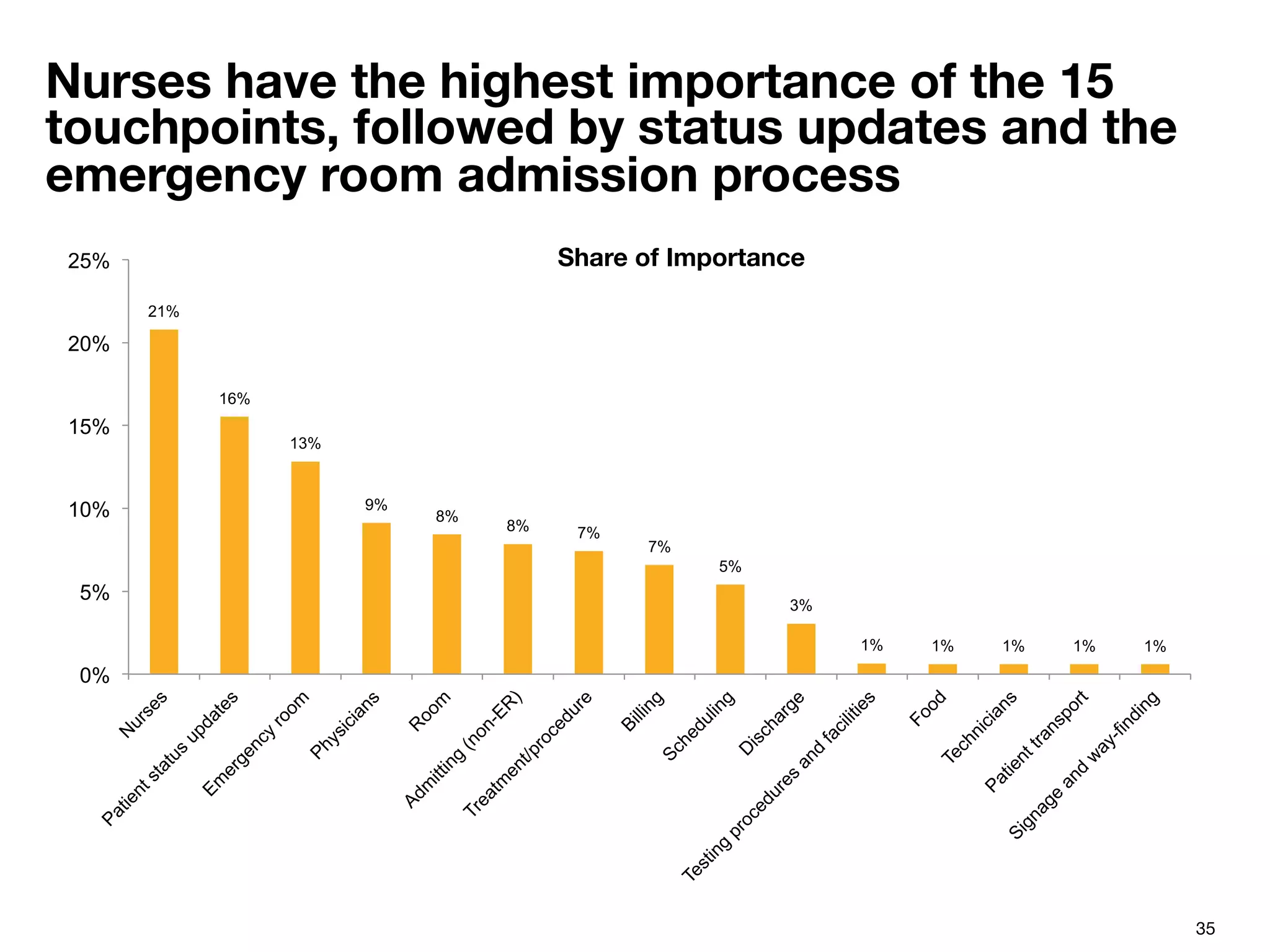
Nurses have the highest importance of the 15
touchpoints, followed by status updates and the
emergency room admission process
21%
16%
13%
9%
8%
8% 7%
7%
5%
3%
1% 1% 1% 1% 1%
0%
5%
10%
15%
20%
25% Share of Importance
36
Step 5: 

Determine the
incidence of
exposure and
impact for each
touchpoint
37
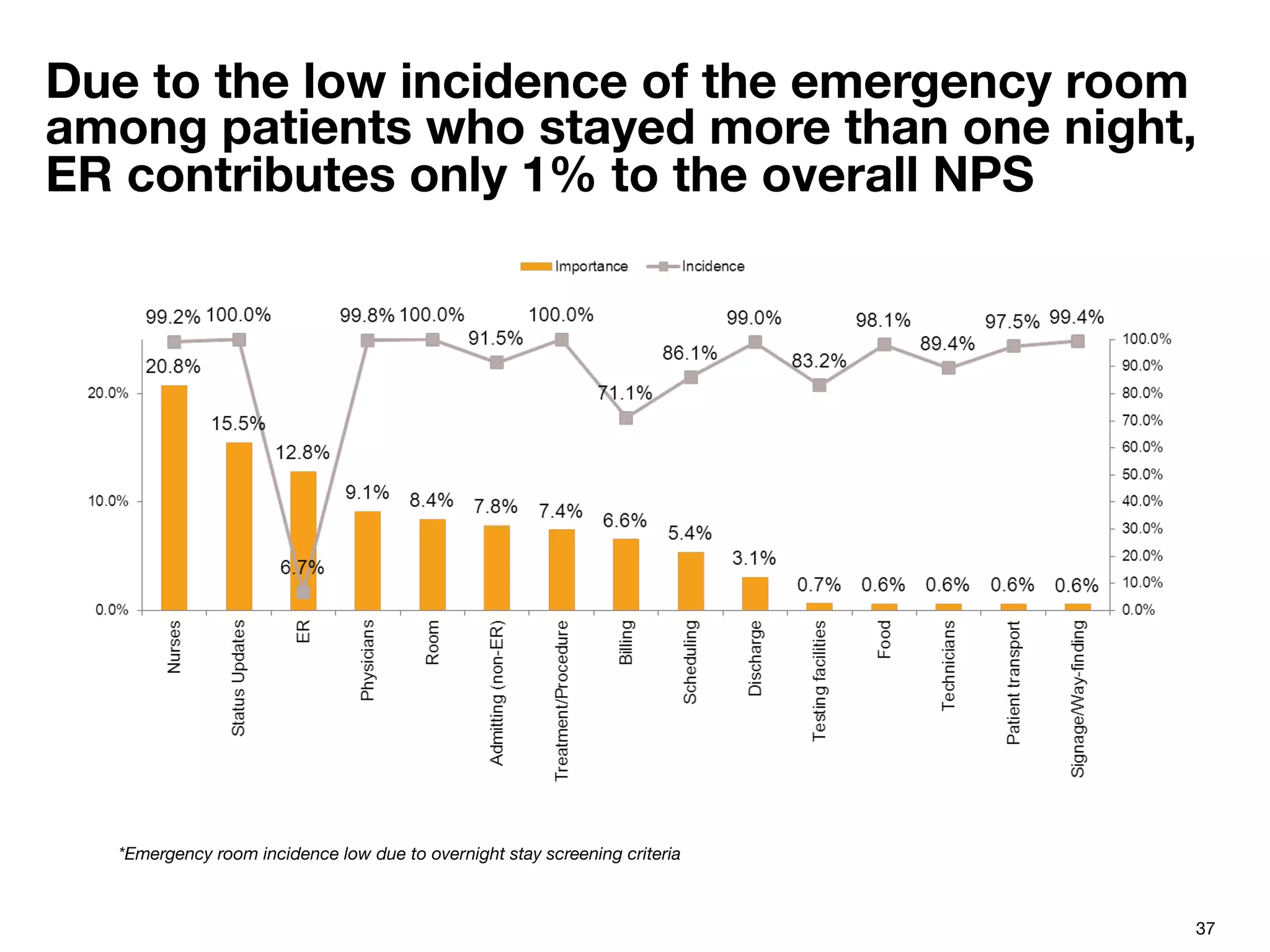
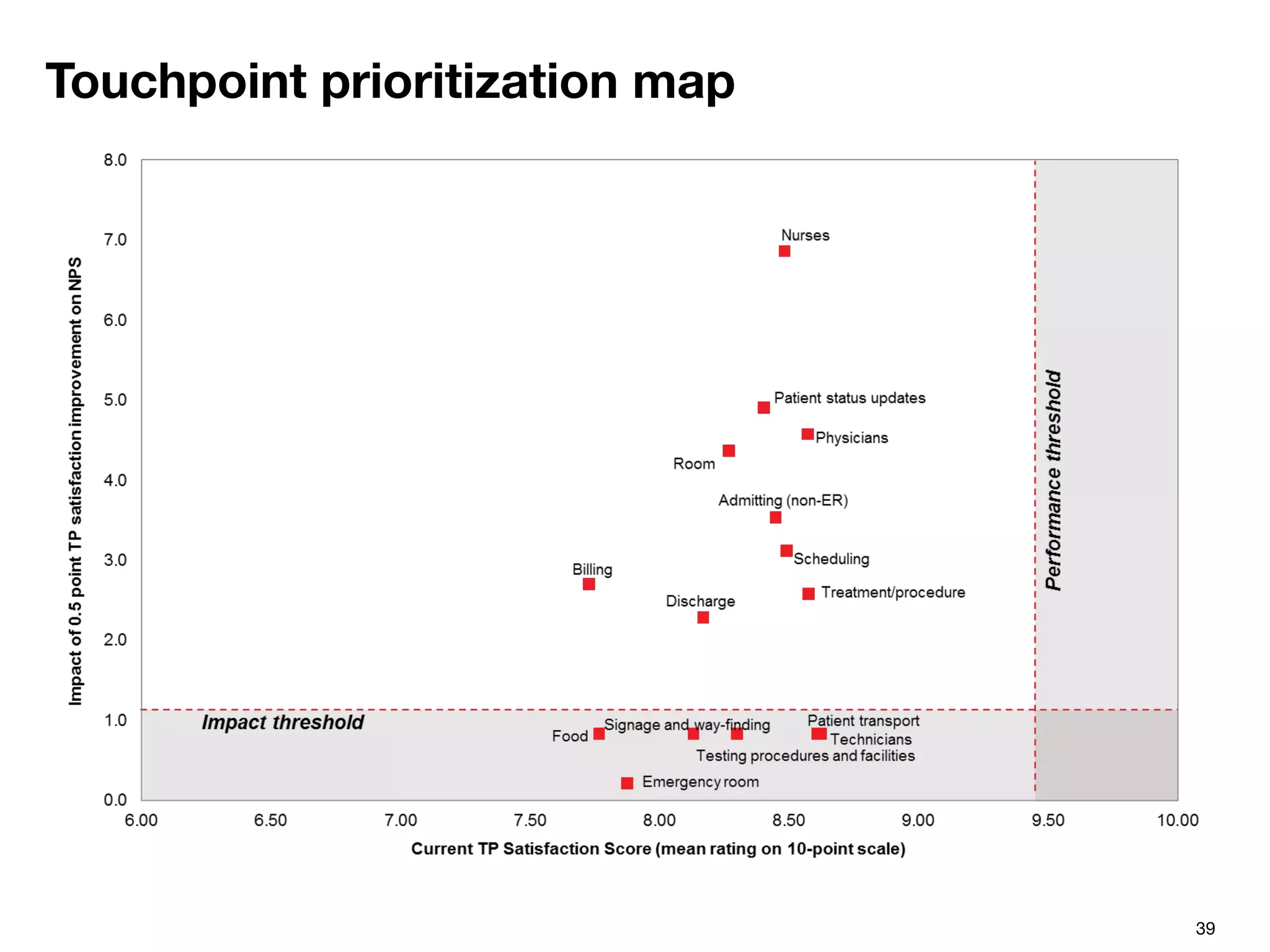
Due to the low incidence of the emergency room
among patients who stayed more than one night,
ER contributes only 1% to the overall NPS
*Emergency room incidence low due to overnight stay screening criteria
38
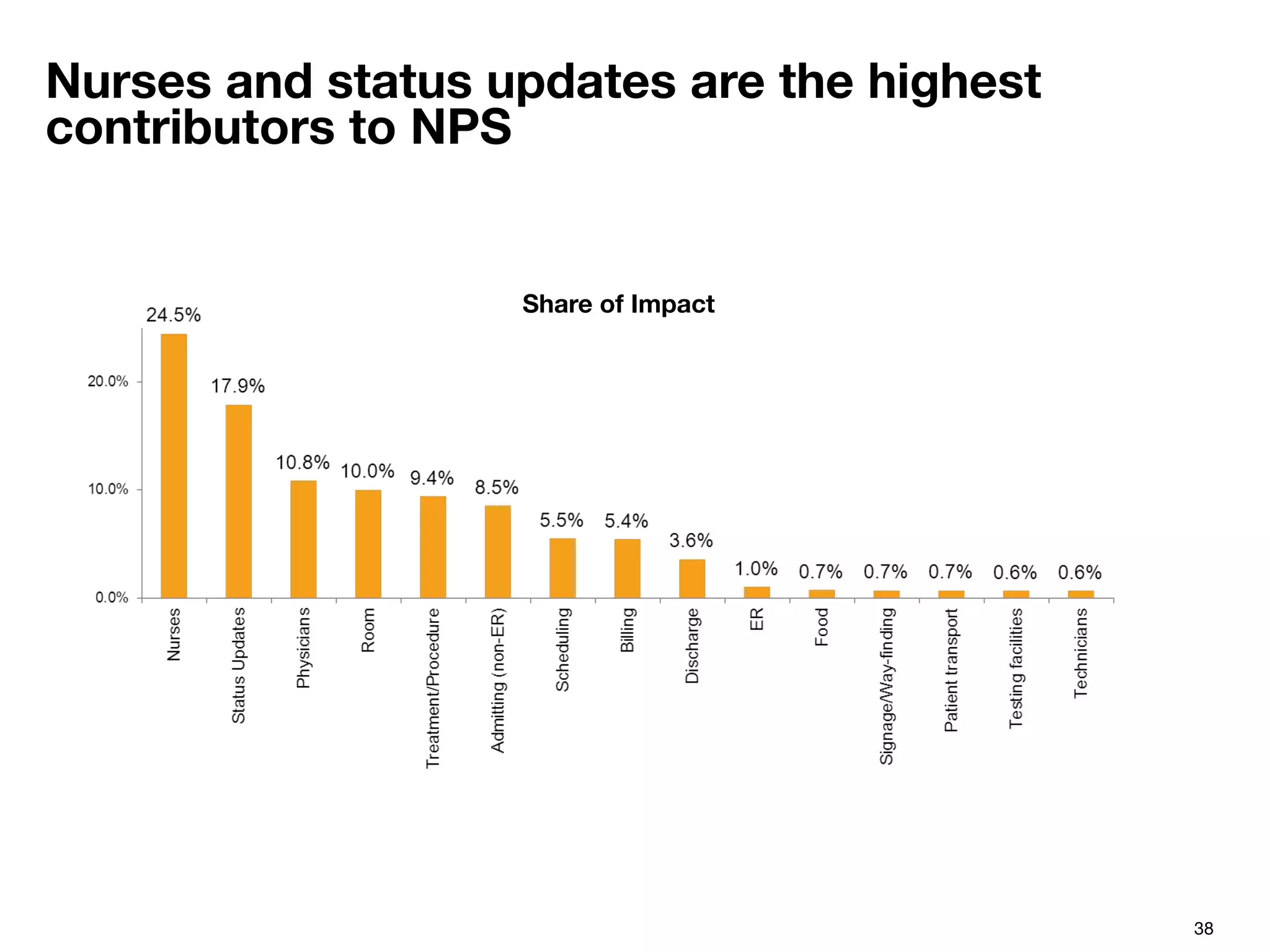
Nurses and status updates are the highest
contributors to NPS
Share of Impact
39
Touchpoint prioritization map
40
Step 6: 

Determine the
importance and
impact of various
performance
aspects
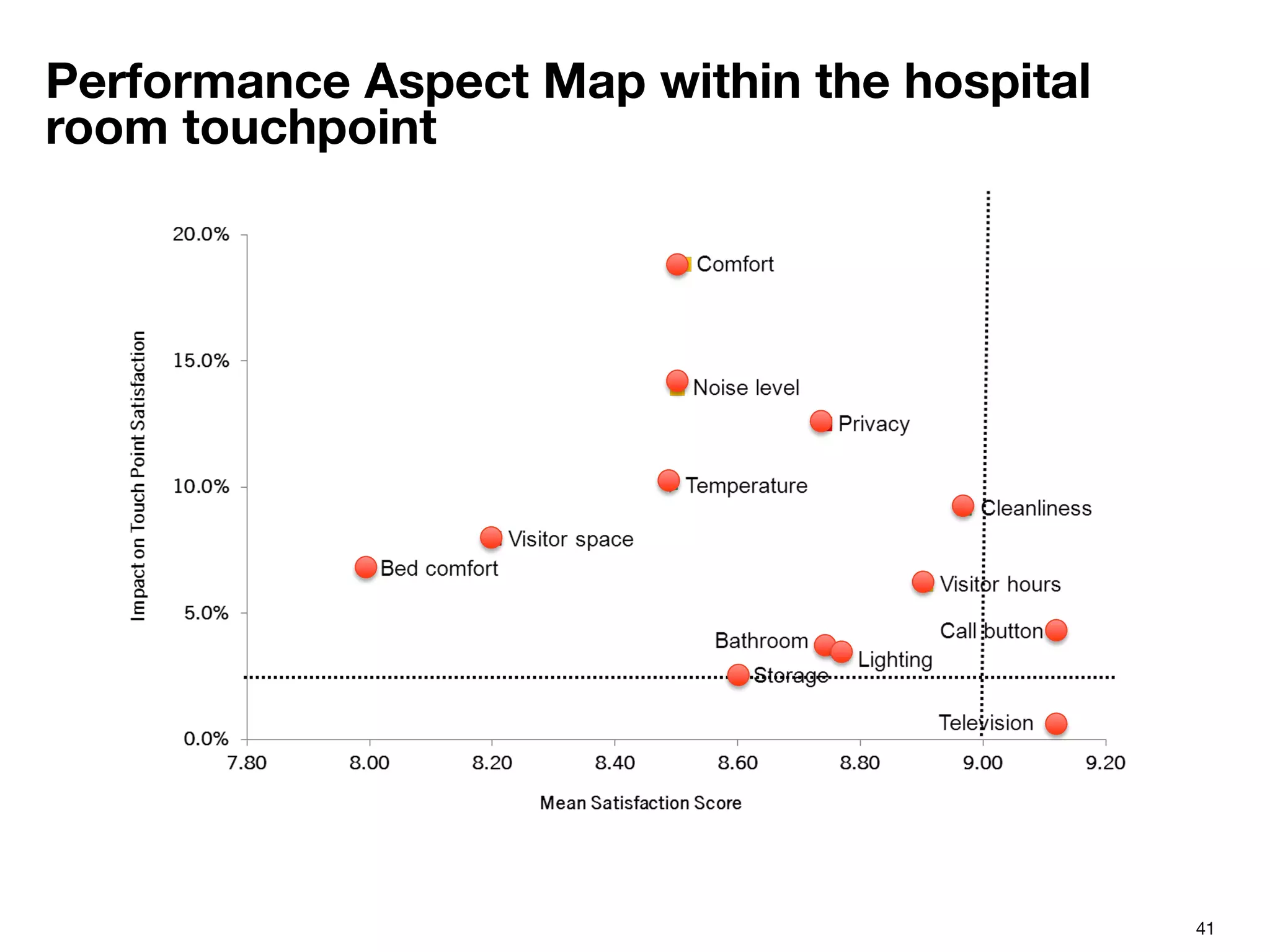
41
Performance Aspect Map within the hospital
room touchpoint
42
Step 7: 

Estimate the
difficulty and/or
cost associated
with each
improvement
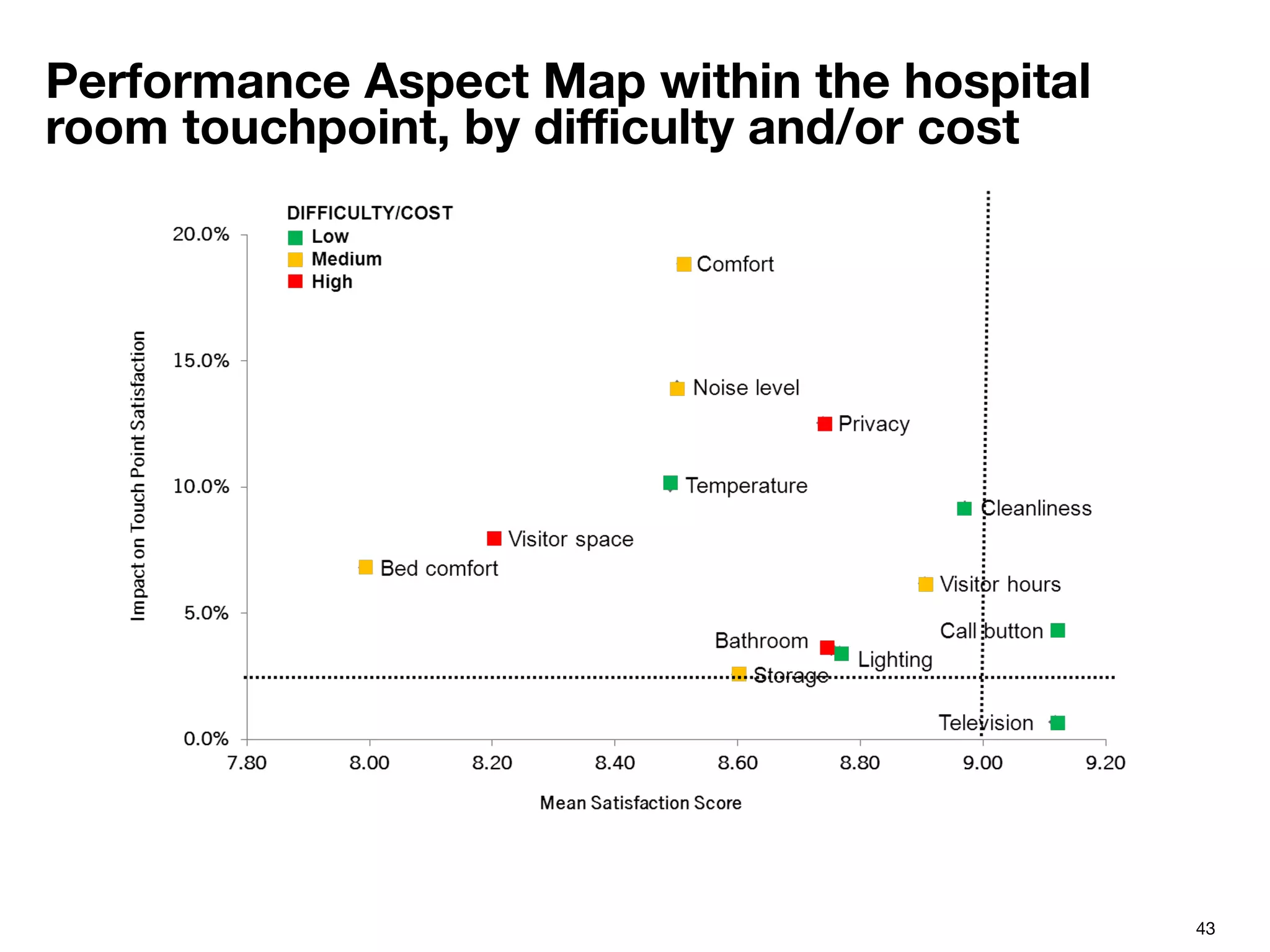
43
Performance Aspect Map within the hospital
room touchpoint, by difficulty and/or cost
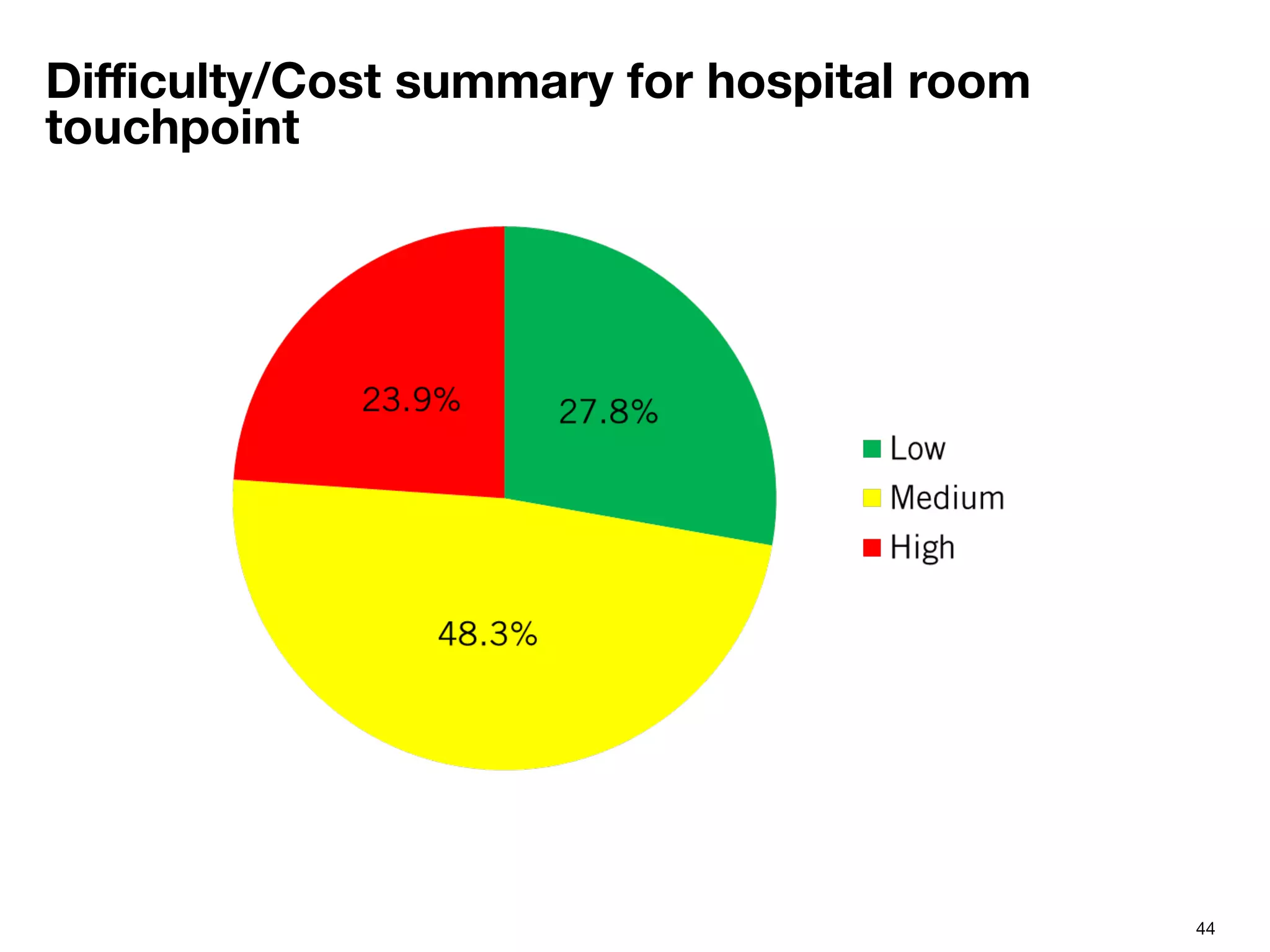
44
Difficulty/Cost summary for hospital room
touchpoint
45
Step 8: 

Create a short-,
medium- and long-
term improvement
plan
46


Q+A

47
@siegelgale
Today’s presenters:

Rolf Wulfsberg, PhD
Global Director, Quantitative Insights 
rwulfsberg@siegelgale.com

Jessica Kirk, Vice President
jkirk@siegelgale.com

Related links:

www.siegelgale.com

We offer

•  Research
•  Brand strategy
•  Brand architecture
•  Experience strategy
•  Simplification
•  Content strategy
•  Content development
•  Naming
•  Visual identity
•  Environments
•  Global implementation
•  Employee engagement
•  Digital experiences
siegel+galesiegel+gale
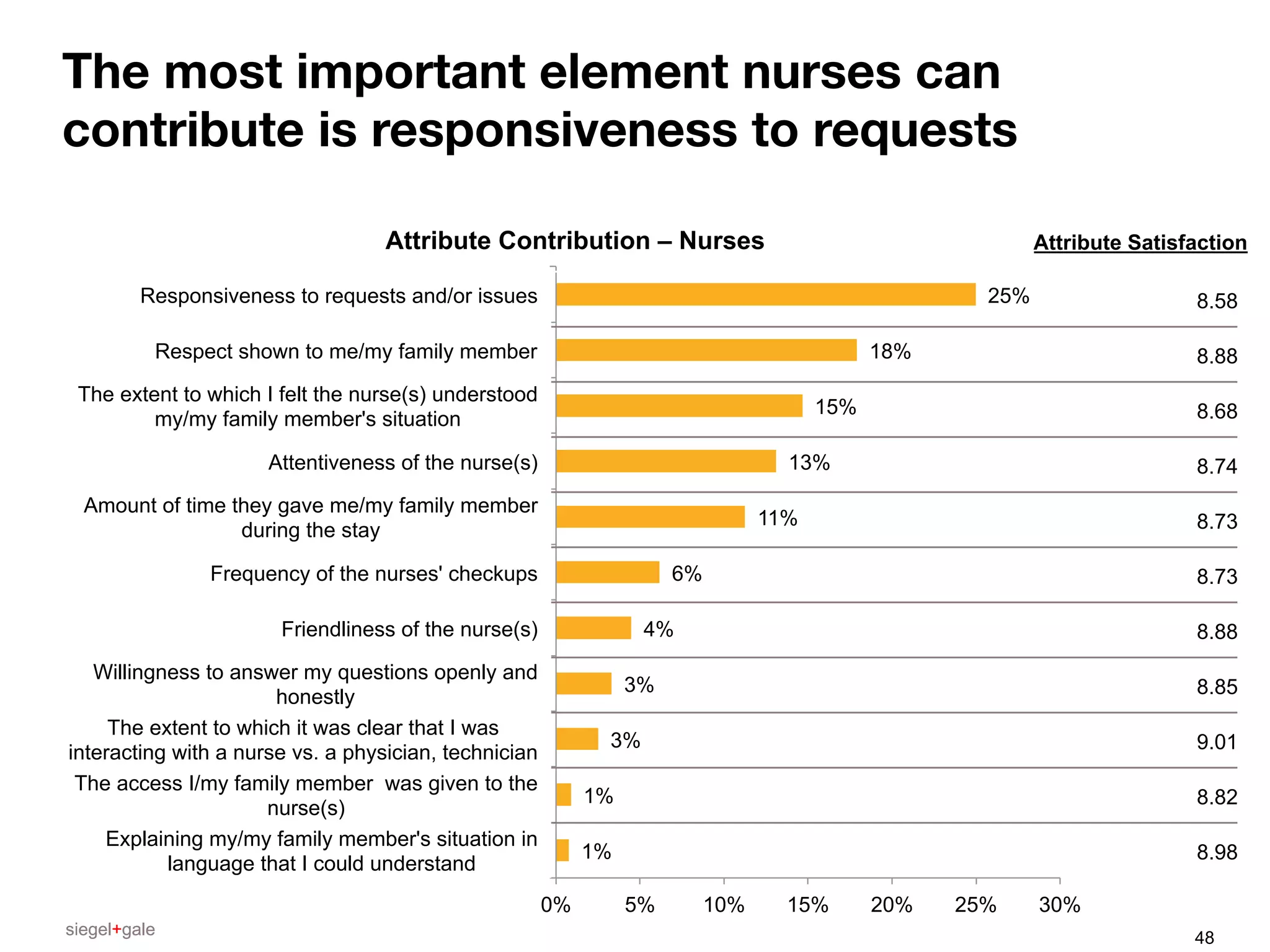
The most important element nurses can
contribute is responsiveness to requests
48
1%
1%
3%
3%
4%
6%
11%
13%
15%
18%
25%
0% 5% 10% 15% 20% 25% 30%
Explaining my/my family member's situation in
language that I could understand
The access I/my family member was given to the
nurse(s)
The extent to which it was clear that I was
interacting with a nurse vs. a physician, technician
Willingness to answer my questions openly and
honestly
Friendliness of the nurse(s)
Frequency of the nurses' checkups
Amount of time they gave me/my family member
during the stay
Attentiveness of the nurse(s)
The extent to which I felt the nurse(s) understood
my/my family member's situation
Respect shown to me/my family member
Responsiveness to requests and/or issues
Attribute Contribution – Nurses
8.58
8.88
8.68
8.74
8.73
8.73
8.88
8.85
9.01
8.82
8.98
Attribute Satisfaction
siegel+galesiegel+gale
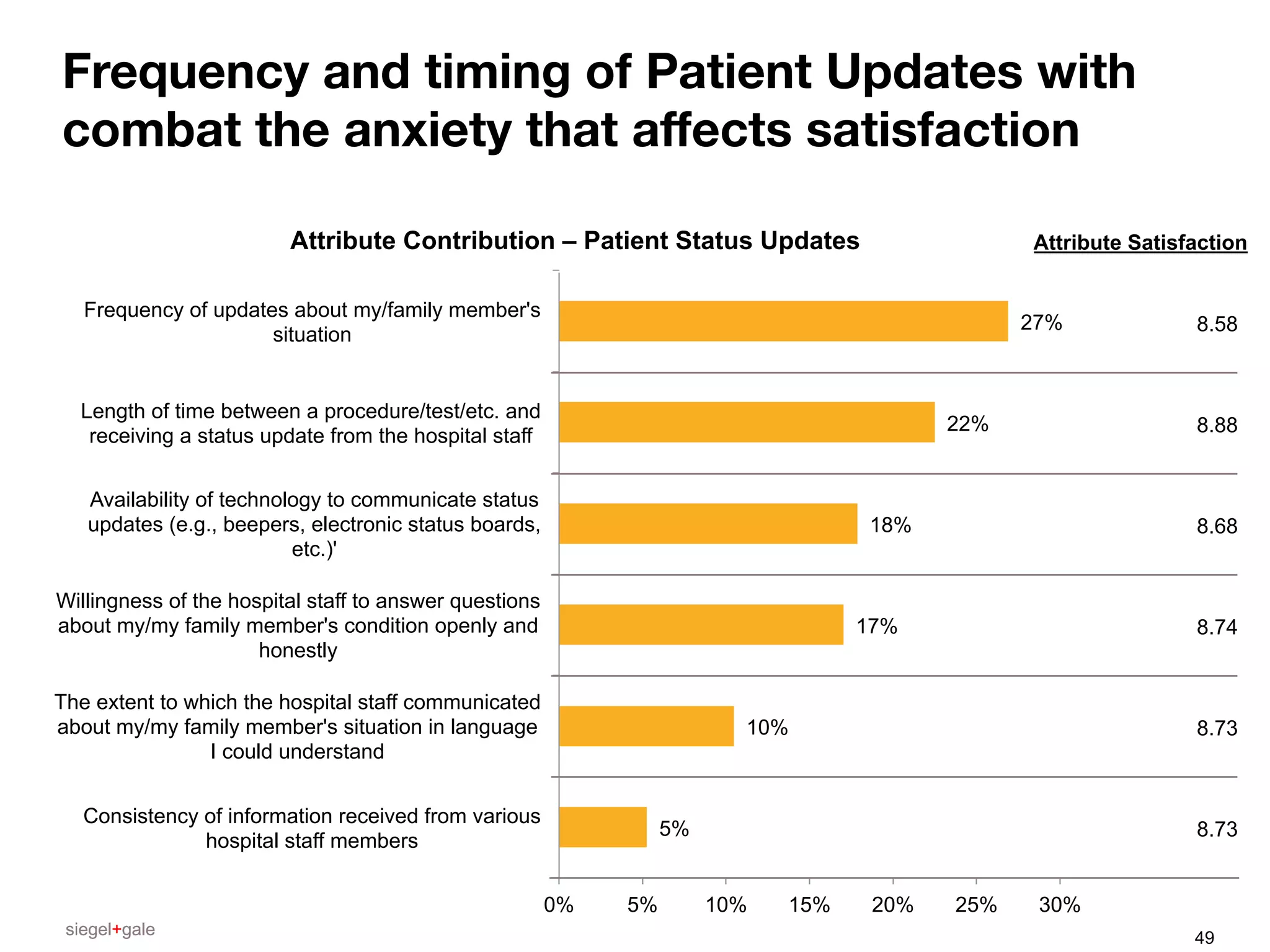
Frequency and timing of Patient Updates with
combat the anxiety that affects satisfaction
49
5%
10%
17%
18%
22%
27%
0% 5% 10% 15% 20% 25% 30%
Consistency of information received from various
hospital staff members
The extent to which the hospital staff communicated
about my/my family member's situation in language
I could understand
Willingness of the hospital staff to answer questions
about my/my family member's condition openly and
honestly
Availability of technology to communicate status
updates (e.g., beepers, electronic status boards,
etc.)'
Length of time between a procedure/test/etc. and
receiving a status update from the hospital staff
Frequency of updates about my/family member's
situation
Attribute Contribution – Patient Status Updates
8.58
8.88
8.68
8.74
8.73
8.73
Attribute Satisfaction

Managing the hospital in-patient experience | Understanding where to invest

  • 1.
    A Siegel+Gale webinar July23, 2014 Managing the Hospital In-Patient Experience
  • 2.
    2 Our promise
 
 
 S+G isthe simplicity company. We define, design and deliver compelling brand experiences that are both unexpectedly fresh and remarkably clear.

  • 3.
    3 We create
 simplicity
 Research Brand strategy Brandarchitecture Experience strategy Simplification Content strategy Content development Naming Visual identity Environments Global implementation Employee engagement Digital experiences
  • 4.
    4 Rolf M. Wulfsberg,PhD 
 Global Director, Quantitative Research •  Nationally recognized expert in survey research with 44 years of experience •  Author of the book Fact-Based Branding in the Real World: A Simple Survival Guide for CMOs and Brand Managers. •  PhD and MA in statistics from the American University and BA in mathematics and economics from Luther College (summa cum laude) •  Former Rhodes candidate and Woodrow Wilson scholar •  Served as an expert witness before the U.S. House of Representatives and the Pennsylvania Supreme Court !
  • 5.
    5 Rolf M. Wulfsberg,PhD 
 Global Director, Quantitative Research
  • 6.
    6 The in-patient experienceaffects a hospital from both an acquisition and retention standpoint
  • 7.
    7 An 8-step processfor prioritizing touchpoints and subsequent investments in those touchpoints 1.  Create a journey map that identifies the various touchpoints
  • 8.
    8 An 8-step processfor prioritizing touchpoints and subsequent investments in those touchpoints 1.  Create a journey map that identifies the various touchpoints 2.  Create a list of various service aspects within each touchpoint
  • 9.
    9 An 8-step processfor prioritizing touchpoints and subsequent investments in those touchpoints 1.  Create a journey map that identifies the various touchpoints 2.  Create a list of various service aspects within each touchpoint 3.  Measure satisfaction with the touchpoint and various performance aspects
  • 10.
    10 An 8-step processfor prioritizing touchpoints and subsequent investments in those touchpoints 1.  Create a journey map that identifies the various touchpoints 2.  Create a list of various service aspects within each touchpoint 3.  Measure satisfaction with the touchpoint and various performance aspects 4.  Determine the importance of each touchpoint to the overall experience
  • 11.
    11 An 8-step processfor prioritizing touchpoints and subsequent investments in those touchpoints 1.  Create a journey map that identifies the various touchpoints 2.  Create a list of various service aspects within each touchpoint 3.  Measure satisfaction with the touchpoint and various performance aspects 4.  Determine the importance of each touchpoint to the overall experience 5.  Determine the percent of all patients who experience the touchpoint in a given period of time and the resulting impact on the hospital
  • 12.
    12 An 8-step processfor prioritizing touchpoints and subsequent investments in those touchpoints 1.  Create a journey map that identifies the various touchpoints 2.  Create a list of various service aspects within each touchpoint 3.  Measure satisfaction with the touchpoint and various performance aspects 4.  Determine the importance of each touchpoint to the overall experience 5.  Determine the percent of all patients who experience the touchpoint in a given period of time and the resulting impact on the hospital 6.  Repeat Steps 4 and 5 for the performance aspects within each touchpoint to determine their importance and impact
  • 13.
    13 An 8-step processfor prioritizing touchpoints and subsequent investments in those touchpoints 1.  Create a journey map that identifies the various touchpoints 2.  Create a list of various service aspects within each touchpoint 3.  Measure satisfaction with the touchpoint and various performance aspects 4.  Determine the importance of each touchpoint to the overall experience 5.  Determine the percent of all patients who experience the touchpoint in a given period of time and the resulting impact on the hospital 6.  Repeat Steps 4 and 5 for the performance aspects within each touchpoint to determine their importance and impact 7.  Estimate the difficulty and/or cost associated with improvements to each performance aspect
  • 14.
    14 An 8-step processfor prioritizing touchpoints and subsequent investments in those touchpoints 1.  Create a journey map that identifies the various touchpoints 2.  Create a list of various service aspects within each touchpoint 3.  Measure satisfaction with the touchpoint and various performance aspects 4.  Determine the importance of each touchpoint to the overall experience 5.  Determine the percent of all patients who experience the touchpoint in a given period of time and the resulting impact on the hospital 6.  Repeat Steps 4 and 5 for the performance aspects within each touchpoint to determine their importance and impact 7.  Estimate the difficulty and/or cost associated with improvements to each performance aspect 8.  Create a plan for short-term, medium-term and long-term improvement investments
  • 15.
    15 Step 1: 
 Createa journey map that identifies the various touchpoints
  • 16.
    16 An example ofa journey map
  • 17.
    17 Siegel+Gale’s nationwide hospitalin-patient survey Last year, Siegel+Gale conducted a nationwide survey of 500 patients or primary caregivers of patients who spent at least one night in a hospital in the previous 6 months
  • 18.
    18 Siegel+Gale’s nationwide hospitalin-patient survey 1.  Scheduling 2.  Emergency room 3.  Admitting (non-ER) 4.  Signage and way-finding 5.  Physicians 6.  Nurses 7.  Technicians 8.  Hospital room 9.  Testing facilities 10.  Patient transport 11.  Food 12.  Treatment/Procedure 13.  Status updates 14.  Discharge 15.  Billing The survey explored the in-patient experience with 15 touchpoints:
  • 19.
    19 Step 2: 
 Createa list of various service aspects within each touchpoint
  • 20.
    20 Example of serviceaspects for the hospital room touchpoint a.  Level of privacy I/my family member was provided b.  Comfort of the room c.  Cleanliness of the room d.  Bathroom facilities e.  Amount of room for visitors/ family f.  Noise level in the room g.  Availability of a working TV in the room h.  Temperature in the room i.  Comfort of the bed j.  Adequacy of storage for personal items k.  Lighting in the room l.  Visitor policies/visiting hours m.  Accessibility of call button and intercom to summon assistance
  • 21.
    21 Step 3: 
 Measurethe satisfaction with each touchpoint and each aspect of service within the touchpoint
  • 22.
    22 Traditional measurement focuseson a single touchpoint Typically, a hospital measures the in-patient experience by conducting transactional surveys of patients who recently experienced a given touchpoint. The problem with this approach is that the various experiences are not independent of each other
  • 23.
    23 Consider the followingexample of a business traveler on her way to an important meeting 1. After being delayed in traffic, she arrived at the kiosks to pick up her ticket only to learn that she has to see a representative at the counter
  • 24.
    24 Consider the followingexample of a business traveler on her way to an important meeting 2. After a long wait in the counter line, she learns that the ticket was issued incorrectly and has to be reissued
  • 25.
    25 Consider the followingexample of a business traveler on her way to an important meeting 3. She then encounters horribly long lines at the airport security checkpoint
  • 26.
    26 Consider the followingexample of a business traveler on her way to an important meeting 4. Once through security, she realizes that her gate is at the end of a very long corridor
  • 27.
    27 Consider the followingexample of a business traveler on her way to an important meeting 5. Upon arrival at her gate, she sees that her plane has already departed
  • 28.
    28 Consider the followingexample of a business traveler on her way to an important meeting 6. She calls the airline customer service number to complain, but the damage has already been done: she missed her meeting
  • 29.
    29 The result isan angry customer, but which touchpoint is to blame? If multiple touchpoints, how do you quantify how much each contributed? •  The initial reservations representative? •  The counter agent? •  TSA? •  The customer service representative? •  Someone or something else?
  • 30.
    30 Step 4: 
 Determinethe importance of each touchpoint
  • 31.
    31 Traditional methods ofprioritizing touch points Hospital staff discuss recent patient feedback, complaints, etc., and identify touchpoints that generate the most “noise” The hospital conducts transactional surveys and compares satisfaction to the stated importance of touchpoints
  • 32.
    32 Touchpoints for ahospital patient
  • 33.
    33 The fact thatdifferent patients touch different sets of touchpoints creates “missing data” ✔ H ✔ ✔ H ✔ H ✔ H ✔ ✔ H ✔ H H
  • 34.
    34 Siegel+Gale’s nationwide hospitalin-patient survey 1.  Scheduling 2.  Emergency room 3.  Admitting (non-ER) 4.  Signage and way-finding 5.  Physicians 6.  Nurses 7.  Technicians 8.  Hospital room 9.  Testing facilities 10.  Patient transport 11.  Food 12.  Treatment/Procedure 13.  Status updates 14.  Discharge 15.  Billing Take a minute or two and rank what you believe are the top 5 most important touchpoints
  • 35.
    35 Nurses have thehighest importance of the 15 touchpoints, followed by status updates and the emergency room admission process 21% 16% 13% 9% 8% 8% 7% 7% 5% 3% 1% 1% 1% 1% 1% 0% 5% 10% 15% 20% 25% Share of Importance
  • 36.
    36 Step 5: 
 Determinethe incidence of exposure and impact for each touchpoint
  • 37.
    37 Due to thelow incidence of the emergency room among patients who stayed more than one night, ER contributes only 1% to the overall NPS *Emergency room incidence low due to overnight stay screening criteria
  • 38.
    38 Nurses and statusupdates are the highest contributors to NPS Share of Impact
  • 39.
  • 40.
    40 Step 6: 
 Determinethe importance and impact of various performance aspects
  • 41.
    41 Performance Aspect Mapwithin the hospital room touchpoint
  • 42.
    42 Step 7: 
 Estimatethe difficulty and/or cost associated with each improvement
  • 43.
    43 Performance Aspect Mapwithin the hospital room touchpoint, by difficulty and/or cost
  • 44.
    44 Difficulty/Cost summary forhospital room touchpoint
  • 45.
    45 Step 8: 
 Createa short-, medium- and long- term improvement plan
  • 46.
  • 47.
    47 @siegelgale Today’s presenters: Rolf Wulfsberg,PhD Global Director, Quantitative Insights rwulfsberg@siegelgale.com Jessica Kirk, Vice President jkirk@siegelgale.com Related links: www.siegelgale.com We offer •  Research •  Brand strategy •  Brand architecture •  Experience strategy •  Simplification •  Content strategy •  Content development •  Naming •  Visual identity •  Environments •  Global implementation •  Employee engagement •  Digital experiences
  • 48.
    siegel+galesiegel+gale The most importantelement nurses can contribute is responsiveness to requests 48 1% 1% 3% 3% 4% 6% 11% 13% 15% 18% 25% 0% 5% 10% 15% 20% 25% 30% Explaining my/my family member's situation in language that I could understand The access I/my family member was given to the nurse(s) The extent to which it was clear that I was interacting with a nurse vs. a physician, technician Willingness to answer my questions openly and honestly Friendliness of the nurse(s) Frequency of the nurses' checkups Amount of time they gave me/my family member during the stay Attentiveness of the nurse(s) The extent to which I felt the nurse(s) understood my/my family member's situation Respect shown to me/my family member Responsiveness to requests and/or issues Attribute Contribution – Nurses 8.58 8.88 8.68 8.74 8.73 8.73 8.88 8.85 9.01 8.82 8.98 Attribute Satisfaction
  • 49.
    siegel+galesiegel+gale Frequency and timingof Patient Updates with combat the anxiety that affects satisfaction 49 5% 10% 17% 18% 22% 27% 0% 5% 10% 15% 20% 25% 30% Consistency of information received from various hospital staff members The extent to which the hospital staff communicated about my/my family member's situation in language I could understand Willingness of the hospital staff to answer questions about my/my family member's condition openly and honestly Availability of technology to communicate status updates (e.g., beepers, electronic status boards, etc.)' Length of time between a procedure/test/etc. and receiving a status update from the hospital staff Frequency of updates about my/family member's situation Attribute Contribution – Patient Status Updates 8.58 8.88 8.68 8.74 8.73 8.73 Attribute Satisfaction