
Rolf M. Wulfsberg, PhD
February 6, 2013
Rolf M. Wulfsberg, Ph.D.
Global Director
Quantitative Research
Siegel+Gale

+ 43 years as a survey researcher and executive
+ Prior to joining S+G, worked at Enterprise IG, several
  leading survey research firms and the US Government
+ An author and frequent speaker at professional conferences
+ An expert witness before the U.S. House of
  Representatives and the Pennsylvania Supreme Court
+ Holds a PhD and an MA in statistics from
  American University, and a BA (summa cum laude) in
  mathematics and economics from Luther College
+ A former Rhodes candidate, Woodrow Wilson
  Fellow and NCAA Postgraduate Fellow


                                                               2
Agenda

+ What is fact-based branding?
+ What is the compelling truth of your
  brand(s)?
+ Predicting ROBI in advance of
  implementation
+ Warning signs of potentially ―bad‖
  research

                                         3
What is
fact-based branding?
What is ―fact-based branding‖?

+ “The use of rigorous quantitative
  measurement and forecasting techniques
  to make better branding decisions.”

+ Fact-based branding covers the entire
  customer life cycle—from the acquisition of
  new customers to the retention and expansion
  of existing customer relationships.


                                                 5
Five reasons to embrace fact-based branding

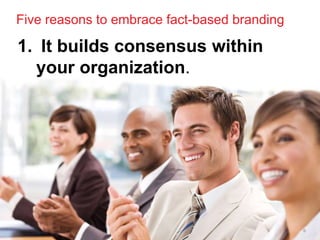
1. It builds consensus within
  your organization.


                                              6
Five reasons to embrace fact-based branding

2. It could add years, if not
   decades, to your tenure
   as CMO.


                                              7
Five reasons to embrace fact-based branding

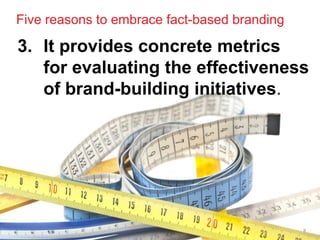
3. It provides concrete metrics
   for evaluating the effectiveness
   of brand-building initiatives.


                                              8
Five reasons to embrace fact-based branding

4. It elevates brand and
   communications to a vital
   role within the organization.


                                              9
Five reasons to embrace fact-based branding

5. It’s really fun!


                                              10
What is the
compelling truth
of your brand(s)?
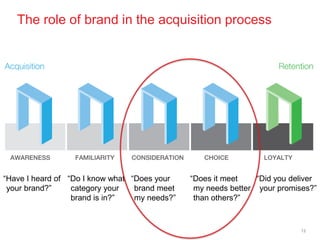
The role of brand in the acquisition process


―Have I heard of ―Do I know what ―Does your    ―Does it meet    ―Did you deliver
 your brand?‖     category your   brand meet    my needs better your promises?‖
                  brand is in?‖   my needs?‖    than others?‖


                                                                           12
Potential ―centers of gravity‖ for the compelling
truth of a brand
1. Infrastructure

2. Products/Services

3. Process/Approach

4. People/Skills

5. Mission/Purpose

6. Emotional connection

7. Emotional projection

8. Personality                                      13
There are several methods researchers use to
determine the importance of brand attributes

1. Ask decision makers how they make choices
2. Derive importance through simple statistical tools
   such as correlation and regression
3. Use more complex trade-off techniques such as
   conjoint analysis or discrete choice modeling
4. Construct a ―micro-model‖ built on decision
   makers’ brand perceptions


                                                    14
A chip allocation exercise that compares brands
head-to-head establishes both preference and
strength of preference
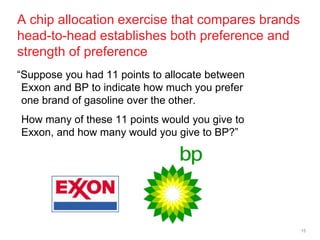
―Suppose you had 11 points to allocate between
 Exxon and BP to indicate how much you prefer
 one brand of gasoline over the other.
How many of these 11 points would you give to
Exxon, and how many would you give to BP?‖


                                                  15
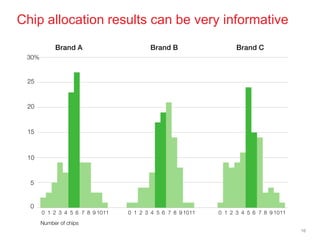
Chip allocation results can be very informative


                                                  16
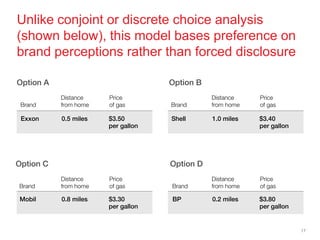
Unlike conjoint or discrete choice analysis
(shown below), this model bases preference on
brand perceptions rather than forced disclosure


                                                  17
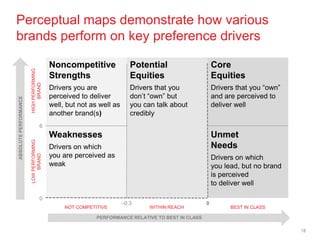
Perceptual maps demonstrate how various
brands perform on key preference drivers

                                         Noncompetitive                Potential                     Core
                       HIGH PERFORMING


                                         Strengths                     Equities                      Equities
                            BRAND


                                         Drivers you are               Drivers that you              Drivers that you ―own‖
                                         perceived to deliver          don’t ―own‖ but               and are perceived to
ABSOLUTE PERFORMANCE


                                         well, but not as well as      you can talk about            deliver well
                                         another brand(s)              credibly
                                  6
                                         Weaknesses                                                  Unmet
                       LOW PERFORMING


                                         Drivers on which                                            Needs
                                         you are perceived as
                            BRAND


                                                                                                     Drivers on which
                                         weak                                                        you lead, but no brand
                                                                                                     is perceived
                                                                                                     to deliver well

                                  0
                                                                    –0.3                         0
                                              NOT COMPETITIVE                WITHIN REACH                  BEST IN CLASS

                                                         PERFORMANCE RELATIVE TO BEST IN CLASS

                                                                                                                              18
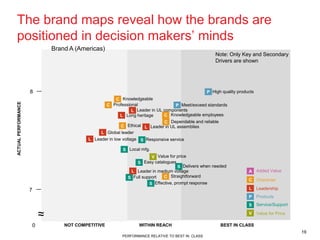
The brand maps reveal how the brands are
positioned in decision makers’ minds
                             Brand A (Americas)
                                                                                                      Note: Only Key and Secondary
                                                                                                      Drivers are shown


                     8                                                                            P High quality products
                                                      C Knowledgeable
ACTUAL PERFORMANCE


                                                   C Professional                 P Meet/exceed standards
                                                              L Leader in UL components
                                                        L Long heritage      C Knowledgeable employees
                                                                           C Dependable and reliable
                                                        C Ethical L Leader in UL assemblies
                                              L Global leader
                                         L Leader in low voltage S Responsive service

                                                          S Local mfg.
                                                                       V Value for price
                                                                S   Easy catalogues
                                                                                     S Delivers when needed
                                                             L Leader in medium voltage                               A Added Value
                                                            S Full support    C Straightforward
                                                                                                                      C Character
                                                                      S Effective, prompt response
                     7                                                                                                L     Leadership
                                                                                                                      P     Products
                                                                                                                      S     Service/Support

                         ~
                         ~                                                                                            V     Value for Price

                     0           NOT COMPETITIVE                 WITHIN REACH                           BEST IN CLASS
                                                                                                                                              19
                                                          PERFORMANCE RELATIVE TO BEST IN CLASS
Predicting return on
brand investment
(ROBI) in advance of
implementation
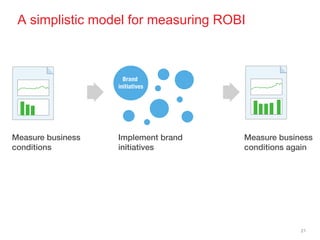
A simplistic model for measuring ROBI


                                        21
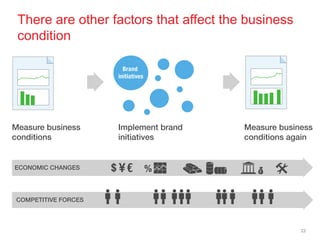
There are other factors that affect the business
condition


                                                   22
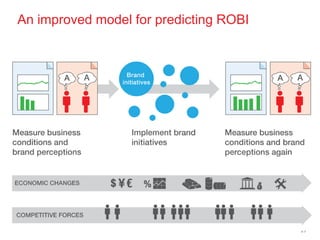
An improved model for predicting ROBI


                                        23
Warning signs of
potentially “bad”
research
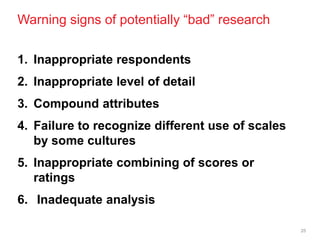
Warning signs of potentially ―bad‖ research

1. Inappropriate respondents
2. Inappropriate level of detail
3. Compound attributes
4. Failure to recognize different use of scales
   by some cultures
5. Inappropriate combining of scores or
   ratings
6. Inadequate analysis

                                                  25
26    2626
     26 26

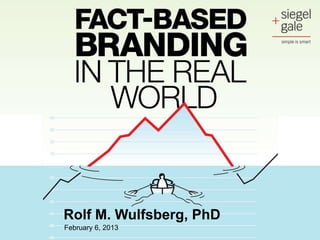
Fact-Based Branding in the Real World

  • 1.
    Rolf M. Wulfsberg,PhD February 6, 2013
  • 2.
    Rolf M. Wulfsberg,Ph.D. Global Director Quantitative Research Siegel+Gale + 43 years as a survey researcher and executive + Prior to joining S+G, worked at Enterprise IG, several leading survey research firms and the US Government + An author and frequent speaker at professional conferences + An expert witness before the U.S. House of Representatives and the Pennsylvania Supreme Court + Holds a PhD and an MA in statistics from American University, and a BA (summa cum laude) in mathematics and economics from Luther College + A former Rhodes candidate, Woodrow Wilson Fellow and NCAA Postgraduate Fellow 2
  • 3.
    Agenda + What isfact-based branding? + What is the compelling truth of your brand(s)? + Predicting ROBI in advance of implementation + Warning signs of potentially ―bad‖ research 3
  • 4.
  • 5.
    What is ―fact-basedbranding‖? + “The use of rigorous quantitative measurement and forecasting techniques to make better branding decisions.” + Fact-based branding covers the entire customer life cycle—from the acquisition of new customers to the retention and expansion of existing customer relationships. 5
  • 6.
    Five reasons toembrace fact-based branding 1. It builds consensus within your organization. 6
  • 7.
    Five reasons toembrace fact-based branding 2. It could add years, if not decades, to your tenure as CMO. 7
  • 8.
    Five reasons toembrace fact-based branding 3. It provides concrete metrics for evaluating the effectiveness of brand-building initiatives. 8
  • 9.
    Five reasons toembrace fact-based branding 4. It elevates brand and communications to a vital role within the organization. 9
  • 10.
    Five reasons toembrace fact-based branding 5. It’s really fun! 10
  • 11.
    What is the compellingtruth of your brand(s)?
  • 12.
    The role ofbrand in the acquisition process ―Have I heard of ―Do I know what ―Does your ―Does it meet ―Did you deliver your brand?‖ category your brand meet my needs better your promises?‖ brand is in?‖ my needs?‖ than others?‖ 12
  • 13.
    Potential ―centers ofgravity‖ for the compelling truth of a brand 1. Infrastructure 2. Products/Services 3. Process/Approach 4. People/Skills 5. Mission/Purpose 6. Emotional connection 7. Emotional projection 8. Personality 13
  • 14.
    There are severalmethods researchers use to determine the importance of brand attributes 1. Ask decision makers how they make choices 2. Derive importance through simple statistical tools such as correlation and regression 3. Use more complex trade-off techniques such as conjoint analysis or discrete choice modeling 4. Construct a ―micro-model‖ built on decision makers’ brand perceptions 14
  • 15.
    A chip allocationexercise that compares brands head-to-head establishes both preference and strength of preference ―Suppose you had 11 points to allocate between Exxon and BP to indicate how much you prefer one brand of gasoline over the other. How many of these 11 points would you give to Exxon, and how many would you give to BP?‖ 15
  • 16.
    Chip allocation resultscan be very informative 16
  • 17.
    Unlike conjoint ordiscrete choice analysis (shown below), this model bases preference on brand perceptions rather than forced disclosure 17
  • 18.
    Perceptual maps demonstratehow various brands perform on key preference drivers Noncompetitive Potential Core HIGH PERFORMING Strengths Equities Equities BRAND Drivers you are Drivers that you Drivers that you ―own‖ perceived to deliver don’t ―own‖ but and are perceived to ABSOLUTE PERFORMANCE well, but not as well as you can talk about deliver well another brand(s) credibly 6 Weaknesses Unmet LOW PERFORMING Drivers on which Needs you are perceived as BRAND Drivers on which weak you lead, but no brand is perceived to deliver well 0 –0.3 0 NOT COMPETITIVE WITHIN REACH BEST IN CLASS PERFORMANCE RELATIVE TO BEST IN CLASS 18
  • 19.
    The brand mapsreveal how the brands are positioned in decision makers’ minds Brand A (Americas) Note: Only Key and Secondary Drivers are shown 8 P High quality products C Knowledgeable ACTUAL PERFORMANCE C Professional P Meet/exceed standards L Leader in UL components L Long heritage C Knowledgeable employees C Dependable and reliable C Ethical L Leader in UL assemblies L Global leader L Leader in low voltage S Responsive service S Local mfg. V Value for price S Easy catalogues S Delivers when needed L Leader in medium voltage A Added Value S Full support C Straightforward C Character S Effective, prompt response 7 L Leadership P Products S Service/Support ~ ~ V Value for Price 0 NOT COMPETITIVE WITHIN REACH BEST IN CLASS 19 PERFORMANCE RELATIVE TO BEST IN CLASS
  • 20.
    Predicting return on brandinvestment (ROBI) in advance of implementation
  • 21.
    A simplistic modelfor measuring ROBI 21
  • 22.
    There are otherfactors that affect the business condition 22
  • 23.
    An improved modelfor predicting ROBI 23
  • 24.
    Warning signs of potentially“bad” research
  • 25.
    Warning signs ofpotentially ―bad‖ research 1. Inappropriate respondents 2. Inappropriate level of detail 3. Compound attributes 4. Failure to recognize different use of scales by some cultures 5. Inappropriate combining of scores or ratings 6. Inadequate analysis 25
  • 26.
    26 2626 26 26