Lean Principles and Processes -
Understanding ‘Value’ to drive change
November 27 2009
- 2 -
Confidential not to be used without consent
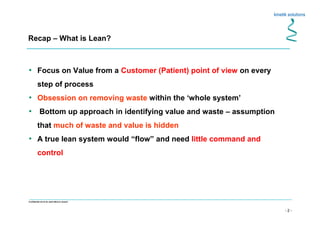
• Focus on Value from a Customer (Patient) point of view on every
step of process
• Obsession on removing waste within the ‘whole system’
• Bottom up approach in identifying value and waste – assumption
that much of waste and value is hidden
• A true lean system would “flow” and need little command and
control
Recap – What is Lean?
- 3 -
Confidential not to be used without consent
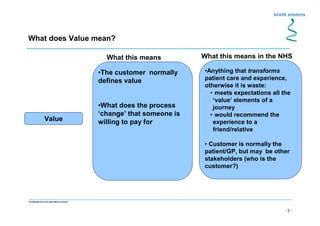
What does Value mean?
Value
•The customer normally
defines value
•What does the process
‘change’ that someone is
willing to pay for
What this means What this means in the NHS
•Anything that transforms
patient care and experience,
otherwise it is waste:
• meets expectations all the
‘value’ elements of a
journey
• would recommend the
experience to a
friend/relative
• Customer is normally the
patient/GP, but may be other
stakeholders (who is the
customer?)
- 4 -
Confidential not to be used without consent
• The cost of poor patient experience has a huge effect on both individual
trust and society at large
• We sometimes make assumptions about ‘what value’ is and then put our
efforts to ‘value stream map’ a better ‘pathways’
• Recording of patient experience helps, but the quality of question design
and analysis is critical to understand true needs
In implementing Lean we sometimes focus on ‘waste’ without proper
consideration of the ‘value’ part.
- 5 -
Confidential not to be used without consent
• The returns are low and statistical significance is questionable
– People likely to fill in questionnaire are likely to be biased against the overall cohort of
service users
– The questions have set gradations wholly based on patient expectation (e.g. very good to
poor) which in itself offers little insight
• On a conscious level patients find it difficult to articulate their true priorities, they
are often unable to articulate exactly what is driving their expectations
– It assumes a linear relationship between matching expectations and providing more of a
specific type of service
• It assumes that there is infinite resource (good is defined as having the highest
mark on all 76 questions)
• The feedback mechanism for change and improvement of services is slow, lacking
enough details and frequency to create any impetus in service change
Current patient satisfaction measures are inadequate at
improving experience
- 6 -
Confidential not to be used without consent
The overall Cost of poor patient experience is huge to the NHS and
society
• c100,000 complaints (most around experience)
– Administration of complaints and dealing with stakeholder
– Poor morale (staff do not have means to tackle root cause)
– Reputation of trust
• Loss to Society
– Frustration, worry, bad feelings
• Effect on Health Outcomes
– Poor and good patient experience has been shown to have a ‘placebo’ effect on outcomes
– Loss of confidence
• Unnecessary resource expended e.g.:
– Use of A&E services due to lack of confidence in primary care patient service
– Patients become the ‘worried’ well
Poor Patient Experience is due to poor understanding of ‘value’
- 7 -
Confidential not to be used without consent
Current methods of patient experience analysis are poor
and reveal little
“Patient experience - Quality of care
includes quality of caring. This means
how personal care is – the compassion,
dignity and respect with which patients
are treated. It can only be improved by
analysing and understanding patient
satisfaction with their own
experiences”
Lord Darzi- NHS Next Stage Review
June 2008
“We need a tool that provides rapid,
simple feedback from patients to staff
in order to improve their
performance. The current method is not
helpful to those of us who wish to
improve the patient experience”
Dr John Coakley – feature writer HSJ
journal July 2008
- 8 -
Confidential not to be used without consent
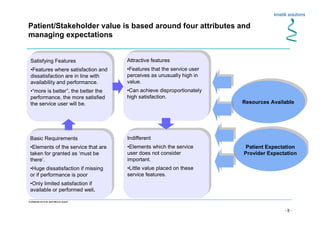
Patient/Stakeholder value is based around four attributes and
managing expectations
Satisfying Features
•Features where satisfaction and
dissatisfaction are in line with
availability and performance.
•“more is better”, the better the
performance, the more satisfied
the service user will be.
Satisfying Features
•Features where satisfaction and
dissatisfaction are in line with
availability and performance.
•“more is better”, the better the
performance, the more satisfied
the service user will be.
Basic Requirements
•Elements of the service that are
taken for granted as ‘must be
there’.
•Huge dissatisfaction if missing
or if performance is poor
•Only limited satisfaction if
available or performed well.
Basic Requirements
•Elements of the service that are
taken for granted as ‘must be
there’.
•Huge dissatisfaction if missing
or if performance is poor
•Only limited satisfaction if
available or performed well.
Attractive features
•Features that the service user
perceives as unusually high in
value.
•Can achieve disproportionately
high satisfaction.
Attractive features
•Features that the service user
perceives as unusually high in
value.
•Can achieve disproportionately
high satisfaction.
Indifferent
•Elements which the service
user does not consider
important.
•Little value placed on these
service features.
Indifferent
•Elements which the service
user does not consider
important.
•Little value placed on these
service features.
Resources AvailableResources Available
Patient Expectation
Provider Expectation
Patient Expectation
Provider Expectation
- 9 -
Confidential not to be used without consent
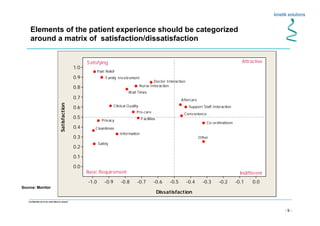
Elements of the patient experience should be categorized
around a matrix of satisfaction/dissatisfaction
Dissatisfaction
Satisfaction
0.0-0.1-0.2-0.3-0.4-0.5-0.6-0.7-0.8-0.9-1.0
1.0
0.9
0.8
0.7
0.6
0.5
0.4
0.3
0.2
0.1
0.0
Other
Wait Times
Doctor Interaction
Nurse Interaction
Clinical Quality
Cleanliness
Convenience
Co-ordinatioon
Aftercare
Pre-care
Safety
Support Staff Interaction
Privacy Facilities
Information
Family Involvement
Pain Relief
Satisfying Attractive
IndifferentBasic Requirement
Source: Monitor
- 10 -
Confidential not to be used without consent
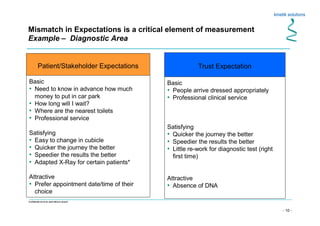
Mismatch in Expectations is a critical element of measurement
Example – Diagnostic Area
Basic
• Need to know in advance how much
money to put in car park
• How long will I wait?
• Where are the nearest toilets
• Professional service
Satisfying
• Easy to change in cubicle
• Quicker the journey the better
• Speedier the results the better
• Adapted X-Ray for certain patients*
Attractive
• Prefer appointment date/time of their
choice
Patient/Stakeholder Expectations
Basic
• People arrive dressed appropriately
• Professional clinical service
Satisfying
• Quicker the journey the better
• Speedier the results the better
• Little re-work for diagnostic test (right
first time)
Attractive
• Absence of DNA
Trust Expectation
- 11 -
Confidential not to be used without consent
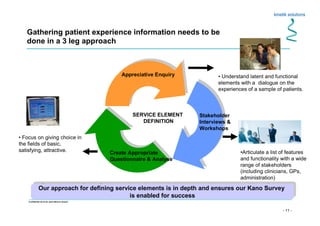
Gathering patient experience information needs to be
done in a 3 leg approach
Stakeholder
Interviews &
Workshops
Create Appropriate
Questionnaire & Analyse
•Articulate a list of features
and functionality with a wide
range of stakeholders
(including clinicians, GPs,
administration)
• Understand latent and functional
elements with a dialogue on the
experiences of a sample of patients.
• Focus on giving choice in
the fields of basic,
satisfying, attractive.
Appreciative Enquiry
Our approach for defining service elements is in depth and ensures our Kano Survey
is enabled for success
Our approach for defining service elements is in depth and ensures our Kano Survey
is enabled for success
SERVICE ELEMENT
DEFINITION
- 12 -
Confidential not to be used without consent
A proper analysis of value, helps us ask the following
questions, before dwelling into service redesign
• The aim is to improve the service, where should resources be
focused?
• What investment will give the best returns in terms of
perceived quality of service and satisfaction?
• Where do we need to manage patient expectation?
• Which elements of services do we need to ‘downgrade’?
• What elements can we adapt, based on the individual or a
smaller cohorts of patients?
• Where do we focus staff training and behaviours?
- 13 -
Confidential not to be used without consent
The value part of Lean needs more exploration in an
NHS service environment
• Current methods of the ‘value’ a service provides needs
exploration in four dimensions
• Exploring ‘value’ mismatches from stakeholders is what
the start point of sustainable service improvement
• Value can be delivered before doing detail process
mapping/Value stream mapping
- 14 -
Confidential not to be used without consent
Thank You
kinetik solutions limited
E:bebetter@kinetik.uk.com
W: www.kinetik.uk.com
T: 0203 397 0686
- 15 -
Confidential not to be used without consent
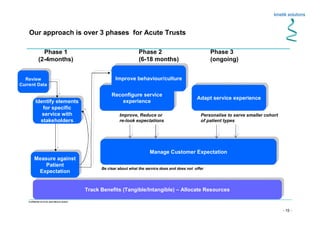
Our approach is over 3 phases for Acute Trusts
Phase 1
(2-4months)
Phase 2
(6-18 months)
Phase 3
(ongoing)
Measure against
Patient
Expectation
Measure against
Patient
Expectation
Identify elements
for specific
service with
stakeholders
Identify elements
for specific
service with
stakeholders
Reconfigure service
experience
Reconfigure service
experience
Manage Customer ExpectationManage Customer Expectation
Be clear about what the service does and does not offer
Adapt service experienceAdapt service experience
Track Benefits (Tangible/Intangible) – Allocate ResourcesTrack Benefits (Tangible/Intangible) – Allocate Resources
Improve, Reduce or
re-look expectations
Personalise to serve smaller cohort
of patient types
Review
Current Data
Review
Current Data
Improve behaviour/cultureImprove behaviour/culture

Kano

  • 1.
    Lean Principles andProcesses - Understanding ‘Value’ to drive change November 27 2009
  • 2.
    - 2 - Confidentialnot to be used without consent • Focus on Value from a Customer (Patient) point of view on every step of process • Obsession on removing waste within the ‘whole system’ • Bottom up approach in identifying value and waste – assumption that much of waste and value is hidden • A true lean system would “flow” and need little command and control Recap – What is Lean?
  • 3.
    - 3 - Confidentialnot to be used without consent What does Value mean? Value •The customer normally defines value •What does the process ‘change’ that someone is willing to pay for What this means What this means in the NHS •Anything that transforms patient care and experience, otherwise it is waste: • meets expectations all the ‘value’ elements of a journey • would recommend the experience to a friend/relative • Customer is normally the patient/GP, but may be other stakeholders (who is the customer?)
  • 4.
    - 4 - Confidentialnot to be used without consent • The cost of poor patient experience has a huge effect on both individual trust and society at large • We sometimes make assumptions about ‘what value’ is and then put our efforts to ‘value stream map’ a better ‘pathways’ • Recording of patient experience helps, but the quality of question design and analysis is critical to understand true needs In implementing Lean we sometimes focus on ‘waste’ without proper consideration of the ‘value’ part.
  • 5.
    - 5 - Confidentialnot to be used without consent • The returns are low and statistical significance is questionable – People likely to fill in questionnaire are likely to be biased against the overall cohort of service users – The questions have set gradations wholly based on patient expectation (e.g. very good to poor) which in itself offers little insight • On a conscious level patients find it difficult to articulate their true priorities, they are often unable to articulate exactly what is driving their expectations – It assumes a linear relationship between matching expectations and providing more of a specific type of service • It assumes that there is infinite resource (good is defined as having the highest mark on all 76 questions) • The feedback mechanism for change and improvement of services is slow, lacking enough details and frequency to create any impetus in service change Current patient satisfaction measures are inadequate at improving experience
  • 6.
    - 6 - Confidentialnot to be used without consent The overall Cost of poor patient experience is huge to the NHS and society • c100,000 complaints (most around experience) – Administration of complaints and dealing with stakeholder – Poor morale (staff do not have means to tackle root cause) – Reputation of trust • Loss to Society – Frustration, worry, bad feelings • Effect on Health Outcomes – Poor and good patient experience has been shown to have a ‘placebo’ effect on outcomes – Loss of confidence • Unnecessary resource expended e.g.: – Use of A&E services due to lack of confidence in primary care patient service – Patients become the ‘worried’ well Poor Patient Experience is due to poor understanding of ‘value’
  • 7.
    - 7 - Confidentialnot to be used without consent Current methods of patient experience analysis are poor and reveal little “Patient experience - Quality of care includes quality of caring. This means how personal care is – the compassion, dignity and respect with which patients are treated. It can only be improved by analysing and understanding patient satisfaction with their own experiences” Lord Darzi- NHS Next Stage Review June 2008 “We need a tool that provides rapid, simple feedback from patients to staff in order to improve their performance. The current method is not helpful to those of us who wish to improve the patient experience” Dr John Coakley – feature writer HSJ journal July 2008
  • 8.
    - 8 - Confidentialnot to be used without consent Patient/Stakeholder value is based around four attributes and managing expectations Satisfying Features •Features where satisfaction and dissatisfaction are in line with availability and performance. •“more is better”, the better the performance, the more satisfied the service user will be. Satisfying Features •Features where satisfaction and dissatisfaction are in line with availability and performance. •“more is better”, the better the performance, the more satisfied the service user will be. Basic Requirements •Elements of the service that are taken for granted as ‘must be there’. •Huge dissatisfaction if missing or if performance is poor •Only limited satisfaction if available or performed well. Basic Requirements •Elements of the service that are taken for granted as ‘must be there’. •Huge dissatisfaction if missing or if performance is poor •Only limited satisfaction if available or performed well. Attractive features •Features that the service user perceives as unusually high in value. •Can achieve disproportionately high satisfaction. Attractive features •Features that the service user perceives as unusually high in value. •Can achieve disproportionately high satisfaction. Indifferent •Elements which the service user does not consider important. •Little value placed on these service features. Indifferent •Elements which the service user does not consider important. •Little value placed on these service features. Resources AvailableResources Available Patient Expectation Provider Expectation Patient Expectation Provider Expectation
  • 9.
    - 9 - Confidentialnot to be used without consent Elements of the patient experience should be categorized around a matrix of satisfaction/dissatisfaction Dissatisfaction Satisfaction 0.0-0.1-0.2-0.3-0.4-0.5-0.6-0.7-0.8-0.9-1.0 1.0 0.9 0.8 0.7 0.6 0.5 0.4 0.3 0.2 0.1 0.0 Other Wait Times Doctor Interaction Nurse Interaction Clinical Quality Cleanliness Convenience Co-ordinatioon Aftercare Pre-care Safety Support Staff Interaction Privacy Facilities Information Family Involvement Pain Relief Satisfying Attractive IndifferentBasic Requirement Source: Monitor
  • 10.
    - 10 - Confidentialnot to be used without consent Mismatch in Expectations is a critical element of measurement Example – Diagnostic Area Basic • Need to know in advance how much money to put in car park • How long will I wait? • Where are the nearest toilets • Professional service Satisfying • Easy to change in cubicle • Quicker the journey the better • Speedier the results the better • Adapted X-Ray for certain patients* Attractive • Prefer appointment date/time of their choice Patient/Stakeholder Expectations Basic • People arrive dressed appropriately • Professional clinical service Satisfying • Quicker the journey the better • Speedier the results the better • Little re-work for diagnostic test (right first time) Attractive • Absence of DNA Trust Expectation
  • 11.
    - 11 - Confidentialnot to be used without consent Gathering patient experience information needs to be done in a 3 leg approach Stakeholder Interviews & Workshops Create Appropriate Questionnaire & Analyse •Articulate a list of features and functionality with a wide range of stakeholders (including clinicians, GPs, administration) • Understand latent and functional elements with a dialogue on the experiences of a sample of patients. • Focus on giving choice in the fields of basic, satisfying, attractive. Appreciative Enquiry Our approach for defining service elements is in depth and ensures our Kano Survey is enabled for success Our approach for defining service elements is in depth and ensures our Kano Survey is enabled for success SERVICE ELEMENT DEFINITION
  • 12.
    - 12 - Confidentialnot to be used without consent A proper analysis of value, helps us ask the following questions, before dwelling into service redesign • The aim is to improve the service, where should resources be focused? • What investment will give the best returns in terms of perceived quality of service and satisfaction? • Where do we need to manage patient expectation? • Which elements of services do we need to ‘downgrade’? • What elements can we adapt, based on the individual or a smaller cohorts of patients? • Where do we focus staff training and behaviours?
  • 13.
    - 13 - Confidentialnot to be used without consent The value part of Lean needs more exploration in an NHS service environment • Current methods of the ‘value’ a service provides needs exploration in four dimensions • Exploring ‘value’ mismatches from stakeholders is what the start point of sustainable service improvement • Value can be delivered before doing detail process mapping/Value stream mapping
  • 14.
    - 14 - Confidentialnot to be used without consent Thank You kinetik solutions limited E:bebetter@kinetik.uk.com W: www.kinetik.uk.com T: 0203 397 0686
  • 15.
    - 15 - Confidentialnot to be used without consent Our approach is over 3 phases for Acute Trusts Phase 1 (2-4months) Phase 2 (6-18 months) Phase 3 (ongoing) Measure against Patient Expectation Measure against Patient Expectation Identify elements for specific service with stakeholders Identify elements for specific service with stakeholders Reconfigure service experience Reconfigure service experience Manage Customer ExpectationManage Customer Expectation Be clear about what the service does and does not offer Adapt service experienceAdapt service experience Track Benefits (Tangible/Intangible) – Allocate ResourcesTrack Benefits (Tangible/Intangible) – Allocate Resources Improve, Reduce or re-look expectations Personalise to serve smaller cohort of patient types Review Current Data Review Current Data Improve behaviour/cultureImprove behaviour/culture