

Motivation Self Management Skills
Motivation Motivation is the key to performance improvement. There is an old saying you can take a horse to the water but you cannot force it  to drink; it will drink only if it's thirsty - so with people. They will do what they want to do or otherwise motivated to do. Whether it is to excel on the workshop floor or in the 'ivory tower' they must be motivated or driven to it, either by themselves or through external stimulus.
Motivation To understand motivation one must understand human nature itself. And there lies the problem! Human nature can be very simple, yet very complex too.  An understanding and appreciation of this is a prerequisite to effective employee motivation in the workplace and therefore effective management and leadership.
Why study and apply employee motivation principles? Quite apart from the benefit and moral value of an altruistic approach to treating colleagues as human beings and respecting human dignity in all its forms,  research and observations show that well motivated employees are more productive and creative. The inverse also holds true.
Motivation Are they born with the self-motivation or drive? Yes and no. If no, they can be  motivated, for motivation is a skill which can and must be learnt. This is essential for any business to survive and succeed.
Motivation Performance is considered to be a function of ability and motivation, thus: Job performance =f (ability) (motivation)  Ability in turn depends on education, experience and training and its  improvement is a slow and long process.  On the other hand motivation can be improved quickly. There are many options and an uninitiated manager may not even know where to start. As a guideline, there are broadly seven strategies for  motivation. Positive reinforcement / high expectations  Effective discipline and punishment  Treating people fairly  Satisfying employees needs  Setting work related goals  Restructuring jobs  Base rewards on job performance
Motivation These are the basic strategies, though the mix in the final 'recipe' will vary from workplace situation to situation. Essentially, there is a gap between an individuals actual state and some desired state and the manager tries to reduce this gap. Motivation is, in effect, a means to reduce and manipulate this gap. It is  inducing others in a specific way towards goals specifically stated by the motivator. Naturally, these goals as also the motivation system must conform to he corporate policy of the organization.  The motivational system must be tailored to the situation and to the organization.
In one of the most elaborate studies on employee motivation, involving 31,000  men and 13,000 women, the Minneapolis Gas Company sought to determine what their potential employees desire most from a job. This study was carried out during a 20 year period from 1945 to 1965 and was quite revealing.  The ratings for the various factors differed only slightly between men and women, but both groups considered security as the highest rated factor. The next three factors were; advancement  type of work  company - proud to work for  Surprisingly, factors such as pay, benefits and working conditions were given a  low rating by both groups. So after all, and contrary to common belief, money is  not the prime motivator. (Though this should not be regarded as a signal to  reward employees poorly or unfairly.)
Goal Setting and motivation Ask any person who is successful in whatever he or she is doing what motivates him/her, and very likely the answer will be "goals".  Goal Setting  is extremely important to motivation and success. So what motivates you? Why are you in college? If you are in college because that's what your parents want, you may find it difficult to motivate yourself. Sure, it's possible to succeed with someone else providing the motivation for you. ("If you graduate from college, I'll give you a car!" or worse "If you don't graduate from college, you won't get a car.") But motivation that comes from within really makes the difference.
Motivation Certainly, you need some intelligence, knowledge base, study skills, and time management skills, but if you don't have motivation, you won't get far. Think about this analogy. You have a car with a full tank of gas, a well-tuned engine, good set of tires, quadraphonic CD system, and a sleek, polished exterior. There it sits. This car has incredible potential. (Have you heard that before?) However, until a driver sits behind the wheel, puts the key in the ignition, and cranks it up, the car doesn't function.
Motivation Interest is an important motivator for a student. So is a desire to learn. When you link these two things together, you create success.  Often success in an endeavor leads to more interest and a greater desire to learn, creating an upward spiral of motivation toward a goal you have established.  So be honest with yourself. Are you genuinely interested in being in college? Have you set realistic goals for yourself? How can you develop the internal motivation that really counts?  When it comes to motivation,  KNOWING  is not as important as  DOING .
What is Motivation? Motivation  refers to the initiation, direction, intensity and persistence of behavior.  Motivation is a temporary and dynamic state that should not be confused with  personality  or  emotion .  Motivation is having the desire and willingness to do something. Motivation  is the set of reasons that determines one to engage in a particular behavior.
Motivation According to various theories, motivation may be rooted in the basic need to minimize physical pain and maximize pleasure, or it may include specific needs such as eating and resting, or a desired object, hobby,  goal , state of being,  ideal , or it may be attributed to less-apparent reasons such as  altruism , or  morality , or overcoming  mortality .
Where does motivation come from? Jeremy Bentham  in  An Introduction to the Principles of Morals and Legislation : “ Nature has placed mankind under the governance of two sovereign masters, pain and pleasure. It is for them alone to point out what we ought to do, as well as to determine what we shall do” (Bentham 1789).
Motivational concepts  The Incentive Theory of Motivation A  reward , tangible or intangible, is presented after the occurrence of an action (i.e. behavior) with the intent to cause the behavior to occur again. This is done by  associating  positive meaning to the behavior. Studies show that if the person receives the reward immediately, the effect would be greater, and decreases as duration lengthens. Repetitive action-reward combination can cause the action to become  habit .
The Incentive Theory of Motivation Motivation comes from two things: you, and other people. There is extrinsic motivation, which comes from others, and intrinsic motivation, which comes from within you. Rewards can also be organized as extrinsic or intrinsic. Extrinsic rewards are external to the person; for example, praise or money. Intrinsic rewards are internal to the person; for example,  satisfaction  or a feeling of accomplishment. Some authors distinguish between two forms of intrinsic motivation: one based on  enjoyment , the other on obligation. In this context,  obligation  refers to motivation based on what an individual thinks ought to be done. For instance, a feeling of responsibility for a mission may lead to helping others beyond what is easily observable, rewarded, or fun.
Intrinsic and extrinsic motivation  Intrinsic motivation  occurs when people engage in an activity, such as a  hobby , without obvious external incentives Students are likely to be intrinsically motivated if they:attribute their educational results to internal factors that they can control (e.g. the amount of effort they put in), believe they can be effective agents in reaching desired goals (i.e. the results are not determined by luck),  are interested in mastering a topic, rather than just rote-learning to achieve good grades.  In knowledge-sharing communities and organizations, people often cite altruistic reasons for their participation, including contributing to a common good, a moral obligation to the group, mentorship or 'giving back'.  In  work  environments,  money  may provide a more powerful extrinsic factor than the intrinsic motivation provided by an enjoyable workplace. In terms of sports, intrinsic motivation is the motivation that comes from inside the performer. That is, the athlete competes for the love of the sport.
Employee Motivation However, intrinsic motivation is no  panacea  for employee motivation. Problems include: For many commercially viable activities it may not be possible to find any or enough intrinsically motivated people.  Intrinsically motivated employees need to eat, too. Other forms of compensation remain necessary.  Intrinsic motivation is easily destroyed. For instance, additional extrinsic motivation is known to have a negative impact on intrinsic motivation in many cases, perceived injustice in awarding such external incentives even more so.
Extrinsic Motivation Extrinsic motivation  comes from outside of the performer. Money is the most obvious example, but  coercion  and threat of punishment are also common extrinsic motivations. In sports, the crowd may cheer the performer on, and this motivates him or her to do well. Trophies are also extrinsic incentives. Competition is often extrinsic because it encourages the performer to win and beat others, not to enjoy the intrinsic rewards of the activity.
Extrinsic Motivation Traditionally,  extrinsic motivation  has been used to motivate employees: Tangible rewards such as payments, promotions (or punishments).  Intangible rewards such as praise or public commendation.  Within economies transitioning from  assembly lines  to  service industries , the importance of intrinsic motivation rises: The further jobs move away from pure assembly lines, the harder it becomes to measure individual  productivity . This effect is most pronounced for  knowledge workers  and amplified in  teamwork .
Punishment Punishment Punishment, when referred in general, is an unfavorable condition introduced into the environment to eliminate undesirable behavior. This is used as one of the measures of Behavior Modification.
Stress Stress Stress works in a strange way to motivate, like  reverse psychology . When under stress and difficult situations, a person feels pressured. This may trigger feelings of under-achieving, which results in a reverse mindset, to strive to achieve.  The net amount motivation under stress may motivate a person to work harder in order to "compensate" for his feelings.
Direct and Indirect Motivation A distinction can also be made between direct and indirect motivation: In direct motivation, the action satisfies the need  In indirect motivation, the action satisfies an intermediate goal, which can in turn lead to the satisfaction of a need.  For Example:  money  is typically viewed as a powerful indirect motivation, whereas  job satisfaction  and a pleasant social environment are more direct motivations.  However, this example highlights well that an indirect motivational factor (money) towards an important goal (having food, clothes etc.) may well be more powerful than the direct motivation provided by an enjoyable workplace.
Coercion Coercion The most obvious form of motivation is  coercion , where the avoidance of  pain  or other negative consequences has an immediate effect.  When such coercion is permanent, it is considered  slavery .  Successful coercion sometimes can take priority over other types of motivation.
Need Theories Maslow's Theory Abraham Maslow's  hierarchy of human needs  theory is the most widely discussed theory of motivation. The theory can be summarized as thus: Human beings have wants and desires which influence their behaviour, only unsatisfied needs can influence behaviour, satisfied needs cannot.  Since needs are many, they are arranged in order of importance, from the basic to the complex.  The person advances to the next level of needs only after the lower level need is at least minimally satisfied.  The further the progress up the hierarchy, the more individuality, humanness and psychological health a person will show.
Maslow’s Theory The needs, listed from basic (lowest, earliest) to most complex (highest, latest) are as follows: Physiological   Safety and security   Social   Self esteem   Self actualization
Herzberg’s Two Factor Theory Herzberg’s Two Factor Theory Frederick Herzberg 's  two factor theory , concludes that certain factors in the workplace result in  job satisfaction , while others do not, but if absent lead to dissatisfaction. He distinguished between: motivation and hygiene Motivators ; (e.g. challenging work, recognition, responsibility) which give positive satisfaction,  and   Hygiene factors ; (e.g. status,  job security ,  salary  and fringe benefits) which do not motivate if present, but if absent will result in demotivation.  The name Hygiene factors is used because, like hygiene, the presence will not make you healthier, but absence can can cause health deterioration. The theory is sometimes called the "Motivator-Hygiene Theory."
Alderfer’s ERG Theory Alderfer’s ERG Theory Created by  Clayton Alderfer , Maslow's hierarchy of needs was expanded, leading to his  ERG theory   ( Existence , Relatedness and  Growth ).  Physiological  and  safety , the lower order needs, were placed in the Existence category.  Love  and  self esteem  needs were placed in the Relatedness category.  The Growth category contained the self actualization and self esteem needs.
Cognitive Dissonance Cognitive dissonance Suggested by Leon Festinger, this occurs when an individual experiences some degree of mental discomfort resulting from an incompatibility between two cognitions. Another example of cognitive dissonance is when a belief and a behavior are in conflict.  A person may believe smoking is bad for one's health and yet continues to smoke.
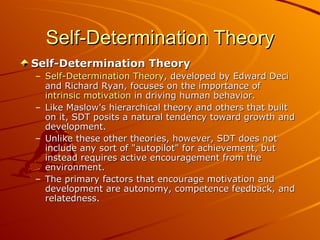
Self-Determination Theory Self-Determination Theory Self-Determination Theory , developed by Edward Deci and Richard Ryan, focuses on the importance of  intrinsic motivation  in driving human behavior.  Like Maslow's hierarchical theory and others that built on it, SDT posits a natural tendency toward growth and development.  Unlike these other theories, however, SDT does not include any sort of "autopilot" for achievement, but instead requires active encouragement from the environment.  The primary factors that encourage motivation and development are autonomy, competence feedback, and relatedness.
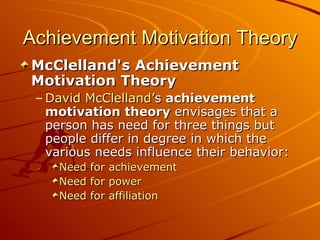
Achievement Motivation Theory McClelland's Achievement Motivation Theory David McClelland ’s  achievement motivation theory  envisages that a person has need for three things but people differ in degree in which the various needs influence their behavior: Need for achievement   Need for power   Need for affiliation
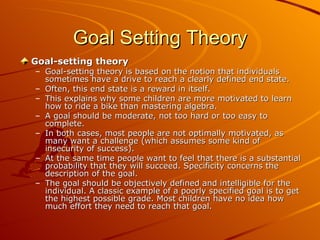
Goal Setting Theory Goal-setting theory Goal-setting theory is based on the notion that individuals sometimes have a drive to reach a clearly defined end state.  Often, this end state is a reward in itself.  This explains why some children are more motivated to learn how to ride a bike than mastering algebra.  A goal should be moderate, not too hard or too easy to complete.  In both cases, most people are not optimally motivated, as many want a challenge (which assumes some kind of insecurity of success).  At the same time people want to feel that there is a substantial probability that they will succeed. Specificity concerns the description of the goal.  The goal should be objectively defined and intelligible for the individual. A classic example of a poorly specified goal is to get the highest possible grade. Most children have no idea how much effort they need to reach that goal.
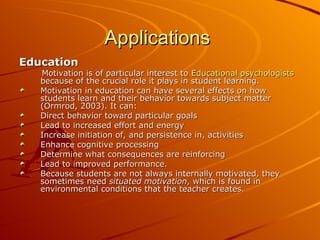
Applications  Education Motivation is of particular interest to  Educational psychologists  because of the crucial role it plays in student learning. Motivation in education can have several effects on how students learn and their behavior towards subject matter (Ormrod, 2003). It can: Direct behavior toward particular goals  Lead to increased effort and energy  Increase initiation of, and persistence in, activities  Enhance cognitive processing  Determine what consequences are reinforcing  Lead to improved performance.  Because students are not always internally motivated, they sometimes need  situated motivation , which is found in environmental conditions that the teacher creates.
Applications Business At lower levels of  Maslow's hierarchy of needs , such as Physiological needs, money is a motivator, however it tends to have a motivating effect on staff that lasts only for a short period (in accordance with  Herzberg 's two-factor model of motivation). At higher levels of the hierarchy, praise, respect, recognition,  empowerment  and a sense of belonging are far more powerful motivators than money,  as Motivated employees always look for better ways to do a job.  Motivated employees are more quality oriented.  Motivated workers are more productive

motivation pps

  • 1.
  • 2.
    Motivation Motivation isthe key to performance improvement. There is an old saying you can take a horse to the water but you cannot force it to drink; it will drink only if it's thirsty - so with people. They will do what they want to do or otherwise motivated to do. Whether it is to excel on the workshop floor or in the 'ivory tower' they must be motivated or driven to it, either by themselves or through external stimulus.
  • 3.
    Motivation To understandmotivation one must understand human nature itself. And there lies the problem! Human nature can be very simple, yet very complex too. An understanding and appreciation of this is a prerequisite to effective employee motivation in the workplace and therefore effective management and leadership.
  • 4.
    Why study andapply employee motivation principles? Quite apart from the benefit and moral value of an altruistic approach to treating colleagues as human beings and respecting human dignity in all its forms, research and observations show that well motivated employees are more productive and creative. The inverse also holds true.
  • 5.
    Motivation Are theyborn with the self-motivation or drive? Yes and no. If no, they can be motivated, for motivation is a skill which can and must be learnt. This is essential for any business to survive and succeed.
  • 6.
    Motivation Performance isconsidered to be a function of ability and motivation, thus: Job performance =f (ability) (motivation) Ability in turn depends on education, experience and training and its improvement is a slow and long process. On the other hand motivation can be improved quickly. There are many options and an uninitiated manager may not even know where to start. As a guideline, there are broadly seven strategies for motivation. Positive reinforcement / high expectations Effective discipline and punishment Treating people fairly Satisfying employees needs Setting work related goals Restructuring jobs Base rewards on job performance
  • 7.
    Motivation These arethe basic strategies, though the mix in the final 'recipe' will vary from workplace situation to situation. Essentially, there is a gap between an individuals actual state and some desired state and the manager tries to reduce this gap. Motivation is, in effect, a means to reduce and manipulate this gap. It is inducing others in a specific way towards goals specifically stated by the motivator. Naturally, these goals as also the motivation system must conform to he corporate policy of the organization. The motivational system must be tailored to the situation and to the organization.
  • 8.
    In one ofthe most elaborate studies on employee motivation, involving 31,000 men and 13,000 women, the Minneapolis Gas Company sought to determine what their potential employees desire most from a job. This study was carried out during a 20 year period from 1945 to 1965 and was quite revealing. The ratings for the various factors differed only slightly between men and women, but both groups considered security as the highest rated factor. The next three factors were; advancement type of work company - proud to work for Surprisingly, factors such as pay, benefits and working conditions were given a low rating by both groups. So after all, and contrary to common belief, money is not the prime motivator. (Though this should not be regarded as a signal to reward employees poorly or unfairly.)
  • 9.
    Goal Setting andmotivation Ask any person who is successful in whatever he or she is doing what motivates him/her, and very likely the answer will be "goals". Goal Setting is extremely important to motivation and success. So what motivates you? Why are you in college? If you are in college because that's what your parents want, you may find it difficult to motivate yourself. Sure, it's possible to succeed with someone else providing the motivation for you. ("If you graduate from college, I'll give you a car!" or worse "If you don't graduate from college, you won't get a car.") But motivation that comes from within really makes the difference.
  • 10.
    Motivation Certainly, youneed some intelligence, knowledge base, study skills, and time management skills, but if you don't have motivation, you won't get far. Think about this analogy. You have a car with a full tank of gas, a well-tuned engine, good set of tires, quadraphonic CD system, and a sleek, polished exterior. There it sits. This car has incredible potential. (Have you heard that before?) However, until a driver sits behind the wheel, puts the key in the ignition, and cranks it up, the car doesn't function.
  • 11.
    Motivation Interest isan important motivator for a student. So is a desire to learn. When you link these two things together, you create success. Often success in an endeavor leads to more interest and a greater desire to learn, creating an upward spiral of motivation toward a goal you have established. So be honest with yourself. Are you genuinely interested in being in college? Have you set realistic goals for yourself? How can you develop the internal motivation that really counts? When it comes to motivation, KNOWING is not as important as DOING .
  • 12.
    What is Motivation?Motivation refers to the initiation, direction, intensity and persistence of behavior. Motivation is a temporary and dynamic state that should not be confused with personality or emotion . Motivation is having the desire and willingness to do something. Motivation is the set of reasons that determines one to engage in a particular behavior.
  • 13.
    Motivation According tovarious theories, motivation may be rooted in the basic need to minimize physical pain and maximize pleasure, or it may include specific needs such as eating and resting, or a desired object, hobby, goal , state of being, ideal , or it may be attributed to less-apparent reasons such as altruism , or morality , or overcoming mortality .
  • 14.
    Where does motivationcome from? Jeremy Bentham in An Introduction to the Principles of Morals and Legislation : “ Nature has placed mankind under the governance of two sovereign masters, pain and pleasure. It is for them alone to point out what we ought to do, as well as to determine what we shall do” (Bentham 1789).
  • 15.
    Motivational concepts The Incentive Theory of Motivation A reward , tangible or intangible, is presented after the occurrence of an action (i.e. behavior) with the intent to cause the behavior to occur again. This is done by associating positive meaning to the behavior. Studies show that if the person receives the reward immediately, the effect would be greater, and decreases as duration lengthens. Repetitive action-reward combination can cause the action to become habit .
  • 16.
    The Incentive Theoryof Motivation Motivation comes from two things: you, and other people. There is extrinsic motivation, which comes from others, and intrinsic motivation, which comes from within you. Rewards can also be organized as extrinsic or intrinsic. Extrinsic rewards are external to the person; for example, praise or money. Intrinsic rewards are internal to the person; for example, satisfaction or a feeling of accomplishment. Some authors distinguish between two forms of intrinsic motivation: one based on enjoyment , the other on obligation. In this context, obligation refers to motivation based on what an individual thinks ought to be done. For instance, a feeling of responsibility for a mission may lead to helping others beyond what is easily observable, rewarded, or fun.
  • 17.
    Intrinsic and extrinsicmotivation Intrinsic motivation occurs when people engage in an activity, such as a hobby , without obvious external incentives Students are likely to be intrinsically motivated if they:attribute their educational results to internal factors that they can control (e.g. the amount of effort they put in), believe they can be effective agents in reaching desired goals (i.e. the results are not determined by luck), are interested in mastering a topic, rather than just rote-learning to achieve good grades. In knowledge-sharing communities and organizations, people often cite altruistic reasons for their participation, including contributing to a common good, a moral obligation to the group, mentorship or 'giving back'. In work environments, money may provide a more powerful extrinsic factor than the intrinsic motivation provided by an enjoyable workplace. In terms of sports, intrinsic motivation is the motivation that comes from inside the performer. That is, the athlete competes for the love of the sport.
  • 18.
    Employee Motivation However,intrinsic motivation is no panacea for employee motivation. Problems include: For many commercially viable activities it may not be possible to find any or enough intrinsically motivated people. Intrinsically motivated employees need to eat, too. Other forms of compensation remain necessary. Intrinsic motivation is easily destroyed. For instance, additional extrinsic motivation is known to have a negative impact on intrinsic motivation in many cases, perceived injustice in awarding such external incentives even more so.
  • 19.
    Extrinsic Motivation Extrinsicmotivation comes from outside of the performer. Money is the most obvious example, but coercion and threat of punishment are also common extrinsic motivations. In sports, the crowd may cheer the performer on, and this motivates him or her to do well. Trophies are also extrinsic incentives. Competition is often extrinsic because it encourages the performer to win and beat others, not to enjoy the intrinsic rewards of the activity.
  • 20.
    Extrinsic Motivation Traditionally, extrinsic motivation has been used to motivate employees: Tangible rewards such as payments, promotions (or punishments). Intangible rewards such as praise or public commendation. Within economies transitioning from assembly lines to service industries , the importance of intrinsic motivation rises: The further jobs move away from pure assembly lines, the harder it becomes to measure individual productivity . This effect is most pronounced for knowledge workers and amplified in teamwork .
  • 21.
    Punishment Punishment Punishment,when referred in general, is an unfavorable condition introduced into the environment to eliminate undesirable behavior. This is used as one of the measures of Behavior Modification.
  • 22.
    Stress Stress Stressworks in a strange way to motivate, like reverse psychology . When under stress and difficult situations, a person feels pressured. This may trigger feelings of under-achieving, which results in a reverse mindset, to strive to achieve. The net amount motivation under stress may motivate a person to work harder in order to "compensate" for his feelings.
  • 23.
    Direct and IndirectMotivation A distinction can also be made between direct and indirect motivation: In direct motivation, the action satisfies the need In indirect motivation, the action satisfies an intermediate goal, which can in turn lead to the satisfaction of a need. For Example: money is typically viewed as a powerful indirect motivation, whereas job satisfaction and a pleasant social environment are more direct motivations. However, this example highlights well that an indirect motivational factor (money) towards an important goal (having food, clothes etc.) may well be more powerful than the direct motivation provided by an enjoyable workplace.
  • 24.
    Coercion Coercion Themost obvious form of motivation is coercion , where the avoidance of pain or other negative consequences has an immediate effect. When such coercion is permanent, it is considered slavery . Successful coercion sometimes can take priority over other types of motivation.
  • 25.
    Need Theories Maslow'sTheory Abraham Maslow's hierarchy of human needs theory is the most widely discussed theory of motivation. The theory can be summarized as thus: Human beings have wants and desires which influence their behaviour, only unsatisfied needs can influence behaviour, satisfied needs cannot. Since needs are many, they are arranged in order of importance, from the basic to the complex. The person advances to the next level of needs only after the lower level need is at least minimally satisfied. The further the progress up the hierarchy, the more individuality, humanness and psychological health a person will show.
  • 26.
    Maslow’s Theory Theneeds, listed from basic (lowest, earliest) to most complex (highest, latest) are as follows: Physiological Safety and security Social Self esteem Self actualization
  • 27.
    Herzberg’s Two FactorTheory Herzberg’s Two Factor Theory Frederick Herzberg 's two factor theory , concludes that certain factors in the workplace result in job satisfaction , while others do not, but if absent lead to dissatisfaction. He distinguished between: motivation and hygiene Motivators ; (e.g. challenging work, recognition, responsibility) which give positive satisfaction, and Hygiene factors ; (e.g. status, job security , salary and fringe benefits) which do not motivate if present, but if absent will result in demotivation. The name Hygiene factors is used because, like hygiene, the presence will not make you healthier, but absence can can cause health deterioration. The theory is sometimes called the "Motivator-Hygiene Theory."
  • 28.
    Alderfer’s ERG TheoryAlderfer’s ERG Theory Created by Clayton Alderfer , Maslow's hierarchy of needs was expanded, leading to his ERG theory ( Existence , Relatedness and Growth ). Physiological and safety , the lower order needs, were placed in the Existence category. Love and self esteem needs were placed in the Relatedness category. The Growth category contained the self actualization and self esteem needs.
  • 29.
    Cognitive Dissonance Cognitivedissonance Suggested by Leon Festinger, this occurs when an individual experiences some degree of mental discomfort resulting from an incompatibility between two cognitions. Another example of cognitive dissonance is when a belief and a behavior are in conflict. A person may believe smoking is bad for one's health and yet continues to smoke.
  • 30.
    Self-Determination Theory Self-DeterminationTheory Self-Determination Theory , developed by Edward Deci and Richard Ryan, focuses on the importance of intrinsic motivation in driving human behavior. Like Maslow's hierarchical theory and others that built on it, SDT posits a natural tendency toward growth and development. Unlike these other theories, however, SDT does not include any sort of "autopilot" for achievement, but instead requires active encouragement from the environment. The primary factors that encourage motivation and development are autonomy, competence feedback, and relatedness.
  • 31.
    Achievement Motivation TheoryMcClelland's Achievement Motivation Theory David McClelland ’s achievement motivation theory envisages that a person has need for three things but people differ in degree in which the various needs influence their behavior: Need for achievement Need for power Need for affiliation
  • 32.
    Goal Setting TheoryGoal-setting theory Goal-setting theory is based on the notion that individuals sometimes have a drive to reach a clearly defined end state. Often, this end state is a reward in itself. This explains why some children are more motivated to learn how to ride a bike than mastering algebra. A goal should be moderate, not too hard or too easy to complete. In both cases, most people are not optimally motivated, as many want a challenge (which assumes some kind of insecurity of success). At the same time people want to feel that there is a substantial probability that they will succeed. Specificity concerns the description of the goal. The goal should be objectively defined and intelligible for the individual. A classic example of a poorly specified goal is to get the highest possible grade. Most children have no idea how much effort they need to reach that goal.
  • 33.
    Applications EducationMotivation is of particular interest to Educational psychologists because of the crucial role it plays in student learning. Motivation in education can have several effects on how students learn and their behavior towards subject matter (Ormrod, 2003). It can: Direct behavior toward particular goals Lead to increased effort and energy Increase initiation of, and persistence in, activities Enhance cognitive processing Determine what consequences are reinforcing Lead to improved performance. Because students are not always internally motivated, they sometimes need situated motivation , which is found in environmental conditions that the teacher creates.
  • 34.
    Applications Business Atlower levels of Maslow's hierarchy of needs , such as Physiological needs, money is a motivator, however it tends to have a motivating effect on staff that lasts only for a short period (in accordance with Herzberg 's two-factor model of motivation). At higher levels of the hierarchy, praise, respect, recognition, empowerment and a sense of belonging are far more powerful motivators than money, as Motivated employees always look for better ways to do a job. Motivated employees are more quality oriented. Motivated workers are more productive