




sami@samipaju.com
THE EXPERIMENTATION-DRIVEN APPROACH TO
ORGANISATIONAL DEVELOPMENT
Spark the Change, June 13th 2017
#sparkto @sparkconfto
linkedin.com/in/samipaju@samipaju
SAMIPAJU.COM
samipaju
C O P Y R I G H T © S A M I PA J U 2 0 1 7
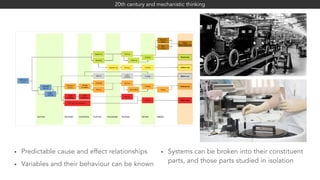
• Predictable cause and effect relationships
• Variables and their behaviour can be known
20th century and mechanistic thinking
• Systems can be broken into their constituent
parts, and those parts studied in isolation
“The society is like a clock whose secrets will be
revealed to us.
-Auguste Comte (1798-1857)
L O U T H , J O N AT H O N ( 2 0 1 1 ) . F R O M N E W T O N T O N E W T O N I A N I S M : R E D U C T I O N I S M A N D T H E D E V E L O P M E N T O F T H E S O C I A L S C I E N C E S . E M E R G E N C E : C O M P L E X I T Y &
O R G A N I Z AT I O N , V O L . 1 3 , N O . 4 , 6 3 - 8 3 .
DAVE CARROLL: UNITED BREAKS GUITARS
UNITED BREAKS GUITARS
IN 1980?
Local newspaper reports: “Airline breaks musicians
instrument – refuses to compensate!”
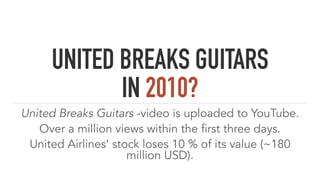
UNITED BREAKS GUITARS
IN 2010?
United Breaks Guitars -video is uploaded to YouTube.
Over a million views within the first three days.
United Airlines’ stock loses 10 % of its value (~180
million USD).
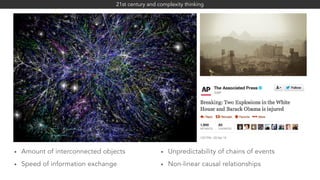
• Amount of interconnected objects
• Speed of information exchange
21st century and complexity thinking
• Unpredictability of chains of events
• Non-linear causal relationships
“Adaptability, not efficiency, must become our
central competency.
-Stanley McChrystal: Team of Teams
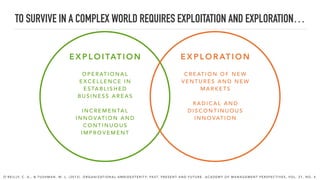
TO SURVIVE IN A COMPLEX WORLD REQUIRES EXPLOITATION AND EXPLORATION…
O ’ R E I L LY, C . A . , & T U S H M A N , M . L . ( 2 0 1 3 ) . O R G A N I Z AT I O N A L A M B I D E X T E R I T Y: PA S T, P R E S E N T A N D F U T U R E . A C A D E M Y O F M A N A G E M E N T P E R S P E C T I V E S , V O L . 2 7 , N O . 4 .
E X P L O I TAT I O N
O P E R AT I O N A L
E X C E L L E N C E I N
E S TA B L I S H E D
B U S I N E S S A R E A S
I N C R E M E N TA L
I N N O VAT I O N A N D
C O N T I N U O U S
I M P R O V E M E N T
E X P L O R AT I O N
C R E AT I O N O F N E W
V E N T U R E S A N D N E W
M A R K E T S
R A D I C A L A N D
D I S C O N T I N U O U S
I N N O VAT I O N
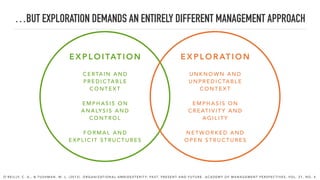
…BUT EXPLORATION DEMANDS AN ENTIRELY DIFFERENT MANAGEMENT APPROACH
E X P L O I TAT I O N
C E RTA I N A N D
P R E D I C TA B L E
C O N T E X T
E M P H A S I S O N
A N A LY S I S A N D
C O N T R O L
F O R M A L A N D
E X P L I C I T S T R U C T U R E S
E X P L O R AT I O N
U N K N O W N A N D
U N P R E D I C TA B L E
C O N T E X T
E M P H A S I S O N
C R E AT I V I T Y A N D
A G I L I T Y
N E T W O R K E D A N D
O P E N S T R U C T U R E S
O ’ R E I L LY, C . A . , & T U S H M A N , M . L . ( 2 0 1 3 ) . O R G A N I Z AT I O N A L A M B I D E X T E R I T Y: PA S T, P R E S E N T A N D F U T U R E . A C A D E M Y O F M A N A G E M E N T P E R S P E C T I V E S , V O L . 2 7 , N O . 4 .
“We are using mechanistic thinking and methods
in a world that is increasingly complex. To steer
organisations that do not behave mechanistically,
but instead follow the logic of complexity.
PA J U , S . ( 2 0 1 7 ) . K O M P L E K S I N E N M A A I L M A VA AT I I K E T T E R Ä Ä O R G A N I S O I T U M I S TA . I N M A RT E L A , F. , & J A R E N K O , K . ( E D S . ) I T S E O H J A U T U V U U S : M I T E N O R G A N I S O I T U A
T U L E VA I S U U D E S S A ? , H E L S I N K I : A L M A TA L E N T. C H A P T E R 2 .
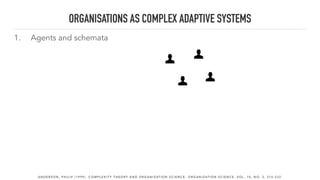
ORGANISATIONS AS COMPLEX ADAPTIVE SYSTEMS
A N D E R S O N , P H I L I P ( 1 9 9 9 ) . C O M P L E X I T Y T H E O RY A N D O R G A N I Z AT I O N S C I E N C E . O R G A N I Z AT I O N S C I E N C E , V O L . 1 0 , N O . 3 , 2 1 6 - 2 3 2 .
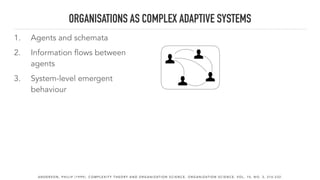
1. Agents and schemata
ORGANISATIONS AS COMPLEX ADAPTIVE SYSTEMS
A N D E R S O N , P H I L I P ( 1 9 9 9 ) . C O M P L E X I T Y T H E O RY A N D O R G A N I Z AT I O N S C I E N C E . O R G A N I Z AT I O N S C I E N C E , V O L . 1 0 , N O . 3 , 2 1 6 - 2 3 2 .
1. Agents and schemata
2. Information flows between
agents
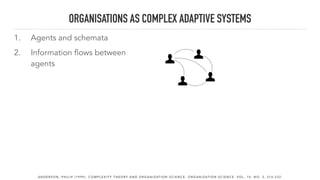
ORGANISATIONS AS COMPLEX ADAPTIVE SYSTEMS
A N D E R S O N , P H I L I P ( 1 9 9 9 ) . C O M P L E X I T Y T H E O RY A N D O R G A N I Z AT I O N S C I E N C E . O R G A N I Z AT I O N S C I E N C E , V O L . 1 0 , N O . 3 , 2 1 6 - 2 3 2 .
1. Agents and schemata
2. Information flows between
agents
3. System-level emergent
behaviour
COMPLEX ADAPTIVE… JAZZ?
E I S E N H A R D T, K . M . , & B R O W N , S . L . ( 1 9 9 8 ) . C O M P E T I N G O N T H E E D G E : S T R AT E G Y A S S T R U C T U R E D C H A O S . L O N G R A N G E P L A N N I N G , V O L . 3 1 , N O . 5 , 7 8 6 - 7 8 9 .
ORGANISATIONS AS COMPLEX ADAPTIVE SYSTEMS
A N D E R S O N , P H I L I P ( 1 9 9 9 ) . C O M P L E X I T Y T H E O RY A N D O R G A N I Z AT I O N S C I E N C E . O R G A N I Z AT I O N S C I E N C E , V O L . 1 0 , N O . 3 , 2 1 6 - 2 3 2 .
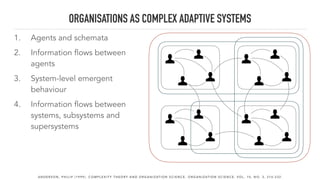
1. Agents and schemata
2. Information flows between
agents
3. System-level emergent
behaviour
4. Information flows between
systems, subsystems and
supersystems
ORGANISATIONS AS COMPLEX ADAPTIVE SYSTEMS
A N D E R S O N , P H I L I P ( 1 9 9 9 ) . C O M P L E X I T Y T H E O RY A N D O R G A N I Z AT I O N S C I E N C E . O R G A N I Z AT I O N S C I E N C E , V O L . 1 0 , N O . 3 , 2 1 6 - 2 3 2 .
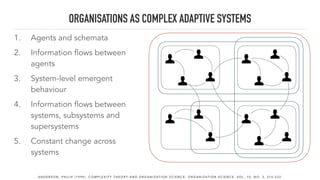
1. Agents and schemata
2. Information flows between
agents
3. System-level emergent
behaviour
4. Information flows between
systems, subsystems and
supersystems
5. Constant change across
systems
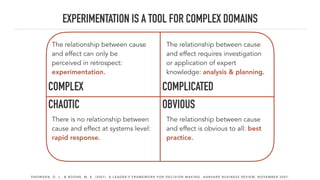
EXPERIMENTATION IS A TOOL FOR COMPLEX DOMAINS
COMPLEX COMPLICATED
OBVIOUSCHAOTIC
The relationship between cause
and effect can only be
perceived in retrospect:
experimentation.
The relationship between cause
and effect requires investigation
or application of expert
knowledge: analysis & planning.
There is no relationship between
cause and effect at systems level:
rapid response.
The relationship between cause
and effect is obvious to all: best
practice.
S N O W D E N , D . J . , & B O O N E , M . E . ( 2 0 0 7 ) . A L E A D E R ’ S F R A M E W O R K F O R D E C I S I O N M A K I N G . H A R VA R D B U S I N E S S R E V I E W , N O V E M B E R 2 0 0 7 .
“Learning by experimentation is fundamental to
solving problems for which outcomes are
uncertain and where critical sources of
information are nonexistent or unavailable.
L E E , F. , E D M O N D S O N , A . C . , T H O M K E , S . , & W O R L I N E , M . ( 2 0 0 4 ) . T H E M I X E D E F F E C T S O F I N C O N S I S T E N C Y O N E X P E R I M E N TAT I O N I N O R G A N I Z AT I O N S . O R G A N I Z AT I O N
S C I E N C E , V O L . 1 5 , N O . 3 , 3 1 0 - 3 2 6 .
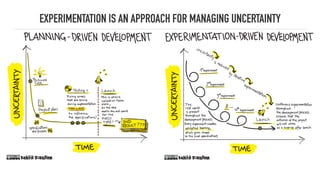
EXPERIMENTATION IS AN APPROACH FOR MANAGING UNCERTAINTY
STAND UP, HUG THE
PERSON NEXT TO YOU,
AND SMILE AS BIG AS
YOU CAN!
Raise your hand if you feel more
positive, energetic or happy!
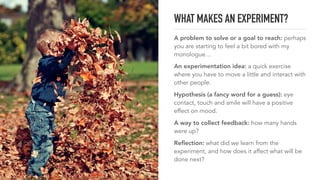
WHAT MAKES AN EXPERIMENT?
A problem to solve or a goal to reach: perhaps
you are starting to feel a bit bored with my
monologue…
An experimentation idea: a quick exercise
where you have to move a little and interact with
other people.
Hypothesis (a fancy word for a guess): eye
contact, touch and smile will have a positive
effect on mood.
A way to collect feedback: how many hands
were up?
Reflection: what did we learn from the
experiment, and how does it affect what will be
done next?
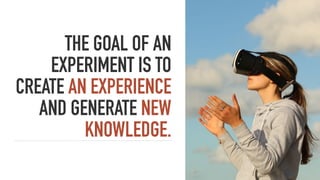
THE GOAL OF AN
EXPERIMENT IS TO
CREATE AN EXPERIENCE
AND GENERATE NEW
KNOWLEDGE.
EXPERIMENTATION IS…
Behaviour
• Bias to action
I M A G E : VA L I A N T I Z E @ F L I C K R
EXPERIMENTATION IS…
Behaviour
• Bias to action
Mindset
• Skepticism towards second-hand
knowledge
• Trust on empirical evidence
• Willingness to dance with uncertainty
I M A G E : VA L I A N T I Z E @ F L I C K R
EXPERIMENTATION IS…
Behaviour
• Bias to action
Mindset
• Skepticism towards second-hand
knowledge
• Trust on empirical evidence
• Willingness to dance with uncertainty
A set of tools and techniques
• Prototyping
• Experiment design
• Sense-making
I M A G E : VA L I A N T I Z E @ F L I C K R
DESIGNING EXPERIMENTS
A step by step guide
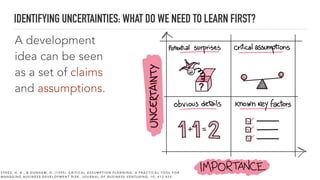
A development
idea can be seen
as a set of claims
and assumptions.
IDENTIFYING UNCERTAINTIES: WHAT DO WE NEED TO LEARN FIRST?
S Y K E S , H . B . , & D U N H A M , D . ( 1 9 9 5 ) . C R I T I C A L A S S U M P T I O N P L A N N I N G : A P R A C T I C A L T O O L F O R
M A N A G I N G B U S I N E S S D E V E L O P M E N T R I S K . J O U R N A L O F B U S I N E S S V E N T U R I N G , 1 0 , 4 1 3 - 4 2 4 .
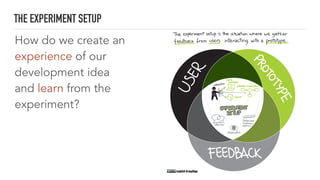
How do we create an
experience of our
development idea
and learn from the
experiment?
THE EXPERIMENT SETUP
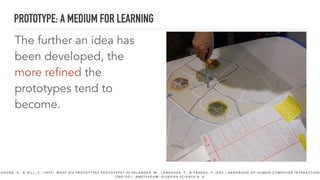
The further an idea has
been developed, the
more refined the
prototypes tend to
become.
PROTOTYPE: A MEDIUM FOR LEARNING
H O U D E , S . , & H I L L , C . ( 1 9 9 7 ) . W H AT D O P R O T O T Y P E S P R O T O T Y P E ? I N H E L A N D E R , M . , L A N D A U E R , T. , & P R A B H U , P. ( E D S . ) H A N D B O O K O F H U M A N - C O M P U T E R I N T E R A C T I O N
( 2 N D E D . ) , A M S T E R D A M : E L S E V I E R S C I E N C E B . V.
ARE YOU TRYING TO
UNDERSTAND A
PROBLEM, OR ARE YOU
TESTING A SOLUTION?
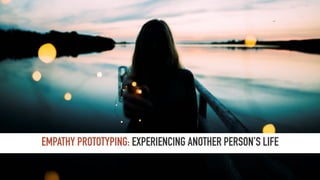
EMPATHY PROTOTYPING: EXPERIENCING ANOTHER PERSON’S LIFE
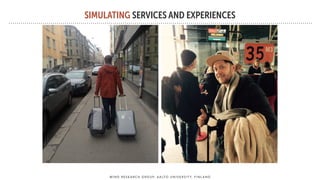
SIMULATING SERVICES AND EXPERIENCES
M I N D R E S E A R C H G R O U P, A A LT O U N I V E R S I T Y, F I N L A N D
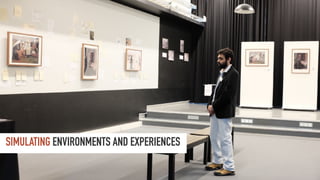
SIMULATING ENVIRONMENTS AND EXPERIENCES
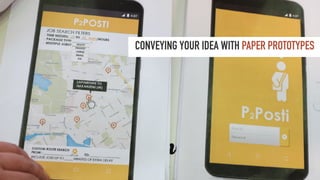
CONVEYING YOUR IDEA WITH PAPER PROTOTYPES
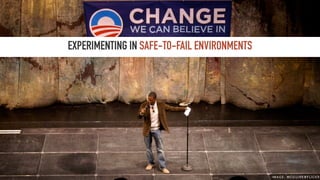
EXPERIMENTING IN SAFE-TO-FAIL ENVIRONMENTS
I M A G E : M C G U I R K @ F L I C K R
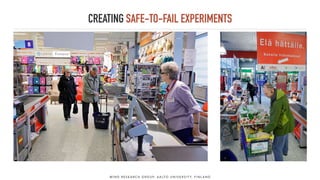
CREATING SAFE-TO-FAIL EXPERIMENTS
M I N D R E S E A R C H G R O U P, A A LT O U N I V E R S I T Y, F I N L A N D
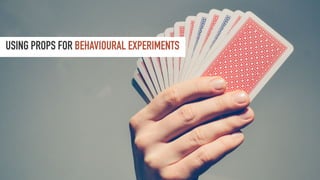
USING PROPS FOR BEHAVIOURAL EXPERIMENTS
A GREAT EXPERIMENT
CREATES AS MUCH
LEARNING AS POSSIBLE
WITH THE LEAST
AMOUNT OF EFFORT
Experiment design is as much a creative process
as coming up with good development ideas.
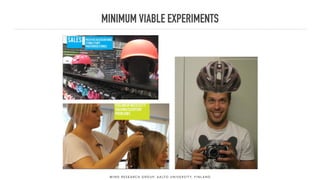
MINIMUM VIABLE EXPERIMENTS
M I N D R E S E A R C H G R O U P, A A LT O U N I V E R S I T Y, F I N L A N D
1. What is the
hypothesis?
2. How does the
experiment benefit
the organisation?
3. How will you collect
feedback?
ORGANISED ACTION OVER LONG-TERM PLANNING
[target market / target users]
[will behave like this / will use the solution]
[because...]
Hypothesis Template
This Hypothesis Template is originally published in www.kehitakokeillen.fi
and licensed under a Creative Commons Attribution-ShareAlike 4.0 International license:
http://creativecommons.org/licenses/by-sa/4.0/.
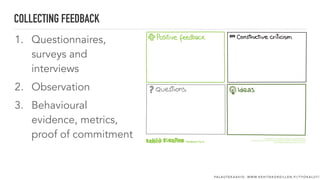
1. Questionnaires,
surveys and
interviews
2. Observation
3. Behavioural
evidence, metrics,
proof of commitment
COLLECTING FEEDBACK
PA L A U T E K A AV I O : W W W. K E H I TA K O K E I L L E N . F I / T Y O K A L U T /
Feedback Form
This Feedback Form is originally published in www.kehitakokeillen.fi
and licensed under a Creative Commons Attribution-ShareAlike 4.0 International license:
http://creativecommons.org/licenses/by-sa/4.0/.
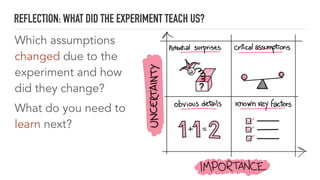
Which assumptions
changed due to the
experiment and how
did they change?
What do you need to
learn next?
REFLECTION: WHAT DID THE EXPERIMENT TEACH US?
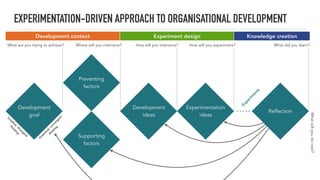
EXPERIMENTATION-DRIVEN APPROACH TO ORGANISATIONAL DEVELOPMENT
Development

goal
What are you trying to achieve?
Preventing
factors
Supporting
factors
Where will you intervene?
Development
ideas
How will you intervene?
Experimentation
ideas
Reflection
How will you experiment? What did you learn?
Whatwillyoudonext?
Experim
ents
Creative,divergent

thinking
A
nalytical,convergent

thinking
Development context Experiment design Knowledge creation
EXPERIMENTATION PITFALLS
Some things that typically go wrong
LACK OF COMMITMENT TO THE AGREED EXPERIMENTS
NO FEEDBACK COLLECTION, NO REFLECTION
Hypothesis
Notes
Notes
+ Where?
+ When?
+ Who will bring what
to the meeting?
+ Who?
+ How many?
+ How do we recruit them?
+ Responsible person
+ Where? Place
+ When?
Starting & ending dates
+ What? Tasks
+ Who? Responsible person
Item 1 + responsible person
Item 2 + responsible person
Item 3 + responsible person
+ How? Method
+ Where? Place
+ When?
+ Who? Responsible person
Execution:
We want to learn:
This is important for our
developmentidea,because:
This is important right now,
because:
Reflection meeting:
We will have learnt enough
when:
Preparingtheexperimentsetup:
Participants:
Required materials, props,
prototypes, etc.:
Collecting feedback:
purpose of the experiment
Task 1 + responsible person
Task 2 + responsible person
Task 3 + responsible person
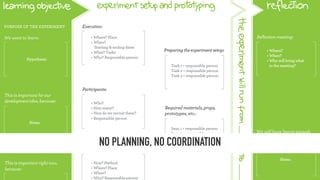
NO PLANNING, NO COORDINATION
NO STRUCTURES, PROCESSES OR TOOLS THAT SUPPORT EXPERIMENTATION
CONTRADICTORY STRUCTURES, PROCESSES AND REWARDS
LACK OF LEADERSHIP SUPPORT AND ENCOURAGEMENT
LACK OF EXPERIMENTATION KNOW-HOW
BAD EXPERIMENTS GET MISTAKEN FOR BAD IDEAS
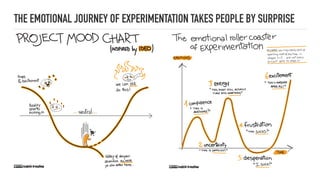
THE EMOTIONAL JOURNEY OF EXPERIMENTATION TAKES PEOPLE BY SURPRISE
“Make your decisions based on data, not
opinions. If you notice you’re arguing over
opinions, design an experiment. Get data, then
talk.
-Sami Honkonen, Tomorrow Labs
YOUR EXPERIMENTATION TOOLKIT: BIT.LY/SPARK2017TOOLS
SAMIPAJU.COMCopyright © Sami Paju 2017
Idea Canvas
This Idea Canvas is originally published in www.kehitakokeillen.fi
and licensed under a Creative Commons Attribution-ShareAlike 4.0 International license:
http://creativecommons.org/licenses/by-sa/4.0/.
[target market / target users]
[will behave like this / will use the solution]
[because...]
Hypothesis Template
This Hypothesis Template is originally published in www.kehitakokeillen.fi
and licensed under a Creative Commons Attribution-ShareAlike 4.0 International license:
http://creativecommons.org/licenses/by-sa/4.0/.
Uncertainty Matrix
This Uncertainty Matrix is originally published in www.kehitakokeillen.fi
and licensed under a Creative Commons Attribution-ShareAlike 4.0 International license:
http://creativecommons.org/licenses/by-sa/4.0/.
Hypothesis
Notes
Notes
Notes
+ Where?
+ When?
+ Who will bring what
to the meeting?
+ Who?
+ How many?
+ How do we recruit them?
+ Responsible person
+ Where? Place
+ When?
Starting & ending dates
+ What? Tasks
+ Who? Responsible person
Item 1 + responsible person
Item 2 + responsible person
Item 3 + responsible person
+ How? Method
+ Where? Place
+ When?
+ Who? Responsible person
Execution:
We want to learn:
This is important for our
developmentidea,because:
This is important right now,
because:
Reflection meeting:
We will have learnt enough
when:
Preparingtheexperimentsetup:
Participants:
Required materials, props,
prototypes, etc.:
Collecting feedback:
purpose of the experiment
Task 1 + responsible person
Task 2 + responsible person
Task 3 + responsible person
Experimentation Plan
This Experimentation Plan is originally published in www.kehitakokeillen.fi
and licensed under a Creative Commons Attribution-ShareAlike 4.0 International license:
http://creativecommons.org/licenses/by-sa/4.0/.
Execution:
We want to learn:
This is important for our
developmentidea,because:
This is important right now,
because:
Reflection meeting:
We will have learnt enough
when:
Preparingtheexperimentsetup:
Participants:
Required materials, props,
prototypes, etc.:
Collecting feedback:
Experimentation Plan
This Experimentation Plan is originally published in www.kehitakokeillen.fi
and licensed under a Creative Commons Attribution-ShareAlike 4.0 International license:
http://creativecommons.org/licenses/by-sa/4.0/.
purpose of the experiment
Feedback Form
This Feedback Form is originally published in www.kehitakokeillen.fi
and licensed under a Creative Commons Attribution-ShareAlike 4.0 International license:
http://creativecommons.org/licenses/by-sa/4.0/.
SPARK THE CHANGE, June 13th 2017

#sparkto @sparkconfto
Mechanistic view of organisations is helplessly outdated
in modern and fast-changing business environments.
Organisations need both exploitation and exploration to
survive. The faster the change, the more emphasis
should be put on exploration.
A great experiment creates as much learning as possible
with the least amount of effort.
The goal of an experiment is to create an experience
and generate new knowledge.
All development ideas consist of claims and
assumptions. Create experiments around those that are
most important and uncertain.
sami@samipaju.com linkedin.com/in/samipaju@samipaju samipaju

Experimentation-Driven Approach to Organisational Development

  • 1.
    sami@samipaju.com THE EXPERIMENTATION-DRIVEN APPROACHTO ORGANISATIONAL DEVELOPMENT Spark the Change, June 13th 2017 #sparkto @sparkconfto linkedin.com/in/samipaju@samipaju SAMIPAJU.COM samipaju C O P Y R I G H T © S A M I PA J U 2 0 1 7
  • 2.
    • Predictable causeand effect relationships • Variables and their behaviour can be known 20th century and mechanistic thinking • Systems can be broken into their constituent parts, and those parts studied in isolation
  • 3.
    “The society islike a clock whose secrets will be revealed to us. -Auguste Comte (1798-1857) L O U T H , J O N AT H O N ( 2 0 1 1 ) . F R O M N E W T O N T O N E W T O N I A N I S M : R E D U C T I O N I S M A N D T H E D E V E L O P M E N T O F T H E S O C I A L S C I E N C E S . E M E R G E N C E : C O M P L E X I T Y & O R G A N I Z AT I O N , V O L . 1 3 , N O . 4 , 6 3 - 8 3 .
  • 4.
    DAVE CARROLL: UNITEDBREAKS GUITARS
  • 5.
    UNITED BREAKS GUITARS IN1980? Local newspaper reports: “Airline breaks musicians instrument – refuses to compensate!”
  • 6.
    UNITED BREAKS GUITARS IN2010? United Breaks Guitars -video is uploaded to YouTube. Over a million views within the first three days. United Airlines’ stock loses 10 % of its value (~180 million USD).
  • 7.
    • Amount ofinterconnected objects • Speed of information exchange 21st century and complexity thinking • Unpredictability of chains of events • Non-linear causal relationships
  • 8.
    “Adaptability, not efficiency,must become our central competency. -Stanley McChrystal: Team of Teams
  • 9.
    TO SURVIVE INA COMPLEX WORLD REQUIRES EXPLOITATION AND EXPLORATION… O ’ R E I L LY, C . A . , & T U S H M A N , M . L . ( 2 0 1 3 ) . O R G A N I Z AT I O N A L A M B I D E X T E R I T Y: PA S T, P R E S E N T A N D F U T U R E . A C A D E M Y O F M A N A G E M E N T P E R S P E C T I V E S , V O L . 2 7 , N O . 4 . E X P L O I TAT I O N O P E R AT I O N A L E X C E L L E N C E I N E S TA B L I S H E D B U S I N E S S A R E A S I N C R E M E N TA L I N N O VAT I O N A N D C O N T I N U O U S I M P R O V E M E N T E X P L O R AT I O N C R E AT I O N O F N E W V E N T U R E S A N D N E W M A R K E T S R A D I C A L A N D D I S C O N T I N U O U S I N N O VAT I O N
  • 10.
    …BUT EXPLORATION DEMANDSAN ENTIRELY DIFFERENT MANAGEMENT APPROACH E X P L O I TAT I O N C E RTA I N A N D P R E D I C TA B L E C O N T E X T E M P H A S I S O N A N A LY S I S A N D C O N T R O L F O R M A L A N D E X P L I C I T S T R U C T U R E S E X P L O R AT I O N U N K N O W N A N D U N P R E D I C TA B L E C O N T E X T E M P H A S I S O N C R E AT I V I T Y A N D A G I L I T Y N E T W O R K E D A N D O P E N S T R U C T U R E S O ’ R E I L LY, C . A . , & T U S H M A N , M . L . ( 2 0 1 3 ) . O R G A N I Z AT I O N A L A M B I D E X T E R I T Y: PA S T, P R E S E N T A N D F U T U R E . A C A D E M Y O F M A N A G E M E N T P E R S P E C T I V E S , V O L . 2 7 , N O . 4 .
  • 11.
    “We are usingmechanistic thinking and methods in a world that is increasingly complex. To steer organisations that do not behave mechanistically, but instead follow the logic of complexity. PA J U , S . ( 2 0 1 7 ) . K O M P L E K S I N E N M A A I L M A VA AT I I K E T T E R Ä Ä O R G A N I S O I T U M I S TA . I N M A RT E L A , F. , & J A R E N K O , K . ( E D S . ) I T S E O H J A U T U V U U S : M I T E N O R G A N I S O I T U A T U L E VA I S U U D E S S A ? , H E L S I N K I : A L M A TA L E N T. C H A P T E R 2 .
  • 12.
    ORGANISATIONS AS COMPLEXADAPTIVE SYSTEMS A N D E R S O N , P H I L I P ( 1 9 9 9 ) . C O M P L E X I T Y T H E O RY A N D O R G A N I Z AT I O N S C I E N C E . O R G A N I Z AT I O N S C I E N C E , V O L . 1 0 , N O . 3 , 2 1 6 - 2 3 2 . 1. Agents and schemata
  • 13.
    ORGANISATIONS AS COMPLEXADAPTIVE SYSTEMS A N D E R S O N , P H I L I P ( 1 9 9 9 ) . C O M P L E X I T Y T H E O RY A N D O R G A N I Z AT I O N S C I E N C E . O R G A N I Z AT I O N S C I E N C E , V O L . 1 0 , N O . 3 , 2 1 6 - 2 3 2 . 1. Agents and schemata 2. Information flows between agents
  • 14.
    ORGANISATIONS AS COMPLEXADAPTIVE SYSTEMS A N D E R S O N , P H I L I P ( 1 9 9 9 ) . C O M P L E X I T Y T H E O RY A N D O R G A N I Z AT I O N S C I E N C E . O R G A N I Z AT I O N S C I E N C E , V O L . 1 0 , N O . 3 , 2 1 6 - 2 3 2 . 1. Agents and schemata 2. Information flows between agents 3. System-level emergent behaviour
  • 15.
    COMPLEX ADAPTIVE… JAZZ? EI S E N H A R D T, K . M . , & B R O W N , S . L . ( 1 9 9 8 ) . C O M P E T I N G O N T H E E D G E : S T R AT E G Y A S S T R U C T U R E D C H A O S . L O N G R A N G E P L A N N I N G , V O L . 3 1 , N O . 5 , 7 8 6 - 7 8 9 .
  • 16.
    ORGANISATIONS AS COMPLEXADAPTIVE SYSTEMS A N D E R S O N , P H I L I P ( 1 9 9 9 ) . C O M P L E X I T Y T H E O RY A N D O R G A N I Z AT I O N S C I E N C E . O R G A N I Z AT I O N S C I E N C E , V O L . 1 0 , N O . 3 , 2 1 6 - 2 3 2 . 1. Agents and schemata 2. Information flows between agents 3. System-level emergent behaviour 4. Information flows between systems, subsystems and supersystems
  • 17.
    ORGANISATIONS AS COMPLEXADAPTIVE SYSTEMS A N D E R S O N , P H I L I P ( 1 9 9 9 ) . C O M P L E X I T Y T H E O RY A N D O R G A N I Z AT I O N S C I E N C E . O R G A N I Z AT I O N S C I E N C E , V O L . 1 0 , N O . 3 , 2 1 6 - 2 3 2 . 1. Agents and schemata 2. Information flows between agents 3. System-level emergent behaviour 4. Information flows between systems, subsystems and supersystems 5. Constant change across systems
  • 18.
    EXPERIMENTATION IS ATOOL FOR COMPLEX DOMAINS COMPLEX COMPLICATED OBVIOUSCHAOTIC The relationship between cause and effect can only be perceived in retrospect: experimentation. The relationship between cause and effect requires investigation or application of expert knowledge: analysis & planning. There is no relationship between cause and effect at systems level: rapid response. The relationship between cause and effect is obvious to all: best practice. S N O W D E N , D . J . , & B O O N E , M . E . ( 2 0 0 7 ) . A L E A D E R ’ S F R A M E W O R K F O R D E C I S I O N M A K I N G . H A R VA R D B U S I N E S S R E V I E W , N O V E M B E R 2 0 0 7 .
  • 19.
    “Learning by experimentationis fundamental to solving problems for which outcomes are uncertain and where critical sources of information are nonexistent or unavailable. L E E , F. , E D M O N D S O N , A . C . , T H O M K E , S . , & W O R L I N E , M . ( 2 0 0 4 ) . T H E M I X E D E F F E C T S O F I N C O N S I S T E N C Y O N E X P E R I M E N TAT I O N I N O R G A N I Z AT I O N S . O R G A N I Z AT I O N S C I E N C E , V O L . 1 5 , N O . 3 , 3 1 0 - 3 2 6 .
  • 20.
    EXPERIMENTATION IS ANAPPROACH FOR MANAGING UNCERTAINTY
  • 21.
    STAND UP, HUGTHE PERSON NEXT TO YOU, AND SMILE AS BIG AS YOU CAN! Raise your hand if you feel more positive, energetic or happy!
  • 22.
    WHAT MAKES ANEXPERIMENT? A problem to solve or a goal to reach: perhaps you are starting to feel a bit bored with my monologue… An experimentation idea: a quick exercise where you have to move a little and interact with other people. Hypothesis (a fancy word for a guess): eye contact, touch and smile will have a positive effect on mood. A way to collect feedback: how many hands were up? Reflection: what did we learn from the experiment, and how does it affect what will be done next?
  • 23.
    THE GOAL OFAN EXPERIMENT IS TO CREATE AN EXPERIENCE AND GENERATE NEW KNOWLEDGE.
  • 24.
    EXPERIMENTATION IS… Behaviour • Biasto action I M A G E : VA L I A N T I Z E @ F L I C K R
  • 25.
    EXPERIMENTATION IS… Behaviour • Biasto action Mindset • Skepticism towards second-hand knowledge • Trust on empirical evidence • Willingness to dance with uncertainty I M A G E : VA L I A N T I Z E @ F L I C K R
  • 26.
    EXPERIMENTATION IS… Behaviour • Biasto action Mindset • Skepticism towards second-hand knowledge • Trust on empirical evidence • Willingness to dance with uncertainty A set of tools and techniques • Prototyping • Experiment design • Sense-making I M A G E : VA L I A N T I Z E @ F L I C K R
  • 27.
  • 28.
    A development idea canbe seen as a set of claims and assumptions. IDENTIFYING UNCERTAINTIES: WHAT DO WE NEED TO LEARN FIRST? S Y K E S , H . B . , & D U N H A M , D . ( 1 9 9 5 ) . C R I T I C A L A S S U M P T I O N P L A N N I N G : A P R A C T I C A L T O O L F O R M A N A G I N G B U S I N E S S D E V E L O P M E N T R I S K . J O U R N A L O F B U S I N E S S V E N T U R I N G , 1 0 , 4 1 3 - 4 2 4 .
  • 30.
    How do wecreate an experience of our development idea and learn from the experiment? THE EXPERIMENT SETUP
  • 31.
    The further anidea has been developed, the more refined the prototypes tend to become. PROTOTYPE: A MEDIUM FOR LEARNING H O U D E , S . , & H I L L , C . ( 1 9 9 7 ) . W H AT D O P R O T O T Y P E S P R O T O T Y P E ? I N H E L A N D E R , M . , L A N D A U E R , T. , & P R A B H U , P. ( E D S . ) H A N D B O O K O F H U M A N - C O M P U T E R I N T E R A C T I O N ( 2 N D E D . ) , A M S T E R D A M : E L S E V I E R S C I E N C E B . V.
  • 32.
    ARE YOU TRYINGTO UNDERSTAND A PROBLEM, OR ARE YOU TESTING A SOLUTION?
  • 33.
    EMPATHY PROTOTYPING: EXPERIENCINGANOTHER PERSON’S LIFE
  • 34.
    SIMULATING SERVICES ANDEXPERIENCES M I N D R E S E A R C H G R O U P, A A LT O U N I V E R S I T Y, F I N L A N D
  • 35.
  • 36.
    CONVEYING YOUR IDEAWITH PAPER PROTOTYPES
  • 37.
    EXPERIMENTING IN SAFE-TO-FAILENVIRONMENTS I M A G E : M C G U I R K @ F L I C K R
  • 38.
    CREATING SAFE-TO-FAIL EXPERIMENTS MI N D R E S E A R C H G R O U P, A A LT O U N I V E R S I T Y, F I N L A N D
  • 39.
    USING PROPS FORBEHAVIOURAL EXPERIMENTS
  • 40.
    A GREAT EXPERIMENT CREATESAS MUCH LEARNING AS POSSIBLE WITH THE LEAST AMOUNT OF EFFORT Experiment design is as much a creative process as coming up with good development ideas.
  • 41.
    MINIMUM VIABLE EXPERIMENTS MI N D R E S E A R C H G R O U P, A A LT O U N I V E R S I T Y, F I N L A N D
  • 42.
    1. What isthe hypothesis? 2. How does the experiment benefit the organisation? 3. How will you collect feedback? ORGANISED ACTION OVER LONG-TERM PLANNING [target market / target users] [will behave like this / will use the solution] [because...] Hypothesis Template This Hypothesis Template is originally published in www.kehitakokeillen.fi and licensed under a Creative Commons Attribution-ShareAlike 4.0 International license: http://creativecommons.org/licenses/by-sa/4.0/.
  • 43.
    1. Questionnaires, surveys and interviews 2.Observation 3. Behavioural evidence, metrics, proof of commitment COLLECTING FEEDBACK PA L A U T E K A AV I O : W W W. K E H I TA K O K E I L L E N . F I / T Y O K A L U T / Feedback Form This Feedback Form is originally published in www.kehitakokeillen.fi and licensed under a Creative Commons Attribution-ShareAlike 4.0 International license: http://creativecommons.org/licenses/by-sa/4.0/.
  • 44.
    Which assumptions changed dueto the experiment and how did they change? What do you need to learn next? REFLECTION: WHAT DID THE EXPERIMENT TEACH US?
  • 45.
    EXPERIMENTATION-DRIVEN APPROACH TOORGANISATIONAL DEVELOPMENT Development
 goal What are you trying to achieve? Preventing factors Supporting factors Where will you intervene? Development ideas How will you intervene? Experimentation ideas Reflection How will you experiment? What did you learn? Whatwillyoudonext? Experim ents Creative,divergent
 thinking A nalytical,convergent
 thinking Development context Experiment design Knowledge creation
  • 46.
    EXPERIMENTATION PITFALLS Some thingsthat typically go wrong
  • 47.
    LACK OF COMMITMENTTO THE AGREED EXPERIMENTS
  • 48.
  • 49.
    Hypothesis Notes Notes + Where? + When? +Who will bring what to the meeting? + Who? + How many? + How do we recruit them? + Responsible person + Where? Place + When? Starting & ending dates + What? Tasks + Who? Responsible person Item 1 + responsible person Item 2 + responsible person Item 3 + responsible person + How? Method + Where? Place + When? + Who? Responsible person Execution: We want to learn: This is important for our developmentidea,because: This is important right now, because: Reflection meeting: We will have learnt enough when: Preparingtheexperimentsetup: Participants: Required materials, props, prototypes, etc.: Collecting feedback: purpose of the experiment Task 1 + responsible person Task 2 + responsible person Task 3 + responsible person NO PLANNING, NO COORDINATION
  • 50.
    NO STRUCTURES, PROCESSESOR TOOLS THAT SUPPORT EXPERIMENTATION
  • 51.
  • 52.
    LACK OF LEADERSHIPSUPPORT AND ENCOURAGEMENT
  • 53.
  • 54.
    BAD EXPERIMENTS GETMISTAKEN FOR BAD IDEAS
  • 55.
    THE EMOTIONAL JOURNEYOF EXPERIMENTATION TAKES PEOPLE BY SURPRISE
  • 56.
    “Make your decisionsbased on data, not opinions. If you notice you’re arguing over opinions, design an experiment. Get data, then talk. -Sami Honkonen, Tomorrow Labs
  • 57.
    YOUR EXPERIMENTATION TOOLKIT:BIT.LY/SPARK2017TOOLS SAMIPAJU.COMCopyright © Sami Paju 2017 Idea Canvas This Idea Canvas is originally published in www.kehitakokeillen.fi and licensed under a Creative Commons Attribution-ShareAlike 4.0 International license: http://creativecommons.org/licenses/by-sa/4.0/. [target market / target users] [will behave like this / will use the solution] [because...] Hypothesis Template This Hypothesis Template is originally published in www.kehitakokeillen.fi and licensed under a Creative Commons Attribution-ShareAlike 4.0 International license: http://creativecommons.org/licenses/by-sa/4.0/. Uncertainty Matrix This Uncertainty Matrix is originally published in www.kehitakokeillen.fi and licensed under a Creative Commons Attribution-ShareAlike 4.0 International license: http://creativecommons.org/licenses/by-sa/4.0/. Hypothesis Notes Notes Notes + Where? + When? + Who will bring what to the meeting? + Who? + How many? + How do we recruit them? + Responsible person + Where? Place + When? Starting & ending dates + What? Tasks + Who? Responsible person Item 1 + responsible person Item 2 + responsible person Item 3 + responsible person + How? Method + Where? Place + When? + Who? Responsible person Execution: We want to learn: This is important for our developmentidea,because: This is important right now, because: Reflection meeting: We will have learnt enough when: Preparingtheexperimentsetup: Participants: Required materials, props, prototypes, etc.: Collecting feedback: purpose of the experiment Task 1 + responsible person Task 2 + responsible person Task 3 + responsible person Experimentation Plan This Experimentation Plan is originally published in www.kehitakokeillen.fi and licensed under a Creative Commons Attribution-ShareAlike 4.0 International license: http://creativecommons.org/licenses/by-sa/4.0/. Execution: We want to learn: This is important for our developmentidea,because: This is important right now, because: Reflection meeting: We will have learnt enough when: Preparingtheexperimentsetup: Participants: Required materials, props, prototypes, etc.: Collecting feedback: Experimentation Plan This Experimentation Plan is originally published in www.kehitakokeillen.fi and licensed under a Creative Commons Attribution-ShareAlike 4.0 International license: http://creativecommons.org/licenses/by-sa/4.0/. purpose of the experiment Feedback Form This Feedback Form is originally published in www.kehitakokeillen.fi and licensed under a Creative Commons Attribution-ShareAlike 4.0 International license: http://creativecommons.org/licenses/by-sa/4.0/. SPARK THE CHANGE, June 13th 2017
 #sparkto @sparkconfto Mechanistic view of organisations is helplessly outdated in modern and fast-changing business environments. Organisations need both exploitation and exploration to survive. The faster the change, the more emphasis should be put on exploration. A great experiment creates as much learning as possible with the least amount of effort. The goal of an experiment is to create an experience and generate new knowledge. All development ideas consist of claims and assumptions. Create experiments around those that are most important and uncertain. sami@samipaju.com linkedin.com/in/samipaju@samipaju samipaju