




Wellbeing and Change
Jo Twiselton
Association for Project Management, East of England
26th April 2023
linkedin.com/in/jotwiselton/
www.twistconsultants.co.uk
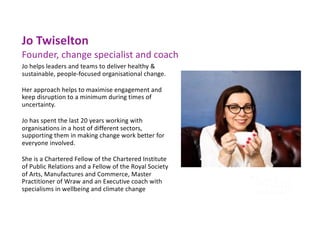
Jo Twiselton
Founder, change specialist and coach
Jo helps leaders and teams to deliver healthy &
sustainable, people-focused organisational change.
Her approach helps to maximise engagement and
keep disruption to a minimum during times of
uncertainty.
Jo has spent the last 20 years working with
organisations in a host of different sectors,
supporting them in making change work better for
everyone involved.
She is a Chartered Fellow of the Chartered Institute
of Public Relations and a Fellow of the Royal Society
of Arts, Manufactures and Commerce, Master
Practitioner of Wraw and an Executive coach with
specialisms in wellbeing and climate change
Today…
• Change and uncertainty – the reactions this can spark
• What this means for project management
• Wellbeing, resilience and mindsets – practical approaches
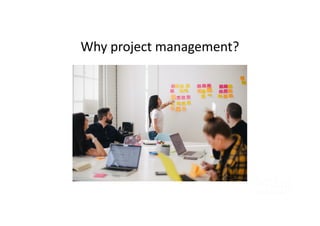
Why project management?
Change and Uncertainty
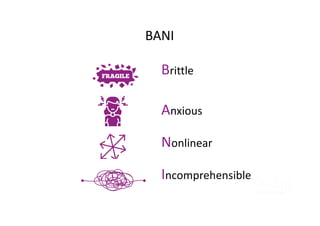
Brittle
Anxious
Nonlinear
Incomprehensible
BANI
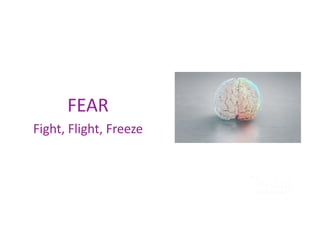
FEAR
Fight, Flight, Freeze
Mental Wellbeing
“…describes our mental state – how we’re feeling and
how well we can cope with day-to-day life.
Our emotional wellbeing can change from
day to day, month to month, year to year”
Mind
”… focuses less on resilience as a trait or the passive act of
waiting to ‘bounce back’ and more on the agency that we have
to pursue resources (or to seek assistance finding them).
As a result, we have something to focus on when we don’t know
what to do.”
Joan P Ball, Stop, Ask, Explore,
Resilience
Why wellbeing and resilience matter
in times of change
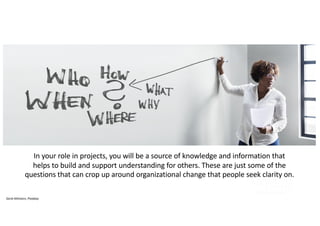
Gerd Altmann, Pixabay
In your role in projects, you will be a source of knowledge and information that
helps to build and support understanding for others. These are just some of the
questions that can crop up around organizational change that people seek clarity on.
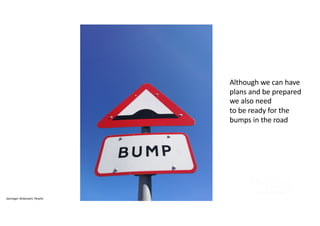
Janroger Antonsen, Pexels
Although we can have
plans and be prepared
we also need
to be ready for the
bumps in the road
By developing
our wellbeing and
resilience, means we
have more time
and energy to support
others, be more
empathetic and
empower them to
make change happen
What impacts resilience and wellbeing?
• Emotions – getting hijacked by them
• Attitudes to change – seeing change as an opportunity to learn
• Hope and optimism – there are three elements to hope: vision
(where we’re heading), the pathway (the road we’re taking to get
there) and agency (what we can do to get there)
• Clarity – confusion hijacks successful change and can stop it in its
tracks
Practical approaches to support wellbeing
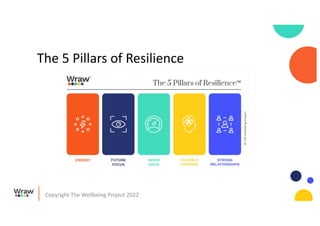
A model for understanding wellbeing and resilience
• Wraw – Workplace Resilience and Wellbeing – is an evidence-
based model for understanding resilience
• It is based on the Wraw 5 Pillars of Resilience
• Employees can get insights into their own resilience profiles
using the Wraw psychometric
STRESS
LESS
The 5 Pillars of Resilience
Copyright The Wellbeing Project 2022
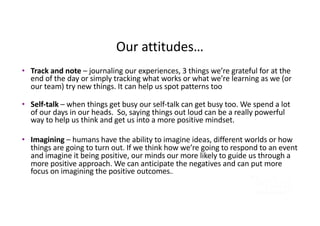
Our attitudes…
• Track and note – journaling our experiences, 3 things we’re grateful for at the
end of the day or simply tracking what works or what we’re learning as we (or
our team) try new things. It can help us spot patterns too
• Self-talk – when things get busy our self-talk can get busy too. We spend a lot
of our days in our heads. So, saying things out loud can be a really powerful
way to help us think and get us into a more positive mindset.
• Imagining – humans have the ability to imagine ideas, different worlds or how
things are going to turn out. If we think how we’re going to respond to an event
and imagine it being positive, our minds our more likely to guide us through a
more positive approach. We can anticipate the negatives and can put more
focus on imagining the positive outcomes..
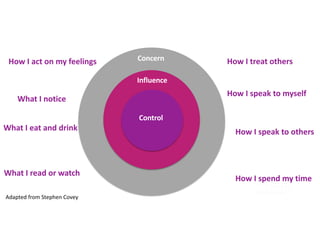
Influence?
Influence?
How I speak to others
How I treat others
What I read or watch
What I eat and drink
How I act on my feelings
How I spend my time
How I speak to myself
What I notice
Concern
Influence
Control
Adapted from Stephen Covey
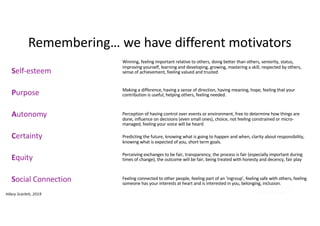
Remembering… we have different motivators
Self-esteem
Purpose
Autonomy
Certainty
Equity
Social Connection
Winning, feeling important relative to others, doing better than others, seniority, status,
improving yourself, learning and developing, growing, mastering a skill, respected by others,
sense of achievement, feeling valued and trusted
Making a difference, having a sense of direction, having meaning, hope, feeling that your
contribution is useful, helping others, feeling needed.
Perception of having control over events or environment, free to determine how things are
done, influence on decisions (even small ones), choice, not feeling constrained or micro-
managed, feeling your voice will be heard
Predicting the future, knowing what is going to happen and when, clarity about responsibility,
knowing what is expected of you, short term goals.
Perceiving exchanges to be fair, transparency, the process is fair (especially important during
times of change), the outcome will be fair, being treated with honesty and decency, fair play
Feeling connected to other people, feeling part of an ‘ingroup’, feeling safe with others, feeling
someone has your interests at heart and is interested in you, belonging, inclusion.
Hilary Scarlett, 2019
Control
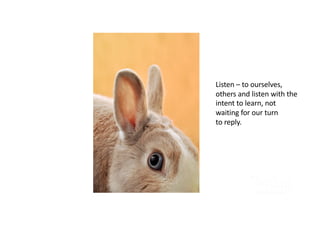
Listen – to ourselves,
others and listen with the
intent to learn, not
waiting for our turn
to reply.
26
Boundaries – set
them, reinforce
them and listen out
for and respect other
people’s boundaries
too
Image by Saveliy Morozov from Pixabay
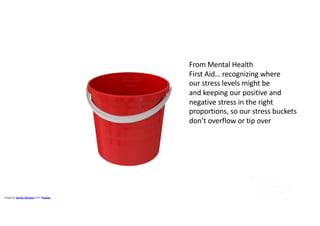
From Mental Health
First Aid… recognizing where
our stress levels might be
and keeping our positive and
negative stress in the right
proportions, so our stress buckets
don’t overflow or tip over
What one thing will you
take away?
Invitation to connect
Email: jo@twistconsultants.co.uk
LinkedIn: www.linkedin.com/in/jotwiselton
Telephone: +44 7834 378070
Questions?
Resource references
Throughout this presentation, I referenced a few books and resources.
Where I’ve written a review of any of these books, I’ve included the link too. Please do
share any other interesting resources on this topic!
• Imagine It Forward – Courage, Creativity and the Power of Change, Beth Comstock -
https://www.twistconsultants.co.uk/blog/book-review-imagine-it-forward
• Chatter – the Voice in our Head and how to harness it – Ethan Kross
https://www.twistconsultants.co.uk/blog/2022/11/21/want-to-harness-your-inner-voice
• Neuroscience for Organisational Change – Hilary Scarlett
• Stephen Covey - The 7 habits of highly effective people

Talking about wellbeing and change

  • 1.
    Wellbeing and Change JoTwiselton Association for Project Management, East of England 26th April 2023 linkedin.com/in/jotwiselton/ www.twistconsultants.co.uk
  • 2.
    Jo Twiselton Founder, changespecialist and coach Jo helps leaders and teams to deliver healthy & sustainable, people-focused organisational change. Her approach helps to maximise engagement and keep disruption to a minimum during times of uncertainty. Jo has spent the last 20 years working with organisations in a host of different sectors, supporting them in making change work better for everyone involved. She is a Chartered Fellow of the Chartered Institute of Public Relations and a Fellow of the Royal Society of Arts, Manufactures and Commerce, Master Practitioner of Wraw and an Executive coach with specialisms in wellbeing and climate change
  • 3.
    Today… • Change anduncertainty – the reactions this can spark • What this means for project management • Wellbeing, resilience and mindsets – practical approaches
  • 4.
  • 5.
  • 6.
  • 7.
  • 9.
    Mental Wellbeing “…describes ourmental state – how we’re feeling and how well we can cope with day-to-day life. Our emotional wellbeing can change from day to day, month to month, year to year” Mind
  • 10.
    ”… focuses lesson resilience as a trait or the passive act of waiting to ‘bounce back’ and more on the agency that we have to pursue resources (or to seek assistance finding them). As a result, we have something to focus on when we don’t know what to do.” Joan P Ball, Stop, Ask, Explore, Resilience
  • 11.
    Why wellbeing andresilience matter in times of change
  • 12.
    Gerd Altmann, Pixabay Inyour role in projects, you will be a source of knowledge and information that helps to build and support understanding for others. These are just some of the questions that can crop up around organizational change that people seek clarity on.
  • 13.
    Janroger Antonsen, Pexels Althoughwe can have plans and be prepared we also need to be ready for the bumps in the road
  • 14.
    By developing our wellbeingand resilience, means we have more time and energy to support others, be more empathetic and empower them to make change happen
  • 15.
    What impacts resilienceand wellbeing? • Emotions – getting hijacked by them • Attitudes to change – seeing change as an opportunity to learn • Hope and optimism – there are three elements to hope: vision (where we’re heading), the pathway (the road we’re taking to get there) and agency (what we can do to get there) • Clarity – confusion hijacks successful change and can stop it in its tracks
  • 16.
    Practical approaches tosupport wellbeing
  • 17.
    A model forunderstanding wellbeing and resilience • Wraw – Workplace Resilience and Wellbeing – is an evidence- based model for understanding resilience • It is based on the Wraw 5 Pillars of Resilience • Employees can get insights into their own resilience profiles using the Wraw psychometric
  • 18.
    STRESS LESS The 5 Pillarsof Resilience Copyright The Wellbeing Project 2022
  • 20.
    Our attitudes… • Trackand note – journaling our experiences, 3 things we’re grateful for at the end of the day or simply tracking what works or what we’re learning as we (or our team) try new things. It can help us spot patterns too • Self-talk – when things get busy our self-talk can get busy too. We spend a lot of our days in our heads. So, saying things out loud can be a really powerful way to help us think and get us into a more positive mindset. • Imagining – humans have the ability to imagine ideas, different worlds or how things are going to turn out. If we think how we’re going to respond to an event and imagine it being positive, our minds our more likely to guide us through a more positive approach. We can anticipate the negatives and can put more focus on imagining the positive outcomes..
  • 21.
    Influence? Influence? How I speakto others How I treat others What I read or watch What I eat and drink How I act on my feelings How I spend my time How I speak to myself What I notice Concern Influence Control Adapted from Stephen Covey
  • 22.
    Remembering… we havedifferent motivators Self-esteem Purpose Autonomy Certainty Equity Social Connection Winning, feeling important relative to others, doing better than others, seniority, status, improving yourself, learning and developing, growing, mastering a skill, respected by others, sense of achievement, feeling valued and trusted Making a difference, having a sense of direction, having meaning, hope, feeling that your contribution is useful, helping others, feeling needed. Perception of having control over events or environment, free to determine how things are done, influence on decisions (even small ones), choice, not feeling constrained or micro- managed, feeling your voice will be heard Predicting the future, knowing what is going to happen and when, clarity about responsibility, knowing what is expected of you, short term goals. Perceiving exchanges to be fair, transparency, the process is fair (especially important during times of change), the outcome will be fair, being treated with honesty and decency, fair play Feeling connected to other people, feeling part of an ‘ingroup’, feeling safe with others, feeling someone has your interests at heart and is interested in you, belonging, inclusion. Hilary Scarlett, 2019
  • 23.
  • 25.
    Listen – toourselves, others and listen with the intent to learn, not waiting for our turn to reply.
  • 26.
    26 Boundaries – set them,reinforce them and listen out for and respect other people’s boundaries too
  • 27.
    Image by SaveliyMorozov from Pixabay From Mental Health First Aid… recognizing where our stress levels might be and keeping our positive and negative stress in the right proportions, so our stress buckets don’t overflow or tip over
  • 28.
    What one thingwill you take away?
  • 29.
    Invitation to connect Email:jo@twistconsultants.co.uk LinkedIn: www.linkedin.com/in/jotwiselton Telephone: +44 7834 378070
  • 30.
  • 31.
    Resource references Throughout thispresentation, I referenced a few books and resources. Where I’ve written a review of any of these books, I’ve included the link too. Please do share any other interesting resources on this topic! • Imagine It Forward – Courage, Creativity and the Power of Change, Beth Comstock - https://www.twistconsultants.co.uk/blog/book-review-imagine-it-forward • Chatter – the Voice in our Head and how to harness it – Ethan Kross https://www.twistconsultants.co.uk/blog/2022/11/21/want-to-harness-your-inner-voice • Neuroscience for Organisational Change – Hilary Scarlett • Stephen Covey - The 7 habits of highly effective people