MANAGING CAPACITY
AND DEMAND
Dr. Binod Sinha
Professor BIMM Pune
HOW TO FILL 281 ROOMS 365
DAYS
Hotel Radisson Blue -----A Five Star Business Hotel
-------Demand (Peak time and Off)
Think How to fill 281 rooms 365 days……..
E SQUARE A MULTIPLEX IN
PUNE
4 SCREEN 200 SEATS IN
EACHSCREEN HOW TO FILL 200
SEATS IN EVERY SHOW 365
DAYS
Think if not there is huge loss………
EXAMPLE OF RESTAURANT
You must have noticed that there is heavy demand in a restaurant
during lunch or dinner hours, while it is relatively free of customers
during other times. As there is a constraint on the capacity of the
restaurant, the restaurant can serve a limited number of customers at
any point in time.
THINK
If more customers arrive at the restaurant during the rush hours or
‘peak period’ they have to wait for the service or they have to leave
the restaurant and take their business elsewhere.
Waiting might cause some discomfort to the customer. On the other
hand, the restaurant loses business, if customers have to leave due to
the capacity constraint.
At the same time, there are few customers during ‘lean periods’. This
means that there are more servers than required to serve the small
number of customers who turn up during the lean period and the
service business is wasting its resources due to idling.
THINK
This phenomenon of mismatch between service demand and capacity
occurs due to the perishable and simultaneous characteristics of
services. You might be aware of some methods restaurants use to
circumvent the above problems.
Some restaurants like McDonald’s use ‘Happy Hours’ during lean
periods during which McDonald’s provides discounts to its
customers.
Other restaurants use ‘floating staff’ who serve customers during
peak periods and do other work during lean periods.
CONCEPT OF OPTIMUM VS
MAXIMUM
There is a difference between optimal use of
capacity versus maximum use of capacity.
Optimal usage ensures that all resources are
being used productively to deliver the desired
quality while maximum use may require that
resources be strained to serve more customers
than that can be served at the desired level of
quality.
Obviously, it is recommended that a service
business should make optimal use of its
capacity instead of making maximum use of its
capacity. Service businesses must understand
and codify the optimum capacity of its human
resources and other physical facilities in order
to be consistently delivering the promised level
of service quality.
CAPACITY CONSTRAINTS
Service capacity is fixed for many firms.
Depending on the type of service, time, labour,
equipment, facilities or a combination of these
can be a constraint. For example, time is a
constraint for legal and medical services, labour
is a constraint for restaurant services,
equipment is a constraint for a fitness centre
and facilities are a constraint for a school or
college.
THINK
We can chart out the periodic and random demand
fluctuations and try to understand their causes. This
can help us devise strategies towards matching
demand and capacity. WE can chart periodic demand
hourly, daily, weekly, monthly or yearly. For instance,
restaurants will have daily demand fluctuations while
retail stores will face yearly demand fluctuations.
THINK
Similarly there can be random demand
fluctuations due to factors like the weather,
which can affect demand for restaurant seats.
Similarly, demand from different segments can
fluctuate. For instance, a bank might face
predictable service demand from its business
customers but unpredictable demand from its
individual customers
When service businesses have clear
understanding of their capacity
constraints and the source and periodicity
of their demand fluctuations, they can
closely match their capacity to their
demand. An example of such match for a
restaurant business has been given earlier
in this lesson.
THINK
There are two generic strategies of matching capacity
with demand. The first is to smooth the demand
fluctuations by shifting parts of peak demand to lean
periods as in the case of ‘Happy Hours’ by McDonald’s
in order to match the capacity. The second strategy is
the match the excess capacity with the demand peaks
and troughs as in the case of using multi-skilled staff
who can serve customers during peak periods and do
other work during lean periods, as given in the
example earlier. Various tactics that can be used in
relation to the above two generic strategies are
discussed in the following sections.
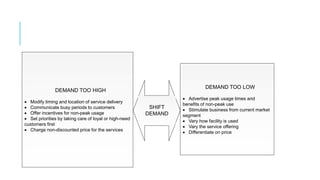
DEMAND TOO HIGH
 Modify timing and location of service delivery
 Communicate busy periods to customers
 Offer incentives for non-peak usage
 Set priorities by taking care of loyal or high-need
customers first
 Charge non-discounted price for the services
DEMAND TOO LOW
 Advertise peak usage times and
benefits of non-peak use
 Stimulate business from current market
segment
 Vary how facility is used
 Vary the service offering
 Differentiate on price
SHIFT
DEMAND
When the demand is too high as compared to the capacity various tactics can be
used to reduce the demand during peak periods as illustrated in Figure and
discussed below.
Communicate with Customers: An approach to shifting demand when it is too
high is to let customers know the periods of high demand. Customers can be
requested to visit the facility at periods of low demand.
Modify Timing and Location of Service Delivery: Longer operating hours suiting
the requirements of customers can be a method of shifting demand, Moreover,
locating facilities like banks and theatres to supermarkets or hypermarkets can
also help in smoothing demand for these facilities.
Offer Incentives for Non-peak Usage: Incentives can be offered for beginning of
season or end of season usage.
Set Priorities: Service providers can priorities service delivery to the most
lucrative needy customers thereby making other customers wait for their
turn during non-peak hours.
Charge Full Price: Service providers can charge full price for customers who
require the use of services during peak periods.
When the demand is too low as compared to the capacity of the service
provider, the demand can be increased using a variety of tactics as discussed
below.
Stimulate Business from Current Market Segments: Service providers like
tourists can advertise their services during dull periods to enhance demand
during dull periods.
Provide Facility for Alternative Uses: Service providers like provide their
facilities during lean periods for alternative uses. For example, movie
theatres can rent out their facilities for business conventions during dull
periods.
Vary the Service Offering: Service providers can vary how the service is
offered during peak periods to smooth the demand. When theatres are
packed, people may not venture out to buy eatables fearing that the movie
would start while they are negotiating long queues. In such cases, the
theatre can make provision of eatables inside the theatre and increase
demand.
Differentiate on Price: Service providers can provide their services at low
prices during lean periods to whip up demand and at high prices during
peak periods to lower demand for their services.
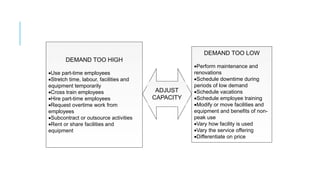
DEMAND TOO HIGH
Use part-time employees
Stretch time, labour, facilities and
equipment temporarily
Cross train employees
Hire part-time employees
Request overtime work from
employees
Subcontract or outsource activities
Rent or share facilities and
equipment
DEMAND TOO LOW
Perform maintenance and
renovations
Schedule downtime during
periods of low demand
Schedule vacations
Schedule employee training
Modify or move facilities and
equipment and benefits of non-
peak use
Vary how facility is used
Vary the service offering
Differentiate on price
ADJUST
CAPACITY
The service capacity can be temporarily adjusted to match the demand as
illustrated in Figure above, when the demand is too high as compared to the
capacity, the capacity can be temporarily stretched as discussed below. It
must however be kept in mind that quality of the service remains within
acceptable limits while the capacity is stretched.
Stretch Time Temporarily: Accountants can temporarily offer their services
during extended periods near the end of the tax season to handle higher
demand during those times.
Stretch Labour Temporarily: Frontline employees are asked to serve more
customers during peak times than during longer or lean periods. However,
people must be provided enough refreshments so that continuous stretch in
labour does not affect their health adversely.
Stretch Facilities Temporarily: Chairs and tables can be increased
temporarily within a facility like a restaurant to serve more customers
during peak periods.
Stretch Equipment Temporarily: Computers, tour busses etc. can be
temporarily increased during peak periods to handle peak demand.
The capacity of the service provider can be reduced when the demand for
services is too low. Tactics for doing this is discussed below.
Use Part-Time Employees: Use part-time employees who work during peak
periods and leave when not needed during lean periods.
Cross-Train Employees: Train employees to be multi-skilled so that they
can move to providing some services during peak periods and come back to
their own service during normal hours.
Outsource: Companies can outsource their work during times when the
demand exceeds capacity.
Rent or Share Facilities of Equipment: A church can share its facilities
with a preschool during weekdays, while the church can use the
facility during weekends.
Schedule Downtime during Periods of Low Demand: The service
provider can schedule repair, maintenance and renovations during
off-peak periods. For instance, a college can repair its furniture
during the vacations.
Modify or Move Facilities and Equipment: Hotels can use a temporary
partition to create two rooms from one during peak periods. Airplane
seats can be reconfigured to vary the number of seats in different
classes in the plane to adjust capacity to the demand.
QUESTIONS
Omega Fitness centre is a popular GYM in Pune. On some days (such
as weakened and holidays ) and during some timeslots (SUCH EARLY
MORNING AND LATE EVENING ),Omega experienced high demand.
What strategies can OMEGA implement to shift demand to match
capacity ?
What strategies Omega implement to adjust capacity to meet
demand?
SECOND PART : YIELD
As you might have understood by now, there can be demand-capacity
mismatches faced by a service business. One way to balance capacity
utilisation, pricing, market segmentation and financial returns is yield
or revenue management. This method tries to maximise the yield,
where
Yield = Actual revenue/Potential revenue
The potential revenue is the product of full capacity and the
maximum price that can be charged per unit capacity. However, the
actual revenue is the product of the actual capacity that could be
rented out a certain price(s).
THIS CONCEPT CAN BE
CLARIFIED WITH THE
FOLLOWING EXAMPLE:
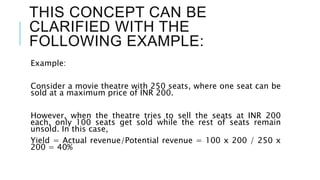
Example:
Consider a movie theatre with 250 seats, where one seat can be
sold at a maximum price of INR 200.
However, when the theatre tries to sell the seats at INR 200
each, only 100 seats get sold while the rest of seats remain
unsold. In this case,
Yield = Actual revenue/Potential revenue = 100 x 200 / 250 x
200 = 40%
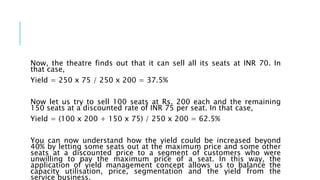
Now, the theatre finds out that it can sell all its seats at INR 70. In
that case,
Yield = 250 x 75 / 250 x 200 = 37.5%
Now let us try to sell 100 seats at Rs. 200 each and the remaining
150 seats at a discounted rate of INR 75 per seat. In that case,
Yield = (100 x 200 + 150 x 75) / 250 x 200 = 62.5%
You can now understand how the yield could be increased beyond
40% by letting some seats out at the maximum price and some other
seats at a discounted price to a segment of customers who were
unwilling to pay the maximum price of a seat. In this way, the
application of yield management concept allows us to balance the
capacity utilisation, price, segmentation and the yield from the
service business.
WAITING LINE
Bielen and Demoulin wrote in 2007 that customers are dissatisfied
when they have to wait for service delivery, Moreover, your business
may lose customer if their wait becomes long and intolerable. You
can use four strategies when you have to deal with customer waiting.
These strategies are discussed in the following paragraphs.
Employ Operational Logic
If customer waits are common, the first step is to analyse whether
the operational logic of the service system is making customers
wait more than necessary. For instance, Zeithaml and colleagues
have written in their book entitled “Services Marketing” that when
a bank found that its customers long queues, it developed a
computer-based customer information system to allow tellers to
answer questions more quickly, implemented an electronic
queuing system, hired “peak time” tellers, expanded its hours and
provided customers with alternative delivery channels.
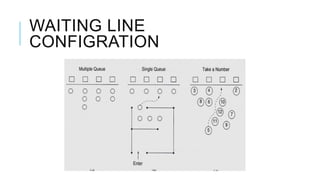
WAITING LINE
CONFIGRATION
Research by Zhou and Soman published in 2003 suggests that the probability of
a customer continuing to wait in a queue varies directly as the length of the
queue behind that customer.
Employ a Reservation Process
You might already be knowing about a reservation process in a train for
instance. When a service provider has a doubt that a flight will have to leave with
less than full capacity due to last minute cancellations or no show, they can
resort to overbooking. In case of overbooking, the overbooked passenger knows
is overbook status and can be paid a compensation if the s(he) cannot be
provided a seat in the flight.
Differentiate waiting customers: The usual “queue discipline” is first come, first
served. However, some customers can be served before others using different
modes of differentiation. These include:
a. Importance of the customer – customers who do more business with the
service provider are more important to the business and can be served
using a different queue.
b. Urgency of the job – Emergency patients get attention before others do
c. Duration of the service transactions – relatively shorter transactions are
served before longer ones
d. Premium price – customers willing to pay premium price are served
before others.
Make waiting pleasurable or at least tolerable: In 1985 David Maister wrote a
classic article entitled the “They Psychology of Waiting Lines” which proposed
several principles about waiting, each of which has implications for how
organisations can make waiting more pleasurable or at least tolerable.
The principles are as follows:
Unoccupied time feels longer than occupied time, so involve customers in
co-creating the service while waiting
Pre-process waits feel longer that in process waits
Remove customer worries like whether the other line is going to move
faster
Uncertain waits are longer than know finite waits. When customers
do not know how long they have to wait, they are more anxiety and
dissatisfied as compared to when they know the length of time they
have to wait.
Unexplained waits are longer than explained waits
Unfair waits are longer than equitable waits
The more valuable the service, longer the customer is willing to wait
Solo waits feel longer than group waits
We have discussed strategies for matching supply and
demand and the concept of yield management. We
have also discussed various waiting line strategies,
including the principles of making waiting pleasurable
or at least tolerable.

Managing capacity and demand

  • 1.
    MANAGING CAPACITY AND DEMAND Dr.Binod Sinha Professor BIMM Pune
  • 2.
    HOW TO FILL281 ROOMS 365 DAYS Hotel Radisson Blue -----A Five Star Business Hotel -------Demand (Peak time and Off) Think How to fill 281 rooms 365 days……..
  • 3.
    E SQUARE AMULTIPLEX IN PUNE 4 SCREEN 200 SEATS IN EACHSCREEN HOW TO FILL 200 SEATS IN EVERY SHOW 365 DAYS Think if not there is huge loss………
  • 4.
    EXAMPLE OF RESTAURANT Youmust have noticed that there is heavy demand in a restaurant during lunch or dinner hours, while it is relatively free of customers during other times. As there is a constraint on the capacity of the restaurant, the restaurant can serve a limited number of customers at any point in time.
  • 5.
    THINK If more customersarrive at the restaurant during the rush hours or ‘peak period’ they have to wait for the service or they have to leave the restaurant and take their business elsewhere. Waiting might cause some discomfort to the customer. On the other hand, the restaurant loses business, if customers have to leave due to the capacity constraint. At the same time, there are few customers during ‘lean periods’. This means that there are more servers than required to serve the small number of customers who turn up during the lean period and the service business is wasting its resources due to idling.
  • 6.
    THINK This phenomenon ofmismatch between service demand and capacity occurs due to the perishable and simultaneous characteristics of services. You might be aware of some methods restaurants use to circumvent the above problems. Some restaurants like McDonald’s use ‘Happy Hours’ during lean periods during which McDonald’s provides discounts to its customers. Other restaurants use ‘floating staff’ who serve customers during peak periods and do other work during lean periods.
  • 7.
    CONCEPT OF OPTIMUMVS MAXIMUM There is a difference between optimal use of capacity versus maximum use of capacity. Optimal usage ensures that all resources are being used productively to deliver the desired quality while maximum use may require that resources be strained to serve more customers than that can be served at the desired level of quality.
  • 8.
    Obviously, it isrecommended that a service business should make optimal use of its capacity instead of making maximum use of its capacity. Service businesses must understand and codify the optimum capacity of its human resources and other physical facilities in order to be consistently delivering the promised level of service quality.
  • 9.
    CAPACITY CONSTRAINTS Service capacityis fixed for many firms. Depending on the type of service, time, labour, equipment, facilities or a combination of these can be a constraint. For example, time is a constraint for legal and medical services, labour is a constraint for restaurant services, equipment is a constraint for a fitness centre and facilities are a constraint for a school or college.
  • 10.
    THINK We can chartout the periodic and random demand fluctuations and try to understand their causes. This can help us devise strategies towards matching demand and capacity. WE can chart periodic demand hourly, daily, weekly, monthly or yearly. For instance, restaurants will have daily demand fluctuations while retail stores will face yearly demand fluctuations.
  • 11.
    THINK Similarly there canbe random demand fluctuations due to factors like the weather, which can affect demand for restaurant seats. Similarly, demand from different segments can fluctuate. For instance, a bank might face predictable service demand from its business customers but unpredictable demand from its individual customers
  • 12.
    When service businesseshave clear understanding of their capacity constraints and the source and periodicity of their demand fluctuations, they can closely match their capacity to their demand. An example of such match for a restaurant business has been given earlier in this lesson.
  • 13.
    THINK There are twogeneric strategies of matching capacity with demand. The first is to smooth the demand fluctuations by shifting parts of peak demand to lean periods as in the case of ‘Happy Hours’ by McDonald’s in order to match the capacity. The second strategy is the match the excess capacity with the demand peaks and troughs as in the case of using multi-skilled staff who can serve customers during peak periods and do other work during lean periods, as given in the example earlier. Various tactics that can be used in relation to the above two generic strategies are discussed in the following sections.
  • 14.
    DEMAND TOO HIGH Modify timing and location of service delivery  Communicate busy periods to customers  Offer incentives for non-peak usage  Set priorities by taking care of loyal or high-need customers first  Charge non-discounted price for the services DEMAND TOO LOW  Advertise peak usage times and benefits of non-peak use  Stimulate business from current market segment  Vary how facility is used  Vary the service offering  Differentiate on price SHIFT DEMAND
  • 15.
    When the demandis too high as compared to the capacity various tactics can be used to reduce the demand during peak periods as illustrated in Figure and discussed below. Communicate with Customers: An approach to shifting demand when it is too high is to let customers know the periods of high demand. Customers can be requested to visit the facility at periods of low demand. Modify Timing and Location of Service Delivery: Longer operating hours suiting the requirements of customers can be a method of shifting demand, Moreover, locating facilities like banks and theatres to supermarkets or hypermarkets can also help in smoothing demand for these facilities. Offer Incentives for Non-peak Usage: Incentives can be offered for beginning of season or end of season usage.
  • 16.
    Set Priorities: Serviceproviders can priorities service delivery to the most lucrative needy customers thereby making other customers wait for their turn during non-peak hours. Charge Full Price: Service providers can charge full price for customers who require the use of services during peak periods. When the demand is too low as compared to the capacity of the service provider, the demand can be increased using a variety of tactics as discussed below. Stimulate Business from Current Market Segments: Service providers like tourists can advertise their services during dull periods to enhance demand during dull periods.
  • 17.
    Provide Facility forAlternative Uses: Service providers like provide their facilities during lean periods for alternative uses. For example, movie theatres can rent out their facilities for business conventions during dull periods. Vary the Service Offering: Service providers can vary how the service is offered during peak periods to smooth the demand. When theatres are packed, people may not venture out to buy eatables fearing that the movie would start while they are negotiating long queues. In such cases, the theatre can make provision of eatables inside the theatre and increase demand. Differentiate on Price: Service providers can provide their services at low prices during lean periods to whip up demand and at high prices during peak periods to lower demand for their services.
  • 18.
    DEMAND TOO HIGH Usepart-time employees Stretch time, labour, facilities and equipment temporarily Cross train employees Hire part-time employees Request overtime work from employees Subcontract or outsource activities Rent or share facilities and equipment DEMAND TOO LOW Perform maintenance and renovations Schedule downtime during periods of low demand Schedule vacations Schedule employee training Modify or move facilities and equipment and benefits of non- peak use Vary how facility is used Vary the service offering Differentiate on price ADJUST CAPACITY
  • 19.
    The service capacitycan be temporarily adjusted to match the demand as illustrated in Figure above, when the demand is too high as compared to the capacity, the capacity can be temporarily stretched as discussed below. It must however be kept in mind that quality of the service remains within acceptable limits while the capacity is stretched. Stretch Time Temporarily: Accountants can temporarily offer their services during extended periods near the end of the tax season to handle higher demand during those times. Stretch Labour Temporarily: Frontline employees are asked to serve more customers during peak times than during longer or lean periods. However, people must be provided enough refreshments so that continuous stretch in labour does not affect their health adversely.
  • 20.
    Stretch Facilities Temporarily:Chairs and tables can be increased temporarily within a facility like a restaurant to serve more customers during peak periods. Stretch Equipment Temporarily: Computers, tour busses etc. can be temporarily increased during peak periods to handle peak demand.
  • 21.
    The capacity ofthe service provider can be reduced when the demand for services is too low. Tactics for doing this is discussed below. Use Part-Time Employees: Use part-time employees who work during peak periods and leave when not needed during lean periods. Cross-Train Employees: Train employees to be multi-skilled so that they can move to providing some services during peak periods and come back to their own service during normal hours. Outsource: Companies can outsource their work during times when the demand exceeds capacity.
  • 22.
    Rent or ShareFacilities of Equipment: A church can share its facilities with a preschool during weekdays, while the church can use the facility during weekends. Schedule Downtime during Periods of Low Demand: The service provider can schedule repair, maintenance and renovations during off-peak periods. For instance, a college can repair its furniture during the vacations. Modify or Move Facilities and Equipment: Hotels can use a temporary partition to create two rooms from one during peak periods. Airplane seats can be reconfigured to vary the number of seats in different classes in the plane to adjust capacity to the demand.
  • 23.
    QUESTIONS Omega Fitness centreis a popular GYM in Pune. On some days (such as weakened and holidays ) and during some timeslots (SUCH EARLY MORNING AND LATE EVENING ),Omega experienced high demand. What strategies can OMEGA implement to shift demand to match capacity ? What strategies Omega implement to adjust capacity to meet demand?
  • 24.
    SECOND PART :YIELD As you might have understood by now, there can be demand-capacity mismatches faced by a service business. One way to balance capacity utilisation, pricing, market segmentation and financial returns is yield or revenue management. This method tries to maximise the yield, where Yield = Actual revenue/Potential revenue The potential revenue is the product of full capacity and the maximum price that can be charged per unit capacity. However, the actual revenue is the product of the actual capacity that could be rented out a certain price(s).
  • 25.
    THIS CONCEPT CANBE CLARIFIED WITH THE FOLLOWING EXAMPLE: Example: Consider a movie theatre with 250 seats, where one seat can be sold at a maximum price of INR 200. However, when the theatre tries to sell the seats at INR 200 each, only 100 seats get sold while the rest of seats remain unsold. In this case, Yield = Actual revenue/Potential revenue = 100 x 200 / 250 x 200 = 40%
  • 26.
    Now, the theatrefinds out that it can sell all its seats at INR 70. In that case, Yield = 250 x 75 / 250 x 200 = 37.5% Now let us try to sell 100 seats at Rs. 200 each and the remaining 150 seats at a discounted rate of INR 75 per seat. In that case, Yield = (100 x 200 + 150 x 75) / 250 x 200 = 62.5% You can now understand how the yield could be increased beyond 40% by letting some seats out at the maximum price and some other seats at a discounted price to a segment of customers who were unwilling to pay the maximum price of a seat. In this way, the application of yield management concept allows us to balance the capacity utilisation, price, segmentation and the yield from the service business.
  • 27.
    WAITING LINE Bielen andDemoulin wrote in 2007 that customers are dissatisfied when they have to wait for service delivery, Moreover, your business may lose customer if their wait becomes long and intolerable. You can use four strategies when you have to deal with customer waiting. These strategies are discussed in the following paragraphs. Employ Operational Logic
  • 28.
    If customer waitsare common, the first step is to analyse whether the operational logic of the service system is making customers wait more than necessary. For instance, Zeithaml and colleagues have written in their book entitled “Services Marketing” that when a bank found that its customers long queues, it developed a computer-based customer information system to allow tellers to answer questions more quickly, implemented an electronic queuing system, hired “peak time” tellers, expanded its hours and provided customers with alternative delivery channels.
  • 29.
  • 30.
    Research by Zhouand Soman published in 2003 suggests that the probability of a customer continuing to wait in a queue varies directly as the length of the queue behind that customer. Employ a Reservation Process You might already be knowing about a reservation process in a train for instance. When a service provider has a doubt that a flight will have to leave with less than full capacity due to last minute cancellations or no show, they can resort to overbooking. In case of overbooking, the overbooked passenger knows is overbook status and can be paid a compensation if the s(he) cannot be provided a seat in the flight. Differentiate waiting customers: The usual “queue discipline” is first come, first served. However, some customers can be served before others using different modes of differentiation. These include:
  • 31.
    a. Importance ofthe customer – customers who do more business with the service provider are more important to the business and can be served using a different queue. b. Urgency of the job – Emergency patients get attention before others do c. Duration of the service transactions – relatively shorter transactions are served before longer ones d. Premium price – customers willing to pay premium price are served before others.
  • 32.
    Make waiting pleasurableor at least tolerable: In 1985 David Maister wrote a classic article entitled the “They Psychology of Waiting Lines” which proposed several principles about waiting, each of which has implications for how organisations can make waiting more pleasurable or at least tolerable. The principles are as follows: Unoccupied time feels longer than occupied time, so involve customers in co-creating the service while waiting Pre-process waits feel longer that in process waits Remove customer worries like whether the other line is going to move faster
  • 33.
    Uncertain waits arelonger than know finite waits. When customers do not know how long they have to wait, they are more anxiety and dissatisfied as compared to when they know the length of time they have to wait. Unexplained waits are longer than explained waits Unfair waits are longer than equitable waits The more valuable the service, longer the customer is willing to wait Solo waits feel longer than group waits
  • 34.
    We have discussedstrategies for matching supply and demand and the concept of yield management. We have also discussed various waiting line strategies, including the principles of making waiting pleasurable or at least tolerable.