New Service Development
and Process Design
G GOPINATH
ASST PROF - MECH
Learning Objectives
• Discuss the new service development process.
• Prepare a blueprint for a service operation.
• Describe a service process using the dimensions of
divergence and complexity.
• Use the taxonomy of service processes to classify a service
operation.
• Compare and contrast the generic approaches to service
system design.
• Place an example of service automation in it proper
category.
• Discuss the managerial issues associated with the adoption
of new technology.
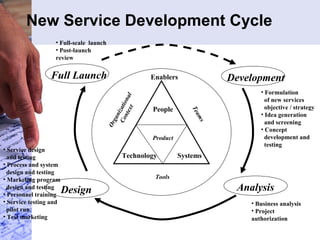
New Service Development Cycle
• Service design
and testing
• Process and system
design and testing
• Marketing program
design and testing
• Personnel training
• Service testing and
pilot run
• Test marketing
People
Technology Systems
Product
Full Launch Development
Design Analysis
Organizational
Context
Teams
Tools
Enablers
• Formulation
of new services
objective / strategy
• Idea generation
and screening
• Concept
development and
testing
• Business analysis
• Project
authorization
• Full-scale launch
• Post-launch
review
Levels of Service Innovation
Radical Innovations
• Major Innovation: new service driven by information and
computer based technology
• Start-up Business: new service for existing market
• New Services for the Market Presently Served: new services
to customers of an organization
Incremental Innovations
• Service Line Extensions: augmentation of existing service
line (e.g. new menu items)
• Service Improvements: changes in features of currently
offered service
• Style Changes: modest visible changes in appearances
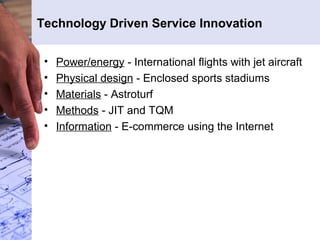
Technology Driven Service Innovation
• Power/energy - International flights with jet aircraft
• Physical design - Enclosed sports stadiums
• Materials - Astroturf
• Methods - JIT and TQM
• Information - E-commerce using the Internet
Adoption of New Technology in
Services
• Challenges of Adopting New Technology
The Process is the Product
Back Office vs Front Office Changes
Need for Standardization
• Managing the New Technology Adoption
Process
Ten step process with concern for
employees and customers
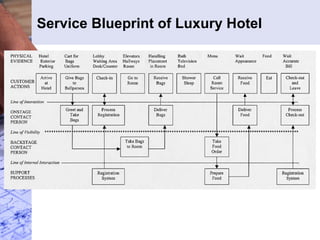
Service Blueprint of Luxury Hotel
Blending Blueprinting with Lean
Womack and Jones, “Lean Consumption”, HBR March 2005.
• Principles of Lean Consumption:
1. Solve the customer’s problem completely by ensuring that all the
goods and services work, and work together
– Home: search, find, purchase, maintain, repair, upgrade
– Cell phone: calling, pda, pictures, music, hot synch., downloads, internet…
1. Don’t waste the customer’s time
– Enhanced blueprint: add value-creating, and wasted time for customer and
provider. Calculate total time and % value added.
1. Provide exactly what the customer wants
– Prevent stockouts from long supply chains
– Nike’s custom bags from NuSewCo in San Francisco
1. Provide what’s wanted exactly where it’s wanted
– Offer services through all desired channels, on-line, local, big-box,
phone…
1. Provide what’s wanted where it’s wanted exactly when it’s wanted
– Sometimes this may be some time off. Could I get it customized merely by
sharing plans?
1. Continually aggregate solutions to reduce the customer’s time and
hassle.
– One stop for the really big problems: mobility, communications, shelter,
health care, financial management, shopping.
Strategic Positioning
Through Process Structure
• Degree of Complexity: Measured by the
number of steps in the service blueprint.
For example a clinic is less complex than a
general hospital.
• Degree of Divergence: Amount of discretion
permitted the server to customize the
service. For example the activities of an
attorney contrasted with those of a
paralegal.
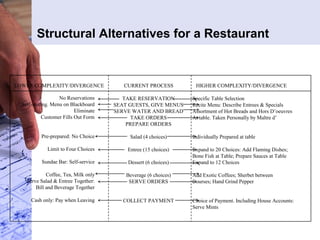
Structural Alternatives for a Restaurant
No Reservations
Self-seating. Menu on Blackboard
Eliminate
Customer Fills Out Form
Pre-prepared: No Choice
Limit to Four Choices
Sundae Bar: Self-service
Coffee, Tea, Milk only
Serve Salad & Entree Together:
Bill and Beverage Together
Cash only: Pay when Leaving
TAKE RESERVATION
SEAT GUESTS, GIVE MENUS
SERVE WATER AND BREAD
TAKE ORDERS
PREPARE ORDERS
Salad (4 choices)
Entree (15 choices)
Dessert (6 choices)
Beverage (6 choices)
SERVE ORDERS
COLLECT PAYMENT
Specific Table Selection
Recite Menu: Describe Entrees & Specials
Assortment of Hot Breads and Hors D’oeuvres
At table. Taken Personally by Maltre d’
Individually Prepared at table
Expand to 20 Choices: Add Flaming Dishes;
Bone Fish at Table; Prepare Sauces at Table
Expand to 12 Choices
Add Exotic Coffees; Sherbet between
Courses; Hand Grind Pepper
Choice of Payment. Including House Accounts:
Serve Mints
LOWER COMPLEXITY/DIVERGENCE CURRENT PROCESS HIGHER COMPLEXITY/DIVERGENCE
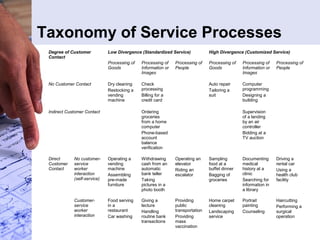
Taxonomy of Service Processes
Degree of Customer
Contact
Low Divergence (Standardized Service) High Divergence (Customized Service)
Processing of
Goods
Processing of
Information or
Images
Processing of
People
Processing of
Goods
Processing of
Information or
Images
Processing of
People
No Customer Contact Dry cleaning
Restocking a
vending
machine
Check
processing
Billing for a
credit card
Auto repair
Tailoring a
suit
Computer
programming
Designing a
building
Indirect Customer Contact Ordering
groceries
from a home
computer
Phone-based
account
balance
verification
Supervision
of a landing
by an air
controller
Bidding at a
TV auction
Direct
Customer
Contact
No customer-
service
worker
interaction
(self-service)
Operating a
vending
machine
Assembling
pre-made
furniture
Withdrawing
cash from an
automatic
bank teller
Taking
pictures in a
photo booth
Operating an
elevator
Riding an
escalator
Sampling
food at a
buffet dinner
Bagging of
groceries
Documenting
medical
history at a
clinic
Searching for
information in
a library
Driving a
rental car
Using a
health club
facility
Customer-
service
worker
interaction
Food serving
in a
restaurant
Car washing
Giving a
lecture
Handling
routine bank
transactions
Providing
public
transportation
Providing
mass
vaccination
Home carpet
cleaning
Landscaping
service
Portrait
painting
Counseling
Haircutting
Performing a
surgical
operation
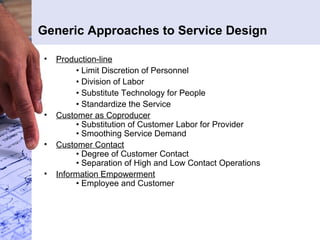
Generic Approaches to Service Design
• Production-line
• Limit Discretion of Personnel
• Division of Labor
• Substitute Technology for People
• Standardize the Service
• Customer as Coproducer
• Substitution of Customer Labor for Provider
• Smoothing Service Demand
• Customer Contact
• Degree of Customer Contact
• Separation of High and Low Contact Operations
• Information Empowerment
• Employee and Customer
Discussion Questions
• What ethical issues are raised in the promotion of
sales during a service transaction?
• What are some drawbacks of customer
participation in the service delivery process?
• What are the limits in the production-line approach
to service?
• Give an example of a service in which isolation of
the technical core would be inappropriate.
Commuter Cleaning - New Venture Proposal
1. Prepare a service blueprint for Commuter
Cleaning.
2. What generic approach to service design is
illustrated by Commuter Cleaning, and what
competitive advantage does this offer?
3. Using the data in Table 4.6 calculate a break-
even price per shirt if monthly demand is
expected to be 20,000 shirts and the contract
with a cleaning plant stipulates a charge of $0.50
per shirt.
4. Critique the business concept, and make
recommendations for improvement.
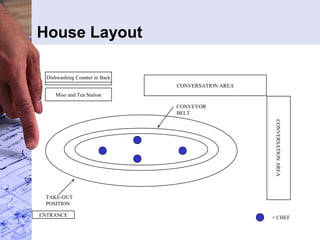
House Layout
Miso and Tea Station
CONVERSATION AREA
CONVERSATIONAREA
Dishwashing Counter in Back
ENTRANCE
CONVEYOR
BELT
TAKE-OUT
POSITION
= CHEF
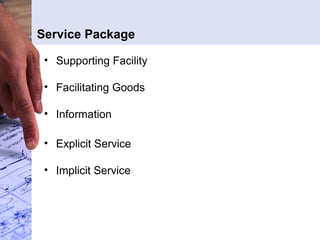
Service Package
• Supporting Facility
• Facilitating Goods
• Information
• Explicit Service
• Implicit Service

New service-development-process-design

  • 1.
    New Service Development andProcess Design G GOPINATH ASST PROF - MECH
  • 2.
    Learning Objectives • Discussthe new service development process. • Prepare a blueprint for a service operation. • Describe a service process using the dimensions of divergence and complexity. • Use the taxonomy of service processes to classify a service operation. • Compare and contrast the generic approaches to service system design. • Place an example of service automation in it proper category. • Discuss the managerial issues associated with the adoption of new technology.
  • 3.
    New Service DevelopmentCycle • Service design and testing • Process and system design and testing • Marketing program design and testing • Personnel training • Service testing and pilot run • Test marketing People Technology Systems Product Full Launch Development Design Analysis Organizational Context Teams Tools Enablers • Formulation of new services objective / strategy • Idea generation and screening • Concept development and testing • Business analysis • Project authorization • Full-scale launch • Post-launch review
  • 4.
    Levels of ServiceInnovation Radical Innovations • Major Innovation: new service driven by information and computer based technology • Start-up Business: new service for existing market • New Services for the Market Presently Served: new services to customers of an organization Incremental Innovations • Service Line Extensions: augmentation of existing service line (e.g. new menu items) • Service Improvements: changes in features of currently offered service • Style Changes: modest visible changes in appearances
  • 5.
    Technology Driven ServiceInnovation • Power/energy - International flights with jet aircraft • Physical design - Enclosed sports stadiums • Materials - Astroturf • Methods - JIT and TQM • Information - E-commerce using the Internet
  • 6.
    Adoption of NewTechnology in Services • Challenges of Adopting New Technology The Process is the Product Back Office vs Front Office Changes Need for Standardization • Managing the New Technology Adoption Process Ten step process with concern for employees and customers
  • 7.
  • 8.
    Blending Blueprinting withLean Womack and Jones, “Lean Consumption”, HBR March 2005. • Principles of Lean Consumption: 1. Solve the customer’s problem completely by ensuring that all the goods and services work, and work together – Home: search, find, purchase, maintain, repair, upgrade – Cell phone: calling, pda, pictures, music, hot synch., downloads, internet… 1. Don’t waste the customer’s time – Enhanced blueprint: add value-creating, and wasted time for customer and provider. Calculate total time and % value added. 1. Provide exactly what the customer wants – Prevent stockouts from long supply chains – Nike’s custom bags from NuSewCo in San Francisco 1. Provide what’s wanted exactly where it’s wanted – Offer services through all desired channels, on-line, local, big-box, phone… 1. Provide what’s wanted where it’s wanted exactly when it’s wanted – Sometimes this may be some time off. Could I get it customized merely by sharing plans? 1. Continually aggregate solutions to reduce the customer’s time and hassle. – One stop for the really big problems: mobility, communications, shelter, health care, financial management, shopping.
  • 9.
    Strategic Positioning Through ProcessStructure • Degree of Complexity: Measured by the number of steps in the service blueprint. For example a clinic is less complex than a general hospital. • Degree of Divergence: Amount of discretion permitted the server to customize the service. For example the activities of an attorney contrasted with those of a paralegal.
  • 10.
    Structural Alternatives fora Restaurant No Reservations Self-seating. Menu on Blackboard Eliminate Customer Fills Out Form Pre-prepared: No Choice Limit to Four Choices Sundae Bar: Self-service Coffee, Tea, Milk only Serve Salad & Entree Together: Bill and Beverage Together Cash only: Pay when Leaving TAKE RESERVATION SEAT GUESTS, GIVE MENUS SERVE WATER AND BREAD TAKE ORDERS PREPARE ORDERS Salad (4 choices) Entree (15 choices) Dessert (6 choices) Beverage (6 choices) SERVE ORDERS COLLECT PAYMENT Specific Table Selection Recite Menu: Describe Entrees & Specials Assortment of Hot Breads and Hors D’oeuvres At table. Taken Personally by Maltre d’ Individually Prepared at table Expand to 20 Choices: Add Flaming Dishes; Bone Fish at Table; Prepare Sauces at Table Expand to 12 Choices Add Exotic Coffees; Sherbet between Courses; Hand Grind Pepper Choice of Payment. Including House Accounts: Serve Mints LOWER COMPLEXITY/DIVERGENCE CURRENT PROCESS HIGHER COMPLEXITY/DIVERGENCE
  • 11.
    Taxonomy of ServiceProcesses Degree of Customer Contact Low Divergence (Standardized Service) High Divergence (Customized Service) Processing of Goods Processing of Information or Images Processing of People Processing of Goods Processing of Information or Images Processing of People No Customer Contact Dry cleaning Restocking a vending machine Check processing Billing for a credit card Auto repair Tailoring a suit Computer programming Designing a building Indirect Customer Contact Ordering groceries from a home computer Phone-based account balance verification Supervision of a landing by an air controller Bidding at a TV auction Direct Customer Contact No customer- service worker interaction (self-service) Operating a vending machine Assembling pre-made furniture Withdrawing cash from an automatic bank teller Taking pictures in a photo booth Operating an elevator Riding an escalator Sampling food at a buffet dinner Bagging of groceries Documenting medical history at a clinic Searching for information in a library Driving a rental car Using a health club facility Customer- service worker interaction Food serving in a restaurant Car washing Giving a lecture Handling routine bank transactions Providing public transportation Providing mass vaccination Home carpet cleaning Landscaping service Portrait painting Counseling Haircutting Performing a surgical operation
  • 12.
    Generic Approaches toService Design • Production-line • Limit Discretion of Personnel • Division of Labor • Substitute Technology for People • Standardize the Service • Customer as Coproducer • Substitution of Customer Labor for Provider • Smoothing Service Demand • Customer Contact • Degree of Customer Contact • Separation of High and Low Contact Operations • Information Empowerment • Employee and Customer
  • 13.
    Discussion Questions • Whatethical issues are raised in the promotion of sales during a service transaction? • What are some drawbacks of customer participation in the service delivery process? • What are the limits in the production-line approach to service? • Give an example of a service in which isolation of the technical core would be inappropriate.
  • 14.
    Commuter Cleaning -New Venture Proposal 1. Prepare a service blueprint for Commuter Cleaning. 2. What generic approach to service design is illustrated by Commuter Cleaning, and what competitive advantage does this offer? 3. Using the data in Table 4.6 calculate a break- even price per shirt if monthly demand is expected to be 20,000 shirts and the contract with a cleaning plant stipulates a charge of $0.50 per shirt. 4. Critique the business concept, and make recommendations for improvement.
  • 15.
    House Layout Miso andTea Station CONVERSATION AREA CONVERSATIONAREA Dishwashing Counter in Back ENTRANCE CONVEYOR BELT TAKE-OUT POSITION = CHEF
  • 16.
    Service Package • SupportingFacility • Facilitating Goods • Information • Explicit Service • Implicit Service