 The leadership studies in this case identified two
  concepts, which the researchers called employee
  orientation and production orientation.
 The employee-oriented leaders emphasized the
  relationship aspects of their job.
 Production-oriented leaders emphasized
  production and the technical aspects of the job,
  while employees were seen as tools to accomplish
  the goals of the organization.
 The study concluded that employee-orientation
  leader behaviour was found to be more effective.
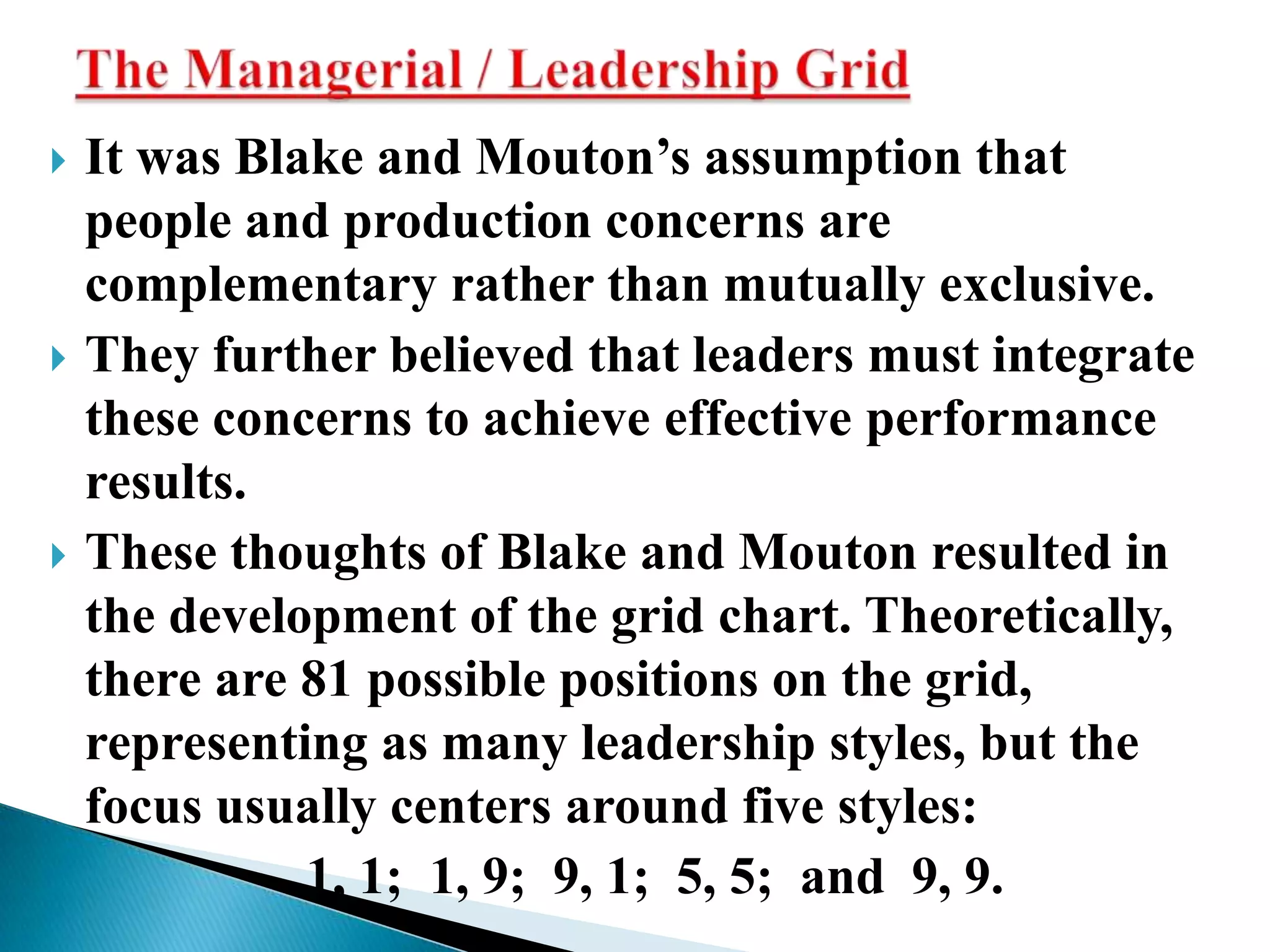
   It was Blake and Mouton’s assumption that
    people and production concerns are
    complementary rather than mutually exclusive.
   They further believed that leaders must integrate
    these concerns to achieve effective performance
    results.
   These thoughts of Blake and Mouton resulted in
    the development of the grid chart. Theoretically,
    there are 81 possible positions on the grid,
    representing as many leadership styles, but the
    focus usually centers around five styles:
              1, 1; 1, 9; 9, 1; 5, 5; and 9, 9.
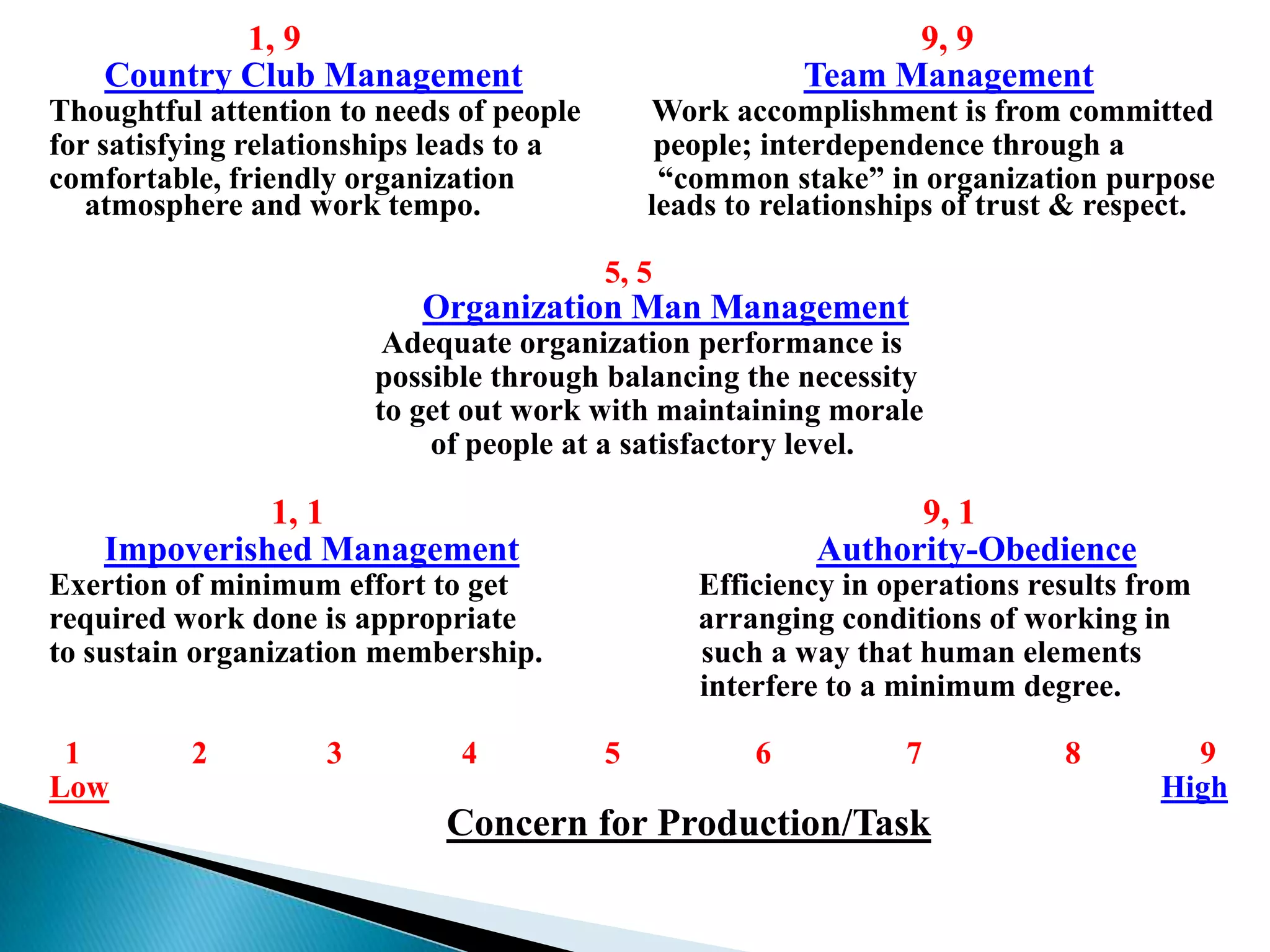
1, 9                                               9, 9
    Country Club Management                              Team Management
Thoughtful attention to needs of people       Work accomplishment is from committed
for satisfying relationships leads to a        people; interdependence through a
comfortable, friendly organization             “common stake” in organization purpose
   atmosphere and work tempo.                 leads to relationships of trust & respect.

                                          5, 5
                           Organization Man Management
                         Adequate organization performance is
                        possible through balancing the necessity
                        to get out work with maintaining morale
                            of people at a satisfactory level.

              1, 1                                              9, 1
    Impoverished Management                               Authority-Obedience
Exertion of minimum effort to get                Efficiency in operations results from
required work done is appropriate                arranging conditions of working in
to sustain organization membership.              such a way that human elements
                                                 interfere to a minimum degree.

 1        2         3         4           5          6           7          8        9
Low                                                                                High
                             Concern for Production/Task
   The 9, 1 leader is primarily concerned with production
    task accomplishment and has little, if any concern for
    people. This person wants to meet schedules and get the
    work done at all costs.
   The 1, 9 style represents a minimal concern for
    production, coupled with a maximal concern for the
    people;
   The 1, 1 style represents both minimal concern for both,
    people and production.
   The 9, 9 style is viewed as the ideal approach for
    integrating a maximum concern for production with a
    maximum concern for people.
   Though this managerial grid has not been thoroughly
    supported by research, it is still a popular theory of
    leadership.
The theories and research studies presented
thus far, each employ two factors: employee
oriented and production oriented and
initiating structure and consideration and
concern for production and concern for
people. Bowers and Seashore however felt
that two factors alone were inadequate to
define a complex aspect like leadership.
They felt that the under mentioned four
factors more adequately defined leadership.
   Support – behaviour which enhances the
    followers’ feelings of personal support and esteem.
   Interaction Facilitation – behaviour which
    encourages followers in the group to develop
    close, mutually satisfying relationships.
   Goal Emphasis – behaviour which motivates an
    enthusiasm within the group for achieving high
    levels of performance.
   Work Facilitation – behaviour which helps goal
    accomplishment by such activities as scheduling,
    coordinating and planning and by providing
    resources such as tools, materials and technical
    knowledge.

Managerial leadership grid

  • 1.
     The leadershipstudies in this case identified two concepts, which the researchers called employee orientation and production orientation.  The employee-oriented leaders emphasized the relationship aspects of their job.  Production-oriented leaders emphasized production and the technical aspects of the job, while employees were seen as tools to accomplish the goals of the organization.  The study concluded that employee-orientation leader behaviour was found to be more effective.
  • 2.
    It was Blake and Mouton’s assumption that people and production concerns are complementary rather than mutually exclusive.  They further believed that leaders must integrate these concerns to achieve effective performance results.  These thoughts of Blake and Mouton resulted in the development of the grid chart. Theoretically, there are 81 possible positions on the grid, representing as many leadership styles, but the focus usually centers around five styles: 1, 1; 1, 9; 9, 1; 5, 5; and 9, 9.
  • 3.
    1, 9 9, 9 Country Club Management Team Management Thoughtful attention to needs of people Work accomplishment is from committed for satisfying relationships leads to a people; interdependence through a comfortable, friendly organization “common stake” in organization purpose atmosphere and work tempo. leads to relationships of trust & respect. 5, 5 Organization Man Management Adequate organization performance is possible through balancing the necessity to get out work with maintaining morale of people at a satisfactory level. 1, 1 9, 1 Impoverished Management Authority-Obedience Exertion of minimum effort to get Efficiency in operations results from required work done is appropriate arranging conditions of working in to sustain organization membership. such a way that human elements interfere to a minimum degree. 1 2 3 4 5 6 7 8 9 Low High Concern for Production/Task
  • 4.
    The 9, 1 leader is primarily concerned with production task accomplishment and has little, if any concern for people. This person wants to meet schedules and get the work done at all costs.  The 1, 9 style represents a minimal concern for production, coupled with a maximal concern for the people;  The 1, 1 style represents both minimal concern for both, people and production.  The 9, 9 style is viewed as the ideal approach for integrating a maximum concern for production with a maximum concern for people.  Though this managerial grid has not been thoroughly supported by research, it is still a popular theory of leadership.
  • 5.
    The theories andresearch studies presented thus far, each employ two factors: employee oriented and production oriented and initiating structure and consideration and concern for production and concern for people. Bowers and Seashore however felt that two factors alone were inadequate to define a complex aspect like leadership. They felt that the under mentioned four factors more adequately defined leadership.
  • 6.
    Support – behaviour which enhances the followers’ feelings of personal support and esteem.  Interaction Facilitation – behaviour which encourages followers in the group to develop close, mutually satisfying relationships.  Goal Emphasis – behaviour which motivates an enthusiasm within the group for achieving high levels of performance.  Work Facilitation – behaviour which helps goal accomplishment by such activities as scheduling, coordinating and planning and by providing resources such as tools, materials and technical knowledge.