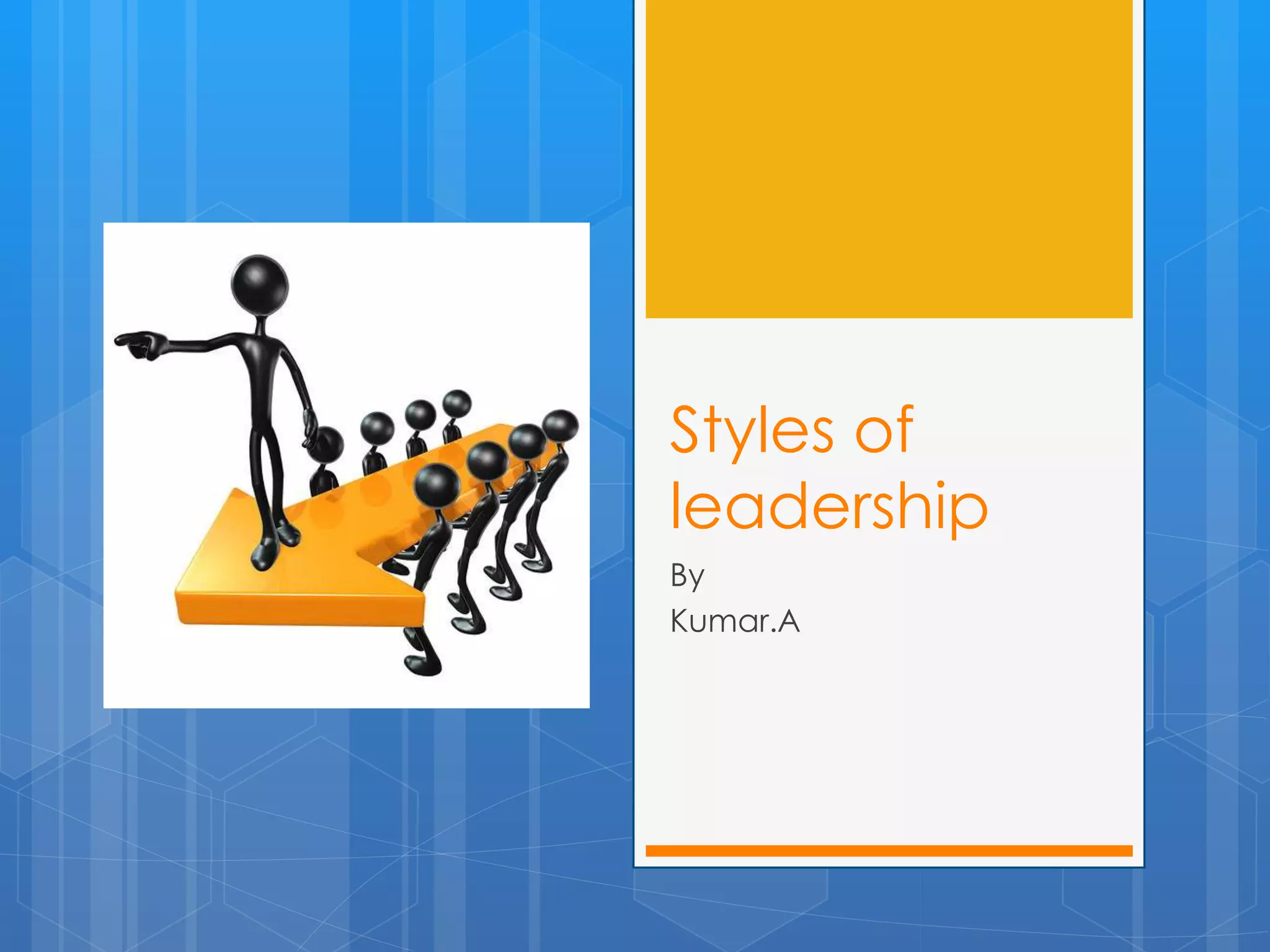
Styles of
leadership
By
Kumar.A
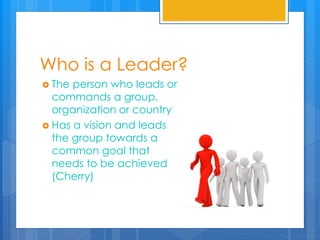
Who is a Leader?
 The person who leads or
commands a group,
organization or country
 Has a vision and leads
the group towards a
common goal that
needs to be achieved
(Cherry)
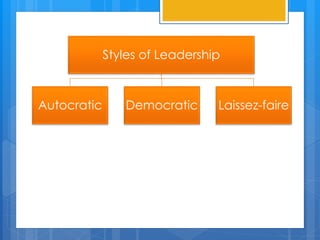
Styles of Leadership
Autocratic Democratic Laissez-faire
Autocratic Leaders
 Characterized by individual
control over all decisions and little
input from group members
 Provide clear expectations for
what needs to be done, when it
should be done, and how it should
be done.
 Best applied to situations where
there is little time for group
decision-making or where the
leader is the most knowledgeable
member of the group (Cherry)
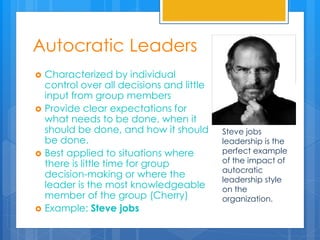
 Example: Steve jobs
Steve jobs
leadership is the
perfect example
of the impact of
autocratic
leadership style
on the
organization.
Autocratic Leaders: Effects on
Teams
Positive Negative
-Helps New Members by
teaching them how to
perform a task so they have
a set of clear expectations
-allows knowledgeable
members to direct new
members in terms of
appropriate behavior until
the new members are
capable of making
decisions on their own
-decision making is less
creative
-doesn’t develop good
relationships between group
members
-lessened commitment: the
leader takes credit for all the
success
-high stress: members feel
stressed due to high
expectations and a low
feeling of worth
Managing: Autocratic
Effective Not Effective
-In businesses/companies
where the tasks are more
independent (ex.
Construction Companies)
-Certain decisions, such as
those that affect worker
safety, should be handled
by experts and should not
be open to discussion
-In work places where work
involves everyone’s input
and decisions are
influenced by the whole
group (ex. Magazine
company)
Democratic Leaders
 Generally the most effective leadership
style
 Offer guidance to group members, but
they also participate in the group and
allow input from other group members
 Encourage group members to
participate, but retain the final say over
the decision-making process.
 Members in this group were less
productive than the members of the
authoritarian group, but their
contributions were of a much higher
quality.
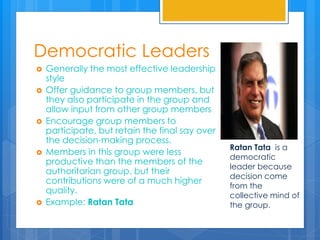
 Example: Ratan Tata
Ratan Tata is a
democratic
leader because
decision come
from the
collective mind of
the group.
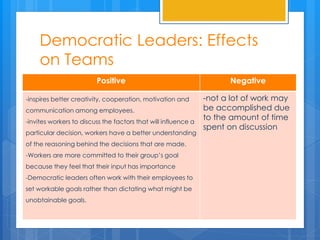
Democratic Leaders: Effects
on Teams
Positive Negative
-inspires better creativity, cooperation, motivation and
communication among employees.
-invites workers to discuss the factors that will influence a
particular decision, workers have a better understanding
of the reasoning behind the decisions that are made.
-Workers are more committed to their group’s goal
because they feel that their input has importance
-Democratic leaders often work with their employees to
set workable goals rather than dictating what might be
unobtainable goals.
-not a lot of work may
be accomplished due
to the amount of time
spent on discussion
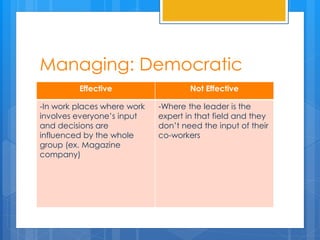
Managing: Democratic
Effective Not Effective
-In work places where work
involves everyone’s input
and decisions are
influenced by the whole
group (ex. Magazine
company)
-Where the leader is the
expert in that field and they
don’t need the input of their
co-workers
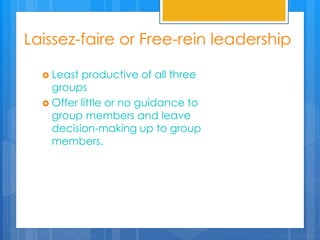
Laissez-faire or Free-rein leadership
 Least productive of all three
groups
 Offer little or no guidance to
group members and leave
decision-making up to group
members.
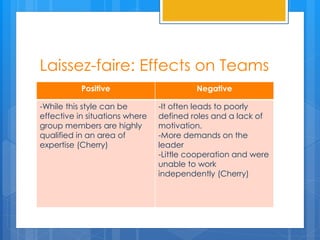
Laissez-faire: Effects on Teams
Positive Negative
-While this style can be
effective in situations where
group members are highly
qualified in an area of
expertise (Cherry)
-It often leads to poorly
defined roles and a lack of
motivation.
-More demands on the
leader
-Little cooperation and were
unable to work
independently (Cherry)
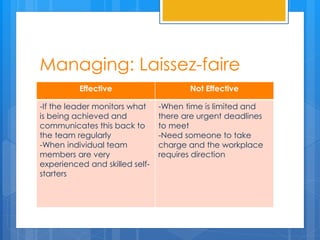
Managing: Laissez-faire
Effective Not Effective
-If the leader monitors what
is being achieved and
communicates this back to
the team regularly
-When individual team
members are very
experienced and skilled self-
starters
-When time is limited and
there are urgent deadlines
to meet
-Need someone to take
charge and the workplace
requires direction
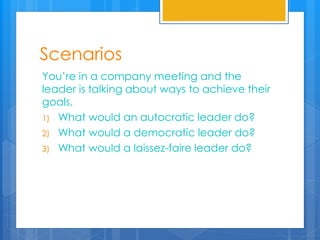
Scenarios
You’re in a company meeting and the
leader is talking about ways to achieve their
goals.
1) What would an autocratic leader do?
2) What would a democratic leader do?
3) What would a laissez-faire leader do?
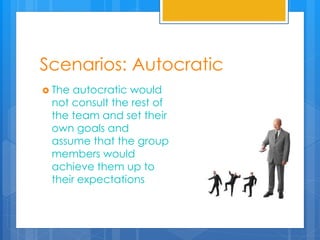
Scenarios: Autocratic
 The autocratic would
not consult the rest of
the team and set their
own goals and
assume that the group
members would
achieve them up to
their expectations
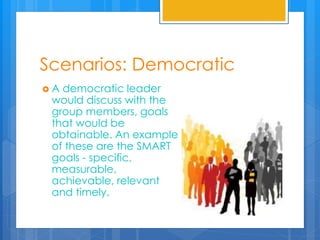
Scenarios: Democratic
 A democratic leader
would discuss with the
group members, goals
that would be
obtainable. An example
of these are the SMART
goals - specific,
measurable,
achievable, relevant
and timely.
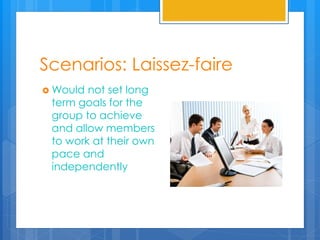
Scenarios: Laissez-faire
 Would not set long
term goals for the
group to achieve
and allow members
to work at their own
pace and
independently
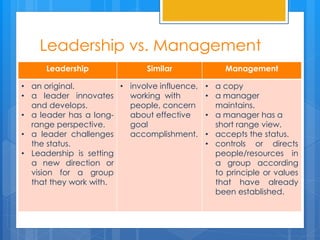
Leadership vs. Management
Leadership Similar Management
• an original.
• a leader innovates
and develops.
• a leader has a long-
range perspective.
• a leader challenges
the status.
• Leadership is setting
a new direction or
vision for a group
that they work with.
• involve influence,
working with
people, concern
about effective
goal
accomplishment.
• a copy
• a manager
maintains.
• a manager has a
short range view.
• accepts the status.
• controls or directs
people/resources in
a group according
to principle or values
that have already
been established.
THANK YOU

Leadership Style in Management

  • 1.
  • 2.
    Who is aLeader?  The person who leads or commands a group, organization or country  Has a vision and leads the group towards a common goal that needs to be achieved (Cherry)
  • 3.
    Styles of Leadership AutocraticDemocratic Laissez-faire
  • 4.
    Autocratic Leaders  Characterizedby individual control over all decisions and little input from group members  Provide clear expectations for what needs to be done, when it should be done, and how it should be done.  Best applied to situations where there is little time for group decision-making or where the leader is the most knowledgeable member of the group (Cherry)  Example: Steve jobs Steve jobs leadership is the perfect example of the impact of autocratic leadership style on the organization.
  • 5.
    Autocratic Leaders: Effectson Teams Positive Negative -Helps New Members by teaching them how to perform a task so they have a set of clear expectations -allows knowledgeable members to direct new members in terms of appropriate behavior until the new members are capable of making decisions on their own -decision making is less creative -doesn’t develop good relationships between group members -lessened commitment: the leader takes credit for all the success -high stress: members feel stressed due to high expectations and a low feeling of worth
  • 6.
    Managing: Autocratic Effective NotEffective -In businesses/companies where the tasks are more independent (ex. Construction Companies) -Certain decisions, such as those that affect worker safety, should be handled by experts and should not be open to discussion -In work places where work involves everyone’s input and decisions are influenced by the whole group (ex. Magazine company)
  • 7.
    Democratic Leaders  Generallythe most effective leadership style  Offer guidance to group members, but they also participate in the group and allow input from other group members  Encourage group members to participate, but retain the final say over the decision-making process.  Members in this group were less productive than the members of the authoritarian group, but their contributions were of a much higher quality.  Example: Ratan Tata Ratan Tata is a democratic leader because decision come from the collective mind of the group.
  • 8.
    Democratic Leaders: Effects onTeams Positive Negative -inspires better creativity, cooperation, motivation and communication among employees. -invites workers to discuss the factors that will influence a particular decision, workers have a better understanding of the reasoning behind the decisions that are made. -Workers are more committed to their group’s goal because they feel that their input has importance -Democratic leaders often work with their employees to set workable goals rather than dictating what might be unobtainable goals. -not a lot of work may be accomplished due to the amount of time spent on discussion
  • 9.
    Managing: Democratic Effective NotEffective -In work places where work involves everyone’s input and decisions are influenced by the whole group (ex. Magazine company) -Where the leader is the expert in that field and they don’t need the input of their co-workers
  • 10.
    Laissez-faire or Free-reinleadership  Least productive of all three groups  Offer little or no guidance to group members and leave decision-making up to group members.
  • 11.
    Laissez-faire: Effects onTeams Positive Negative -While this style can be effective in situations where group members are highly qualified in an area of expertise (Cherry) -It often leads to poorly defined roles and a lack of motivation. -More demands on the leader -Little cooperation and were unable to work independently (Cherry)
  • 12.
    Managing: Laissez-faire Effective NotEffective -If the leader monitors what is being achieved and communicates this back to the team regularly -When individual team members are very experienced and skilled self- starters -When time is limited and there are urgent deadlines to meet -Need someone to take charge and the workplace requires direction
  • 13.
    Scenarios You’re in acompany meeting and the leader is talking about ways to achieve their goals. 1) What would an autocratic leader do? 2) What would a democratic leader do? 3) What would a laissez-faire leader do?
  • 14.
    Scenarios: Autocratic  Theautocratic would not consult the rest of the team and set their own goals and assume that the group members would achieve them up to their expectations
  • 15.
    Scenarios: Democratic  Ademocratic leader would discuss with the group members, goals that would be obtainable. An example of these are the SMART goals - specific, measurable, achievable, relevant and timely.
  • 16.
    Scenarios: Laissez-faire  Wouldnot set long term goals for the group to achieve and allow members to work at their own pace and independently
  • 17.
    Leadership vs. Management LeadershipSimilar Management • an original. • a leader innovates and develops. • a leader has a long- range perspective. • a leader challenges the status. • Leadership is setting a new direction or vision for a group that they work with. • involve influence, working with people, concern about effective goal accomplishment. • a copy • a manager maintains. • a manager has a short range view. • accepts the status. • controls or directs people/resources in a group according to principle or values that have already been established.
  • 18.